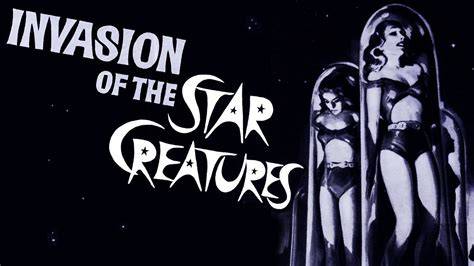
CHILLER THEATER MONTH: Invasion of the Star Creatures (1962)

EDITOR’S NOTE: Invasion of the Star Creatures was on Chiller Theater on Saturday, May 22, 1965 at 11:20 p.m.

Directed by character actor Bruno VeSota and written by Jonathan Haze, this has Privates Philbrick (Robert Ball) and Penn (Frank Ray Perilli) assigned to Fort Nicholson, which has a cave under the Earth — is this another Shaver Mystery film? — where they meet Kalar aliens Dr. Puna (Joanne Arnold, Playboy Playmate of the Month for May 1954) and Professor Tanga (Dolores Reed, sadly her third — after Hit and Run and Party Girl — role before she died of a drug overdose). Along with their vegetable men, they want to take over our planet, but because men are sexist pigs, they have learned how to stop them with a kiss. I kid!

Shot in Bronson Canyon, where all monsters and aliens find their homes, this was originally going to team up Haze (the star of The Little Shop of Horrors) with Dick Miller. It played double features with The Brain That Wouldn’t Die, which is a two-movie deal I love.

You can watch this on Tubi.

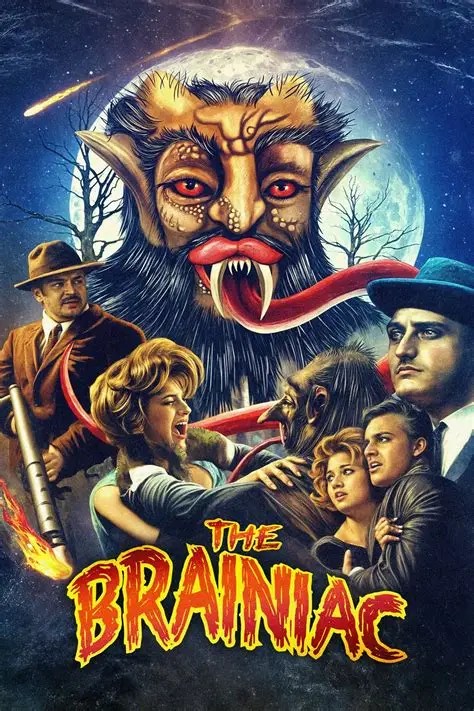
CHILLER THEATER MONTH: The Brainiac (1962)

EDITOR’S NOTE: The Brainiac was on Chiller Theater on Saturday, October 15, 1966, at 1:00 a.m.; Saturday, May 3, 1969, at 1:00 a.m.; Saturday, June 19, at 1:00 a.m.; and Saturday, March 4, 1972, at 1:00 a.m.

Known as El Baron del Terror in Mexico, this was directed by Chano Urueta, who helped Blue Demon get on the silver screen and was written by Federico Curiel, who would make The Champions of Justice, several Santo movies and Neutron.

All the way back in 1661, Baron Vitelius was burned at the stake during the Inquisition and claimed that the next time a particular comet passed by the Earth, all of the children of those who did him wrong would pay. I mean, you would think a bunch of religious folks would treat a necromantic sorcerer better, but such is life in ancient Mexico.

Three hundred years later, Baron Vitelius rides back in on that comet and is now able to change at will into a monster able to suck out the brains of his victims via a giant forked tongue, which is incredibly easy to do thanks to his ability to hypnotize his victims.

How bonkers is this movie? No less than Frank Zappa and Captain Beefheart paid tribute to it in their song “Debra Kadabra,” saying “Turn it to Channel 13 / And make me watch the rubber tongue / When it comes out! From the puffed and flabulent Mexican rubber-goods mask / Next time they show the Binaca / Make me buy The Flosser / Make me grow Brainiac Fingers / But with more hair!”

In America, we’d be satisfied with an evil alien. In Mexico, it was added that he was a wizard who brought people back from the dead before he was burned alive and ascended to a heavenly body for three hundred years. ¡Viva las películas de terror!

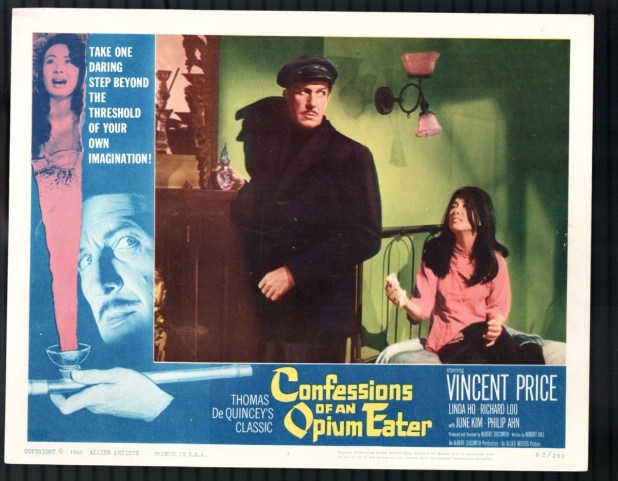
WEIRD WEDNESDAY: Confessions of an Opium Eater (1962)

Based on Confessions of an English Opium-Eater, written by Thomas De Quincey — the same person who inspired Suspiria — and has Vincent Price as Gilbert De Quincey. He’s an adventurer hired to stop the sale of Chinese brides to overseas men.

That makes this sound too ordinary, a film that feels like you’re on drugs, that has Yvonne Moray as a small courtesan, a fishing net filmed backward filled with captured women, bad girl Ruby Low (Linda Ho), a two-fisted action hero role for Vincent Price, floating skulls, rotting bodies and a narration by Price that makes this feel even more odd.

You can also find this as Souls for Sale and Evils of Chinatown. Director Albert Zugsmith also made College ConfidentialSex Kittens Go to CollegeThe Private Lives of Adam and EveFanny Hill, Psychedelic Sexualis and the horrific nightmare that is Dondi. He also produced The Incredible Shrinking Man and High School Confidential. What many may not know is that he was also a lawyer. In 1947, he represented a friend from the war, Jerry Siegel and Joe Shuster, in their lawsuit against National Comics for stealing their creation, Superman. They settled out of court for $100,000, and National kept the character. Most of the money went to pay Zugsmith’s fees.

Siegel wanted Bob Kane to come on board and sue over Batman. In the years that followed, both Siegel and Shuster believed that Kane and Zugsmith had made a deal without telling them. They got nothing, Kane got his part ownership and profit deal on Batman, and Zugsmith got his pay. They lost their jobs, never getting to create new adventures for the Man from Krypton.

Writing for this movie has some class. Seton I. Miller won the Oscar for the script for Here Comes Mr. Jordan. He also wrote Scarface and A Knife for the Ladies.

You can watch this on YouTube.

WEIRD WEDNESDAY: The Brainiac (1962)

Known as The Brainiac in the U.S., this was directed by Chano Urueta, who helped Blue Demon get on the silver screen and was written by Federico Curiel, who would make The Champions of Justice, several Santo movies and Neutron.

All the way back in 1661, Baron Vitelius was burned at the stake during the Inquisition and claimed that the next time a particular comet passed by the Earth, all of the children of those who did him wrong would pay. I mean, you would think a bunch of religious folks would treat a necromantic sorcerer better, but such is life in ancient Mexico.

Three hundred years later, Baron Vitelius rides back in on that comet and is now able to change at will into a monster able to suck out the brains of his victims via a gigante-forked tongue, which is incredibly easy to do thanks to his ability to hypnotize his victims.

How bonkers is this movie? No less than Frank Zappa and Captain Beefheart paid tribute to it in their song “Debra Kadabra,” saying, “Turn it to Channel 13 / And make me watch the rubber tongue / When it comes out! From the puffed and flabulent Mexican rubber-goods mask / Next time they show the Binaca / Make me buy The Flosser / Make me grow Brainiac Fingers / But with more hair!”

In America, we’d be satisfied with an evil alien. In Mexico, it was added that he was a wizard who brought people back from the dead before he was burned alive and ascended to a heavenly body for three hundred years. Viva la peliculas de terror!

You can watch this on Tubi.

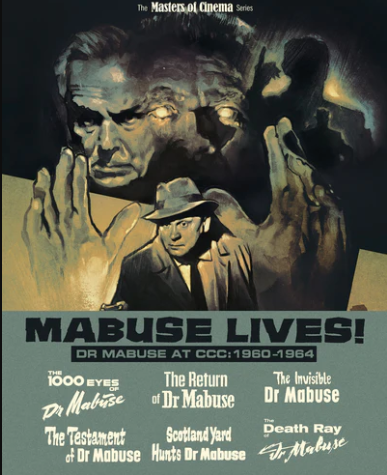
EUREKA BOX SET: Mabuse Lives! Dr. Mabuse At CCC: 1960-1964: The Invisible Dr. Mabuse (1962)

Dr. Mabuse has a new base under a theater, a place that is putting on a play about the French Revolution but really, it’s just a place for dancer Liane Martin (Karin Dor, You Only Live TwiceAssignment Terror) to take a steamy bath. Something for daddy, as they say.

Anyhow, Mabuse wants an invisibility machine and he’ll kill for it. Or at least his new henchmen will, who include Walter Bluhm as a murder clown. Only FBI agent Joe Como (Lex Barker) — Perry’s brother? — can save the day. There’s also a mutated scientist, if you have a Letterboxd list of those.

Released in the U.S. as The Invisible Horror, this was directed by Harald Reinl, who also made Chariots of the Gods, Mysteries of the Gods, The Torture Chamber of Dr. Sadism and The Strangler of Blackmoor Castle.

The Eureka box set Mabuse Lives! has this movie, along with an introduction by genre film expert and Video Watchdog founder Tim Lucas, a new 1080p presentation from a 2K restoration of the original film elements undertaken by CCC, a commentary track by film historian and author David Kalat, and an alternate ending. You can get it from MVD.

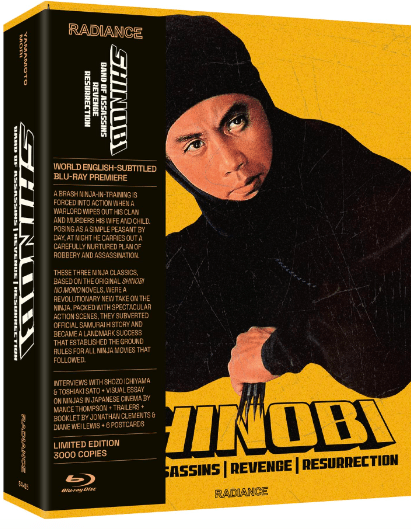
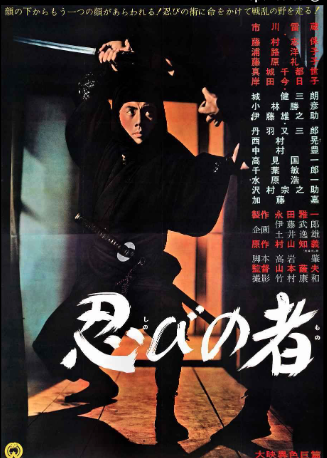
RADIANCE FILMS BOX SET RELEASE: The Shinobi Trilogy (1962,1963)

We often think that ninjas only started to exist in the 80s. Yet, in the early 60s, there was a craze in Japan because of the Shinobi no Mono books and these three movies. Written by Tomoyoshi Murayama, these stories were serialized in the Sunday edition of the newspaper Akahata from November of 1960 to May of 1962, with the name meaning “ninja.”

The novels are set during Japan’s Sengoku period and star Goemon Ishikawa, a famous outlaw hero who used his ninja skills to battle the samurai. While the real man and his son were boiled alive in public after their failed assassination attempt on the warlord Toyotomi Hideyoshi, the fictional version has become a Robin Hood-like character, a man with near-superhuman ninja powers at times.

Goemon had already been the subject of several pre-WWII Japanese films- Ishikawa Goemon Ichidaiki and Ishikawa Goemon no Hoji. Still, in the early 60s, when a thief protecting villagers against the rich and powerful would be a theme that resonated with the Japanese, he became a pop culture sensation.

Band of Assassins (1962): Raizo Ichikawa plays Goemon as a young man here, a member of a ninja clan who must constantly worry about being found and destroyed by the samurai. He’s been selected to kill Nobunaga Oda (Tomisaburo Wakayama), which makes the other ninjas jealous. So now, Goemon is nearly a man without a country as he must deal with assassination attempts, double crosses and his mission.

Directed by Satsuo Yamamoto, this turned into the kind of movie that grabbed the attention of Japanese kids. It was intended to be one and done, but by the end, even though only Goemon survives and can escape this world of treachery and violence to have a family, he had to return. Ninjas, a real thing that had disappeared from the world- or is that what they want you to believe? — only to take over pop culture twice in the 20th century.

Revenge (1963): Nobunaga Oda has killed all of the ninjas of the Iga clan, yet he doesn’t know that Goemon has survived. Our hero just wants to build a family and disappear- ninjas are good at part of that- but he’s soon pulled back into combat when his infant son is killed.

Instead of running straight into the bad guys, as most action heroes would, Goemon uses psychological trickery and his ability to hide just about anywhere to drive his enemies crazy. Unlike the first film, where his honor is constantly on the line and he must watch everyone, his goals in this film are much more straightforward: kill the people who ruined his life.

Even though Goemon is boiled alive at the end of this- but not before shouting out the bad guys as way worse thieves than him- there’s still one more movie. How can that happen?

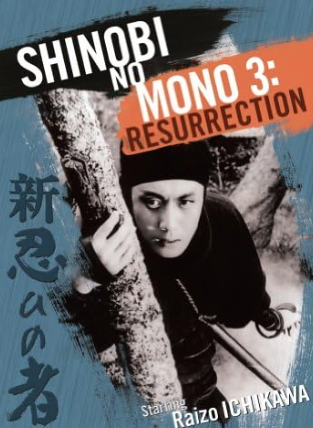
Resurrection (1963): Thanks to Hattori Hanzo (Saburô Date)- yes, the same man who made swords in Kill Bill– Goemon has survived, as he was switched out with another ninja at the last minute. I didn’t see it happen, but that’s just how talented a master ninja can be.

This idea was enough to get director Satsuo Yahamoto to quit the series, which brought in Kazuo Mori to make this for Daiei. It’s revisionist history- perhaps this is where Tarantino got the idea to save Sharon Tate- but in the service of pop culture and film commerce.

Now, he must get the revenge he’s craved for two movies now and take out Toyotomi Hideyoshi (Eijiro Tono). This is more personal and has less swordplay, but I’m sure audiences were ready for more, seeing as how all three of these movies were made over two years.

The Radiance Blu-ray box set of the Shinobi trilogy has digital transfers of each film presented on two discs, made available on Blu-ray for the first time outside Japan. Extras include an interview about director Satsuo Yamamoto with Shozo Ichiyama, artistic director of the Tokyo International Film Festival, a visual essay on the ninja in Japanese cinema by film scholar Mance Thompson, an interview with film critic Toshiaki Sato on star Raizo Ichikawa, trailers, six postcards of promotional material from the films, reversible sleeves featuring artwork based on original promotional materials and a limited edition booklet featuring new writing by Jonathan Clements on the Shinobi no mono series and Diane Wei Lewis on writer Tomoyoshi Murayama. This limited edition of 3000 copies is presented in a rigid box with full-height Scanavo cases and removable OBI strip, leaving packaging free of certificates and markings. You can get this from MVD.

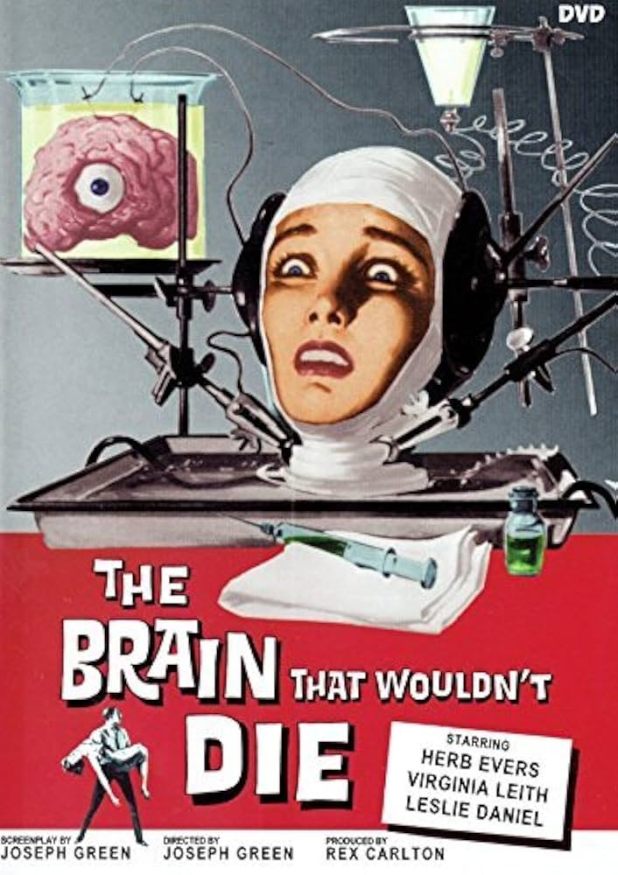
CHILLER THEATER MONTH: The Brain That Wouldn’t Die (1962)

EDITOR’S NOTE: The Brain That Wouldn’t Die was on Chiller Theater on Saturday, February 5, 1966 at 11:20 p.m., Saturday, June 28, 1969 at 1:00 a.m. and Saturday, February 27, 1971 at 1:00 a.m.

I really dislike anyone who makes fun of this movie. It’s been riffed and goofed on for years, but it’s way better made than it has any right to be and is filled with some big ideas that other movies from its genre and time never would dare to include.

Shot independently around Tarrytown, New York, in 1959 under the working title The Black Door, this film finds Dr. Bill Cortner (Jason Evers) as a surgeon who just won’t accept that death is the end for his patients. And when his fiancee Jan Compton (Virginia Leith) is critically injured in a car accident that he causes, he takes her head and along with his crippled assistant Kurt (Anthony La Penna), he struggles to find her a new body to transplant her still living head on.

While Jan loses her mind due to pain and the sheer oddity of being alive without a body, Dr. Bill hits the go go clubs looking for the perfect body for her. That’s one of the strangest and most delightful moments here, as instead of just any body, Dr. Bill realizes that he needs a body that best answers his sexual needs, which means he cares less about saving Jan than satisfying his repressed desires.

Throughout this story and its slowly going mad rush to tragedy, there’s a past experiment hidden behind the door. It’s played by Eddie Carmel, a 7’3″ circus performer who was known as The Jewish Giant.

This was directed and written by Joseph Green, who owned Joseph Green Pictures. It was such a tiny corporation that it had one employee, Joseph Green, and brought so many wild movies to screens like Jess Franco’s Kiss Me Monster and Two Undercover Angels, Claude Chabrol’s Pleasure Party, Something Creeping in the DarkDeath Knocks Twice and his own film, The Perils of P.K. 

I love the way this movie takes our world and instead creates its own, a place where strippers fight on stage, where camera clubs are a plot point — Sammy Petrillo is one of the dirty men taking pictures! — and old girlfriends can be wooed back just to potentially get to be the body for a new fiancee.

You can watch this on Tubi.

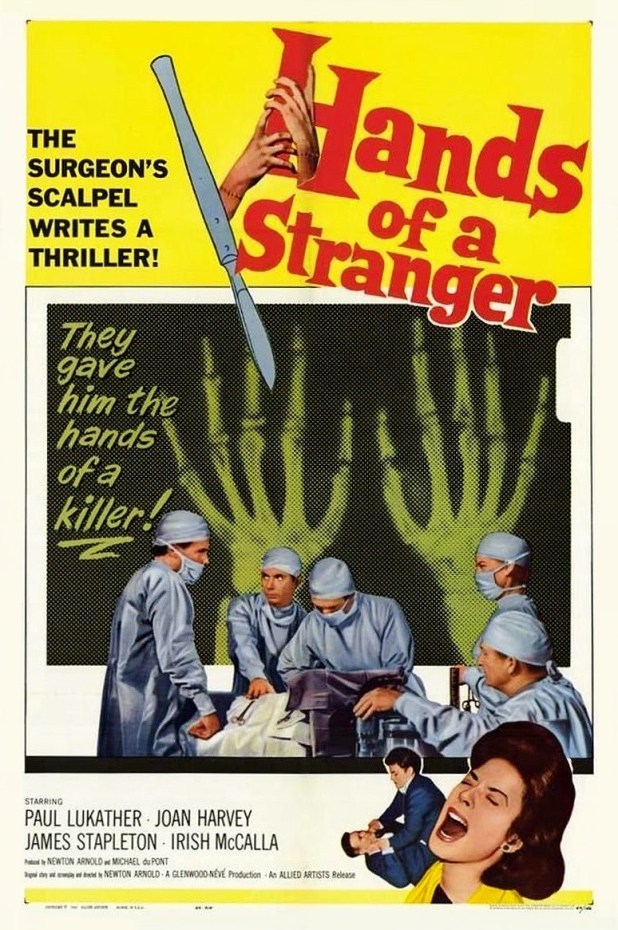
CHILLER THEATER MONTH: Hands of a Stranger (1962)

EDITOR’S NOTE: Hands of a Stranger was on Chiller Theater on Saturday, July 10, 1965 at 1:00 a.m. and Saturday, October 25, 1969 at 1:00 a.m.

Concert musician Vernon Paris’ hard work has finally paid off. He’s become the biggest star there is. That’s when his hands are ruined in an auto accident and Dr. Gil Harding amputates them — with no authority — and replaces them with the hands of a murderer, all in the hopes that Paris can play piano again. Sure, the transplant is a success, but Paris becomes unhinged and increasingly violent toward those he blames for him needing his killer new mitts.

Sure, this is based on the 1920 novel Les Mains d’Orlac by French writer Maurice Renard, but the real draw is the absolutely over the top slasher like violence — well, as good as it gets in 1962 — throughout the film. First, Paris argues with his former girlfriend Eileen, who can’t love him as a normal man and craves the limelight that dating him gave her. Her dress catches on fire as they fight and she burns alive. Later, Skeet, the son of the taxi driver who caused the accident, enrages Victor by being able to play the piano when he cannot. He crushes the child’s hands, then smashes his head open.

Keep your eyes peeled for a very young Sally Kellerman and Irish McCalla, who was TV’s Sheena: Queen of the Jungle. This isn’t a great movie, per se, but it’s over the top and filled with brimming menace. It’s also anything but boring!

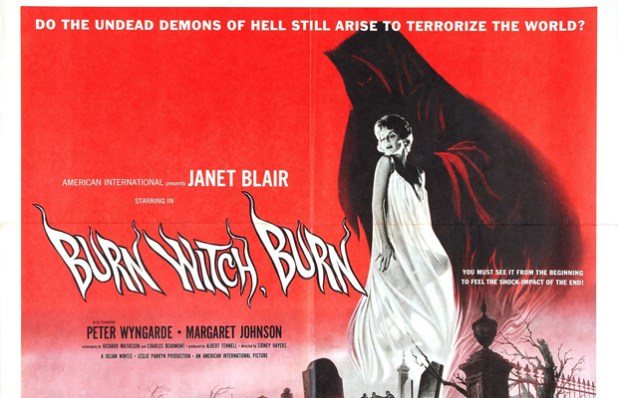
CHILLER THEATER MONTH: Burn, Witch, Burn (1962)

EDITOR’S NOTE: Burn, Witch, Burn! was on Chiller Theater on Saturday, November 5, 1966 at 11:20 p.m.; Saturday, June 28, 1969 at 11:30 p.m.; Saturday, October 31, 1970 at 1 a.m.; Saturday, July 17, 1971 at 1:00 a.m. and Saturday, May 13, 1972 at 1.m.

Based upon the 1943 Fritz Leiber novel Conjure Wife, this movie was called Day of the Eagle in the UK before getting a title that sounded more like a horror movie for American audiences. The book had already been adapted once before as Weird Woman in 1944 and then one more time afterward in 1979 as Witches’ Brew.

The American version also has an opening in complete blackness where the voice of Paul Frees reads a spell intended to protect the audience from the evil within the film. Filmgoers also were given a special pack of salt and the words to an ancient incantation. Man, going to the movies used to be awesome. American-International Pictures knew how to sell an occult movie!

Written by a combination of Charles Beaumont (The Masque of the Red Death, several great Twilight Zone episodes), Richard Matheson (I Am LegendDuel) and George Baxt (Shadow of the CatThe City of the Dead), this is the story of Norman Taylor (Peter Wyngarde, Klytus from Flash Gordon), a man who discovers that all of his career success is due to the magic skills of his wife. As soon as he demands that she burns all of her magical ephemera, everything in his life goes wrong

By the end of the movie, his rational view of the world must confront the fact that magic truly exists. It also posits that women are the magic workers of the world and that men just stumble through, a view I can completely agree with.

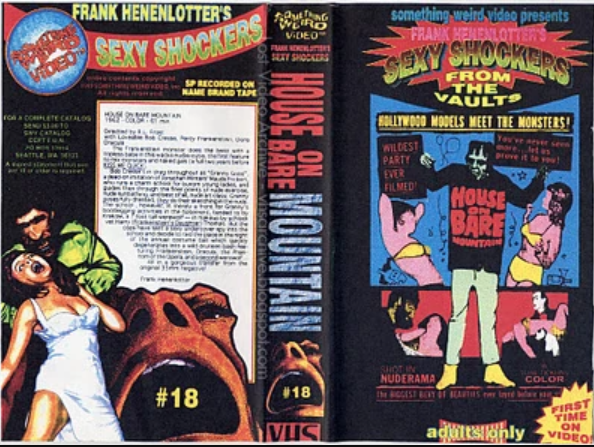
The Sizzlin’ Something Weird Summer Challenge 2024: The House on Bare Mountain (1962)

BONUS WILDCARD WEEK (September 22 – 28) Go order something from the SWV website and watch it!

You’ve never seen more! Let us prove it to you when the monsters meet the girls! The nudies meet the nasties! No monster ever had it so good! See Frankenstein do the twist with Miss Hollywood! The gayest girlie spree of all time! Everything’s off when the horror boys meet Granny Good’s girls! The biggest bevy of beauties ever laid before your eyes! For adult adults only!

Get ready for 62 minutes of sheer wildness as directed by Lee Frost and Wes Bishop. If you wonder, with scumbags — and I say that term with the utmost of respect, admiration and love — like this were at the wheel, how far away was Harry Novak? Oh, he was there. He was there.

Granny Good’s School for Good Girls is really a front for girls to get naked and make booze for Granny Good, who is played by producer Bob Cresse. She also employs a werewolf named Krakow. Yes. A werewolf. And when the girls throw a party, that’s when Dracula and Frankenstein’s Monster show up.

Ann Perry, who plays Sally in this, was originally going to be a nun before she met her first husband Ron Myers. After starting her career in Cresse’s softcore films, she went fill hardcore and started her own production company, Evolution Enterprises, in the 1970’s, becomingone of the only women to write, direct, and produce her own hardcore movies. She was also the first female president of the Adult Film Association of America (AFAA).

The adult films of 1962 are incredibly odd affairs today, featuring little to no sex and mostly women taking off their clothes and doing things like reading topless. I find them incredibly charming, almost time capsules of a more innocent time, a place where small movies like this could find an audience of raincoaters who found something, anything erotic in what we would now see as just plain silly.

Sadly for Frost and Cresse, the advent of hardcore would put an end to their films. Then again, Frost would go on to produce and direct one of the oddest — and roughest — films of the golden age of adult films, A Climax of Blue Power. He kept on working right up until 1995’s direct to video softcore thriller Private Obsession. I’d also recommend his mondo films Witchcraft ’70 and Mondo Bizarro. Oh yeah! He also directed The Thing With Two Heads and The Black Gestapo. He also made Love Camp Seven, which also features Cresse acting as a commander of a German prison camp. Wow. I know more about Lee Frost than some members of my family.

You can download this on the Internet Archive. Even better, Nicolas Winding Refn’s ByNWR site has a totally cleaned up version straight from the director’s archive. Man, I want to sit down and talk to that dude someday.