CHILLER THEATER MONTH: The Wasp Woman (1959)

EDITOR’S NOTE: The Wasp Woman was first on Chiller Theater on Saturday, April 24, 1964 at 4 p.m. It also was on the show on February 20, 1965.

Produced and directed by Roger Corman, this movie was originally a double feature with Beast from Haunted Cave. When it was released to TV two years later, a new prologue was added by director Jack Hill to add to its running time.

The musical score from this film may seem familiar, because it’s the same music from Corman’s A Bucket of Blood. It was written by Fred Katz, who sold Corman the same score was used for a total of seven films, including The Little Shop of Horrors and Creature from the Haunted Sea.

Janice Starlin is the founder and owner of a large cosmetics company,  (Susan Cabot). She starts losing money when the public begins to see that she is aging, so her scientists reverse the aging process by using the royal jelly of the queen wasp. It doesn’t work fast enough, so she breaks into her own company’s lab and injects herself multiple times.

So she gets twenty years younger over the weekend, but occasionally transforms into a wasp woman who kills people. At the end, when acid is thrown in her face, that scene was more real than it should have been. Someone had filled the breakaway bottle with water and it was so heavy that when hit her, she thought that her teeth had been knocked out. To make matters worse, the fake smoke used to simulate the acid also choked her. So after she fell through the window, she found herself unable to breathe. To save herself, she tore off her makeup as well as a good chunk of skin around her neck.

Things didn’t get much better in life for Susan Cabot. This was her last film and at the end of her life, she suffered from depression and suicidal thoughts. The psychologist that she was seeing felt that she was so troubled that he could no longer see her and her home was filled with trash and rotting food.

After her mental health continued to worsen, Cabot’s 25-year-old son, Timothy Scott Roman, beat her to death with a weightlifting bar. While he would initially claim that a man in a ninja mask was the killer — thinking that no one would believe her struggles with mental illness — the truth was that she woke him screaming and attacked him with both a scalpel and the barbell. His defense attorneys claimed his aggressive reaction to his mother’s attack was due to the drugs he took to counteract his dwarfism and pituitary gland problems.

Prosecutors changed the charge to voluntary manslaughter at the end of the trial, as no evidence had been presented to support the premeditation required for a murder conviction. Roman, who had already spent two-and-a-half years in jail, was sentenced to three years’ probation.

Corman remade this with director Jim Wynorski for his Roger Corman Presents series on Showtime.

You can watch this on Tubi. You can also watch it with the Cinematic Titanic crew riffing on it on Tubi.
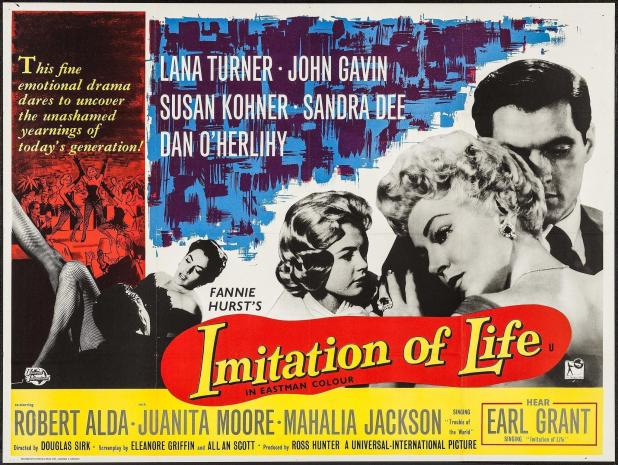
2022 Scarecrow Psychotronic Challenge Day 9: Imitation of Life (1959)

9. PASSES LIKE MOLASSES: One with a looooong death/dying sequence.

My grandmother loved this movie. Whenever she would hear about how many movies I watched, she always said that I should watch more movies like Imitation of Life. My grandmother is a few years gone now and I remember that very early in my life, she pulled me aside and told me that this would be our last holiday together. I cried for days and days, worried that after all the gifts that she would be dead. Instead, she lived. And the next year, she did the same thing and my brother reacted like I did. After a few years, we realized that she would tell us this every year or her other Christmas idea, the thought that this year, we would have to cancel the season. I have no idea why Christmas was canceled, but it was often because of something my grandfather — who worked triple holiday shifts to pay for it — had done. To be fair, he drunkenly knocked the tree down every year. But after several more years of canceling the birth of the Christ child, she finally either quit doing this or we just laughed it off.

Decades later, I was picking her up — our tradition, I’d come to town later than everyone else and always pick her up whenever she was ready to be around the rest of the family — and she said to me, “You know, this is out last Christmas together.”

I looked her in the eye and said, “Grandma, that was in 1977, and you’ve told me that every year since.”

“I have,” she said, as she looked out the window and started to laugh.

Anyways, that should explain to you why this is my grandmother’s favorite movie, because she lived to be in her 90s on a diet of Coca-Cola and chocolate. Never any real food. She fell off the couch twice in the same week, cleaning the curtains, and went through a table like a pro wrestler and got up and did it again. Once, she was trying to find something under the bed and used a lit match to look. This was in like 2018, I kid you not. And man, did she like emotional drama and gossip. She still had a scanner and CB radio in her home and absolutely loved Facebook, having two accounts so she could keep up on the small town I grew up in. She had subscriptions to the National Enquirer, the Star, the Examiner and Globe, so my love of scandal and sleaze probably came from her.

I can see what she loved about Imitation of Life.

I mean, first off, Lora Meredith (Lana Turner, who had her own scandal, as her daughter Cheryl stabbed her boyfriend Johnny Stampano in the stomach to save her from a beating; Sean Connery also knocked a gun out of the gangster’s hand on the set of Another Time, Another Place) is a single mom who cares more about being a star than raising her daughter Susie (Terry Burnham as a young girl, Sandra Dee when she grows up). She loses her at Coney Island and the girl is saved by Steve Archer (John Gavin) who will forever be her friend-zoned man, always saving the day to the point that her daughter will realize what she hasn’t and grow up to love him like a woman should love a man, even if it’s kind of incestuous and Steve is too much of a good person to give in to an attractive 16-year-old Sandra Dee but hey, I’d take a 38-year-old Lana Turned over that anyway.

Lora and Steve find Susie with Annie Johnson (Juanita Moore) and her daughter Sarah Jane (Karin Dicker as a kid, Susan Kohner as a grown woman). To pay her back, Lora takes in this single woman and her daughter, which seems like a kindness, but she’s really getting a free person to take care of her daughter while she acts in the plays of her boyfriend David Edwards (Dan O’Herlihy, yes, the same man who would dominate Old Detroit and the mask and novelty industry as the owner of Silver Shamrock) and the schemes of her agent Allen Loomis (Robert Alda).

As for Steve, he never wanted her to be a star and that’s the one bad thing we can say about him. Maybe he knew how sleazy it was all going to be. But he should have let her have her career. That said, it was 1959, but eh, that’s just trying to make up for men being men.

More troubling, but again, it was 1959, is that Sarah Jane wants to be white to the point that when she finally runs away from home, her mother has to act like she was her maid so she doesn’t give away the fact that her daughter is white.

Lora also goes to Italy to be in a movie so I assume that she’s either Carroll Baker or Jennifer North.

The end of this movie, man. After a whole two hours of denying her blackness — then again, if blonde boys were slapping me in the face when I confessed that I wasn’t white, would I feel any other emotion? — Annie dies after an entire marathon of being depressed and weakened. Like, she’s dying from the first time we see her and she dies for this whole movie until she dies with her daughter throwing herself on the coffin screaming, “I killed my own mother!”

In the book, the white woman is Bea Pullman, who becomes rich when she sells her maid Delilah’s family waffle recipe. The white woman gets all the money and the kindly black woman doesn’t even take the 20% she is offered and remains working in the house.

Anyways, Lana Turner wore like a million worth of gowns in this and as I said before, you can watch this just to stare at her. I’d never seen a Douglas Sirk movie before this. It was the movie he went out on. R.E. M. sang the words, “That’s sugarcane that tasted good / That’s cinnamon, that’s Hollywood / Come on, come on, no one can see you try” in the song named for this movie but they never saw it.

Oddly, my grandmother’s favorite song was “Everybody Hurts” by R.E.M. and she would play it over and over for hours, the same 45 single, knowing all the words.

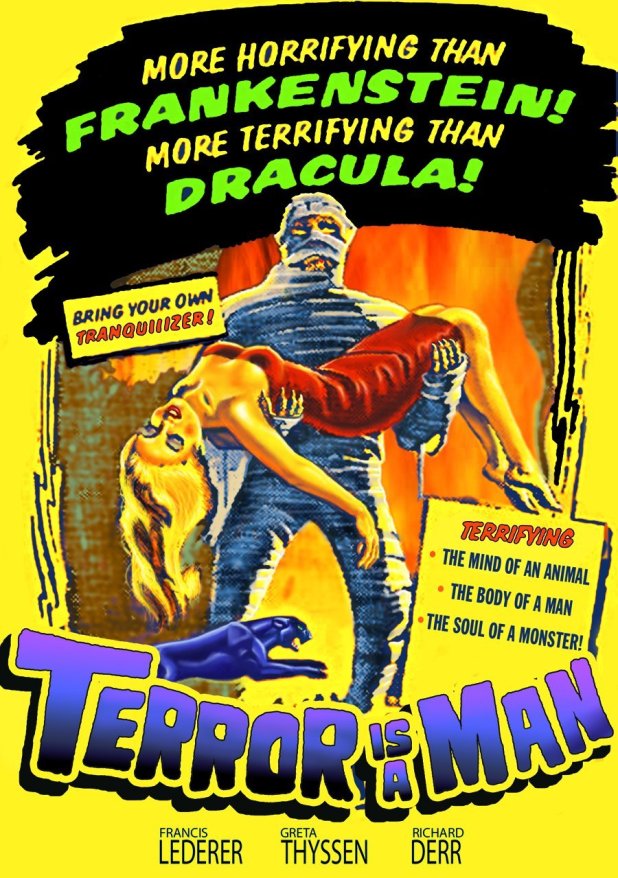
CHILLER THEATER MONTH: Terror Is a Man (1959)

EDITOR’S NOTE: Terror Is a Man was first on Chiller Theater on Saturday, March 28, 1964 at 4 PM. It also aired on April 24, 1965; February 4, 1967 and May 18, 1968.

Call it Blood Creature, Creature from Blood Island, The Gory Creatures, Island of TerrorGore Creature, or its most well-known title, Terror Is a Man, but what you should really call it is the first of the Blood Island films. These movies, produced by Eddie Romero and Kane W. Lynn, include Brides of Blood, The Mad Doctor of Blood Island and Beast of Blood.  You can also consider The Blood Drinkers a Blood Island movie.

This movie was in theaters for nearly ten years—until 1969, when distributor Sam Sherman re-released it as Blood Creature with a warning bell that alerted the audience to impending gore.

William Fitzgerald (Richard Derr, who was almost The Shadow in a TV pilot that was turned into a movie called The Invisible Avenger) is the lone survivor of a ship that has crashed on Blood Island. Also, there are Dr. Girard (Francis Lederer, whose Simi Hills home is considered a landmark residence), his frustrated wife Frances (Greta Thyssen, who was in three of the Three Stooges shorts and Cottonpickin’ Chickenpickers) and his assistant Walter Perrera.

Much like The Island of Dr. Moreau, Girard is making half-man, half-animals like the panther he’s been experimenting on that tends to attack villagers. Of course, the doctor’s wife falls in love with the protagonist, and the beast gets loose and kills all sorts of people, including his creator. But hey — that mummy-like cat-eyed fiend seems to survive at the end, as a small island boy sends him away on a rowboat.

Gorgeous natives. Strong men. Crazy doctors. Werecats in bandages. Blood Island. Indeed, this one has it all.

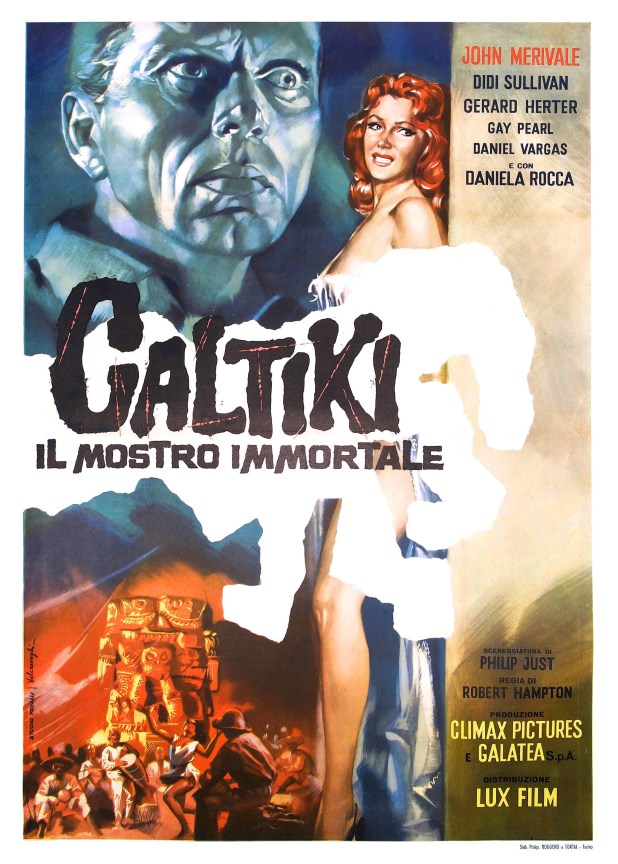
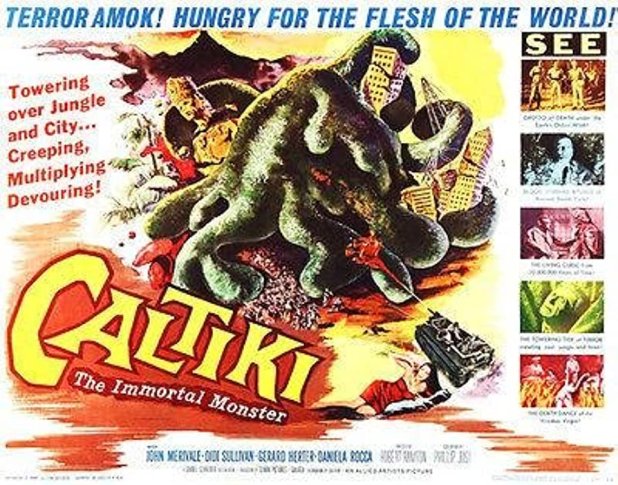
CHILLER THEATER MONTH: Caltiki – The Immortal Monster (1959)

EDITOR’S NOTE: Caltiki – The Immortal Monster was first on Chiller Theater on Sunday, February 23, 1964 at 11:10 PM. It also aired on August 22, 1964.

After the success of Hercules, Galatea Film began production on films made for the international market. They hired Riccardo Freda to make this movie, but he left before it was done, supposed to allow Mario Bava — the cinematographer and special effects artist on this — the opportunity to direct and earn more money. This same situation — Freda leaving and Bava finishing the movie — also happened during I Vampiri (The Devil’s Commandment)

There are different stories over who did what. Freda told Luigi Cozzi that he “left it when there were just two days of shooting left. I did shoot it yes, but it’s Bava’s type of film. I don’t enclose it in my body of work. The only thing I remember with pleasure about it are the statues that decorated the sets: I sculpted them myself,” while Bava referred to this as his first film and claimed that Freda left the movie” because everything was falling to pieces. I managed to carry it out, patching it up here and there.”

Cozzi would come back to this interview thirty years later, setting the record straight by stating that “the director of Calitiki il mostro immortale is Riccardo Freda, full stop. Mario Bava did take care of the cinematography, the special effects and directed the scenes with the miniatures (that is, mostly the tanks….) and in addition to that he filmed some shots of soldiers with flame throwers. That’s all, and of course it cannot be enough to say that Bava directed that movie.” That said, in the last two or three weeks of filming, Bava directed and shot over 100 special effects shots.

Honestly, the answer depends on who you ask and when you ask them.

A group of archaeologists discovers a large statue of Caltiki, a supposed Mayan goddess who demanded human sacrifices. When one of them descends into a pool, he finds skeletons covered in gold and jewels. He keeps going back for more before he’s melted into a skeleton himself.

Now, Caltiki is a made-up deity. But man, who cares, because soon a blob-like creature emerges and tries to devour everyone. The monster was created from cloth and tripe, which is the stomach of a cow. It made a horrific smell, so no one wanted to be around it.

Anyhow, the blob-like organism attaches itself to one man’s arm and, of course, replicates and feeds on radiation. It’s about to have a buffet, because a radioactive comet that last appeared in our orbit during the time of the Mayans is about to come back and every little blob will become gigantic unless the smart brains in this can figure something out. How do you destroy a blob in the world of this movie? Flamethrowers. It’s that simple.

You can watch this on Tubi.

CHILLER THEATER MONTH: The Bat (1959)

EDITOR’S NOTE: The Bat was first on Chiller Theater on Sunday, November 17, 1963 at 11:10 PM. It also aired on February 8, 1964 and December 25, 1965.

The 1959 version of The Bat is the fourth version* of the story, all based on the 1908 novel The Circular Staircase. This played a double bill with the Hammer version of The Mummy.

Agnes Moorehead plays Cornelia Van Gorder, a mystery author who gets involved with a bank president and his physical (Vincent Price) who are trying to scam $1 million dollars ($8.9 million adjusted for inflation) when a forest fire breaks out.

Meanwhile, a giallo-esque masked villain named The Bat is tearing out the tender throats of young women with his steel claws. He learns of the scam and terrorizes an entire house full of women, among them Darla Hood. Yes, the very same Darla from Our Gang in her last role.

Crane Wilbur, who directed this, started his career as an actor. He was also a screenwriter and wrote House of Wax.

You can watch this on Amazon Prime and Tubi or download it from the Internet Archive.

*The other versions are the 1926 silent film The Bat, as well as the 1930 movie The Bat Returns and a 1920 stage play.

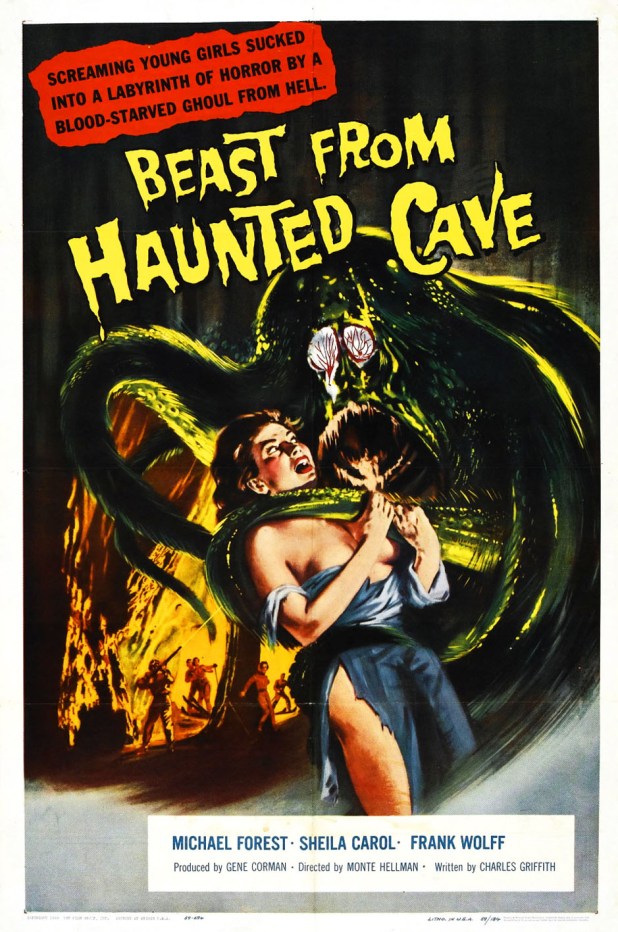
CHILLER THEATER MONTH: Beast from Haunted Cave (1959)

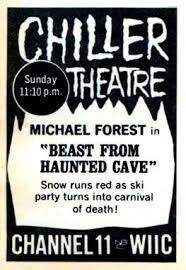
EDITOR’S NOTE: Beast from Haunted Cave first played on Chiller Theater on the second week of the show when it still aired on Sundays. It was on the September 22, 1963 show at 11:10 PM. It also played on the show on Saturday, April 4, 1964 at 4 PM.

Filmed at the same time as Ski Troop Attack and released on a double bill with The Wasp Woman, this Monte Hellman movie would mark the first of his many projects with Roger Corman.

Hellman would say, “What interested me about it was that it really wasn’t a monster movie. Roger liked Key Largo very much. I think that was one of his favorite movies. He kept making Key Largo just different versions of it. In this case he added a monster to it.

As for the titular beast, Hellman would say, “They literally spent two dollars at the dime store. It was mostly angel hair and paper mache monster.” The crew nicknamed the beast Humphrass. It was created and operated by Chris Robinson, who would go on to play the lead in William Grefé’s Stanley.

Basically, a gang gets together and tries to steal some gold, but ends up waking this monster and, well, bad things happen.

Linné Ahlstrand, who plays the doomed barmaid Natalie, was Playboy’s Playmate of the Month for July 1958 and Richard Sinatra, who plays Marty, was a cousin of Ol’ Blue Eyes. It’s things like that that sell a movie, you know.

There was a sequel planned — that’s why this ends like it does — but it never happened. However, Corman would pretty much make the movie all over again in 1961 and call it Creature from Haunted Sea.

You can watch this on Tubi.

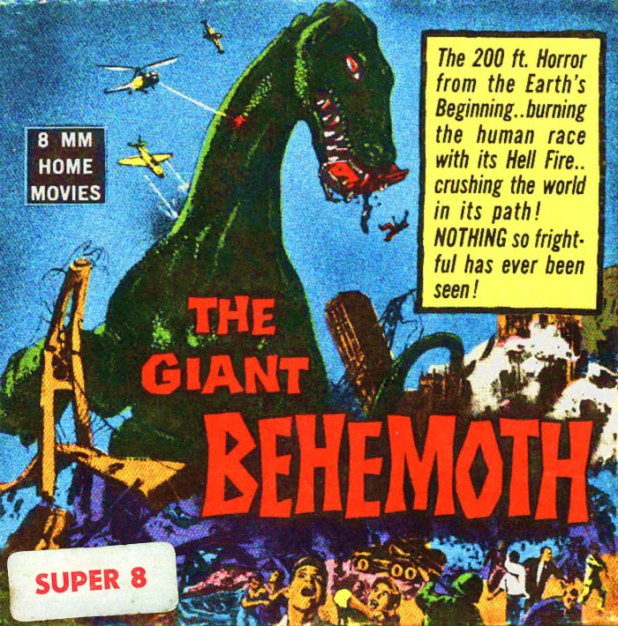
CHILLER THEATER MONTH: The Giant Behemoth (1959)

EDITOR’S NOTE: The Giant Behemoth was the second movie to ever be on Chiller Theater on Sunday, September 15, 1963 at 11:10 PM. It also aired on the show on January 11, 1964; June 26, 1965 and December 2, 1967.

While the stop-motion animation special effects by Willis O’Brien — the man who made King Kong alive — were shot in a Los Angeles studio. The rest of the footage, filmed in London, was optically integrated with the effects. The distributor wanted this to be a clone of The Beast from 20,000 Fathoms and they got exactly what they asked for, nearly scene for scene and word for word.

Scientist Steve Karnes (Gene Evans) tries to warn everyone about the dangers of nuclear radiation. Before he even goes back to the U.S., thousands of dead fish are washing up and a fisherman’s last words point to the existence of a giant monster. Dr. Sampson (Jack MacGowran) identifies it as a Paleosaurus, a water-friendly dinosaur that has electrical powers like an eel. Oh Dr. Sampson. That kind of power only exists in this story.

Prof. James Bickford (Andre Morell) and Steve have a plan. You see the dinosaur is already dying from all the radiation, so they decide to give it even more radiation. This is where, as a kid, I would grow enraged at humanity and despise them for the way they have turned the world. I still feel like that as an old man. I wish that the monsters would win in these movies.

One of the reasons that this is so close to The Beast from 20,000 Fathoms is that they share the same writer, Daniel Lewis James, who was blacklisted and wrote this as Daniel Hyatt. Years later, his confidence ruined by the blacklist, he would use the name Danny Santiago. His novel Famous All Over Town won awards and was to be nominated for a Pulitzer Prize. The book became a major work of Chicano literature and Hispanic teens saw its main character, the Danny Santiago who wrote the book about his life, as a role model. They didn’t know that it was really a white man who had grown up in Kansas City and was an assistant director on Charlie Chaplin’s The Great Dictator. His agent, Carl Brandt, had no idea who he was and had never seen him in person. He also wrote Gorgo.

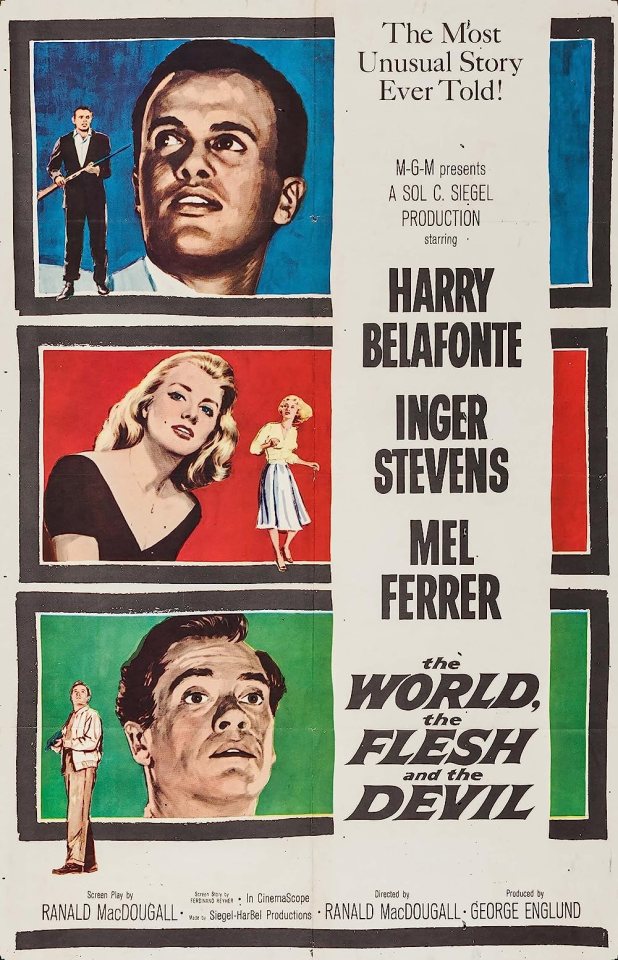
CBS LATE MOVIE MONTH: The World, the Flesh and the Devil (1959)

EDITOR’S NOTE: The World, The Flesh and the Devil was on the CBS Late Movie on March 29 and September 18, 1972; May 13, 1974 and January 27, 1976.

Based on The Purple Cloud by M. P. Shiel and the story “End of the World” by Ferdinand Reyher, this was directed and written by Ranald MacDougall, who also wrote Mildred Pierce.

In his third objection to the ‘prudence of the flesh’ is a sin in Summa Theologica, Saint Thomas Aquinas said, ‘Just as man is tempted by the flesh, so too is he tempted by the world and the devil.’ This theological concept forms the title of the film, ‘The World, The Flesh and the Devil ‘, as these three are the enemies of man. The film uses this title to explore the complex and intertwined nature of these three temptations, and how they manifest in the context of race relations.

Harry Belafonte’s production company, Harbel Productions, set out to create films that would offer a more authentic representation of African-Americans in Hollywood. This film was their first venture. However, by the film’s conclusion, Belafonte and his co-stars, Inger Stevens and Mel Ferrer, found themselves critiquing the film’s portrayal of race relations.

Ralph Burton (Bellafonte) finds himself in a mine when the world ends, a revelation he uncovers as he frees himself from his entrapment. Living alone in a building with mannequins, he soon encounters Sarah Crandall (Stevens), who has been observing him for some time. She falls in love with him, but even as the last two people alive, he is unable to overcome the barriers of segregation.

They soon nurse Benson Thacker (Ferrer) back to health after finding him, and he falls for Sarah. Ralph tries to leave them to be a couple but can’t find himself to leave the city. Benson believes that with Ralph alive, he can never be with Sarah, so they go to war with one another, a ridiculous thing when everyone else is dead, killed by a radioactive cloud. The film’s ending is particularly poignant, as it shows Sarah making Ralph and Benson walk hand in hand down the street, symbolizing a potential for unity and understanding between races, even in the most extreme circumstances.

Source

The World, The Flesh And The Devil – Morrissey-solo Wiki. https://www.morrissey-solo.com/w/index.php?title=The_World,_The_Flesh_And_The_Devil&mobileaction=toggle_view_mobile

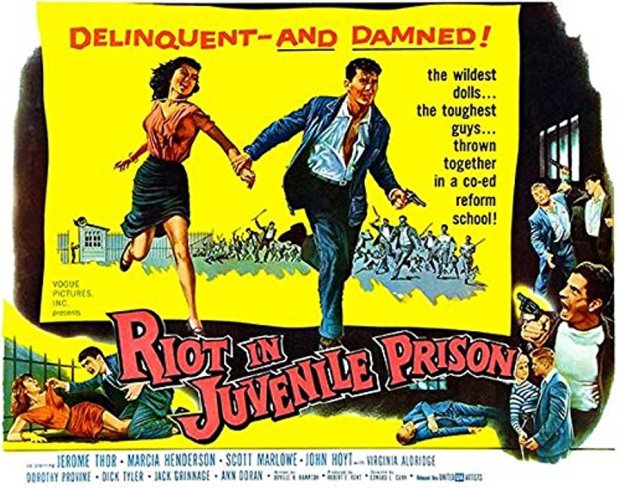
Junesploitation: Riot in Juvenile Prison (1959)

June 1: Junesploitation’s topic of the day — as suggested by F This Movie— is Free Space! We’re excited to tackle a different genre every day, so check back and see what’s next.

Dr. Paul Furman (Jerome Thor, whose trenchcoat from Foreign Intrigue is in the Smithsonian; he’s in a lot of later Bronson movies like 10 to MidnightKinjite: Forbidden SubjectsMurphy’s Law and Messenger of Death) takes over a reform school and makes some big changes, including easing the discipline, trusting the inmates more and, perhaps most importantly, making it co-ed.

Eddie Bassett (Scott Marlowe, who was in The Cool and the Crazy and had a long career of TV roles) is enjoying all this freedom and the interest of the girls that have arrived, like the shy Kitty Anderson (Virginia Aldridge) and the more in your face Babe (Dorothy Provine, That Darn Cat).

Everything goes bad when Kitty and Babe fight over him, which turns into a big rumble and even Dr. Furman gets involved when she’s punched by Eddie.

The governor fires Furman and brings back Col. Ernest Walton (Lance Hoty), who was a strict believer in the power of discipline. One of his guards, Quillan (Richard Reeves) beats on Eddie, who decides to start a riot — a Riot In Juvenile Prison — that can only be stopped by Furman.

I mean, in the real world, they’d just tear gas these kids and shoot them, but go with director Edward L. Cahn (The Four Skulls of Jonathan DrakeInvasion of the Saucer MenCreature With the Atom Brain) and Orville H. Hampton (whose career started in 1950 with movies like Rocketship X-M and ended in 1983 with The Dukes cartoon series; he also wrote Friday Foster) and watch a world where juvenile delinquents and authority can walk hand in hand into a sunshiny brand new day.

I first watched this thanks to the always amazing and wonderful White Slaves of Chinatown 3D YouTube page.

APRIL MOVIE THON 2: Caltiki – The Immortal Monster (1959)

April 25: Bava Forever — Bava died on this day 43 years ago. Let’s watch his movies.

After the success of Hercules, Galatea Film began production on films made for the international market. They hired Riccardo Freda to make this movie, but he left before it was done, supposed to allow Mario Bava — the cinematographer and special effects artist on this — the opportunity to direct and earn more money. This same situation — Freda leaving and Bava finishing the movie — also happened during I Vampiri (The Devil’s Commandment)

There are different stories over who did what. Freda told Luigi Cozzi that he “left it when there were just two days of shooting left. I did shoot it yes, but it’s Bava’s type of film. I don’t enclose it in my body of work. The only thing I remember with pleasure about it are the statues that decorated the sets: I sculpted them myself,” while Bava referred to this as his first film and claimeed that Freda left the movie”because everything was falling to pieces. I managed to carry it out, patching it up here and there.”

Cozzi would come back to this interview thirty years later, setting the record straight by stating that “the director of Calitiki il mostro immortale is Riccardo Freda, full stop. Mario Bava did take care of the cinematography, the special effects and directed the scenes with the miniatures (that is, mostly the tanks….) and in addition to that he filmed some shots of soldiers with flame throwers. That’s all, and of course it cannot be enough to say that Bava directed that movie.” That said, in the last two or three weeks of filming, Bava directed and shot over 100 special effects shots.

Honestly, the answer depends on who you ask and when you ask them.

A group of archarologists discover a large statue of Caltiki, a supposed Mayan goddess who demanded human sacrifices. When one of them descends into a pool, he finds skeletons covered in gold and jewels. He keeps going back for more before he’s melted into a skeleton himself.

Now, Caltiki is a made up deity. But man, who cares, because soon a blob like creature emerges and tries to devour everyone. The monster was created from cloth and tripe, which is the stomach of a cow. It made a horrific smell, so no one wanted to be around it.

Anyhow, the blob-like organism attaches itself to one man’s arm and, of course, replicates and feeds on radiation. It’s about to have a buffet, because a radioactive comet that last appeared in our orbit during the time of the Mayans is about to come back and every little blob will become gigantic unless the smart brains in this can figure something out. How do you destroy a blob in the world of this movie? Flamethrowers. It’s that simple.

You can watch this on Tubi.