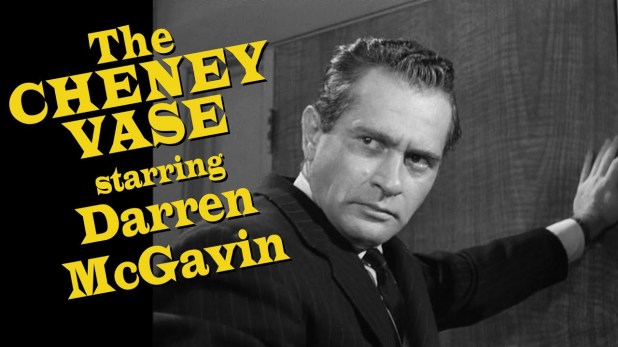
Season 1, Episode 13 of Alfred Hitchcock Presents, “The Cheney Vase,” stars Darren McGavin as Lyle Endicott, who is hired to be the personal assistant of Martha Cheney (Patricia Collinge). What he really wants is the money he’ll get when he takes a family heirloom, the Cheney Vase.
He’s already found a buyer in Herbert Koether (George Macready), but Cheney wants to keep the vase in her family until she dies. This may not be far from happening. And hey — Carolyn Jones is in this!
Directed by Robert Stevens and written by Robert Bless (Frogs), this seems like Endicott has it all figured out. Then again, this is an Alfred Hitchcock show, so it’s one thing to replace the maid and shut an older woman off from everyone else. It’s another thing to get away with it.
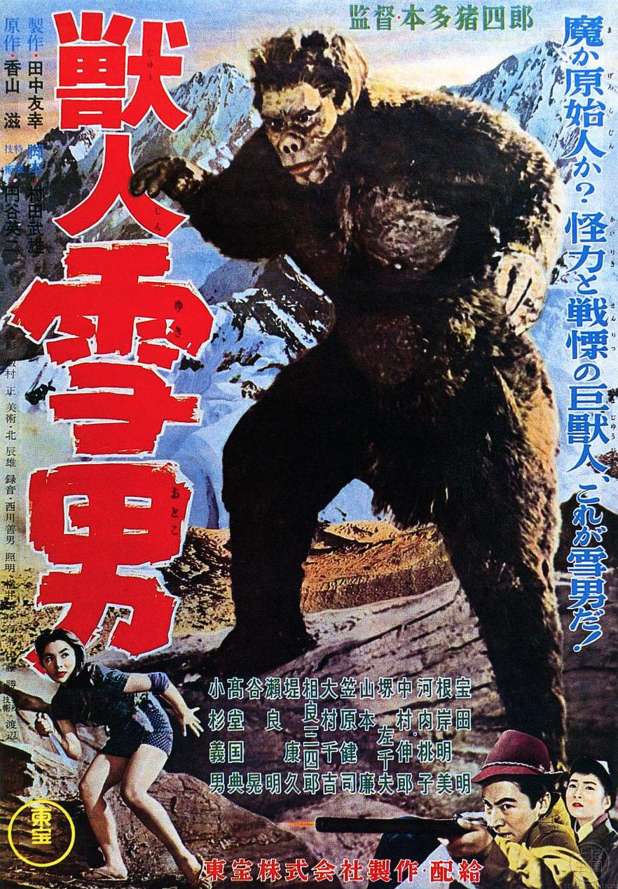
Five young university students — Takashi Iijima, his girlfriend, Machiko Takeno, her older brother, Kiyoshi Takeno, and their friends, Nakada and Kaji — went to the Japanese Alps for a skiing vacation. Kiyoshi and Kaji go to meet their friend Gen, but in the middle of a blizzard, they’re lost, and a phone call only reports screams and a gunshot. And just who is the mysterious mountain girl Chika?
All they can find are large piles of fur, Gen’s body inside, Kaji’s in the snow and Kiyoshi has disappeared. Six months later, when the snow has melted, Takashi and Machiko join an expedition led by anthropologist Professor Shigeki Koizumi. The goal? Find a giant monkey man. They’re not alone, as a hunter named Oba wants the creature and nearly kills Takashi, who is rescued by Chika.
Poor Chika. She’s abused by her grandfather, who leads the village, a man who beats her for every mistake. By the end of the movie, the monster drags her into a sulphur pit as it dies. Chika didn’t ask for any of this.
This film was decided upon before Godzilla was released, with Ishiro Honda to direct. It was inspired by Eric Shipton’s photographs of large footprints found in the snow at Mount Everest. This film, however, has been seen more in the U.S. than in Japan.
That’s because the villagers are similar to burakumin, who are outcasts at the bottom of the traditional Japanese social hierarchy. Their ancestors worked in jobs considered impure or tainted by death, such as executioners, undertakers, slaughterhouse workers, butchers or tanners. They’re even called by that name in the film. As a result of new civil rights in Japan protecting these castes, Toho has imposed a self-imposed ban on its own version of the film. The U.S. version of Half Human remains the only version available on home video worldwide.
As for the American version, remixed by Distributors Corporation of America, it features English-language scenes and narration. The scene where the child snowman is experimented on is replaced with footage of American scientists, including John Carradine (who also narrates), Robert Karnes, Russell Thorson, and Morris Ankrum. The new scene features the child snowman’s costume, which was sent by Toho to the U.S. for filming. The added U.S. sequences were directed by Kenneth G. Crane. This played double features with Monster from Green Hell(Zombo’s Closet has the pressbook).
You can download the Japanese version from the Internet Archive. There’s also a colorized version of the U.S. cut available on the site.
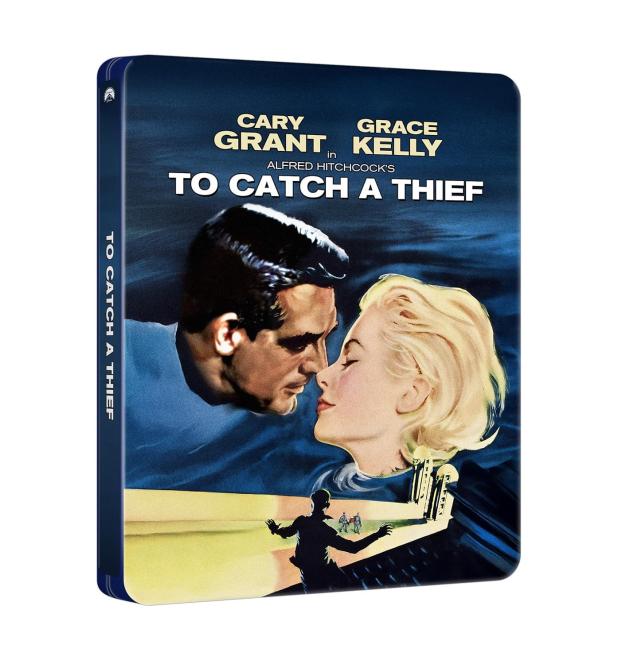
John “The Cat” Robie (Cary Grant) is a retired jewel thief who is suspected of crimes all over the French Riviera. His old gang has gone straight, and maybe he has, too. The only way to prove himself is to catch whoever is pulling off these thefts, working with insurance agent H. H. Hughson (John Williams).
His way of proving his innocence is like casing the joint, starting with Frances Stevens (Grace Kelly) and her mother Jessie (Jessie Royce Landis), who have just come into money. Whenever he’s in trouble, it seems that his old partner’s daughter, Danielle Foussard (Brigitte Auber), is there to save him. But is there just one burglar? Or several? And will Robie be able to pull off stealing Frances away from her mother?
Hitchcock’s first film in VistaVision and last with Grace Kelly, it wasn’t well-received by critics when it came out, as they expected Hitchcock’s suspense. Instead, they got an adventure movie with romance, including a gorgeous scene as Grant and Kelly watch fireworks.
Hitchcock got Grant out of retirement for this movie. With the rise of Method actors like Marlon Brando, he thought no one wanted to see him, and he was upset with how the McCarthy era had treated Charlie Chaplin. After this, he acted for more than a decade.
The Paramount Steelbox of this movie — it’s the only movie Hitchcock made for Paramount that he didn’t get the rights to — has the film on 4K UHD, Blu-ray and a digital code. Extras include commentary by Dr. Drew Casper, a Leonard Maltin feature on To Catch a Thief, featurettes on the Hitchcocks, the writing and casting of the film, censorship, the making of the film and Grant and Grace. Plus, it looks gorgeous and I’m so happy to have it on my shelf.
EDITOR’S NOTE: Bride of the Monsterwas on Chiller Theater on Saturday, February 12, 1966 at 11:20 p.m., Saturday, March 24, 1973 at 11:30 p.m., Saturday, February 1, 1975 at 11:30 p.m., Saturday, October 4, 1975 at 1:00 a.m. and Saturday, August 12, 1978 at 11:30 p.m.
Two psychotronic film experiences shaped my early love of discovering strange movies.
HBO showed It Came from Hollywood, a movie written by Dana Olsen (Wacko, The ‘Burbs) and directed by Malcolm Leo and Andrew Solt. It’s packed with clips of all manner of strange films, as well as wraparound segments hosted by Dan Aykroyd, John Candy, Gilda Radner, Cheech Marin and Tommy Chong.
Writers Harry and Michael Medved worked as consultants on this film, which leads me to the next experience: their books. I was gifted these by my uncle, who recognized my love of horror movies and would use his job as a librarian to find me books to read about the movies that I loved so much, such as the legendary orange cover hardback Crestwood Monsters series.
Again, in the pre-internet days, writers like the Medveds were the only ones who you could find writing about strange movies and most of what they said about them colored the perceptions that people will always have. In fact, in the first of their books, the aforementioned The Golden Turkey Awards, they voted Ed Wood as the worst director of all time. The worst film, as written in by their readers, was his Plan 9 From Outer Space (the runner-up was another of my favorites that the world hates, Exorcist II: The Heretic).
As I read these books, I started to realize that perhaps the Medveds didn’t know everything about movies. When Michael Medved and Jeffrey Lyons replaced Siskel and Ebert on Sneak Previews in 1984, I realized that my suspicions were correct. That’s when I started re-evaluating these films.
That’s when I learned that Ed Wood was pretty great.
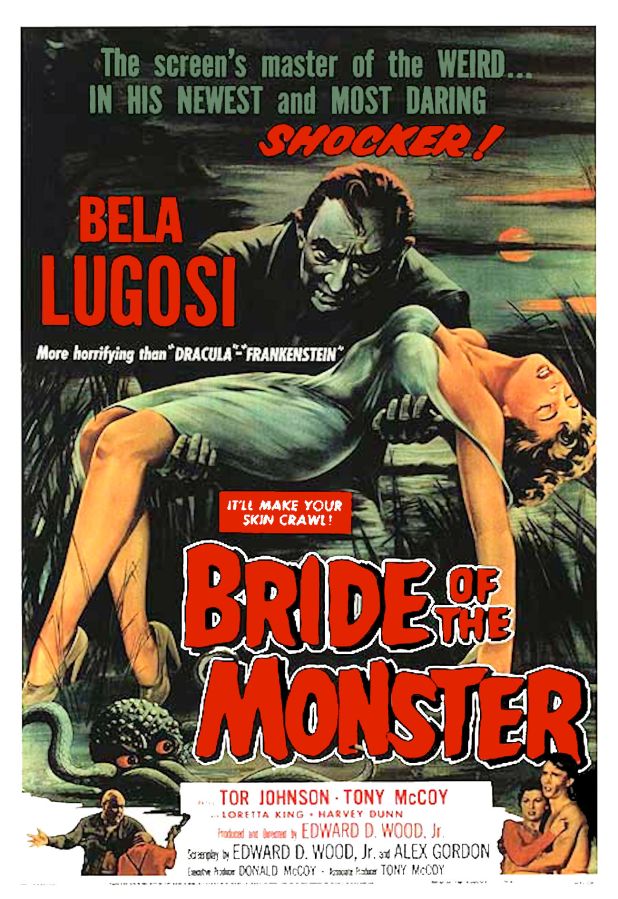
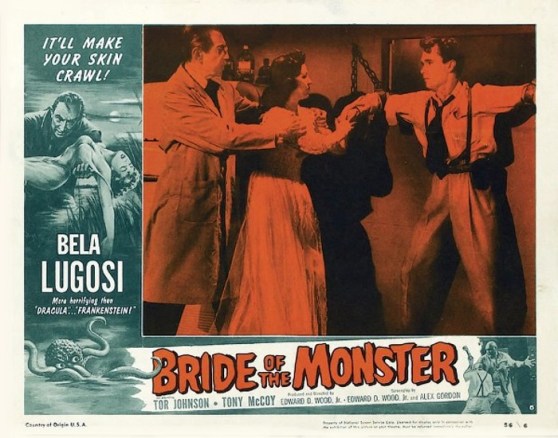
Bride of the Monster is considered to have the biggest budget that Wood ever enjoyed — $70,000 or $678,000 in today’s cash. That money came from a rancher named Donald McCoy, who became the film’s de facto producer. He had two demands: his son Tony would play the film’s hero, Lieutenant Dick Craig. And the movie had to end with an atomic explosion.
The final film, which originally premiered under the title Bride of the Atom, was released through a deal with Samuel Z. Arkoff, who made more money off the movie than Wood. Enough, in fact, to fund American-International Pictures.
This movie would also mark the final speaking role for Bela Lugosi. It’s nearly a sequel to The Corpse Vanishes and finds Lugosi recreating the hypnotic stare that he’d used in previous movies like Dracula and White Zombie.
The Golden Turkey Awards claims that Lugosi’s failing health/mental faculties — or Wood’s incompetence as a director — led to him telling the Lobo character that he is “as harmless as a kitchen.” The truth is that Lugosi says the line correctly: “Don’t be afraid of Lobo; he’s as gentle as a kitten.” Sadly, again, the Medveds’ version of reality is what has stuck with us.
Bela’s speech in this movie reveals the darkness and pathos in his soul. I’m always reminded of it and how it must have felt to recite: “Home? I have no home. Hunted, despised, living like an animal! The jungle is my home. But I will show the world that I can be its master! I will perfect my own race of people. A race of atomic supermen which will conquer the world!”
The film begins in the woods, where two hunters try to hide from a rainstorm in the Willows House, where Dr. Eric Vornoff uses an octopus — urban legend states that it was stolen from the Republic Pictures lot and the John Wayne film Wake of the Red Witch — and his manservant Lobo (former pro wrestler Tor Johnson) to kill both of them. Well, after he experiments on one of them, of course.
We cut to a police station, where the police discuss twelve recent murders that all feel connected. This is also the opportunity to meet our heroes: Captain Tom Robbins (Harvey B. Dunn, Teenagers from Outer Space), Lieutenant Dick Craig (the son of the producer, as mentioned earlier), Janet Lawton (Loretta King; according to actress Dolores Fuller, who usually had the lead in Wood’s films, she offered to help finance the movie if given this role. However, Loretta denied this.) and Professor Vladimir Strowski. In this scene, there are also cameos by a drunk (Ben Frommer, who was Count Bloodcount in Transylvania 6-5000) and a newspaper seller (William Benedict, Whitey of The Bowery Boys).
Janet decides to take off for the house herself to investigate and is soon captured and transformed into, well, a Bride of the Monster. It takes Lobo — who ends up having a heart — to stop the experiments and sham marriage, allowing our heroine to escape and Lugosi’s character to gain superhuman atomic powers, powers that end up finding him battling that octopus, his home being destroyed by a strike of lightning and a nuclear blast wiping him off the face of the Earth.
After all, as the movie reminds us, he “tampered in God’s domain.”
Paul Marco shows up in this film as a goofball cop named Kelton. He’d play the same role in Plan 9 from Outer Space and Bride of the Monster‘s spiritual sequel, Night of the Ghouls. Thought to be a lost film until Ed Wood fan Wade Williams discovered that the film was sitting in a lab, held hostage due to its bills never being paid. It was released to home video in 1984 and also has Johnson returning as Lobo. Johnson would also play a character with the same name in The Unearthly.
EDITOR’S NOTE: King Dinosaur was on Chiller Theater on Saturday, September 18, 1965 at 11:20 p.m., Saturday, October 26, 1968 at 1:00 a.m. and Saturday, September 14, 1974 at 1:00 a.m.
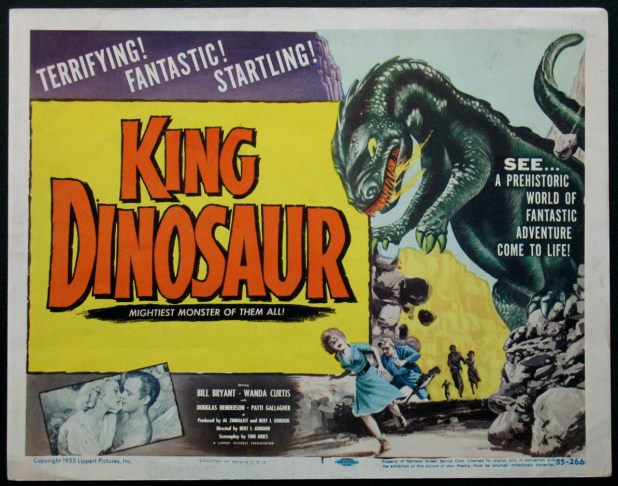
This shot-in-one-week effort was Bert I. Gordon’s first solo movie as a writer-director (he co-directed the previous year’s Serpent Island, which he wrote), made with borrowed equipment and the cast of four all working on deferred salaries. The rest of the footage is all stock, including a mammoth taken from One Million B.C. And it takes 10 minutes — of educational space exploration stock footage and narration — before the first actor steps foot on the newly discovered planet.
It takes place five years in the future, which would be sixty years in our past.
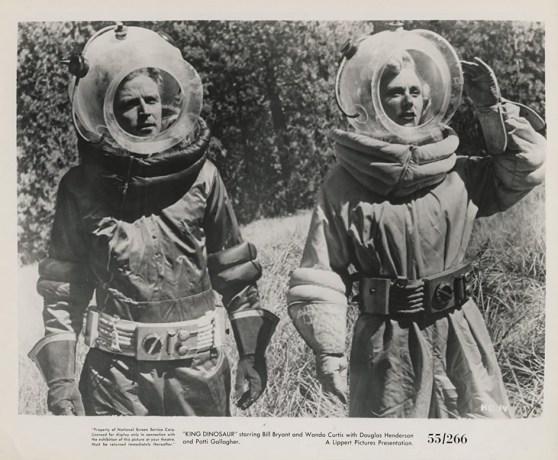
Zoologist Dr. Richard Gordon, geologist Dr. Nora Pierce, medical specialist Dr. Ralph Martin, and chemist Dr. Patrica Bennett (while the men wear baggy flight suits and military-issue boots, the gals wear sensible gauchos and knee-high boots) are on a space voyage to the planet Nova in the hopes of starting a new Earth colony. It’s filled with animals (bears, elk) that are way bigger than they should be — remember that Burt I. Gordon directed this one — including King Dinosaur, which is really an iguana. So the scientists do what any good researcher should: they nuke the processed-shot and floating-matte planet, and leave.
Is there a deeper message about Manifest Destiny and American Imperialism in the frames? Is this a plight of the American Indian allegory? Nope. Burt just likes big creatures on film and blowing up stuff: for this is a world where, regardless of the intelligence of smartly-dressed women (clad in ballet flats and wedged mules with their tailored flight wears) conquering space — just like in The Angry Red Planet and Gog — they’re still screaming and imploring the men to “do something” and to shoot everything they survey.
The funny thing about this movie is that Ray Harryhausen and Ray Bradbury wanted to provide the dinosaur effects, so they brought in some footage. Gordon watched it, didn’t acknowledge them and just walked out. Harryhausen and Bradbury were obviously upset, but a few years later, at the premiere, Bradbury allegedly approached Gordon and said, “Remember me? Ray Bradbury. It won’t make a dime!”
If you wonder, “Have I heard this music before?” then you’ve probably seen Ed Wood’s The Violent Years. Actually, you should just watch that movie. It’s way better than this. Even at its short running time at a measly 63 minutes — 43 if you cut out the opening stock-narration salvo. And if you recognized the narrator, that’s Marvin Miller, who was the voice of Robby The Robot in Forbidden Planet and was Mr. Proteus on Commander Buzz Corey and the Space Patrol. And if you recognize the rocketing landing from King Dinosaur, that’s because it ended up in Fire Maidens from Outer Space.
You can watch the Mystery Science Theater 3000 version of this movie on Amazon Prime and Tubi. It’s also available without the commentary on Daily Motion.
EDITOR’S NOTE: The Quartermass Experiment was on Chiller Theater as The Creeping Terror on Saturday, June 29, 1977 at 11: 30 p.m., Saturday, July 28, 1979 at 1:00 a.m., Saturday, February 16, 1980 at 1:00 a.m., Saturday, June 20, 1981 at 1:00 a.m. and Saturday, March 13, 1982 at 1:00 a.m.
This film is based upon The Quatermass Experiment, a British science fiction serial broadcast by BBC Television during the summer of 1953 that was written by Nigel Kneale. Hammer Films producer Anthony Hinds, who had a history of making movie versions of radio shows. Kneale, a BBC employee, was paid nothing for his work making the company so much more cash.
Directed by Val Guest, this starts with the crash landing of a British-American Rocket Group spaceship that was designed by Professor Bernard Quatermass (Brian Donlevy). Of the three astronauts, only Victor Carroon (Richard Wordsworth) survives, while the space suits of Reichenheim and Green are empty.
Caroon begins to mutate as its discovered that not even his fingerprints are human by Scotland Yard Inspector Lomax (Jack Warner). His wife Judith (Margia Dean) hires a private detective named Christie (Harold Lang) to break him out of the hospital, but now the man she loves starts to absorb organic material and kills the man sent to get him. By the end of this movie, he’s grown into a gigantic mass of animals and plants, filling Westminster Abbey, which is filled with electricity and used to destroy the alien before it can infect the Earth.
The start of not just Hammer horror, body horror and the Quatermass series of films all start here. It’s got a monster covered in cow guts and tripe that probably smelled like absolute death, as well as a young Jane Asher as the little girl menaced by the alien.
This played with The Black Sleep as a double feature. In Chicago, the parents of Stewart Cohen sued United Artists and the theater playing this movie after their nine-year-old son died of a ruptured artery, dying of fright. Not to make light of that, but William Castle had to be happy it wasn’t one of his movies, as he’d have to pay off the family with one of his life insurance policies.
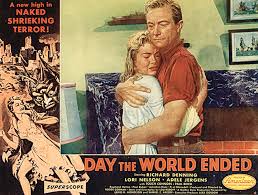
EDITOR’S NOTE: Day the World Ended was on Chiller Theater on Saturday, December 12, 1964 at 11:15 p.m. and Saturday, May 14, 1966 at 11:20 p.m.
Produced and directed by Roger Corman, this movie somehow had newsman Chet Huntley as its narrator and tells the story of the end of the world and the mutant monster that comes afterward.
U.S. Navy Commander Jim Maddison and his daughter Louise have somehow survived all the atomic bombs, a uranium miner named Rick, a gangster named Tony and his girl Ruby (Adele Jergens, who was an understudy of Gypsy Rose Lee).
Between the creature on the loose, Tony being a jerk and radioactive fallout, how will anyone make it to the end of this movie alive? Well, you will learn a new science fact in this movie: rain can wash away radiation.
Larry Buchanan remade this movie, using almost all the same dialogue, as In the Year 2889 in 1967.
A nine day wonder with a foam rubber monster, this got its name from future American-International Pictures boss James H. Nicholson before it was even filmed. It was Corman’s fourth film and played on a double bill with The Phantom from 10,000 Leagues.
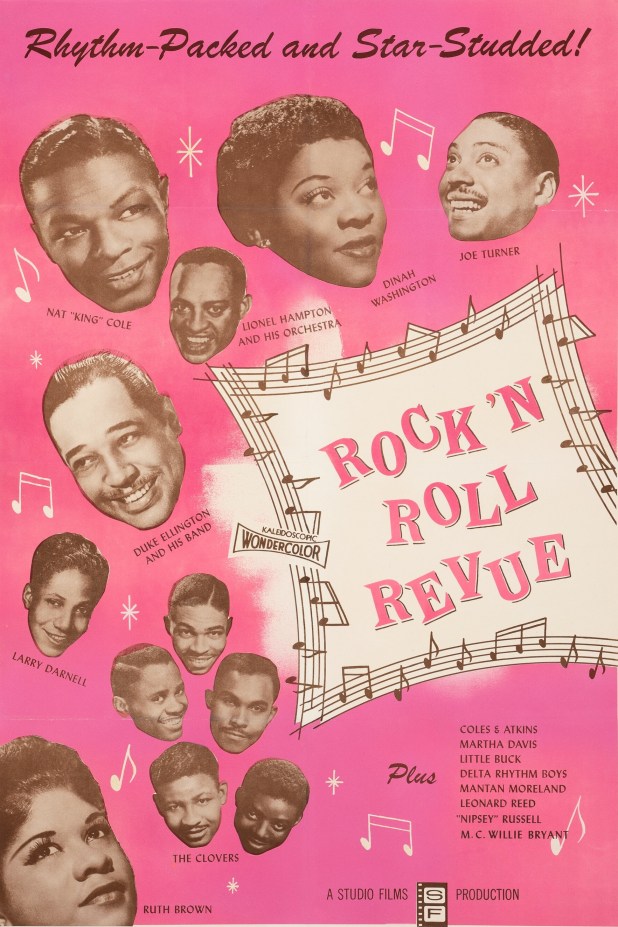
Directed by Joseph Kohn, who specialized in these music films, this was put together from several TV shorts and host segments with Willie Bryan were added. Bryan was the “Mayor of Harlem,” famous for being the host of the original Showtime at the Apollo, a 13-episode TV show that is where many of these songs originated.
This was an opportunity for white kids across the country to see and hear bands they may not get the chance to at the time. Well, if they wanted to go to all black movie houses. That said, it has a great mix of songs from this era, including Duke Ellington and His Orchestra playing “The Mooche,””Your Cash Ain’t Nothin’ But Trash” by The Clovers, “Only a Moment Ago” by Dinah Washington, Big Joe Turner playing “Okimoshebop,” Larry Darnell performing”What More Do You Want Me to Do,” “Only a Moment Ago” by Dinah Washington and Nat “King” Cole singing “The Trouble With Me Is You.”
Somehow, 21st Century ended up with the rights to this. Consider it your chance to see what rock and roll was in its nascent embryonic stage. There’s also another similar film that 21st Century also ended up owning, Rhythm and Blues Revue.
Johnny Legend’s Untamed Video (August 25 – 31) Welcome to the wonderfully wacky world of Johnny Legend’s Untamed Video! Take a walk on the wild side with troublesome teenagers, sleazy sex kittens, way-out hippies, country bumpkins, big bad bikers, Mexican wrestlers, and every other variety of social deviant you can think of.
I first watched this movie in the best of ways. On our weekly webcast, Drive-In Asylum, we had the great opportunity to have Bret McCormick, director of The Abomination, as a guest. This was the movie that he chose to watch with us.
Director, writer and producer John Parker started this film as a short and then expanded it. He had been inspired by a dream that his secretary, Adrienne Barrett, had and picked her to star in the film along with Bruno VeSota, who would go on to star in several Roger Corman films.
Barrett plays the Gamin, a young woman who wakes up from a nightmare to be in another one. Newspapers scream that there was a mysterious stabbing, men try to assault her only to be beaten into oblivion by police and a pimp buys her a flower, then asks her to accompany a rich man (Ve Sota) as she dreams back to stabbing her abusive father after he had shot and killed her mother.
After an evening touring the city’s bars and nightclubs, they enter his elegant apartment where he ignores her attempts at seduction as he gorges on a huge meal. He finally attempts to attack her and she stabs him with the same blade that murdered her father and he plummets to the street, holding her necklace in a death grip. She saws off his hand as people watch without caring and the same cop appears that saved her in the alley, only now with the face of her father as she runs away, clutching the severed hand.
The pimp comes back to pull her into a jazz club, soon followed by the cop and the dead body of the rich man, whose bloody stump points her out as his killer. The audience surrounds her, laughing, as she wakes up back where she began, in the hotel room. She goes to put on her necklace and finds that its being held by a severed hand.
Dementia was briefly released in 1953 before it was banned by the New York State Film Board, who deemed it “inhuman, indecent, and the quintessence of gruesomeness.” Perhaps that’s because it’s a movie that shows the violence and fear that women live with every day, but goes further to have a heroine who strikes back with the kind of strength that seperates a man’s body part. Today, this would be considered an art film, or maybe even elevated horror, but in the 1950s, the only genre it could fit into was horror. When it was re-released in 1955, theater employees submitted medical examinations of patrons to “heart specialists” who would assure the theatergoers that they would not be frightened to the point of death. One of the big reasons why the 1955 re-release was troubled was that some areas of the country weren’t ready for the interracial dancing in the jazz club.
Originally, Dementia has no dialogue and only sound effects and a score by composer George Antheil, with vocal effects by Marni Nixon and jazz musician Shorty Rogers and his band the Giants performing in the night club scene. Jack H. Harris, who had a habit of getting films and re-releasing them — Equinox, Dark Star — added narration by Ed McMahon and release it as Daughter of Horror.
When we showed this, Bret was worried that our audience would hate it. After all, The New York Daily News said, “The presentation, designed as a shocker, is enough to drive anybody crazy with alternate sessions of tedium and bedlam.” The good news is that it was received well, much like how Preston Sturges said, “It stirred my blood, purged my libido. The circuit was completed. The work was a work of art.”
Even if you haven’t seen this movie, you may have. It’s what’s playing in The Colonial Theater when The Blob attacks. And Faith No More used it as the inspiration for their video “Separation Anxiety.”
Supposedly, Aaron Spelling was one of the people in the nightclub. Did you see him?
The re-edit by Harris is strange to the ear, as you’re listening to the friendly voice of Carson’s sidekick saying things like, “Come with me into the tormented, haunted, half-lit night of the insane. This is my world. Let me lead you into it. Let me take you into the mind of a woman who is mad. You may not recognize some things in this world, and the faces will look strange to you. For this is a place where there is no love, no hope…in the pulsing, throbbing world of the insane mind, where only nightmares are real, nightmares of the Daughter of Horror!”
Directed by William Wyler and written by Joseph Hayes and Jay Dratler, it was based on Hayes’ novel and stage play. That play had Paul Newman in the lead, but Humphrey Bogart was a much bigger star for the movie.
The story is based on the Hill family of Whitemarsh Township, Pennsylvania. On September 11 and 12, 1952,. they were held hostage for 19 hours. Hayes’ storyline was invented and didn’t take everything from the Hill family’s experience. However, Life magazine published an article that had the actors from the play — Newman, Karl Malden and Nancy Coleman — in the actual Hill home. The family sued Time, Inc. over this as they had been trying to stay out of the public eye. They also believed that the article falsely described the actual events while claiming it represented the truth. Mr. Hill told the press that his family had been treated well during the crime while the article said that the family was assaulted. They were rewarded with compensatory damages.
Glenn Griffin (Bogart), his younger sibling Hal (Dewey Martin) and Sam Kobish (Robert Middleton) have broken out of jail and are on the run. They hide out at the home of the Hilliard family, which is Daniel (Frederic March), Ellie (Martha Scott), Cindy (Mary Murphy) and Ralphy (Richard Eyer). Plus, you get Arthur Kennedy as a deputy sheriff who has to figure this all out.
They create a terror-filled situation not just for the family but for the entire neighborhood, killing a garbageman (Walter Baldwin) and Glenn decimating the suburban dream. The exterior of the house is the same from Leave It to Beaver and here’s Bogart, in his last role as a bad guy — he said, “I’m too old to play gangsters.” — and his next-to-last movie making life horrifying for everyone around him.
Glenn and Daniel have the same problems as fathers — well, older brother and father — and yet they come from different worlds. The idea of a home invasion movie remains frightening even today. Imagine how it felt in the post-war 1950s.
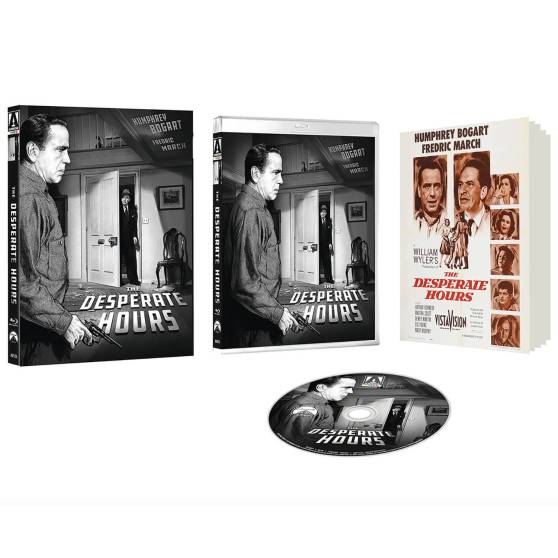
Arrow’s blu ray release of Desperate Hours has a brand new restoration by Arrow Films from a 6K scan of the original VistaVision negative. It features extras like a new audio commentary by film historian Daniel Kremer, several appreciations of the film, a new audio interview with Catherine Wyler, daughter of director William Wyler, a reversible sleeve featuring original and newly commissioned artwork by Jennifer Dionisio, an illustrated collector’s booklet featuring new writing on the film by Philip Kemp and Neil Sinyard and even a lobby card gallery.


 B&S About Movies
You must be logged in to post a comment.