UNSUNG HORRORS HORROR GIVES BACK 2025: The President Must Die (1981)

Each October, the Unsung Horrors podcast does a month of themed movies. This year, they will once again be setting up a fundraiser to benefit Best Friends, which works to save the lives of cats and dogs across America, giving pets second chances and providing them with happy homes.

Today’s theme: Unsung Horrors Rule (under 1,000 views on Letterboxd)

The last documentary produced by Sunn Classic Pictures, The President Must Die, is a fairly groundbreaking film, one that explores the conspiracy theories related to the assassination of President John F. Kennedy.

Urban legend says that it was tested in theaters in Arizona and Virginia in January 1981, but performed poorly. It was ultimately shelved and is now considered a piece of “lost media.” Just a few months later, the real-life assassination attempt on President Ronald Reagan made it an impossible movie to market.

Or so they say.

I interviewed James Conway, this film’s director, for an upcoming issue of Drive-In Asylum and got to ask about this movie, one that has fascinated me for years:

DIA: One last question about that era. What happened with The President Must Die?

JAMES: It was sort of the end of our believing in the market research and testing of ideas. Because when we tested that – making some trailers – it received incredibly high ratings. Everybody wanted to see this movie. We made the movie and did an excellent job. I mean, it’s absolutely authentic based on the time. I flew all over the country, interviewing all these people who you’ll see in the movie, and when it opened, nobody cared. Nobody came to see it.

DIA: In my research, I’ve heard that it was pulled from theaters in the wake of Reagan being shot. Is that true?

JAMES: I know it didn’t perform. I’m not sure about the Reagan thing. 

I’ll tell you a funny story. Though. We moved the company from LA to Park City, Utah when we did Grizzly Adams in 1976 and I moved there as well. I moved back to Los Angeles in 1982, but kept a home there. It’s where I live now, several months a year. 

We did the post-production for The President Must Die in Park City and we’re flying with all the reels to go to LA to do the mixing and have all the boxes with all the reels. And in those days, I don’t know how old you are, but when you used to do sound effects and music, you’d have 30-40 reels for each movie. Each of these boxes had The President Must Die marked on them, ready to be sent on a United Airlines plane to the sound editors in LA.

Somebody who saw the boxes saying The President Must Die called the FBI, and the people who were flying to LA with those boxes were pulled off the plane as soon as they hit the ground. But once they explained what it was, they were let go. But isn’t that fun? (laughs)

At the end of the interview, as I was fact-checking a few things, I told him that this movie was one of my holy grails.

“Do you want to see it?” Conway asked. “Check your email.”

Imagine my joy at hearing the dulcet tones of Brad Crandall again, a voice I figured I’d heard everything from in all of the other Sunn films. Now, he’s setting up the story of JFK and how he was changing America. Unlike so many other conspiracy films, this begins and ends with positivity.

You also have to understand that in 1981, there weren’t many other, as I said, conspiracy films.

Conspiracy wasn’t what it is today. It was in photocopied sheets and by word of mouth. There was no internet. There were just pockets of this information, and you had to hunt for it. A relatively mainstream film espousing the idea that Kennedy was killed by one of the many groups it could have been (in fact, at one point, Crandall says, “Who would want to kill someone as popular as Kennedy?” and nearly answers himself by suddenly naming at least five groups that absolutely hated him and had a motive.

This movie shows the Zapruder film from a time when you couldn’t just look it up on your phone.

The only evidence, for years, that it even existed was a Bantam tie-tin paperback co-written by Sunn’s Charles E. Sellier, Jr.

But it’s real.
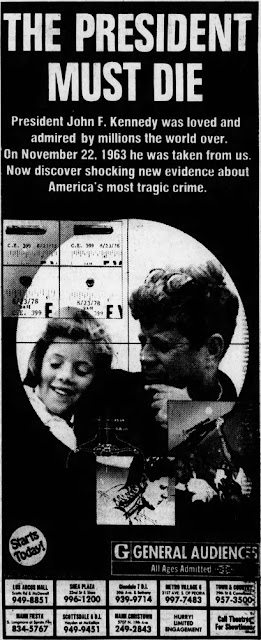
In the February 2-3 issue of Parade, an article, “Making Movies the Computer Way,” was published. In it, this film is discussed:

“Once the most popular ideas are collated, Sunn’s research teams are sent out again. This time, the man on the street is asked to help flesh out the concepts. Take, for example, the research conducted for The President Must Die, a docu-drama on the assassination of John F. Kennedy.

“After feeding our data into the computer,” explains screenwriter Brian Russell, “we went with the conspiracy theory – the premise that was closest to what the majority believed.” What if the computer had pinned the blame solely on Oswald? “We would have gone with that angle instead,” Russell says. “We’re interested in drama, not politics.”

(This appeared on Temple of Schlock.)

We all know the Magic Bullet Theory now, probably by heart. But to see a much younger Cyril Wecht discuss it in detail is incredible. What did people in 1981 even think? I mean, what did I think the multiple times I saw Wecht speak live, where he would gather four audience members, create the seating arrangements of Kennedy’s death car (which is now in Michigan).

This is from a time before when our own President espoused conspiracy theories and gave dog whistles to Q-Anon, using it when it benefited his cause and rapidly disposing of it. We’re to care and not care about conspiracy; today it feels as if it’s transitory and can come and go as easily as the wind. How did the ear grow back? Was the election fixed or wasn’t it? Is Project 2025 real or not? Everything is truth and fiction at the same time; feelings and emotions matter more than evidence.

Here is this documentary from a time past Watergate that recognizes that the innocence of the nation — one that had not yet discovered that the Third Reich studied Jim Crow laws as inspiration — was damaged by the deaths of JFK, RFK, Malcolm X and Martin Luther King, Jr., as well as both Nixon leaving the office and Ford nearly being assassinated twice, once by Manson Family member Lynette “Squeaky” Fromme and the second by a radicalized Sara Jane Moore. Crandall even wonders, aloud, if America can ever find hope again.

In the past, you were a kook for believing that the Warren Commission could lie to you (as an aside, I still hate the line in Bull Durham, “I believe Lee Harvey Oswald acted alone,” but then again, Kevin Costner was also Jim Garrison). You were more sane to believe in the Warren’s Single-Bullet Theory, one that argues that “a single bullet struck Kennedy in the back, exited his throat, and then wounded Governor Connally, who was seated in front of him.”

In James Shelby Downard’s “King-Kill/33: Masonic Symbolism in the Assassination of John F. Kennedy,” the conspiracy theorist (artist?) wrote, “Most Americans are beyond being tired; the revelations have benumbed them.”

Downard claimed, way back thirty years or more ago, “Never allow anyone the luxury of assuming that because the dead and deadening scenery of the American city-of-dreadful-night is so utterly devoid of mystery, so thoroughly flat-footed, sterile and infantile, so burdened with the illusory gloss of ‘baseball-hot dogs-apple-pie-and-Chevrolet’ that it is somehow outside the psycho-sexual domain.” I have lived by those words since I read them, as well as his belief that “Only the repetition of information presented in conjunction with knowledge of this mechanism of Making Manifest of All That is Hidden provides the sort of boldness and will which can demonstrate that we are aware of all the enemies, all the opponents, all the tricks and gadgetry, and yet we are still not dissuaded, that we work for the truth for the sake of the truth. Let the rest take upon themselves and their children the consequences of their actions.”

We work for the truth for the sake of the truth.

I may hide inside movies and explore the archaeology of what was lost, but I dream of what could be. This film reminds me of that.

This was an interesting movie to watch in the wake of several political and business-based killings this very year. Much like The Killing of America, the questions asked in this movie haven’t been answered. They probably never will be.

But I’ve solved one of my own conspiracies.

I’ve actually got to see this. Thanks, James.
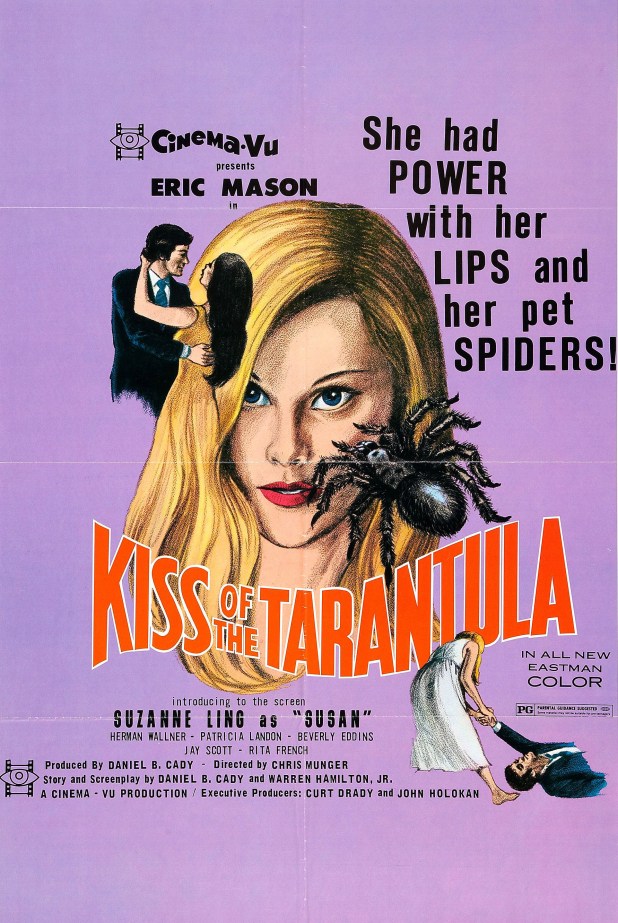
CHILLER THEATER MONTH: Kiss of the Tarantula (1975)

EDITOR’S NOTE: Kiss of the Tarantula was on Chiller Theater on Saturday. November 22, 1980 at 1:00 a.m. and Saturday, August 6, 1983 at 1:00 a.m.

Also known as Death Kisses and Shudder, this gender and species swapped cover version of Willard is all about Susan Bradley, a little girl who can control spiders, which she does to kill her mother — well, she was gonna kill daddy — before taking out anyone else who displeases her. Susan really loves her spiders — to the point that one scene almost suggests that she loves them biblically. Oh 1975, what a magical time you were to be alive.

The big issue is Walter, Susan’s creepy uncle and a dirty cop. He has evidence that his niece has killed at least two people, but he covers it up and even kills to protect her, all so he can get the chance to aardvark with this little arachnophile. Guess what? She’s not a habit of it. Oh yeah — Walter was also sleeping with her mom and helping her plan to murder his own brother. Whew!

You kind of have to love a movie where a little girl kills an entire VW worth of teenagers at the drive-in. This movie checks almost all the boxes for our site: murderous children and animals gone wild. If only there was an acid sequence, a Satanic ritual and George Eastman dressed as a big hairy tarantula.

Writer and producer Daniel Cady would go on from this to write and produce several adult films, such as Soft PlacesReflections and Tomboy under the name William Dancer. He also produced the regional shocker Dream No Evil.m ader Chris Munger would also direct Black Starlet and The Year of the Communes, a documentary narrated by Rod Steiger.

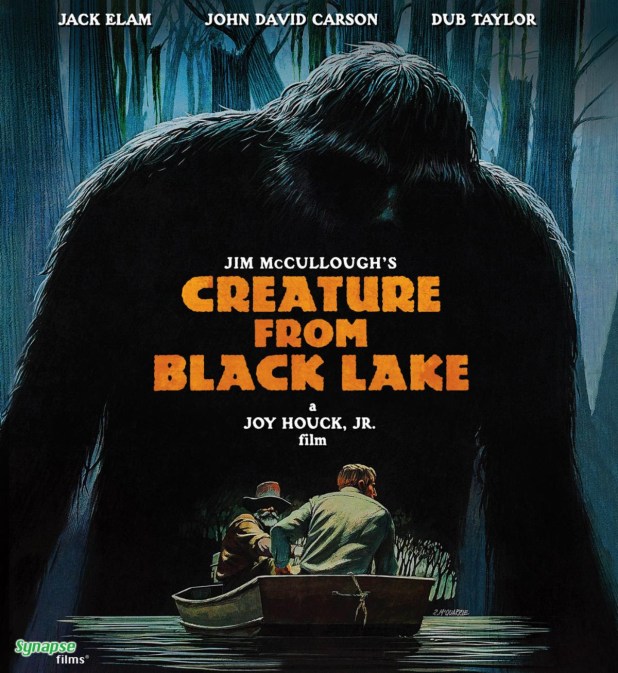
CHILLER THEATER MONTH: Creature from Black Lake (1976)

EDITOR’S NOTE: Creature from Black Lake was on Chiller Theater on Saturday. August 7, 1982 at 1:00 a.m.

If I’ve learned anything from my week of watching Bigfoot movies, it’s that Yankees aren’t wanted in the places where Bigfoot resides. You can also rewrite that sentence to cover that city folks aren’t wanted when Bigfoot decides to walk on through Western Pennsylvania or Southeastern Ohio.

This one is all about two dudes: Rives (John David Carson, Empire of the Ants) and Pahoo (Dennis Fimple, House of 1000 Corpses). That’s right, Pahoo. Dennis Fimple was 36 when he played this young twenty-something just back from ‘Nam and looking for something, anything, maybe even Bigfoot. Rives is more concerned with hamburgers, fries and Cokes. And oh yeah, redhead goddesses. Well, everyone gets what they want in Black Lake.

You get a lot of character actors in here, like Western star Dub Taylor as Grandpa Bridges, Bill Thurman whose career stretches from The Last Picture Show to Mountaintop Motel Massac, re, and Jack Elam, who is the best part of this film as the tracker Joe Canton.

Elam lost an eye to a sharpened pencil at a Boy Scout meeting as a child (he also literally grew up picking cotton) before serving in WW II, becoming a studio accountant and even managing the Bel Air Hotel in LosWorld Warngeles. A character actor in numerous gangster and Western films, as well as TV, Elam came up with a quote that many have stolen over the years in relation to how Hollywood sees people. He said that casting directors about him:

  • Stage 1: “Who is Jack Elam?”
  • Stage 2: “Get me Jack Elam.”
  • Stage 3: “I want a Jack Elam type.”
  • Stage 4: “I want a younger Jack Elam.”
  • Stage 5: “Who is Jack Elam?”

He shows up in some crazy roles, such as Doctor Nikolas Van Helsing in the Cannonball Run films and in The Norseman, Charles B. Pierce’s bonkers ode to Vikings that stars Lee Majors. The film was re-released theatrically in 1982 as part of a multi-film package called “5 Deranged Features.” Also on the bill were Dracula vs. Frankenstein (1971) (under the title They’re Coming to Get You so perhaps people went thinking they were about to see the American cut of All the Colors of the Dark), The Wizard of Gore under the name House of Torture, Shriek of the Mutilated and The Corpse Grinders under the title Night of the Howling Beast.

If you’re up for seeing college students try to get laid while eating burgers and hunting Bigfoot, then this is probably the exact movie you’re looking for.

What this movie really has going for it is cinematography by Dean Cundey (HalloweenThe FogWho Framed Roger Rabbit?, Rock ‘n Roll High School and many, many more great movies). There are some interesting shots, and it’s not your typical dark, swampy seventies affair.

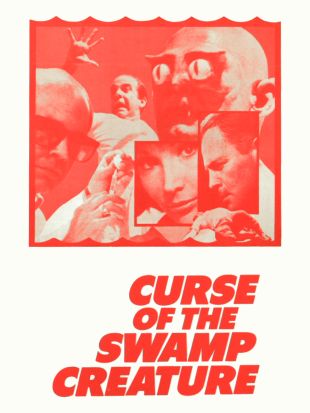
THE IMPORTANT CINEMA CLUB’S SUPER SCARY MOVIE CHALLENGE DAY 13: Curse of the Swamp Creature (1968)

13. A Horror Film That Features a Swamp Creature

Larry Buchanan made a number of low-budget 16mm color remakes of American International Pictures movies for television. Despite the limited budget, he was able to create some truly wild films, including this one, which was inspired by Voodoo Woman.

Dr. Simond Trent (Jeff Alexander) has set up shop deep in the Texas swamps — these are a real thing — and has taken the natives — this is not a thing — for experiments, trying to reverse their evolution.

MOASASOURI – A MONSTER FROM ANOTHER AGE…with terrifying, destructive powers…his victims fight for their lives in a silent, eerie underwater battleground!

Sure, whatever you say!

Every time Trent creates a new creature in his glass fog machine, yelling “Live! Breath!” it never makes it. So then he carries it to his swimming pool full of stock footage and feeds it to the gators, as if Porky Wallace did mad science instead of running a redneck bar.

Frenchy (Roger Ready) and Brenda Simmons (Shirley McLine) join oilman Driscoll West’s (Bill Thurman) expedition in the hopes of making some money for doing nothing. She tries to seduce him, but he turns her down, and one of their thugs, Ritchie (Cal Duggan), kills the rich man. So when geologist Barry Rogers (John Agar) arrives to start the exploring, she explains that she’s Driscoll’s wife, and he’s none the wiser.

Thanks to their guide, Rabbit Simms (Charles McLine), they all end up at the suburban house/mad scientist lab of Trent, whose wife, Pat (Francine York), wants to leave, and the men all treat her like they’re John Ashley in a Blood Island movie. Then, Brenda’s plans go awry, and she is transformed into something else. A green creature that doesn’t look real at all, and therefore makes this movie so much better as a result. She instantly launches Trent into his own gators, then dives in herself, escaping a life as a monster instead of, well, being a monster.

I watched this in the middle of the night, and maybe I wasn’t sober at all, which was the ideal way to watch it. You should feel on the verge of passing out and in another state of consciousness before it starts, then let it wash over you. More monster movies should have body paint instead of latex suits or complicated CGI.

Buchanan would take Invasion of the Saucer Men and make The Eye CreaturesDay the World Ended  as In the Year 2889It Conquered the World as Zontar The Thing from Venus and The She-Creature as Creature of Destruction. Of this movie, he said, “Never make a swamp picture. Your film comes back and it’s all…strange”.

You can watch this on Tubi.

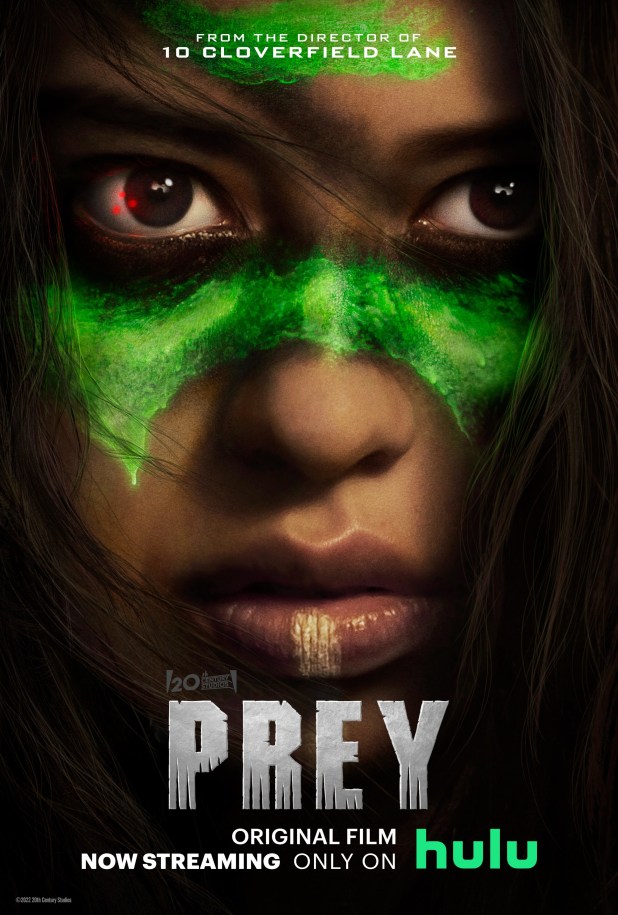
2025 Scarecrow Psychotronic Challenge Day 13: Prey (2022)

13. HOLLYWOODLAND BACK: Made by an indigenous filmmaker or has featured indigenous cast members.

How is this movie, directed by Dan Trachtenberg and written by Patrick Aison, the best Predator in, well, maybe ever?

The Comanche Naru (Amber Midthunder, a citizen of the Fort Peck Assiniboine and Sioux Tribe) dreams of being a warrior like her brother Taabe (Dakota Beavers). She’s a healer, and the tribe would be upset to know she’s tracking deer to improve her hunting skills. That night, she sees strange lights in the sky, just as she’s called to service, as a member of the tribe has been attacked by a cougar. In her head, she wishes she were at the party sent to hunt the beast. Soon, she forms a hunting party to fund them and is brave enough to face off with the cougar, which knocks her out. Her brother hunts it and comes back with it as a trophy.

Those lights bother our heroine, so she heads out with her dog, Saril. When her grandmother hears of whatever is out there, she believes it is Mupitsi, the mother owl of her ancestors. Her brother is taken by French traders, whose translator Captain Raphael Adolini (Bennett Taylor) is the last to be killed by the Predator (Dane DiLiegro) that is waiting in the woods.

Yes, the same Anolini whose name is on the pistol that Mike Harrigan (Danny Glover)has at the end of Predator 2.

What I love most about this movie is that its heroine is just as fierce as any of the men. She’s not a damsel to be rescued; in fact, she is one of the few who has ever bested a Predator. Sorry, I know I should call them Yautja, Hish-Qu-Ten or Skin Thieves.

Plus, it has roles for indigenous peoples like Michelle Thrush (Canadian Aborigine), Julian Black Antelope (Cree and Métis by birth, adopted by the Kainai Nation), Stormee Kip, Harlan Blayne Kytwayhat (Cree), Stefany Mathias (Squamish Nation), Skye Pelletier, Ginger Cattleman, Samiyah Crowfoot, Seanna Eggtail and Samuel Marty (Plains Cree and Nakota Stoney). According to IMDB, “The script was rewritten by two Comanche activists to ensure its depiction of Comanche culture wasn’t inaccurate or stereotypical, and the movie was praised for the results of their efforts. Among their changes, they insisted on giving every character (Comanche and French) a name in their language, even if it wasn’t stated onscreen.”

Plus, Billy Sole from Predator is a reincarnation of Taabe, and in that film, he is “reframing his last stand with that film’s Predator as being due to subconscious memories of a past life.” Trachtenburg said that as a kid, he was told that in the original, Billy “stood on a bridge over a waterfall and fought the Predator. But when I eventually saw the movie, that scene was not in it. The beginning of it is, but then it cuts away. So the seed was planted, and then I thought, ‘Wouldn’t it be awesome to have a movie that focuses on that character’s story?’ And Prey isn’t exactly that, but it is, spiritually.”

I just read a review of this on IMD, B and it said, “Not bad, except for the teeny bopper stuff.”Yes, men, sometimes you have to watch women as the hero of your movie. That said, “Naru would have an easier time proving herself before her peers as women warriors, being among the various Great Plains Nations was actually very common and would sometimes even lead other warriors into battle.”

UNSUNG HORRORS HORROR GIVES BACK 2025: Moebius (2013)

Each October, the Unsung Horrors podcast does a month of themed movies. This year, they will once again be setting up a fundraiser to benefit Best Friends, which works to save the lives of cats and dogs across America, giving pets second chances and providing them with happy homes.

Today’s theme: South Korea

Directed and written by Kim Ki-duk, Moebius has no words, using only vocables like “uh-huh” and “hmm” for character communication. Want to see me get fancy? It also has no non-diegetic sound except for the beginning and the end.

The mother (Lee Na-ra) is upset that the father (Cho Jae-hyun) has a mistress (also Lee Na-ra), so she tries to castrate him. That fails, so she does the same to their son (Seo Young-joo) and eats his severed beenie weenie. Yes, this happens and quite early.

The father decides to research a penis transplant while also teaching his son all about BDSM. As he has no penis, the son is bullied until he participates in the gang assault of his father’s mistress. As he has no penis, he is found not guilty; he makes his way to the mistress’s work, where they have a threesome with the leader of the gang of bullies. A knife gets involved, another penis gets sliced, and then a truck runs over the gang leader’s wang. The mistress likes the son better without a penis, so when the father gives him his in the transplant, that falls away, just in time for the mother to come home. She wants a sexual relationship with the father, which is impossible, but the son’s penis has a mind of its own and gets erect around the mother. The father tries to castrate his son, then kills himself and his wife. The son responds by shooting off his member, then becoming a holy man.

The scary part of all of this is that Lee Na-ra replaced another actress who was slapped multiple times by director Kim Ki-duk, as well as being forced to be in the assault scene that was much rougher than she thought it would be. Four years after these charges, Kim Ki-duk was accused of sexual molestation of his students and actor Cho Jae-hyun was also charged with multiple accounts of physical assault, sexual assault and rape alongside the director.

I didn’t learn about the crimes until after I saw this; it now stays with me for much different reasons.

You can watch this on Tubi.

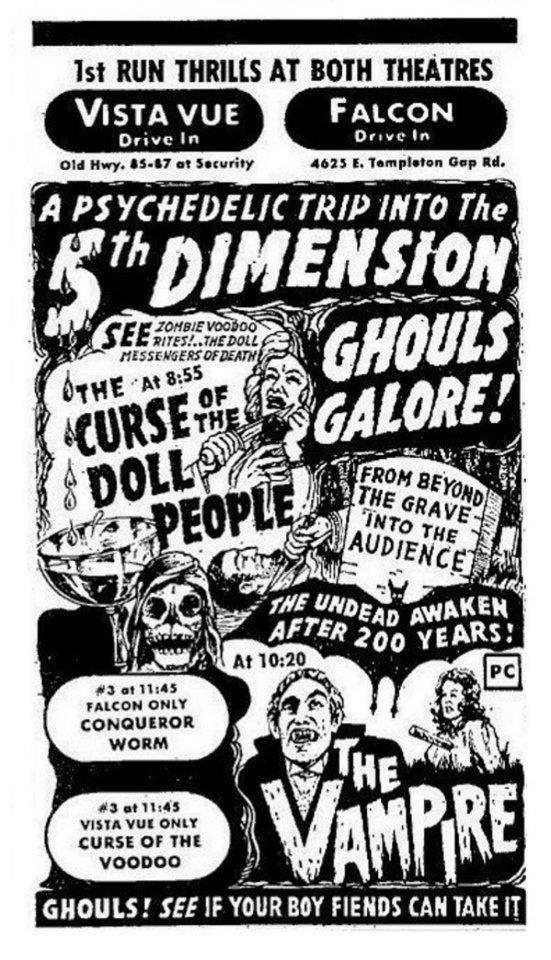
CHILLER THEATER MONTH: Curse of the Doll People (1961)

EDITOR’S NOTE: Curse of the Doll People was on Chiller Theater on Saturday. August 17, 1968 at 1:00 a.m.

Known in Mexico as Munecos Infernales, this movie was directed by Benito Alazraki, who was also behind Santo contra Los Zombies and Espiritismo, both of which were made the same year as this film.

Four men have stolen an idol from a voodoo priest. I don’t have to tell you what a bad idea that is in any country. Soon, evil dolls begin killing their family members years before we even heard of Puppet Master. It’s actually based on the book Burn Witch Burn! by A. Merritt, which has nothing to do with the movie of the same name. That British-American film was initially titled Night of the Eagle and was based on the Fritz Leiber novel “Conjure Wife.”

Speaking of that movie, it had a Paul Frees-narrated prologue in which he read a protective spell for the audience, who were also given further occult defenses via a special pack of salt and the words to an ancient incantation.

This movie has no such assurances.

K. Gordon Murray, who brought The Brainiac and Santa Claus up north, as well as the writer of Shanty Tramp, also brought this movie to America, but not before adding some new scenes.

Ramon Gay, who starred in all of the Aztec Mummy films, is featured. He was one of the brightest lights in Mexican cinema when a dispute over the affections of the actress Evangelina Elizondo ended with her estranged husband shooting Gay dead.

UNSUNG HORRORS HORROR GIVES BACK 2025: I Saw the Devil (2010)

Each October, the Unsung Horrors podcast does a month of themed movies. This year, they will once again be setting up a fundraiser to benefit Best Friends, which works to save the lives of cats and dogs across America, giving pets second chances and providing them with happy homes.

Today’s theme: South Korea!

About the Author: Parker Simpson is a writer and podcaster focusing on cult films and their social impacts. They currently cohost Where Is My Mind, a podcast focusing on underappreciated films from a variety of genres and countries. They have also held panels, chartered local organizations, and written articles to their blog. When not writing or studying, they like to spend time with their pets and go outside. Check out the podcast Linktree and blog.

I remember watching a trailer for this a few months ago and thinking the serial killer was the aggressor the entire movie. I was wrong.

Anger is an addiction. When someone gets mad, they want to stay mad, even when they tire of it and destroy the lives of others. This can be as small as a petty friend drama, or as large as a full-scale revenge plot. The rampage is unable to be stopped until the person is, at least before wrath consumes them whole.

If you take anything away from 2010’s I Saw The Devil, that may be the smallest and least sensitive reading you could possibly get. Focusing on an intelligence agent’s quest to hunt down the serial killer that murdered his wife, both parties end up in a cat-and-mouse game that affects everyone around them.

The most talked about aspect of the film is its gratuitous violence. This film never lets up its attack, nearly desensitizing the audience until the very final shot, falling into the same vein as other Korean revenge films like Oldboy and Mother. Clocking in at over 140 minutes, it is an endurance test to get through certain scenes involving torture, mutilation, and murder in between lengthy bits centering around character disposition. Some call it torture porn, graphic and tiring; not to sound like the edgelord in the room, but that could be the point. In one’s conquest to exact revenge, you will eventually find the journey for such satisfaction tedious and uninspiring. You may forget what you were even fighting for. Does that mean it’s worth it to go on? I Saw The Devil doesn’t make a particularly compelling argument, showing both parties devolving into insanity and unsavory sadism in a world where there is no good or evil, just wrath, envy, lust, and all of the other sins. 

This point seems to go over many heads amidst the rampant violence against women and lagging pace, not that I don’t disagree; I have yet to see the rest of Kim Jee-woon’s filmography, but many online are quick to point out very few of his films have a favorable view of women. From this one film, it’s important to note the only female characters are shown as helpless, either mourning the death of Kim Soo-hyeon’s wife, Joo-Yeon, or becoming a victim of sexual assault. It fits the killer’s motif, yes, but it’s tiring and even degrading. It makes you wonder what could have been done differently, given the fascinating take on revenge.

I Saw The Devil’s strongest aspect is its visuals. The opening sequence with Joo-Yeon is one of the best cold openings I’ve seen in a long time; the second you see the glimmer in the “Good Samaritan’s” otherwise black eyes, you know what you’re in for: something creepy and unforgiving. Its immaculate cinematography is complemented by a sickly color palette that is simultaneously pale, harsh, and dark. Pretend all the violence was off-screen; you would still walk away feeling nauseous.

Additionally, the performances by the two leads, Lee Byung-hun and Choi Min-sik are mesmerizing, perfectly capturing two psychopaths in a sick loop, hell bent on destroying each other. I see that the former is involved in Squid Game and KPop Demon Hunters – not the plot twist I expected to see after I watched him make the world’s worst Rube Goldberg contraption. Despite both their sorrows and pains, neither express any regret of continuing their little game. And that may be the biggest tragedy of all.

I strongly recommend this to anyone who has seen Oldboy, Lady Vengeance, and Mother, yet somehow not seen this. And if you have not seen any of those titles, this isn’t a bad place to start – just be warned: it’s an intense, polarizing ride that leaves you sick to your stomach.

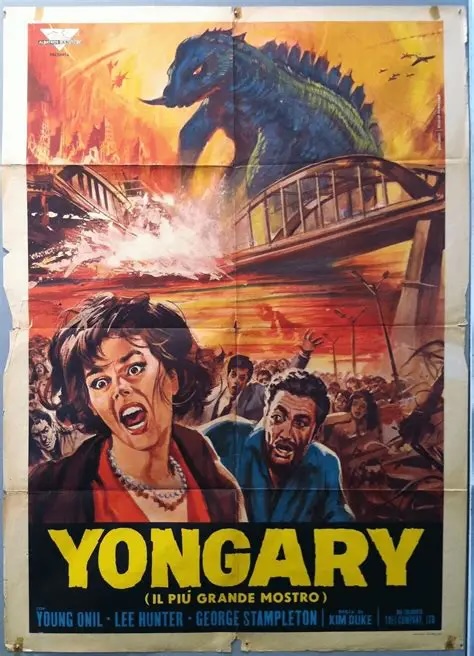
UNSUNG HORRORS HORROR GIVES BACK 2025: Yongary (1967)

Each October, the Unsung Horrors podcast does a month of themed movies. This year, they will once again be setting up a fundraiser to benefit Best Friends, which works to save the lives of cats and dogs across America, giving pets second chances and providing them with happy homes.

ABOUT THE AUTHOR: Adam Hursey is a pharmacist specializing in health informatics by day, but his true passion is cinema. His current favorite films are Back to the FutureStop Making Sense, and In the Mood for Love. He has written articles for Film East and The Physical Media Advocate, primarily examining older films through the lens of contemporary perspectives. He is usually found on Letterboxd, where he mainly writes about horror and exploitation films. You can follow him on Letterboxd or Instagram at ashursey.

Today’s theme: South Korea!

Filmgoers of Korea: We want Godzilla!

Director Kim Kee-duk: We have Godzilla at home!

Godzilla at home:


When I am making my list of films to watch for challenges, I keep several factors in mind. First and foremost, do I have access to the film I want to watch? There is nothing worse than getting excited about watching a movie, only to discover that it is not readily available anywhere. Next, how long is the movie? For example, I really loved The Wailing (a film that would fit into this category), but I do not have 156 minutes to devote to it in October. I have to get through too many films. Third, you want your list to have a nice variety about it. You don’t want 31 slashers. You need some diversity.

Yongary, Monster from the Deep checks all of the necessary boxes. I own the Vinegar Syndrome 4K (a 4K?) thanks to being a subscriber (a membership I question more and more each year). The film is only 79 minutes long, a blessing. And I can say I threw a kaiju on my list. 

Does the movie have to be good? No. Do I have to like every movie on my list? Absolutely not. Am I glad I watched Yongary? Let’s just say that this 4K is going on my sale pile. 

The film has its charms for sure. If you love seeing a guy in a rubber suit stomping around a set of miniatures, this is the film for you. If you want to see a monster dance with a precocious little kid, you are in luck. If you want to see a kaiju die by bleeding out of the rectum into a large body of water, no kink shaming here. But for me, this film will fall into that rare category of a film I did not really care for, would not watch again, but will probably never forget. Especially that last part.

CHILLER THEATER MONTH: The Witch’s Mirror (1960)

EDITOR’S NOTE: The Witch’s Mirror was on Chiller Theater on Saturday. January 13, 1968 at 1:00 a.m.

The Witch’s Mirror is why I love 1960s Mexican horror. Some movies of that era only hint at witchcraft and the occult, and this one goes all in, showing rituals and all manner of Satanic mayhem. Ah, Mexico. Long may your movies live on.

It’s directed by Chano Urueta, who also made the confoundingly wonderful El Baron del Terror and the Blue Demon films.

If you’re going to steal, I always say to steal big. Chanto draws from numerous sources here — Edgar Allen Poe, Hitchcock’s RebeccaEyes Without a Face — while somehow synthesizing them into his own unique narrative.

Deborah (Rosita Arenas, distinct from the Aztec Mummy movies) is the new wife of Dr. Eduardo Ramos (Armando Calvo), but she has no idea that years ago, he poisoned her. Still, she was the first wife, Elena (Dina de Marco).

The thing is, Elena may be dead, but her spirit will not rest. She calls out to her aunt, a witch named Sara (Isabela Corona), whose spells and incantations place Deborah directly in the path of revenge, starting with her face being burned in a fire.

Luckily — or maybe not — Dr. Ramos ends up being somewhat of a mad scientist, so he starts stealing dead bodies to take their skin and attempt to give his new bride her beauty back.

Somehow, in all of this, the witch comes off the best of all of them. This movie is nightmarish in ways that movies made outside of Mexico just can’t pull off because I get the idea that the filmmakers have one foot in believing that everything in this movie is possible.