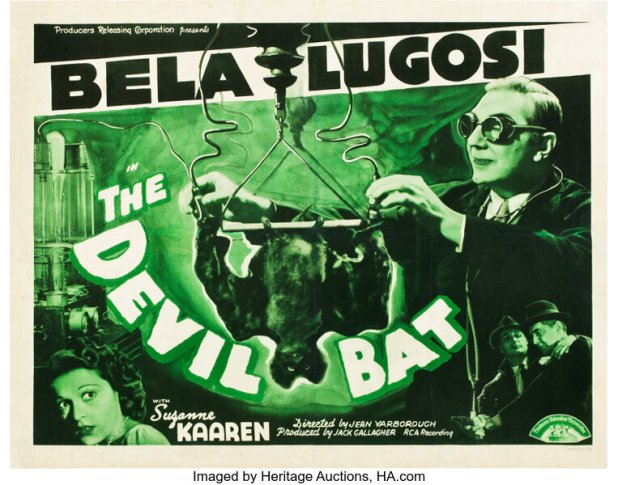
MILL CREEK LEGENDS OF HORROR: The Devil Bat (1940)

The work of Dr. Paul Carruthers (Bela Lugosi) has earned his company millions, and all they give him is $5,000. But didn’t he take a buyout early rather than become a partner? Isn’t that the way corporations work?

So why wouldn’t he grow giant bats and have them kill anyone who wears a new aftershave he’s created? He’s destroying the CEO class —the elite —well, really everyone. He’s got Devil Bats — big, bad rubber bats that scream right at the camera — and he leads the first horror film from the poverty-row Producers Releasing Corporation studio, a movie that played alongside Man Made Monster.

Carrruthers destroys everyone that owned the company other than Mary Heath (Suzanne Kaaren), the daughter, who is saved by Chicago Register reporter Johnny Layton (Dave O’Brien) and the aftershave lotion gets dumped all over Carruthers, his bats attacking their master, following the way that he killed those who held him in chains.

Or maybe not, as he speaks from the shadows in the non-horror sequel, Devil Bat’s Daughter. There was also a 2015 movie, Revenge of the Devil Bat, starring Lynn Lowrey. Another PRC movie, The Flying Serpent, is almost the same movie.

Director Jean Yarbrough’s career spanned the days of television. He also directed one of my favorite movies, Hillbillys In a Haunted House, as well as Footsteps In the NightShe-Wolf of London and The Creeper. Based on a story by John T. Neville, the script was written by George Bricker, who also wrote an early wrestling movie, Bodyhold.

More movies should feature fake bats. I recommend A Lizard In a Woman’s Skin, as man, that bat attack was so good it ended up on the U.S. poster.

You can watch this on Tubi.

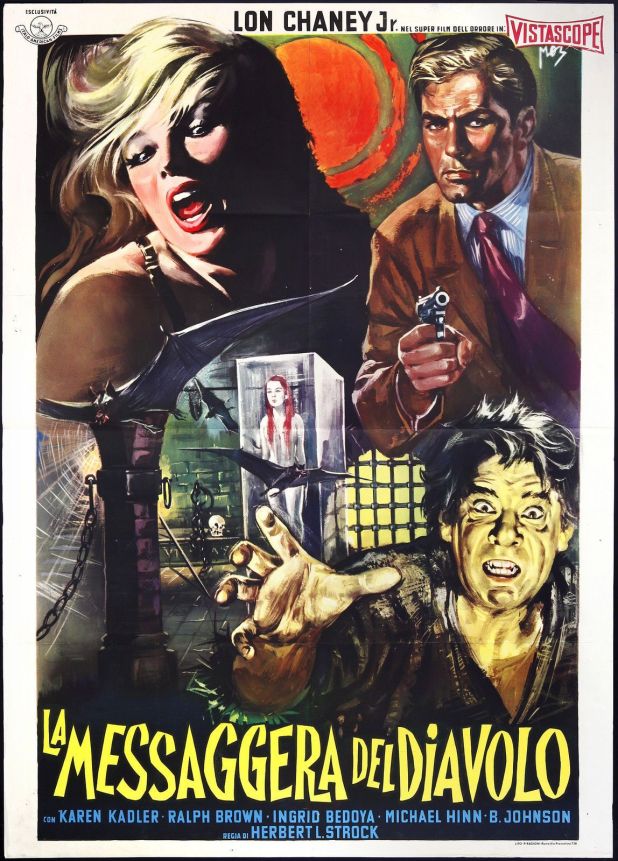
MILL CREEK LEGENDS OF HORROR: The Devil’s Messenger (1961)

I know that Lon Chaney Jr.’s career highlight was being in the Universal monster movies. I realize that the end of his life seems sad — he suffered from throat cancer and heart disease after decades of hard drinking and smoking. In fact, Robert Stack claimed in his autobiography that Chaney and Broderick Crawford were known around the Universal lot as “the monsters” due to how much they drank and raised hell.

Despite living in his father’s shadow, Chaney could be one hell of an actor. After all, he played Lennie Small in the original Of Mice and Men. You get reminded of that when you watch late period Chaney and he has to use his voice and body instead of makeup in films like Spider Baby.

That brings us to The Devil’s Messenger, a 1961 anthology that takes three episodes of the Swedish TV series 13 Demon Street. From the tale of a 50,000-year-old woman trapped in ice bewitching scientists to a man who learns of his death in a dream to a photographer who attacks a woman in teh snow and can’t escape her, these are some pretty decent stories. And oh yeah — there’s a framing device starring Chaney, Karen Kadler and John Crawford that was directed by Herbert L. Strock (I Was a Teenage Frankenstein).

Guess what? Those three Swedish episodes — The Photograph,” “The Girl in the Glacier,” and “Condemned in Crystal” — were directed by Curt Siodmak. Who is that? Oh, only the guy who wrote the original The Wolf ManI Walked with a ZombieSon of Dracula and House of Frankenstein as well as directing Curucu, Beast of the Amazon and The Magnetic Monster.

Look, any movie where Lon Chaney Jr. makes good on Satan’s plot to nuke the world is one I’m going to love.

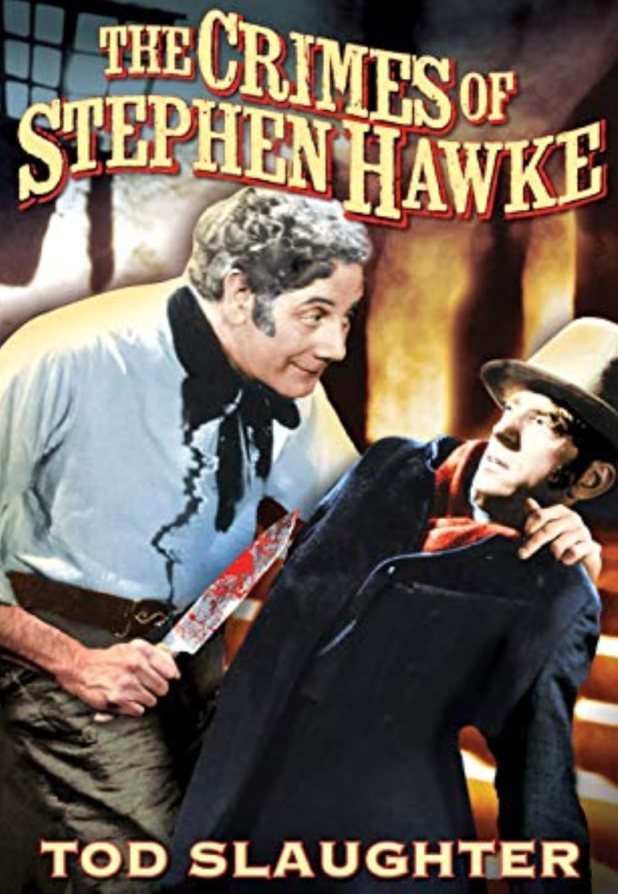
MILL CREEK LEGENDS OF HORROR: The Crimes of Stephen Hawk (1936)

Starting with Todd Slaughter at the BBC, talking about his first two movies (Maria Marten or Murder in the Red Barn and Sweeney Todd: The Demon Barber of Fleet Street), this has him playing Stephen Hawke, a money lender who loves his daughter Julia (Marjorie Taylor). He’s also the Spine-Breaker, a serial killer who is the opposite of his friendly self.

He ends up murdering Joshua Trimble (D J Williams), the father of his daughter’s fiancee Matthew (Eric Portman). Miles Archer (Gerald Barry), another suitor, finds out and tries to blackmail Julia into marrying him instead, so Hawke kills him, but falls off a roof to his death.

It’s a stage play, like Slaughter’s other films, but he’s so strong in this that he can snap a man with his bare hands. Director George King and Slaughter teamed for several of these films, which were encouraged by the British government so that not every movie was made in Hollywood that screened in the UK.

You can watch this on Tubi.

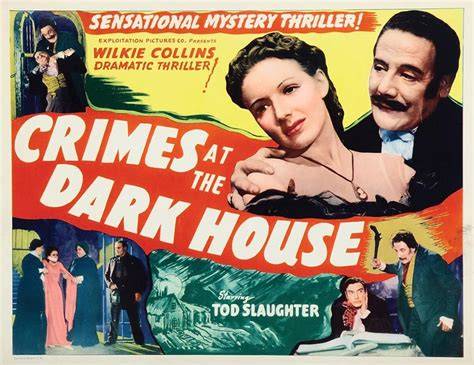
MILL CREEK LEGENDS OF HORROR: Crimes at the Dark House (1940)

Based on The Woman in White by Wilkie Collins, this was directed by George King and written by Edward Dryhurst, Frederick Hayward and H. F. Maltby. It stars Tod Slaughter as a man taking the place of Sir Percival Glyde, trying to take his estate, Blackwater Park. It starts with him hammering a tent stake into the man’s ear and continues to have him murder many people who think that he’s an imposter. Who knew that slashers started in 1940?

Maybe the estate is bankrupt, so despite all the killing that the fake Sir Percival has already done, he has to romance and marry heiress Laurie Fairlie (Sylvia Marriott), then he plans to murder her and replace her with a mental patient who looks just like her.

Slaughter was known as the villain in Victorian stage plays, which were all about him being over the top. He does that here, strangling people, shouting about “beastly germs” when someone sneezes and being haunted by the woman in white. He’s the best.

You can download this from the Internet Archive.

The Heatwave Lasted Four Days (1975)

ABOUT THE AUTHOR: Exploitation-film historian A.C. Nicholas, who has a sketchy background and hails from parts unknown in Western Pennsylvania, was once a drive-in theater projectionist and disk jockey. In addition to being a writer, editor, podcaster, voice-over artist, and sometime actor and stand-up comedian, he’s a regular guest co-host on the streaming Drive-In Asylum Double Feature and panelist on the Deep Images podcast and has made multiple appearances on Making Tarantino: The Podcast. He also contributes to the Drive-In Asylum fanzine, the B & S About Movies Podcast, and the Horror and Sons website. He currently programs a monthly film series, A.C. Nicholas’s Hidden Gems, at the Babylon Kino in Columbia, South Carolina.

“You got peanut butter on my chocolate! You got chocolate in my peanut butter!” Those of us of a certain age remember those famous lines from the TV commercials for Reese’s candy back in the 1970s. Chocolate and peanut butter, a mash-up made in heaven. There’ve been many movie mash-ups over the years, everything from horror comedies like Shaun of the Dead, westerns with horror elements, like Bone Tomahawk, and romance noirs, like the seriously underrated Thief of Hearts. But the craziest mash-up I’ve ever seen is the Canadian film The Heatwave Lasted Four Days.

Let’s get the plot out of the way before discussing this bizarre melding of two disparate genres. Cliff Reynolds, played by Canadian legend Gordon Pinsent (The Rowdyman, The Shipping News, and Away from Her), is a news cameraman working for CFCF-TV in Montreal. He’s a sleazy lothario given to wearing garish shirts with too many buttons unbuttoned and medallions. I guess I shouldn’t be too hard on his wardrobe choices. We all looked like that back in the 70s. Anyway, one day he’s at the beach getting some footage for a story about the heatwave. But more importantly, he uses the assignment to chat up some cute girls in bikinis. Jerry Cuozzo, a local drug dealer with ties to organized crime, played by yet another Canadian legend, Lawrence Dane (Rituals, Scanners, and Happy Birthday to Me), has just escaped from prison. (He apparently climbed over the wall while awaiting trial. Don’t ask.) He’s spending some time at the beach with his main gal, Barbara, the delectable Alexandra Stewart (The Bride Wore Black, The Uncanny, Emanuelle 3, Phobia, and Bolero). And while we’re playing spot-the-Canuck, beloved Al Waxman (King of Kensington, Cagney and Lacey, Death Weekend, The Class of 1984, and Spasms) shows up as Cliff’s boss. Of course he does.

Here we have the fugitive lounging at the beach while his face is plastered all over TV. Why? Don’t ask. Jerry realizes that Cliff has filmed him in the background, so he and Barbara tell Cliff that they’re having an affair and implore him not to use the footage. Cliff says that he won’t. He goes home to his wife and daughter. There we learn, in short order, that it’s his little girl’s birthday, his wife is fed up with his carousing, and they’re in financial trouble. (The film’s short running time means we get some speedy exposition at the expense of giving the wife a name.) As you can probably guess, Cliff figures out that the guy on the beach was Jerry. Now you can ask: Will he try to use this information to solve his money problems and get in over his head? Will the mob try to rub out Jerry? Will there be a deal to move heroin across the border to the Lower 48, eh? Will there be a few twists? And will Cliff try to bed one of the beach babes? Of course you know the answers to those questions.

OK, that’s the basis of a tidy little film with some vintage footage of Montreal and a nice economy of direction from Douglas Jackson, a stalwart of Canadian TV and a 1970 Oscar nominee for Best Live-Action Short. But you’re thinking that my plot synopsis gives no hint of the mash-up. Well, wait no longer. Here’s the solution to the mystery: The Heatwave Lasted Four Days is a neo-noir and educational film. As Scooby-Doo would say, “Huh???”

This film was a weird experiment of the National Film Board of Canada to teach English as a second language to Francophones in Quebec and to do so in an entertaining, commercial way. There were several films in this “Filmglish” series. So if you think about it, it’s a mash-up within a mash-up. Apparently, no one in the film was to speak with a French accent. Indeed, the only French spoken is in a short scene in a Montreal restaurant. The end credits even list a script language adviser. Incroyable! 

The film had a distribution history that was equally weird. In addition to being shown in Canadian classrooms, it was reportedly the first Canadian TV film purchased by a U.S. network, where it was shown twice on ABC’s Wide World of Entertainment. That was the network’s short-lived late-night offering designed to compete with NBC’s The Tonight Show and The CBS Late Movie. Afterward, the film disappeared for decades. But surprisingly, it popped up this past summer in a special edition Blu-ray from Vinegar Syndrome in conjunction with Canadian International Pictures, a company dedicated to preserving everything from “arthouse to Canuxploitation.” And what an edition it is, with three versions of the film: the 66-minute broadcast version, an extended 72-minute cut, and the classroom Filmglish version in four parts with added recaps and interstitials that run a total of 80 minutes. You also get audio commentary from the great TV-movie historian Amanda Reyes, along with a short comparing the three versions, two shorts and another TV film from director Douglas Jackson, a press gallery, and a poster. That’s a luxurious presentation for a film that until yesterday, I didn’t know existed. Tres incroyable!

If you want to be the geekiest film geek in your circle of film-geek friends, you could dress like they did in Montreal circa 1975, or you could just check out The Heatwave Lasted Four Days. While not a masterpiece, it’s an amazing curio. Here’s hoping for the release of more Canuck telefilms from our friends at Vinegar Syndrome.

MILL CREEK LEGENDS OF HORROR: Champagne (1928)

Based on an original story by writer and critic Walter C. Mycroft, this was directed by Alfred Hitchcock, who co-wrote it with Eliot Stannard. This is the second comedy that Hitchcock made after The Farmer’s Wife; he later voiced his unhappiness with the film in François Truffaut’s Hitchcock/Truffaut, saying that the movie had no story. During a press conference for Family Plot, he again said that it was his least favorite movie.

Betty (Betty Balfour) uses a plane to fly to see her boyfriend (Jean Bradin) in France, which upsets her wealthy father (Gordon Harker). She meets a mysterious stranger (Ferdinand von Alten) and breaks up with her boyfriend just as her family loses all their money. But it’s all a lie; the father has hired the man and has tipped off the boyfriend.

Not my favorite Hitchcock, but he would be OK with me saying that.

You can watch this on YouTube.

MILL CREEK LEGENDS OF HORROR: Cataclysm (1980)

Have you ever seen Night Train to Terror and wondered — what would one of that film’s portmanteau sequences be like if they were expanded to an entire movie? Good news! Well, maybe. Your wishes have come true.

The final story of Night Train, “The Case of Claire Hansen”, was really a film called The Nightmare Never Ends (alternatively known as Cataclysm and Satan’s Supper). It boasts three directors. Amazingly, it was written by Philip Yordan, who not only won the Academy Award for Broken Lance in 1954, but also provided a front for blacklisted Hollywood writers (he was Bernard Gordon’s front for The Day of the Triffids)!

This is my favorite kind of movies — a film I discover at 5 a.m. when the rest of the world is asleep, and I wonder if it can really be true and if I am not still asleep. To say that this is a batshit insane film is to do a disservice to the phrase batshit insane. I feel ill-prepared to share its wonder with you, but I’m sure going to try.

Two stories are going on here:

Nobel Prize-winning author James Hansen (Richard Moll of TV’s Night Court and House) and his devoutly Catholic wife Claire (who is a surgeon, which totally comes into play later) decide to go to Vegas to both celebrate James’ new book and to get away from Claire’s nightmares. Wondering what James won the Nobel Prize for? He wrote a book that proved that God is dead. Now, he’s planning a TV special to tell the whole story to the entire world (he’s preaching the bad news!). Well, alright. And that Claire — seems that she’s been dreaming about volcanoes. They decide to go see a magician, who puts Claire into a trance in seconds.

That’s when we learn the real secret of what has been bothering Claire — Nazis! She dreams of a handsome young officer who kills a room of other officers and an all-female string orchestra. After the show, Claire invites him to dinner after he tells her that a demon is after her. He never makes it — he is killed and a 666 tattoo is left on his scalp.

Remember when I said there was a second story?

Mr. Weiss is super old and out of it, but totally recognizes a Nazi when he sees one. Pretty and rich Olivier is being interviewed during the intermission of the New York Ballet, and he looks exactly like the Nazi officer who killed Weiss’ parents at Auschwitz (and he’s also the Nazi from Claire’s dream). Weiss is a Nazi hunter, believe it or not, and he calls in his neighbor, Lieutenant Stern (Cameron Mitchell, who has been in more movies than there have been movies, but let’s call out Blood and Black Lace as one of the best of his films). They go to the ballet and follow Olivier to his extravagant mansion, all the while Stern tries to convince the old man that this cannot be the man who tormented his childhood. Weiss grabs his Luger and goes to kill Olivier, but an unseen demon kills him and leaves a 666 on his body.

Oh yeah, there’s also a homeless priest named Papini who tries to protect James and Claire, even telling her how to kill Olivier.

Numerous characters show up and just die, like Stern’s partner and Claire’s nephew. Even better, there are multiple disco scenes, which feature some wonderfully horrid songs and Olivier seducing Claire’s nephew’s fiancée (so many degrees of separation) until he takes off his shoe to reveal a furry hoof!

As to not skip any exploitation genre — we’ve already had Nazis, tough cops, disco and the occult — Claire goes to visit a black spiritualist who unexpectedly goes off on a rampage, pushing the film toward blaxploitation!  “I am a black man–a (N WORD) in your country. You are a rich woman; I’m sure you have many powerful friends… but they couldn’t help you! You had to seek the help of a (N WORD)!” It’s so insane and doesn’t fit into the movie at all.

Neither does the scene where Papini is killed by Ishtar, Olivier’s assistant (who is only in this one scene). It’s the chance to add some skin to the film and even more blasphemy.

Seriously — this film has blasphemy in spades. If you’re in a metal band that needs samples about religion and the devil, you should totally give this a watch. You’re going to find tons of samples.

Every single actor in this film either reads their lines in monotone or screams them as loudly as possible — sometimes within the same sentence. The lone exceptions are Richard Moll, who is the best actor here and Mitchell, who is the gruffest cop of all time.

Nearly everyone in this movie (and the related Night Train to Terror) was also involved in another film that destroyed my brain cells, Cry Wilderness, which was featured on the latest season of Mystery Science Theater. A Bigfoot meets E.T. epic of pure maniacal weirdness, it was also written by Yordan and was directed by Jay Schlossberg-Cohen, who created the wraparound story for Night Train to Terror. Seems that Visto International Inc., a small theatrical motion picture production and distribution company, produced these films in the early 80s, a magical era of cheaply made independent films. Plus, both films (or all three, if we can cross over between Night TrainNightmare and Wildernessfeature the acting skills, if you will, of Tony Giorgio, Maurice Grandmaison and Faith Clift.

Let me see if I can summarize the ending of this — after Oliver kills everyone else, Claire hits him with her car. She throws the body in the trunk and takes him to surgery, where she and her nephew’s girlfriend give him open heart surgery, complete with blood spraying and puking. Oh yeah, there’s also stabbing and slapping and screaming. And the bad guy wins!

Holy fuck — this is certainly a slice of cinematic goofball awesome that I won’t soon forget. Make no mistake — it’s a horrible film. But at the same time, it’s also a great one!

You can watch this on Tubi.
MILL CREEK LEGENDS OF HORROR: Bowery at Midnight (1942)

Criminology professor Brenner (Bela Lugosi) is also Karl Wagner and in addition to teaching, he also runs the Bowery Friendly Mission, where he feeds the unhoused but is also getting new members of his criminal army, which includes Doc Brooks (Lew Kelly), an alcoholic drug addict who knows how to make zombies.

Sure, alright.

Somehow, Bela’s character is able to do all of that and be a happily married man and he’s not exhausted by all of that. I mean, I’m tired just typing that out.

Meanwhile, Richard Dennison (John Archer) gets involved as his girlfriend Judy (Wanda McKay) works in the soup kitchen. He also gets killed, brought back as a zombie and somehow ends this film feeling perfectly fine. You know, he got better. He’s also a student of Brenner, so coincidences are everywhere in this.

Zombies in the basement are effective at eliminating corpses. That’s the lesson from this movie. Monogram is pretty great because their movies exist in the universe of their films, as East End Kids and The Corpse Vanishes posters are visible.

You can watch this on Tubi.

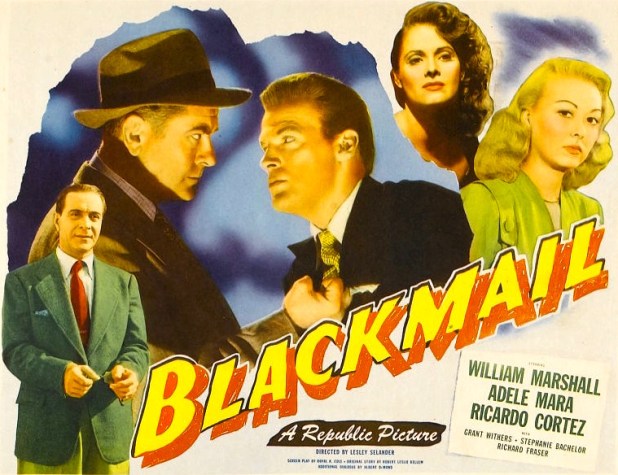
MILL CREEK LEGENDS OF HORROR: Blackmail (1947)

Detective Dan Turner (William Marshall) has been hired by movie exec  Ziggy Cranston (Ricardo Cortez) to stop a blackmail plot against him by Carla (Stephanie Bachelor), who has photos of him but is soon murdered. He’s also being set up by some mobsters. 

Based on Dan Turner, Hollywood Detective, a pulp story that ran in Spicy Detective and Hollywood Detective. This story came from “Stock Shot” by Robert Leslie Bellem, which was in the June 1944 issue of the latter magazine. The character was also played by Marc Singer in The Raven Red Kiss-Off, which was also released as Dan Turner, Hollywood Detective

This is just 67 minutes, which is perfect for a quick film noir. This has a lead that says, “Don’t move, sweetheart, this thing doesn’t shoot marshmallows.” It was directed by Lesley Selander, who did more than fifty episodes of Lassie and ended his career working in Westerns. Writers included Royal K. Cole (who did the Captain AmericaBlackhawkSuperman and Tex Granger movie serials, as well as Valley of the ZombiesThe Tiger Woman and The Monster and the Ape) and Albert DeMond (who wrote The Crimson Ghost and D-Day On Mars). 

MILL CREEK LEGENDS OF HORROR: The Ape Man (1943)

Based on “They Creep in the Dark” by Karl Brown, this William Beaudine-directed, Barney Sarecky-written film stars Bela Lugosi as Dr. James Brewster, a scientist whose experiments have turned him into an ape man. He needs human spinal fluid to transform back to a man again, which as you can imagine, leads to him killing all manner of people when he becomes the ape (Emil Van Horn) version of himself.

By the end, his assistant Dr. Randall (Henry Hall) has been forced to keep injecting the quickly going mad doctor, ending with him breaking what’s left of it in their lab. The ape Randall flips out and strangles him then goes wild killing everyone he can to get that spine juice.

The next year, Monogram released Return of the Ape Man as a sequel to this, even if it has nothing to do with it.

This has the weirdest ending, as the protagonists escape and a man shows up in their car. They ask who he is and he says, “Me? I’m the author of the story! Screwy idea, wasn’t it?”

You can watch this on Tubi.