Ghost (2020)

In this emotionally rewarding, scruffy London-based crime drama, ex-mob thug Tony Ward (the excellent Anthony Mark Streeter) finds himself a free man after a decade-long prison stretch. He soon discovers the incarceration the outside world offers is as difficult as the inside kind when his well-intentioned efforts to reconnect with his estranged wife and now adult son unravels as the temptations of his criminal past catches up with him.

The opening of the film is smartly nuanced—and quite stunning. It opens on black with the sound effect of a roller-slamming gate. Then we see Tony standing outside of a prison. He looks around. You can hear him say, “Now what the fuck do I do?”—without saying it. Meanwhile, his wife and son clean their home and prepare for his arrival. And that’s how the first nine minutes unrolls—without dialog: dialog that’s not needed. And it’s beautiful because this is a film that realizes images and body language speak louder than physical words.

Now, at first mention of a “British crime drama,” your mind calls up Guy Ritchie’s Lock, Stock, and Two Smoking Barrels (1998), Layer Cake (2004), and In Bruges (2008). And if you’re looking for the violence of those films, you’ll be disappointed. Writer-director Anthony Z. James knows we’ve been down this road before and we know hard-ass guys like Tony. This isn’t about the crime caper that put Tony in prison or the crime that’ll put him back in there. It’s not about revenge. Even at their most violent, criminals have families. They experience love. And self-loathing when they disappoint the ones they love. That’s this movie. This is a movie that goes behind the violence.

If the pioneering, independent spirit of John Cassavetes was still with us (he’d be 91 this year), and still spry enough to shoot films, he would have utilized smartphone technology and made Ghost. (Why not: Asian action-stars Leo Fong and Chun-Ku Lu are still making films at the incredible, respective ages of age of 91 and 74.) So keep that in mind, as I know the modestly budgeted tales by Cassavetes that focus on characters and story, shot with handheld cameras, available lighting and spontaneous improvisation isn’t easily digested by a mass audience. (And it’s interesting to point out: Unlike James, Cassavetes was unable to find an American distributor for his debut film, 1960’s Shadows.)

I have to admit that, at first, the concept of making movies via smartphones didn’t sound too promising. I’ve worked on my share of shorts as an actor where my directors couldn’t even handle professional cameras and editing suites with aplomb (or finish their masterpieces 50 percent of the time), so the use of phones and MacBooks to make movies sounded like amateur hour.

Then James Cullen Bressack proved us all wrong with 2013’s To Jennifer: the first commercially released film shot and edited entirely on an iPhone 5. Then Steven Soderbergh (Erin Brockovich, Ocean’s Eleven, Magic Mike) upped the game with his smartphone-shot feature, 2018’s Unsane.

Since then, Apple has gone through three upgrades and now we have this impressive feature film debut by British filmmaker Anthony Z. James shot on a pair of iPhone 8s and edited on a MacBook Pro equipped with a freeware version of DaVinci Resolve editing software. And if you didn’t tell me Ghost was shot smartphone DIY guerilla-style, I would have thought it was shot “more professionally” via permits, a Canon EOS C200, and Final Cut Pro.

Which just goes to show you: It’s not the technology. It’s not the “cost” of the filmmaking tool. It’s the person behind the technology that creates great film.

And I am glad that Anthony Z. James is the man behind the technology. If he accomplishes this with a minimal crew and budget on smartphones, then what can he do with an $80,000 Red Digital and a seven-figure budget?

Amazing things.

And Ghost is only his beginning.

After a limited theatrical release in the UK this April, Ghost is now available in the U.S on Amazon Prime and Vimeo-On-Demand. You can find more info on the film at ghost-movie.com.

About the Author: You can read the music and film reviews of R.D Francis on Medium and learn more about his work on Facebook. He also writes for B&S About Movies.

Disclaimer: This movie was sent to us by its PR company. As always: you know that has no bearing on our review of the film.

The In-Between (2020)

“Please don’t make this another metaphor for your body.
“If the clothes fit. . . .”
— Mads and Junior

What do you get when you take a 65-page screenplay written over a weekend that’s tossed into a car (okay, two cars) with four people traveling 4500 miles for 14 days from Los Angeles to Las Vegas to South Dakota to Portland?

You get the instantly engaging industry calling card The In-Between, an indie road movie that, we hope, will do for the multitalented Mindy Bledsoe what She’s Gotta Have It, Clerks, and Flywheel did for Spike Lee, Kevin Smith, and Alex Kendrick.

Now, before you’re turned off by the “road movie” aspect of The In-Between, take note: this isn’t a Melissa McCarthy or Tim Allen slapstick comedy rife with oddball characters. And if you’re in the market for a Todd Phillips road comedy, keep on truckin’—and zip right on by the Judd Apatow comedy exit.

A film, at its core, should entertain. And the films by those A-List La-La Landers, in their own way, certainly do. And The In-Between definitely does. However, at its best, a film should give the viewer a new perspective on the lives of others. And most films—a lot of films—don’t. Why? Because they’re product made to fill seats; they’re not personal. The In-Between is that personal film. It’s the one that shakes the viewer out their little I-Me-Mine world. For Bledsoe’s film possesses a depth and warmth that Jennifer Aniston’s corporate chronic pain romp, 2014’s Cake, lacked. Aniston researched and acted (for Oscar gold). Bledsoe, as well as her co-writer and co-star, Jennifer Stone, live it—everyday.

While The In-Between is a brave journey into the world of everyday people dealing with their “invisible chronic illness”—the illness, takes a back seat courtesy of an intelligent screenplay (filled with natural, realistic dialog). Most of us never think twice of eating a pizza; a person with Type 1 diabetes, does (which afflicts actress Jennifer Stone). Washing our hands is a pain-free experience; not for a person with Complex Regional Pain Syndrome Type 2 (which afflicts Mindy Bledsoe). The monitors. The needles. The compression sleeves. The pills. The schedules. It’s those we-take-for-granted moments that provide an insight to the lives of Mads (Jennifer Stone, of Disney Channel’s The Wizards of Waverly Place) and Junior (writer, director, producer Mindy Bledsoe) that serve to elevate the script to its true purpose: not as an Oscar violin about dealing with illness, but as an examination on the importance of friendship, and the spiritual and emotional voids a bond of trust between friends, fills.

In addition to its exquisite cinematography, screenwriting, and acting, there’s the soundtrack. In so many films, a soundtrack’s creation is solely for the purposes of mood; most times, the soundtrack is nothing more than a record company’s product placement. In the case of The In-Between, the music serves as a third character that drives the plot and develops the other characters. We come to learn the reason for the cross-country trip is to visit the place where Junior’s musician-sister, Veronica, was killed in a car-crash and caused Junior’s chronic pain. Veronica’s “voice” is beautifully portrayed by the music of the common-bands Super Water Symphony/Hydrogen Child, which plays via car-based CDs and vinyl albums on a portable, battery-powered record player.

Everything about this movies works. And the festival crowds agree. The In-Between recently came off a successful film festival run, where it won multiple awards at the Austin Revolution, Toronto Female Eye, Twister Alley International, and Women Texas film festivals. It’s currently in the market for distribution and we hope it finds a deserving home in the PPV and VOD universe, soon. You can keep up to date with film’s success at its official Facebook page.

You can also visit Louisiana’s Hydrogen Child on Facebook and Twitter, and listen to their music on You Tube.

About the Author: You can read the music and film reviews of R.D Francis on Medium and learn more about his work on Facebook. He also writes for B&S About Movies.

Disclaimer: We discovered this movie via social media, were intrigued by the trailer, and reached out to the filmmakers to provide us with a screener copy.

This Life, I am a flower pot (2018)

If there was ever a film that definitively proves film is a universal art form that defies the roughly 6,500 languages in our world, it is this 38th directing effort from Chun-Ku Lu: This Life, I am a flower pot.

Unknown in the United States, outside of the most discriminating martial arts connoisseur, director Chun-Ku Lu is a respected, major star in China and the Pacific Rim territories with 80-odd combined credits as a writer, actor, and director. He’s best known to U.S audiences for his work during the martial arts heyday of ‘70s cinema for The Black Dragon’s Revenge, along with the popular ‘80s video rentals Bastard Swordsman (1983) and its sequel: Return of the Bastard Swordsman (1984).

After a 20-year retirement from the business in the late ‘90s, Chun-Ku Lu returns with this touching, beautifully-shot drama about a single mother and her portly, young son who leave Taiwan to live in the U.S. The title of this Mandarin language short out of Taiwan is pronounced Zhè bèizi, wǒ shì huā pén, which is also understood as: This world is a small bonsai.

Even without subtitles, this voiceover-related story is easy to digest by understanding the universal symbolism of the art of bonsai: a minimalist approach practiced in Zen Buddhism where one strives for peace, harmony, and balance; a maintaining and ordering of thoughts, so as to remove clutter from one’s life; an art that teaches man—like trees—must fight against the elements of nature (and his unbalanced fellow man).

The voiceover is provided—it seems—by Jimmy, who tells the story of how he and his mother left Taiwan for a better life in the United States. Of course, in their new land, they are “Guizi”: a xenophobic slang in their language to describe a foreigner. Jimmy quickly becomes the target of bullies; his mother is also a “ghost man”: one who lives an invisible existence, in her case, as a janitor, to provide for Jimmy; she can provide him only the simplest of birthdays (in Buddhism the candle represents the aware, enlightened mind). The receipt of a small wooden box—with three gold symbols—for his birthday from a relative in Taiwan becomes the catalyst for the next phase of young Jimmy’s life.

The Canadian cinematographer behind this stunner is Jimmy Wu. Relatively new to the film world, Wu made his debut three years ago with the 2017 Canadian-Chinese language short, The Molecule. He’s since shot seven shorts, served as an Assistant Camera and 2nd Assistant Camera on eight more, produced two, and has also composed music for the 2017 surrealistic, animated comedy, Love Ninja. You can view Wu’s superb reel featuring scenes from those projects on his You Tube page.

The bright lights of Hollywood aren’t far behind for Wu: we’ll be seeing more from him very soon. You can watch his and Chun-Ku Lu’s This Life, I am a flower pot in its entirety on You Tube (also embedded below).

Disclaimer: This movie wasn’t sent to us by its production company or PR department. We discovered the movie all on our own—courtesy of its Chun-Ku Lu connection—and genuinely enjoyed the movie.

About the Author: You can read the music and film reviews of R.D Francis on Medium and learn more about his work on Facebook. He also writes for B&S About Movies.

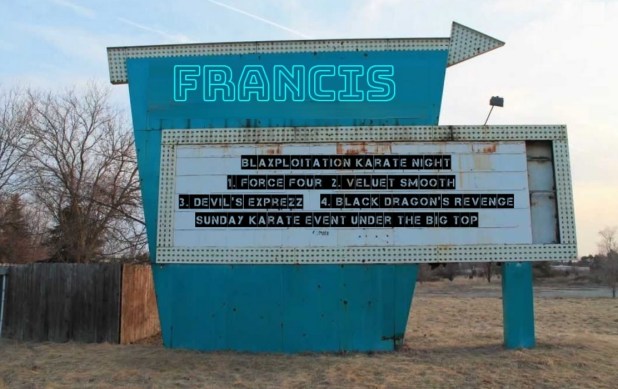
Drive-In Friday: Karate Blaxploitation

If I had a video store, there’d inevitably be a martial arts section. And that section would be next to the Blaxploitation section. And the shelf-transition between those two sections would feature a “Karate Blaxploitation” sub-genre shelf.

Sure, you’d find all the obvious films in there and you’d probably go looking for Black Belt Jones (shot by Kent Wakeford, who worked with Eric Roberts on Power 98; our debut review for “Radio Week” that ran March 15 to 21) or Black Samurai starring Jim Kelly of Enter the Dragon fame. You may even look for Kelly’s Three the Hard Way or Golden Needles.

Sorry. No Swap Shop this Sunday. All day Karate exhibition fights under the Big Top!

But we aren’t throwin’ back to the video ‘80s. This Friday feature is all about the Drive-Ins of the ‘70s. And we need to go deeper than a Jim Kelly theme night for our Friday’s “Karate Blaxploitation” night at B&S About Movies. (Be sure to check out our “Radio Week” review of 1972’s Melinda, which features plenty of karate courtesy of Jim Kelly.)

The two of the films on the schedule star a smooth ass-kicker by the name of Warhawk Tanzania. And after his work in Force Four and Devil’s Express, he vanished into the eastern red sunset. What happened to the man who was born Warren Hawkins? No one knows; is he dead or alive? But the last word was that he was a businessman in residing in Brooklyn, New Work. What we do know is that Tanzania was a practitioner of the “Nisei Goju-Ryu” karate method, a martial art form developed by Hanshi Frank Ruiz, who served as the fight director on both of Tanzania’s films—and one more, as you’ll soon see.

And don’t forget: Junior’s always hungry, so stop by the snack bar.

Movie 1: Force Four (1975)

The tale is a simple one: A jive-cool New York crime lord’s prized African artifact—a mystical voodoo doll—is stolen. And he wants it back. So he hires an all-black squad of martial artists to retrieve it at all costs, because, well, “it can’t fall into the wrong hands.”

The awfulness of this kung-fu battle begins with acting by graduates of the Ed Wood Thespian Academy, and goes downhill from there . . . with inept fight chorography, out-of-sync dubbing, and sound effects more ludicrous than all of the “punches” and “blows” in all Asian Kung-fu flicks combined. Basically, all the things you want in a Drive-In Kung fu marathon. Is this just inept or a homage to the films from the Orient? You decide.

Also known as Black Force, this big screen debut of Tanzania also served as the second and final movie of director Michael Fink, who made his debut with Velvet Smooth. And in a twist only a B&S About Movies reader can appreciate: Fink went on to become an acclaimed visual effects supervisor, choreographing the fight scenes in Stallone’s Tango & Cash and Mel Gibson’s Golden Globe and Oscar-winning Braveheart.

You can watch Force Four for free on TubiTV.

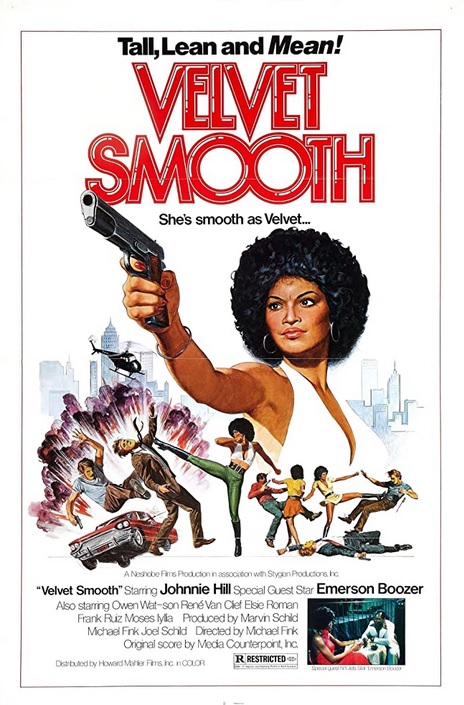
Movie 2: Velvet Smooth (1976)

First, there was the black Kung fu fightin’ babes you know and love: Pam Grier (Jackie Brown) in Coffy, Foxy Brown, and Friday Foster, and Tamara Jones in Cleopatra Jones. But not too many remember Johnnie Hill in her one and only film as Velvet Smooth.

‘Ol Vel is a detective-for-hire contracted by another inner city crime lord, the arrogantly named King Lathrop, who wants to know who’s muscling-in on his turf. Of course, King double crosses Vel, so she brings on the whoop-ass. What did you think was going to happen?

This debut feature by Michael Fink is the second installment of the unofficial “Nisei Goju-Ryu” karate trilogy, since all three films utilize the martial arts form developed by Hanshi Frank Ruiz.

You can watch Velvet Smooth on Daily Motion HERE and HERE or on You Tube.

Intermission!

Back to the Show!

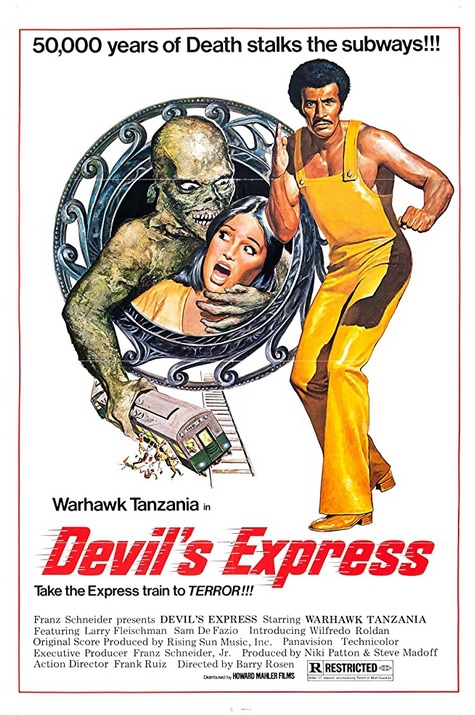
Movie 3: Devil’s Express (1976)

Warhawk Tanzania is back for the final film in the “Nisei Goju-Ryu” trilogy that made the VHS ‘80s rounds as Gang Wars. He’s Luke, a New York martial arts sensei who takes Rodan, his ne’er-do-well, drug-dealing student to China to complete his training. And while exploring an ancient cave, Rodan finds an amulet. And he takes it home. And the demon guardian of the amulet comes to New York retrieve the trinket. And only Tanzania can stop the . . . well, you thought the xenomorphs in the Alien knock-offs of the ’80s were inept. . . .

While director Barry Rosen finished his directing career with his second and final film, the bouncing teen-driven T&A flick The Yum Yum Girls (1976), he went onto produce the highly rated UHF-TV ‘90s syndicated series Highlander and Zorro. (We explore some of those T&A Drive-In flicks with our review of Crown International Pictures’ Van Nuys Blvd.)

You can watch Devil’s Express for free on You Tube. Damn right it so good we reviewed it twice!

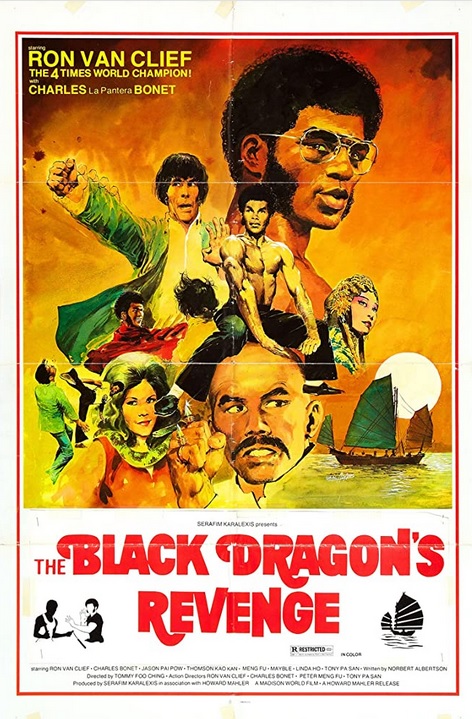
Movie 4: The Black Dragon’s Revenge (1975)

Martial arts legend Ron van Clief received top billing in his fourth film, a tale about three rival karate street gangs (is there any other kind in New York) searching for a lost “finger fighting” manual written by the master himself: the late Bruce Lee. Does Ron sport a fro and sideburns that makes Jim Kelly jealous? You bet!

Unknown in the United States, outside of the most discriminating martial arts connoisseur, director Chun-Ku Lu is a respected, major star in China and the Pacific Rim territories with 80-odd credits as a writer, actor, and director. After retiring from the business in the late ‘90s, he’s back with a new film as a director: 2018’s This Life, I am a flower pot.

And Ron “The Black Dragon” van Clief is still going strong at the age of 77 and is currently filming Snow Black. His most recently released film was 2018’s retro-romp, Hot Lead Hot Fury (trailer; You Tube).

Do Sam and I need to write and direct a Kung fu blowout starring the 91-year old Leo Fong, who currently working on Pact of Vengenance, and Ron van Clief? If only we had the money and the connections . . . if only.

You can watch Black Dragon’s Revenge on You Tube.

What this? An Easter Egg?

We finally got around to one of our Karate Exploitation favorites with Dynamite Brothers (1974) — brought to us by the production team of Al Adamson and producer Cirio H. Santiago. Yeah, we just blew our nut! Uncle Al and Uncle Cy, in one movie? Oh, hell yes and a bag ‘o chips and a supersized Dr. Pepper!

About the Author: You can read the music and film reviews of R.D Francis on Medium and learn more about his work on Facebook.

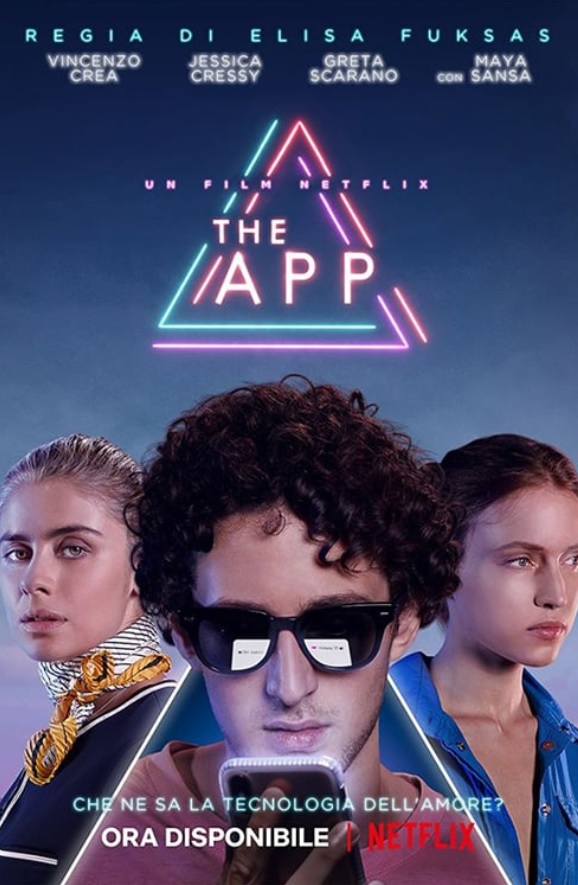
The App (2020)

Algorithm and reality may not end up coinciding.”
— Eva

The App is a relevant-for-the-times techno-noir about loneliness and alienation brought on by one’s addiction to social media. It’s a tale about not trusting another’s digital identity; a philosophical exploration that makes us aware that, regardless of how much one achieves in life, they’ll always be riddled with self-loathing, never finding true happiness in their moments; for man is a creature always pining for something more, something different.

And that “more” comes in the form of the mysterious Maria, a digital femme fatale who takes over young Nick’s life.

Nick Melfi (Vincenzo Crea) is “Italy’s most famous heir” and an up-and-coming Hollywood actor (think actor-oil scion Armie Hammer or actress-sport scion Kate Mara) who defies his father’s wishes to be part of the family’s industrial empire alongside his brother and sister. His father even goes as far as to send the company’s attorney to Rome whilst Nick prepares for his first leading man role.

To fill his loneliness while away on location, and to help his girlfriend, Eva (Jessica Cressy), with her college thesis, Nick agrees to help her test a new dating app. “US, is the future of self,” she tells Nick. “It’s for people already in relationships, but curious.” And they each sign up under the aliases of “Lorenzo” and “Sara.” And you know what they say about “adventure. . . .”

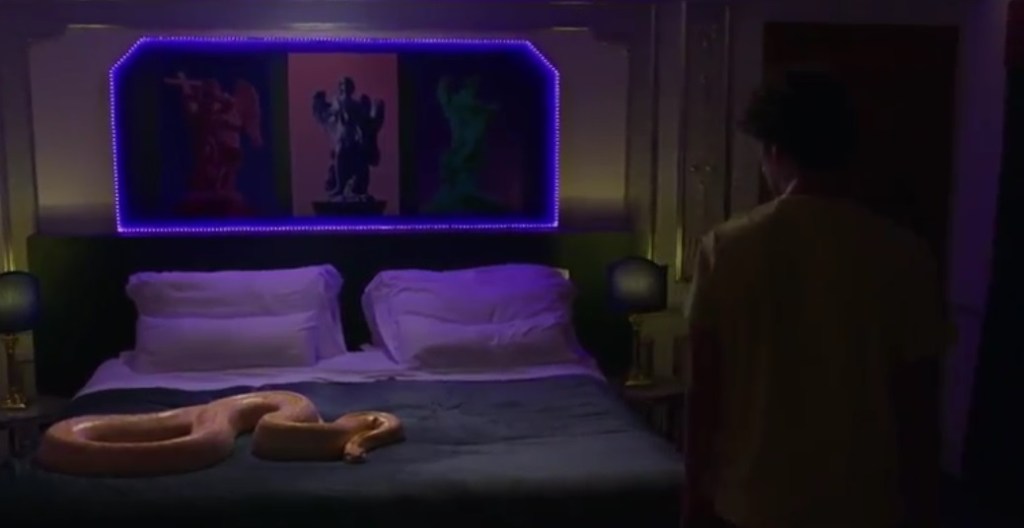
Keep in mind that Nick is portraying Jesus Christ in an Italian production The Life of Jesus (directed by the acting-cameo Abel Ferrara as Paolo; yes, he of the U.K. Section 1 video nasty Driller Killer), and that Eva is Nick’s “Eve,” the phone app is the “apple,” Maria is the “serpent,” and Ofelia, the attractive, Catholic-practicing hotel concierge (Greta Scarano), is “Mary Magdalene.” And that, as Eva reminds Nick, “. . . a lot of actors have gone a little mad playing Jesus.” So Nick has ventured into the isolated, digital wilderness of the New Testament’s parable of the “Temptation of Christ.”

Will Nick experience a reboot-resurrection and be upgraded-reborn in spirit?

As the unconventional narrative of The App streamed (ironically) on my laptop, I was reminded of Italian filmmaker Michelangelo Antonioni’s L’Avventura (1960), La Notte (1961), and L’Eclisse (1962), his trilogy-statement regarding the alienation of man in the modern world; each dealt with the failure of the self and their relationships—his first color film, Il deserto rosso (1964), in particular. As with that film’s Giuliana, writer-director Elisa Fuksas’s Nick desires to end his spiritual conflicts (with his father), and while Giuliana resists her “lover” Corrado’s advances, Nick also resists, then accepts, Maria’s advances. And while Fuksas’s Maria is a cloud-based entity, Nick still makes “love” to her. For, as Antonioni said in the past, “When sexuality fails as a means of communication and provides only physical relief, then Eros is sick.”

And Antonioni was right.

Why do we, as humans, eschew physical contact for technical contact? Why will we stare for hours on end into plasma, but not into the eyes and hearts of the other? Why does one gratify the self by the “idea” of another self—a fantasy? It was Antonioni’s belief that man’s technological development did not cause his alienation, but his failure to adapt to his changing environs caused his neuroses. And here we are today, with man’s current state of illness: an illness caused by our multi-media environs. The new and most dangerous “pandemic” we face isn’t an organic disease, but an inorganic sickness. And the inorganic sickness exacerbates our (current) organic pandemic through rumor and falsehoods. For Antonioni was right: “. . . it is the men who don’t function properly—not the machines.”

Considering writer-director Elisa Fuksas’s father, Massimiliano, is an award-winning Italian architect who oversees the Euro-renown Studio Fuksas with his wife, it seems there’s a biographical element in Elisa’s work: she eschewed the family business for filmmaking. And while Antonioni’s incorporation of modern landscapes in his works shines in Fuksas’s, there’s no doubt her work serves as homage to her father and mother’s architectural influences. Her visually pleasing, mood-driven plotting in The App can be best described as a 21st century meeting of the Baroque/Rococo-infused fantasies of Federico Fellini, the sweeping color palates of Dario Argento, and the neo-noir storytelling of Abel Ferrera (look over Ferrera’s ever-evolving resume; he’s come a long way since Ms. 45).

Elisa Fuksas made her feature film debut in 2013 with the multiple-nominated and award-winning drama, Nina. Based on The App, it’s a film that I’ll seek out as I look forward to her future works. You can watch The App on Netflix in Italian with English subtitles or dubbed into English (the dub is well done).

Disclaimer: We didn’t receive a screener copy of The App from the film’s PA firm or distributor. We discovered this movie all on our own and genuinely loved the film.

About the Author: You can read the music and film reviews of R.D Francis on Medium and learn more about his work on Facebook. He also writes for B&S About Movies.

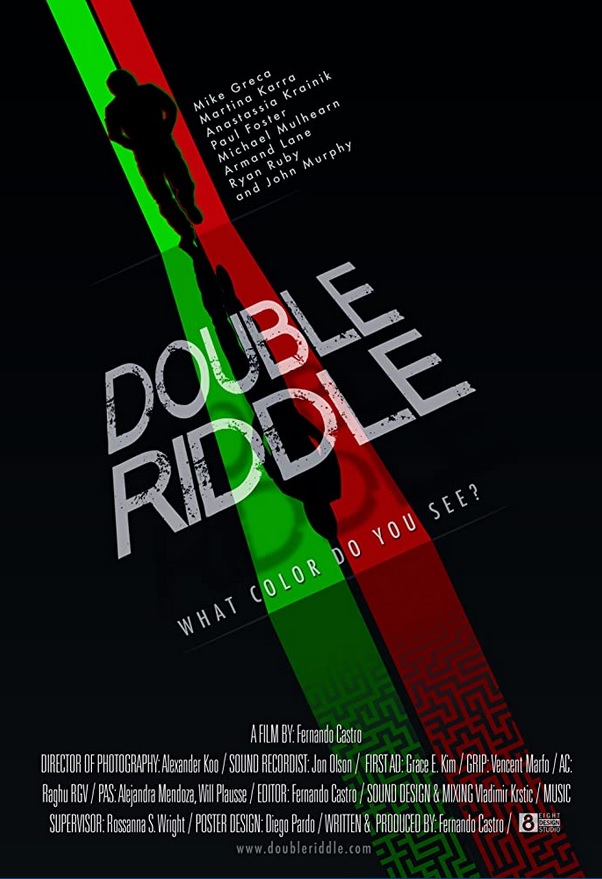
Double Riddle (2020)

“It’s time for your upgrade. It’s not gonna hurt.”
—the Man in Black

Frank, a burnt out architect, quits his job to become a filmmaker and create a star-making role for Sara, his actress-girlfriend. Of course, she leaves him. Or did she? He did fantasize he killed his boss, after all.

Frank’s subsequent web searchers to prepare for his film (e.g., Egyptian hieroglyphs, atomic testing, surveillance) place him on the radar of a dark government project in need of a test subject for their new device—a device that results in his inner demons to physically manifest. Or have they? Is he being followed? Is the mysterious woman he met through a dating app part of the conspiracy? Is she even real? Why can Frank perceive the primary colors of red and green, but not blue?

Ambiguity and interpretation is afoot in this indie writing and directing debut by Fernando Castro Sanguino, which reminds of the low budget sci-fi introductions to the works of Darren Aronofsky with Pi and Shane Carruth with Primer, as well as the late Anthony Anderson’s VHS-obscure, Interface (1984).

Astute film lovers will notice Sanguino’s homages to Bernardo Bertolucci’s Last Tango in Paris and Martin Scorsese’s Taxi Driver in the disillusioned, downward spiral of his trouble architect-cum-filmmaker, along with the ugly-truth revelations of the Coen Brother’s Barton Fink. To classify Double Riddle as a sci-fi version of the Christian Bale-starring The Machinist isn’t far off the mark, either. Personally, I’d go as far as to say Sanguino has crafted a low-budget version of David Cronenberg’s Videodrome—using the internet instead of cable television.

This hour-long experimental film is a debut that fires on all the cylinder-disciplines of writing, directing, cinematography, and acting—and worth the psychological trip. Yeah, this rates alongside and inspires me to re-watch Elisa Fuksas’s really fine The App (2020), as well as Jason Lester’s High Resolution (2019).

After a successful film festival run, Fernando Castro Sanguino released Double Riddle as a free-with-limited-ads stream on Tubi via Indie Rights Movies.

Disclaimer: We didn’t receive a screener copy of Double Riddle from the film’s PA firm or distributor. We discovered this movie all on our own and genuinely enjoyed the film.

About the Author: You can read the music and film reviews of R.D Francis on Medium and learn more about his work on Facebook. He also writes for B&S About Movies.

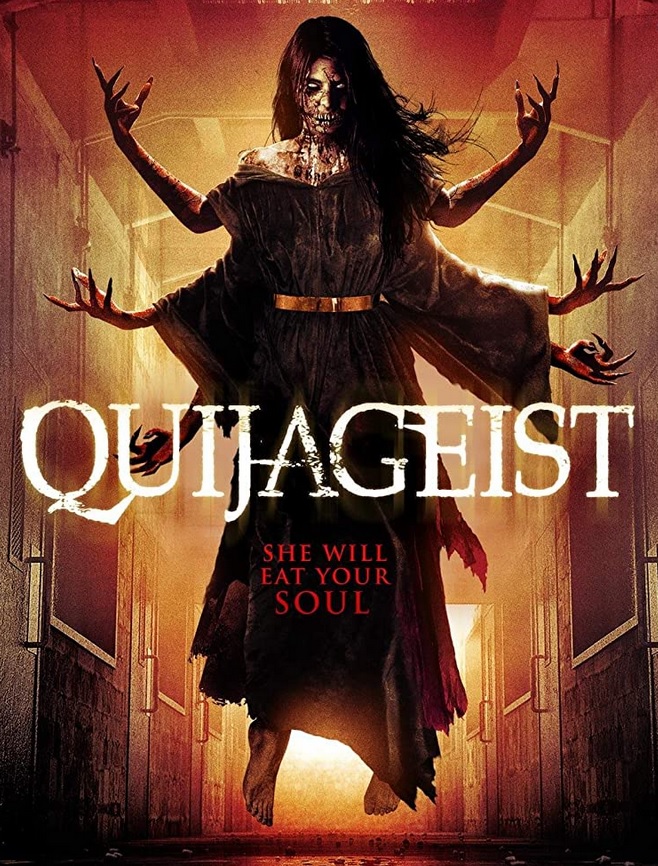
Ouijageist (2020)

While not wholly original, this micro-budgeted, meta pseudo-sequel ended up being an entertaining work that led me to reminisce of the VHS home video days of Charles Band’s Full Moon universe when he’d converge the timelines of his oeuvre (e.g, Dollman from Dollman shows up Dollman vs. Demonic Toys, Dollgirl from Bad Channels shows up in Dollman, etc.).

Look out. I really enjoyed this movie. And in my glee I’m gonna plot-spoil it!

In addition to Mr. Band, this second indie film from writer-director John R. Walker (who debuted with 2015’s fun-to-watch The Amityville Playhouse) also harkens Don Coscarelli’s Phantasm. Now don’t get worked up. I’m not saying Ouijageist is as good as Phantasm: I speak of Walker eschewing the awful CGI effects of today’s low budget horror films for budgetary-but-effective practical (in camera) effects and homage touches. (And Ouijageist’s sometimes too loud to-the-point-of-distraction synth-piano track is no Fred Myrow or Pino Donaggio masterpiece by any means. But Argento always cranked the music on his films, so maybe it’s a Goblin homage?)

And if that celluloid reminiscing doesn’t hook you, perhaps the meta aspect will: John R. Walker returns as “Peter Sommers,” who also appeared in Ghoul (2020), Meathook Massacre 4 (2018), and Amityville: Evil Never Dies (2015) alongside Lesley Scoble, aka Karen Harper, from Walker’s The Amityville Playhouse (2015). And if the meta aspects of the film don’t entice you to hit the big red streaming button, perhaps ye curiosity seekers of classic sci-fi and horror will recognize the name of Lesley Scoble as one of the creepy village children in 1960’s Village of the Damned.

Now, if you haven’t “geist,” this is a tale of an errant witchboard, aka Ouija board, and the malicious spirits it conjures from the beyond via the stupidity of the curious (that’s not an insult to Walker’s writing; all characters in horror films are too curious and dumb for their own good, natch). Like Eddie Murphy pointed out: Why don’t white people just get the fuck out of the house? And why didn’t Tom Selleck burn the painting in Daughters of Satan? Why do Paul Naschy’s warriors of evil in Horror Rises from the Tomb wait until the third act to pull out the ancient amulet? So let’s cut young India a break, okay?

Single mum India (Lois Wilkenson, affable in her acting debut) and her baby daughter Emily have moved out of their cramped apartment into a rental home owned by a friend of her mom Karen (Lesley Scoble). And during the course of moving in, her mischievous dog digs up the ubiquitous box in the backyard (now where have I seen that before?).

Oh, before I forget: Did you know that the board was responsible for a Swiss banker killing six people . . . then disappearing? Well, that’s what you get for not paying attention to the expositional news report. Eh, that’s okay. Neither did India’s friend Becca who, regardless of the word “Witchboard” wood burned into the box’s lid, decides it would be fun to play with the board inside.

Well, that didn’t take long. . . .

Becca’s pushed down the stairs, Emily’s blocks are spelling words, Mungo the dog (Pixie) is seeing things others don’t, Emily’s boiling in the bathtub, Mungo’s been decapitated, a garden hose takes on a serpent-like quality and kills a handyman, a Phantasm-styled creature jumps out of the sink drain, and Emily’s ex Paul does a Bruce Campbell with some pentagram body boils and scares the tea bags off of some coffee house patrons. Yep, the poltershites hittin’ the fan. Nope, Emily’s isn’t swallowed by the TV. But still . . . we better call Rod Steiger. Uh, we can’t. He’s dead. Eh, Father West and Bishop Chapman will have to do. Shite, that didn’t work. Here comes The Evil Dead siege. Does anyone pull a Linda Blair spiderwalk? Nope. (That’s too expensive a homage for the budget.) Does that six-armed Kâli from the cover show up? Nope. (But since when does anything from a horror box’s cover art actually appear in the film? Case in point: there’s no ponytailed, plaid skirted schoolgirl—complete with ax and skull mask—in the frames of One Night in October, either.) Is India accused of three murders? Does she vanish like the Swiss banker? Does her landlord play his cards close to the chest? Check, check, and check (just like a Paul Naschy movie).

Writer-director John R. Walker started out as a background and day player in the late ‘90s on several top-rated British programmes (Hollyoaks, Coronation Street, Emmerdale, Doctor Who) and made what we here at B&S About Movies think is a pretty decent writing and directing debut with one of the better Amityville mocksequels, with the aforementioned The Amityville Playhouse.

While Ouijageist certainly doesn’t live up to its press release claim as a “frightening new supernatural spooker in the tradition of The Conjuring,” it presents genre homages that an Argento and Coscarelli fan like myself appreciates. Walker does a commendable job with his slight budgets and unknown actors, so it will be interesting to see what he comes up with on his currently in-development/productions Blood Bride and the Demons from Hell (great exploitive title), The Great British Massacre, and the oh-so-Italian retro zombie romp, Hell of the Screaming Dead (it’s all about the poster!).

Ouijageist made its U.S debut on DVD and VOD on April 14 via Wide Eye Releasing. You can stream it on Amazon Prime and learn more about the film at its official Facebook page.

About the Author: You can read the music and film reviews of R.D Francis on Medium and learn more about his work on Facebook. He also writes for B&S About Movies.

Disclaimer: This movie was sent to us by its PR department. As always: you know that has nothing to do with our feelings on the movie.

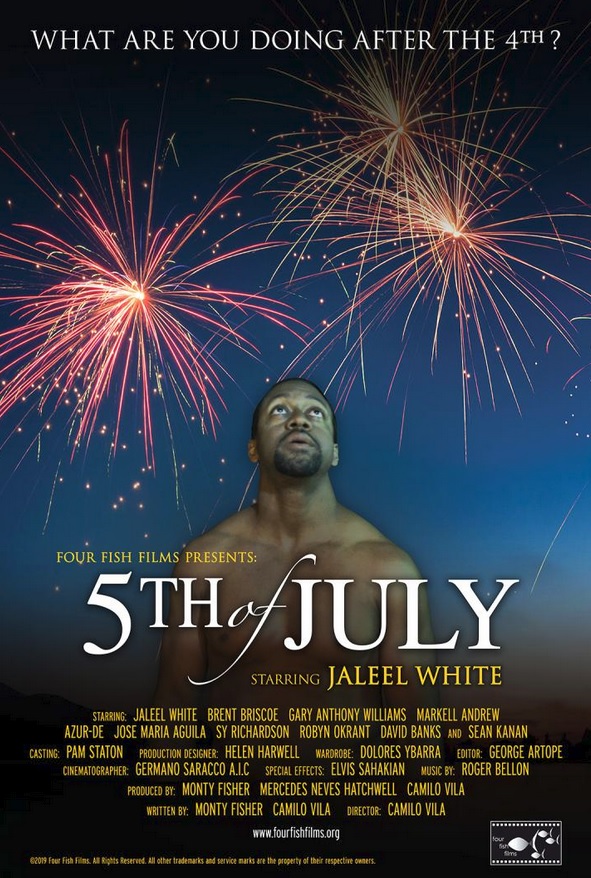
5th of July (2020)

Nothing beats going down a Tubi rabbit hole and discovering a new movie—especially when it’s a slapstick comedy of the roadtrip kind directed by Camilo Vila of the 1988 horror flick The Unholy (starring Ben Cross and Hal Holbrook) and stars an ’80s child sitcom star.

And you know what? It ended up being just as good as any Tim Allen or Melissa McCarthy slapstick road movie with quirky characters (Wild Hogs and Tammy).

Jaleel rocks this movie.

Now I know you’re not expecting much from a slapstick road movie starring Jaleel White. And that’s a shame. I’ve seen the adult White in dramatic roles in reruns of TV’s Castle, CSI: Crime Scene Investigation, and Hawaii Five-O and he’s more than proven he’s brilliantly beat the child actor curse. And say what you will about ’80s TV comedies of the ABC kind, but what Jaleel White did with his star-making role in Family Matters was nothing short of astounding.

White is Orlando Leal, a French literature professor excited to spend the 4th of July weekend with his new girlfriend flying in from Washington, D.C. But before he can make that airport pickup, he has to fulfill his father’s dying wish: spread his ashes across Mosquito Lakes in California’s Sequoia National Park where they spent their previous father-son holidays. And the self-centered Orlando, who always hated the trips, curses his father while dumping the ashes. So his father decides to teach his son a lesson—and curses him from the beyond.

First, Orlando’s robbed of his backpack containing his wallet and keys by a pair of ex-cellmate thieves, Dakota and Cowboy. While trying to get back to San Jose, he’s drugged by a busload of neo-hippies. Then he’s tazed and pepper sprayed by a racist country girl. That leads to his hitching a ride with Mexican mirgrant workers and his having to steal the farm boss’s motorcycle. Then, when Orlando finally makes it home, he discovers his home is cleaned out. And there’s the bumpkin park rangers, the Barney Fife-cops, and clueless credit card company representatives adding merriment to his travels.

Will Orlando reverse his father’s curse in time to pick up the love of his life at the airport, or will he lose her forever?

Lead actors are only as good as their co-stars and Gary Anthony Williams (best remembered by Malcolm in the Middle fans for his role as Abraham “Abe” Kenarban; he got his start with a support role in Radioland Murders, but Star Wars fans know his work in that franchise’s animated universe) and the late Brent Briscoe (“JJ” from NBC-TV’s Parks and Recreation) excel in their roles as the theives Cowboy and Dakota. And no matter how small the role, it’s hard to pass up a movie starring the welcomed face of ‘80s TV actor Sy Richardson from Rudy Ray Moore’s Petey Wheatstraw (along with Bad Dreams, Repo Man, Shattered Illusions, and Sid and Nancy; the list goes on and on) as Orlando’s pop.

This film is worthy of a watch. You’ll enjoy it.

After a succesfull run on the U.S comedy film festival circuit—including a win at the 2019 International Black Film Festival—5th of July makes its debut as a free with-limited-ads stream on TubiTv. You can learn more about film at Four Fish Films.

Disclaimer: We didn’t receive a screener copy of 5th of July from the film’s PA firm or distributor. We discovered this movie all on our own and genuinely enjoyed the film.

About the Author: You can read the music and film reviews of R.D Francis on Medium and learn more about his work on Facebook. He also writes for B&S About Movies.

Nana’s Secret Recipe (2020)

The comedy of NBC-TV’s long-running The Golden Girls meets with the edge of AMC’s Breaking Bad as five friends lose all of their retirement savings in a ponzi scheme—so the “nanas” join forces to open a bakery serving pot-infused desserts. When they learn one of them is secretly battling cancer, their quest for success becomes even more imporant—and attracts the attentions of Kingpin Paint, the local drug dealer.

During the press junkets for the Nana’s Secret Recipe, producer and director and Mehul Shah stated he was searching for a project with strong female characters of a certain age, a fun, zany plot, and larger than life villains. And he certainly found it in this stellar debut script by screenwriter Yolanda Avery, an insightful work that reminds of the female-empowering films Steel Magnolias and The First Wives Club. (You can read this interview by The Blacklist on how Shah and Avery came to work together.)

Not only does Avery’s first time screenwriting effort bring on the laughs, it also questions the importance of friendship and sisterhood, the art of using humor to get through difficult times, and the hard questions about the legalization of medicinal marijuana and how to pick up life’s pieces and move on after the loss of a loved one.

The under-the-radar cast of Linda Bradshaw, Cinda Donovan, Nancy L. Gray, Trish Powell, and Charlotte White are simply amazing. Not only are they each fantastic at their craft, it’s heartwarming to see not only unknown actors, but older unknown actors, being giving such a stellar showcase for their talents. If Nana’s Secret Recipe doesn’t prove to be each of their respective calling cards to the industry . . . then screenwriting guru William Goldman’s insight about Hollywood was right: “Nobody knows anything.”

It is my sincere belief we will see each of them on a network or cable comedy or drama—more sooner than later. And Nana’s Secret Recipe is prime fodder for The Hallmark Channel. Simply put: these actresses and this movie deserves the widest exposure possible.

After a successful film festival run, Nana’s Secret Recipe made its free-with-limited-ads stream this March on TubiTv. It’s an amazing indie film and comes highly recommended. Update: As of May, you can stream the film ad-free via Amazon Prime.

You can learn more about the film on its official Facebook page and the website for Kenetik Films. If you hang out with director Mehul Shah on his You Tube page, you can enjoy a couple of informative film festival Q&A’s with the film’s crew and actors. Also be sure to visit the “real” Nana’s, which was shot at Kellie’s Baking Co. in Austin, Texas.

Disclaimer: We didn’t receive a screener copy of Nana’s Secret Recipe from the film’s PA firm or distributor. We discovered this movie all on our own and genuinely enjoyed the film.

About the Author: You can read the music and film reviews of R.D Francis on Medium and learn more about his work on Facebook. He also writes for B&S About Movies.

Getaway (2020)

I first heard of this indie-budgeted homage to ‘70s drive-in horror films—written and directed by Lane Toran—courtesy of the horror-centric webzine Blood Disgusting back in 2016.

The original theatrical one-sheet.

As a teen, Toran found success as an actor on the WB Network (7th Heaven) and as an animated voice artist for the Disney and Nickelodeon Networks (Hey, Arnold!). As a composer, he wrote “Sweet 16” and “Inner Strength” on Hilary Duff’s triple-platinum first album, Metamorphosis. (For you horror dogs: Duff portrayed Sharon Tate in 2019’s The Haunting of Sharon Tate.) Although I never watched any of Toran’s TV series, I was intrigued to hear a child actor beat the so called “child actor curse” and continued to flourish in the business as an adult—and as a horror film director, no less.

Upon a further Internet-investigation of Getaway, I discovered Toran (born Toran Caudell) is the son of actor-musician Lane Caudell,* the star of two of the coolest rock ‘n’ roll films of my ‘80s UHF-TV and video store youth: Goodbye, Franklin High and Hanging on a Star. Courtesy of his son, Getaway marks the first time Lane Caudell has acted in front of the camera since eschewing the acting world—for a behind-the-scenes success in the country music world—after the 1982-1983 season of the NBC-TV U.S. daytime serial, Days of Our Lives.

The new theatrical one-sheet.

Toran’s wife Jaclyn Bethan (TV’s NCIS: New Orleans, Grand Hotel), who co-wrote the screenplay, stars as Tamara, a roadside damsel-in-distress on the way to meet her two friends at a lakeside cabin getaway. And along comes the usual, questionable down-home fellas to her rescue: Merv (Toran) and Kib (Noah Lowdermilk; excellent in his acting debut). Once the scuzzy duo gases up her late ‘60s classic Mustang (the girls in these flicks always have a set of classic wheels), Tamara meets up with Maddy (Scout Taylor-Compton; Rob Zombie’s Halloween reboots, Abducted, Eternal Code) and Brooke (Landry Allbright; acting debut as “Casey Poe” in Con Air).

So we’ve got booze and bikinis, partying at a backwoods watering hole, chicks kissing, and two rough-looking knights in dirty armor. Yeah, these girls have just entered the hicksploitation** hills; however, while a familiar road, Toran cleverly screws with the compass and sets up forks and potholes in the road.

And one of those twists comes in the form of Lane Caudell (who’s excellent in his acting return). He isn’t the kindly town sheriff or southern gent I was expecting: he’s a backwoods lothario who masturbates to women’s scalps while he prays to the Lord and he’s concocted a Satan’s Cheerleaders-styled religious kidnap cult (Lane made his debut in that 1977 Greydon Clark T&A exploiter).

So once the mickey is slipped at the local bar, Tamara’s waking up under a tarp in the back of a pickup truck: she’s become the latest victim in Pa Caudell’s master plan to kidnap and impregnate women, then kill them, so the girls can birth “angel babies” in heaven. And regardless of the bible thumpin’, the denizens of the hicksploitation woods always enjoy a barn rape ‘n’ torture session before they restock the angel corps.

That is until Tamara cooks up a little supernatural surprise.

Toran’s feature film debut is nicely shot, edited with suspense and displays his confidence and competency as a director who gets the most from is budget. The acting from everyone is solid (again, Lowdermilk and Caudell Sr. shine) in a story that, courtesy of its tight 70-minute runtime, will slide nicely into a SyFy Channel programming block.

Toran was obvious battling the same obstacles all indie filmmakers face—regardless of genre—without the backing of a film studio. Considering the long, four-year road to get his debut film to its inevitable DVD and streaming debut, it was well worth the trip. Toran’s created an outstanding calling card to show the industry he’s arrived as a director. I see more work behind the camera in his future . . . and hope Caudell Sr. does more in front of it. Yes, other reviewers and streamers haven’t been kind, but I enjoyed the film.

You’ll be able to enjoy Getaway courtesy of Uncork’d Entertainment on April 14. And we are digging “Slow Rise Lady,” the grungy-country tune from the Deacons on the film’s closing credits. As of September 2020, Getaway is now available as a free-with-ads stream on TubiTV.

* You can learn more about the life and career of Lane Caudell with the retrospective “Lost Somewhere on the Road between Franklin High and Nashville: The Life and Career of Lane Caudell” on Medium.

** You can learn more about hicksploitation cinema courtesy of our “Top 70 Good Ol’ Boys Film List” retrospective.

Disclaimer: This movie was sent to us by its PR department. As always: you know that has nothing to do with our feelings on the movie.

About the Author: You can read the music and film reviews of R.D Francis on Medium and learn more about his work on Facebook. He also writes for B&S About Movies.