Lately, I’ve noticed that several of my favorite films fit into a very specific genre with no prescribed name. If it had one, it would probably be something like, “coming of age while the supernatural lurks around the corner.”
The best examples of this very unique genre include the Czechoslovakian surrealist film Valerie and Her Week of Wonders, The Lady In White, Lemora: A Child’s Tale of the Supernatural and, while not explicitly otherworldly, movies such as Alice Sweet Alice, Picnic at Hanging Rock and The Little Girl Who Lived Down the Lane. All of these fit this mold in their own ways, with the only modern film I can pick as relevant being The VVitch.
That brings us to the West German film Laurin. A film that has been rarely seen outside its native country — which always lends the lure of the occult to the proceedings — it’s a perfect example of these films.
Laurin is a nine-year-old girl who lives with her grandmother in a quiet Bavarian town. Since the death of her mother — whose relationship with Laurin’s father was primal and lusty, as evidenced by them nearly making love in front of her — and the seafaring disappearances of her father — which increase after her mother’s death — she has retreated into a world of school time drudgery punctuation with moments of sinister make-believe. By night, she finds herself haunted by visions of a dilapidated castle owned by a man in black and his sinister dog, where each window finds a child trapped and clawing at the glass. These waking dreams stand side by side with a true nightmare: her friends and classmates are disappearing, one by one.
I’ve always been struck by how these films apply the supernatural to the worries that accompany the journey from adolescence to adulthood. As one’s body and feelings toward sexuality change, so too does how we see the world. And while the terror of child abduction is very real, to a child, the only form of explanation must be a fairy tale monster.
Laurin is a sumptuous affair, one that contrasts the dreary and washed-out world of adulthood with the kaleidoscopic fantasies of childhood; the kind of dreams that only Mario Bava could properly light, color and frame.
Without revealing the end of this film, the rising sunlight that would often proclaim victory over Satan feels rather hollow. As Martin Mathias, the hero of George Romero’s Martin, would tell us — much further along than adolescence — “There’s no real magic ever.”
I’ve often wondered about the time in my life when I went from having my destiny controlled to being in charge of it myself. The questioning that ensued and the realization that adults didn’t have all the answers are perfectly essayed here. In my experience, horror films remain the most honest of all genres. Despite cloaking our fears in the capes, cowls and fangs of the nosferatu, they hold up a mirror to ourselves. Whether or not you appear in it is up to you, dear reader.
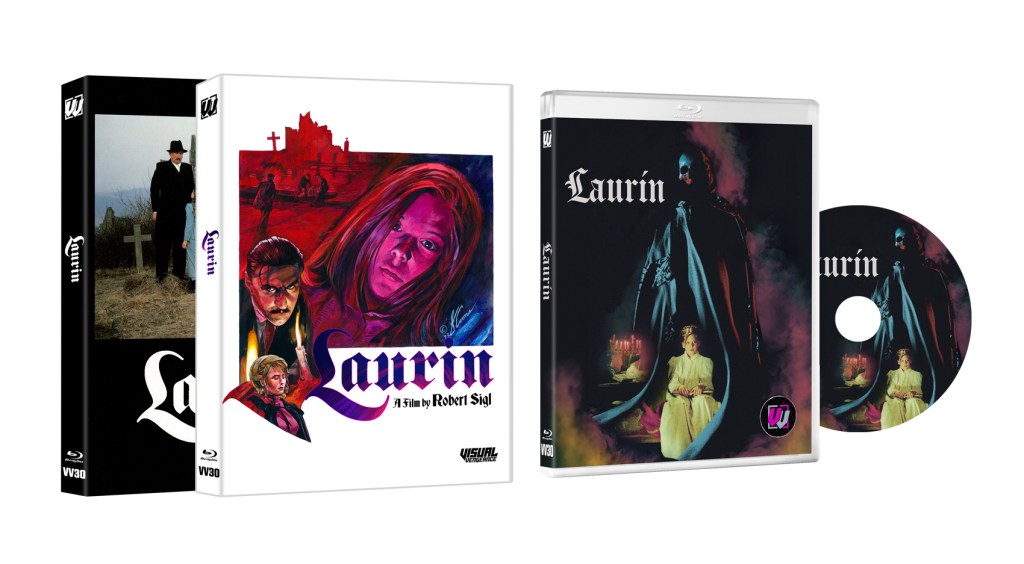
The Visual Vengeance release of Laurin has a director-approved 2K HD transfer from the original 35mm film elements, complete and uncut, in both English- and German-language versions; feature-length audio commentary by film historian Troy Howarth, author of Innocence Lost and Robert Sigl and the Curse of Laurin; updated subtitle translations for the German version assisted by Robert Sigl; the original VHS rough cut of Laurin from Sigl’s private collection, featuring set-recorded audio allowing viewers to hear the actors’ real voices prior to overdubbing, a new interview with Sigl; two shorts, The Christmas Tree and Coronoia 21: It Comes with the Snow; The Making of Laurin archival documentary; interviews with Dóra Szinetár, Barnabás Tóth, cinematographer Nyika Jancsó and film historian Jonathan Rigby; Robert Sigl Bavarian Film Awards Presentation; 8 photo galleries featuring never-before-seen images from Robert Sigl’s personal archives; a collectible folded mini-poster; a blu-ray sleeve featuring original home video art; a 6-page liner notes essay by Tony Strauss of Weng’s Chop magazine; a limited edition mini-postcard set reproduced from German promotional materials; a “Stick Your Own” VHS sticker set; a limited edition O-card by Justin Coons and a trailer. This will be available from MVD and Diabolik DVD.
 B&S About Movies