Rene Bond week (August 11 – 17) Rene Bond could brighten up even the most dreary productions, and she was in plenty of them. In the early adult scene she was one of the better actors, particularly when it came to comedy, though she could squeeze into some leather and throw the whips around when the role called for it. Bond appeared in somewhere near 100 films, thanks to her affable professionalism she worked with many filmmakers multiple times and regularly performed with her boyfriend Ric Lutze. Her career received an enhancement when she became one of the first stars to get a boobjob. She retired from film in the late-70s just as the porno chic era was dying down, but before the video era. You can find her in a ton of SWV titles, so take yer pick!
I know Bernard Girard more for the movies he didn’t finish — he was replaced with Lee H. Katzin on What Ever Happened to Aunt Alice? by producer Robert Aldrich and started the movie We’re All Crazy Now with The Runaways that was completed by director Alan Sacks and released as Du-beat-e-o — but he did actually direct some efforts, including The Rebel Set, This Woman Is Dangerous, The Happiness Cage, The Mad Room, Gone With the West and Dead Heat On a Merry-Go-Round. He also directed and wrote this movie and man, why are people not clamoring for this to get a blu ray release?
John Blake (Robert Culp) is dissatisfied with the rat race and dealing with the pressures of his family’s architecture business. So he takes his wife Joanna (Samantha Eggar) and moves into his great grandfather’s home The Grove in the countryside and you know what happens when city folk go back to their roots in 1970s movies.
Distributed by Cinerama Releasing Corporation — who also released Asylum, Walking Tall, The Vault of Horror, The Mack, And Now the Screaming Starts!, Terror In the Wax Museum, The Harrad Experiment, Your Three Minutes Are Up, Dr. Death: Seeker of Souls, The Pyx, Arnold and Marco all in 1973 — and produced by Penthouse — which will make sense in a little — this starts strange when everyone back home refers to John’s grandfather as The Colonel and many of them want nothing to do with him. Even the man he hires to renovate the house — Clarence “Big” Miller (blues singer Big Miller, who was the title character in Big Meat Eater) — seems to think that The Colonel doesn’t want John there. His wife doesn’t want to be there either, but there are times that it seems that she loves him and others like she might as well be a ghost.
This was shelved by MGM because it made so little sense. It was based on a novel by Andrew Lytle and that book was a definite ghost story. This can’t make up its mind. That voice saying “Go away” also feels the same way. Just when everything feels dreary, John walks out of his house and finds a white horse that brings him to town and soon has him participating in an orgy set to a live performance of Billy Joe Royal singing “Mountain Woman.” Soon, he’s making love to Luanna Baxter (Sheila Sullivan, AKA Sheila Culp, the wife of our lead actor at the time) and running through the woods completely naked. Yes, Robert Culp, star of I Spy, dashing full dong through a meadow and making love in a waterfall.
Yet when he gets home, his wife claims that he had rough sex with her that night and couldn’t stop touching himself. Was it him? Or was it The Colonel? Or could it be all of those things, as this movie seems to have multiple timeline all within one movie. It all ends with Eggar slashing Culp with a straight razor and him throwing her out the same window that he tossed their TV out of at the beginning of the movie.
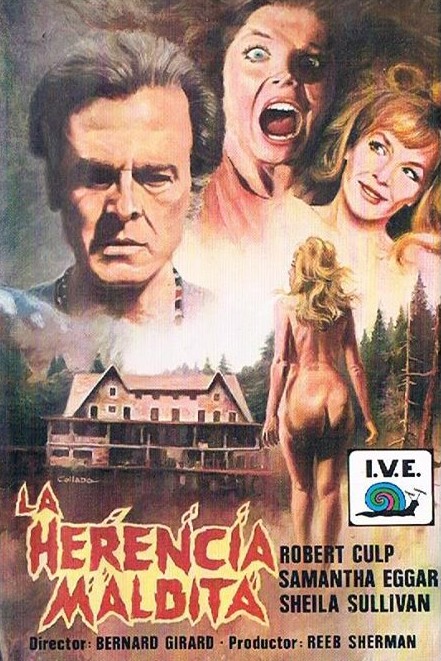
I’m not saying this is a good movie, but I am saying that it’s a film with an orgy scene that feels like it could be in The Wicker Man except that everyone eats spaghetti — to be fair, I was once a guest at an OTO lodge party where everyone was eating bowl after bowl of guacamole with no chips, just spoons — before doing a line dance and then having sex and hey, there’s Rene Bond to remind you that Penthouse bought this three years after MGM threw it away. It’s like Antichrist without the cock violence, Dark August but horny, the 70s hippy aesthetic fighting with a movie that wants to be to be something more than it is but possibly made by a director who has no idea how to bring the movie inside his head onto the celluloid. He claimed that it was about “a modern man’s attempt to get away from his contemporary hang-ups by returning to his ancestral home.”
As for Culp, he told The Bucks County Courier, “This is the kind of picture you wait for your whole life.” He also said, “The story is that I decided to do it because I couldn’t understand it. “It’s true, I didn’t understand it. But that was because there were 3 pages of the climax missing!”
The amazing caligula.org site has a great article on this film, which explains how Caligula wasn’t really Penthouse’s first movie.
“There is no telling what condition the movie was in when Penthouse Pictures acquired it. It may or may not have still been the authentic version. It may well have been tampered with by Stone et al or some emissary thereof. But it is unquestionable that Penthouse commissioned a firm to film something new, and it was actually quite beautiful to look at: a psychedelic multiple exposure of a topless dancer, as well as a dancer in a skeleton outfit, all accompanied by an acoustic guitar. That footage was intercut into a domestic scene, as though it were a flashback of some sort. But by the time the movie finishes, we realize that it was not a flashback after all; it was merely meddling by Penthouse. Penthouse further enhanced the film with a country singer surrounded by three nude women.”
Billy Joe Royal’s performance was force-fitted into the scene of the hoedown, but the footage simply did not match, and the intercutting is rather jarring. I wish I could see how the scene originally played. Penthouse then hired an editor to simplify the movie, cutting it down to 74 minutes. In this short version, characters and relationships were never developed or explored, leaving so many loose ends that it’s no wonder people had trouble following the narrative. I would guess that the original was far more ambiguous and a bit challenging, and that the haunted-house story was a suggestion, planted into disordered minds, that flowered under duress. It was surely not only the Robert Culp character who was affected, but the Eggar character too, as well as many others.”
Penthouse replaced the credits with some crazy paintings, then this played theaters and drive-ins on double features with Asylum and The Vault of Horror. Penthouse Pictures Inc. went out of business after this and was replaced by Penthouse Productions, Ltd., which put out Good to See You Again, Alice Cooper and Watched, which were four-walled. They also invested in Chinatown, Day of the Locust and The Longest Yard.
You can watch this on YouTube.
 B&S About Movies
You must be logged in to post a comment.