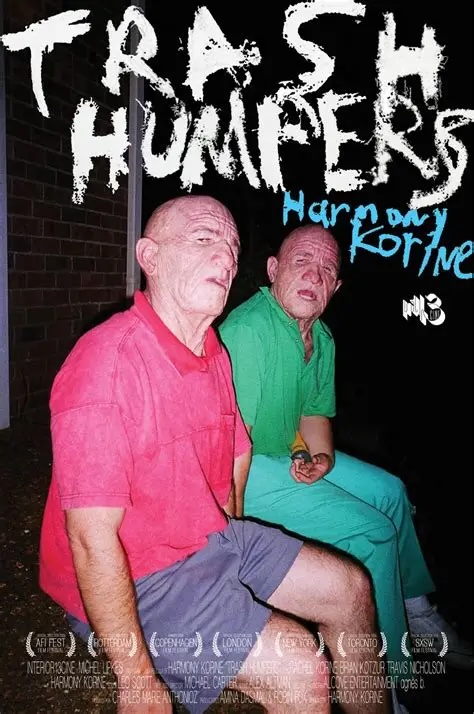
The Trash Humpers are running through the streets of Nashville, causing chaos everywhere they go, which mostly means making people eat pancakes covered in soap, choking out baby dolls with plastic bags and killing a poet. They’re also all mostly old men or men wearing old man masks. They are very dada; nothing means anything. Momma (Rachel Korine), the only female member, kidnaps a child to add some meaning to her life, while the man recording all of this, Hervé (Harmony Korine), at least tries to explain to the viewer the ethos of the group.
One night, as he looked at trash cans in the moonlight, Korine remembered a gang of old men peeping toms who would come out at night, referring to them as “the neighborhood boogeymen who worked at Krispy Kreme and would wrap themselves in shrubbery, cover themselves with dirt, and peep through the windows of other neighbors.” Using video — yes, SOV — made the images softer and less sharp, which he was looking for. It was even edited on two VCRs.
The tracking errors and static make the viewer feel like a voyeur watching something they aren’t supposed to see. A snuff film of human dignity, I guess. This feels like the kind of movies we filmed as kids and then realized we’d get arrested if anyone found them.
I’d like to say that when the Trash Humpers scream “Make it, make it don’t fake it!” or cackle while smashing televisions, they aren’t protesting society; they are simply existing outside of it. They’re celerating the discarded: people, formats (VHS) and things. Did I go too A24 with this? Korine said, “I wanted to make a film that looked like it had been found in a bag of trash on the side of the road, or buried in a basement.”
Jerry Williams also directed Catnado, so know that going in.
Space queen Fiona (Leslie Rogers) is the force behind Channel D, which is my dream channel, because it airs nothing but Debbie Rochon movies. The bad part of that is that Channel D is also draining the soul of anyone who watches it. Or maybe robbing them, which better ties into the title.
Conrad Brooks from Plan 9 from Outer Space is in this. That makes sense, as the original title of that movie was Grave Robbers From Out of Space.
Debbie Rochon is as well, which you would figure, given that so much of the movie is about her.
If you told me this movie was made in the 1990s, not 2009, I would believe you.
Vernon Chatman (creator of Wonder Showzen) decided to reach out to four different low-production-value adult film-on-demand groups and have them film his script. There’s nothing sexually arousing here, which makes you wonder what the porn actors involved in this had to believe that they were doing.
Women give birth to meat, men want to go back to the womb, the end of the world arrives, God carries humanity as if it were a fetus, the Pollard family keeps changing with each different group of actors, and this has way more sitting on the toilet than any other movie I’ve seen.
Did you know that to see God’s face, you have to strip?
Can you imagine going to work and your job is having sex all day on film, and then you’re instead making a movie about nuclear war, cheese gratering penises and spraying acid into the face of the Supreme Being. I wonder whether people who have jobs we think they’d love get burned out. Do they come into the office — or the hotel or Van Nuys rented house — and think, “I’m so tired of oral sex.”
This is an interesting experiment, but also a torture test.
Directed and written by Greg Robbins, this is the kind of movie that makes me go nuts, nearly jumping around the room while my wife wonders why she married me. She was watching part of it and said, “None of the words match people’s mouths, and why are there Spanish subtitles?” That’s because I’ll watch a movie however I can get it, like Russian OK.ru movies with long ads and screamed foreign translations, or even trying to find old gialli on adult sites and being freaked out by the sexual gymnastics on display before I get to what I really want, black gloved hands killing pretty folks.
But I digress.
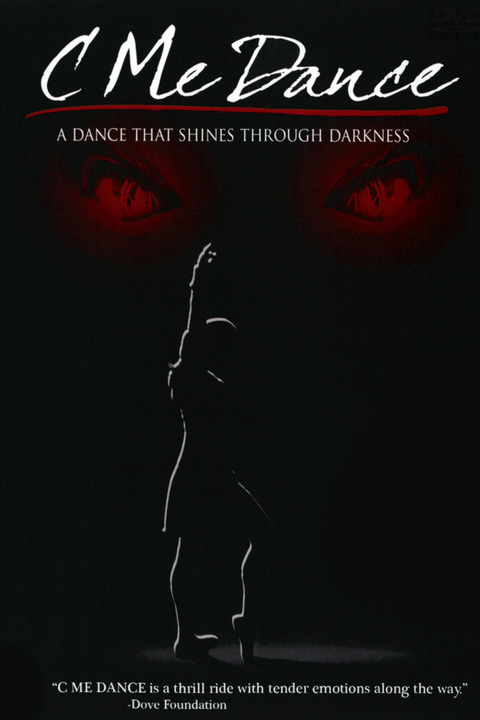
Shot in Pittsburgh and Carnegie, PA — you have no idea how proud this makes me — this is the story of Sheri (Christina DeMarco), who, as the title will tell you — don’t worry, they say it out loud and even have the name appear in the ending — just wants to dance. However, she soon learns that she has leukemia. As if life wasn’t bad enough, her mother died when she was just a baby. Yes, Sheri was in the car when a demon hit her mother with an 18-wheeler in a scene that is a little Duel, a bit Maximum Overdrive and lots of Final Destination 2. Raised by her father, Vince (Robbins, vanity is one of the seven deadly sins, but vanity projects are my favorite), she was just trying to navigate the high school years of boys, friends, and shopping.
But then, she gets powers.
Yes, Sheri is somehow incredibly healthy, still able to dance, despite being in Stage 3. She also gets the power of thought projection, so when she touches people, she heals their trauma by showing them Christ being nailed to the cross.
Working with Pastor Tony (Scott Kerschbaumer), her powers are able to stop crime by 89%, halt Hollywood from making anti-Christian movies (“In Variety, it says the next big three movies scheduled for release have been shelved by the studio executives! It reports that they say that they may harm family values, and they’re never gonna release them!”) and halves the production of pornography. She is also able to save some of her friends, including a few who wanted nothing to do with the church.
This also has Eddie Mekka, who was Carmine “The Big Ragoo” Ragusa, in the cast, as well as Peter Kent (who was a Terminator in the arcade game for Terminator 2, as well as showing up in Dead Heat, Re-Animatorand Nemesis as well as being Arnold Schwarzenegger’s personal stunt double, stand-in and friend) as the devil and oh wow — “The Russian Nightmare” Nikita Koloff is a biker.
Sheri can also change minds — this doesn’t feel Christian — and get her message on every network. Satan keeps stalking her and her dad, who is now dating her oncologist, which seems a bit unprofessional.
And then — spoilers — at Christmas, when everyone in the world has accepted Jesus, she goes to get her gift and dies in the other room. In Heaven, she finally dances for her mother.
I don’t think that secular creators could make this movie. It’s just too oddly sure of its mission, a film in which a rape is stopped by touching someone in the heart, and then they find their way, as well as that scene where the one naysayer in church has a mental battle with Sheri. It did what faith movies should do. It made me wonder what I’m doing with my life, writing long things about film such as this — to be fair, there’s no other movie like this — instead of trying to save girls with cancer or preach the Good News. We all have our own purpose, and I guess that mine is trying to see as many movies as I can and share that joy.
You can watch this—with the out-of-sync audio and Spanish subtitles—on YouTube.
Eventually, otaku who are all into tokusatsu grow up and become perverts. This movie is for them, a Sapphic ode to sentai rangers and giant women called forth to battle kaiju and get goo all over their chests.
There’s a whole series of these Mighty Lady movies. In fact, this is not the first movie by director Ichiro Omomo that I have seen, as he also made Star Virgin. That means that when you read that paragraph above, know I am not knocking any of my fellow pervs. I get it, perhaps more than anyone.
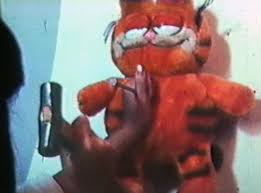
There’s also a 1984 movie, All About Mighty Lady, in which she nails a stuffed Garfield doll to a wall.
Now I have to see it.
Thanks, Bleeding Skull!
Is this porn? Well, I found a copy on eBay, so the answer is no. It’s…I can see how some people could be into it, but it’s mostly how they did the effects. That said, there are a lot of makeout scenes and guys are kind of fascinated by that. Then again, ladies love Boys Love yaoi or Girls Love yuri manga, which is focused on same sex romance. It’s a big world filled with lots of flavors, so why limit yourself, even if you want to be stepped on by a fifty-foot-tall Japanese superhero?
Rina (AV actress Rina Fukada) grows big when exposed to electricity. When her father is kidnapped, she’s forced to become a kaiju woman and destroy the city. Not even tanks can stop her. But can a tentacle monster? Or a metallic lobster?
Look, I get it. These movies are weird. However, don’t you owe it to yourself, just once in your life, to see a gorgeous Japanese starlet get raw frogged by a giant amphibious kaiju?
What blows my brain out is the care that was given to the city set. We know this has been made for jerking off to, yet the city looks as good as a real kaiju movie. The monsters look better than several I’ve seen in real movies. What was the tentacle and lube budget? And ah, there’s that pixelation so that even though this is as perverted as it gets, you never see any real genitals.
Aug 18-24 indie comix week: When I was a kid, I used to read Mad Magazine and Cracked, so when I got a little older, it didn’t take much convincing to pick up Eightball and Hate. I’m an OG in the “complaining about superheroes” game, and my scars were anointed on the Comics Journal message board!
Why did I wait so long to watch this? Why was I able to buy it at a dollar store? Why isn’t it on a major streaming service?
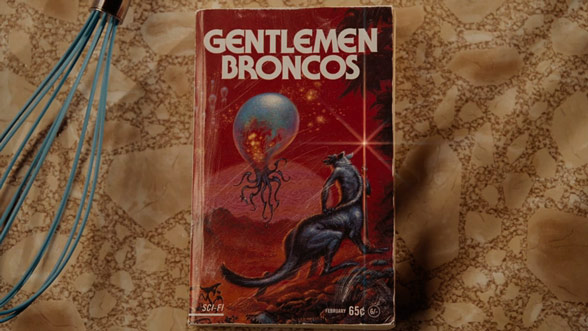
Directed by Jared Hess, who co-wrote it with his brother Jerusha, Gentlemen Broncos has some of Napoleon Dynamite in it. Benjamin Purvis (Michael Angarano) has a strange home life, one seemingly fixated on his dead father, living with his mother Judith (Jennifer Coolidge), who dreams of selling her nightgowns but is stuck working retail and making popcorn balls. Ben escapes his real life by writing science fiction. His latest book is Yeast Lords, which is all about Bronco (Sam Rockwell), a hero he has based on his father. As he writes, the audience sees the movie in his head.
Ben’s a nice guy. He’s unable to talk to most girls, but when introduced to fellow writer Tabatha (Halley Feiffer) at a science fiction writer camp, he allows her to read his story. She reacts strangely, running away, when in truth she’s stunned by how good it is. I get the feeling she wants to be with him but doesn’t have the language or ability to do that; instead she’s with Lonnie (Hector Jimenez), who makes cheap SOV-style films.
At the camp, Ben takes a lecture from one of his heroes, Dr. Ronald Chevalier (Jermaine Clement). He quickly realizes that the person who was his idol is really a jerk; eventually, one realizes that he’s run out of ideas. He turns a contest at the camp — to publish one winner’s work — into a chance to steal an idea. Ben’s Yeast Lords becomes Brutus and Balzaak with minor changes.
Throughout, Ben’s mom wants more for him. She introduces him to a Guardian Angel from church, Dusty (Mike White), who is less a father figure and more someone who teaches him how to shoot blowdarts. When everything goes bad in a few days — the Yeast Lords movie that Lonnie made is horrible, a rich man tries to assault his mother under the pretenses that he wants to get her clothes into stores and Chevalier shows up at a local bookstore — Ben flips out and gets arrested.
This is where his mother’s love appears again. She has sent all of his books to be registered and officially bound by the Writers Guild of America. There’s proof that he’s the one who wrote Chevalier ‘s work. His books replace those ones and everyone lives happily forever after.
From the opening — “In the Year 2525” by Zager and Evans playing over book covers — to how fully formed its villain is (and how much he sounds like Michael York in Logan’s Run — thanks Gizmodo, I couldn’t figure out who he reminded me of) and the love that drives the end of the movie, I was totally won over by this movie. At one point, Tabatha tells Ben, “Well, you’ll never get anywhere by just letting your mom read your work.” I am so happy to know the truth.
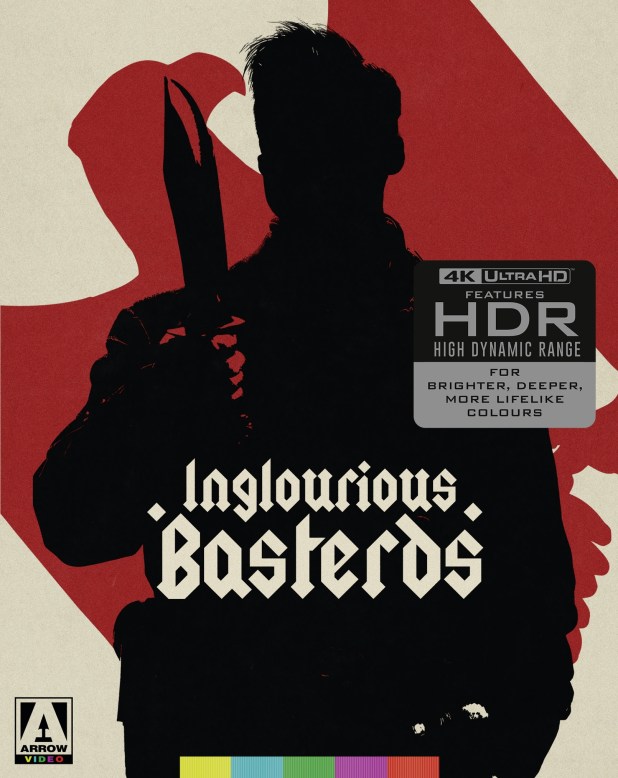
Enzo G. Castellari’s The Inglorious Basterds — known in Italy as Quel Maledetto Treno Blindato or That Damned Armored Train — is a 1978 film that ran near constantly on cable throughout the late 70s and early 80s. In case you’re wondering just how important this film was to Quentin Tarantino, check out his excitement as he speaks to Castellari in this clip from the extras from Severin’s out of print release.
Tarantino started writing his World War II film in 1998, but would struggle with the film, working on it and then shelving it again and again. That’s when he arrived at a story much like Castellari;s film — a group of soldiers escape from their executions and go on a suicide mission. While that idea changed slightly, it was what he needed to get the script written.
Tarantino had always wanted to work with Brad Pitt, so this felt like the right film, and the addition of Christoph Waltz — Tarantino felt that the role of Hans Landa was unplayable until then — made the movie for him. Tarantino saw the film as just as much a spaghetti western as a war film and almost called the movie Once Upon a Time in Nazi-Occupied France.
The film starts with SS colonel Landa interrogating a French dairy farmer about the last Jewish family in town. The farmer is promised that his family will be spared if he gives up the family, so the soldiers shoot through the floor, killing all of the members of the Dreyfus family except for their daughter, Shosanna (Melanie Laurent).
We them meet Lieutenant Aldo Raine (Brad Pitt) of the First Special Service Force, who is recruiting Jewish-American soldiers to his team. They go way further than the regular troops, scalping Germans when they kill them. Called The Basterds, we soon meet two of them — Sergeant Hugo Stiglitz, a rogue German soldier who has changed sides and already claimed the lives of thirteen Gestapo officers, and Donny “The Bear Jew” Donowitz (Eli Roth), a baseball bat carrying maniac. There’s also Smithson “The Little Man” Utivich (B.J. Novak) and Private Omar Ulmer (Omar Doom) amongst others.
Meanwhile, Hitler learns that the Basters have been atatcking his troops, carving swastikas into the heads of the survivors so they can never hide their shame. And teh surviving Shosanna is now operating a Paris cinama under the assumed name Emmanuelle Mimieux, plotting with her lover Marcel to murder the Nazi leadership who will attend the premiere of Nation’s Pride, a propaganda film all about Fredrick Zoller, who recently killed 250 Allied soldiers in one battle.
British Royal Marine Lieutenant Archie Hicox (Michael Fassbender) and the Basterds are planning their own attack. He and Stiglitz meet an undercover agent, the German film star Bridget von Hammersmark (Diane Kruger), but Hicox’s accent nearly destroys the entire mission, as a firefight breaks out between the Basterds and an entire bar full of Germans. They survive, but now Landa is on to them. At the premiere, he strangles Hammersmark and catches on to the Basterds who have snuck in.
That’s when Landa makes his gambit. He has Raine contact his superiors and cuts a deal: the mission can continue as long as he has immunity for his war crimes. Zoller attempts to seduce Shosanna before they shoot one another and die. As the film draws to a close, footage of Shosanna appears, telling the assembled audience — including Hitler and most of his high command — that a Jew is about to kill all of them. The screen erupts into flames as Ulmer and Donowitz — using the fake name Antonio Margheriti, obviously a reference to the director of Yor Hunter from the Future — break into the box containing Hitler and Goebbels, killing the before firing their guns into the audience as bombs kill everyone.
The film closes with Landa and his radio operator driving Raine and Utivich into Allied territory, where they surrender. Raine responds by shooting the radio operator and carving a swastika into Landa’s forehead, marking him for life so that he’s never able to truly escape.
This being a Tarantino film, it’s filled with cameos and references. Bo Svenson from the original Bastards shows up as an American Colonel in the Eli Roth directed film within a film. Mike Myers plays Ed Fenech, named for the queen of giallo Edwige Fenech. Samuel Jackson and Harvey Keitel’s voices are in the film as the narrator and an OSS commander. And Castellari himself shows up as a Nazi general.
How does this fit into the Tarantino Universe? Well, Lieutenant Aldo Raine is Floyd from True Romance‘s great-grandfather. And Donowitz would be the father of producer Lee Donowitz from that same film. This has great significance, as instead of Hitler killing himself in a bunker, American heroes killed him in a blaze of glory. Is it any coincidence that one of Lee’s movies was a war picture called Coming Home In a Body Bag?
For all the amazing roles that Quentin Tarantino has created for actors, this is the first of his films to win an Oscar for acting, as Christoph Waltz won Best Actor in a Supporting Role (he’s win another Oscar for Tarantino’s Django Unchained).
Arrow Video is giving this the release it deserves. It all comes inside a limited edition “Operation Kino” packaging with new art by Dare Creative, complete with a 60-page Films & Filmmakers collector’s book with writing by film critics Dennis Cozzalio and Bill Ryan; a double-sided fold-out poster; Replica Nation’s Pride Premiere programme booklet; a La Louisianne beermat; 3 postcard sized double-sided art cards; a strudel recipe card and a reversible sleeve with original and newly commissioned artwork by Dare Creative.
As for the extras, you get audio commentary by film critic and author Tim Lucas; interviews with editor Fred Raskin, special make-up effects supervisor Greg Nicotero and actor Omar Doom; Making it Right, a new visual essay by film critic Walter Chaw, author of A Walter Hill Film; Film History on Fire, a new visual essay by film scholar Pamela Hutchinson, author of BFI Film Classics Pandora’s Box; Filmmaking in Occupied France, a new interview with film scholar Christine Leteux, author of Continental Films: French Cinema Under German Control; extended and alternate scenes; Nation’s Pride and a making of feature; an archival interview with Quentin Tarantino, Brad Pitt and Elvis Mitchell; featurettes on the original film, Rod Taylor and a film poster gallery tour and trailers.
You can get the 4K UHD and blu ray release of this movie from MVD.
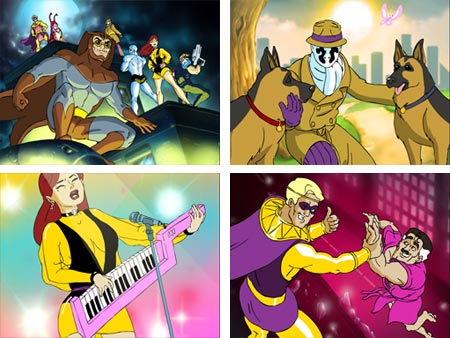
I love that this short — created by Harry Partridge and posted a day before the Zack Snyder movie was released — exists. It presents a happier version of the Watchmen, as if they were a Saturday morning cartoon, with a buff Nite Owl, Ozymandias saving the Comedian from falling, Rorschach being an animal-loving comedy character, Silk Spectre being Jem, Dr. Manhattan acting like Turbo Teen and Ozymandias and Bubastis being afraid of ghosts like Shaggy and Scooby-Doo.
There’s also the psychic squid, three Dr. Manhattans in bed and The Comedian being in love with Silk Spectre, who is his daughter. Dave Gibbons said, “The thing is, obviously they’re having fun with it but the way it was done, you know that the person really cared about what they were doing…really knew Watchmen in detail.”
Now I wish that this was an actual show, just like how I wanted the toys in the comic to exist.
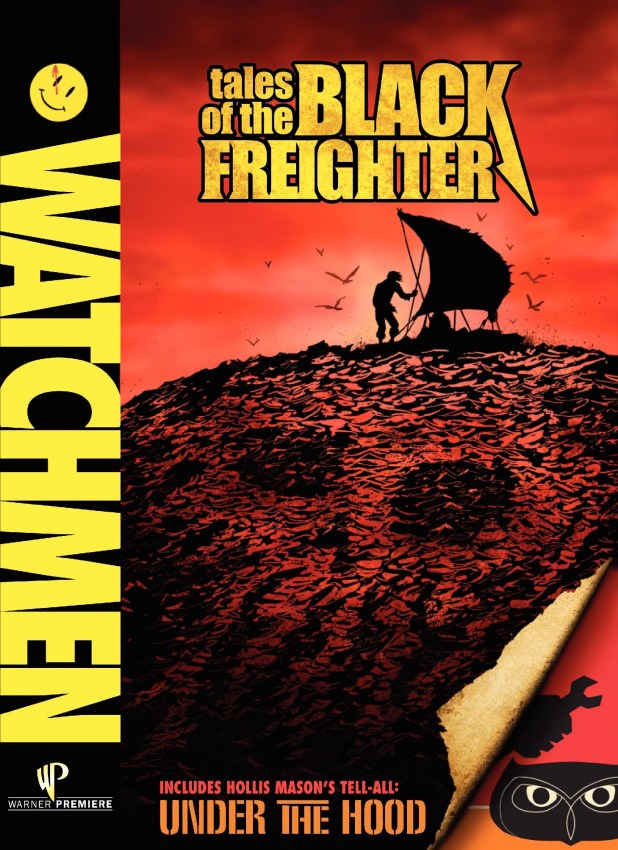
One of my favorite things about Watchmen is that in the universe of that story, superheroes are real, so comic books never needed to write about them. Instead, pirate comics became the best sellers. Published by National Comics (the original name for DC Comics in our universe) and written by Max Shea and artists Joe Orlando and Walt Feinberg (Alan Moore and Dave Gibbons in our world), Tales of the Black Freighter tells the stories of sailors who are damned by their encounters with the phantom pirate ship.
Named from a lyric from the song “Pirate Jenny” in The Threepenny Opera, the Black Freighter collects souls of men who become the crew of its blood stained decks, call at the command of a mysterious and demonic captain. At the time of its publishing in this universe, it was never seen as commercially successful as the EC Comics Piracy and Buccaneers, but as Shea developed in his writing style, his stories soon became dark and moralistic.
This cartoon adapts the story “Marooned,” in which a castaway’s increasingly desperate attempts to return home in time to warn them of the Black Freighter only lead to him being taken by it. As he rides a raft made of his dead crewmates, he fights sharks and kills numerous people, only to realize that he has murdered the very people he wanted to save.
Gerald Butler, the star of Snyder’s 300, is the voice of the man in this. Directed by Daniel DelPurgatorio and Mike Smith and written by Alex Tse and Snyder, it was intended to be part of the Watchmen movie. It’s added in the longer cuts.
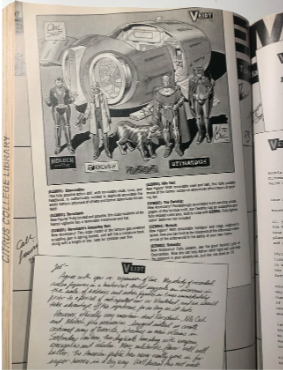
Why is this story so important? Because it’s the real story of Adrian Veidt, the villain behind everything. He is using the bodies of his former associates to get closer to the end of his world and fix things, even if he must go insane and compromise his morals.






 B&S About Movies
You must be logged in to post a comment.