Faceless (1988)

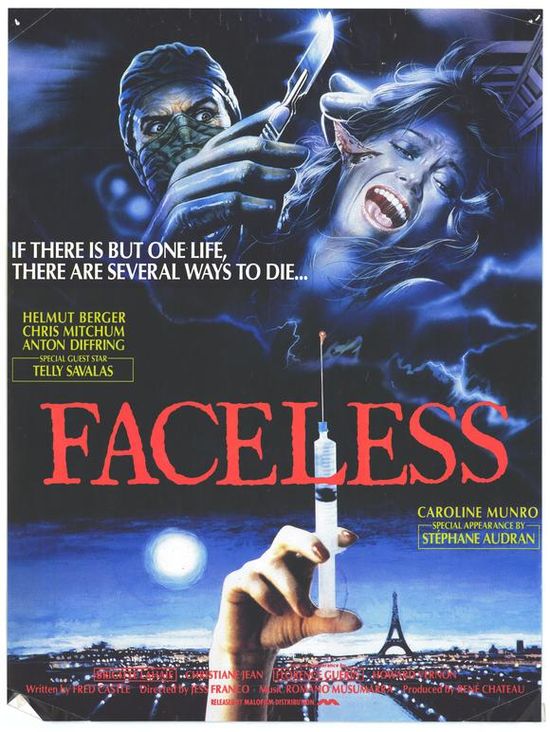
Sure, Jess Franco is just making a new version of The Awful Dr. Orloff with this film, but with bigger stars and plenty of gore. And when you’re looking for a movie to watch at 4 AM — and I often am — it certainly does the trick.

Dr. Frank Flamand (Helmut Berger, The Damned) is a plastic surgeon surrounded by gorgeous women who walk arm in arm to his fancy car. But a former patient wants revenge, so she tosses acid at him. Instead, she catches his sister, Ingrid, directly in the face, ruining her gorgeous looks.

Fast forward to a modeling shoot in Paris, where Flamand’s assistant Nathalie (Brigitte Lahaie, The Grapes of Death) drugs and abducts Barbara Hallen (Caroline Munro, Captain Kronos – Vampire Hunter, Dr. Phibes Rises Again). As she locks her into the basement of the doctor’s clinic, Nathalie gets into an argument with Gordon, a maniac who lives down in the basement and chops off women’s arms for a hobby.

Still with us? Then let’s go to New York, where Barbara’s dad Terry (Telly Savalas, Lisa and the Devil) is searching for his daughter, turning to Sam Morgan (Chris Mitchum, Alejandro Jodorowsky’s TuskBigfootChisum) to help find her. He first travels to a Paris morgue, where her body supposedly is, but the headless victim is not her as it’s missing a mole.

Flamand and his sister meet Dr. Orloff (Howard Vernon, who played Orloff in six of his seven films) and learn how they can cut off Barbara’s face to replace Ingrid’s thanks to a Nazi scientist named Dr. Karl Heinz Moser (Anton Diffring, who played numerous Nazis in his career, including in Jerry Lewis’ long lost The Day the Clown Cried). Plus, Franco’s longtime muse, Lina Romay, appears here as Orloff’s wife. When the doctor returns to his office, he learns Gordon has cut up Barbara’s face.

Morgan beats up Barabra’s photo director before a bouncer makes him leave. He has to call Terry with some bad news — his daughter had been working as a prostitute.

The doctor finds another face donor for the surgery, but Moser destroys it. That means they need to find yet another victim, during which Barbara’s credit card is traced to Flamand’s clinic. Morgan starts surveillance and notices that Nathalie is wearing Barbara’s clothes.

He arrives at the clinic and takes out Gordon, but is overcome and locked into the cell with all of the girls. The villains leave them bricked up and with their air running out.

But Sam has sent Barbara’s dad a message, who gets ready to rescue everyone. And then…the movie ends.

Yep.

The original ending of the film had Sam saving the day, but Franco wanting to make it different and leave it open as to whether Sam and Barabara survived. Why? Why ask.

Oh yeah — I almost forgot. This film is replete with surgical horror, like faces being sliced and lifted off, needles into eyeballs, scissors into throats and much, much more. If only it lived up to the promise of its poster, but that said, it’s grimy and seedy fun if you can’t find anything else.

Too Beautiful to Die (1988)

I came across this film on YouTube and had no idea what I’d be watching. I’d give it five minutes and then be done with it, I said. And then I realized that the film was nearly over and I’d been quite interested in the proceedings. Life’s funny like that.

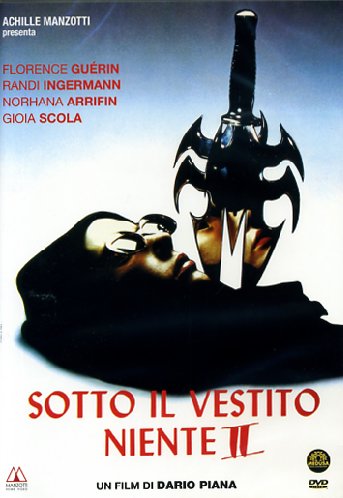
Written and directed by Dario Piana, this sequel to Nothing Underneath is the only giallo I’ve seen that has both Huey Lewis and the News and Frankie Goes to Hollywood (you got close, Body Double) on the soundtrack. A major point of the film is that the models are trying to put together a video for Frankie’s “Warriors of the Wasteland!”

Let me see if I can summarize this one quickly for you. A fashion agency is shooting videos that feel very BDSM and feature really long, intricate daggers. Those models are all prostitutes, except for one, who won’t give in and have sex with an old man in a whirlpool, so everyone rapes and kills her. Her car goes off a cliff, but an autopsy proves that she was shot in the head first. That said — everyone who was there starts getting killed, one by one.

Some of the death scenes are really well shot and the murder weapon is quite insane looking. One of the murders, with a model falling off a large building into water, looks particularly good.

This one’s hard to find, outside of YouTube, but the great folks at CultAction have it.

CHRISTMAS CINEMA: Die Hard (1988)

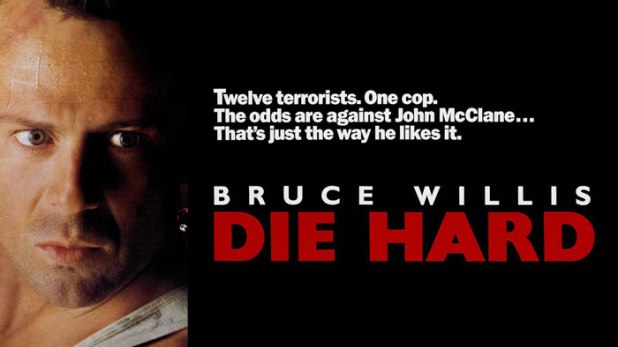
Roderick Thorp wrote the book Nothing Lasts Forever in the hopes that it could be made into a film. Seeing as how Frank Sinatra had just starred in the adaption of Thorp’s The Detective and this story would be a sequel, it seemed like a sure bet. But then the film went into development and it would be nine years before his film hit the screen.

The final film — Die Hard — features action sequences taken almost word for word from the book. Where it differs is by making its hero younger, changing his name from Joe Leland to John McClane and putting his wife, not his daughter, in danger.

Sinatra had first right of refusal to make the film, but once he stepped down, Die Hard was offered to Sylvester Stallone, Harrison Ford, Charles Bronson, Robert Deniro, Richard Dean Anderson, Mel Gibson, Don Johnson, Burt Reynolds, Richard Gere, Kurt Russell, Dennis Quaid, John Travolta, Nick Nolte, Michael Keaton, Patrick Swayze, Bill Paxton, Mickey Rourke and Clint Eastwood. Whew. It seems all of Hollywood was offered the film. Yet all of these casting choices seem ridiculous today because only one man could star in this film: Bruce Willis. But at the time, he was an unproven and virtually unknown actor.

Do I really have to explain the plot to you, dear reader? It’s simple: McClane is a man out of place, a New York cop at a fancy Christmas party trying to reconnect with his estranged wife when terrorists take over. The set-up in incredibly simple, but the resourcefulness of our hero — and the charisma of a young, hungry Willis — take this film from the ordinary to the classic. Throw in a classic villain in Alan Rickman’s Hans Gruber and you have a movie worth watching and rewatching.

There’s been some debate as to whether Die Hard is a Christmas movie. Of course it is. It symbolizes the worry behind every holiday party, of trying to repair broken relations during the most wonderful time of the year. The awkwardness of attending your spouse’s Christmas party? Die Hard may get unrealistic later, but in the way that it translates McClane’s feelings of not belonging in Nakatomi Plaza, Die Hard strikes me as bracingly honest. The holidays are a rough place for a cop whose only real relationship is the one he has with his job. And throughout the terrorist-filled night, he hopes to use his wits to survive, save the wife he realizes he has lost and give the Vreski family the worst Christmas ever.

Die Hard also has the distinction of staring two character actors who excel at playing what can only be described as real dicks: Paul Gleason (The Breakfast Club) and William Atherton (Ghostbusters). Their IMDB pages are rich with roles that make you want to punch them in the belly.

From how Hans Gruber is treated as one of the stars of the film to its idea of one man against overwhelming odds, Die Hard has influenced every action movie that followed it. But is it a Christmas movie? Well, we don’t have ornaments on our tree from any other film!

FULCI WEEK: Touch of Death (1988)

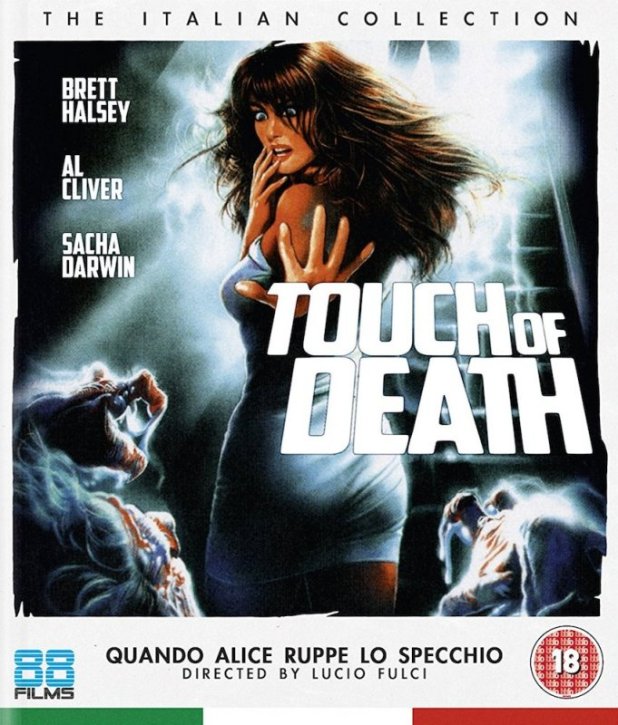
If Touch of Death was simply the poster filmed for 70 minutes, it’d be such a better movie than what I just watched.

Lester (Brett Halsey, Demonia) is a cannibal serial killer who meets, dates and eats various women, sometimes giving parts of them to his pigs. He also talks to a tape recording of his own voice and has plenty of gambling debts that Randy (Al Cliver, Zombi 2The Beyond) is ready to collect.

There’s a long scene that involves Maggie, a woman he marries. She’s an oversexed, overweight, overmustached woman that is such a caricature, it reduces the film to pure comedy. He tries to kill her several times with poison, which she thinks is just a love game. Then, Lester bashes her brains in — literally — with a stick, leading to her eyeball popping out and rolling down the hallway. If you thought The New York Ripper was too restrained, Fulci is ready for you. Because she isn’t dead, which means Lester has to repeatedly punch her and then cooks her head in the microwave, where we watch the flesh melt off her face. Then, in a moment of absurdity, her body can’t fit into his trunk, so he has to saw her legs off.

I don’t want to see Fulci be a second-rate Herschell Gordon Lewis.

Lester is caught by a homeless man (who has the mark of Eibon on his forehead), who he runs over and leaves for dead. He doesn’t have any follow-through, because the man shares his description, which means he has to shave and get contacts.

His next wife is a woman who likes to sing opera during sex, who he strangles to death with some stockings. Even after getting pulled over by a cop — with the body in the front seat — Lester gets away. He tries to sell her jewelry, but it’s all fake. And now, the cops know what he looks like — again — so he dyes his hair and puts on glasses.

Depressed at home — and with even more gambling debts — Lester gets a phone call from Virgina (Zora Ulla Kesler, Anthropophagus, The New York Ripper), who is like all of his victims, except much younger. She’s DTF for Lester, but he is grossed out by her facial scar and decides to kill her and steal everything she has.

Meeting her for dinner, she pulls a gun before he can kill her. She recognized him from the news and Lester barely makes it out of her apartment. As he has a conversation with his other self, now a shadow on the wall, he merges with this second voice. Then, he dies.

Also known as When Alice Broke the Looking Glass, this film is everything Fulci detractors accuse him of being — misogynist, leering, obsessed with gore and slapdash. It was an effort to even finish it — as I love his movies. Up until now, even with Ripper, it felt as if there was a balance of art and bloody organs being severed and smashed. Touch of Death’s 81 minutes of screen time feels like 81 hours.

Postscript: I did not care for the scene where the killer kicks a cat, at all. Yes, I was not upset by a woman’s head smashed with a stick and more peeved at an orange cat being booted.

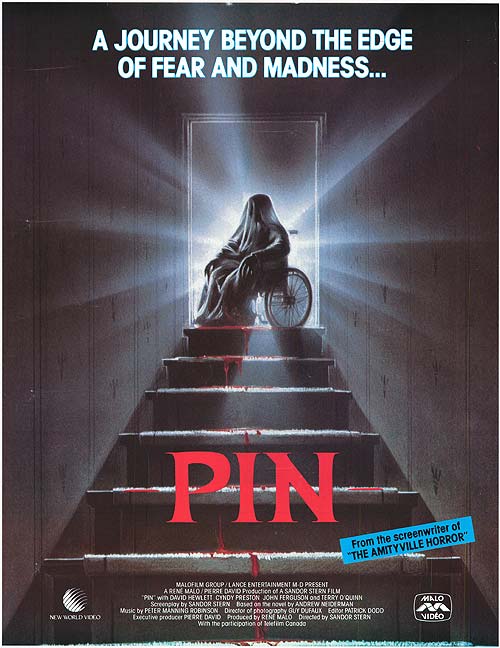
PAPERBACKS FROM HELL WEEK: Pin (1988)

In Paperbacks from Hell (page 143 to be exact), Grady Hendrix explains what PIN is all about:

“Leon and Ursula have lived together ever since their parents died in a car accident. The kids grew up thinking dad’s anatomical model, PIN, was alive, and now Leon throws his voices unconsciously, keeping PIN talking. PIN eats with them, listens to Leon’s weird recitals, and when Leon and Ursula have incest sex, PIN likes to help. If you’re a completely insane lunatic shut-in with ice waters in your veins and screaming bats inside your skull, this would be paradise. And for Leon, it is.”

PIN was written by Andrew Neiderman, who has written forty-seven novels under his own name, but is perhaps better known for the sixty-eight — and counting — that’s ghostwritten from V.C. Andrews and her Flowers in the Attic series.

1988’s Canadian movie adaption skips most of the incest, but trust me, it’s no less strange.

Directed by Sandor Stern (the writer of the original The Amityville Horror and writer/director of the Patty Duke starring Amityville: The Evil Escapes), PIN starts with Dr. Frank Linden (Terry O’Quinn, forever The Stepfather in our hearts), who keeps a human size, anatomically correct Slim Goodbody-esque medical model in his office that he’s named Pin. He uses Pin — throwing his voice to make him speak — to explain how the body works without it being awkward. The doctor is a cold and distant man; only his interactions through the doll seem warm.

Leon has problems. He probably has some mental illness, which isn’t helped by his domineering mother, who doesn’t allow him to play outside or bring friends home. Pin is his only friend in the entire world. Imagine his shock when he goes to visit Pin one day and a nurse is having sex with the doll. Isn’t it delightful when a movie can just make your jaw hit the floor? Well, keep watching Pin.

The doctor and his wife constantly feel like they could kill one another at any moment. And Leon may not ever want to think about sex, but his sister can’t stop thinking about it. Jump cut ahead in time and she’s literally having sex with most of the football team while her brother is scrubbing graffiti about her off a locker. After Leon angrily fights several boys who are lining up to have their way with her (remember what I said about the surprising strangeness of this one), she agrees to stop having sex. That said, she needs an abortion, an operation that her father coldly does in front of Leon, telling him that he needs to watch this procedure for when he does it himself. They’ll just tell mother she had some cramps.

One night, Dr. Linden and his wife are leaving for a speech. He forgets his notes and runs back to his office, where he finds Leon talking to Pin. Realizing his son has lost his mind, he takes Pin away. However, a car accident caused by his speeding (or is it Pin?) kills the parents off. As Leon investigates the crash, he takes Pin with him.

Leon and Ursula enjoy their freedom from their mother’s strict cleaning habits and menus, but as other people try and enter their lives, like Aunt Dorthy or Stan, Ursula’s love interest, Leon and Pin take them out. At this point, Pin is now dressing in Dr. Linden’s clothes and has latex skin and a wig so he can appear human.

Oh! In the middle of all of this, Leon has a date with a redhead who is all over him. He panics and runs to Pin for help, then uses the frightening doll to chase the girl away from the house.

Leon believes that Stan is only interested in Ursula’s money and to put him away. To be fair, they did discuss how crazy he’s been acting and what they should do. I’ve never had to meet the doll friend of a girlfriend’s brother, somewhat amazingly. Pin tells Leon how to dispose of Stan, but he’s interrupted by Ursula, who is on her way home from her library job.

Upon finding blood on the carpet, Ursula starts to run. Leon blames Pin, who flips out on him, telling him that he has never lied for him or to him. His sister returns with an axe as the screen goes white.

Fast forward: Stan is OK and still with Ursula. She comes home to see Pin, who asks whether or not she’s seen Leon. She answers, “No.” It’s then revealed that Ursula destroyed the doll, but now Pin has become Leon’s full personality. He is now the doll.

Pin is unsettling. It’s relatively bloodless, but that doesn’t stop its power to shock, whether you’re reading it in book form or watching the movie.

NO FALSE METAL MOVIES WEEK: Black Roses (1988)

Growing up, two things both saved and damned me: heavy metal and horror movies. They go together like guitar and bass, guns and roses, beer and weed, leather and denim. Off the top of my head, I can name plenty of bands for whom horror movies are a central element: Electric Wizard, Hooded Menace, The Misfits, Acid Witch, Mortician, Uncle Acid . . . seriously, I could name bands all day long.

But what movies meet the metal grade? Which ones would you be able to put on the back of your battle vest? Also — a tip of the horns to Mike “McBeardo” McPadden’s evil and doom filled tome, Heavy Metal Movies.

You probably remember Black Roses more for its garish VHS case than the actual movie. A 3D standout on rental shelves everywhere, it’s a favorite of many 80s horror fans. Believe it or not, I’d never seen the movie until this year. I was inspired by Acid Witch covering the song “Soldiers of the Night” on their Midnight Movies EP and had to look up the film that goes with it.

The small town of Mill Basin is about to become the first place that the band Black Roses will ever play a show. Up until now, they’ve only been a studio band. And parents are concerned because these guys have taken over the hearts and souls of the town’s kids. But do you blame the kids? Mill Basin reminds me of where I grew up — there’s nothing to do but fuck and do recreational drugs. And if you have bad self-esteem issues, you’re gonna just stay in your room reading comic books, playing guitar, drawing pictures of Leatherface and staring at your Traci Lords poster while listening to Among the Living on repeat. Oh wait — I was wallowing in the past.

There’s one teacher that cares — Matthew Moorhouse, who several of the students believe is having an affair with goody two shoes Julie. He’s stuck in a loveless relationship with an ice queen named Priscilla (Carla Ferrigno, yep, Lou’s wife). And the parents remain up in arms about Black Roses until the mayor calms them, reminding them that their parents hated rock and roll, too. The parents decide to be open-minded and go see the concert, which is the lightest, softest hair ballad cheese that you can ever imagine . . . until they leave and the real Black Roses starts playing and zombifying the crowd.

The kids come back at their parents with knives, just like Charley claimed they would, like a patricide by stereo (Vincent Pastore of The Sopranos), a mother killed by a car, another kid shooting his dad in the face and one watching while her best friend humps her father to death (one of these deaths is not like the other). Even virginal Julie goes astray, killing her lecherous stepfather and Moorhouse’s ex-girlfriend before transforming into a creature that I can only describe as a snaggletoothed fetal pig that makes cat noises.

This leads him to the band’s final concert, where lead singer Damian doffs his hair and shows off his demon dome. Moorhouse responds by setting the demon on fire, killing it. Wait a second — a demon that can be killed by fire? That just seems like poor planning.

So often, if you meet me in person, I get evangelical about movies, selling everyone on how amazing they are. I realize I often make bad movies sound way better than they really are. And when people are not ready for the onslaught of offal that I so often enjoy, they wonder, “Is Sam insane?”

Yes, I am. And if I were to be sitting next to you in person, I’d tell you that this movie is awesome because the lead singer turns crowd members into skeletons and purple zombies. That little dinosaur people that sound like kittens come out of speakers to kill fat dads. That my real dad, Carmine Appice, is in this movie, because his band King Kobra did most of the Black Roses music and that his name in this movie is Vinny Apache, which is the best name maybe ever, except for Sheriff Gene Freak. That Julie Adams from The Creature from the Black Lagoon and Dennis Hopper’s insane The Last Movie is in it.

But then you’d watch it and be like, why should I be cheering for the obviously a pedophile teacher with a sweater who is trying to set all the kids on fire with gasoline? Why are the creature effects so fucking weirdly bad? Is the film on the side of the parents or the kids? Why is the biggest band in the world playing such a small town shithole? How did they survive to play Madison Square Garden two weeks later and everyone is like, “Oh well” like it means nothing to them?

I should really start sharing disclaimers when I get all excited about movies. But yeah. Purple zombies. Dinosaur cats. Plenty of nudity. Metal lifers playing ridiculous songs (Carmine Appice was also in the solo bands of Ozzy Osbourne, Paul Stanley, Ted Nugent and Rod Stewart, which has to help you in a trivia contest someday). And you know, kids rising up to kill their parents. You can forgive a bad movie for a lot when it has all of these elements.

You can watch it over at the Internet Archive for free.

Update: This is now playing on Blechbuster Video!

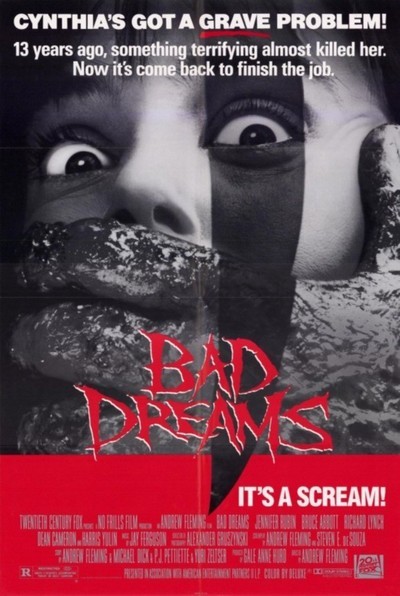
Bad Dreams (1988)

Everyone likes to proclaim that the world is so much worse today than it ever has been. If you feel that way and weren’t alive for the 1970s, allow me to debase you of this notion. The “Me Decade” was full of random violence, the fuel crisis, Three Mile Island, Watergate, Son of Sam, the end of Manson, Zodiac and religious orders that some would proclaim as cults, from the Process Church and the Moonies to Jonestown. We don’t really have a modern analogue for these fringe groups that would spring up from time to time because it seems like the Hale-Bopp comet wiped the last of these off the planet.

That’s the world that Bad Dreams takes place in. In 1975, the Unity Fields cult decides to commit mass suicide by setting themselves on fire under the command of their leader, Franklin Harris (Richard Lynch of Invasion U.S.A., The Sword and the Sorcerer, Rob Zombie’s Halloween and God Told Me To). Only one person survives, Cynthia (Jennifer Rubin, Nightmare on Elm Street 3: Dream Warriors), who still a kid when Harris set everyone on fire. She’s been in a coma for over 13 years before she awakens to flashbacks of Harris being interviewed on a TV program. The final thing she sees is his face telling her that she belongs to him and he’d be coming back to take her life. This entire sequence is really well edited, showing how the cult’s teachings had been accepted by every member, intercut with Cynthia being wheeled through a hospital as doctors struggle to save her life, all to the ominous strains of The Electric Prunes’ “I Had Too Much to Dream Last Night.”

After awakening, Cynthia attends experimental group therapy sessions for borderline personality disorder, led by Dr. Alex Karmen (Bruce Abbott, the Re-Animator films). As she becomes more aware, she begins to remember more and more — including the thirty other people who died from dousing themselves in gasoline. Worse, she sees a burned and scarred Harris when she’s trapped in an elevator, who reminds her that she is his property.

What follows is an insane scene that shows the parallels between group therapy and cult behavior, as the discussion room becomes Unity Fields and Cynthia watches everyone ladle gasoline onto one another. Again, another hint is dropped that Cynthia is a “love child,” as her mother is also part of the cult. One by one, the members walk to the front of the room and are baptized with gasoline, before Harris takes handfuls of the fuel and coats himself before lighting the room on fire. What starts as a peaceful embrace of death quickly turns into horror, as entire families go up in a blaze of pain, flames, and screams. Finally, Harris reappears to tell Cynthia that she and she alone screwed up and that her entire family is waiting for her, as they cannot move on without her death.

Every waking moment is caught between reality and flashback, as even a simple shower brings back the violent baptism that brought Cynthia into Unity Fields. Directly after, another patient, one who wanted to know more about Unity’s message, drowns herself in the pool. Another patient (the only one who has been nice to Cynthia) named Miriam attempts to escape the hospital. Helping her to an elevator, Cynthia waves goodbye, only to see Harris smiling and waving back. She gives chase, only to find Miriam’s purse left behind…as Miriam jumps from a window, sending blood and glass all over the pavement

Harris has taken up residence at Cynthia’s bedside, berating her for staying alive when everyone else followed him has given their lives to him. As soon as Cynthia’s doctor, Dr. Kamel, flips on the light, he disappears. While Kamel yells at her about her not taking the therapy seriously, she notices Connie and Ed, two other members of her discussion group, sneaking away to have sex — only to be followed by Harris. The lights go out in the whole hospital as patients wander the halls. Turns out that amorous couple got caught up in the blades of a giant industrial fan, as a hapless custodian discovers when blood — and a severed hand — pour down all over him. Harris then appears in the ceiling grate, telling Cynthia that Connie and Ed belong to him now. She screams at the ceiling as even more blood begins spraying out of the hospital’s sprinkler system. Yep — institutionalized folks are running up and down a dark hallway, covered in gore. It’s a shocking surprise and one that made this movie really stand out to me.

All of the other discussion group patients now believe that Harris is behind all of the suicides, even if the doctors refuse to listen. Ralph, a patient who has a crush on Cynthia, asks why they’re all still in the hospital and in this therapy if people keep dying. That’s a great point. I love when movies take a plot hole and have someone call it out as if simply calling out bullshit makes the bullshit go away. No, instead, it just makes you focus on the plot hole as if you were continually pulling and yanking on it until the hole is now a gaping maw. It’s situations like this that make me hate modern horror movies, as they think that being self-referential excuses them from being poorly constructed films. Scream, I blame you.

After a junk food date, Ralph — a jokester, you see, because he has a rubber chicken on his wall — begins stabbing himself in the hand to the strains of Mamby Pamby & The Smooth Putters covering “My Way,” a la the Sex Pistols. Everyone is on suicide watch, so he knocks out the cop following him, takes Cynthia to the basement and stabs himself to death. What a first date!

Ralph is an example of a character that either works or doesn’t in a movie. The loveable prankster who hates authority, when played by Bill Murray in Ghostbusters, becomes someone you want to be, a joy-infused burst of anarchy in an otherwise mundane world. Or you get someone who saw Murray and wants to be him and comes off as insufferable and cloying. Ralph is that person and I’d imagine most audiences will cheer his demise. Look — not every darling is worth saving.

Dr. Berrisford, Kamel’s boss, demands that Cynthia is placed under sedation and that Kamel has grown too close to her. As they argue in the hallway, Cynthia tells him goodbye, walking with two nurses down the hallway, which becomes Unity Fields. For a movie made before the CGI era, the transitions between reality and dreams are virtually seamless, giving this film an unworldly feel. It’s not an art film, mind you, it’s still very much an American studio release, yet it aspires to be more.

Kamel believes that the best treatment for Cynthia is human contact and that putting her directly into what amounts to a second coma will undo any of the progress that she has made. I’m not taking a side in what psychological school makes the most sense, but the inclusion that Unity Fields preached, the need to become a family that protects individuals from the world’s pain, is a key way that cults destroy minds and reap souls. By sublimating the individual and making the leader the only person free to have a true identity that can make decisions, the cult member feels that sense of belonging and that they no longer have to worry about making mistakes. Gradually, they don’t even care when their innate human rights are trampled, as it is for the good of the group. Interestingly, groups like the Process Church came directly from Scientology and many other groups are rooted in self-help or betterment programs. It was a slippery slope that took the People’s Temple from preaching racial understanding in Indianapolis to ingesting poison in Guyana, after all. Religion — just like psychology — often preys on those that cannot save themselves and need help. There’s no judgment here, as many people do need such help and it’s not a black mark on them for asking and receiving it. It’s only when the guru or doctor becomes a svengali and demands complete devotion and subservience that we enter into places like Unity Fields. It also calls to mind the battle between psychology and Scientology — two groups that want to heal the mind.

But I digress. The police believe that Cynthia is behind the murders of the patients — and perhaps everyone at Unity Fields. That’s why isolation seems to be the best choice. That said — she isn’t alone. Harris appears to tell her that she is his love child and demands that she commit suicide. That’s when Hattie visits her, informing Cynthia that she doesn’t plan on being alive for long, but that Cynthia can survive if she really wants to. This leads to Harris following Hattie, as he has with every other patient. “I knew you’d come, but you’re too late. I told her what she had to do. You won’t get to her. You won’t get to me,” she says as she drinks formaldehyde and dies. The bottle hits the floor and conveniently has smoke coming out of it, assuring us that yes, it is deadly.

The next scene feels disconnected at first. But upon review, it totally makes sense. Dr. Karmel is upset that he’s lost all of his patients and is walking out of the hospital, dejected. He tries one of their pills while having a breakdown. Getting in his car, he sees his boss, Berrisford, walking and on a whim, decides to hit him multiple times with his car. Sitting in the blood-strewn car, he just stares into space as it explodes — except it was all a dream. So why is this scene so incongruous? It’s the director’s way of letting us know that Berrisford has decided to play with the therapy group, lacing their drugs with a hallucinogen so that they’d kill themselves and prove that his research is the one that’s actually true. Whew!

Tell that to Cynthia! She asks Harris why he keeps coming after her, why he doesn’t just kill her and confesses that she’s exhausted and ready to give up. He informs her that “She must do it herself” as he hands her a syringe. Karmel pulls an emergency alarm and busts into Cynthia’s room, but she won’t listen to him. She knows that Harris is coming for her, but who she is seeing as Harris is really Berrisford. Or is it?

They go to the roof, where she’s urged to kill herself by leaping off the roof. As she does, she awakens back at Unity Fields, where Harris asks for her to walk into his arms, telling her that she is his forever — unity, one spirit, and one will. She awakens to Karmel catching her and asking her to open her eyes and live. She keeps yelling that she has nothing left in the real world as Berrisford tells her that death is eternal bliss, that friends are waiting for her. She finally sees that it isn’t Harris at all and begins to climb up…only to have Berrisford push Karmel off too, stabbing him repeatedly in his hand. The cops and hospital security arrive only to have Berrisford drop a big load of BS, playing Karmel for the whole thing, even pulling a gun before Cynthia shoves him off the roof. One more jump shock and here comes the credits, which feature Guns N’ Roses’ “Sweet Child of Mine.” There were even plans of a Bad Dreams clip video of the song.

The original ending has Berrisford simply killing himself, then Cynthia and Kamel going back to the house at Unity Fields. She has a vision of all the cult members as they welcome her back, but at the last moment, she stabs Harris with a dagger. They drive away from the house, but not before the “big Carrie scare” of a skeletal hand grabbing the dagger. This ending, however, more explicitly reveals that Cynthia is Harris’ daughter and has her stab, slash and kill every other cult member. It doesn’t seem as dramatic as it should, but the ending isn’t color corrected or scored, so that would have added more gravitas.

Bad Dreams is the directorial debut of Andrew Fleming, director of Nancy Drew, Dick and The Craft, perhaps his best-known film and was produced by Gale Ann Hurd (Terminator, Aliens, The Abyss). It owes an awful lot to the Nightmare on Elm Street films, obviously, and perhaps would have benefitted from a more downer ending — but that could be because I have been watching way too many 70s occult movies. You can get it at a great price, though, as Shout Factory! has released it on a double disk with Visiting Hours.

My armchair psychoanalysis of this film? It’s OK to fall in love with a hot cult survivor, as long as you don’t drug her and make her see visions because, in the movie world, there is no law that protects the patient from amorous analysts. And you can just shove evil doctors to their doom and get away with it, as long as it seems like you have a good reason. Ah, movie world, where decisions are made so much simpler.

Is psychology worse or better than a cult? Is free will possible? Are drugs that shape moods just as bad as people that tell us how to feel? None of these questions really get raised here, but just imagine if they did! Maybe it’s time to bring Unity Fields back for the sequel nobody wants, cares about or needs!

This article originally appeared at http://www.thatsnotcurrent.com/drugs-cults-burned-svengalis-bad-dreams-1988/