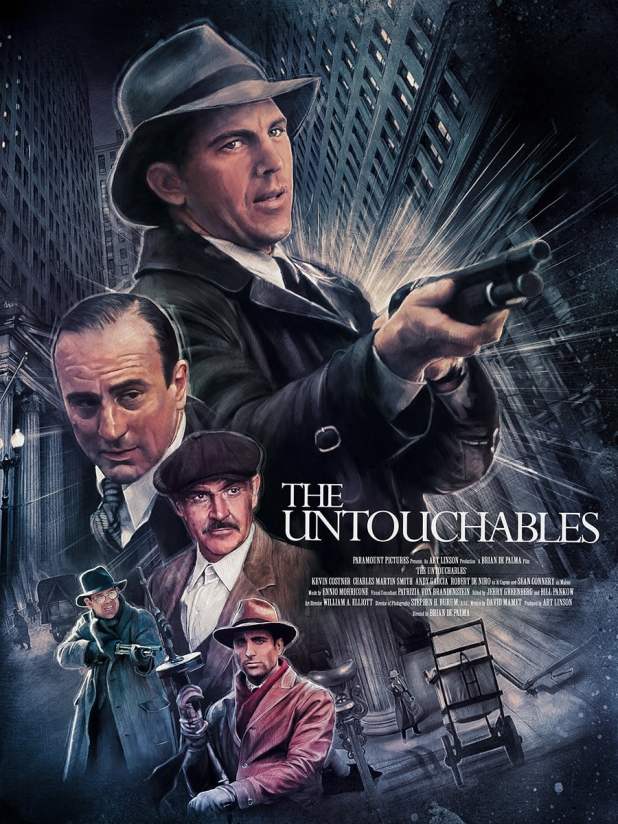
THE FILMS OF BRIAN DE PALMA: The Untouchables (1987)

Robert DeNiro* had not worked with Brian De Palma since Greetings and Hi Mom. That theme for taking forever to make something happen also is something that Ned Tanen knew all about.

He spent years trying to obtain the rights to Eliot Ness’s life story while working as an executive at Universal Pictures. After becoming head of motion picture productions at Paramount Pictures, which owned the film and television rights to Ness’s memoir The Untouchables, he hired Art Linson to begin producing a film adaptation.

Linson didn’t have any interest in remaking the TV series. Instead, he wanted to show the real world Ness and his career in Chicago. He hired playwright David Mamet to write the script, which other than a few changes for the sake of new locations, went unchanged. De Palma wouldn’t take much credit for what he did, telling The New York Times, “Being a writer myself, I don’t like to take credit for things I didn’t do. I didn’t develop this script. David used some of my ideas and he didn’t use some of them. I looked upon it more clinically, as a piece of material that has to be shaped, with certain scenes here or there. But as for the moral dimension, that’s more or less the conception of the script, and I just implemented it with my skills – which are well developed. It’s good to walk in somebody else’s shoes for a while. You get out of your own obsessions; you are in the service of somebody else’s vision, and that’s a great discipline for a director.”

While De Palma’s movie is based on historic events, most of the film is inaccurate. For example, there was no border raid, no shootouts at the train station or courthouse. Ness didn’t even have much to do with Capone’s conviction at the end of everything. Frank Nitti killed himself 12 years after the trial. And Capone ordered his men to not kill or harm Ness or any of his agents. Sure, he tried to bribe them. But he knew that any violence against him would only bring more government interest.

Movies don’t have to be real to be great.

Instead, let’s indulge in the world of this film, where Ness (Kevin Costner) and James Malone (Sean Connery) form their Untouchables with George Stone (Andy Garcia) and Oscar Wallace (Charles Martin Smith) to go up against Capone and his henchmen like the sinister Nitti (Billy Drago, incredible as always). Let’s thrill to De Palma restaging the Odessa Steps scene in Sergei Eisenstein’s Battleship Potemkin on the stairs of a train station. Let’s watch moments that have transcended just this movie and become part of the film language for everyone.

It really is astounding when you think of the highs and lows of De Palma. For all the attacks he received for his violent films and talk of misogyny, he made movies that have become iconic parts of our mythology.

*De Niro almost didn’t make the film. He was on Broadway at the time and his schedule wasn’t lining up. De Palma then had Bob Hoskins ready for the part. When it. all worked out, he mailed Hoskins a check for £20,000 with a “Thank You” note. Hoskins called the directed to ask him if there were any more films he didn’t want him to be in.
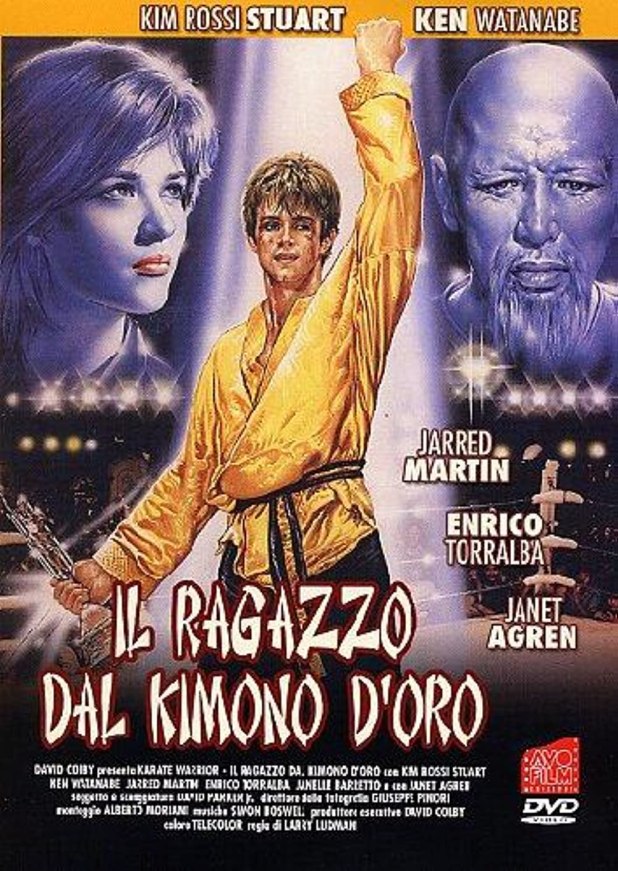
Karate Warrior (1987)

Also known as Fist of Power or Il Ragazzo Dal Kimono D’oro The Boy in the Golden Kimono), Karate Warrior was directed by Larry Ludman, who is really Fabrizio De Angelis. He also wrote this along with Dardano Sacchetti, using The Karate Kid as the obvious playbook but taking the Italian exploitation way of going harder and weirder.

Anthony Scott (Kim Rossi Stuart, who was in Lamberto Bava’s Fantaghiro series of made for TV movies) is in the Philippines visiting his estranged father Paul (Jared Martin, Steve Farlow from Dallas) against the wishes of his mother Juliet (Janet Agren, who got so much work in the 80s and 90s). While there, he falls for Maria (Jannelle Barretto), a girl whose father is being shaken down by a gang led by Quino (Enrico Torralba). Quino was once the student of Miyagi figure Master Kimura (Ken Watanabe), who may as well be Yoda the way the locals speak of him in hushed tones, but now he loves to hurt people. He’s won the local karate tournament five times in a row, a fact that Anthony gets to see for himself.

He can’t keep his mouth shut and the white savior flashbulbs the karate master with his camera and then spin kicks him, leading to a chase all across the Manilla scenery, ending with Anthony getting the beating of his life. Or death, just about. Luckily, he’s nursed back to health by Kimura.

When Anthony recovers, Kimura teaches him how to defend himself in Drunken Master training style, ending with giving him the Stroke of the Dragon, a special martial arts strike that should only be used when he has to defend his life.

This training involves punching cows with karate magic and finding a jungle cat and staring it directly in the eyes. This is way more intense than painting a fence or waxing a car, as Daniel-San will not be able to tell you.

Also in true Italian style, we are asked to believe that Anthony is a true blue American citizen who loves the American football. Except that he’s always wearing a Jacksonville Bulls jersey from the USFL, a team that played their last game two years before this movie was made. And yes, Kim Rossi Stuart is from Rome.

It takes decades to learn martial arts and a lifetime to master them, much less be able to fight blindfolded and throw magic fireballs. Somehow, Karate Warrior does it in ten days and is able to defeat the outfight a killing machine. Cool story, dude.

That said, I totally love that every time Anthony gets beat up, it’s the most violent beatdown you’ve ever seen. I never feared for Daniel’s life in The Karate Kid but in this, I am sure every time that Karate Warrior is about to die. And how about the ending, where his dad tells his ex-wife that yes, their son is going to an expensive Ivy League school, but now he has to prove himself as a man and in the very next scene he gets beaten so badly that he bleeds out of his eyeballs and needs to go into the last round blindfolded.

This was so successful that there are six of these movies, which is way more than The Karate Kid got before Cobra Kai started. I am probably the only person demanding a new Karate Warrior series.

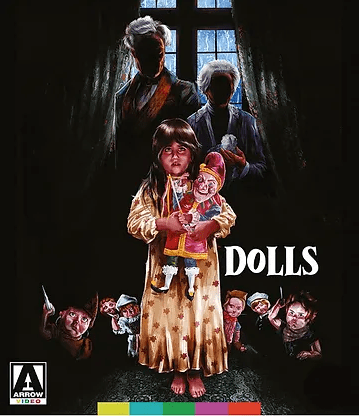
ARROW BOX SET RELEASE: Enter the Video Store – Empire of Screams: Dolls (1987)

EDITOR’S NOTE: This was first on the site on . It’s back as it’s now part of the Enter the Video Store — Empire of Screams box set. Extras include new audio commentary by David Decoteau, an archive audio commentary with director Stuart Gordon and writer Ed Naha and a third archive audio commentary with cast members Carolyn Purdy-Gordon, Stephen Lee, Carrie Lorraine, and Ian Patrick Williams. There’s also a new interview with editor Lee Percy, a making-of, film-to-storyboard comparisons, trailers and an image gallery. You can get this set from MVD.

Six people are stranded at a mansion in the English countryside — David Bower and Rosemary Bower (Carolyn Purdy-Gordon, wife of Stuart Gordon), two totally selfish and uncaring parents, and their daughter Judy. Plus, we have nice guy Ralph and two British punk rock hitchhikers, Isabel (played by Bunty Bailey, who starred in two landmark music videos for the band A-Ha) and Enid.

The mansion is owned by Gabriel and Hilary Hartwicke (Hilary Mason, the blind psychic from Don’t Look Now), toy makers who fill their home with their creations. As Judy had to give up her old teddy bear by her evil stepmother, they give her a new doll, Mr. Punch.

We soon discover that the dolls are alive and love to destroy humans — the eviler the better. The two girls try to steal antiques and get their faces smashed in and shot by toy soldiers before becoming dolls themselves. Rosemary is attacked by the dolls, then leaps out a window to her death. Her body is brought back to the house, leading David to believe Ralph is a killer.

Meanwhile, Judy reveals to Ralph that the dolls are alive and talks them into saving his life. David attacks, knocking out his daughter and the man he blames for his wife’s death, but the dolls save them. Mr. Punch battles David but is destroyed.

The old owners of the house reveal themselves and explain that the house tests people. Either they pass — like Ralph and Judy. Or they fail, like everyone else, and are turned into dolls. It just depends on who believes in the power of childhood. David now becomes Judy’s new doll, Judy picks Ralph to be her new dad and she leaves for home.

Meanwhile, we see all the evil folks as dolls on the shelf as new people get stuck outside the house and the cycle begins again.

Dolls is a Stuart Gordon (Re-AnimatorHoney, I Shrunk the KidsCastle Freak) film and feels like a test run for the Demonic Toys movies. There are some moments of great invention, like the giant evil teddy bear and the eyeballs popping out of the punk girl. It was a theatrical release that actually didn’t do well, but found new life on video — where a young version of my wife found it and rented it just about every day.

Interestingly enough, the house where the movie was filmed once belonged to Dino De Laurentiis. It was an actual two-story house, but the outside of the house featured remnants of other De Laurentiis films, including Barbarella!

You can listen to us discuss this film on our podcast right here!

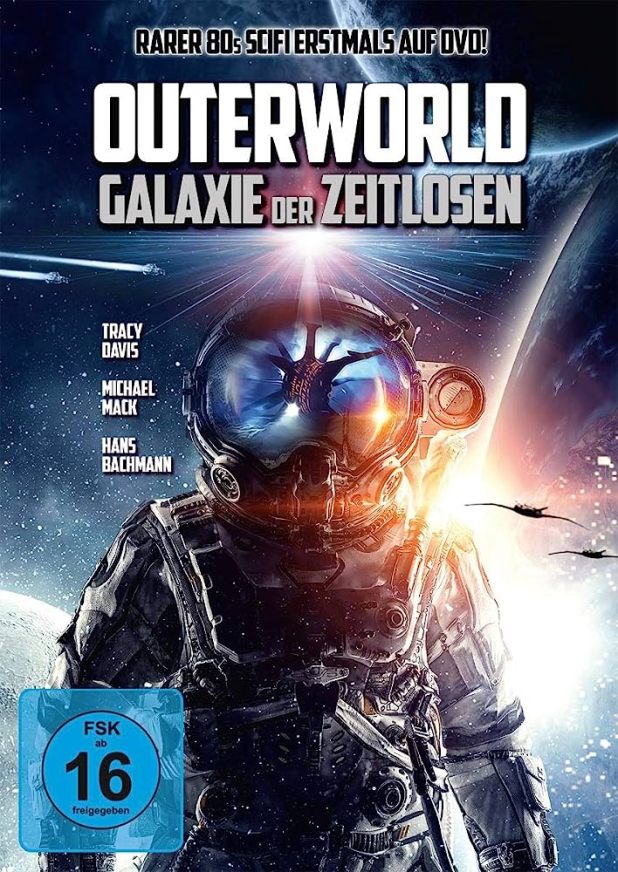
Outerworld (1987)

EDITOR’S NOTE: You can read another take on this movie here.

2074: Corporations control the world instead of governments. Genetically engineered superbeing Pentan (Tracy Davis) serves her creator, Kuriyama Enterprises,  as a corporate assassin and covert agent. Her latest mission involves finding an abandoned alien ship, the second that has crashed landed. The first made those that found it rich beyond their wildest fantasies; the kind of rich that can change Pentan’s life.

The only problem is that because she’s turned her back on her creators, a nanite bomb in the back of her head will kill her in just a few days unless scientist Robert Thorton (Rick Foucheaux) can save her.

Together with space jockey Harold Brickman (Hans Bachman), she plans on finding the treasure while avoiding the massive star cruiser Promethian and the killers who want her back. And oh yeah — instead of just pretending to have feelings, she’s finally developing them.

Outerworld originally was StarQuest: Beyond the Rising Moon and if you had Sci-Fi back before it was SyFy, you may have seen it. Director and writer Phillip J. Cook took this shot on film effort and restored, remixed and added new digital video effects to improve the movie.

Cook’s Gerry Anderson influence is all over this movie, as the ships look like they could come from Stingray or any other of his shows. As a kid, I used to stare in wonder at a book of spaceships that had art by Colin Hay, Chris Foss, Angus McKie and Peter Elson. This movie takes those gorgeous pieces of space fantasy art and makes them as real as possible (and as a low budget will allow). There were thirty hand-built sets and over 270 effects shots which were all achieved for around $175,000. That budget is the most science fiction part of this entire film as it’s incredible that they were achieved for such a low price.

Pentan is the one who is strong and capable, yet unable to trust as she’s never been programmed to. Brickman takes on the role that women usually do in science fiction, needing to be rescued and protected.

Plus, this is lean and mean. 78 minutes. More movies should be that length.

Beyond working for Don Dohler — and then working as a DP for Godfrey Ho on Undefeatable — I assume that Cook played tons of Star Frontiers. This is the second review of his films that I’ve claimed that he played a deep cut TSR game — Despiser feels so much like Gamma World it could be a module for that game — and if I ever get to speak to Mr. Cook, I plan on asking him tons of questions about the Legion of Gold and the Knight Hawks.

What I love about all of his films is that they return you to the joy and wonder of being a child. I get the same kind of sense of amazement that I received when I watched Starcrash at the drive-in. And even when people decry the story or the effects, I can’t hear a single thing they say. This movie is beyond criticism. All I can do is tell you why it’s important to me and ask you to watch it.

You can watch this on Tubi.

Junesploitation: Night Screams (1987)

June 7: Junesploitation’s topic of the day — as suggested by F This Movie— is Slashers! We’re excited to tackle a different genre every day, so check back and see what’s next.

Wichita, Kansas is a crazy place.

David (Joe Manno) has been playing football his whole life to make his father happy, finally getting scouted and getting to be a Boomer Sooner for Barry Switzer’s  University of Oklahoma. But he better keep up on his pills, as his mother keeps reminding him.

Mom and dad aren’t around tonight, though, so his friends D.B. (Ron Thomas, Bobby from The Karate Kid), Russell, Chuck, Brenda, Mason, Joni, Lisa (Janette Caldwell, who also shows up in small parts in Heart and Souls and Striking Distance), Frannie, Doug and Chris throw him a farewell party — I mean, college does not work this way, you don’t instantly leave town in the middle of the football season, which I would assume is late September — and set themselves up as sacrifices for Runner and Snake, two escaped convicts who have conveniently decided to hide in the basement of David’s house, along with a former mental patient who has ties to David.

And boy do they die. Mason is impaled with a fireplace poker. Brenda tries to leave and someone attacks her inside her car, so she jumps out and hides under another car, which crushes her. Chris is hit in the head with an axe. Doug is killed by a light tube tossed into the hot stones of a sauna. Frank has his face grilled. Lisa is strangled. Russell is choked. Frannie is electrocuted in the hot tub. Even Russell gets killed when he starts to show some morality about the whole evening. D.B. gets stabbed in the stomach but is able to kill Snake at the last minute. I feel like I should have buried some of the lyrics from “88 Lines About 44 Women” in this paragraph to see if you were paying attention.

David has had a hyperactivity disorder since he was a kid which causes him to lose his temper. You might start to think that he could be the killer — I mean, the cops and his parents sure do — but then you’d miss the twist.

Director Allen Plone went on to direct Phantom of the RitzSweet Justice and made a winery’s franchise video this year, so he’s still working. Writer Mitch Brian went on to write Transformations and twelve episodes of Batman the Animated Series and his co-writer Dillis L. Hart II also produced this movie.

When this was first made, the producers felt that it wasn’t long enough, plus it was missing the critical ingredients of the slasher: sex, nudity and gore. They grafted on scenes from Graduation Day, with the kids watching that movie — and giving away the ending of that movie! — and then shooting some skin so that no one would be disappointed when they watched it. And hey! The Sweetheart Dancers show up and dance in a nightclub!

This movie hit just right for me, thanks to a religion-obsessed killer, a hidden secret killer (double positive or negative, depending on your morals), a cop not only set on fire but shotgun blasted, the jokester character getting killed in a satisfying way, a couple that just wants to watch porn (she even complains about watching the same one all the time but man, I recognize Seka on the TV and this makes me happy and realize what a pervert I am that a brief clip of early 80s hardcore shows up and I say, “Oh yeah, that’s Seka and John Holmes” and wonder who I would have thrown on and yes, it would have either been Siobhan Hunter at the time this came out) and a synth soundtrack that pleases my ears as much at 50 as it would have at 15 when this came out.

Someone wrote on Letterboxd “it’s hardly deserving of an individual release” and the jokes on you. It’s not just a DVD or blu ray, it’s a 4K now.

You can get this from Vinegar Syndrome. The film has been newly scanned and restored in 4K from its 35mm original camera negative. You get both the Pre-Release and Standard Theatrical versions, as well as brand new commentary from director Allen Plone and cinematographer Eric Anderson, moderated by special features producer Ewan Cant. There’s also Blood and Chopsticks: Echoes of Night Screams, a new making-of documentary featuring interviews with the cast and crew, an introduction from executive producer Richard Caliendo and co-writer/producer Dillis L. Hart II, the original trailer and reversible sleeve artwork.

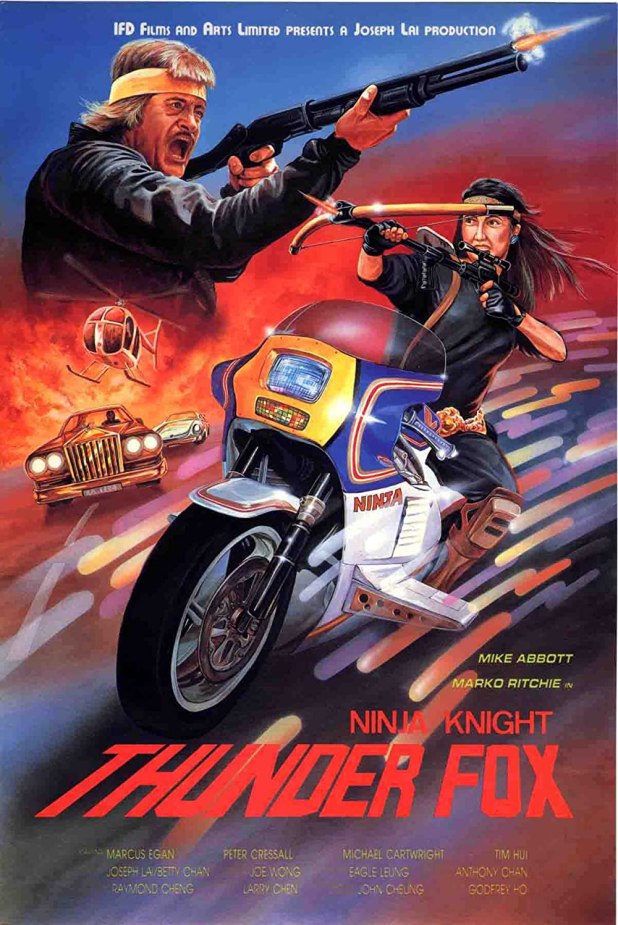
Night Ninja Thunder Fox (1987)

Night Ninja Thunder Fox is a much better title than Ninja Empire. I don’t know what it has to do with this movie, but it does sound more mysterious.

Just so you know, I hate AI writing. I’ve been tasked at work with using more of it and I feel like I’m helping Skynet kill John Connor, so this is really the worst timeline as writers like me look at our jobs being co-opted and a world where machines make art and words while we look at the kind of backbreaking work that machines were supposed to do. The Terminator didn’t win through violence, they won by convincing those that can’t create that creativity is no longer worth time or energy.

However, I thought it would be funny if I asked ChatGPT to write some of this and asked it, “How is Godfrey Ho like ChatGPT?”

Godfrey Ho and ChatGPT have some similarities, despite being different entities.

  1. Creativity and uniqueness: Godfrey Ho is known for his unconventional filmmaking style, often combining unrelated footage from different movies to create a new narrative. Similarly, ChatGPT demonstrates creativity by generating unique responses based on the input it receives, sometimes coming up with unexpected and original ideas.
  2. Adaptability: Godfrey Ho was known for working on low-budget films and making the best out of limited resources. Similarly, ChatGPT is designed to adapt to various topics and provide information or engage in conversation on a wide range of subjects.
  3. Collaboration: Godfrey Ho frequently collaborated with other filmmakers, actors and production teams, often incorporating their work into his own movies. Similarly, ChatGPT is a product of collaboration between OpenAI engineers and researchers, who worked together to create and refine the language model.
  4. Engaging with the audience: Godfrey Ho’s films, despite their unconventional nature, managed to capture the attention of audiences through their unique style and storytelling. Similarly, ChatGPT engages with users by providing responses that aim to be informative, helpful and engaging.

Despite these similarities, it’s important to note that Godfrey Ho is a filmmaker, while ChatGPT is an artificial intelligence language model. Their purposes, capabilities and areas of expertise differ significantly.

As you can see, the idea — that Godfrey Ho and ChatGPT are similar, came from a human brain. The rest is all filler, the kind a college student angry that they have to write 500 words on a paper would write.

But yes, Godfrey Ho is like artificial intelligence. The films change titles, they incorporate multiple movies, but they are viruses for my brain, named things like, well, Night Ninja Thunder Fox with eye-catching posters and odd choices and here I am, watching ten of them in a week.

Maybe the machines will win.*

Taking new ninja footage shot with nothing to do with the narrative of another movie, the Wen-Hsing Lai directed and written Fierce Lady, this movie even has a detective team — Brad and Bonnie’s Detective Agency — split between the two totally unique halves of its whole. Brad (Marko Ritchie) sits in an office, surrounded by posters of motorcycles and Cobra along with a huge phto of Bonnie and cases of Coca-Cola, talking on the phone with Bonnie (Hsu Ying-Chu), who is the one getting into all the action, seeing as how she’s in the other movie that takes so much of. Brad eventually has to deal with Decker (Mike Abbott), but for now, he’s listening in on his partner and her adventures.

A student from Judy Chen’s Modeling School named Pam calls Brad, telling him that she’s located microfilm — microfilm is to Godfrey Ho as stolen diamonds are to Jess Franco — that has the evidence he needs for his big case. That school has some wild classes, including one where girls do aerobics until some criminals bust in and get decimated by the ladies. It almost makes you wonder why they have to go through with their business strategy of hooking every student on drugs and then turning them out as sex workers. It’s like, I go crazy trying to figure out how Tanz Akademie ran a school where ancient witches murdered nearly every student. I worked in higher education marketing for years and it’s incredibly difficult. One can only imagine how angry some people had to be, because their ads were good enough to get American girls to come and study there, and that old woman in the basement just wants her dead. How do they make actual money? I mean, I can see Judy Chen’s plan. I guess there’s more to sex work than modeling and they can claim 100% placement, which looks good to parents.

Bonnie is a student at that school now, the same place where her sister was killed, and if you think a movie about a girl’s school isn’t going to be full of the male gaze, you have not ever been on our site before. That said, fashion models fighting and killing evil men is a genre I think we can all support.

Somehow in all this, Brad reveals that he’s a ninja and so is Decker. They can transform with finger signals now. Forget Shazam. They don’t even need to say a magic word. Except even with all their magic,  they fight with guns.

There are also some intense stabbing scenes and a final battle where Bonnie puts on a studded headband and goes full on Stallone — but with a crossbow — and kills everyone and everything. I am a fan.

My Shazam app lost its mind during this: “Run Nancy,” “No Escape” and “Final Search” from the score to A Nightmare On Elm Street; “Eyes Are Mosaics” by Cocteau Twins; “Dolphin Dance,” “Ride On a Ray,” “Song of the Whale parts 1 and 2,” “Phaedra” and “Poland” by Tangerine Dream (plus an Edgar Frosse version of that song); some of the Starman score; “The Narrow Way part 3” by Pink Floyd; “Back Door” by Clan of Xymox; “Pointless” and “Hurt” by Re-Flex and “A Nation Rejects” by Art of Noise. I’m still at a loss to figure it out, but I love every song.

My brain hurts from fighting T800 chat programs and Godfrey Ho ninjas.

You can watch this on Tubi.

*In fact, a machine would remember that they already watched this. I already posted this in June of last year and watched it all over again and it was like watching a whole new movie.

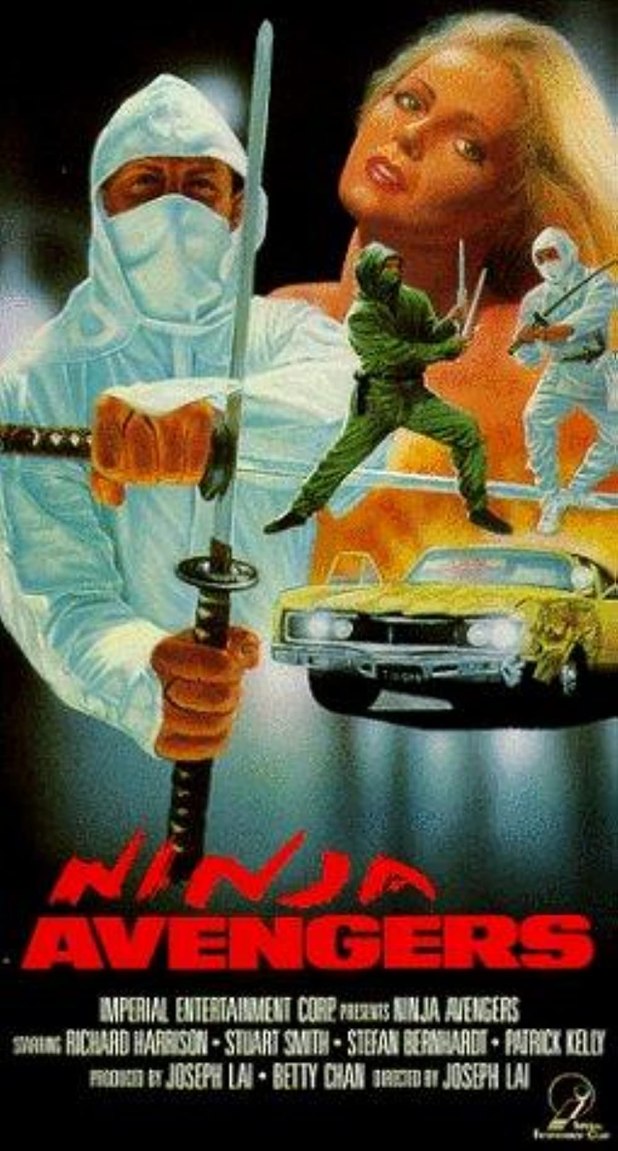
Ninja Avengers (1987)

Also known as Shaolin Quick DrawNinja: Champion on Fire and Ninja Operation 6: Champion on Fire, this Godfrey Ho-directed mix and match remake remix rip-off takes much of its story from Da di long zhong (Fury In Storm), a 1974 Chin-Liang Hsu-directed movie that features a guy named Anthony (Patrick Kelly), a Catholic who is such a true believer that he carries a wooden cross like Jesus. He carries it everywhere.

He’s nearly killed when the train that allows him on is taken over by a Japanese gang, but he’s the one that slowed the train down so they could attack it. They get what they wanted, a gold statue, and then double-cross him.

They crucify him, even placing a man on each side of him, but somehow he survives and ends up meeting a man named Dragon (Yi Chang), a martial arts master who teaches him how to withstand blows from weapons and walk through punches and kicks.

Does this seem weird enough for you? I mean, the original film was called Django – Im Reich der gelben Teufel (Django – In the Realm of the Yellow Devils) in Germany. That’s because just like Django’s coffin, Anthony’s crucifix — that he’s already survived being crucified on — has a Gatling gun inside it.

Master Gordon (Richard Harrison), the ninja who has been in so many of Godfrey Ho’s movies, shows up in this, battling other brightly colored ninjas and also meeting Anthony in a waterfall to warn him about a danger he is about to face. He’s also about to battle an evil ninja named Ringo (Stuart Smith).

This is also very much an Italian Western with an ambiguous hero — Anthony is a man of God but somehow has no issues slapping around the lover of the main bad guy, who has fallen for Dragon and he or her — and an ending where, like the best of the Eurowest, nearly everybody dies, including Anthony chasing most of the gang that put him up against a firing squad earlier and doing onto others as you would have them do onto you.

Also, as always, lots of Tangerine Dream. Some Mike Oldfield, too.

The movies of Godfrey Ho and the AAV Creative Unit are always going to be strange. But even I was not ready for this film which tears through pop culture, ripping off rip-offs, reducing film to some formless amorphous ever-changing Silly Putty that distorts but retains some of the story of the funny pages that it has stretched out upon.

You can watch this on Tubi.

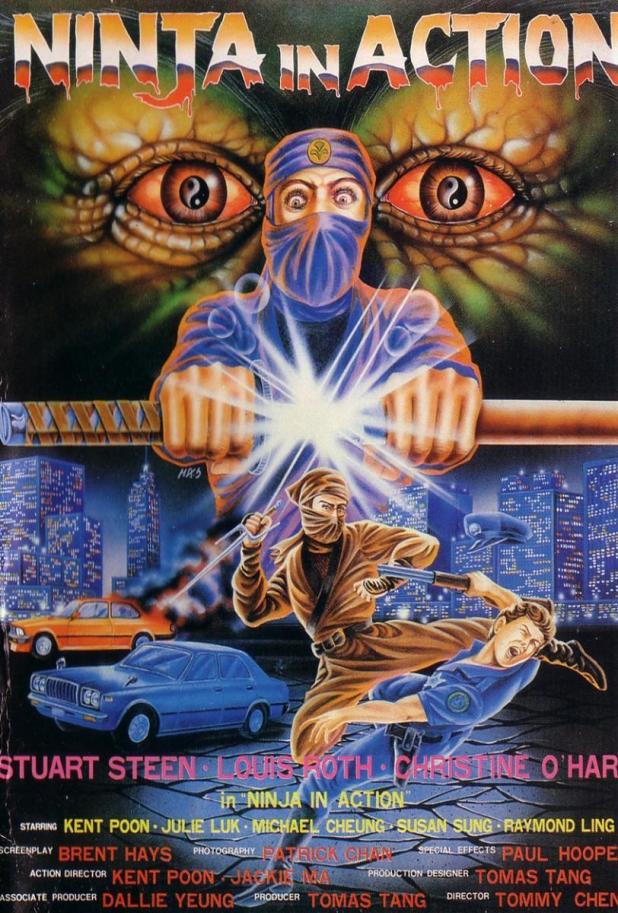
Ninja In Action (1987)

When Mr. Hansen comes to Hong Kong, he is attacked in moments by ninjas, as often happens. Please understand that I have never been to Hong Kong and I base this thought on the fact that I have watched ten Godrey Ho movies in two days. But anyways, Hansen as a briefcase filled with diamonds handcuffed to his wrist and the ninjas just slice it off, killing him.

Back in their ninja base — or lair — Mr. X laughs about their big win and offers wine for all his ninja friends. They’re sure he’s poisoned it, but he drinks some himself, so they figure it’s safe. Nope. Only Allan — yes, Allan the ninja — doesn’t drink. He steals the briefcase and runs, ending up at the birthday party for his girlfriend Rose.

This is where Godfrey tempts the gods of music copyright law, using not just one but two different versions of “Happy Birthday” back when you had to pay for it. More on music later, but suffice to say that Godfrey Ho feels the same way about copyright law as Negativland. Or maybe he just doesn’t care at all. Definitely, actually.

Mr. X calls the cops on Allan and he gets arrested. Near immediately, his brother Ken makes a move on Rose, which I think is worse than poisoning your ninja brothers. Allan spends years in jail and gets out with revenge on the brain. Also, obviously, everything in this part of the story is from a completely different already-made movie.

Meet our other hero: Rex (Stuart Smith). He’s in a hotel room working out when his girl — and surprise Mr. Hansen’s daughter — Tina (Christine O’Hara) end up making love in a way that feels voyeuristic to me, the viewer, in a way that does not make me comfortable. Who says things like, “It’s not fair. You’re so fit and strong.” while getting made love to?

They’re in Hong Kong to find the real killer and cross over with Allan but never actually meet because they’re in two different movies. Allan is really in Chester Wong’s The Outlaw (his Queen Bee’s Revenge had already been remixed by Ho as Ninja: American Warrior).

What they do, however, is capture one of the ninjas that attacks them and spend an inordinate amount of time studying a guide on acupuncture and stabbing him with multiple needles — after waterboarding him and using a cigarette lighter on his balls — to get the answers they need. Oh yeah. They’re Americans.

According to some sources, this isn’t Godfrey Ho — he used the name Tommy Cheng — but really Cheng Kei-Ying, who was once an actor. It feels just like the typical Ho movie if not more mean spirited in all the best of ways. I mean, when else will you see the heroine put rocks in her purse and beat the stuffing out of the final boss? Or one that ends with the hero taking away the villain’s ability to ever be a ninja again, which causes him to commit seppuku as blood sprays everywhere?

Now, to the music.

Ninja In Action has some great selections, including “The Sun Always Shines On TV” by a-ha, “Cuba Libre (remix)” by Modern Rocketry, Dirty Harry soundtrack by Lalo Schifrin, Star Trek II: The Wrath of Khan soundtrack by James Horner and “Love’s Gonna Get You” by Freeez.

According to nts.live, Modern Rocketry was “a hi-nrg disco band featuring Ken Kessie, active from 1983 to 1988. They’re not very well known — in fact they’re downright obscure — but what little fame they enjoyed was probably due to their 1985 release, best described as the gayest disco song ever. “Homosexuality,” with its b-side of ‘Thank God For Men,” followed in the well-trodden footsteps of Patrick Cowley’s “Menergy” and Boystown Gang’s “Cruising In The Streets” with massive gay audience appeal. A hit in gay clubland, it’s not uncommon to hear it nowadays.”

Hear it in a ninja movie.

You can watch this on Tubi.

Cobra Against Ninja (1987)

A purple ninja named Cobra (Stuart Smith) is making big bets on fight club ninja battles involving pink and white ninja Gordon (Richard Harrison, who told Nanarland that he thought he was making one movie for director Godfrey Ho and “I have no idea how many films they made from my last filming, but some say as many as ten. I put a lot of trust in friendship, so it hurt more than just professionally.” He also claimed that this experience made him stop making movies.), who is training some ninjas named David, Kirk, Benny and Chester. Chester is the one who ends up mixed up in organized crime with his mother killed and his siter kidnapped. There is also talk of a ninja challenge card.

With Joseph Lai credited as director — Ho’s all over this — and the AAV Creative Unit, Stephen So and Ho credited as writing the script, this is another remix from multiple sources, in this case being footage from 1978s Kaa maa jaak meuang na-kon.

There’s also a scene where a girl named Rose is belittled because she never finished school and all she knows how to do is cook, how stupid cooking is and how stupid she is for continuing to cook.

I want to know just how secret these ninjas are, because Cobra just goes to a betting office — an OTNB (Off Track Ninja Betting)? — to place wagers on battles between pajama wearing karate fighters. Then again, this is a movie that has a ninja named White Dolphin wearing all black and a plot that wishes it was just confusing but is so many steps beyond simply being incomprehensible, so I don’t know why I ask these things.

The Ninja Commandments have been broken. That’s what I really need to worry about.

As always, the music in this movie is jarring. This time, I was able to watch “Main Attraction” by Italian-American post-disco recording artists B. B. & Q. Band, “Johnson’s Aeroplane” by INXS and “Set Controls for the Heart of the Sun” by Pink Floyd.

You can watch thion Tubi.

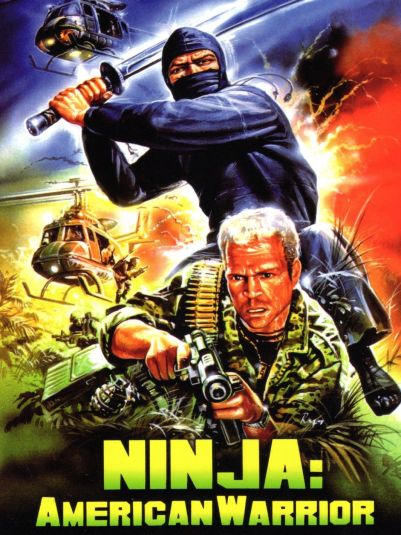
Ninja: American Warrior (1987)

If you have not indulged in the movie drug heroin that is the cinema of Godfrey Ho, the best way to describe it is watching several movies at once. He goes beyond even the remix remake rip-off cinema of other countries and the copy and paste of Bruno Mattei to outright sample and steal from so many sources that it often seems as if the movie begins and ends in ways that you have no way to see coming. Characters appear and disappear, film stocks and aspect ratios no longer matter, rational storytelling is deleted and music from sources you’d never expect take over.

Also: This has totally new footage by Tommy Cheng (Cheng Kei-Ying) interacting with the footage that Filmark bought and tossed into a blender.

It’s nearly useless to even explain what this movie is about but hey, I’m the kind of person who stays awake all night trying to round off infinity. Let’s attempt this.

One of the stories in this movie is taken outright from Queen Bee’s Revenge (Nu wang feng fu qiao), a 1981 revenge-a-matic sequel to another revenge movie, Queen Bee, which was released in Taiwan the very same year.

But forget all that. This movie begins with two ninjas attacking a woman dressed in very 80s workout gear. One of them even sets his own hands ablaze to battle her. She easily defeats them and mentions that she only has Black Cougar Ninja — a face painted goth looking ninja — left to defeat. Well, he and his men attack and seemingly kills Amazonia (who is Queen Bee from the footage from that movie) but she ends up being the aerobics-gear woman. Confused? Forget the definition of what that means.

Anyways, Amazonia is on the trail of The Shrew, the biggest Triad boss, and she’s also a ninja. Or ninja trained. Is that the same thing?

There’s also a guy named John, who I guess is the American Ninja in this — no, he’s not American Ninja Michael Dudikoff or American Ninja David Bradley — as he goes after a drug dealer named Justin. John is a really horrible mustached ninja, as he can’t even escape a locked car without using a smoke bomb, which is one of the dumbest — and most entertaining — moments I’ve ever seen in a movie.

He’s also a Vietnam vet, so you know, get all the different mom and pop shelves covered here. But yeah — John and Justin once were in the shit together and they have a bond, but once you work for The Shrew, you sign your death warrant. We even get a drunken flipout from the bad guy about how America never took back its vets so he’s staying here, he’s dealing drugs and he plans on never going back. Then he yells, “I’m a winner! I’m a super winner!”

I have so many questions from this movie and I hope they are never answered so that I can remain blissfully wondering forever. What is “time warp king fu?” How do ninjas learn how to basically throw bullets? Who is that little kid that gets menaced or the guy who refers to the criminals as “fuck abouts?” Who decided that a fight in a disco should be scored to “In the City” by Eagles?

Speaking of music, this movie also uses  “Love Is a Fire” by Genya Ravan from The Warriors in that same club scene, which makes a lot of sense, even if the movie itself doesn’t.

You can watch this on Tubi which added to my enjoyment because it’s part of Sho Kosugi Ninja Theatre and this starts with a moment of Sho showing off how to use Tekagi-Shuko — ninja claws, if you will — in combat. This footage looks battered, like tenth generation VHS quality and I loved every minute of it.