Armand Mastroianni directed The Clairvoyant, The Supernaturals and He Knows You’re Alone, so he has to have some understanding of horror. Sadly, this is another funny — so they say — episode. David Gerrold wrote plenty of TV — maybe we can’t blame Louis Haber, one of the credited writers, who didn’t — so one wonders why an episode where the entire plot is summed up as politicians are clowns ever made it to air.
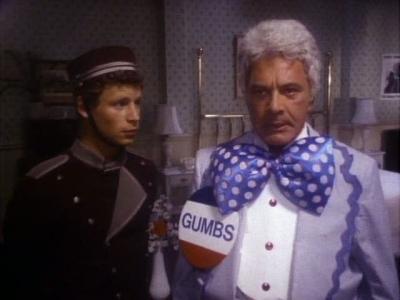
Dick Shawn is Bo Gumbs, a politician drinks whiskey, dancing with a maid and talks about politics with the bellboy. Then, as he sends his clothes to the laundry, surprise, he ends up having clown shoes.
Remember when George Romero was once the guy who had nuanced commentary in his films and then suddenly his later movies felt like the most obvious messages ever? I worry that he was compromised by this show, which often takes the easiest way to 22 minutes of syndicated storytelling.
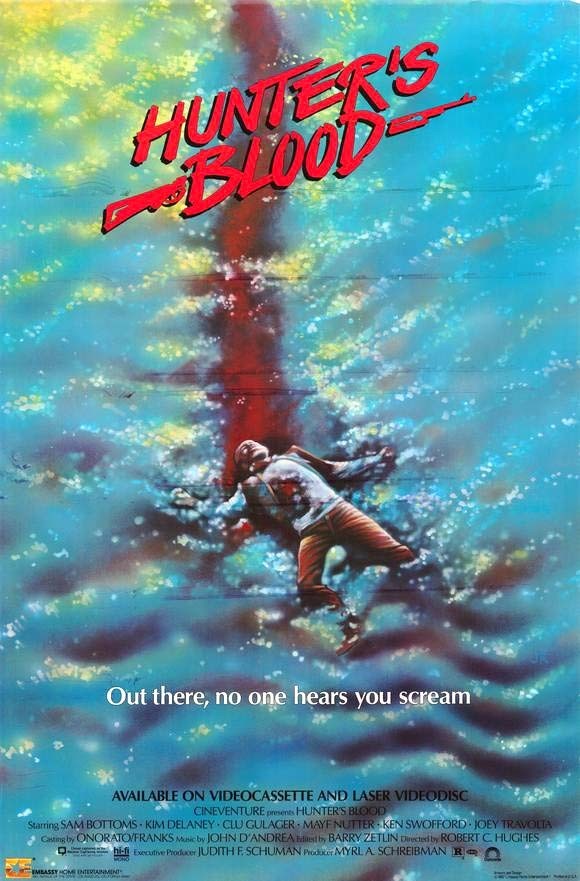
Hickspoitation is a genre I don’t get into all that much, but this is a fine example of it and feels like going down to the river (I almost wrote going down river, because Western Pennsylvania language eats all the verbs and connective words).
Look, if you have a girlfriend as hot as Kim Delaney willing to have sex with you at 4 AM and then let you go hunting, you should just skip the outdoors and stay in bed with her. Or the shower. Or anywhere she wants to go.
But yeah. David Rand (Sam Bottoms) leaves Melanie (Delaney) at home and heads off to get a buck with his dad (Clu Gulager), his dad’s best friend Big Al (Ken Swofford), Al’s brother Ralph (Mayf Nutter) and Marty (Joey Travolta). Every single one of them other than dad — Mason is his name — is a complete idiot. I mean, why would you drive to the woods that you own and then anger the people all around you, the people that have to live there and already resent you?
People like Charles Cyphers, Bruce Glover, Billy Bob Thornton and Micky Jones, all looking like they just want you to screw up so they can set you straight. Of course, the men from the civilized world will have to become uncivilized, as always occurs in these movies.
Director Robert Hughes also made Memorial Valley Massacre, while writer Emmett Alston would also create the script for Three-Way Weekend, Nine Deaths of the Ninja(which he also directed) and New Year’s Evil. This movie was based on a novel by Jere Cunningham, who also wrote Judgement Night, which is pretty much the same idea as this except in the inner city.
EDITOR’S NOTE: This was first on the site on May 28, 2022 and I almost did it myself for Cannon Month, but nobody knows Fred Olen Ray movies better than Jenn.
Take a look at that catalog from 21st Century. What a year of pure wild cinema!
ABOUT THE AUTHOR: Jennifer Upton is an American (non-werewolf) writer/editor in London. She currently works as a freelance ghostwriter of personal memoirs and writes for several blogs on topics as diverse as film history, punk rock, women’s issues, and international politics. For links to her work, please visit https://www.jennuptonwriter.com or send her a Tweet @Jennxldn
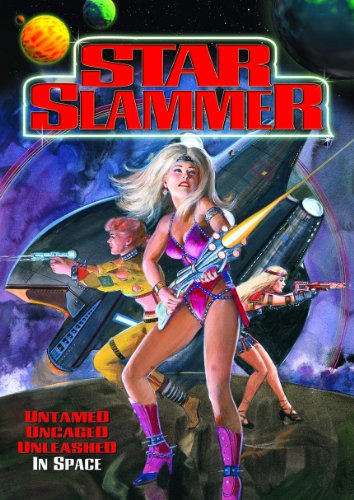
Fred Olen Ray’s women’s prison in space movie. Sandy Brooke plays Taura, a miner who gets sent to the big house…or rather big ship…after crossing paths with Bantor (Ross Hagen in his first appearance in Ray joint), on the planet Arous. Once onboard the “Vehemence”, it’s pretty standard stuff in terms of the women’s prison genre minus the obligatory shower scene. We have a sadistic warden, and her flunky lesbian head guard, played by Marya Gant and an eye-patched Dawn Wildsmith, respectively. We also have a group of tough female convicts with names like Mike and Squeaker who are, at first, wary of Taura but ultimately learn to trust her so they can band together to escape when the opportunity presents itself.
Produced for $200,000 at Roger Corman’s New World studios in Venice Beach, California, Star Slammer gives you a lot of bang for the buck. The prison sets were built using abandoned egg flats and carpet remnants, but they’re lit so well that you can’t tell. Eagle-eyed viewers will also notice that the villains’ costumes came from Metalstorm: The Destruction of Jared-Syn (1983) and the prison guard uniforms are from Galaxy of Terror (1981.) There’s also the land rover from the TV reboot of Logan’s Run, the monster from Ted Bohus’s The Deadly Spawn, footage from John Carpenter’s Dark Star (1974), and spaceship effects from Battle Beyond the Stars (1980). Waste not, want not!
I assumed the most impressive effect of all was Sandy Brooke’s boob job, but an expert has since counseled me that they are more than likely natural. A rare thing indeed in the 1980s. Star Slammer is not a film that takes itself seriously and it looks like it was a helluva lotta fun to make. The scene with the prisoner grooving out playing the harmonica in her cell is hilarious. It’s so funny, it even made the trailer. Throw in cameos from John Carradine and Aldo Ray as “The Judge” and the “Inquisitor” and a cute little robot voiced by the director and you’ve got a lot of laughs.
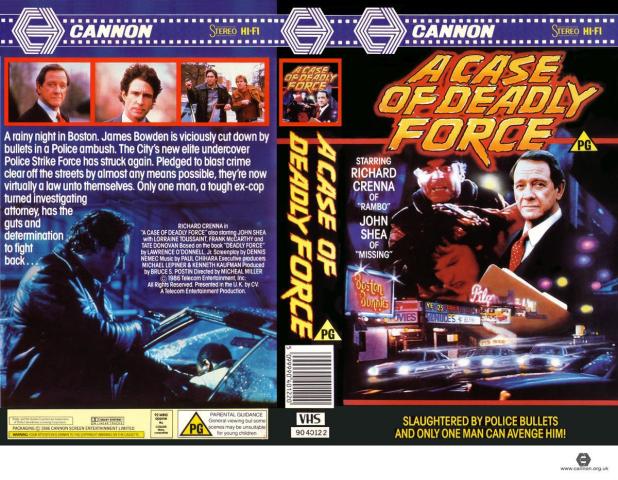
EDITOR’S NOTE: A short break from the 21st Century Films with this non-Cannon-produced TV movie that was released by them in the UK on the Cannon Screen Entertainment Limited video label.
Adapted from the book Deadly Force by Lawrence O’Donnell — who now hosts The Last Word with Lawrence O’Donnell on MSNBC — this made-for-TV movie was released on video by Cannon yet is at odds with so many of the subjects presents by the action-heavy studio.
In a Cannon film, the near-vigilante tactics of the Boston Tactical Unit would be celebrated. Here, this fact-based tale of the 1975 cover-up of an unjustified shooting of a black man by two white members of this police group presents the police as overactive and brutal.
Despite claims of self-defense, the dead man’s widow Pat Bowden (Lorraine Toussaint) claims that her husband would not be carrying a weapon. She hires former cop and current lawyer Lawrence O’Donnell Sr. (Richard Crenna) to clear her husband’s name.
At one point, Lawrence reveals to his legal team — made up of sons Michael, Lawrence Jr., Billy and Kevin (John Shea, Tate Donovan, Tom Isbell, and Dylan Baker) that his father’s death was listed as a suicide and how that impacted the way that the world saw the man that he loved forever after. The case, for him, has become personal, clearing Bowden’s name being seen as him atoning for the way he saw his father.
Director Michael Miller made several films that I dug, like Silent Rage, Jackson County Jail and Class Reunion. He turned those movies into a run of TV movies. Writer Dennis Nemec also was a TV movie veteran and they combined to make a pretty solid film here.
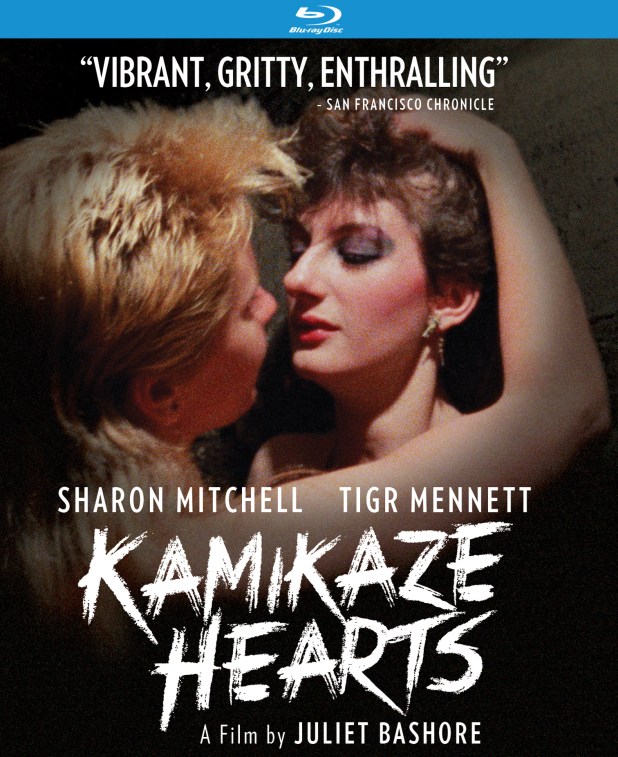
EDITOR’S NOTE: Kamikaze Hearts was first on the site on June 18, 2022. Kino Lorber has now released it on blu ray with extras like a documentary on the making of the film and its enduring legacy, featuring actors Sharon Mitchell and Howie Gordon, author and critic Susie Bright, sexologist Annie Sprinkle, artist Beth Stephens and director Juliet Bashore; audio commentary by Bashore, Mitchell, Gordon, Jon Martin and Shelly Mars; Crash, a short film by Bashore as well as the original and 2022 trailers. Get it now — this is a huge recommendation — from Kino Lorber.
Kamikaze Hearts is a film that has fascinated me since I first read about it in the venerable Cinema Sewer. Now that Kino Lorber has released a new 2K restoration of the film, this is the perfect time to dig in, watch it and learn as much as I can about it.
I’ve been just as intrigued by Ms. Sharon Mitchell and perhaps for a much longer time. During the late 90s and early 00s– yes, when you still had VHS tapes and not streaming — when bleach blondes and pneumatic implants were all the shelves had to offer, Mitchell would occasionally show up in films for brief moments and I’d want to know more about her. With short cropped hair and a non-silicone implanted body, she looked closer to normalcy while also having the kind of real punk look and attitude that doesn’t buy its shirts years later online.
There was no internet — only Adam Film World and Hustler rated movies on an erection scale — so i didn’t learn her full life until later, such as how she began her career as an off-Broadway actress and dancer before starring in some of the 70s roughest films, like Waterpower and The Violation of Claudia.
In 1996, a male stalker assaulted and nearly killed her, which led to her finally kicking heroin, becoming a certified addiction counselor and getting both an MA and a Ph.D. from the Institute for Advanced Study of Human Sexuality all while working a series of odd jobs like catering, dogwalking, being a florist and as a maid.
Mitchell founded the Adult Industry Medical Health Care Foundation (AIM), an organization that provided information and innovated STD testing for all workers in adult entertainment. While a data breach ended that company, Mitchell did so much to make it a safer space.
A decade before that, she was one of the stars of this film. For years, I saw it regarded as a documentary on the relationship that Mitchell had with her co-star Tigr Mennett. The truth is a lot more complicated.
In the incredible oral history of this film conducted by the always astounding The Rialto Report— that will be referred to and used as reference throughout this article — George Csicsery (a documentarian and actor in the film) says, “Some people don’t believe it’s a fictional film and have categorized it as a documentary, while other people see it for what it is; a pure narrative film. But that begs a deeper question: Is anything a documentary? In many ways, I think that is either the genius or the downfall of Kamikaze Hearts.”
Director Juliet Bashore had come from Orange County to San Francisco with no small degree of culture shock. Here was art, punk rock and even adult film — which she was paid well for to work as production assistant. She said, “I’ve got to find a way to make art out of this. I worked a few more of those gigs, telling myself I was “doing research” but frankly equally thrilled to be paid (and very well) in hard, cold (probably Mafia) cash.”
After meeting Tigr on a set, the two began to talk about the strangeness of the world of adult and decided to make a movie about it. And Tigr was in love — or had been in love or never fell out of love — with the woman she saw as its star: Mitchell.
Bashore was influenced by Spalding Grey — ironically, the Swimming to Cambodia author and raconteur performed in adult himself in the Zebedy Colt movie Farmer’s Daughters — and decided to make real life into art with some guardrails, saying “The whole film was completely storyboarded, leaving space within those boarded shots for improvisation. The final edit matches the original storyboard pretty much shot by shot — with the exception of a few additional scenes that were added later. But even these pick-ups were planned for.”
Keep in mind, this was years before movies were completely ad-libbed or even partially made with improvised moments. This Is Spinal Tap was made around the same time as this movie but that’s nearly all trained comedians. This was…more real.
The film starts with Tigr breathlessly telling us about Mitchell: “When I first met her I thought she was sleazy. She needed to make a living, she was fucking on camera – I thought she was just another dumb porno slut. But I was wrong.” And then we see Mitchell, movie star glamorous even on a porn budget — in the back of a cab on the way to the set, discussing Old Hollywood actors and how she feels like she could go mainstream (she was in Tootsie and The Deer Hunter).
Tigr goes on to explain how being in the orbit of a being like Mitchell led her down a path she didn’t expect. And this is why this movie feels so real — and not a quasi-documentary — because it obviously has real significance: I became different. I changed. I wanted to be like her. I wanted to be streetwise. I wanted to know how to use a needle… Goddamn irresponsible, gorgeous, sleazy porno slut. And she has it. And I mean, she’s this woman from New York City, who’s Italian, and she’s hot, and she speaks street language, no one can fuck with her, right? And there was some sort of power that she had that a porno person doesn’t have.”
Much like how in pro wrestling life imitates art imitates life, we soon see Mitchell on stage dancing, then kneeling nude and answering audience questions. When asked what her next film will be, she says, “Truth or Fiction. It is a surrealistic look at myself and my girlfriend and the way we look at the X-rated film business and our relationship with each other, and it’s very nice…I don’t know whether I’m more truth or more fiction.”
Again, like wrestling, porn is about using your body for money, but also engaging in whole cloth character reinvention. Don’t like that you’re a geek who got bullied all through school and have a fascination with the dark side of humanity? Wrestling can give you a corpse paint-covered alter ego and make you way tougher as you fake it — literally — until you make it. In the same way, being nude on screen can create a psychic armor of transgressiveness that allows a star to become more than they are — at least for a time — and become an object of desire. And just like the synchronized violence that happens in the squared circle, fake emotions can become real anger, relationships behind the scenes can become storylines and people can become lost and forget who they ever really were.
Bashore claims that the entire movie was a gift from Tigr to Mitchell, an opportunity to allow her muse to show the world just how talented she could be. That said, it’s hard to say that it’s truly mainstream. In the final moments, in the midst of a breakup, Tigr and Mitchell shoot up coke — real coke in a fake scene — and the camera never breaks for a single moment as Mitchell holds up a needle and says, “This was my dick and I fucked her with my dick. And I waited for this relationship to mature. This is a movie within a movie within a movie. This is timeless.”
In the same way no documentary or narrative movie can show you everything behind the scenes, this feels at once totally false and unabashedly sincere. It exists on a dichotomy that runs through the entire movie like a fault line. And there are real adult figures here — director Charles Webb (Charles De Santos), photographer Vincent Fronczek and actor Jon Martin show up — and musicians like Jennifer Blowdryer and Fast Floyd and the Famous Firebirds appear.
After disappearing for two decades, Kamikaze Hearts was released again. But now, thanks to the world of streaming — and Kino Lorber — we can all decipher for ourselves what is true, what is made up and what is probably both. And none of our answers really need to be right.
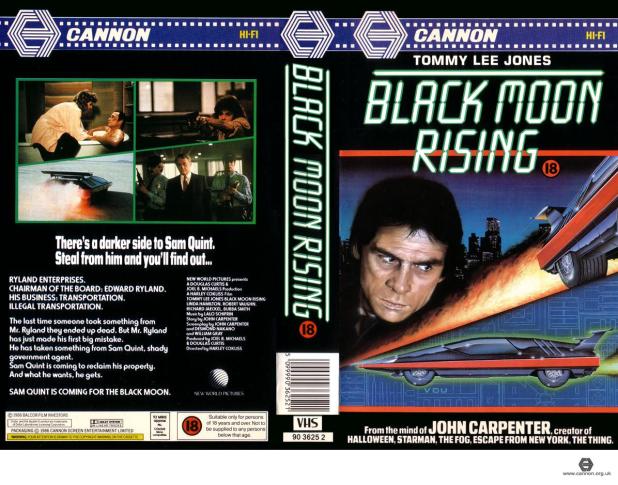
EDITOR’S NOTE: Black Moon Rising was not produced by Cannon but was sold on videotape in the UK by Cannon Screen Entertainment Limited. If you want to read another take on this movie, click here.
John Carpenter wrote this film around the time of Escape from New York but didn’t end up directing it. After some rewrites by William Gray and Desmond Nakano, it ended up being directed by Harley Cokeliss (Battletruck, Dream Demon).
Sam Quint (Tommy Lee Jones) is a thief hired by the FBI to steal evidence against The Lucky Dollar Corporation of Las Vegas. He’s being followed by former friend Marvin Ringer (Lee Ving) so he hides the disk on a car known as the Black Moon which is on its way for Los Angeles and being driven by Earl Windom (Richard Jaeckel).
The Black Moon was designed by Bernard Beaujardins and Clyde Kwok and made by Wingho Auto Classique. Based on the 1980 Wingho Concordia II, it only had one model built and the stunt cars were molded after the hero car. The third car used was just an interior. In the movie, the car can go at least 325 miles an hour which has to be completely out of control to drive.
FBI agent Johnson (Bubba Smith) meets with Quint, who demands more money from all the danger. Well, it gets crazier when a gang of car thieves led by Nina (Linda Hamilton) takes it. Now Quint has three days to get the disk back or not get paid.
With a cast that has William Sanderson, Robert Vaughn, Keenan Wynn, Dan Shor, Don Keith Opper and Nick Cassavetes, the lead role was originally intended for Charles Bronson. Also, if you think the theme is familiar, it’s the same tune that plays in Blue Thunder.
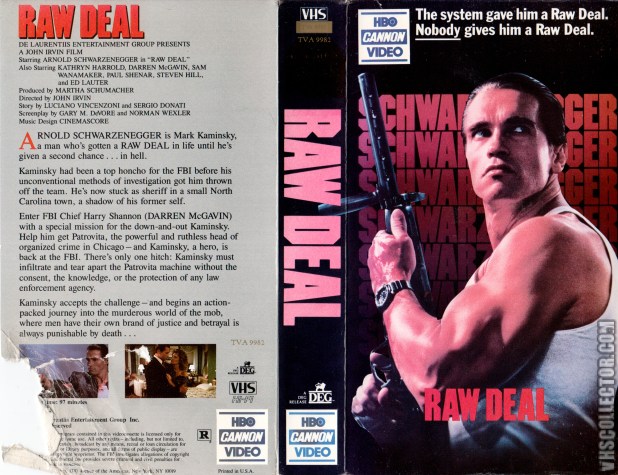
EDITOR’S NOTE: This originally appeared on July 26, 2022. Raw Deal was not produced by Cannon but was released on video by HBO/Cannon Video.
Dino De Laurentiis made this so he could make a quick buck and then make Total Recall. De Laurentiis would eventually file for bankruptcy and sell the rights to Carolco Pictures, who would make the movie with Arnold, who Dino never saw as the lead in that Phillip K. Dick story.
As for Schwarzenegger, if he made this, De Laurentiis would finish out his contract.
I keep thinking back to Roger Ebert’s review* of this: “This plot is so simple (and has been told so many times before), that perhaps the most amazing achievement of Raw Deal is its ability to screw it up. This movie didn’t just happen to be a mess; the filmmakers had to work to make it so confusing.”
That’s true. All they had to do was watch Yojimbo. Or A Fistful of Dollars. Or Django. Or Il conto è chiuso. Or The Warrior and the Sorceress. It’s a simple story that can be told in any way, but this one, well…
At least it has Arnold.
Blair Shannon protects a mob informant with his life, a fact that causes his father — FBI Agent Harry Shannon (Darren McGavin) — to want only one thing: revenge. The object of that pound of flesh retrieval will be Sheriff Mark Kaminski AKA Joseph P. Brenner (Schwarzenegger), himself a former FBI agent who was kicked out for beating the life out of a suspect who sexually assaulted and murdered a young girl. The man who ruined his career — Marvin Baxter (Joe Regalbuto) — is now a special forces prosecutor looking into the same crime family who killed Shannon’s son.
Like some 70s paperback action hero, Kaminski “dies” in a chemical plant explosion and is reborn as the crook Joseph P. Brenner, ready to infiltrate the family — as an Italian it is my duty to inform you that the mafia does not exist and has been created by the mass media as a slander against my people — and has to keep up his fake identity which gets compromised nearly at the cost of Shannon’s life.
It’s a movie filled with character actor tough guys — Ed Lauter, Steven Hill, Dick Durock, Robert Davi and Sven-Ole Thorsen — but the amazing thing is just how brutalized Arnold is by every woman in the cast, in particular his wife Amy (Blanche Baker, Molly Ringwald’s sister in Sixteen Candles and also the daughter of Carroll), who has taken to their isolated small town life with bottle in hand. Yet Arnold remains devoted to her, not giving in to the urge to fall in love with gangster moll Monique (Kathryn Harrold, who was menaced by bats in Nightwing and a large opera singer in Yes, Giorgio).
Directed by John Irvin (Next of Kin — the one with Swayze, who was almost in this) from a script by Luciano Vincenzoni (For a Few Dollars More, Miami Supercops), Sergio Donati (Once Upon a Time In the West, the original Man on Fire) and Gary DeVore (Running Scared), this film seems like a rest stop on the way to Arnold owning Hollywood. However, Arnold has also said that he learned a lot here, referring to Irvin as “a real actor’s director.”
*Meanwhile, Gene Siskel said “it has essentially the same story as Cobra,” which is so wrong.
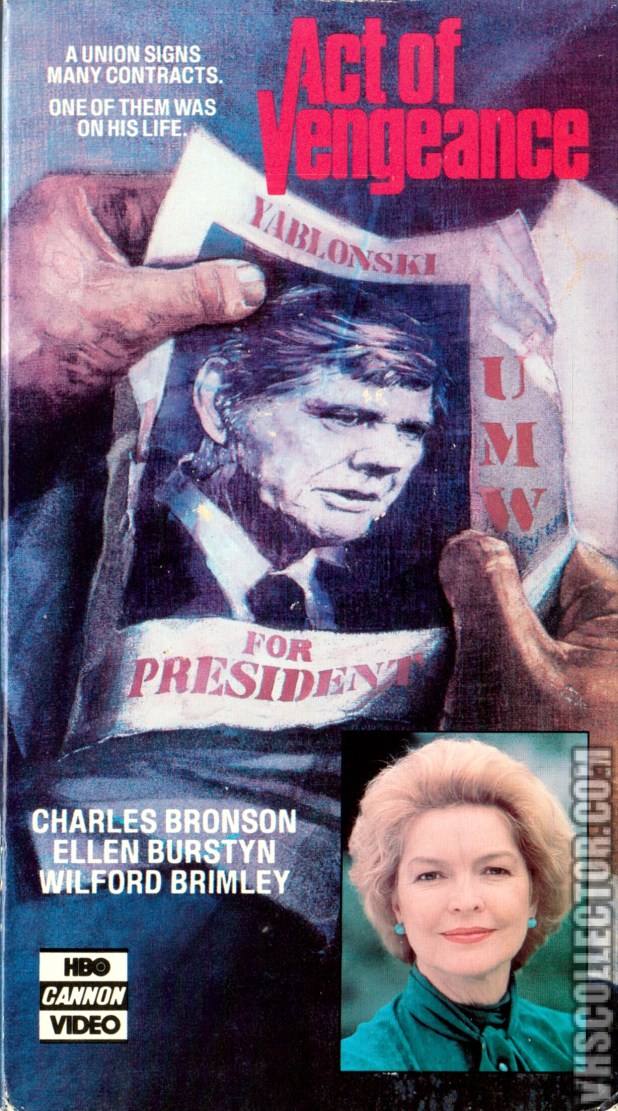
EDITOR’S NOTE: Act of Vengeance was an HBO movie not produced by Cannon but was released on video by HBO/Cannon Video.
Act of Vengeance is based on the book by Trevor Armbrister and is all about the corruption that occurred during the United Mine Workers’ presidential elections in 1969, including the death of Joseph “Jock” Yablonski, played in this movie by Charles Bronson with no mustache!
Directed by John Mackenzie and written by Scott Spencer (who wrote the novel Endless Love was based on), it starts with Jock being surprised by his wife (Ellen Burstyn) and family on his birthday. They’re upset that Tony Boyle (Wilford Brimley) has been picked as the mine worker president. Jock laughs it off but starts to realize that Tony is a horrible leader, someone who has no empathy when eighty miners die in West Virginia and no ethics when he asks Jock to do some creative accounting.
Two of Tony’s underlings, Albert Pass (Alan North) and Silous Huddleston (Hoyt Axton) figure out what to do: hire lowlifes like Hudleston’s son-in-law Paul (Robert Schenkkan), who has be convinced by his wife Annie (Ellen Barkin) to do the hit, along with Claude (Maury Chaykin) and Buddy Martin (Keanu Reeves) to kill Paul as he sleeps in bed with his wife, killing her and their daughter Charlotte (Caroline Kava) too.
That’s right. Bronson gets shot dead while he sleeps. Come on!
You could watch this as John Wick versus Paul Kersey or Theodore Logan getting revenge for Bill S. Preston, Esq. for Death Wish 3 or just a movie where Bronson gets to flex his dramatic muscles. A lot of it probably hit home for him, as before he was an actor, Charles Dennis Buchinsky was a coal miner in his hometown of Ehrenfeld, PA, starting at the age of ten when his father died. He claimed in interviews that he earned a dollar for each ton of coal that he mined and that he and his brother often found themselves nearly dying in cave-ins.
EDITOR’S NOTE: Something Wild was not produced by Cannon but was sold on videotape by HBO/Cannon Video.
I’ll be perfectly honest: so much of what I find attractive in the opposite sex can best be summed up by a series of Melanie Griffith roles: the toughness of Edith Johnson in Cherry 2000, the smarts of Tess McGill in Working Girl, the unashamed sexuality of Holly Body in Body Double and the dangerous edge of Audrey Hankel in this film. Thanks, Melanie Griffith for if not always introducing me to the right women at least having me find the interesting ones.
Charles Driggs (Jeff Daniels) has no wife, a job he hates and no excitement in his life when Audrey (or Lulu) blows into his life like a hurricane. The problem is that she also has a violent husband Ray Sinclair (Ray Liotta) who tears their new relationship into pieces.
Directed by Jonathan Demme and written by E. Max Frye, I remember staring at the box art for this movie and wondering how nervous I’d be if I ever encountered an Audrey in my life, never mind Ray. Girls always seemed — they still do, who am I kidding? — like a mystery, a frightening thing that could destroy your life and make you do things you never dreamed of. This movie in no way dispelled my thoughts. In fact, it both excited and frightened me.
Demme has a great cast in those too, like Tracy Walter (Bob the Goon!), John Sayles, Charles Napier and John Waters as a used car salesman. I love that he went from movies like Caged Heat and Crazy Mama to Married to the Mob, The Silence of the Lambs and Philadelphia. His death left behind a major hole in American cinema. He also wrote Angels Hard as They Come, The Hot Box, Fighting Mad and White Mama Black Mama, along with writing Stop Making Sense and directing videos for The Talking Heads. Speaking of them, when you see the older ladies running the re-sale shop, that’s Demme’s and David Byrne’s mothers.
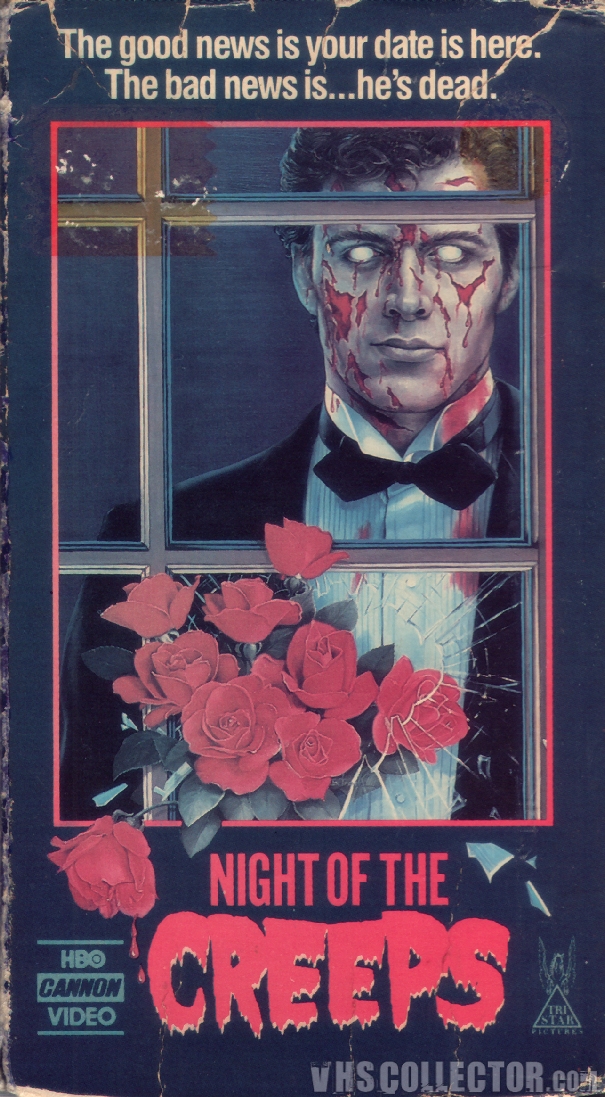
EDITOR’S NOTE: This was originally on the site on October 8, 2019. Night of the Creeps was not produced by Cannon but was released on video by HBO/Cannon Video.
“The good news is your dates are here. The bad news is they’re dead.”
Has any movie so perfectly been a synthesis of the gore aesthetic of the 1980’s and the science fiction angst of the 1950’s? I doubt it — Night of the Creeps takes on those genres and adds zombies to the mix, making for a crowd-pleasing bit of popcorn filmmaking.
Between writing the story for House and bringing The Monster Squad to the screen, Fred Dekker’s name generally signifies that you’re about to watch something pretty darn interesting. This was his directing debut, working from a script that took him only a week to write.
Back in 1959, a fight on board a UFO leads to a mysterious canister being shot out into space, crash landing on Earth. It looks like a falling star to a couple on lover’s lane. As they try to see where the star has landed, the girl is killed by an axe-wielding mental patient and a small slug jumps into the boy’s mouth.
Decades later, Chris Romero (Jason Lively, Rusty Griswold from National Lampoon’s European Vacation) is trying to get over being dumped. His friend J.C. is trying to help him out. Luckily — or perhaps not — our hero falls for Cynthia Cronenberg (Jill Whitlow, Twice Dead).
To try and win her heart, he decides to pledge a fraternity. Unfortunately, he decides to pick the Beta Epsilon house — the very one that Cynthia’s boyfriend is in charge of. He charges Chris and J.C. with stealing a corpse from the morgue as part of their initiation.
That’s when the plot kicks in. That corpse is still alive and they run from it after setting it free. That dead body — now very much alive — is the boy who ate the slug in the opening.
The reanimated dead kid heads back to the sorority house where its head explodes, releasing more of the slugs. Soon, they’ve started to take over more bodies who then start killing everything in their path. Meanwhile, Cameron (Tom Atkins) reveals his stake in all this — the girl killed in the beginning was the woman he never fell out of love with. He’d hunted down and killed her murderer way back in the late 50s and buried the body near the sorority house. Now that axe killer is back among the living thanks to the alien slugs.
Things move even faster now, as the slugs infect a dog that causes a bus crash filled with frat boys that transform into zombies that come after our heroes. Can the suicidal and bitter Cameron, Chris and Cynthia survive?
I’ve always been struck by the relationship between J.C. and Chris in this film. It’s really obvious that J.C. is in love with his best friend and he pretty much says so in the message he leaves for him after the bugs infect him. It’s not presented as humorous, but as very much matter of fact.
There’s also an alternate ending that shows Cameron transformed into a zombie, causing more slugs to worm their way into more graves before the spaceship from the beginning of the film returns. That ending is somehow even darker than the one that made it into the released film.
Back when I was a teenager, this movie ran on Cinemax at 5 AM nearly every night. I remember that it would still be one when my dad and I ate breakfast together. It’s packed with so much head exploding gore that I was worried that I might not be able to keep my toast and cereal down.
Also — if you didn’t notice from the character names, Dekker named every character after famous horror directors — George A. Romero (Chris Romero), John Carpenter and Tobe Hooper (J.C.’s full name is James Carpenter Hooper), John Landis (Detective Landis), Sam Raimi (Sgt. Raimi), David Cronenberg (Cynthia Cronenberg), James Cameron (Detective Ray Cameron) and Steve Miner (Mr. Miner is the janitor’s name) And the college setting is named for Roger Corman.
This movie remains Tom Atkins’ favorite role. It’s obvious he’s loving every moment, stopping to smell the flowers and dreaming that he’s on a beach when he’s not saying. “Thrill me” and “It’s Miller Time” while shotgun blasting zombies to oblivion.
I pretty much consider this movie required viewing. It’s a roller coaster ride that must be experienced.
You can watch this on Shudder or grab it from Shout! Factory. Sadly, you can no longer get the deluxe version that came with a Tom Atkins action figure. I still can’t believe that they made that.





 B&S About Movies
You must be logged in to post a comment.