WEIRD WEDNESDAY: Eugenie (1970)

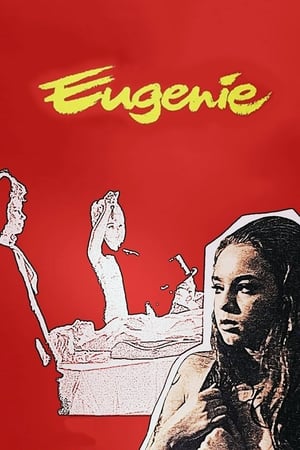
An adaptation and modern-day update of Marquis de Sade’s Philosophy in the Bedroom, this was the second de Sade film made by Jess Franco*, but by no means the last. In fact, it’s not even the previous movie, called Eugenie, that he would make. While this one is Eugenie… The Story of Her Journey into Perversion (or De Sade 70 or Marquis de Sade’s Philosophy in the Boudoir), there’s also the better-known — and Soledad Miranda-starring — Eugenie de Sade.

Eugenie (Marie Liljedahl, IngaDorian Gray) has spent her entire life in a convent, and despite an exterior that drives men and women wild with lust, she’s inexperienced in the ways of the world. Her father (Paul Muller, NanaBarbed Wire Dolls) wants to bed Madame Saint Ange (the wife of producer Harry Alan Towers who appears in 99 Women, Venus In Furs and The Bloody Judge amongst other movies; don’t judge her being in this as nepotism, because she’s amazing in this movie), who agrees as long as she can take Eugenie to her secluded island mansion, where she and her step-brother Mirvel (Jack Taylor, whose career in exploitation movies took him all over the world) can seduce her and probably each other and definitely everyone and play the kind of strange incestual games that only the super rich seem to play.

Sir Christopher Lee also shows up as the narrator for all this wallowing and also as Dolmance, the leader of a cult of fiends that drug young women and beat them with whips and yeah, Sir Christopher claims he had no idea what kind of movie he was in, which I find hilarious, because this wouldn’t be the last time he’d work with Franco. Providing his own wardrobe — the smoking jacket he wore in Sherlock Holmes and the Deadly Necklace — Lee claimed that he was unaware there was a nude woman on the sacrificial altar behind him, as Franco and crew had wrapped drapery over her that they’d yank off as soon as the camera started and would then recover her when he was done with his scene. I mean, I love Jess, but sometimes he can barely focus the camera. One wonders how he’d ever had the chicanery and ability to pull one over on a man who was once quite literally a secret agent.

This movie feels like a dream. I’ve said that of other Franco movies, but trust me, a much better-realized, better-shot dream, with a score by Bruno Nicolai that makes it seem way classier than it is.

*The first is Marquis de Sade: Justine.

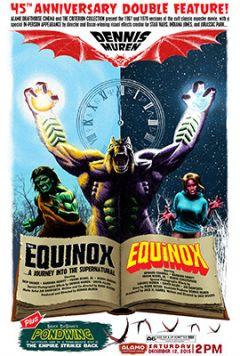
WEIRD WEDNESDAY: Equinox (1970)

Also known as The Equinox … A Journey into the Supernatural and The Beast, this movie was directed by Jack Woods and Dennis Muren. It started as a $6500 film that Muren made with his friends Dave Allen, Jim Danforth and Mark McGee while he was in business classes at Pasadena City College. Strangely enough, Ed Bagley Jr. was one of the cameramen!

Producer Jack H. Harris hired editor Woods to add enough footage to make this a full-length film. When the final movie was released, Muren was listed as the associate producer, even though he directed the entire movie and created many of the effects.

Four teenagers — David Fielding, Susan Turner, Jim Hudson (Frank Bonner, who would go on to be Herb Tarlek on WKRP in Cincinnati) and Jim’s girlfriend, Vicki — have gone looking for a lost scientist named Dr. Arthur Waterman, who is played by Fritz Leiber. Leiber isn’t just any actor. Nope, he’s one of the foremost fantasy authors of all time and the person who actually came up with the term sword and sorcery. He was brought into this project by Famous Monsters of Filmland editor Forrest J. Ackerman.

They have a picnic — as you do when you’re in the foreboding woods — then make their way to a mysterious castle. They also learn that Dr. Waterman’s cabin has been destroyed, and even worse, the demon Asmodeus (played by Jack Woods, the new director, when he’s a park ranger at least) is hunting them with his army of monsters. He really goes after them once they get a book of spells from an old man inside a cave. Those monsters — a giant ape and a green-furred giant — are marvels of stop-motion. Our heroes barely escape as the ape kills the old man.

It turns out the book belonged to Dr. Waterman, who used it to conjure demons of his own, but lost control of a tentacled beast that destroyed his home. After Asmodeus kills Jim, he reveals his true form as a winged demon. Dave and Susan are killed before our remaining teens, Dave and Susan, make their way to a cemetery.

After a battle with Asmodeus, they destroy the demon with a giant cross, which causes the cemetery to explode, killing Susan. Another giant monster appears and tells Dave that he will die in one year and a day, which drives him insane. The movie quickly moves to that time, where we see Susan — now looking totally evil — showing up at his insane asylum.

The entire crew that made this movie did so much more afterward. Muren would go on to become a nine-time Oscar-winning visual-effects artist for his work on Star Wars and Jurassic Park. Danforth would create matte and stop-motion work for The Thing, Creepshow, Clash of the Titans, and Prince of Darkness, among others. Mark McGee, who was in high school when he worked on this film and was already writing for Famous Monsters (he’s the one who got connected with Leiber and brought Forry along to be a doctor’s voice), wrote the scripts for Sorority House Massacre II and Sorceress, both movies directed by Jim Wynorski. Finally, David Allen would go on to work on everything from Flesh Gordon, Laserblast and The Howling to Full Moon efforts like the Puppet Master series and The Dungeonmaster.

You can see the influence of Equinox on movies like Evil Dead and Phantasm. It’s the bridge between the Ray Harryhausen stop motion movies they loved and the occult-tinged efforts that would make up 1970s genre films. This is a movie packed with ideas and talent.
UNSUNG HORRORS HORROR GIVES BACK 2025: The Body Beneath (1970)

Each October, the Unsung Horrors podcast does a month of themed movies. This year, they will once again be setting up a fundraiser to benefit Best Friends, which works to save the lives of cats and dogs across America, giving pets second chances and happy homes.

ABOUT THE AUTHOR: Adam Hursey is a pharmacist specializing in health informatics by day, but his true passion is cinema. His current favorite films are Back to the FutureStop Making Sense, and In the Mood for Love. He has written articles for Film East and The Physical Media Advocate, primarily examining older films through the lens of contemporary perspectives. He is usually found on Letterboxd, where he mainly writes about horror and exploitation films. You can follow him on Letterboxd or Instagram at ashursey.

Today’s theme: 1970s

Diving back into the Andy Milligan box set from Severin Films with The Body Beneath, another one of Milligan’s horror films made during his London period. If you’ve ever watched an Andy Milligan film, you know that your mileage may vary.

Too much inbreeding has caused a degradation in the bloodline of a family of vampires. Led by the Reverend Alexander Ford (Gavin Reed), the brood sets out to gather some fresh blood, namely, relative Susan Ford (Jackie Skarvellis), who has recently disclosed to her boyfriend Paul (Richmond Ross) that she is expecting. After the Reverend takes over Carfax Abbey (obviously an allusion to Count Dracula’s London estate—you could never accuse Milligan of subtlety), he begins a reign of terror, kidnapping Susan for her offspring and others for their blood supply while punishing his hunchbacked servant (there always has to be a character with a hunchback in a Milligan movie). Can Paul rescue Susan before it is too late? 

No one could accuse Milligan about properly pacing a movie either. Fortunately for me, I’m never in any rush to get through one of his films. I never really expected to embrace his films like I have, but there is just something about the bad acting, low production values, and magnificent costumes that keeps me coming back for more. I’m not sure what I will do when I run out of new films to watch in this box set. I mean, I guess I’ll just start over. And I’m perfectly okay with that option. Although Severin did discover a couple of previously lost Milligan films recently. So that release will be something to look forward to. Hopefully soon.

September Drive-In Super Monster-Rama 2025: Mark of the Devil (1970)

September Drive-In Super Monster-Rama is back at The Riverside Drive-In Theatre, September 19 and 20, 2025. Two big nights with four feature films each night include:

  • Friday, September 19: Mark of the Devil, The Sentinel, The Devil’s Rain and Devil Times Five
  • September 20: The Omega Man, Invasion of the Body Snatchers, the Grindhouse Releasing 4K restoration drive-in premiere of S.F. Brownrigg’s Scum of the Earth and Eaten Alive

Admission is $15 per person each night (children 12 and under – accompanied by an adult guardian – are admitted free). Overnight camping is available (breakfast included) for an additional $20 a person per night. Advance online tickets (highly recommended) for both movies and camping here: https://www.riversidedrivein.com/shop/

Hexen bis aufs Blut gequält (Witches Tortured Till They Bleed) got the maniacs at Hallmark Releasing all hot and bothered. The ad campaign — “Positively the most horrifying film ever made” and “Rated V for Violence”, plus giving out free barf bags — is evidence of the fact that this got so much of their creativity. Director Michael Armstrong’s first film, the Frankie Avalon-starring The Haunted House of Horror, in no way prepared audiences for this movie, which goes wild in showing the tortures it promises.

Count Christian von Meruh (Udo Keir) is a well-meaning young witchhunter — this comes in the wake of Witchfinder General — who comes to a small town to prepare the way for his boss Lord Cumberland (Herbert Lom) and to investigate the insanity of another local witch hunter, Albino (Reggie Nalder), who uses the threat of witchcraft to have sex with anyone he wants; he now wants Vanessa Benedikt (Olivera Katarina), a barmaid who catches Christian’s eye.

But really, so much of this is the chance to see gorgeous women like Deidre von Bergenstein (Gaby Fuchs) get tortured. It condemns these actions while simultaneously bragging about and reveling in them; such is exploitation. Soon, Christian learns that even his master, Cumberland, is corrupt; even if some people must die wrongfully, they will be martyrs who get into heaven. Mostly, everyone’s goal is money in this world, so who cares if an innocent family is murdered because of a puppet show?

Victoria is the one who gets the villagers to throw off the chains of oppression, and even though this good work happens, it costs her true love, as he’s thrown into a witch catcher and killed, seen as part of the same machine she has rallied them against.

It seems like making this movie was a war, as producer Adrian Hoven had his own ideas and script; he worked with cinematographer Ernst W. Kalinke to film some of his own footage. It’s difficult to determine who made what at this point, but you’ll probably be so confronted by nails used to find the Devil’s spot, tongues being torn out, whippings, beatings, nun assault, and outright killing that you’ll not worry who made what, you know?

Hoven made Mark of the Devil Part II, the official sequel, while in the VHS era, Alucarda was released as Mark of the Devil – Part III; two of the Blind Dead films were repackaged with new Michelle Bauer covers as Mark of the Devil – Part IV and Mark of the Devil – Part V; there are also two American sequels, Mark of the Devil 666: The Moralist and Mark of the Devil 777: The Moralist, Part 2.

You can watch this on Tubi.

WEIRD WEDNESDAY: Darker Than Amber (1970)

Travis McGee was created by John D. MacDonald and is neither a police officer nor a private investigator. He claims to be a “salvage consultant” who reclaims others’ property for a fee of 50 percent. He lives on a 52-foot houseboat, The Busted Flush, named for a thirty-hour poker game in which he won the floating home. The character has been in 21 novels, but only this movie and The Copper Sea have adapted McGee for the screen.

The film starts as Travis (Rod Taylor) and his friend Meyer (Theodore Bikel) are fishing. They’re surprised as a woman, Vangie (Suzy Kendall), is tossed off a bridge with her legs bound. He saves her and, as you imagine, falls in love. I mean, it’s Suzy Kendall in 1970, the same year she was in The Bird with the Crystal Plumage.

Vangie soon tells Travis that she was part of a sex and murder scheme on cruise ships, where she would lure rich men to their rooms, and after she drugged them, her partner Terry (William Smith) would toss them into the ocean. She got out because she thought they were just stealing money, not killing people. Of course, Terry tracks her down and kills her, which sends Travis after her and his new partner Del (Ahna Capri), as well as teaming with a woman who looks just like Vangie named Merrimay (Kendell).

The fight between Travis and Terry at the end of the movie was real. Taylor broke three of Smith’s ribs. who, in turn, smashed his nose.

MacDonald disliked the film. saying that it was “feral, cheap, rotten, gratuitously meretricious, shallow and embarrassing.”

Robert Clouse, of course, went on to make Enter the Dragon. This is very much a 70s man’s novel movie, a place where men may get turned around by women, but they’re always correct, and everyone always wants to fall in love with them. Or in bed. Or fight them.

You can watch this on Tubi.

USA UP ALL NIGHT: Beneath the Planet of the Apes (1970)

EDITOR’S NOTE: Beneath the Planet of the Apes was on USA Up All Night on November 19, 1993 and March 22, 1996.

Nothing succeeds like, well, success.

After Planet of the Apes, producers considered several treatments before finally hiring Paul Dehn to write the movie, making him the primary writer for the films.

They didn’t use the sequel suggested by Pierre Boulle, author of the original novel, whose Planet of the Men script had Taylor as a messiah leading humans against the apes.

However, he eventually agreed, only if his character died and all of his salary went to charity.

Dehn altered the script to center on a new character, Brent, played by James Franciscus. And with original director Franklin J. Schaffner unavailable, as he was making Patton, Ted Post was hired. He’d go on to make one of my favorite movies ever, The Baby.

Immediately after Planet of the Apes, Taylor (Heston) and Nova (Linda Harrison) ride through the Forbidden Zone. Suddenly, fire emerges from the ground and Taylor disappears into a mountain.

That’s when a second ship — looking for Taylor — emerges. It crash lands and only Brent (Franciscus) survives. He soon meets Nova and sees that she wears Taylor’s dog tags. She takes him to Ape City, where he watches General Ursus (James Gregory, who went on to play Inspector Luger on Barney Miller) rally his soldiers into conquering the Forbidden Zone. Brent is discovered and wounded, which brings him to the home of Cornelius (David Watson takes over for Roddy McDowall for this installment, as the star was in Scotland directing a movie) and Zira (Kim Hunter).

Orson Welles almost played Ursus. I wish that had happened. Plus, Gregory Sierra, who played Verger, was also on Barney Miller as Detective Sergeant Chano Amenguale. And for some real ape trivia, while Normann Burton played a human and an ape in the films (he was the Hunt Leader in Planet of the Apes and an Army Officer in Escape from the Planet of the Apes), only Natalie Trundy (who was the wife of producer Arthur P. Jacobs) played all three groups across four sequels. She’s the mutant Albina in this movie, then plays Dr. Stephanie Branton in Escape and then finally the ape Lisa in Conquest and Battle.

Soon, they’re back in the Forbidden Zone, where psychic voices tell Brent to kill Nova, voices that come from telepathic mutants who worship an atomic bomb. Either this is going to make you check out — as many critics did — or love this movie as much as I do.

In the ruins of St. Patrick’s Cathedral, these humans who survived the bomb and became mutants are ready to go to war with the apes, ready to use their Divine Bomb as a last resort. Then, you get to witness their religious ceremony where they remove their faces to reveal their true form — skinless faces praying to a nuclear god. This set is reused from Hello, Dolly! if you can believe that.

Oh yeah — Victor Buono shows up too!

Brent is separated from Nova and taken to a cell where the mutant Ongaro (Don Pedro Colley, who would later play Sheriff Ed Little on The Dukes of Hazzard) forces him to battle the still-alive Taylor to the death. Nova utters Taylor’s name and the humans kill the mutant.

Just like Shakespeare, everyone dies. Seriously, most of the mutants commit suicide, Nova gets killed, Menedez is shot, Taylor gets gunned down and Brent gets murked, too. Luckily, Brent took out Ursus and Taylor says screw it and nukes everyone and everything. The end of this movie is amazing, so astounding that Electric Wizard used a sample from it on the song “Son of Nothing.”

“In one of the countless billions of galaxies in the universe lies a medium-sized star, and one of its satellites, a green and insignificant planet, is now dead.”

An alternate ending was written where Taylor, Brent and Nova escape and return to Ape City. With the help of Zira and Cornelius, they release the humans from the cages and a new order of peace begins. Hundreds of years later, the Lawgiver is teaching a group of ape and human children when a mutated gorilla appears and shoots a dove.

Before Richard Zanuck was fired as studio president during production, he is the one who gave the thumbs up to using the bomb to end this series. It was another Charlton Heston idea, who really didn’t want to be in these movies it seems. That said — this isn’t the end. Not at all.

How many movies keep going after the entire world gets blown up?

WEIRD WEDNESDAY: Cotton Comes to Harlem (1970)

Directed and written by Ossie Davis, based on the book by Chester Himes, Cotton Comes to Harlem is an early blaxploitation film. It starts big and bold, as Deke “Reverend” O’Malley (Calvin Lockhart) is raising money for a ship to sail black people back to Africa when armed and masked men attack, stealing the cash. This brings on detectives “Gravedigger” Jones (Godfrey Cambridge) and Ed “Coffin Ed” Johnson (Raymond St. Jacques) — who were in nine of Himes’ The Harlem Detective books — on the case. They see through O’Malley and despite their Nixon-respecting boss telling them to leave him alone, they do anything but.

His mistress, Iris Brown (Judy Pace), is being tracked by them and narrowly escapes them, only to find O’Malley in bed with Mabel (Emily Yancy), the wife of one of the men killed just hours ago in the robbery. The truth is that the preacher is working with white criminal Calhoun (J.D. Cannon) and the robbery was all a scam. The money is now in a bale of hay that’s been taken by scrap dealer Uncle Budd (Redd Foxx, always a junkman).  By the end, the bad guys get exposed and Uncle Budd makes his way to Ghana, where all that cash buys him a harem.

Davis didn’t make the sequel because of disagreements with the studio. That’s why Mark Warren made Come Back, Charleston Blue, a movie loosely based on Himes’ The Heat’s On.

A film made with the protection of John Shabazz and the Black Citizen Patrol, and one that pushes that self-determinism and the ghetto policing itself are the only ways out, was a volatile mix. It would be now, much less back in 1970.

You can watch this on Tubi.

WEIRD WEDNESDAY: Cool It Carol (1970)

According to the opening credits, “this story is true, but actual names and places are fictitious.” That’s because Pete Walker read a story in the tabloid News of the World and got inspired. And unlike movies of this era like Permissive and More, the degenerate lifestyle he envisioned wasn’t tragic.

Joe (Robin Askwith, the Confessions of… series) and Carol (Janet Lynn*, Twins of Evil) have left behind their small town for swinging London, where Joe struggles to find work and she quickly becomes a model.

Before you can open the newspaper to Page 3, Carol’s involved in the scummier side of entertainment — the photoshoot for a dirty magazine was shot in Mayfair photographer Philip O. Stearn’s studio and the stills were in the July 1970 issue — with dirty old men all wanting a piece of our heroine.

There’s some great casting here, with Stubby Kaye (the owner of Acme in Who Framed Roger Rabbit?), Harry Baird (The Four of the Apocalypse), Chris Sandford (who was also in Walker’s Die Screaming, Marianne), radio DJ Pete Murray, Carry On star Eric Barker, Pearl Hackney (who was in four Walker films, including Four Dimensions of Greta, Tiffany Jones and Schizo) and Martin Wyldeck (Walker really liked using the same actors, as he also was in several of his movies).

This never gets as dirty as the American title — The Dirtiest Girl I Ever Met — promises. It exists in a different time of sexuality, where Robin Askwith’s butt and innuendos are enough. But man, all those scenes of old men licking their lips in slow motion make me realize that Walker really was created to be a horror director.

*Susan George was initially considered for this movie.

WEIRD WEDNESDAY: Clegg (1970)

Also known as The Bullet Machine, Clegg Private Eye and Harry and the HookersClegg was directed by one of my favorite British scum directors, Lindsay Shonteff, the same man who brought us Devil Doll, The Second Best Secret Agent in the Whole Wide World, License to KillThe Fast Kill, The Million Eyes of SumuruNight, After Night, After NightPermissiveBig ZapperNo. 1 of the Secret ServiceLicensed to Love and Kill and so many more. He even made two SOV movies, Lipstick and Blood and The Killing Edge. Born in Canada, he went to the UK to make movies and did what he loved until the day that he died, closing out his life on the last day of production of his final film, Angels, Devils, and Men.

Ex-policeman and private detective Harry Clegg (Gilbert Wynne) is hired by Lord Cruickshank (Norman Claridge) after the rich man gets a threat on his life. Clegg may be the hero, but his inner dialogue includes lines like I’m a private eye. Also a cold-blooded killer, a liar and a thief. My big problem is, I’ve been a loser since the day I was born.”

A sex worker named Suzy the Slag (Gilly Grant, School for Sex) is killing off old rich men with beartraps, guns and her sexual charms. Maybe she’s just mad that the filmmaker chose such a poor and misogynistic name for her. Sometimes she strangles men, lets them get their breath, then drowns them in her bathtub. A former adult actress, Suzy, serves as the killer for Wildman (Gary Hope), who has waited twenty years for his revenge on these rich guys.

Wildman also has five lollipop girls — Susan Killington, Laura Beaumont (who went on to write for Thomas the Train), Hannah Leek, Susan Babbage and Felicity Leach — who may be in their 20s but are dressed like teenagers or younger, all sucking on lollipops more than once in this film.

This isn’t great, but it has a gross charm to it. That’s a compliment.

You can watch this on YouTube.

MILL CREEK BLU-RAY BOX SET: Bewitched The Complete Series

Bewitched aired throughout the most tumultuous time in modern history — hyperbole, that could also be today, but true, as rehearsals for this show’s first episode were on the day Kennedy was shot and the episode “I Confess” was interuppted by Martin Luther King Jr.’s death — from September 17, 1964, to March 25, 1972. The #2 show in the country for its first season and remaining in the top ten until its fifth season, it presents a sanitized and fictional world that at the time may have seemed contrary and fake to the simmering 60s, but today feels like the balm I need and an escape.

Within the home on 1164 Morning Glory Circle, Samantha (Elizabeth Montgomery) and Darrin Stephens (Dick York, later Dick Sargent) have just had a whirlwind romance and ended up as husband and wife. At some point, she had to tell him that she was a witch, a fact that he disapproved of, and that she should be a normal housewife instead of using her powers. Yet she often must solve their problems — usually caused by her family, such as her mother Endora (Agnes Moorehead) — with a twitch of her nose.

Creator Sol Saks was inspired by I Married a Witch and Bell, Book and Candle, which luckily were owned by Columbia, the same studio that owned Screen Gems, which produced this show. You could use either of those movies as a prologue for this, which starts in media res — I like that I can use such a highbrow term to talk of sitcoms — with our loving couple already settling into the suburbs.

Author Walter Metz claims in his book Bewitched that the first episode, narrated by José Ferrer, is about “the occult destabilization of the conformist life of an upwardly mobile advertising man.” As someone who has spent most of his life in marketing, maybe I should look deeply into the TV I watched as a child. Bewitched was there all the time in my life, wallpaper that I perhaps never considered.

Head writer Danny Arnold, who led the show for its first season, considered the show about a mixed marriage. Gradually, as director and producer William Asher (also Montgomery’s husband at the time) took more control of the show, the magical elements became more prevalent. What I also find intriguing is that with the length of this show’s run, it had to deal with the deaths of its actors and York’s increasing back issues, which finally forced him to leave the show and another Dick, Dick Sargent, stepping in as Darren, a fact that we were to just accept.

That long run, the end of Montgomery and Asher’s marriage and slipping ratings led to the end of the show, despite ABC saying they would do two more seasons. Instead, Asher produced The Paul Lynde Show, using the sets and much of the supporting cast of this show. He also produced Temperatures Rising, which was the last show on his ABC contract, which ended in 1974.

Feminist Betty Friedan’s two-part essay “Television and the Feminine Mystique” for TV Guide asked why so many sitcoms presented insecure women as the heads of households. None of this has changed much, as the majority of sitcoms typically feature attractive women and funny but large husbands, a theme created by The Honeymooners, and the battles between spouses. I always think of I Dream of Jeannie, a show where a powerful magical being is subservient to, well, a jerk. At least on Bewitched, Samantha is a powerful, in-control woman with a mother who critiques the housewife paradigm.

Plus, unlike so many other couples on TV at the time, they slept in the same bed.

Bewitched‘s influence stretched beyond the movie remake. The show has had local versions in Japan, Russia, India, Argentina and the UK, while daughter Tabitha had a spin-off. There was even a Flintstones crossover episode!

Plus, WandaVision takes its central conceit — a witch hiding in the suburbs — from this show. And Dr. Bombay was on Passions!

This is the kind of show that has always been — and will always be — in our lives. Despite my dislike of Darren’s wedding vows of no magic, there’s still, well, some magic in this show. Just look at how late in its run it went on location to Salem for a multi-episode arc, something unthought of in other sitcoms.

You can watch this just for the show itself, to see the differences between the two Darrens and when Dick York had to film episodes in special chairs because of his back pain, when the show did tricks like have Montgomery (using the name Pandora Spocks) playing Samantha’s cousin Serena to do episodes without York or just imagine that the world was changing outside. Yet, magic and laughter were always there on the show, throughout the lives, divorces and deaths of its principals and supporting cast.

The Mill Creek box set is an excellent, high-quality way to just sit back, twitch your nose and get away from it all. This 22-disc set has everything you’d want on Bewitched, including extras like Bewitched: Behind the Magic, an all-new documentary about the making of Bewitched, featuring special guest appearances by actor David Mandel (Adam Stephens), Steve Olim (who worked in the make-up department at Columbia), Bewitched historian Herbie J Pilato, film and television historian Robert S. Ray, Bewitched guest star Eric Scott (later of The Waltons) and Chris York, son of D. York (the first Darrin). There are also sixteen new episodic audio commentaries, moderated by Herbie J Pilato that include behind-the-scenes conversations with Peter Ackerman (son of Bewitched executive producer Harry Ackerman), David Mandel, Bewitched guest star Janee Michelle (from “Sisters at Heart”), Steve Olim, Robert S. Ray, former child TV actors and Bewitched guest stars Ricky Powell (The Smith Family), Eric Scott (The Waltons), and Johnny Whitaker (Family Affair and Sigmund and the Sea Monsters) and Chris York (son of D. York). There’s also an exclusive 36-page booklet featuring pieces by Bewitched historian Herbie J. Pilato, as well as an episode guide. You can order it from Deep Discount.