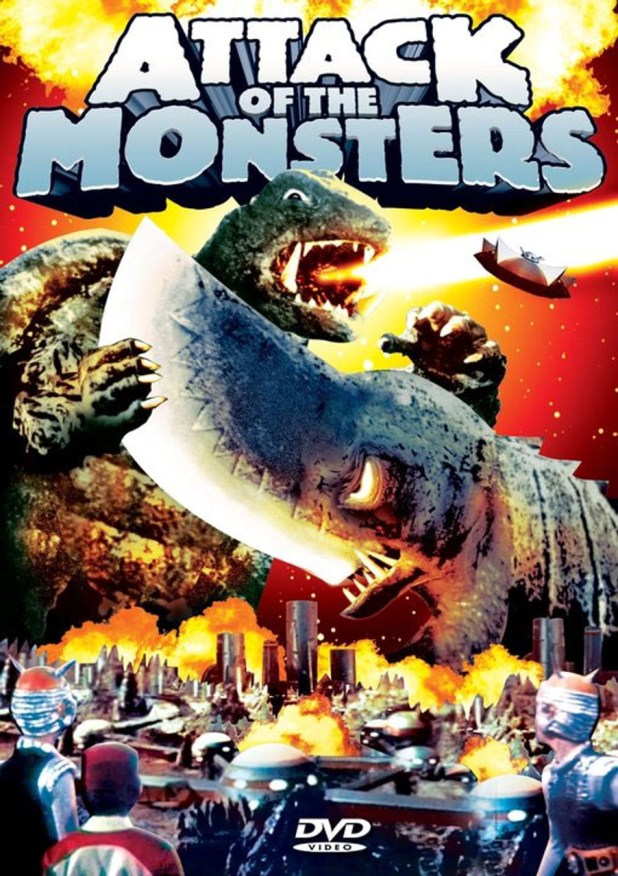
Attack of the Monsters is really Gamera vs. Guiron. That’s the name it was given by American International Television. That’s so weird to me as there are a bunch of other Gamera movies and you’d think that this series would have some popularity, you know?
At this stage in the Gamera series, the special effects are starting to not feel so special and there’s even more padding than in past films. But you know, Guiron looks so awesome — he has a giant sword nose and throws shuriken from around his eyes — that I can’t help but love this movie.
Two boys find a flying saucer and are taken on an adventure into space, where Gamera magically appears and rescues them from an asteroid field. But then, they go into hyperspace and a new Gyaos appears to attack their ship. That’s when Guiron shows up and slices that beast — which just gave Gamera so much grief — into small little bits, even beheading it, which seems way too far for what is supposed to be a kiddie film.
It turns out that the Space Gyaos are all over this planet called Terra, which is on the other side of the sun. Somehow, those scientists — some of the dumbest smart people in the world are in the Gamera movies — have never found their planet.
There are also twin alien women named Barbella and Florbella who control Guiron, who eventually gets out of control and cuts their spaceship in half. Florbella then kills the injured Barbella, explaining that useless members of their society are euthanized. What is she, in charge of the stock market?
Finally, Gamera does what you’ve wanted him to do all along: he slices that monster in half. Yes, unlike Godzilla, Gamera straight up eviscerates and annihilates his foes. Godzilla would just heat blast them. Nope. Gamera is like, “You’re not getting up from this one.”
Don’t have the box set? You can watch this on Tubi.
October 26: A Horror Film Released by Something Weird on VHS
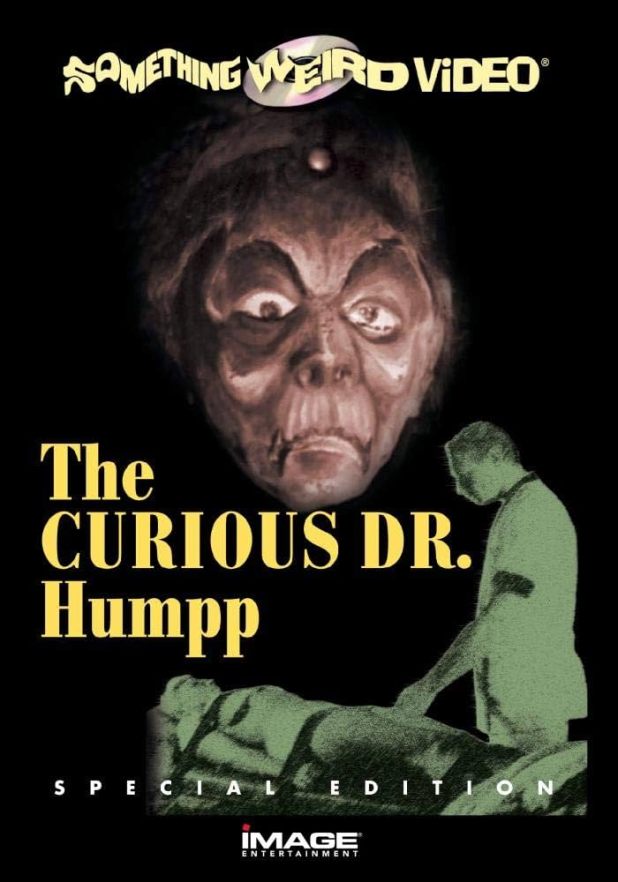
La venganza del sexo (Revenge of Sex) was released by Forbes-Unistar in the U.S. with the amazing title of The Curious Dr. Humpp.
Dr. Humpp (Dr. Zoide in the original, played by Aldo Barbero and wearing a wild outfit) plans on giving mankind eternal life using the power of the human libido. He has kidnapped several people*, including Rachel (Gloria Prat) and her boyfriend, a few hippies, a couple of lesbians and a woman with photos of naked men, and plans on forcing them to make love as much and as often as possible.
He also has a monster to kidnap these young sexual folks.
George (Ricardo Bauleo) is a reporter who follows Dr. Humpp after watching him buy boner pills at a pharmacy. Why does a sex doctor need to buy these things? He follows him to his secret lab and gets captured. He and Rachel make a plan and while George is getting it on with the nurse (Susana Beltrán), he learns that she wants to escape and be part of their plan. The monster has also become obsessed with a stripper that he captured.
Directed by Emilio Vieyra (who wrote this) and Jerald Intrator, this is a movie filled with dialogue like, “I must position this positive electrode against the nerves of the libido. If this experiment succeeds, I’ll not only be able to restrain lust, but also turn humans into veritable screwing machines!,” “Sex dominates the world! And now, I dominate sex!” and “It was I who first discovered how to make a man impotent by hiding his hat. I was the first one to explain the connection between excessive masturbation and entering politics.”
Fog. A monster that plays guitar. A strange and haunting soundtrack that’s as much jazz as early electronic music and I have no way of making it fit into a single category. A movie that tries to look like an Italian horror movie but also has nudity in nearly every scene. And the main power lurking in the shadows? A brain kept alive in fluid. And yes, one of my favorites, ether kidnapping.
The love that I have for this movie cannot be calculated by the logic of alphabets and the weights and measures of the human race.
*All of these scenes are inserts added when the movie made its way to the U.S. You can see Kim Pope (Intimate Teenager) and Kim Lewid (A Thousand Pleasures).
EDITOR’S NOTE: All Monsters Attack was on Chiller Theater on Saturday, September 19, 1970. It also aired on May 22, 1971; July 22, 1972 and April 14, 1973.
As a kid, I hated All Monsters Attack as much as I loved kaiju movies.
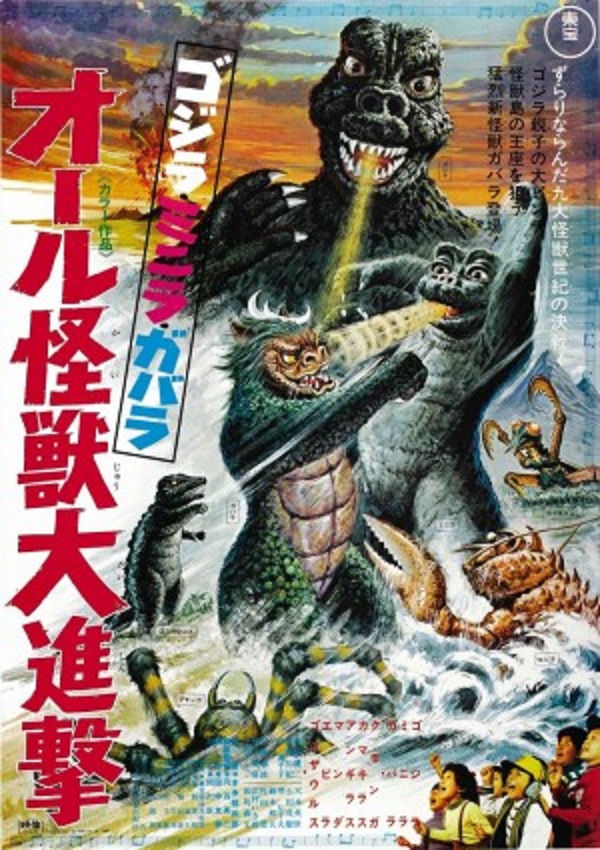
Gojira Minira Gabara Ōru Kaijū Dai-shingeki was released as Godzilla’s Revenge as a double feature with Night of the Big Heat. It was nearly named Minya, Son of Godzilla.
In Japan, it was released as part of Toho Champion Matsuri, a festival-style program that included shorts and feature films. Honda came to say that it was one of his favorite movies in the Godzilla films. So why did I hate it, like most people?
It’s not really about Godzilla.
Ichiro Miki is a latchkey kid growing up in a filthy town, bullied near-constantly and with hardly any friends. Perhaps as a kid the same age when I first saw this, I saw so much of myself that I just couldn’t like what I was watching. Because as an adult, I find it so wonderful that Ichiro Miki dreams of Monster Island and that even though Minilla is the son of the king of the monsters, he still has a bully by the title of Gabara. Now, he must give his friend on Monster Island courage and find it in himself.
I wish I could tell young Sam that everything would be OK and that he would grow up to not be so nervous that he doesn’t sleep for days at a time, but that has never gone away. But both of us still love monsters.
The kumihois a nine-tailed fox that appears in many classic Korean folktales. It is similar to the Chinese huli jing, the Japanese kitsune and the Vietnamese hồ ly tinh, which are ancient creatures that live on the flesh of humans and often shapeshift into female form.
As the film begins, Yeo-hwa is banished fby the queen. She walks the wilderness with her baby. Bandits attack her, killing the baby — by stomping it to death — and as she escapes, she drowns in a lake. However, the fox spirit raises her and takes over her body, using it to seduce and destroy men. Back in the kingdom, Yeo-hwa’s husband wants to save her, but he is being seduced by the queen.
This was picked up by Shaw Brothers and distributed in Hong Kong. It has some really cool wirework fights as well as a near-genre jumping feel.
Director Shin Sang-ok is, of course, the same man who was taken from his country to make Pulgasari and then, after escaping, came to America to produce all of the 3 Ninjas movies and direct 3 Ninjas: Knuckle Up. Life’s weird.
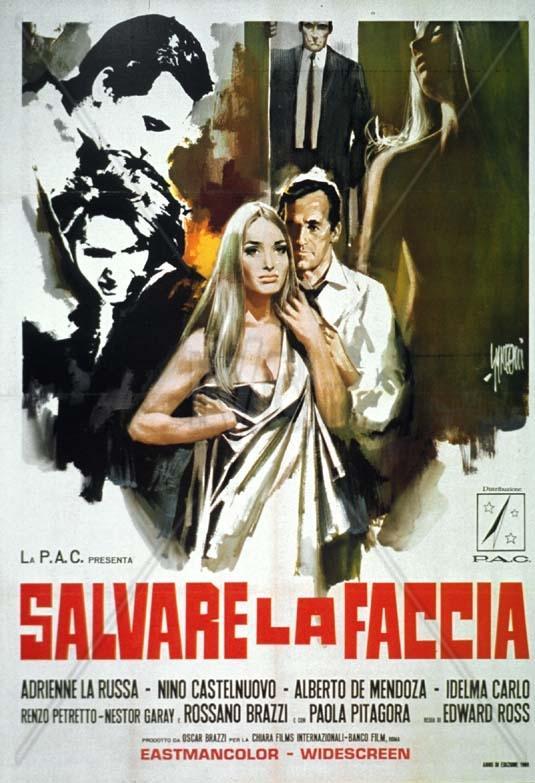
Salvare la faccia (SavingFace) is a giallo directed by Rossano Brazzi, who was once the actor who played Emile De Becque in South Pacific. His career started all the way back in the late 30s and saw him work back and forth between America and Italy. He was also in Frankenstein’s Castle of Freaks, Omen III: The Final Conflict and there’s even a moment where his adoring female fans tear his shirt off in Mondo Cane. He only directed two other movies — using the name Edward Ross — The Christmas That Almost Wasn’t and Criminal Affair, which he also starred in opposite Ann-Margaret and she tries everything to get in bed with him. It’s good work if you can get it, even if you need to direct and write it yourself.
He was also one of the writers for this movie, alongside Piero Regnoli (Voices from Beyond, Burial Ground), Diana Crispo and Renato Polselli.
Brazzi plays a well-respected and quite wealthy manufacturer named Marco Brignoli (Rossano Brazzi). He’s having issues keeping his daughter Licia (Adrienne Larussa, who was the star of Fulci’s Beatrice Cenci) from acting up. Like how when he gives a major speech, she and a photographer named Mario (Nino Castelnuovo) sneak off to a house of ill repute where he takes some scandalous photos of her to blackmail her father. The cops then come in on a tip he called in, just as he guides her into the flashes of the paparazzi.
Completely upset about the scandalous activities of his unruly little daughter, father Brignoli sees only one way to clean up the publicly scratched appearance of his family to some extent: Licia must be publicly portrayed as mentally ill and for treatment of her “alleged” ailment be forcibly committed to a closed mental hospital. No sooner said than done, and only a few days later, the horrified nest defiler finds herself against her will in the closed ward of a psychiatric clinic, where she is then immediately given her currently registered place of residence for a longer period of time.
There’s only one way to do what the Italian title states. Licia must be seen as mentally ill and sent to a mental asylum. We see bursts of fast cuts, of her twirling around, the press conference, a car she was given and finally her in white trapped inside the asylum. Larussa is incredible in the role, at once a little girl and at others a calculating mad woman transformed — maybe, maybe not — by her time unjustly locked away.
A side note: Larussa was on Days of Our Lives for three years as well as the Bowie movie The Man Who Fell to Earth. And in the mid 80s, she was quickly both married and had an annulment from Steven Seagal when she found out that he was still married to his first wife.
Her character decides to find and unleash all the scandals of her family, like her father’s affair with Laura (Idelma Carlo), the wife of a politician (Nestor Garay) in the pocket of the industrialist. Or trying to steal Francesco (Alberto de Mendoza) away from her sister Giovanna (Paola Pitagora). She also uses Mario as part of her schemes, trailing a gun on him and informing him that because she’s insane, she can kill him at any time and get away with it. They use the Monsignor (Marcello Bonini Olas) that her father pays kickbacks to as the next part of the scheme. As the entire family prepares to watch a home movie of Marco leading his workers on a pilgrimage to Lordes, they instead watch him make love to Laura.
In order to keep everything quiet, Marco must agree to let Mario marry his daughter. But Licia is ahead of him as well, setting up his death to look like her father did it, seducing her brother in law — which sends her sister to her doom but not before screaming, “What’s your game? Don’t you realize you’re trying to destroy people who’re already dead? They’re all dead, Licia, only they don’t know it.” — and even learning about all of her dad’s biggest deals.
The family all pays for the way they treated Licia, as they have taken someone they only claimed was mentally ill and made her into the kind of black widow that populates the giallo, a woman driven by revenge and willing to do absolutely anything and destroy anyone.
So, when I say giallo, I don’t mean that this has black-gloved hands holding a straight razor. But the way it’s shot, the quick edits, every woman in long hair and mini-skirts, well, it’s definitely worth your time. I’m shocked that no one has taken this movie, cleaned it up and gotten a new cult intrigued by it. Larussa is also hypnotically captivating in it, owning every frame despite her young age and relative acting experience. It’s a shame she didn’t make more films in the genre (or more films at all, although she did a lot of TV work).
I’d be pleasantly surprised if this ends up on a future Vinegar Syndrome Forgotten Gialli set.
EDITOR’S NOTE: The Devil’s Eight was on the CBS Late Movie on June 19 and June 6, 1973; January 29, 1974 and May 13, 1975.
Oh American International Pictures. You knew exactly what the kids wanted. In 1969, they wanted their own version of The Dirty Dozen. Who better to give it to them than you?
Based on a story by AIP story editor Larry Gordon and the first draft was by James Gordon White. It was eventually rewritten in ten days by two of his assistants, John Milius and Willard Huyck. The future director of Conan the Barbarian quipped, “It was called The Devil’s 8 because they didn’t have enough money for a full dozen.”
White wasn’t a fan of the final film. “They took the Southern flavor out of it and I’m from the south, so I know from whereof I talk.” Take it from the writer of Bigfoot, The Mini-Skirt Mob and both movies about a head transplant, The Incredible 2-Headed Transplant and The Thing with Two Heads.
Originally known as Inferno Road, this movie has an all-star cast. And by that, I mean an all-star AIP 1969 cast.
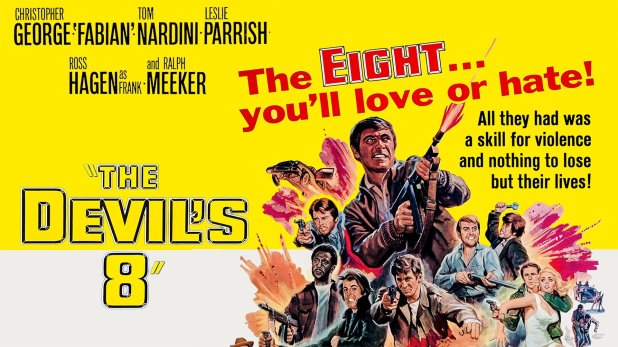
Christopher George (Day of the Animals, City of the Living Dead, Pieces and about a hundred other movies that I love) plays federal agent Ray Faulkner, who starts the movie on a road gang before he breaks the rest of the guys out and forces them on to a helicopter at gunpoint. They are:
Sonny (Fabian!) is in prison for murder but he’s a great driver. Unfortunately, he has a drinking problem.
Frank Davis (Ross Hagen, The Sidehackers) used to drive for the mob, but then they murdered his brother.
Billy Joe (Tom Nardini, Cat Ballou) is a mechanic who just wants to drive.
Sam (Joseph Turkel, Dr. Eldon Tyrell from Blade Runnerand Lloyd from The Shining) loves to get in brawls.
Henry (Robert DoQuia, the sergeant from the RoboCop movies) is an African-American prisoner who can really handle the wheel.
Chandler (Larry Bishop, son of Joey, who was in Wild In the Streets) would rather read the Bible than get involved in all this.
Stewart Martin (Ron Rifkin, L.A. Confidential) is a rookie fed.
After training “The Eight…you’ll either love or hate!” in high-speed driving and throwing bombs, they work their way into Burl’s (Ralph Meeker, who was actually in The Dirty Dozen, as well as Without Warning and The Alpha Incident) illegal moonshine operation. There are all manner of double crosses and not everyone makes it out alive, but Burl’s mistress Cissy (Leslie Parrish) ends up with her real man, Davis.
Let me talk about Leslie Parrish for awhile. She’s led a pretty amazing life, starting under her birth name Marjorie Hellen, which she changed in 1959. While she was a teenager at the Philadelphia Conservatory of Music, she started modeling and became a human test pattern for NBC known as Miss Color TV, as they used her skin tones to test how well they’d transmit over the airwaves.
In 1956, she started her contract with MGM and appeared in redneck classic Lil’ Abner as Daisy Mae. In fact, it was director Melvin Frank who convinced her to change her name. She was also in The Manchurian Candidate and a ton of TV shows at this time, as well as being the Associate Producer on Jonathan Livingston Seagull. Part of that job meant caring for the real seagulls and keeping them in her hotel room, as well as being the mediator between her husband, author Richard Bach, and director Hall Bartlett after they stopped talking. Despite all that, her role is only listed as researcher in the credits.
While acting paid the bills, her real job was activism. She was a member of the Jeannette Rankin Brigade, a coalition of women’s peace groups and had private audiences with politicians and led huge public protests. She has also been incredibly involved in environmental activism and even created KVST-TV, which looked pretty much like C-SPAN does today, but all the way back in 1967. Today, she continues to develop and lead the Spring Hill Wildlife Sanctuary on Orcas Island in Washington. And oh yeah — she was also in The Giant Spider Invasion. Check out her official site!
The Devil’s 8 is decent, but as always, I’m on the side of the bootleggers. Don’t make me divide my loyalty by putting Fabian on the side of Johnny Law! Come on, AIP!
The 2012 we dreamed of in 1969 was very different. In this film, the official review of the Institute of History, after the restless 1960s and 1970s, shows that society has become liberal. Class boundaries no longer exist, and progress is the goal of all.
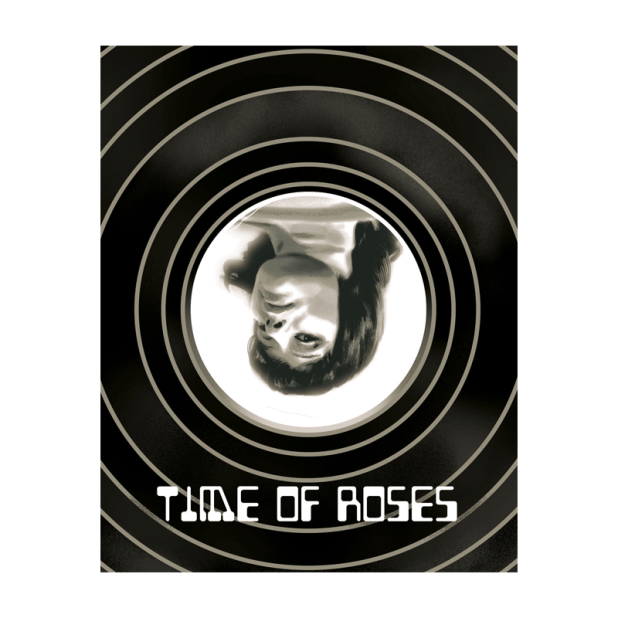
Documentarian Raimo Lappalainen (Arto Tuominen) is looking back at Finland in the late 60s and making a movie about sex symbol Saara Turunen (Ritva Vepsä), a nude model who dies at some point in the 70s. But as he gets deeper into her life, he discovers that the same issues her world struggled with haven’t truly gone away. Things get stranger when Kisse (Vepsä) plays the role of Saara in recreating her death. Ironically, this film’s director, Risto Jarva, would die young in a car crash in 1977.
This movie promised a future of people dancing by themselves in crowded clubs while wearing headphones, politically compromised media, Edie Sedgwick-looking doomed heroines, pushbutton instant food, unrest in a nuclear plant and inflatable see-through furniture. I should start a Letterboxd list of movies with transparent furnishings, starting with this movie, Too Beautiful to Die and Camille 2000.
Also, I learned from Kathy Fennessy’s Seattle Film Blog that co-writer Peter von Bagh—who worked on the script along with Jarva and Jaakko Pakkasvirta—wrote his master’s thesis on Vertigo. This makes the dead woman being reborn—or at least a look-alike appearing—make even more sense.
By the end, Lappalainen seems like no hero, as the leader of the protests mentions the title of the movie before being killed live on TV, an event that shatters Kisse and barely a notice from him. He seeks to control her in his work, using her as an object instead of a person; this follows through to his real life.
I am obsessed with the ancient future. It seemed like the world would be cleaner and better than the world we live in today. Is it a better place? This movie makes me doubt that. It would, however, be much more stylish.
You can get Time of Roses on Blu-ray directly from Deaf Crocodile. It comes with plenty of extras, including an hour-long documentary Risto Jarva, Tyotoverini (Risto Jarva, My Colleague), in which director Antti Peippo explores the life of the director; two of Jarva’s shorts, Pakasteet (Frozen Foods) and Tietokoneet Palvelevat (Computers Serve); a deleted scene and the original song “Pääskytorni” (“The Swallow Tower”); the trailer; new commentary by film critic, professor and programmer Olaf Möller; a new essay by filmmaker and critic Ville Suhonen of the Risto Jarva Association and newly translated extracts from Risto Jarva’s writings.
As with everything from Deaf Crocodile, this is an incredible release of a film that we may never see in America otherwise.
EDITOR’S NOTE: The Maltese Bippy was on the CBS Late Movie on December 23, 1977.
As a kid, I was thrilled when Laugh-In came back to TV. I’d read about it—I was already a devotee of pop culture—and was excited to see this stream-of-consciousness show for myself. Yes, it was before the internet when we couldn’t just dial up everything we wanted to see instantly.
It may seem dated today — it has to; it was nearly sixty years ago — but at the center of this mad show were two men: Dan Rowan and Dick Martin. They were the everymen who couldn’t keep the wild energy of the show from bursting through the screen. But they were also fascinating people in their own right, who knew that the show was the star.
Dan Rowan spent his childhood years following his parents from town to town as they performed their carnival dancing act. He was orphaned at 11 and spent four years in an orphanage. By the time he was 18, he hitchhiked to Los Angeles, where he got a job in the Paramount mailroom. Soon, he was the youngest writer on the lot.
During World War II, Rowan was a fighter pilot, winning the Distinguished Flying Cross with Oak Leaf Cluster, the Air Medal and the Purple Heart. He returned from action and formed his comedy duo with Martin. He was married three times—to Miss America 1945 runner-up Phyllis J. Mathis, Australian model Adriana Van Ballegooyen and TV spokeswoman Joanna Young—and retired in the early 1980s. He only returned to help celebrate NBC’s 60th anniversary in 1988 by appearing with his comedy partner.
Dick Martin didn’t serve in the war — tuberculosis kept him from combat — but was a young writer as well, working on the radio show Duffy’s Tavern. He started teaming with Martin in 1952, playing nightclubs, hosting NBC’s Colgate Comedy Hour and appearing in the movie Once Upon a Horse Together. He also played Lucille Ball’s neighbor on The Lucy Show before Laugh-In became a big hit. After his partner retired, Martin was a frequent game show guest and TV show director. He was married to singer Peggy Connelly and Beyond the Valley of the Dolls star Dolly Read twice.
Anyways…The Maltese Bippy.
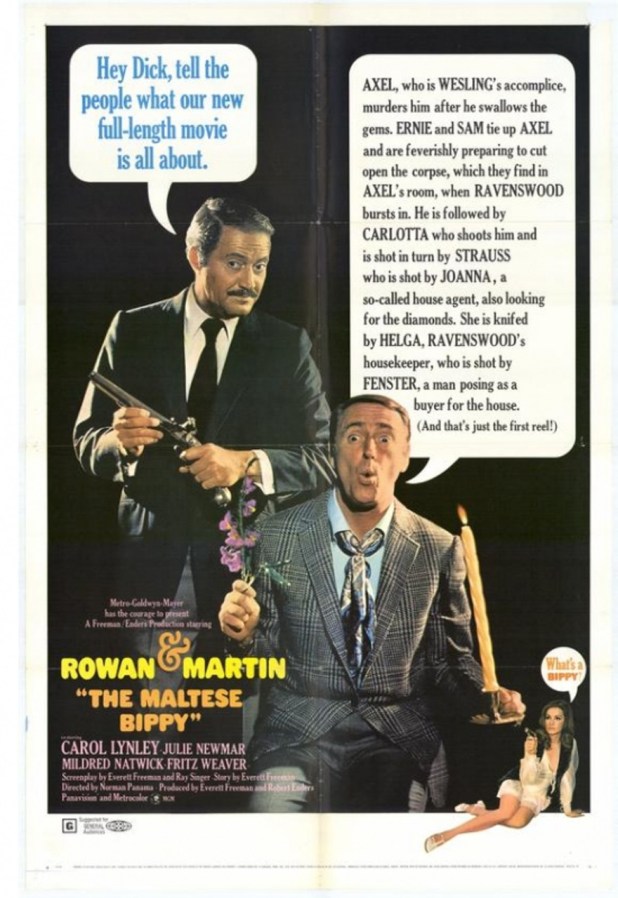
Sam Smith and Ernest Grey (Rowan and Martin) are the producers of nudie cuties — their latest film is Lunar Lust — and they’re forced out of their office for not paying the rent. Somehow, a G-rated movie in 1969 could concern pornography, and no one cared.
They move into Ernest’s house by the cemetery in Long Island, a place where a mutilated corpse has already been found and a woman is frightened by a howling man. Oh yeah, Ernest is also given to barking like a dog.
Somehow, despite not being successful, Ernest can have a housekeeper (Mildred Natwick, Do Not Fold, Spindle, or Mutilate). He also has two roommates, the bubbly Robin Sherwood (Carol Lynley, The Poseidon Adventure) and Axel (Leon Askin, Hogan’s Heroes), a Swedish violinist.
Meanwhile, the Ravenswoods next door — Mischa (Fritz Weaver, Creepshow), Carlotta (Julie Newmar!) and Helga (Eddra Gale, Fellini’s 8 1/2) — are vampires who want Ernest to join their pack. Sam thinks they should be a variety act, but the truth is that nearly everyone just wants to search for a giant diamond inside the house. (and more to the point, inside the corpse of the home’s original owner).
Hijinks ensue, and everyone but our heroes perish. But that’s not good enough, so they both present their happy endings to the audience and walk into the sunset together.
Look for a pre-Brady Bunch Robert Reed, David Hurst (the head waiter in Hello, Dolly), character actor Dana Eclar, voiceover actor Alan Oppenheimer, Arthur Batanides (he was Mr. Kirkland in Police Academy 2, 3, 4 and 6), Jennifer Bishop (who was in the William Grefe movies Mako: The Jaws of Death and Impulse, as well as Al Adamson’s Horror of the Blood Monsters, Jessi’s Girls and The Female Bunch) and Garry Walberg, who played Jack Klugman’s poker buddy Homer “Speed” Deegan on The Odd Couple and his boss Lt. Frank Monahan on Quincy, M.E.
Director Norman Panama wrote White Christmas and 1959’s Li’l Abner. He also directed the Hope and Crosby — with Joan Collins! — film The Road to Hong Kong.
This isn’t a great movie—or even alright—but the TV lover in me appreciated it and found joy in discovering this buried moment in time.
EDITOR’S NOTE: Frankenstein Must Be Destroyed was on the CBS Late Movie on March 10 and July 19, 1972 and November 23, 1973.
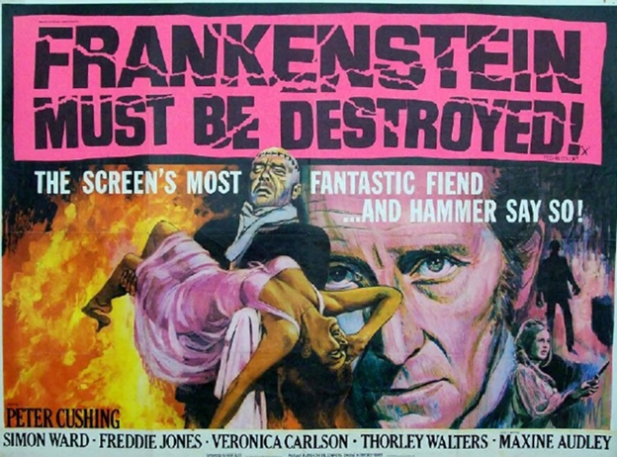
There’s a moment in this movie where Baron Victor Frankenstein (Peter Cushing) assaults Anna Spiegler (Veronica Carlson) that was filmed over the objections of Cushing, Carlson and director Terence Fisher, who finally ended shooting when he felt enough was enough. This moment isn’t even in the original script but was added at the demand of Hammer executive James Carreras, who was under pressure to keep the American distributors happy. The fact that a rape scene is what it took is pretty upsetting,
The film starts in a lab where a thief has broken in. By the time he starts his crime, a masked man has broken in as well and decapitated a doctor. The thief reports the crime to the police as the masked man reveals himself to be Dr. Frankenstein, now known as Mr. Fenner. He’s renting a room from Anna, whose fiancee, Karl Holst (Simon Ward), is one of the doctors overseeing the care of Frankenstein’s assistant, Dr. Frederick Brandt (George Pravda).
Karl has a secret. He’s been stealing narcotics to treat Anna’s mother, a fact that Frankenstein uses against him. They work together to free Brandt, and Karl even kills a man in the middle of a robbery, further giving the doctor power over him.
After Brandt has a heart attack, they take his brain and place it into the body of Professor Richter (Freddie Jones). When his wife refuses to accept him because of his horrifying appearance, he goes wild. By the end, he’s poured liquid paraffin all over his house and lures the doctor there, planning to burn him alive or put him out of commission long enough until the next movie in the series, Frankenstein and the Monster from Hell. Yes, I realize there’s also The Horror of Frankenstein, but that movie is a remake of Curse of Frankenstein and has Ralph Bates in the lead role.
EDITOR’S NOTE: The Illustrated Man was on the CBS Late Movie on July 14, 1972 and October 11, 1973.
Beyond Bird with the Crystal Plumage, there’s one movie my mother has already brought up that she hated. And that would be this one.
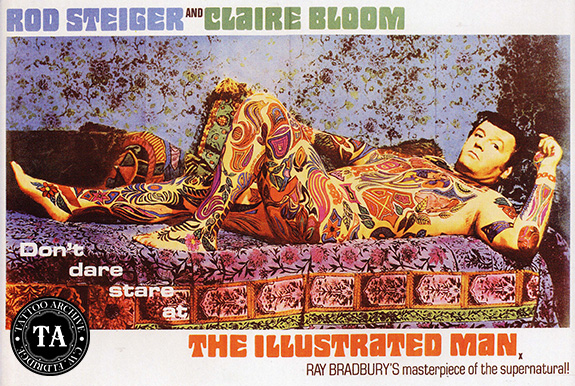
The book that these stories come from has eighteen of them, but Howard B. Kreitsek and Jack Smight picked these three for the film without ever speaking to Ray Bradbury, the author of the book. The tattooed man who appears in the book’s prologue and epilogue would become this film’s main story and be played by Rod Steiger.
The funny thing is that when Steiger takes off his glove to reveal his hand, it’s tattooed and played off as a horrific moment. A half-century after this movie was made, nearly all my friends have this many tattoos.
Carl, the tattooed man, meets Willie and uses his skin illustrations to tell tales throughout time. The ink came from a mysterious woman named Felicia. At the end of the film, Willie sees his death at Carl’s hands in the only bare patch of skin on the Illustrated Man.
The stories that are told include “The Veldt,” which takes place in the future and involves children who study within a virtual version of the African veldt. Soon, the lions will solve this issue of their parents. “The Long Rain” has solar rains* that drive an entire crew to madness in space. And “The Last Night of the World” predates The Mist, with parents who must decide if their children should survive the end of the world.
The final story—and its bleak ending—is exactly why my mom hates this movie. The fact that she may have told me all about it when I was a kid may have given me nightmares.
This movie did poorly critically and financially. Rod Serling, an expert on adapting short stories to film, called it the worst movie ever made.


 B&S About Movies
You must be logged in to post a comment.