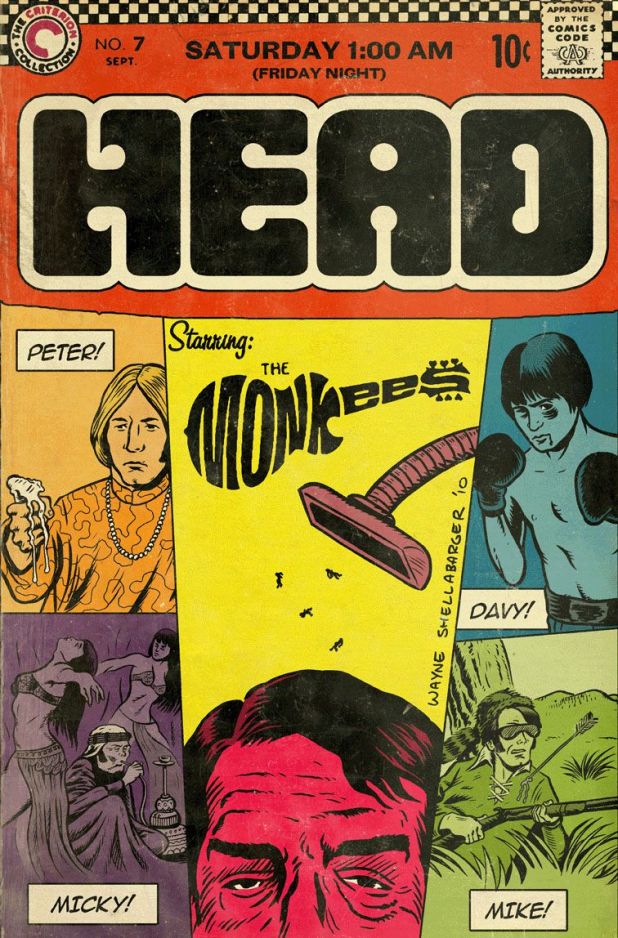
Head (1968)

Despite breaking up in 1971, The Monkees remained in syndication throughout the decade, and that’s when I discovered them. Despite being a band created for a TV show—a burst of comedy, silliness and catchy songs—The Monkees instantly appealed to me.

Initially formed in Los Angeles in 1965 by Bob Rafelson and Bert Schneider, the band was Micky Dolenz, Michael Nesmith, Peter Tork and Davy Jones. Producer Don Kirshner initially supervised the band’s music, with songs written by the songwriting duo of Tommy Boyce and Bobby Hart. The four band members were on set filming for nearly twelve hours a day, so session musicians originally played most of their tunes (that said, Nesmith did compose and produce some songs, with Tork playing guitar and all four contributing vocals).

By the TV show’s second season, The Monkees had won the right to create their own music, marking a significant shift in their artistic journey. They effectively became musicians, singers, songwriters, and producers. This growth was further evident in their fourth album, Pisces, Aquarius, Capricorn & Jones Ltd., where the band collaborated with respected session and star talents like the Wrecking Crew, Glen Campbell, members of the Byrds and the Association, drummer ‘Fast’ Eddie Hoh, Stephen Stills and Neil Young. This artistic growth is a testament to their determination and talent.

However, the Monkees continually battled against the notion that they were a manufactured band. Sure, that’s how things started, but they weren’t that way anymore. While their TV show remained successful, they were bored with its conventional format. They proposed making the show a variety program, a format that would allow them to showcase their musical talents and experiment with different styles and genres. But NBC objected, and by then, most of the band wasn’t getting along anyway.

The film’s title, Head, is a nod to the band’s desire to break free from their manufactured image and the constraints of their success. It’s a reference to the phrase ‘to get your head ‘, meaning to understand or grasp something, which reflects the band’s journey of self-discovery and artistic expression. After The Monkees was canceled in February 1968, Rafelson co-wrote and directed this film with Schneider as executive producer. Jack Nicholson, the other writer — a virtual unknown at the time — worked with the band and Rafelson in a jam session weekend with plenty of weed on hand. Later, under the influence of LSD, Nicholson would rewrite the stream-of-consciousness tapes into the script.

When the band learned they would not be allowed to direct themselves or receive screenwriting credit, every Monkee except Peter Tork had a one-day walkout. The studio agreed to a larger share of the film’s profits if the band returned, which ended the professional relationship between the band and their creators.

The filming of Head resulted in a movie that completely alienated their fanbase. Both Nesmith and Tork felt that this movie was a betrayal, a murder of the band by its creators, who seemed to have their eyes on bigger goals. This sense of disillusionment is palpable in their reactions, adding a layer of disappointment to the narrative.

At the dedication of the Gerald Desmond Bridge, an old man politician struggles with his speech. Suddenly, The Monkees appear, racing through the officials and creating chaos. Micky jumps off the bridge to the water below as we hear the words of “Porpoise Song. ” The lyrics intone, “A face, a voice, an overdub has no choice, an image cannot rejoice.” He floats under the waves until mermaids find him and bring him back to life.

After a kissing contest with all four Monkees being called “even” by Lady Pleasure (Mireille Machu, Nicholson’s girlfriend at the time), they launch into a distorted version of the TV show’s theme song:

“Hey, hey, we are The Monkees

You know we love to please

A manufactured image

With no philosophies.

You say we’re manufactured.

To that, we all agree.

So make your choice, and we’ll rejoice

in never being free!

Hey, hey, we are The Monkees

We’ve said it all before

The money’s in, we’re made of tin

We’re here to give you more!

The money’s in, we’re made of tin

We’re here to give you…”

BAM! A gunshot interrupts the proceedings, with the famous footage of the execution of Viet Cong operative Nguyen Van Lem by Chief of National Police Nguyen Ngoc Loan being shown. Head has no interest in being subtle.

From here, the movie becomes a kaleidoscope of ideas and pastiches as each Monkee gains a moment in the spotlight, yet none of them are thrilled with their situation, and each feels trapped. Any escape attempt — whether it’s through dance (Davy has a great scene with Toni Basil, who choreographed Head more than a decade before her hit song “Mickey”), punching waitresses, blowing up Coke machines with tanks, attending a strange birthday party (shot on one of the sets of Rosemary’s Baby, which was under production at the same time), a swami who claims to have the answer and even a rampage through the movie set itself, the boys can’t escape their prison, which is a large black box.

That box could symbolize the lounge area built for the band during the filming of their television show. When they first started filming, the band would wander the set between takes, bored by the filming speed. They’d often get lost, so Screen Gems built a special room where they were forced to remain, smoking cigarettes, playing music and studying their scripts. Whenever a band member was needed on the stage, a colored light corresponding to that member would inform them.

Throughout the film, the band runs into a massive cast of characters, with everyone from Mickey Mouse Club star Annette Funicello, Carol Doda (considered the first public topless dancer), Sonny Liston, Frank Zappa, Teri Garr, Victor Mature and Dennis Hopper.

After evading the box and all of their enemies in the desert, The Monkees run back to the film’s beginning and all leap from the bridge, this time to the triumphant return of “Porpoise Song.” But it’s all another sham: as they swim away, we see that they’re stuck in an aquarium, another big box, and taken away on a truck.

Unyielding sadness. It seems a far cry from “Hey, hey we’re The Monkees and people say we monkey around.”

Head bombed hard on release, bringing back only $16,000 on its $750,000 budget. It may be the ad campaign. While trailers say the “most extraordinary adventure, western, comedy, love story, mystery, drama, musical, documentary satire ever made (And that’s putting it mildly),” none of the band would appear in the ads.

The Monkees were trapped by another fact: younger and more mainstream audiences rejected the more serious side of the band, along with their new sound. While critics agreed that this was the band’s best music ever recorded — Carole King and Harry Nilsson co-wrote much of the music — serious hippies wanted nothing to do with a band they perceived as plastic and pre-manufactured.

Nesmith said, “By the time Head came out, The Monkees were a pariah. There was no confusion about this. We were on the cosine of the line of approbation, from acceptance to rejection…and it was over. Head was a swan song.”

At the end of the film, a still shot of a stylized Columbia Pictures logo appears before the movie skips frames, gets tangled and melts as we hear the soundtrack continue and the laugh of Lady Pleasure. Maybe some joy has escaped the box that The Monkees are trapped in. I want to think so, as Head may have been a failure upon release, but when viewed more than fifty years later, it transcends the divide between real and fake, manufactured and created, commerce and art.
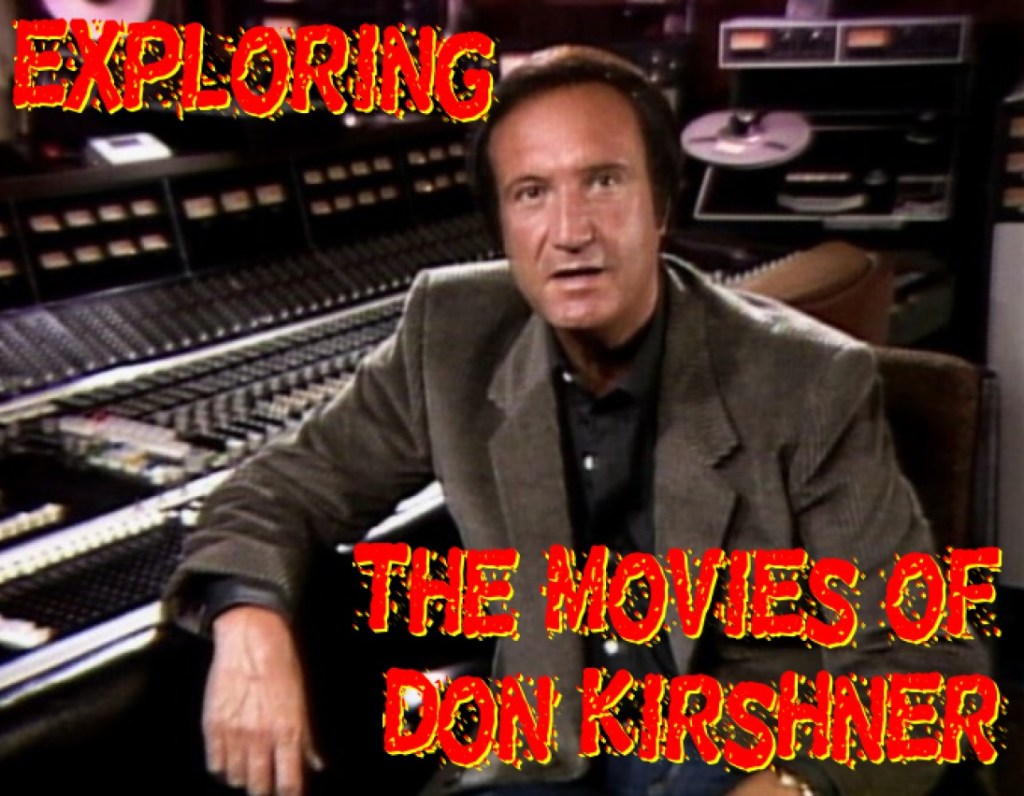
Learn more about the movies of Don Kirshner with our “Exploring” featurette.

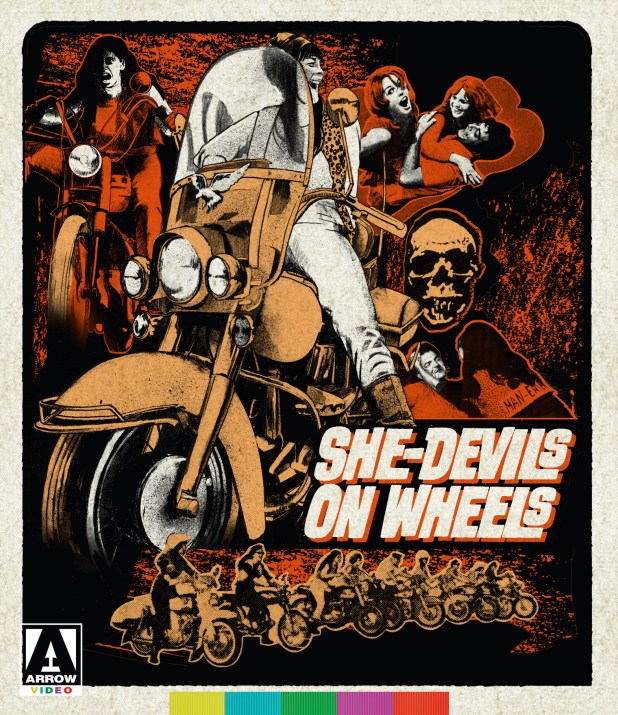
She-Devils on Wheels (1968) take two

We covered this movie in July of last year, referring to it as “filthy, grimy, messy and completely wonderful.” It’s also one of Joe Bob Briggs’ Sleaziest Movies in the History of the World (keep in mind, ten our of the fourteen movies on that list came from Herschell Gordon Lewis). Now, Arrow Video has released it along with Just for the Hell of It on one blu ray, so you don’t have to shell out the big bucks for the Herschell Gordon Lewis Feast Box (but you totally should).

Arrow Video has lent their typical master’s touch to this release, with both movies presented in high def 1080p and filmed introductions from Lewis for both films. As the Godfather of Gore states in that intro, this is the one movie that rivals Blood Feast for box office and was his answer to the question, “Why don’t you stop cutting up all those girls and kill some men?”

This time through, I watched the film with commentary by H.G. Lewis and Something Weird’s Mike Vraney. This commentary track is a real joy, with Lewis quite honest about his faults as a filmmaker while giving tips for would be exploitation creations for how to film things properly. I wasn’t sure how much more I could love this movie, but this release exponentially increased my ardor.

Filmed with a legitimate cast of biker riding women, this movie is years ahead of its time. Heck, it’s years ahead of its time now. These women outride, outfight and dominate every man they meet with no apologies whatsoever. Even Karen, our would-be protagonist, after being forced to kill a lover by dragging him behind her hog, still stays with the Maneaters. They terrorize Florida and every human being they meet because they’re outside of the scope of humanity. They’re superheroes — well, supervillains — who can’t be stopped.

I love that Lewis realizes that adding on a post-credits scene in 1968 was a mistake. It was often trimmed or audiences left before they saw it. The film can’t end with the Maneaters in jail. They speak almost directly to the camera, promising more chaos. It’s as if they’re the biker gang Avengers years before anyone would think to film such a sequence.

I also love that Karen rejects the straight world and her ex-boyfriend Joe, who wants things to be the way they always were. The women in this movie reject the roles their gender has enforced upon them and instead have no issues slicing, dicing, tearing and maiming their way through their rival gang, led by Joe Boy. The fact that he’s a slice of mom and pop Americana, with bleached blonde good looks and it’s astounding — not to be a broken record — that the film ends with her rejecting white picket fences and a certain future.

H.G. Lewis made 33 films between 1962 and 1972. Those films would run in drive-ins for years before the adventure of the VCR and Something Weird would bring them back to viewers. Most of these movies had lower budgets than this and less time ($60,000 spent over two weeks), but they all exhibit a zeal and love for shock and showing you something different than you’ve ever seen before. Lewis remains affable and happy throughout the commentary, the kind of uncle you wish you had who’d done some crazy things in his past and wasn’t shy about sharing them with you. The loss of both he and Mike Vraney are palpable.

Needless to say, this movie has my highest possible recommendation. Don’t wait. Go to Arrow Video and buy She-Devils on Wheels NOW.

Disclaimer: We were sent this by Arrow, but we would have bought it anyway.

Just For the Hell of It (1968)

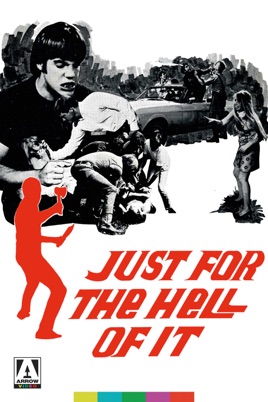
All hail Herschell Gordon Lewis. This movie — his attempt at a whole new genre that was the pornography of destruction — is completely unhinged and out of control, even a half-century after it was made.

Just watch the opening, where a gang of teens go from partying to suddenly decimating everything in their path, trashing an apartment in a moment of joyous destruction. As Lewis says on the intro to the film on its new Arrow Video release, “Watch this and think about how much fun everyone had making it.”

The gang Destruction Incorporated are here to terrorize small towns in Florida just for the hell of it, according to their insane leader Dexter, who has brought together Denny, Bitsy and Lummox as his crew. They beat up a bartender, splash a man with paint and set a woman’s newspaper on fire. Cops? They just make fun of the cops. These kids aren’t square. They just like messing things up for everyone else.

Not even cozy little coffee shops are safe. They just provide an arena for fist fights and grabbing store owners and burning their hands on the very stove that they make java on. The police try again to stop the gang, but no witnesses want to come forward. The violence only stops for a moment before the gang goes wild all over again, beating blind people, attacking men with their own crutches, throwing a baby into a garbage can and then destroying its stroller. They don’t care about anything or anyone, only the feeling of breaking things and the thrill of getting away with it.

Then, the gang invades a little league baseball game and starts attacking the children before Doug gets involved. Sadly, when a senile old woman calls the cop, he gets blamed. While he’s in jail, the gang beats a man on a beach blanket and assaults his girlfriend before they’re murdered.

If the police aren’t going to stop things, Doug and his girl Jeanne will. Bitsy, the mascot of the gang, lures Doug out of his house in the hopes she’ll testify against the Destruction boys, but it’s just a trap. His girlfriend is brutally attacked and left for dead with a drawing of a rat carved into her stomach. You know, for as kind of a man as Lewis seems while introducing this film, he’s an absolute maniac behind the camera.

Doug chases Denny and Bitsy, which leads their motorcycle into an explosive accident and our hero, such as it is, gets arrested. However, Dexter and Lummox have escaped and when told that two of the gang are dead, he answers, “Why cars, man?”

The movie ends with blood written on glass that says, “THE END… of this movie, but not the violence.”

This is a movie that doesn’t care that you find it worrisome or troublesome or problematic. If it could sneak into your parents’ house and beat them up with pool cues, it would do it right now. In fact, it just might be.

You can get Just For the Hell of It as a bonus movie on Arrow Video’s new blu ray release of She-Devils on Wheels.

NOTE: Arrow sent is this video, but we would have bought it anyway.

The Wild Pussycat (1968)

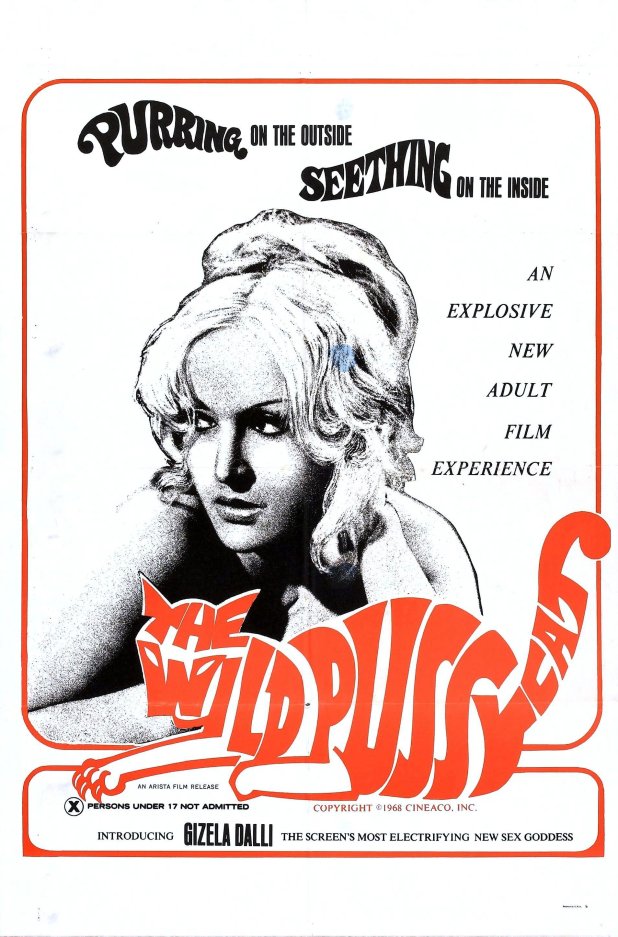
The Wild Pussycat is an unsung classic of exploitation cinema. Originally made in 1968, it wasn’t released for four years and then only in a censored version.

It’s a simple story: Good girl Nadia investigates the death of her sister, who was exploited and driven to suicide by her pimp. Now, she seduces the man, drugs him, then imprisons him in a hidden room that has a one-way mirror. On the other side, she continues her seduction by dancing for him and having affairs with other men and women while he can only look on.

Sure, The Wild Pussycat has rough subject matter, but it wasn’t a porno throwaway. Its director, Dimi Dadiras, directed more than fifty other films and its star Gisela Dali was known as the Greek Bardot.

This is another example of Mondo Macabro stretching out and grabbing films that most people would never know of. This film has never been released anywhere in the world on home video before now. This release includes both the 1972 Greek version (with much of the sex removed and a drug-dealing subplot inserted) uncut export version.

Joe D’Amato and Bruno Mattei would remake this movie in 1975 as Emanuelle’s Revenge, with George Eastman playing the role of the pimp.

As always, Mondo Macabro has put together an amazing release, finding something I didn’t even know was out there, making it look better than it ever has before and adding bonus features on top of all that. They’re putting out some astounding releases and deserve your full support.

You can get this on a double blu ray disc along with The Deserter from Mondo Macabro.

NOTE: This film was sent to us by Mondo Macabro, but that has no bearing on this review.

Death Laid an Egg (1968)

Let me put it out there right now: This movie is completely insane.

Let me see if I can summarize it.

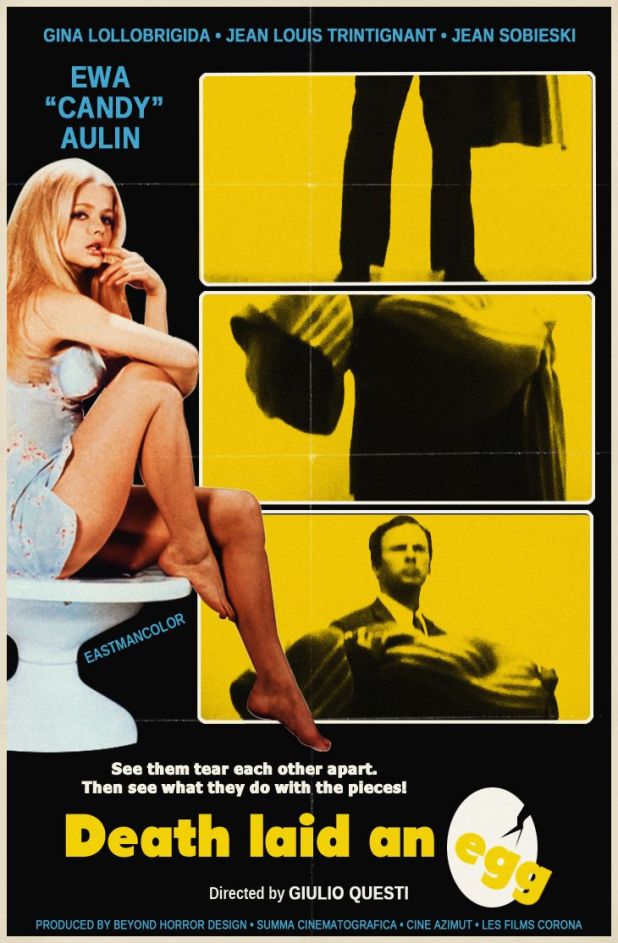
A high tech chicken farm is trying to create birds that have no heads or bones. A love triangle develops between the three people who run it: Anna (international sex symbol and the photojournalist who was one of the first to interview Fidel Castro, Gina Lollobrigida), her prostitute killing husband Marco and their secretary Gabriella (Ewa Aulin, the near goddess who appeared in films like Candy and Death Smiles on a Murderer).

Yes. Headless and boneless chickens, all inside a fashionable proto giallo filled with sex and murder. You better believe I’m all over this movie.

Director Giulio Questi was also behind Django Kill… If You Live, Shoot! and Arcana, two movies that I must investigate immediately if this movie is any indication. I’ve seen this movie explained as a “socio-politically sophisticated avant-garde giallo,” which is pretty much the best way I can think of telling you what it’s all about. It’s also around 40 years ahead of its time yet blissfully stuck in 1968.

Despite being Anna’s cousin, Gabri hooks up with her husband and they debate running away together. However, Gabri is already married to Mondaini and their plan is to kill Anna and frame  Marco. There’s also the issue of Anna wanting to have something special and strange with Marco, which instead of being a child, ends up being these Eraserhead-ish chicken balls that scream and bleed worms when he kills them.

When Marco discovers his wife’s body in a hotel room, he cleans the scene up and brings her body to the farm to turn it into chicken feed. That’s when we learn his big secret: he doesn’t really kill prostitutes, but instead role plays the murder and sends them away with plenty of cash. But then, as he tries to feed his wife into the machine, he falls in just as the police arrive to catch him disposing of the body. Gabri and Mondaini are eventually caught as we watch the chickens chow down on human food. Nothing good is gonna come out of that. I mean, poultry that feeds on human flesh seems like way worse than any steroids or hormones.

I’ve never seen a movie that straddles being an art film, a drug film, a murder mystery story and science fiction examination of man trying to change nature along with psychedelic film techniques and non-linear editing techniques. It’s also a satire of the highest order. I have no idea why people aren’t constantly discussing this movie and I’m going to do my best to drive people nuts talking about it over and over again.

Cult Epics just released this film, which you can get on their site or on Diabolik DVD.

BIKER WEEK: She-Devils on Wheels (1968)

Herschell Gordon Lewis pretty much invented gore. But with this movie, he showed us all how to make a biker movie that takes it to the limit and way beyond.

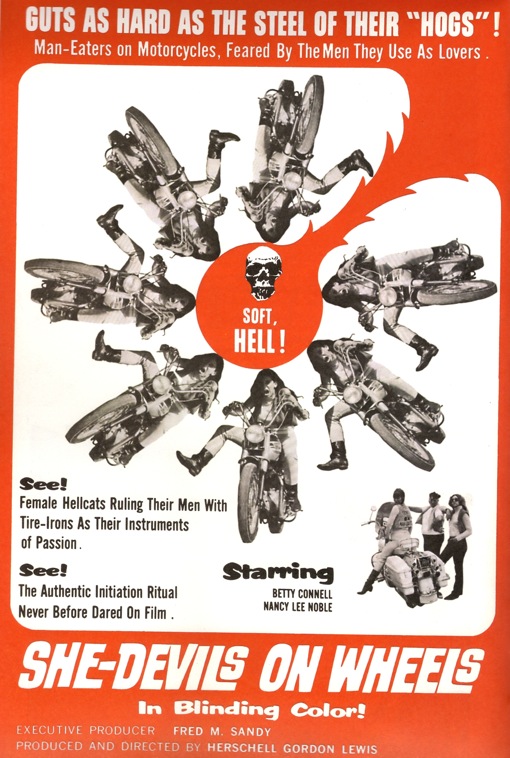
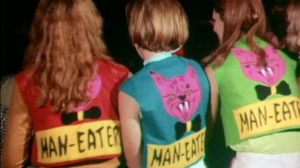
The Maneaters are the secret that Karen keeps from her family. They’re a rough, tough and ready to rumble group of female motorcyclists who hold weekly races to determine who gets to pick first from their many male suitors, or as they call it, the stud line.

Karen wins this week’s race against the gang’s boss, Queen. And even though Karen wins that first pick, she chooses Bill for the fourth week in a row. That’s against the code of the Maneaters, who demand that no one can be attached to anything or anyone save the gang. “All men are mothers!” they shout. “No Manhunter falls in love!” they scream.

Honey Pot (Nancy Noble, Jackson County Jail, Chesty Anderson U.S. Navy) is the teenage mascot of the gang. She’s also following Karen and informs the gang that she’s fallen in love. They demand that she come to the runway that evening, where she must join them in beating the shit out of Bill, then dragging him behind her bike until he dies. She does it. She’s a Maneater.

This also makes Honey Pot an official Maneater. Her left hand is cut open and each girl licks the blood and kisses her, then she strips and is covered in honey and chocolate syrup before she entertains every man on the stud line. Finally, she is cleaned off and given her jacket, proclaiming that she is a member.

This movie presents episodes in the life of the gang, like them going to Medley, Florida and driving their bikes through lawns, in front of and right through businesses and up and down the streets. They’re so mean and nasty that the townsfolk refuse to press charges.

There’s another stud line race, but an all-male gang comes out for a race. It starts fun, but Queen and Joe Boy end up having a knife fight and the Maneaters end up beating the shit out of the guys.

Meanwhile, Karen’s old boyfriend Ted tries to get her to leave, because the male gang is coming back and they want blood. He even infiltrates the stud line to get to her. During a huge orgy, he takes her to another room to try and save her, but she keeps telling him that she’s in too deep to ever go back to a normal life. While this is going on, the gang kidnaps Honey Pot. When she’s dropped off in the morning, she’s bruised, beaten, covered in blood and even has had a ring nailed through her nose. Joe Boy threatens that the Maneaters should stop now.

This movie is in an alternate universe, one where women bike gangs pretty much rule the world. That means that instead of quit, they go even crazier, leaving broken bodies in their wake as they hunt for Joe Boy. Whitey and Terry find him, provoke him and leave a motorcycle so he can follow them. Queen and her gang — Karen, Delta, Supergirl, Ginger and more — wait as a wire decapitates their most hated enemy. Queen leaves her belt as a signature.

Ted tries one more time to take Karen away, but she tells him that she belongs to the Maneaters. The police arrest them all for Joe Boy’s murder, but after the credits, we learn that they don’t have enough evidence.  How could they? The Maneaters are just too powerful. Just stare at them as they ride off into the sunset.

Shot in two weeks, this movie was picked as one of Joe Bob Briggs’ Sleaziest Movies in the History of the World. Of that list of films, it’s worth noting that ten of the fourteen came from Lewis.

This movie is filthy, grimy, messy and completely wonderful. It’s what I want every biker movie to be. It’s also filled with Lewis’ trademark lack of worry for amateurish performances. After all, the majority of the women in this film were actual bikers, picked as much for the bikes they owned and could ride as they were for their looks.

Every single one of them lives up to the Maneaters code: We don’t owe nobody nothin,’ and we don’t make no deals; We’re swingin’ chicks on motors, we’re man-eaters on wheels.

I can’t even put into words — I’ve tried — how much I love this movie.

Something Weird put this out on DVD a while ago. It’s in their Herschell Gordon Lewis collection and on a single DVD, too. You can grab that on Amazon. If you really into his films — and you should be — the giant box set from Arrow is also available here.

Destroy All Monsters (1968)

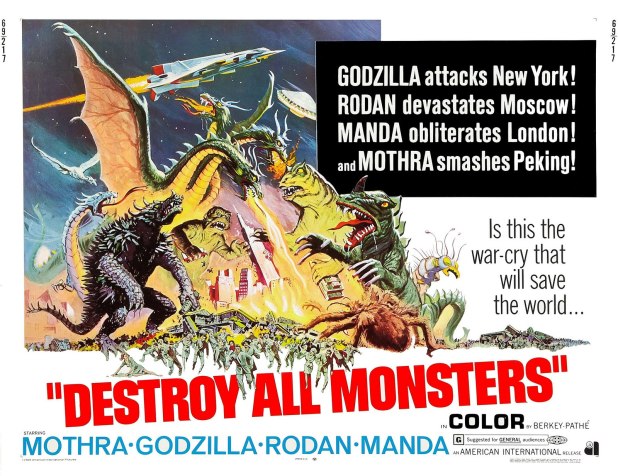
Has there ever been a better movie than Destroy All Monsters? It is everything that is magical about film: giant monsters smashing cities and fighting one another while people run and scream in terror. It is cinematic junk food, a treat for the mind that returns me to watching Action Movie on Youngstown’s WKBN 27 as a little kid, jumping around the room in pure glee.

Every giant monster on Earth has been captured and sent to Monster Island, where they are kept secure and studied — until all communication is mysteriously cut off.

Turns out that the scientists on the island are being mind-controlled by the Kilaaks, who demand the human race surrender or face total destruction. They control the monsters to attack famous cities all over the world: Godzilla decimates New York City, Rodan smashes Moscow, Mothra takes out Beijing, Gorosaurus crushes Paris and Manda, a giant Japanese dragon, goes shithouse on London. All of these attacks are to keep the UNSC forces from finding out that Tokyo is the real target. 

Luckily, the humans are able to take out the control signals and the good guy monsters take on King Ghidorah, who is overcome and killed (Minilla, Varan, Anguirus and Kumonga show up, too). The Kilaaks also have a Fire Dragon, a monster that starts setting cities on fire. Godzilla takes out their base and the forces of good triumph.

This was meant to be the final Godzilla film, as the popularity of the series was waning. However, the success of Destroy All Monsters led to even more Godzilla films.

When I was a kid, I was impatient for the human scenes to end and for the monsters to show up. I’ve never changed. All I want to do is watch giant monsters destroy cities and fight one another. This movie delivers all of that and more. It’s not high art, but does it have to be?

LEAGUE OF FORGOTTEN HEROES: Satanik (1968)

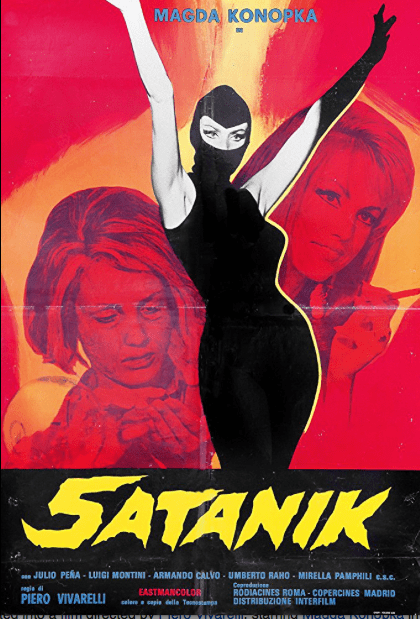
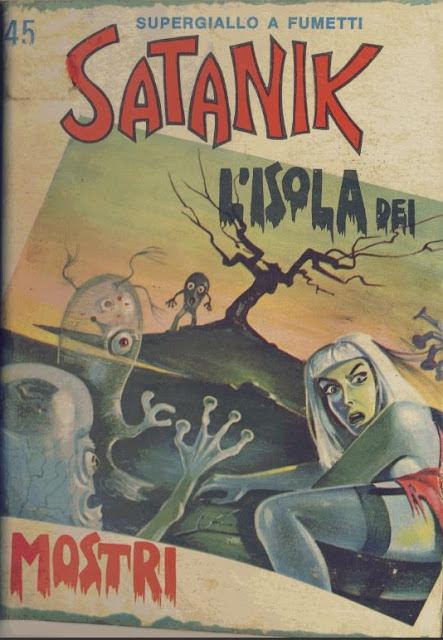
Satanik isn’t a hero, but it is based on an Italian comic book which was part of the fumetti neri (black comics) phase that Danger: Diabolik inspired (which is why Satanik is spelled that way).

Marnie Bannister is a biologist and chemist who earned her Ph.D. at a young age. While a technically brilliant scientist, she is ridiculed by her peers because of her poor background the fact that her face is marked by tumors. She still lives at home, Cinderella-style, with two beautiful sisters, an alcoholic father and closed-minded mother — all of whom make fun of her appearance. Working along with the alchemist Masopust, she develops a drug that makes her beautiful. The side effect? It also makes her into a murderous criminal named Satanik, who uses her beauty and sex appeal to take advantage of men. The comic features plenty of horror characters, such as evil ghosts and a vampire named Baron Wurdalak.

The movie, however, only concerns itself with Satanik’s transformation from old woman to beautiful young woman, playing by Polish model Magda Konopka.

If you’re looking for this film to live up to Bava’s Danger: Diabolik, I have bad news for you. There’s no way that can happen. Sure, there are murders and jet-setting and fun music, but this movie crawls while Bava’s runs, tumbles and pirouettes.

Its director, Piero Vivarelli, is better known for the original Django. With the great poster art and source material, I guess I was just expecting more.

If you want to see it for yourself, you can rent it on Amazon Prime.

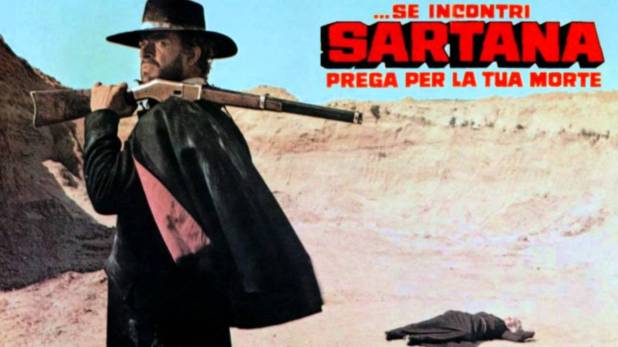
SARTANA WEEK: If You Meet Sartana Pray for Your Death (1968)

For the first film in what would come to be the Sartana series, star Gianni Garko wanted a character whose motivation was more than just vengeance. After turning down script after script, Renato Izzi’s take on the character — a man free from sentiment who pits rivals against one another — Sartana was born.

What breaks the character away from the mold is both his air of mystery and his love of gadgets, which many attribute to director Gianfranco Parolini (God’s Gun) love of James Bond films. His first line of dialogue says all you need to know about him. When faced with an entire gang of killers, led by Morgan (Klaus Kinski, Death Smiles on a Murderer), one of them says, “You look just like a scarecrow.” Sartana coldly replies, “I am your pallbearer,” before ruthlessly killing everyone but the gang’s leader.

The first few scenes of this movie set up that everyone is looking for coffins filled with gold, from Morgan’s gang to a Mexican army led by General Jose Manuel Mendoza (Fernando Sancho, Return of the Blind Dead), who says, “How many times I tell you… that my name is Don José Manuel Francisco Mendoza Montezuma de la Plata Perez Rodriguez… but you can call me General Tampico!” Then there’s another group led by Lasky (William Berger, a frequent actor in Jesus Franco films), who uses a gatling gun to wipe out his rivals. He’s working with/blackmailing Stewal (Sydney Chaplin, son of Charlie, who also appeared in Satan’s Cheerleaders) and Alman, a politician and banker.

Sartana remains the fly in Lasky’s ointment, taking his money in a card game and defeating Morgan, who is sent to kill him. He even wipes out Lasky’s entire gang. But then Stewal and Alman turn him in to Mendoza, who goes after both Lasky and Sartana.

What follows is an elaborate series of double-crosses, with Stewal trying to escape with the gold but being killed by Mendoza to Lasky killing Mendoza and his men and Alman’s wife killing him and taking Lasky to the gold before he kills her. Finally, Lasky and Sartana have a duel, which ends with our hero riding out of town with the coffin filled with gold.

This film sets up the character of Sartana quite well — no one is sure why he does what he does, appearing with the sound of a dead man’s watch, being able to seemingly disappear at will. He’s always a few steps ahead of his enemies and always appears unflappable in the face of sure death.

After all, I wouldn’t be spending an entire week discussing a hero who is anything less than awesome, right?

Want to learn more about Spaghetti Westerns? You can find no better site than the Spaghetti Western Database. It was so helpful as we put these reviews together all week long!

Danger: Diabolik (1968)

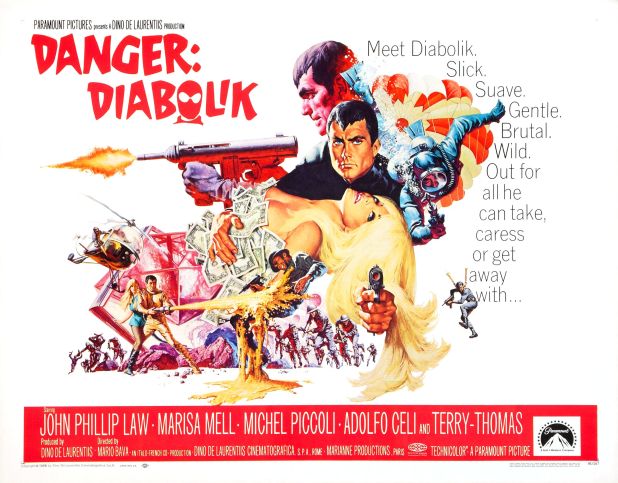
The late 60s pop art/spy fad produced some of my favorite films ever. Sure, they’re very much of their time, but they’re also rich with ideas, sumptuous design and color and great looking men and women risking life and limb to protect (or steal from) the world. From Batman to James Bond to Matt HelmIn Like Flint and Barbarella, there’s a lot to choose from. But for my money, there’s no better choice than Mario Bava’s Danger: Diabolik.

Based on the Italian comic series Diabolik by Angela and Luciana Giussani, this is the tale of a master criminal and thief who confounds the police and the mob at every turn. Along with his girlfriend Eva Kant, they travel the world to try and steal the biggest jewels and treasures.

The original production of this film was — charitably — a mess. Producer Dino De Laurentiis saw the footage that had been already been shot and canceled the film to hire a new director, cast and screenplay. After all, Diabolik was a huge character in his native Italy and there was tons of buzz about the film. Bava was hired to direct with a much lower budget, with any of the more well-known actors taking small roles. Some of the cast and crew came directly from Barbarella, as the film had stalled due to technical issues.

Bava brought along editor Romana Fortini and cinematographer Antonio Rinaldi were also brought in, as they’d had success with him on Planet of the Vampires and Kill, Baby, Kill

Sets were designed by Carlo Rambaldi, who worked with a veritable who’s who of directors — Fellini, Spielberg, Pasolini, Argento, Paul Morrissey, Ridley Scott and so many more. Just a brief overview of his career is awe inspiring, with everything from the two Andy Warhol horror films to the special effects that nearly landed Lucio Fulci in jail (the dog mutilation scenes were thought to be real) for A Lizard in a Woman’s Skin and Oscars for Alien, E.T. and King Kong.

This is a film of pedigree — with no less a talent than Ennio Morricone providing the soundtrack. From comedy work for films like La Cage aux Folles and Pedro Almodóvar’s Tie Me Up! Tie Me Down! to Sergio Leone’s Dollars Trilogy, Argento’s giallo work, John Carpenter’s The Thing, Tarantino’s The Hateful Eight, Terence Malick’s Days of Heaven, even Butterfly, Exorcist II: The Heretic, Red Sonja and the string section on Morrissey’s song “Dear God Please Help Me” — you’re talking about one of the finest and most diverse sonic artists there is. His score for Danger: Diabolik is playful and will stay in your head for a long time. I often find myself singing it to myself, pretending that I could be a famous thief. Then I realize I have no coordination at all.

The film looks like nothing else — pop art colors, strange sets (no accident, the sets were recycled from the currently in hiatus Barbarella), strong leads and outlandish action. I prefer it to Vadim’s take on comics, but obviously I’m always going to choose Bava over almost any other director.

Throughout the film, John Phillip Law shines as Diabolik, much more than he would get the chance to as the angel Pygar in the ad nauseam aforementioned Barbarella (I love the film, but it’s a mess that just barely holds together and cannot hold a candle to this work of genius and art). He does so much in the film with just his eyes and laugh. Marisa Mell is the most stylish and sexy women perhaps ever as Eva Kant, whether she’s setting up a crime or rolling around nude on a giant circular bed of money. If you think Austin Powers movies have ridiculous set pieces, you haven’t seen anything yet. In fact, between this film and the Dr. Goldfoot films, Mike Myers owes the Bava estate some serious money.

Diabolik cheats death throughout, even faking his demise via a technique taught to him by Tibetan monks (no need for Derek Flint’s heart restarting wristwatch here!) and being ejected out of a plane. It’s almost like an old movie serial — with case after case, set up after set up and death trap after death trap. It’s also a ton of fun. Plus, there’s a quick Terry-Thomas cameo as the Minister of Finance that makes me smile every time I watch this.

The film was initially seen as a failure, with poor box office and critical disdain. In the 90s, the Beastie Boys used clips of the film for their song “Body Movin'” and the last episode of the original Mystery Science Theater 3000 riffed on the film. It deserved much better. And thanks to critics finally recognizing the skill of Bava, it gradually has been seen in a whole new light (the breakdown of how the film works so well as a comic translation by Stephen Bissette is worth a watch on the now out of print DVD). And Bava made this film for around $400,000 — well under the budget of (again, I have to mention it) Barbarella.

I can’t see it as anything other than a success. A film that’s all style, with a flashy couple that steals things because — hey, why not? — and battles the mob and the police because — hey, why not? I’ve seen reports that De Laurentiis had budgeted $3 million for this and Bava came in so low, he was offered the chance to do a sequel (this kinda conflicts with other reports that Dino was unhappy with the returns). Bava didn’t want to work with Dino again, even when offered the chance to work on King Kong.

Just watch a few minutes of the film and you’ll realize there has never been anything before or since like it. It’s probably my favorite comic book movie ever — the closest a movie will ever get to simulating the reading experience without slavishly copying panels ala Sin City.