THE FILMS OF RENATO POLSELLI: Mondo pazzo… gente matta! (1966)

Crazy World…Crazy People was directed by Renato Polselli, who co-wrote the film with Giuseppe Pellegrini, who wrote and did second unit work on several of Polselli’s early movies.

A group of young musicians work with Maurizio, an older vaudeville actor (Posani), to organize a show that only gets on the stage thanks to girlfriends and Elvezia Allori, the actor’s wife (France Polesello). One of those musicians is Claudio Natili, who twenty years later would score Fulci’s The Devil’s Honey.

Thea Fleming also appears and is even on some of the posters. She showed up in several Eurospy movies like SuperSeven Calling CairoFrom the Orient With Fury and Operation Counterspy. Franco Latini is in the cast as well and he was the voice for Stan Laurel, as well as several muppets and the Italian dub voice of Skeletor and Donald Duck.

The film itself is a fake mondo about the concert and the issues of it getting to the public. It has none of the other outright insanity that you can find in Polselli’s other movies.

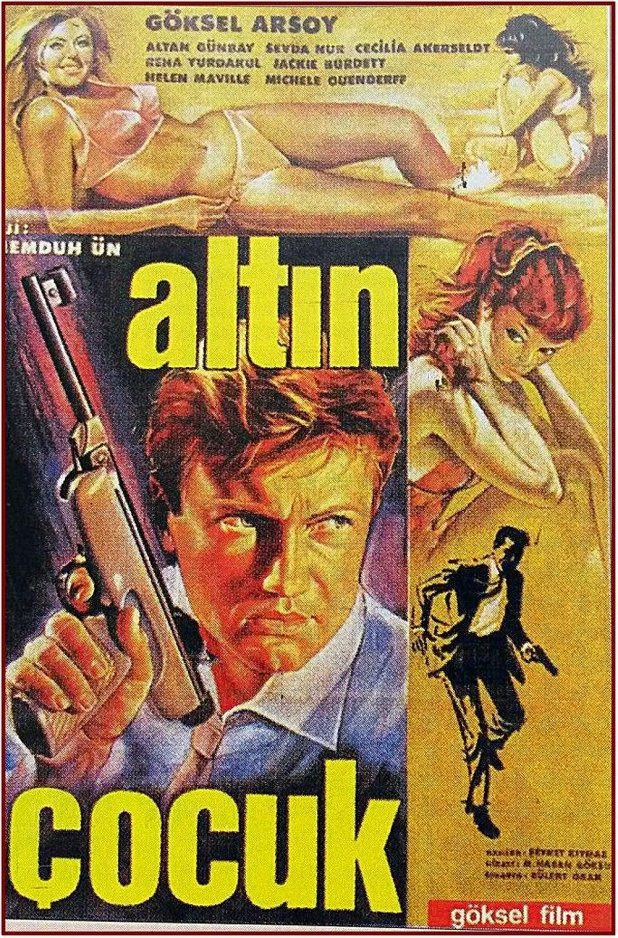
Altin Çocuk (1966)

Altin Çocuk means Golden Boy, who is the name of the superspy played by Goksel Arsoy. His mission? Stop Demetrius (Altan Gunbay), a supervillain who plans to destroy Turkey by firing missiles into Istanbul’s biggest nuclear reactor. Golden Boy was also Arsoy’s nickname, so this is his show. He also produced it.

This even gets the James Bond formula down so well that it starts with credits over a gorgeous woman and has an action scene before the main story, as an evil spy named The Wolf rises from the waves and tries to kill our hero with a speargun. But wait — it turns out that The Wolf was actually wearing a Golden Boy disguise and the killer is our hero. Hit the strip club sounding music and we’re off to the Eurospy — err, Turkspy? — action.

They even shot some of the opening in London to give this a more continental air. We get to see Golden Boy drive a sportscar and win over some British ladies before we get down to the actual spy intrigue. But once he gets back to Turkey, he learns that his fellow agent S-99 has been killed and starts to investigate. He also meets a capable female (Sevda Nur) who fights by his side for the rest of the movie.

Directed by Memduh Un, this even has an ending where Golden Boy and his female friend SCUBA into Demetrius’ underwater lair just like Thunderball.

Golden Boy would return in Altin Çocuk Beyrut’ta (Golden Boy in Beirut).

CBS LATE MOVIE MONTH: The Poppy Is Also a Flower (1966)

EDITOR’S NOTE: The Poppy Is Also a Flower was on the CBS Late Movie on November 10, 1972; May 23 and December 6, 1973 and June 9, 1975.

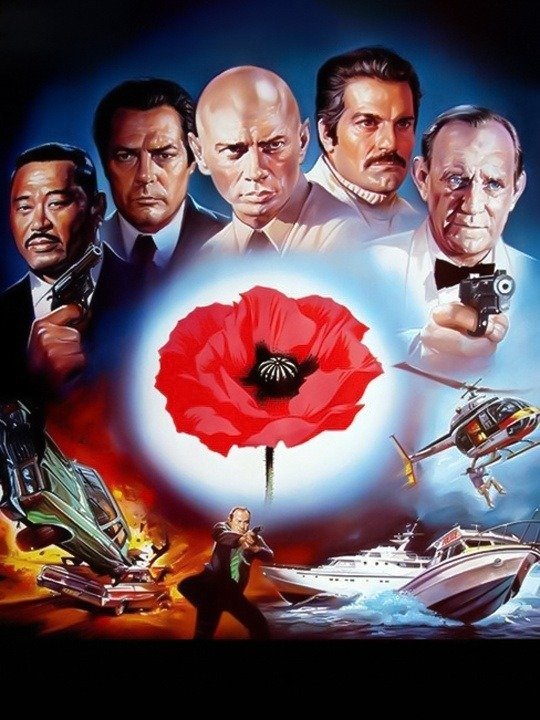
You know how I’ve discussed how Eurospy films often feel like the United Nations, what with so many countries working together to make these movies? This American/French/Austrian made-for-television spy and anti-drug film — also known as Danger Grows Wild — was made with the United Nations themselves as part of a series of television specials designed to promote the organization’s work. It was produced by Xerox.

So how does it tie-in to Bond? Well, 007 director Terence Young is at the helm — he passed up Thunderball to direct this — and it’s based on a story by Ian Fleming.

In an attempt to stop the heroin traffic at the Afghanistan–Iran border, some United Nations operatives inject a trackable radioactive compound into a seized shipment of opium and let it go go back into the wild to try and find Europe’s top heroin distributor.

German-born Sente Berger — who is also in The Man from U.N.C.L.E. film The Spy with My Face and The Ambushers — is here, as is Stephen Boyd (Ben-Hur), Yul Brynner, Angie Dickinson, Georges Geret, Hugh Griffith (another Ben-Hur alumnus), Jack Hawkins (who took as many roles as he could late in his career before his three-pack-a-day habit stole his voice), Rita Hayworth (!), E.G. Marshell, “If I Had a Hammer” singer Trini Lopez as himself, Marcello Mastroianni, Amedeo Nazzari (a huge Italian star from before World War II and well afterward), Omar Sharif, Barry Sullivan, Nadja Tiller (Death Knocks Twice), Eli Wallach (who won an Emmy for his role), Grace Kelly (this is the only movie she made after retiring from acting in 1957) and Harold “Oddjob” Sakata. Truly, this is the very definition of a star-studded affair.

All of them were paid $1 each to be in this film, with Young working for free.

One of the producers, Edgar Rosenberg, was of course the husband of Joan Rivers. This is the movie where Joan would meet Hayworth and write that she was demanding and incoherent, yet still glamorous. That said, it’s possible that Hayworth was already beginning to suffer from the effects of Alzheimer’s Disease.

You can watch this on Tubi.

CBS LATE MOVIE MONTH: Chamber of Horrors (1966)

EDITOR’S NOTE: Chamber of Horrors was on the CBS Late Movie on September 11, 1972.

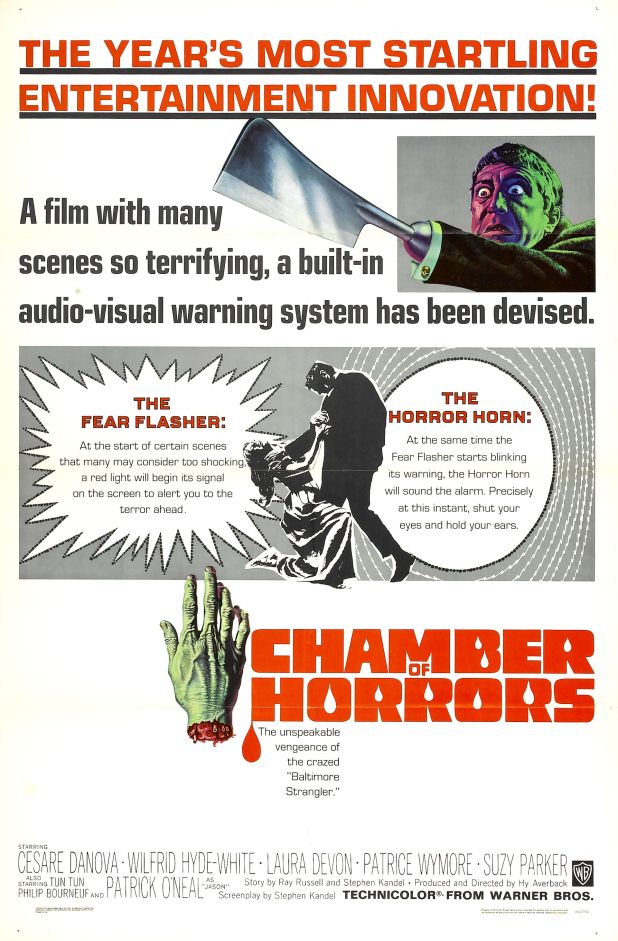
Ladies and gentlemen, the motion picture you are about to see contains scenes so terrifying the public must be given grave warning. Therefore, the management has instituted visual and audible warnings at the beginning of each of the four supreme Fright Points. The Fear Flasher is the visual warning. The Horror Horn is the audible warning. Turn away when you hear the Fear Flasher! Close your eyes when you hear the Horror Horn!”

Chamber of Horrors was initially intended to be a made-for-TV movie and a pilot for a series known as House of Wax. It was way too intense for that, so it came to theaters. It was pretty short — it’s only 99 minutes with padding — so they added two gimmicks: the Fear Flasher turns the screen red when something scary happens, and the Horror Horn makes plenty of noise when something gory is about to befall a character.

This was directed by Hy Averback, who directed and produced plenty of TV as well as directing the movies Where Were You When the Lights Went Out?, I Love You, Alice B. Toklas and The Story of Life, a 62-minute sex educational film with animation by several former Disney cartoonists. He was also the voice of the loudspeaker on M*A*S*H*. It was written by Stephen Kandel, who, in addition to writing tons of TV scripts, also wrote Winchester 73. Seriously, his TV credits hit every major show of the 70s.

Anthony Draco (Cesare Danova) and Harold Blount (Wilfrid Hyde-White) own a wax museum in Baltimore and have a side hustle as detectives. They join the police — including Wayne Rogers as Sgt. Albertson — in the hunt for Jason Cravette (Patrick O’Neal), a man who kills women and then marries her, which doesn’t seem like the usual way these things go. After being caught and sent via train to prison, he escapes by cutting off his own hand and running off to New Orleans, now with a hook where he once had fingers.

He finds a sex worker named Marie Champlain (Laura Devon) and transforms her into a lady — ironic, as Hyde-White played Colonel Pickering in My Fair Lady — and takes her back to Baltimore to seduce and murder the man who convicted him, Judge Walter Randolph (Vinton Hayworth). He chops off the dead man’s hands and head so the police can’t figure out who did the crime. He follows that by killing Dr. Romulus Cobb (Richard O’Brien) and sending that man’s hands to the police to taunt them.

Draco and Blount believe that the mysterious murderer is Cravette and that he’s sending an entire corpse to the police piece-by-piece, with the arms and head still missing. After he kills a police officer for the hands, Draco realizes that the head the killer wants will be his.

There’s a tease for the next episode: a body in the Iron Maiden in the museum turns out to be real. The detectives call the police, and, well, that’s the end of their adventures.

This was supposed to be a House of Wax series, so the sets from the original film are used in this movie. Tony Curtis also appears in a cameo, and William Conrad narrates the story.

Sources

Cool Ass Cinema: Chamber of Horrors (1966) review. http://www.coolasscinema.com/2010/11/chamber-of-horrors-1966-review.html?showComment=1290117394811

CBS LATE MOVIE MONTH: The Glass Bottom Boat (1966)

EDITOR’S NOTE: The Glass Bottom Boat was one of the first movies on the CBS Late Movie, airing on February 17, 1972. It also aired on July 31, 1972; February 19 and November 5, 1973 and March 12, 1976.

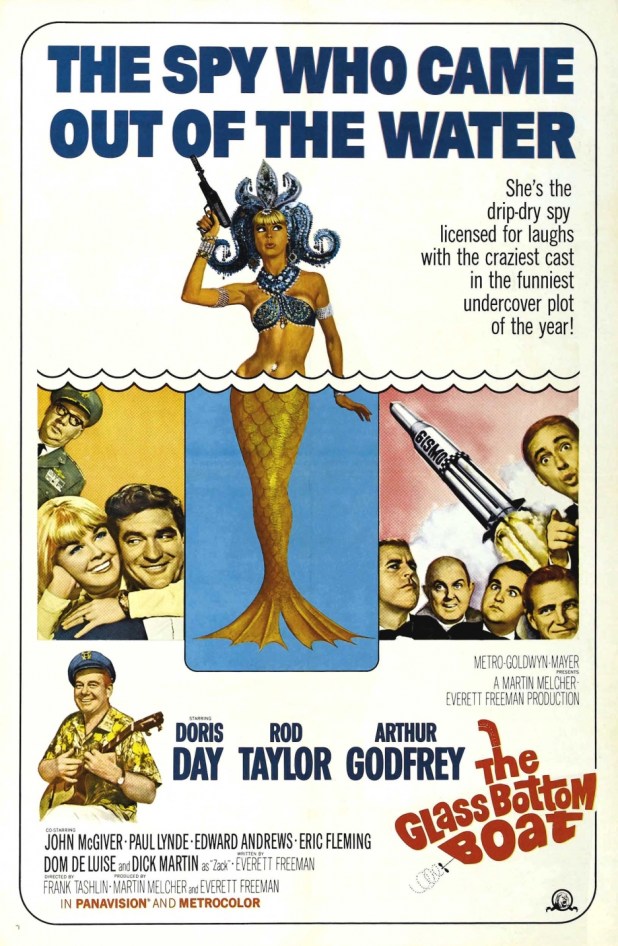
Also known as The Spy in Lace Panties, a title change that was likely made to emphasize the spy plot, this movie teams up animator-turned-director Frank Tashlin (who made one of my favorite movies of all time, The Girl Can’t Help It) and star Doris Day, who gets to sing, of course, but also gets pulled into a spy plot. It was written by Everett Freeman, the writer of The Maltese Bippy.

Day plays Jennifer Nelson, a widow helping her father (Arthur Godfrey) in his tourism business by dressing as a mermaid and swimming under his glass bottom boats. One day, she’s accidentally caught by Bruce Templeton (Rod Taylor) while he’s fishing; the embarrassment of her being nearly nude in front of him is compounded when she realizes that he works at her new position of employment, an aerospace research company.

Bruce’s new project is GISMO, a gravity system, and he hires Jennifer to write his biography. But really, in truth, he just wants to get with her. Jennifer also meets Julius Pritter (Dom DeLuise), a spy struggling to install a stereo in Bruce’s futuristic apartment while gathering information on him, and Edgar Hill (Eric Fleming), a CIA agent protecting Bruce and GISMO.

Love blooms, as it does in romantic comedies, but the issue is that Hill, security guard Homer Cripps (Paul Lynde!) and PR executive Zack Molloy (Dick Martin!) believe that Jennifer is a spy. Why would she call the same phone number multiple times a day and simply hang up after saying, “That’s enough, Vlamdir?”

As it turns out, ‘Vlamdir’ is not a Russian boss, but Jennifer’s dog. The poor pup’s only exercise during her work hours is running around the apartment, irritated by the ringing phone. In a classic rom-com twist, Bruce makes a blunder by underestimating Jennifer’s intelligence. She decides to play along and pretends to be a spy. This leads to a series of light-hearted hijinks at a party, but all’s well that ends well.

For TV aficionados, Norman and Mabel Fenimore (George Tobias and Alice Pearce) are the same characters Tobias and Pearce played on Bewitched. The film also features a memorable cameo by Robert Vaughn, and the theme from The Man from U.N.C.L.E. is heard on the soundtrack. Speaking of the show, Templeton’s ultra-technological apartment was repurposed as the evil spy base on a two-part episode of The Man from U.N.C.L.E., titled ‘The Concrete Overcoat Affair.

After this, Day only made four more movies — including the pure spy movie Caprice with Tashlin  before starting what many would know her best for: The Doris Day Show. In that show, she sang the theme song, “Que Sera Sera,” which became synonymous with Day’s career and was also featured in her earlier films, like The Man Who Knew Too Much and Please Don’t Eat the Daisies.

CBS LATE MOVIE MONTH: The Trygon Factor (1966)

EDITOR’S NOTE: The Trygon Factor was on the CBS Late Movie on January 23, 1973 and January 2, 1974.

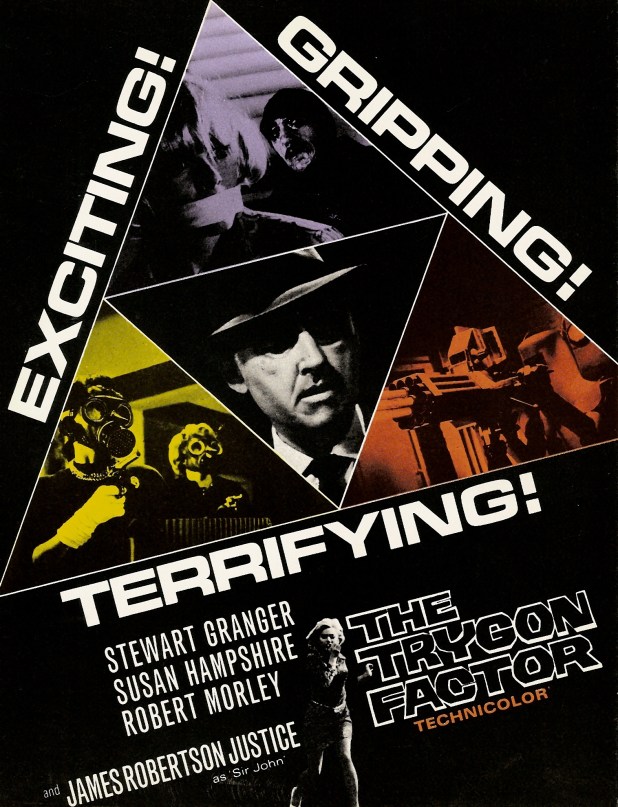
Das Geheimnis der weißen Nonne (Mystery of the White Nun) is known in the U.S. as The Trygon Factor and is based on Edgar Wallace’s book Kate Plus Ten.

Inspector Cooper-Smith (Stewart Granger) is on the hunt for a group of thieves who have been stealing various unconnected goods. His investigation leads him to the country manor of the Emberdays, a respectable English family. The mistress of the house, Livia (Cathleen Nesbitt), and Sister General (Brigitte Horney) and the nuns living in her home, are all suspects. Could they be behind the thefts to save the family fortune? The plot thickens when Inspector Thompson (Allan Cuthbertson) is murdered at Emberday Abbey. The Emberday children, Trudy (Susan Hampshire) and Luke (James Culliford), also come under suspicion.

The Trygon Factor leans more towards the Eurospy genre than the nascent Giallo, a style of Italian thriller, as the Krimi cycle of films began to slow down. The Eurospy genre is characterized by its focus on espionage and action, which is evident in the film’s plot and action sequences. Director Cyril Frankel, known for his work on UFOThe Avengers and Return of the Saint, brings his expertise to the film. The script was written by Derry Quinn (Young, Willing and Eager) and Stanley Munro.

One of the most intriguing scenes in the film features a gang member in a striking yellow suit of armor, wielding a gigantic gatling gun to burst through a bank wall. This unique sequence is only topped by the unexpected moment when Stewart Granger’s character punches a nun right in the face.

CBS LATE MOVIE MONTH: The Psychopath (1966)

EDITOR’S NOTE: The Psychopath was on the CBS Late Movie on July 23, 1973; January 30 and December 17, 1974. 

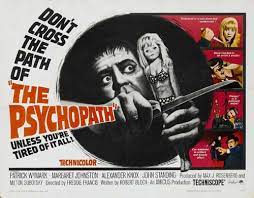
Between Die! Die! My Darling! and the poster for this film featuring the killer, Glenn Danzig clearly found plenty of inspiration in British horror movies.

Directed by Freddie Francis for Amicus, this film revolves around a series of murders in which each victim is found with a doll that looks exactly like them attached to their body.

It embodies the early elements of Giallo cinema, highlighted by a striking scene of a room filled with dolls. If it had some stylish fashion, a jazzy soundtrack, a few bottles of J&B, and a touch of nudity, it could easily fit into that genre. I would also consider it a slasher, and I’d support your choice in that classification.

Patrick Wymark, known for Blood on Satan’s Claw, plays Inspector Holloway. Margaret Johnson, from Night of the Eagle, portrays the mysterious, wheelchair-bound doll maker Mrs. Von Sturm. John Standing, known for his role in The Elephant Man, plays her obsessive son Mark.

If you’re reading this and thinking, “A movie where a man with mommy issues turns into a murderer sounds a lot like Psycho, you’d be right—this was written by the same author, Robert Bloch.

CBS LATE MOVIE MONTH: Eye of the Devil (1966)

EDITOR’S NOTE: Eye of the Devil was on the CBS Late Movie on May 10 and September 8, 1972 and September 6, 1973.

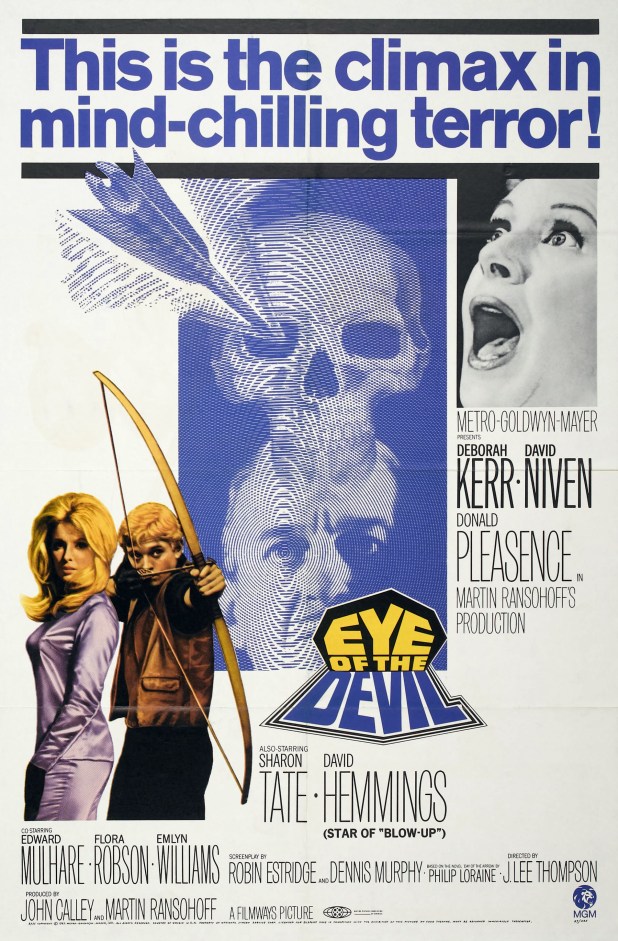
Based on Day of the Arrow by Philip Loraine, this was shot under the title Thirteen. It was a prophetic title, as the film had to have felt cursed.

Sidney J. Furie was originally going to direct, but he was replaced by Michael Anderson, who then got sick and was replaced by J. Lee Thompson. Even worse, two weeks before filming was scheduled to end, star Kim Novak was thrown from her horse and hurt her back. Production shot around her, but it would take eight more weeks for her to heal up, so the entire movie was shot with Deborah Kerr.

But the circumstances of her injury remain shrouded in mystery.

In Blow Up… and Other Exaggerations: The Autobiography of David Hemmings, the actor said that he saw Novak arguing with producer Martin Ransohoff, and she was fired afterward.

Philippe de Montfaucon, the Marquis de Bellenac (David Niven), owns an ancient estate in Bordeaux. The grapes have not grown in three years, but he lives far away in Paris with his wife Catherine (Kerr) and two children.

He is asked to come home, where Père Dominic (Donald Pleasence), a dark priest, gives him a strange amulet. After their son Jacques dreams about his father, Catherine takes her children to Bordeaux. As soon as they arrive, they see Christian de Caray (David Hemmings) shoot a dove.

When asked of him, Aunt Estelle (Flora Robson) says that he is “an evil little boy” and that his sister Odila (Sharon Tate) is “no better.” That night, Catherine watches them conduct a ceremony with the body of the dead dove before an old man closes the doors and tells her to take her children and get away.

That’s when she learns how many heads of the family have died and starts to see robed figures everywhere. Her husband must die to keep the family’s fortunes and even the town strong. There’s no stopping it.

Alex Sanders, renowned as the King of the Witches, was the consultant for all the rituals in this movie, adding a layer of intrigue and authenticity to the film’s occult elements.

This was Tate’s first movie and the last black-and-white movie from MGM.

CBS LATE MOVIE MONTH: Made In Paris (1966)

EDITOR’S NOTE: Made In Paris was on the CBS Late Movie on April 3 and November 24, 1972; October 15, 1972; October 15, 1973 and January 19 and June 17, 1976.

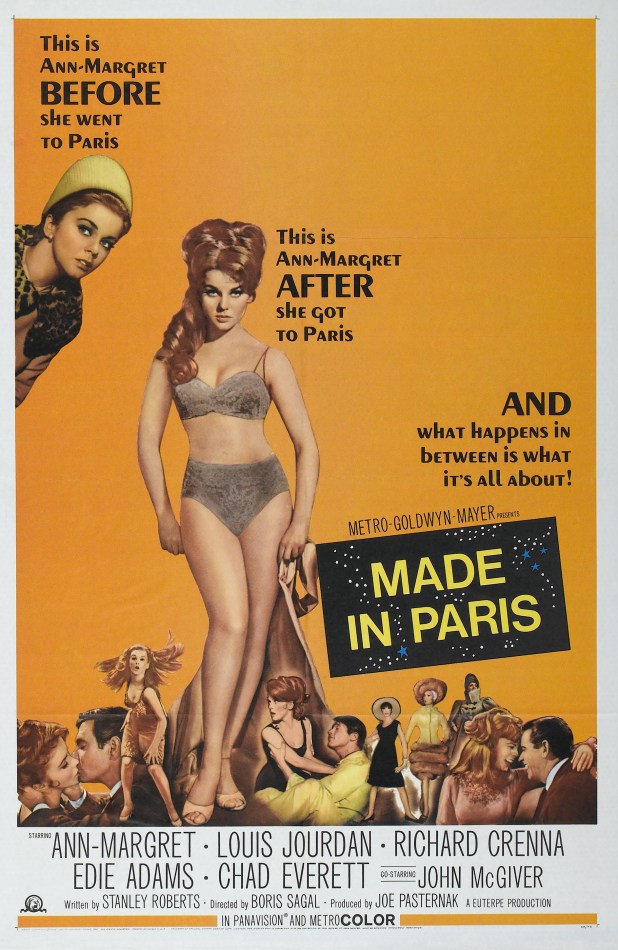
Everybody is in love with Maggie Scott (Ann-Margret), a charming and ambitious young woman. Ted Barclay (Chad Everett) is the son of the department store owner where she works, and he is smitten by her. Fashion designer Marc Fontaine (Louis Jourdan) is captivated by her unique style and elegance. Fashion designer Marc Fontaine (Louis Jourdan). Journalist Herb Stone (Richard Crenna) is intrigued by her story. She’s working as the store’s representative for the annual fashion shows of the prominent European fashion designers,

Both Maggie and her boss, Irene (Edie Adams), wear great fashions in this, designed by MGM costumer Helen Rose, who also designed Princess Grace’s wedding dress. The film’s fashion, designed by Helen Rose, is a significant aspect of the movie, reflecting the elegance and style of the era. Ann-Margret had it in her contract that she could keep any of the clothes made for her for this movie.

Despite its Parisian setting, the movie was actually shot on the MGM studio’s backlot, adding a unique twist to the film’s production. The soundtrack, featuring the legendary Count Basie and his orchestra, further enhances the movie’s allure.

It was directed by Boris Sagal (The Omega Man) and written by Stanley Roberts (The Caine Mutiny).

THE FILMS OF BRIAN DE PALMA: The Responsive Eye (1966)

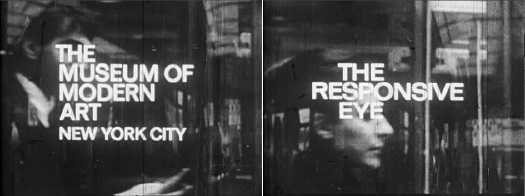
Brian De Palma shot this twenty-minute short about an optical art exhibit at the Museum of Modern Art in 1965. Artists such as David Hockney, Jeffrey Steele, Mon Levinson, Al Lesley, Josef Albers, Larry Rivers and Marisol appear, as well as architect Philip Johnson, curator William Seitz and actress Pamela Tiffin, who mostly acted in Italy in films including The Fifth Cord and Kill Me, My Love!

It’s interesting to think about whether De Palma liked his subject or not, because you can almost see that he’s making fun of the critics and the art scene of the time. Or is he just an impartial observer and that’s how they all really are?

So much of De Palma’s films play with optical illusion, so there’s also the intrigue of seeing him film this art and wonder how it would show up later in his more celebrated movies.

You can watch this on YouTube.