The Living Head (1963)

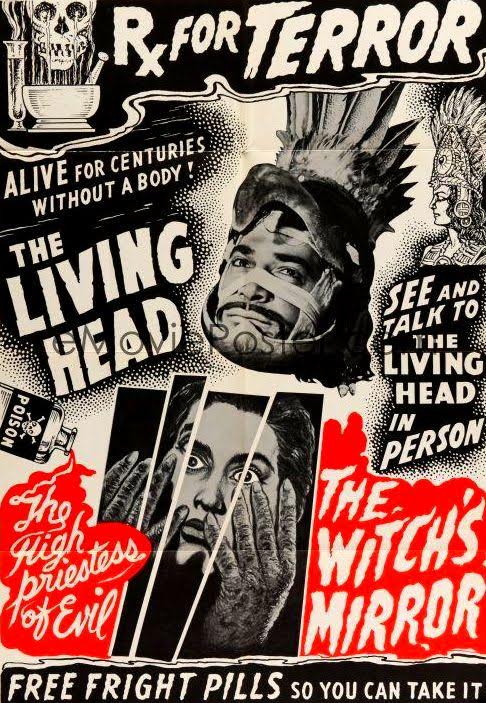
Is there anything scarier than a human head living on after decapitation? Probably, but today, we’re diving into 1963’s La Cabeza Viviente, or The Living Head.

Director Chano Urueta’s films frequently made their way north, with titles like El Baron del Terror (released as The Brainiac) and El Espejo de la Bruja (featured in horror host packages as The Witch’s Mirror). Urueta even appeared as an actor in films like The Wild Bunch and Bring Me the Head of Alfredo Garcia.

The story begins with archaeologists unearthing the Aztec tomb of Acatl, a warrior whose head was severed in battle. A flashback reveals the gruesome fate of the person responsible for Acatl’s death, who has their heart ripped out – say it with me, “Bali mangti Kali Maa” — in a ritual sacrifice. High priest Xiu and high priestess Xochiquetzal then do the sensible thing and entomb themselves with Acatl’s head.

However, treasure hunters disrupt this ancient resting place, opening the chamber to the air and causing the mummified bodies to crumble to dust. All that’s left behind is a gaudy costume jewelry ring adorned with an eyeball, which becomes the focal point of the subsequent terror. 

Is there a curse? Of course there is. Why would you steal from the Aztecs? You wouldn’t, and you’re someone reading an article about mummy movies, not an archeologist who went to school for years to learn your craft. I would think that someone would teach you not to break into the tomb of maniacs who tore out the hearts of their own people, but higher education is a strange place.

As for Mexico, it is fantastic, as writing team Federico Curiel and Adolfo Lopez Portillo are restrained here compared to The Brainiac; yet we’re still talking about a movie where a man’s head has been alive for four hundred years and can command a mummy to kill people.

Who can stop him? Professor Mueller (German Robles, playing the good guy instead of a vampire as usual), as well as his son-in-law Roberto (Mauricio Garces, who is the head) and daughter Marta (Ana Luisa Peluffo, one of the first Mexican actresses to appear nude on screen in her home country; The Force of Desire was a big deal as a result), probably. 

Mueller’s daughter Marta is the reincarnation of Xochiquetzal, because mummy movies are based around coincidence as much as predestination. Is she going to put on that glowing Ring of Death with an eyeball in the middle of it? Certainly. Is a mummy going to tear out the hearts of mortal men? Boy howdy, I hope!

I say that there is a mummy in this, but he’s not even wrapped up. That’s how good the Aztecs were. They could mummify you without the need for leaves or bandages. Plus: Their mummies can talk!

There have been too many questions already, but I ask: If you were a professor with a mummy head and an evil ring just sitting around your home, would you give that ring to your daughter to wear? These are the kind of decisions that people make in this film, somehow all dumber than a stiffly walking zombified Aztec mummy and a head that’s sitting on what appears to be a sponge cake.

But you’re not coming to a Mexican mummy movie for things that make sense. 

Throw in a dub by K. Gordon Murray, and you have even more reason to celebrate this film, as the booming voice of Paul Frees intones as the professor and loud music blares over everything as the words barely match the lips. I don’t say this as an insult. I prefer my movies dubbed.

Maybe the professor isn’t the hero we want him to be. He unleashes a giant spider on his own home and just walks away from it, like someone else will deal with that. And why isn’t he just donating this mummy, this head, this ring to a museum instead of inviting metaphysical dread into his abode? And when the police find the bloody knife of the mummy in his study, do they arrest him? Of course not. They have no idea who did it, and the whole time, the head is giggling at them. Even a four-hundred-year-old decapitated Aztec head realizes that horror movie cops are, at best, fools.

This movie wants to entertain you, despite its reliance on monologue. You get the exact same time travel montage from The Brainiac. You’ll thrill to Martha in a diaphanous white nightgown looking for all the world like an Italian Gothic Horror heroine except she’s carrying an Aztec warrior’s head on a tray. You’ll get grossed out by organs that get cut out of the bodies of scientists and show up right next to the head as bombastic music reminds us that Mexico might be Heaven, at least for horror geeks.

I like to imagine that when this played on late night horror host shows, people came home from night turn shifts at the steel mill, came into the middle of this movie and were stupefied by it. Such is its power. In my wildest dreams, I want Acati and Jan Compton from The Brain That Wouldn’t Die to have a meet-cute and have lots of little craniums. I think we can all admit that they deserve happiness.

MILL CREEK LEGENDS OF HORROR: The Ghost (1963)

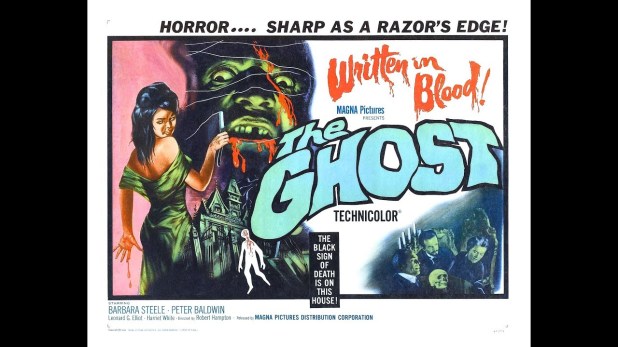
An Italian horror remake of 1955’s Les Diaboliques, I’ll give you one reason to watch this movie: Barbara Steele. Otherwise, it’s a brooding take on murder and gaslighting. And while this is directed by Riccardo Freda, stars Steele and has a character named Dr. Hichcock, it is not the same movie as The Horrible Dr. Hichcock. While this movie was shot right around the same time, it is also not a sequel per se. There are some people who care about these kind of things. Like me.

The ailing Dr. Hichcock and his housekeeper Catherine are engaged in a seance whole his wife Margaret (Steele) is having a love affair with Dr. Livingstone (Peter Baldwin, who in addition to acting in this movie and I Married a Monster from Outer Space, went on to become a director, being behind the camera for TV movies such as the aborted Revenge of the Nerds TV show pilot, The Harlem Globetrotters on Gilligan’s IslandThe Brady Girls Get Married and The Brady Brides series follow-up).

Soon, the doctor is dead and Catherine, Margaret and Livingstone get none of the money. And the key to his safe? Well, he’s literally taken it to the grave. Every time they think they get close or find the money, they’re thwarted. And soon, Catherine the maid is possessed and throws shade on the lovers, convincing Margaret that she should kill the not so good doctor.

The close is where this movie turns the screw. Hichcock has been alive and well the entire time and he murders Catherine, his co-conspirator, and incriminates Margaret. She had been planning suicide and poured a glass of poison, which Hichcock thinks is poison. He begs for the antidote, but she walks away to be arrested for Catherine’s murder. As the movie closes, Hichcock seals himself away inside his castle to die.

Directed by Riccardo Freda and written by Oreste Biancoli, this is another movie that reminds me of how much I love Italian Gothic horror.

You can watch this on YouTube.

CHILLER THEATER MONTH: Doctor of Doom (1963)

EDITOR’S NOTE: Doctor of Doom was on Chiller Theater on Saturday, August 24, 1968 at 11:20p.m. and Saturday, August 7, 1971 at 1:00 a.m.

You know, Gaby (Regina Torne) is great.  Across two movies — Las Luchadoras contra El Medico Asesino and Las Luchadoras contra La Momia  — we’ve watched Gloria Venus and Golden Rubi battle evil doctors and an Aztec mummy, but now we have an evil doctor kidnapping the world’s smartest scientists and also creating a trenchcoat wearing killer who looks like he’s made out of the finest rubber than Senor Benjamin Cooper makes.

Sure, we’ve seen it before as “Return of the Cybernauts” on The Avengers, but have we see it with wrestling women and a half-ape, half-zombie, half-man named Carfax? And then, how about if we put that monsters head into a female wrestler and change her named from Berthe to Black Electra?

As was the custom at the time, there are two cuts of this movie. There was another “sexy” version with nudity that was intended for the U.S. titled El Asesino Loco y el Sexo (Sex and the Mad Killer).  The clean and filthy versions both went unreleased up here.

Director René Cardona was on a quest to make the perfect luchadora against scientists movie and damn if he didn’t succeed more than once. If you want the best realitization of his quixotic quest, I would recommend Night of the Bloody Apes, which features a heroine who dresses like a demon, a monkey/human killer that rips off faces and legitimate footage of an open heart surgery.

He also made the lucha movies La Mujer MurcielagoNeutron Traps the Invisible KillersLas Luchadoras contra El Medico AsesinoLas Luchadoras contra La MomiaSanto vs. the StranglerSanto vs. the Ghost of the StranglerLas Lobas del RingLas Mujeres PanterasThe Treasure of MontezumaSanto in the Treasure of DraculaSanto vs. CapulinaOperation 67Santo vs. the Riders of TerrorSanto in the Vengeance of the Mummy and Santo vs. the Head Hunters.

CHILLER THEATER MONTH: Samson In the Wax Museum (1963)

EDITOR’S NOTE: Samson In the Wax Museum was on Chiller Theater on Saturday, September 14, 1968 at 1:00 a.m. It’s Santo en el Museo de Cera

You have to hand it to the people who made Santo movies, this time Alfonso Corona Blake (who made Santo vs. Las Mujeres Vampiro) and Manuel San Fernando (who made three Santa Claus movies and the American version of Johnny Socko).

Santo is an obsession for me, as he perfectly finds himself in nearly every genre through his long career. He’s a detective. He fights monsters. He becomes a spy. He appears in a gothic horror occult exploitation film. He battles aliens. He goes to the Bermuda Triangle. And then he’s in a karate movie. Santo can be all of these things and so much more.

This time, I can only assume someone watched House of Wax and thought, “This movie would be better with lengthy wrestling scenes and a masked hero.”

The evil Dr. Karol looks the same as he did when he came to Mexico twenty years ago as the survivor of the Dachau concentration camp. He runs a haunted house packed with some of your favorite monsters that come to life, because have you ever seen a horror movie set in a wax museum where things go well?

By the end of the movie, this gets all Dr. Moreau with animal men get whipped. But you have to love a movie where Santo tells the police he’ll get back to crimefighting just as soon as he finishes his next match.

You can download this from the Internet Archive.

CHILLER THEATER MONTH: The Slime People (1963)

EDITOR’S NOTE: The Slime People was on Chiller Theater on Saturday, February 25, 1967 at 11:20 p.m.; Saturday, March 30, 1968 at 1:00 a.m.; Saturday, March 29, 1969 at 1:00 a.m. and Saturday, June 12, 1971 at 11:30 p.m.

There’s so much fog in this movie that Lucio Fulci got jealous.

There was so much fog that the Elizabeth Dane wrecked.

So much fog…

You get it, right?

A bunch of lizard people emerge from under Los Angeles and use their fog machine to invade the city because, well, we nuked them out of their homes. Luckily, Tom Gregory (Robert Hutton, who also directed the movie) joins a group of survivors to battle the slimy reptiles, who can’t handle salt or their own spears.

Susan Hart — who would one day marry American-International Pictures president James H. Nicholson and appear in their beach movies — is one of the humans battling the mucky scaly heels.

This entire movie was filmed in the studios of KTLA, but ran out of money after nine days. The slime creatures cost most of the money, and neither the stuntmen nor Hutton got paid. There was also the wild thought of using small people as giant voles to lead the invasion, but when they watched the footage, it seemed too silly to use. Just think of that, as this movie is one of the goofiest films ever made. I wish I could watch that footage.

Hutton would go on to write Persecution, which was one of Lana Turner’s last films. It’s just as goofy — maybe more — than this one.

CHILLER THEATER MONTH: The Crawling Hand (1963)

EDITOR’S NOTE: The Crawling Hand was on Chiller Theater on Saturday, December 16, 1967 at 1:00 a.m., Saturday, May 30, 1970 at 1:00 a.m. and Saturday, April 17, 1971 at 11:30 p.m.

If an astronaut crash-lands and says things like, “My hand… makes me do things…. kill…. kill!” At this point, you may say that perhaps this is not a lack of oxygen in the astronaut’s helmet, but rather that he may have a medical issue.

There’s also a medical student named Paul (Rod Lauren was a singer who released the song “If I Had a Girl” before acting; he moved to the Philippines, where he married actress Nida Blanca. He became the lead suspect in her death when she was stabbed in a parking garage, then fought extradition back to the country for years before jumping off a hotel room balcony; sorry to bring everyone down with who Paul really was, who finds the astronaut’s hand and well, keeps it. Because that’s what doctors do: keep desiccated hands that they see from space crashes.

Paul begins to use the power of his hand to attack people he dislikes, becoming increasingly obsessed with it. The police — led by The Skipper Alan Hale Jr. — try to catch him, and the space agency starts to realize that the fingerprints of the dead astronaut are all over the place. So Paul takes the hand to the beach and tries to destroy it, and some cats try to eat it, because that’s the kind of movie The Crawling Hand is.

Somehow, writer Rick Moody used this film as inspiration for his novel Four Fingers of Death, the tale of writer Montese Crandall, who attempts to get over the death of his wife by throwing himself into his work and writing a remake of The Crawling Hand.

Director Herbert L. Strock also made Gog and The Devil’s Messenger, and one of the co-writers was Joe Cranston, the father of Bryan. None of them noticed that at times, the crawling hand is a left hand a right hand at other times.

CHILLER THEATER MONTH: Voyage to the End of the Universe (1963)

EDITOR’S NOTE: Voyage to the End of the Universe was on Chiller Theater on Saturday, November 25, 1967 at 11:20 p.m. and Saturday, August 1, 1970 at 11:30 p.m.

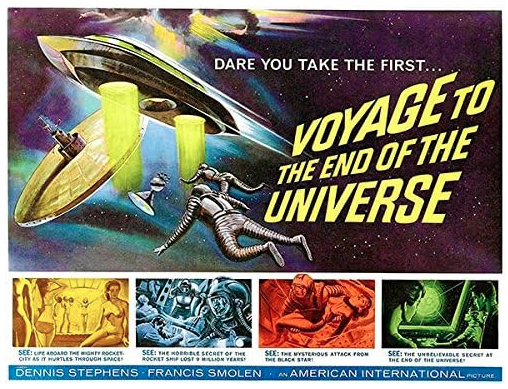
What were American audiences thinking when they got this Czechoslovakian movie dubbed into English, once Ikarie XB-1 and now Voyage to the End of the Universe?

I hoped they loved it.

2163: The 40-person multinational crew of the starship Ikarie XB-1 has spent 28 months at light speed — 15 years of human time — to get to the Green Planet, a mysterious body that humans may be able to live on. To get there, they have to deal with an ancient ship packed with nukes, a radioactive dark star and the crew slowly falling to pieces. Like Dark Star. Or even 2001.

American-International cut twenty-six minutes of this (including a scene where a UFO carries dead capitalists), changed the White Planet to the Green Planet and gave it the new name. However, the most significant change is that, at the end of the original, the crew discovers that the planet is inhabited. In this one, they land and see stock footage of the Statue of Liberty, giving it a gimmick ending.

Director Jindřich Polák used the same props from this film for his next project, a 1963 TV series entitled Klaun Ferdinand a raketa. His career went between science fiction and children-friendly movies, along with some crime movies. He based this on the Stanisław Lem book “The Magellanic Cloud” and co-wrote it with Pavel Juráček.

I really enjoyed this, as it seems to get across what it would be like to be a space traveler. The claustrophobia, the worry, the food not being digestible — encompass all the small details that others overlook.

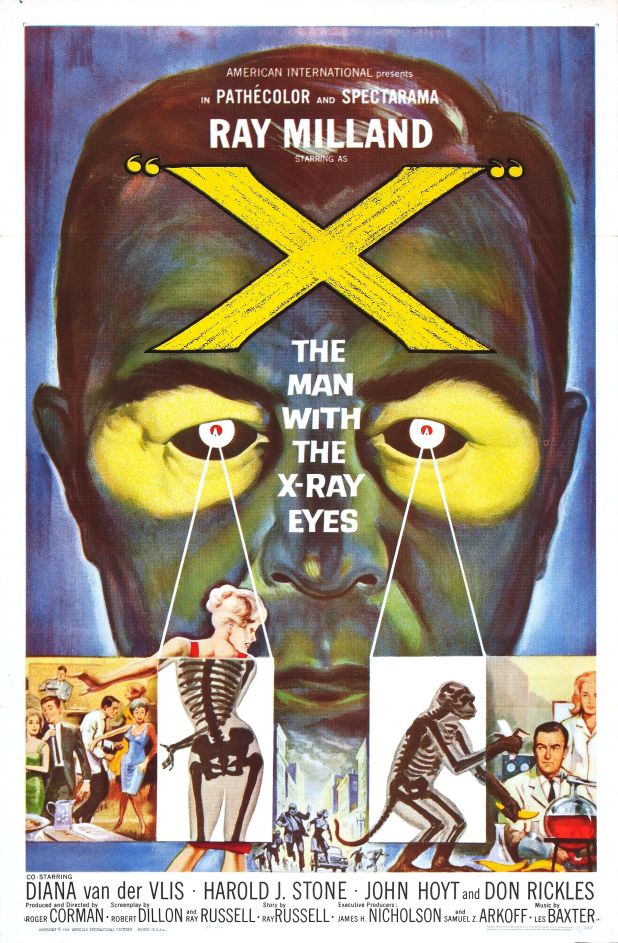
CHILLER THEATER MONTH: X: The Man with the X-ray Eyes (1963)

EDITOR’S NOTE: X: The Man With the X-Ray Eyes was on Chiller Theater on Saturday, February 28 at 1:00 a.m. and  October 31, 1970 at 11:30 p.m.

Roger Corman originally made this movie about a scientist, but that was “too obvious” so he changed the lead to be “a jazz musician who had taken too much drugs, and I get into about four or five pages, and I thought, “You know, I don’t like this idea”, and so I threw the whole thing out, and started back and went back with the scientist, which was the original idea.”

Shot in three weeks on a budget of approximately $300,000 — that seems luxurious for Corman — and played a double feature with Dementia 13.

It stars Ray Milland as Dr. James Xavier, who is trying to expand the range of vision, allowing humans to see ultraviolet and X-ray wavelengths, and even beyond. Being a somewhat mad scientist, he tests the eyedrops on himself and soon can see more than just through clothes; he can discern shapes, colors, and forms even when his eyes are closed, as his eyelids cannot block the visions.

After a friend is killed by accident, he heads for Vegas, where he wins money at casinos and becomes part of a sideshow. The problem is that by this point, his eyes are entirely black, and he can’t shut off the visions that allow him to see into the heart of the universe.

Finally, a revival church tells him that if his eyes offend him, he should pluck them out. So he does! What an ending!

I’m not going to spoil it for you by telling you how awesome Roger Corman is.

In Danse Macabre, Stephen King claimed that there was an unshot ending with Milland screaming “I can still see” after gouging out his eyes. Corman replied by saying, “Now it’s interesting. Stephen King saw the picture and wrote a different ending, and I thought, “His ending is better than mine.”

With significantly minor roles for Don Rickles and Dick Miller, this movie moves so fast and packs in so much that it’s nearly perfect. The effects may be dated, but who cares? They work. The whole movie just works.

You can watch this on Tubi.

CHILLER THEATER MONTH: The Terror (1963)

EDITOR’S NOTE: The Terror was on Chiller Theater on Saturday, May 10, 1966 at 1:00 a.m., Saturday, May 24, 1969 at 11:30 p.m., Saturday, May 16, 1970 at 1:00 a.m. and Saturday, January 8, 1972 at 11:30 p.m.

In his book How I Made a Hundred Movies in Hollywood and Never Lost a Dime, Roger Corman went into detail on this film, an infamous one in his career: “It began as a challenge: to shoot most of a gothic film in two days using leftover sets from The Raven. It turned into the longest production of my career — an ordeal that required five directors and nine months to complete.”

While Corman is listed as the director, the film was also worked on by Francis Ford Coppola, Dennis Jakob, Monte Hellman, Jack Hill, and even Jack Nicholson. It all started with a rained-out tennis game, as Corman decided that since the sets were still there for two days, and he had access to Boris Karloff. Nobody really knew what the movie would be about, except that it would take place in a castle, and that Karloff had only two days to complete his part. The icon of horror had no clue that some of that would be spent in a tank of cold water.

The amusing thing is that American-International Pictures paid for the sets for The Raven, but Corman was making the film independently. He never asked if he could do it. He just started shooting. Samuel Z. Arkoff knew something was happening when, at the wrap party, all of the sets were still standing. Then again, he knew that Corman would be coming to him to distribute the movie.

Other directors came in instead of Corman, as this was a non-union job, and he was a union director. The beach scenes were shot by Coppola, along with Hill and Gary Kurtz, much of which was unusable because Coppola didn’t inform the cameraman that he was shooting night shots and then went over his allotted time. Eleven days of shooting, which was equivalent to two Corman films’ worth of shooting.

Dennis Jakob shot Hoover Dam for the water scenes — while also working on his thesis film, something Corman couldn’t get angry about, because he was doing the same thing so often — and Monte Hellman and Jack Hill finished the film. Well, then Corman thought nothing worked together and it was boring, so he went back and shot a bunch of new scenes to make the movie work together. In many of those reshoots, Jack Nicholson’s wife, Sandra Knight, is noticeably pregnant, whereas she wasn’t in the early shoots.

Meanwhile, Corman had promised Karloff $15,000 if this movie made $150,000. It didn’t. But he had another idea. If Karloff were to appear in Targets, he would get the cash. Corman told Peter Bogdanovich that he would finance his film if he shot twenty minutes of new Karloff footage, added twenty minutes of footage from this movie, and then shot forty minutes with a new cast. Bogdanovich used footage from this movie at the beginning of his film, as Karloff watches himself and proclaims the movie to be terrible.

French soldier André Duvalier (Nicholson) has left his men after a battle gone wrong and is rescued by Helene (Knight), a woman who looks just like the dead wife of a Baron. Twenty years before, after finding his wife with another man, the Baron (Karloff) killed her and had his servant Stefan (Dick Miller) kill the man he saw her with.

A witch named Katrina (Dorothy Neumann) has been sending the ghost of the Baron’s wife to torment him, asking him to kill himself and join her. That’s because she thinks that the Baron killed her son Eric, when the truth — ready for the spoiler — is that Eric killed the Baron and has gone so insane that he thinks that he is the Baron and killed Eric. By the time she learns this, it’s too late to enter the castle, and as she runs to save her son, she walks across consecrated ground and burns. Just like Shakespeare, everyone dies, except our young lovers, except that Hélène is a ghost as well, and she turns into a corpse after kissing André.

Speaking of saving money, AIP used to send its composers to more inexpensive European studios. Despite this movies small budget, Ronald Stein was able to record both the soundtrack and the score for Dementia 13 in one session, utilizing the 90-piece Munich Symphony Orchestra. Speaking of that movie, The Terror played double features with it.

So yes, this isn’t a perfect movie, but at least Nicholson has good memories of it, saying, “I had a great time. Paid the rent. They don’t make movies like The Terror anymore.”
CHILLER THEATER MONTH: The Curse of the Crying Woman (1963)

EDITOR’S NOTE: The Curse of the Crying Woman was on Chiller Theater on Saturday, May 10, 1969 at 1:00 a.m.

An older Mexican horror film that actually played in the U.S. — American-International Pictures offered it for syndication in 1965 — The Curse of the Crying Woman is another film that attempts to translate the legend of La Llorona, the crying woman, and does the best job of any I’ve seen.

The film begins with a full realization of the weirdness and wildness within, as a carriage ride is interrupted and all three passengers are hunted down by a mysterious woman in a long black dress, accompanied by her three monstrous dogs and an even more frightening henchman. In case you wondered, “Did Black Sunday play in Mexico?” this scene will definitely answer affirmatively.

That’s when the film introduces us to Amelia, our heroine, who has come to stay with her Aunt Selma, a place shrouded in cobwebs, where the cries of a woman can be heard at night. The bodies of generations of relatives decompose in the basement. One particular relative was a powerful witch who would return to power and take Selma to an afterlife filled with black masses and blood drinking, a fact that she excitedly related to a shocked Amelia.

From there, the film descends into wild scenes of Selma transforming into the Crying Woman, an eyeless creature surrounded by thousands of eyes, as well as a black mass filmed in negative and dead bodies coming back to life. It’s a movie that transcends its inspiration and delivers its own artful—and scary—take on a legendary story.