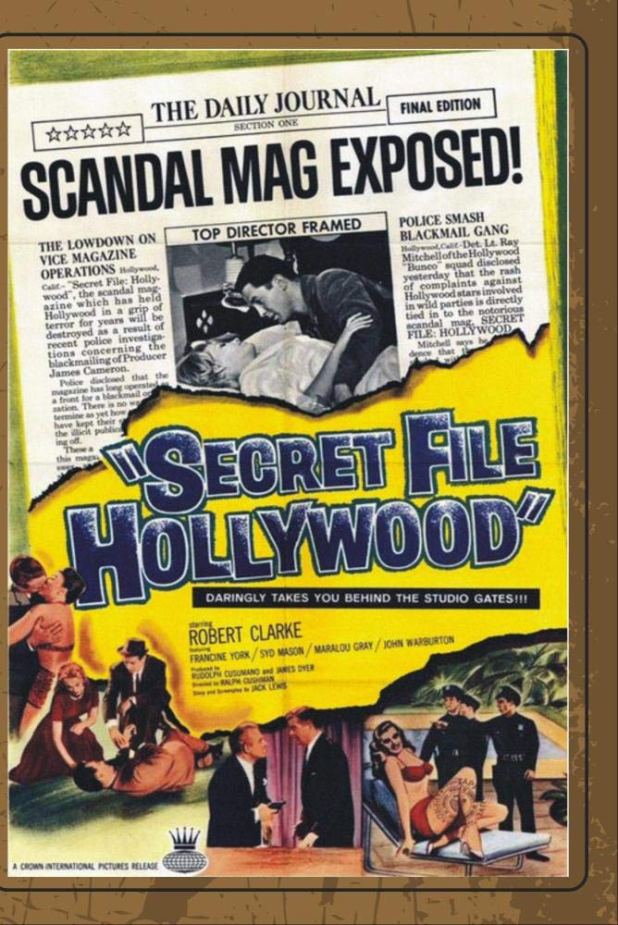
B-MOVIE BLAST: Secret File: Hollywood (1962)

USMC Lieutenant Colonel Jack Lewis did more than write this movie. He lived a life. After enlisting in the Marines in time for World War II, he left to become a screenwriter of westerns. However, he’d return for tours in Korea and Vietnam, where he earned his second and third Air Medals. Lewis didn’t retire from the Marines until the day before his sixtieth birthday.

In between active duty, he also found time to write 12 books and an estimated 6,000 magazine articles and short stories. He was also the co-founder and editor of Gun World, a publication which led to several controversial moments, as he decried America’s reliance on the M-16 and his no-BS take on weapons and love of showing off exotic arms made several major firearms manufacturers choose to not advertise in the pages of his magazine.

Lewis’ screenplays include the Lash LaRue film King of the Bullwhip, as well as the original Naked Gun, Black Eagle of Santa Fe and quite possibly Billy the Kid Versus Dracula. Perhaps most strange of all, he was the music editor for Woody Allen’s What’s Up, Tiger Lily?

This is a story that calls to mind the days that Hedda Hopper and Confidential! could destroy the career of a celebrity. Maxwell Carter (Robert Clark, The Hideous Sun Demon) is an ex-detective whose job it is to dig up the stories the stars don’t want to see in the rags near the checkout.

This is the first movie for Francine York (The Doll Squad). She has a great character name in this — Nan Torr. If you’re a fan of Night Train to Terror, you know that she played Marilyn Monroe in Marilyn Alive and Behind Bars (also known as Scream Your Head Off), which is one of the stories within that movie.

Other folks to keep looking for include Arch Hall Sr., Bill McKinney (Deliverance) and Carolyn Brandt, the wife of Ray Dennis Steckler, who would one day appear in The Incredibly Strange Creatures Who Stopped Living and Became Mixed-Up Zombies!!?

They should have listed the boom mic in the credits, because it shows up in every scene.

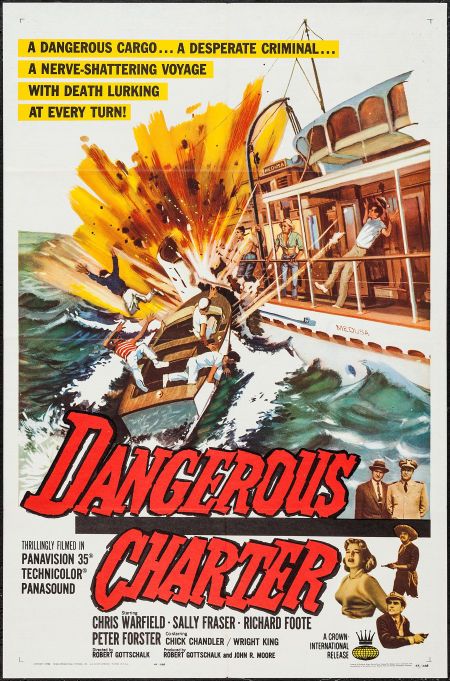
REPOST: Dangerous Charter (1962)

Editor’s Note: This review originally ran on August 7, 2020, a part of our reviews for Mill Creek’s Savage Cinema 12-Movie collection. We’re bringing it back as part of Mill Creek’s B-Movie Blast 50-Film pack.

Savage Cinema’s last film is the 1962 film Dangerous Charter, the only narrative film directed and produced by Robert Gottschalk, who helped found Panavision. This film was to be a showcase for his new process and camera lenses.

Instead, it is 75 minutes that feels like 75 hours, an odyssey at sea that seems to never end. It has no motorcycles in it, no matter what the Savage Cinema box art may promise

The crew of a fishing boat finds a deserted luxury yacht at sea with a dead body and half a million of heroin on board. There is no Blind Dead to save this movie, just a lot of talking. In fact, they may still be talking as I write about this movie.

You can watch this movie on YouTube.

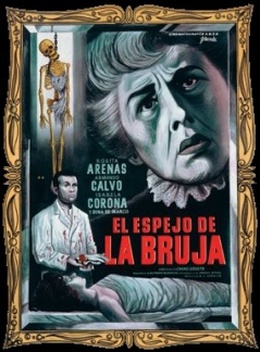
El Espejo de la Bruja (1962)

The Witch’s Mirror is why I love 1960’s Mexican horror. Some movies of that era only hint at witchcraft and the occult and this one goes full in, showing rituals and all manner of Satanic mayhem. Ah, Mexico. Long may your movies live on.

It’s directed by Chano Urueta, who also made the confoundingly wonderous El Baron del Terror and the Blue Demon films.

If you’re going to steal, I always say to steal big. Chanto takes from so many sources here — Edgar Allan Poe, Hitchcock’s RebeccaEyes Without a Face — while somehow synthesizing them into his own out there narrative.

Deborah (Rosita Arenas, Xochitl from the Aztec Mummy movies) is the new wife of Dr. Eduardo Ramos (Armando Calvo), but she has no idea that years ago, he poisoned his first wife, Elena (Dina de Marco).

The thing is, Elena may be dead, but her spirit will not rest. She calls out to her aunt, a witch named Sara (Isabela Corona), whose spells and incantations place Deborah directly in the path of revenge, starting with her face being burned in a fire.

Luckily — or maybe not — Dr. Ramos ends up being somewhat of a mad scientist, so he starts stealing dead bodies to take their skin and attempt to give his new bride her beauty back.

Somehow, in all of this, the witch comes off the best of all of them. This movie is nightmarish in ways that movies made outside of Mexico just can’t pull off, because I get the idea that the filmmakers have one foot in believing that everything in this movie is possible.

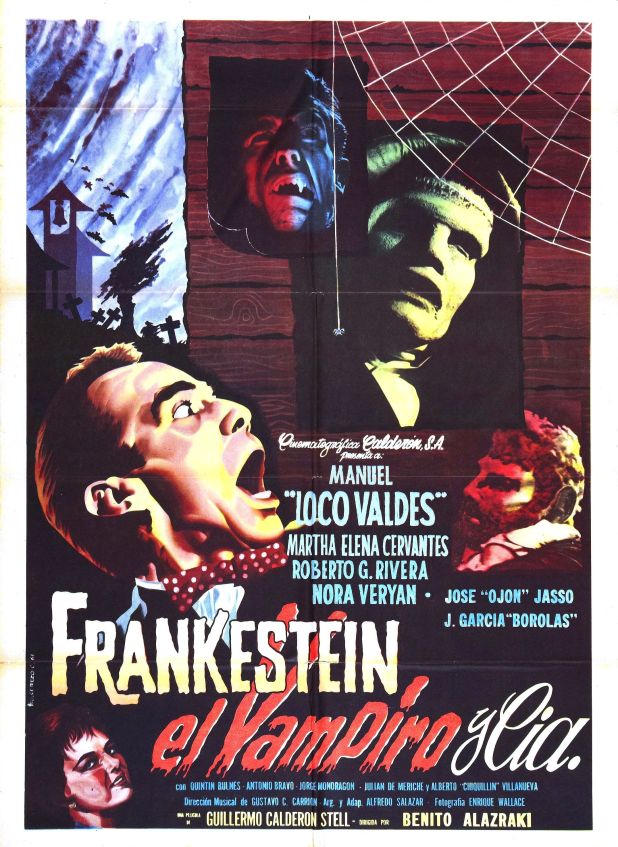
Frankestein el Vampiro y Compañía (1962)

Fifteen years after being made in America, Mexican director Benito Alazraki (Muñecos InfernalesSanto conta Los Zombis) and writer Alfredo Salazar (who would go on to write La Isla de los DinosauriosLas Luchadoras Conta el Robot Asesino and La Mujer Murcielago, amongst many, many other movies) made pretty much an exact copy of Abbott and Costello Meet Frankenstein.

The difference is in the casting. Wilbur Grey (Lou Costello) is now the taller and funnier of the two, Paco (Manuel “Loco” Valdés). The straight man is no longer Chick Young (Bud Abbott), but now the shorter Agapito (José Jasso). That said, both of these comedy teams work at a package station where crates arrive. Except in Mexico, those crates say The Vampire and The Frankenstein Monster. Not to be a total geek, but this is a major pet peeve, as it’s always Frankenstein’s Monster.

Nonetheless, both of these creatures are real and in both movies, an attractive evil female doctor takes them away. In America, we had Dr. Sandra Mornay (Lenora Aubert). In Mexico, it’s Dr. Sofia (Nora Veryán).

There’s also a werewolf in both movies, as well as a plan for one of our heroes to have their brain get inserted into the skull of Frankenstein’s Monster and for the Vampire to take over the world — or at least the United States.

There may have been an English dubbed version of this at one point, but it’s been lost. Regardless of the film’s cheap budget and less than Universal level monsters, it’s still worth a look. The most interesting thing to me is that Dracula is super skinny, just like John Carradine usually was in Mexican vampire films, which has me wondering in the early morning hours whether or not that was a cultural thing South of the Border. I’d like to think that skinny Draculas are totally a Mexican cultural staple. Viva Draculas flacos!

ANOTHER TAKE ON: Little Red Riding Hood and the Monsters (1962)

ABOUT THE AUTHOR: Herbert P. Caine is the pseudonym of a frustrated academic and genre movie fan in Pennsylvania. You can read his blog at https://imaginaryuniverseshpc.blogspot.com. 

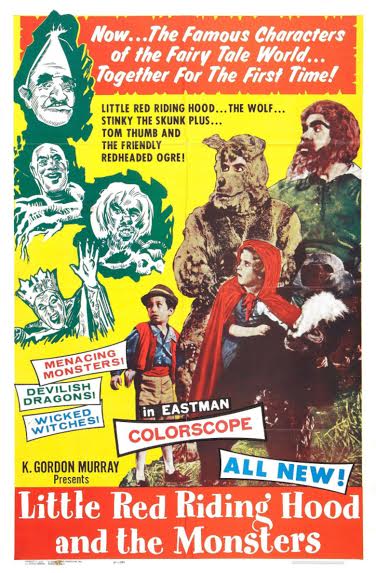
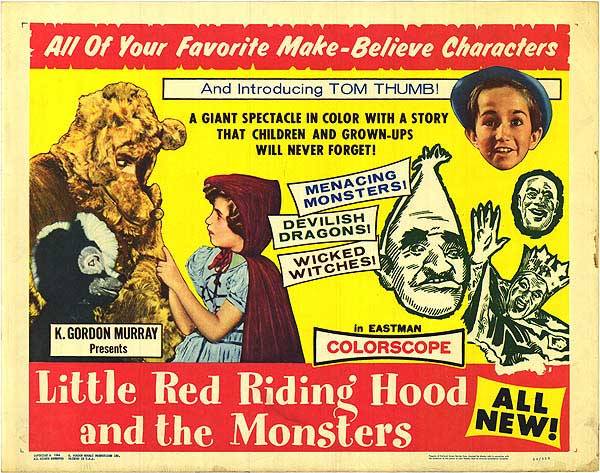
Little Red Riding Hood and the Monsters, also known as Tom Thumb and Little Red Red Riding Hood and Caperucita y Pulgarcito contra Los Monstruos, is at once a bizarre children’s film and yet arguably the ultimate children’s film. It traces the adventures of Little Red Riding Hood, played by Maria Gracia, and Tom Thumb, played by Cesáreo Quezadas (more of him below), as they fight to save their village from the Queen of Badness, who bears an uncanny resemblance to the Queen from Snow White and the Seven Dwarves. (Seriously, how did this film avoid a lawsuit from Disney?) They are assisted by a distinctly creepy-looking skunk who wants to save his master, the Big Bad Wolf, and his ogre friend from being sawed in half for having been nice to Red Riding Hood.

This film is mainly known in the United States from its English dub, which was released by the prolific children’s film producer K. Gordon Murray. Murray was well-known for releasing dubbed Mexican films for children’s matinees, as evidenced by the MST3K classic Santa Claus. As with his other dubs, the quality on this one is highly variable. The voices themselves aren’t bad, but Red Riding Hood’s singing voice is clearly dubbed by an adult woman, who also weirdly dubs Tom Thumb when he is singing. The film tries to hide that Thumb’s singing voice is female through audio distortion, but it really doesn’t work. This version also adds some out-of-place narration at the beginning about creation and warning of the “devil’s dominions.”

What most people remember from this film is its sheer bizarreness, exemplified by the monsters, who serve as the Queen of Badness’s henchmen. We are introduced to this motley crew in the first scene, in which they are gathered to try the Ogre and the Big Bad Wolf for the crime of having been nice to Red Riding Hood in a previous entry in this series. The sequence is unsettling, particularly when compared to American children’s films. The monsters – an assortment that includes Frankenstein, a vampire, “Carrot Head,” and “the Father of Hurricanes” – are unusually creepy, in part because of their low budget make up. The monsters open the trial by singing “Off with Their Heads!” while one boasts of his habit of making naughty children into broth. Even the Wolf, who is a friendly character in this one, looks rather disturbing looking in a moth-eaten suit that makes him seem like he has mange. The mask on the little person playing the skunk is best not described, and is disturbing for even adults to view.

This creepiness, however, is not entirely a bad thing. Even easily frightened children, like myself when I was younger, have a certain fascination with scary things. The monsters themselves seem like something children would come up with while playing a game, while the song about decapitation could easily appear on a school playground. Furthermore, the sheer oddness makes this film memorable and more enjoyable for an adult than something like this typically would be.

Furthermore, the film itself has the feel of a child’s game, with repeated scenes of the monsters and the children chasing each other around. Its “borrowing of characters from other media – the Queen of Badness from Snow White, a good fairy obviously based on Glinda from The Wizard of Oz – has the feeling of something a child might imagine. (Seriously, if you think this is a mash-up, as a kid I once dreamed up a cross over between Gilligan’s Island and Jaws.)

Its low budget production values might lead American viewers to assume this was a fly-by-night production. However, its cast was actually composed of well-known actors in Mexico. For example, the ogre was played by José Elías Moreno, known to weird film connoisseurs for playing the title character in another Murray release, Santa Claus. Elías Moreno was a well-known character actor in Mexico who appeared in a wide variety of films, often as a macho father-figure. Manuel ‘Loco’ Valdés, who played the Big Bad Wolf, was part of a famous family of comic actors. Magda Donato, who played the Queen of Badness’s less menacing sister, was famous not only as an actress, but also as a writer and journalist. She had fled to Mexico from Spain during the Spanish Civil War, having previously been a crusading liberal reformer. In Mexico, she became known as an author of children’s plays, a career which led her to appear in children’s films. Ofelia Guilmáin, who portrayed the Queen of Badness, was another refugee from Franco’s Spain and a popular telenovela actress.

The most notorious member of the cast has to be Cesáreo Quezadas, often known as El Pulgarcito. Quezadas was a well-known child star in Mexico, having previously appeared in a successful adaption of Tom Thumb (the English dub of which, done by Murray, unfortunately appears to be a lost film). He got his nickname from the Spanish translation of Tom Thumb. Child stars are known for having difficulties when they grow up, but Quezadas’s descent into criminality was arguably one for the record books. In the early seventies, he was arrested for trying to rob a store. After this, he appeared to go on the straight and narrow, but in the mid-2000s, he was arrested after his wife found a videotape of him sexually abusing his daughter. He currently resides in a Mexican prison having received a twenty-year sentence.
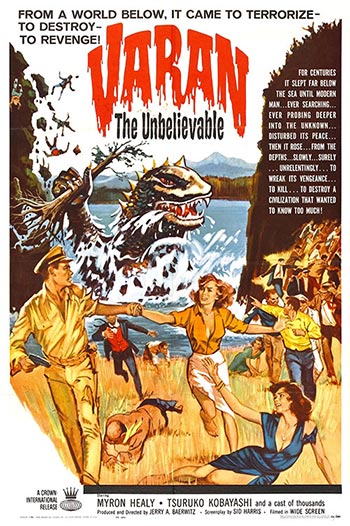
Caperucita y Pulgarcito Contra Los Monstruos (1962)

Little Red Riding Hood and Tom Thumb vs. the Monsters is another nightmare film unleashed on children by K. Gordon Murray, the man who went from the carnivals of America to the King of the Kiddie Matinee, releasing sixty movies in fifteen years. So many of the classic Mexican horror films that I obsess over were originally brought to the U.S. by Murray, who chopped them into oblivion, but hey — how else would the kids of the 50’s and 60’s — and the 70’s, he kept these in circulation forever — have seen things like Las Luchadoras Contra La Momia AztecaEl Baron del Terror and Rene Cardona’s Santa Claus?

Little Red Riding Hood (Maria Gracia) and Tom Thumb (Cesáreo Quezadas, also known as Pulgarcito*) aren’t content to live out the fairy tales that we know them from (or in Tom Thumb’s case, being a member of P.T. Barnum’s circus). No, they seek out and battle the La Reina Bruja — the Queen Witch — who has an army full of monsters.

They find all of the bad guys in her castle in the Haunted Forest, where they are already fighting amongst one another, with a vampire accusing the big bad wolf and an ogre of treason and demands their execution. Yes, this is a kids’ movie.

As for the Queen of Badness — as Murray’s dub calls her — and her older witch sister have started turning the people of the village into monkeys and mice. Luckily, our heroes have an insider, Stinky the Skunk. They’re going to need it, because the bad guys also have a carrot-headed creature, Frankenstein’s monster, robots and Satan himself on their side.

This is the sequel to 1960’s La Caperucita Roja and 1961’s Caperucita y Sus Tres Amigo (Little Red Riding Hood and Her Three Friends) and is directed by Roberto Rodríguez, who also wrote El Latigo contra Satanas. You don’t need to see that movie to watch this one.

While today we watch this and may be astounded by just how strange it was, imagine if you were a very young child dropped off at an unfamiliar theater and kept inside to watch this in the inky blackness while your parents were God knows where. Watch it with that mindset.

*Pulgarcito lived the life of a child star before we ever knew what that was, robbing a bank at one point when his career started slowing down. He eventually settled down with his first wife, who he eventually divorced to marry his secretary. I’d like to say that he lived happily ever, but his second wife eventually found a video of him molesting a daughter from his first marriage.

You can watch this on YouTube.

Jack the Giant Killer (1962)

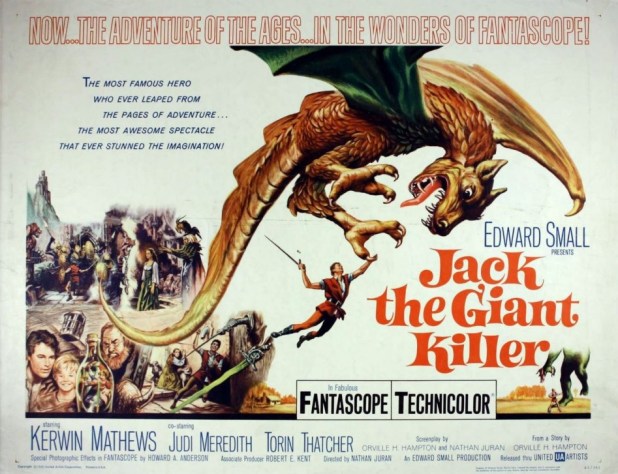
Nathan Juran made some interesting movies. Everything from being. the art director for Kiss the Blood Off My Hands to writing Doctor Blood’s Coffin and directing 20 Million Miles to EarthAttack of the 50 Foot WomanThe 7th Voyage of Sinbad, episodes of Lost In SpaceVoyage to the Bottom of the Sea and The Time Tunnel, and finally The Boy Who Cried Werewolf.

Producer Eddie Small wanted another movie just like The Seventh Voyage of Sinbad. So he hired the star (Kerwin Mathews), the director (Juran) and the villain (Torin Thatcher), which ended up getting him sued and having to re-edit and re-release the film as a musical. Thirty years later,original non-musical adventure version was finally permitted to be released.

Thatcher plays Pendragon, a wizard ruler of the witches, giants, hobgoblins and monsters of a faraway kingdom. He’s defeated by another wizard named Herla, but when the old man dies, there is no defense left when he captures Princess Elaine (Judie Meredith, Queen of Blood) with one of his giants named Cormoran, who is in turn stopped by a farmer named Jack (Matthews).

Pendragon is evil incarnate, turning ladies in waiting (Anna Lee from Picture Mommy Dead) and even Elaine into witches and sending a warlock to wreck the ship Jack is on.

Man, this movie has everything. A viking (that gets turned into a dog). Leprechauns. Two-headed giants battling sea monsters. Pendragon turning himself into a dragon with a wolf’s head, a snake’s tail and huge wings. And, thanks to the lawsuit, musical numbers in one version of the film.

There were even toys made of the film, all the way back in 1962.

You can watch this on Amazon Prime and Tubi. There are also two Rifftrax versions, one in studio and another that was done live.

Black Test Car (1962)

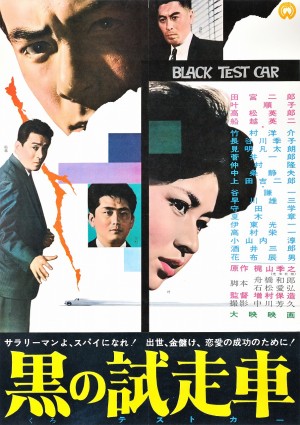
Yasuzô Masumura’s films triumph the idea of the individual versus the needs of the many, standing in diametric opposite to Japanese norms. His 1962 Black Test Car tells the story of the battle between the Tiger Motorcar Company and the Yamato Company, particularly their newest sportcars.

Tiger was planning on a new car named Pioneer to set the world on fire, but the only thing ablaze is the test car. Now, Toru (Hideo Takamatsu, Ninja In a Business Suit) must discover the spy in his company and why Yamamoto’s new car looks so much like an automobile his company has lost.

There are no heroes in this film, only the relentless drive to make the company a success no matter the cost — money, love, human contact, basic decency be damned. It’s a strange film for American eyes, as it somehow is closer to the noir within a subject that few would consider, the cutthroat world of industrial automotive espionage.

Arrow Video keeps succeeding in finding movies I had no idea existed and suddenly making me care deeply about their existence. This is but another of those films.

You can get this blu ray from Diabolik DVD. It comes complete with another Masumura film, The Black Report.

DISCLAIMER: This film was sent to us by Arrow Video.

The House on Bare Mountain (1962)

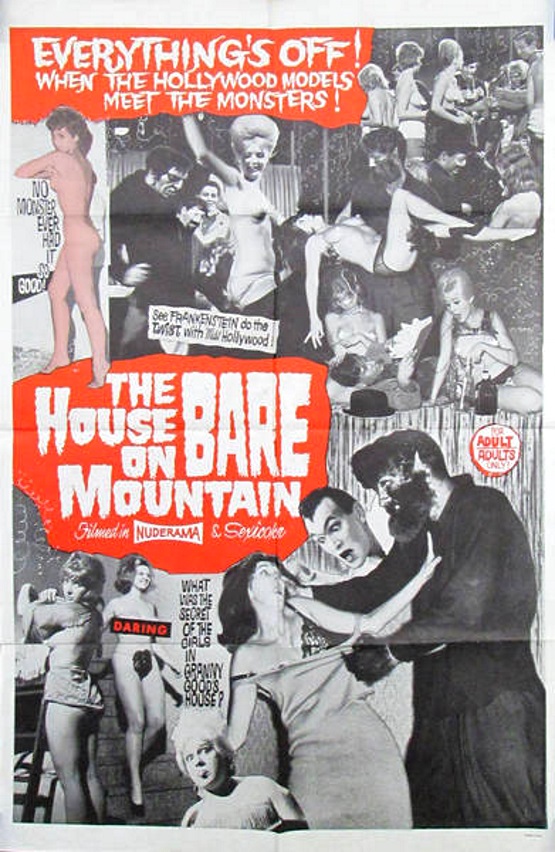
You’ve never seen more! Let us prove it to you when the monsters meet the girls! The nudies meet the nasties! No monster ever had it so good! See Frankenstein do the twist with Miss Hollywood! The gayest girlie spree of all time! Everything’s off when the horror boys meet Granny Good’s girls! The biggest bevy of beauties ever laid before your eyes! For adult adults only!

Get ready for 62 minutes of sheer wildness as directed by Lee Frost and Wes Bishop. If you wonder, with scumbags — and I say that term with the utmost of respect, admiration and love — like this were at the wheel, how far away was Harry Novak? Oh, he was there. He was there.

Granny Good’s School for Good Girls is really a front for girls to get naked and make booze for Granny Good, who is played by producer Bob Cresse. She also employs a werewolf named Krakow. Yes. A werewolf. And when the girls throw a party, that’s when Dracula and Frankenstein’s Monster show up.

Ann Perry, who plays Sally in this, was originally going to be a nun before she met her first husband Ron Myers. After starting her career in Cresse’s softcore films, she went fill hardcore and started her own production company, Evolution Enterprises, in the 1970’s, becomingone of the only women to write, direct, and produce her own hardcore movies. She was also the first female president of the Adult Film Association of America (AFAA).

The adult films of 1962 are incredibly odd affairs today, featuring little to no sex and mostly women taking off their clothes and doing things like reading topless. I find them incredibly charming, almost time capsules of a more innocent time, a place where small movies like this could find an audience of raincoaters who found something, anything erotic in what we would now see as just plain silly.

Sadly for Frost and Cresse, the advent of hardcore would put an end to their films. Then again, Frost would go on to produce and direct one of the oddest — and roughest — films of the golden age of adult films, A Climax of Blue Power. He kept on working right up until 1995’s direct to video softcore thriller Private Obsession. I’d also recommend his mondo films Witchcraft ’70 and Mondo Bizarro. Oh yeah! He also directed The Thing With Two Heads and The Black Gestapo. He also made Love Camp Seven, which also features Cresse acting as a commander of a German prison camp. Wow. I know more about Lee Frost than some members of my family.

You can download this on the Internet Archive. Even better, Nicolas Winding Refn’s ByNWR site has a totally cleaned up version straight from the director’s archive. Man, I want to sit down and talk to that dude someday.

It Happened In Athens (1962)

Andrew Marton had an interesting career. Sure, he made The Thin Red Line, but he also made a Soupy Sales vehicle Birds Do It and even had his name taken off the movie Demon of the Himalayas by Joseph Goebbels because he was Jewish. As for his second unit work, he filmed the iconic chariot race in Ben-Hur and the opulence of Cleopatra. He also worked in TV, making nature shows and family fare like Flipper and Daktari.

So yeah, this movie has none of what he’s known for. It does have Jayne Mansfield.

Made by Associated Producers Incorporated, but really 20th Century Fox, this was Mansfield’s last big budget film. She’s only in a supporting role, but her name was big enough to open a movie.

Fox used API to make the B movies that would support their A features. If they were anything like Cleopatra, they were bleeding the studio out.

Trax Colton is in this as well. Who? Well, after being discovered by Henry Willson, Trax was going to be a big matinee idol. He was even billed directly below Mansfield in this, his second — and last — film. He had a brief affair with his co-star and never made another movie.

He plays Spiridon Loues, a man running in a marathon where the winner gets to marry Mansfield’s character. That seems like a publicity stunt that she’d do in real life.

The story of the people who almost ended up in this movie — Ricardo Montalbán, Fernando Lamas, Robert Wagner, Dean Stockwell — and the many titles — And Seven From AmericaWinged Victory In Athens — are way more interesting than the actual movie. Then again, you can just shut the volume off and stare into space at Mansfield, I guess. I know I did.