Directed by Yuzo Kawashima and written by Kaneto Shindo (Onibaba), this is the story of the Maeda family. They live in a small apartment and are always ready to hide just how much money they have, all so they can continue the plans of their father figure, ex-naval officer Tokizo (Yunosuke Ito).
Tomoko (Yūko Hamada) is sleeping with a rich author, but is always asking for more money, always for the family. Minoru (Manamitsu Kawabata) works at a music talent agency and is stealing money. As for where it all goes, Tokizo is investing in a new Japanese military while Minoru keeps spending it all on Yukie (Ayako Wakao) who is going to figure all of this out because she’s the accountant at the same company. But the joke is on them, because Yukie has been sleeping with more than one man, all so she can have her own hotel.
Now the author can evict them, the family can sell everything they’ve bought and another scam will have to be created. At least this isn’t the same poverty they dealt with at the end of the war. Somehow, this is all within an apartment.
The Radiance Films blu ray release of Elegant Beast has a new 4K restoration, an interview with film critic Toshiaki Sato, an appreciation by filmmaker Toshiaki Toyoda, a visual essay by critic Tom Mes on post-war architecture in Japanese cinema and a trailer, all with a limited edition booklet featuring new writing by Midori Suiren. You can get this from MVD.
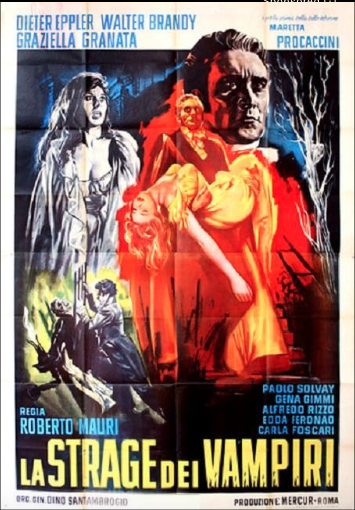
Roberto Mauri isn’t talked about as often as he should be. There’s his oddball King of Kong Island, his Westerns like He Was Called Holy Ghost and his masterful Madeleine: Anatomy of a Nightmare. Now, after this, I need to look up more of his movies.
Released in America on TV as Slaughter of the Vampires and then as a double feature with The Blood Beast Terror — renamed as The Vampire Beast Craves Blood — as Curse of the BloodGhouls, this has the kind of tagline that definitely made me want to watch it: “Satan’s Horror Henchmen enslave beautiful women through weird ways of love transforming them into Blood Ghoul Vampires to satisfy an insatiable LUST.”
This stars Walter Brandi, who was also in The Vampire and the Ballerina and The Playgirls and the Vampire. He plays Wolfgang, who has just become married to Louise (Graziella Granata), and they are unaware that a vampire (Dieter Eppler) has entered the party they’re having. He soon seduces Louise and bites her, which means that Wolfgang must look for a cure, finally meeting Dr. Nietzche (Luigi Batzella).
Where Hammer has rich color, this is shot in black and white, but it’s a whole different type of beautiful filmmaking. The real castle adds quite the scenery and if this movie can’t have crimson blood, it can have bosoms barely held back by their costumes and that is always enough.
A small Japanese village of fishermen has decided to join together to kill the monstrous whale that has been ruining their catches. It becomes such a cause that the richest man in town (Takashi Shimura) offers his power, his land, his money and his daughter (Kyoko Enami) to whoever can kill the kaiju-size whale. This works well for Shaki (Kojiro Hondo), who has been planning on killing the whale after it ate his family. However, a man known only as “I am–” (Shintaro Katsu) has come to town with the same urge to kill the demon whale.
Can a kaiju movie pretty much be Moby Dick? Yes, it can. This is the film. Yet it’s also more, as it’s based on a novel by Uno Koichiro (thanks Japan On Film).
Directed by Tokuzô Tanaka and written by Kaneto Shindô, this finds “I am–” fighting with everyone in town and even assaulting a woman in love with Shaki (Shiho Fujimara). Our hero raises that child as his own. Meanwhile, both “I am–” and the rich man’s daughter are nearly stoic, silent and near-emotionless figures despite their importance to the story. The old man sees his daughter as the biggest prize, but neither man wants or needs her. Our hero wants revenge and his enemy just wants something different, a new experience and something to challenge his will.
Daiei is such a strange company, one that could release Rashomon and also the Gamera, Zatoichi, Yokai Monsters and Daimajin series of films. They even had their own baseball team, the Daiei Stars, which are known today as the Chiba Lotte Marines.
I’ve never seen anything like this movie, a moody look at fishing life that just so happens to feature a kaiju whale.
You can get this movie on blu ray from SRS or download it from the Internet Archive.
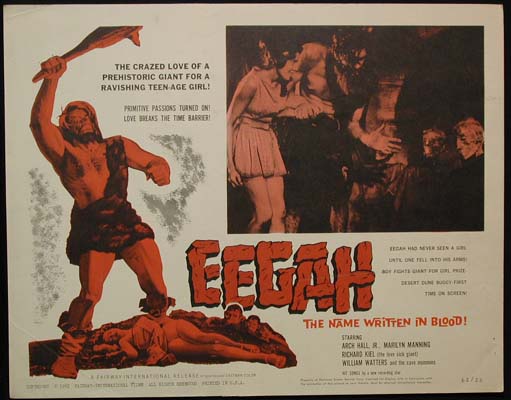
In The Golden Turkey Awards, the Medveds claim that Arch Hall Jr.’s performance as Tommy is “one of the low points in the history of American cinema” and that he has “a face only a mother could love.” He was sixteen when he made this movie, so that feels like a lot of punching down.
Well, maybe they were mad that their dad never put them in a movie.
Well, Arch Hall Sr. thought his son was going to be a star — even if that son said that he couldn’t sing — and made an Elvis movie starring his boy.
Roxy Miller (Marilyn Manning) drives out and accidentally hits Eegah (Richard Kiel) with her car. When she tells her boyfriend Tom Nelson (Arch Hall Jr.) and her father Robert (Arch Hall Sr.), her dad runs out into the desert to try and get a picture. He disappears, she finds him and he’s learned how to speak to the creature and has learned how it has stayed alive all this time. Of course, Eegah wants to marry his daughter, so he says alright, hoping that they can escape.
When they do, Eegah runs after them and dies at a pool party, but not before Ray Dennis Steckler gets thrown into the water. He would go on to make the next Arch Hall Jr. movie, Wild Guitar.
This was shot in the same Bronson Canyon area that Robot Monster was filmed at. In fact, Ro-Man’s base is the same cave that Eegah makes his home.
My favorite thing in this movie was that the sound recorder screwed up his job, so when Robert yells, “Watch out for snakes!” his lips never move.
Don’t have the box set? You can watch this on Tubi.
EDITOR’S NOTE: Whatever Happened to Baby Jane? was on Chiller Theater on January 12, 1974 and September 4, 1976 at 11:30 p.m.
After a viewing of this movie at a very young age, I decided that I’d never have chaffing dishes in my house. That may never come true just because I doubt I’ll ever have the money to spend on such luxurious accouterments, but also because the moment where Baby Jane Hudson (Bette Davis) serves her sister Blanche (Joan Crawford) her parakeet — and later a rat — on a silver platter, I was put off on silver serviceware for the rest of my days. This is not a meal fit for Ms. Crawford!
Robert Aldrich had the idea of bringing together two of America’s most enduring screen icons in one film where they’d bring their long-rumored rivalry to the story of two sisters who had been used up by show business.
Baby Jane was once a vaudeville star who held her family under her thumb, using her stardom to get whatever she wanted. That all changed once movies took over and she couldn’t adapt, so by 1935, her sister Blanche is the toast of Tinseltown while she’s a shell of her former self, her movies seen as failures. One night at a party, an accident leaves Blanche paralyzed from the waist down and it’s all blamed on a drunken Jane.
Flash to three decades later, as residuals from Blanche’s films are enough to keep the sisters in house and home, as the two former stars live in the shadows of their past glories. Jane has become a raging alcoholic, trapping her wheelchair-bound sister within their home, denying her even basic sustenance — hence the pet and vermin meal scenes described above.
Although Jane has gone far into middle age, she still wears the pancake make-up and outfits of her Baby past. She’s hired Edwin Flagg (Victor Buono) to play piano for her, preparing an entirely new show to take on the road. And to get there, she’s using her sister’s money.
Only madness and murder can follow, as well as the revelation that Blanche isn’t the innocent victim that she aspires to be. Both sisters have been forced into roles that they’ve played way beyond typecasting. As both sisters find themselves on a beach, with Blanche dehydrated and near-death, Jane’s plaintively sad question “You mean all this time we could have been friends?” cuts through this film, which ends before giving any resolution to the fate of either character.
Whatever Happened to Baby Jane? was a cultural force, changing Hollywood so that older actresses didn’t have to fade into the role of the matron. It’d be followed by other so-called psycho-biddy films like Aldrich’s follow-up Hush…Hush, Sweet Charlotte, as well as movies that also asked questions like What Ever Happened to Aunt Alice?, What’s the Matter with Helen? and Whoever Slew Auntie Roo?
The feud between the two actresses — which began years before this movie and would extend to their deaths — is so legendary that books and even an entire FX series was created to document it. From allegations that Crawford backed out of a publicity tour because she didn’t want to share the stage with Davis to Crawford accepting Anne Bancroft’s Best Actress statue for The Miracle Worker in a successful attempt to overshadow her enemy, this war was just like the movie — only 100% reality.
I mean — this is the movie where Bette Davis installed a free Coca-Cola machine on the set for the cast and crew for the sole reason of drawing the ire of Crawford, who was on the board of Pepsi.
There are also plenty of personal touches by both actresses. Davis did all of her own makeup, saying “What I had in mind no professional makeup man would have dared to put on me. I felt Jane never washed her face, just added another layer of makeup each day.” And Crawford, who was an avid collector of Margaret Keane’s “sad eyes” paintings, made sure that the paintings appeared in next door neighbor Mrs. Bates’ house, including the famous Big Eyes piece.
While Ingrid Bergman, Susan Hayward, Rita Hayworth, Katharine Hepburn, Jennifer Jones and Ginger Rogers were all rumored for Baby Jane and Tallulah Bankhead, Claudette Colbert, Olivia de Havilland and Marlene Dietrich were all in the running to play Blanche, only Davis and Crawford’s maniac energy — and downright hatred of one another — could make this film work as well as it does.
I truly believe that is Ms. Davis could have served Ms. Crawford a rat on a fancy tray, she would have done so. This is a film I’ve returned to time and time again, even if I’ve made sure to never eat a meal that has a silver cover on it.
EDITOR’S NOTE: How amazing is it that the Mexican Nostradamus vampire movies were on Chiller Theater? The Monster Demolisher was on the show on December 9, 1967 and August 23, 1969. Genie of Darkness was on the show on August 5, 1967. Blood of Nostradamus was on July 15, 1967 at 11:20 p.m. and December 11, 1971. Oddly, Chiller Theater never showed the first movie, The Curse ofNostradamus.
Nostradamus is not the fortune-telling mystic that scared you so badly in 1981’s The Man Who Saw Tomorrow. No, he’s an aristocratic vampire played by German Robles, who also played Count Karol de Lavud in the two El Vampiro films.
This was originally a 12 part serial that has been broken down into 4 films by American producer K. Gordon Murray: this one, known as Curse Of Nostradamus in English, plus The Monsters Demolisher, The Genie Of Darkness and Blood Of Nostradamus.
In the first movie, a professor has been re-elected to lead a society dedicated to the destruction of superstition, all so he can prove that werewolves and vampires aren’t real. However, he’s soon visited by a 400-year-old vampire, the son of Nostradamus the Alchemist. That leads us into the first film that was shown on Chiller Theater.
The Monsters Demolisher: After the first film, the professor finds that he must admit that the undead walk the Earth. He joins with a vampire hunter to stop Nostradamus, who is the son of one of the most powerful bloodsuckers of all time.
Nostradamus takes his evil even further by basically explaining to both of them how if they don’t stop him, he’ll make the world an even worse place. To prove his heart is in the wrong place, he also kidnaps several children and repeatedly places them in danger.
Perhaps most famously in the United States, this movie ran out of sequence as an April Fool’s Selection on the USA Network’s Commander USA’s Groovie Movies. Seeing as how that episode aired on April 4th, I find it even more amusing.
You can watch this on YouTube.
Genie of Darkness: The real trouble with the villagers and professor who are supposed to be the heroes of the Nostradamus film series is that they’re boring as all get out. The only interesting one, Igor the vampire hunter, is unceremoniously dispatched early in this film. The rest just sit around and yammer away at what they should do instead of doing anything.
Meanwhile, the nattily dressed Nostradamus and his hunchback pal Leo are living it up. Well, maybe not so much Leo, whose witch mother Rebeca dares to question the villainous vampiro and gets set on fire for her troubles.
Director Federico Curiel would go on to work with Santo several times, as well as write one of the most out there of all early Mexican horror films — and trust me, that’s saying something — El Baron del Terror.
You can watch this on YouTube.
The Blood of Nostradamus: After three films — The Curse of Nostradamus, The Monsters Demolisher and The Genie of Darkness — we have arrived at the end of our tale, where the society to eliminate superstition must rise up against what we’re to assume is the son of the seer Nostradamus (although this is disputed in this series, depending on where you come in).
The good guys are about as intelligent and effective as a bunch of cops in a giallo film, as they think that by removing the ashes of Nostradamus’ ancestors from his coffin that he will die at sunrise. He just laughs and tells them that are the ashes of someone else he killed. Yes, he sleeps surrounded by the sooty remains of those he has killed before. You go, Nostradamus. You go.
Somehow, the good morons manage to kill off the hunchback and get their hands on a sonic weapon, which does some damage to the vampire before the sword cane of Igor — remember that dude who died and it was kind of a shock? — poetically is used to stake Nostradamus while in bat form.
I don’t know if you should watch all four of these movies in one day, but then again, I’ve also watched around fifty Mexican horror movies in the last few weeks, so I may be muy macho when it comes to watching peliculas de terror.
EDITOR’S NOTE: Amphibian Manwas first on Chiller Theater on Saturday, October 3, 1970 at 11:30 p.m. It also aired on May 29, 1971. I can’t even believe it. I wonder what people thought of this.
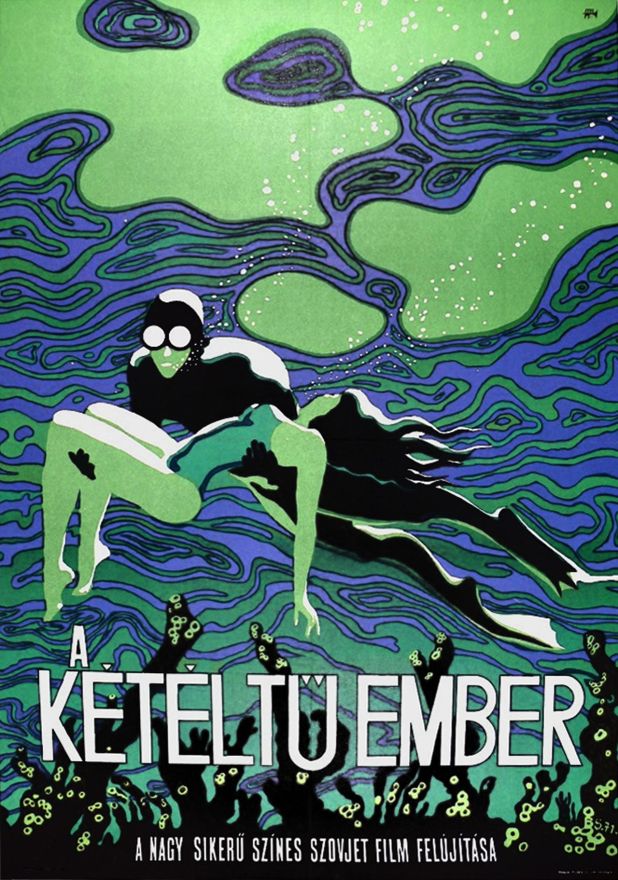
Based on the 1928 novel by Alexander Beliaev, Amphibian Man seems timeless even as its tech seems ancient. It feels like it comes from no set point of origin, as if it could be made today or fifty years ago.
At a seaside port in Argentina, the pearl fishermen all have told the story of an amphibian man who can live in the water. Ichthyander (Vladimir Korenev, voiced by Yuri Rodionov) was adopted by Professor Salvator (Nikolay Simonov), who had to save his life by replacing his lungs with the gills of a shark.
The dramatic thrust of this story occurs when Ichthyander falls in love with Guttiere (Anastasiya Vertinskaya, voiced by Nina Gulyaeva), the daughter of a fisherman and the wife of Pedro (Mikhail Kozakov), who uses the love between his wife and the undersea human to exploit him into getting him more pearls.
As a child, I was always told that Russia was a sad, cold place that had no access to art. How did this beautiful movie come to be? Had I been lied to? Perhaps.
In the January 2018 issue of Indie Cinema, the Oscar-winning The Shape of Water is taken to task, not just for allegedly taking its plot and visuals from the Dutch student film The Space Between Us, but for how close Guillermo del Toro’s film is to Amphibian Man. It’s set in the same year that the Russian film was made and, yes, much of the movie concerns the Russian element in America.
Directed by Vladimir Chebotaryov and Gennadiy Kazanskiy and written by Akiba Golburt, Aleksei Kapler and Aleksandr Ksenofontov, this is at once a retro future movie — whooshing doors are everywhere and the costume that Ichthyander looks like Alex Raymond or Rick Yager drew it — while it also has musical numbers, which makes it so charming that it nearly breaks my heart.
I mean, read this dialogue:
Gutiere: This must be love at first sight!
Ichtyandr: Is there any other kind of love?
Of course it has to end with its lovers separated by the waves and unrequited love.
EDITOR’S NOTE: The Horrible Dr. Hichcockwas first on Chiller Theater on Saturday, March 17, 1973 at 1 a.m. It also aired on October 19, 1974; June 5, 1976 and April 8, 1978.
Producer Luigi Carpentieri wanted writer Ernesto Gastaldi to write a movie based on a giallo novel Spectral, which Gastaldi did and wrote his own treatment called Raptus. That script wasn’t filled with necrophilia — my Italian people go hard even back in 1962 — but Gastaldi told Robert Curdi that maybe someone had asked for something more macabre and he went for the throat.
When producer Ermanno Donati gave Ricardo Freda the script, he said, “Let’s see if you have the balls to shoot this stuff, it’s about corpses!” Freda didn’t even look at it and said, “As long as I get paid, I’m shooting even the phone book.”
Actor Robert Flemyng tried to get out of his contract when he learned about the corpse romance and even tried to get actress Harriet Medin to conspire with him to act so badly that the movie wouldn’t be released.
Three crews were shooting all at the same time with Freda shooting most of the more suggestive Italian cut and Marcello Avallone (Spettri, Maya) directing the more sexualized foreign scenes. Those rougher scenes are lost, as far as I’ve been able to research.
Raptus: The Secret of Dr. Hichcock was shown to American-International Pictures but was too rough for general audiences. It was released as The Horrible Dr. Hitchcock by Sigma III Corporation as a double feature with The Awful Dr. Orloff.
Dr. Bernard Hichcock (Robert Flemyng) likes to drug his wife Margaretha (Maria Teresa Vianello) so that she is near death and then makes love to her. When she overdoses, he thinks he’s killed her. He buries her and flies to London where he eventually marries Cynthia (Barbara Steele).
Thirteen years later, they come back to the ancient and decaying mansion where Margaretha begins to haunt Cynthia. She soon learns that her husband is down with some pretty wild sexual games and when she wakes up feeling dead with him romancing her, well, she realizes that she’s not living a dream life. It also is revealed that Hichcock wants to kill her and use her blood to give his wife back her past glamour.
Barbara Steele is perfect in this, a woman trapped in a horrific life that she struggles to escape. She’s my favorite horror queen, her huge eyes staring out into howling rains and endless darkness. Ah, my heart.
EDITOR’S NOTE: Premature Burial was on the CBS Late Movie on August 2, 1974.
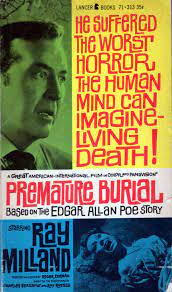
This is the third of Roger Corman’s Poe movies. This time, Corman decided to make his own Poe film outside of his deal with American-International Pictures. He got his financing through Pathé Lab, the company that did the print work for AIP.
While he wanted to use Vincent Price, the actor had an exclusive deal with AIP, so he hired Ray Milland.
Unexpectedly, on the first day of shooting, James H. Nicholson and Samuel Z. Arkoff of AIP made a surprise visit. They informed Corman that they were working together again and were thrilled that they’d convinced Pathé to bring the movie back to them after threatening to pull all their lab work.
Guy Carrell (played by the talented Ray Milland) is a British aristocrat with a unique condition. He suffers from catalepsy, which causes him to fear being buried alive. This fear almost ruins his marriage to Emily (Hazel Court, a familiar face from movies like The Ravenand The Masque of the Red Death). Despite his peculiarities, they decide to get married, even though he has constructed an elaborate coffin from which he can escape.
Let me tell you, the dream sequence where he does get buried alive? I saw it before I was ten when forced to visit the home of other children instead of getting to watch movies at home alone, as I have preferred my entire life. They went and played some games. I grabbed the TV Guide and found a horror movie. This is what I saw, and the burial sequence completely destroyed me. I remember walking onto their porch, staring into the sunset and wondering how the adults could be so carefree when death was stalking our every waking moment. I was a weird kid and grew up to be even more odd.
And to add to the surprises, Dick Miller makes a memorable appearance as a grave robber!
VIDEO ARCHIVES NOTES: This movie was discussed on the February 28, 2023 episode of the Video Archives podcast and can be found on their site here.
Based on the 1928 novel by Alexander Beliaev, Amphibian Man seems timeless even as its tech seems ancient. It feels like it comes from no set point of origin, as if it could be made today or fifty years ago.
At a seaside port in Argentina, the pearl fishermen all have told the story of an amphibian man who can live in the water. Ichthyander (Vladimir Korenev, voiced by Yuri Rodionov) was adopted by Professor Salvator (Nikolay Simonov), who had to save his life by replacing his lungs with the gills of a shark.
The dramatic thrust of this story occurs when Ichthyander falls in love with Guttiere (Anastasiya Vertinskaya, voiced by Nina Gulyaeva), the daughter of a fisherman and the wife of Pedro (Mikhail Kozakov), who uses the love between his wife and the undersea human to exploit him into getting him more pearls.
As a child, I was always told that Russia was a sad, cold place that had no access to art. How did this beautiful movie come to be? Had I been lied to? Perhaps.
In the January 2018 issue of Indie Cinema, the Oscar-winning The Shape of Water is taken to task, not just for allegedly taking its plot and visuals from the Dutch student film The Space Between Us, but for how close Guillermo del Toro’s film is to Amphibian Man. It’s set in the same year that the Russian film was made and, yes, much of the movie concerns the Russian element in America.
Directed by Vladimir Chebotaryov and Gennadiy Kazanskiy and written by Akiba Golburt, Aleksei Kapler and Aleksandr Ksenofontov, this is at once a retro future movie — whooshing doors are everywhere and the costume that Ichthyander looks like Alex Raymond or Rick Yager drew it — while it also has musical numbers, which makes it so charming that it nearly breaks my heart.
I mean, read this dialogue:
Gutiere: This must be love at first sight!
Ichtyandr: Is there any other kind of love?
Of course it has to end with its lovers separated by the waves and unrequited love.










 B&S About Movies
You must be logged in to post a comment.