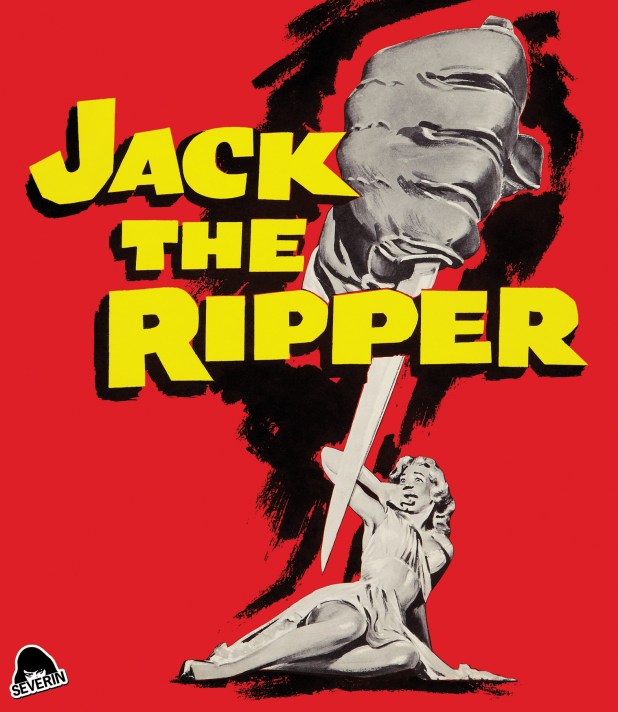
Produced and directed by Monty Berman and Robert S. Baker (the same guys who helped bring The Saint to movies and TV), this 1959 take on Jack the Ripper is based on Leonard Matters’ theory that the killer was a doctor with revenge on his mind. As in Matters’ book, The Mystery of Jack the Ripper, Jack is murdering prostitutes to avenge the death of his son. The difference is his son died of venereal disease in the book and here, he committed suicide once he learned that his lover was a prostitute.
By now, you know the rules: Whitechapel. 1888. Jack the Ripper on a tear.
Scotland Yard’s Inspector O’Neill (Eddie Byrne, Star Wars’ General Willard) gets a visit from NYPD pal Sam Lowry who, despite having no jurisdiction, becomes part of the investigation. Along the way, Sam falls for modern London lady Anne Ford and runs afoul of her guardian, Dr. Tranter.
Jimmy Sangster, who wrote so many Hammer films, has been credited as this film’s screenwriter. It establishes so many of the narrative beats that future Ripper films will follow.
Perhaps just as interesting as the film, producer Joseph E. Levine held a luncheon for major film distributors to kick off U.S. release of the film. At one point, he had Brinks guards wheel in $1 million dollars in cash to show off exactly how much he was putting into promotion. He’d had success doing the same thing with 1958’s Hercules, which starred Steve Reeves. Between plenty of TV ads and saturating theaters with over 640 prints of the film, the film had huge ticket sales and a high number of holdover dates. But, according to Joseph E. Levine, the film was a failure. In their sale copy, Severin says that “audiences were horrified by the film’s startling violence, graphic nudity and bloody Technicolor climax.”
It did, however, have a song that went with it. Nino Tempo released the song “Jack the Ripper” on RCA, backed up by composers Jimmy McHugh and Pete Rugolo and his orchestra. Comic Steve Allen was tapped to write the lyrics! Check it out!
Severin just released this on blu ray, complete with plenty of docs, a robust commentary track with co-director/co-producer/co-cinematographer Robert S. Baker, screenwriter Jimmy Sangster and assistant director Peter Manley, moderated By British horror historian Marcus Hearn and two versions of the film: the original UK cut and the trimmed American version.
Emily Fear is a librarian by day, professional wrestling lover and accordion player in the band Bitter Whiskers by night. You can catch her as the co-host of Talking Honor on PWTorch and read her new blog all about intergender wrestling, Boy Girl Party.
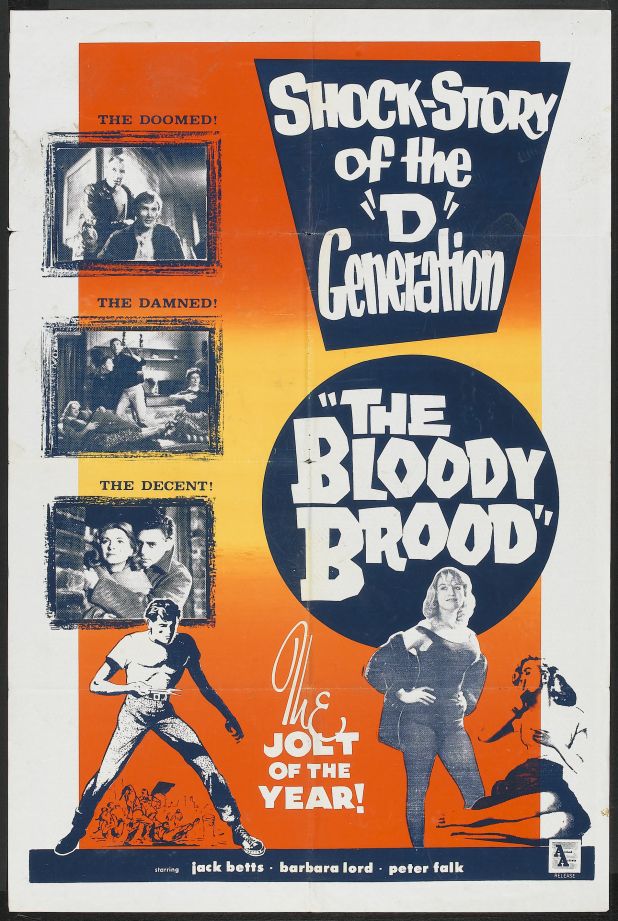
Like the straight-laced, grim-faced cousin of Roger Corman’s A Bucket of Blood, The Bloody Brood (1959) grounds its tale of murder and suspense in the hypocrisies and nihilism of the Beat Generation. While Beatnik caricatures steal scenes with bad improvised poetry and arhythmic, wide-armed dancing to spare bongo beats, the movie is dedicated to a more realistic portrayal of the majority of its hipster coffeehouse denizens – who may talk the talk of the culture, but are definitely working day jobs to support their nighttime wanderings.
That is, except for Nico (Peter Falk), whose business is those same too-jaded truth-seekers. While they flock to his wisdom – “They spend millions developing toothpaste to stop cavities, then they spend billions on bigger and better ways to blow us to bits” – they also partake of the drugs that he is selling, without even realizing that he is the one selling them. While Nico may be about the “truth,” he is happily raking in the profit of the drug deals without the shame or scrutiny, which is left to his rougher mules.
Early in the film, Nico, advertising director Francis and a few Beatnik cronies witness the death of an old newspaper man. What might be a traumatizing event for most warm-blooded civilians is a source of twisted inspiration for Nico: “What do we do? Watch. Gentlemen, this is the greatest show on earth. Spontaneous, unrehearsed, only one performance.”
Turned on by this ultimate kick, Nico ropes Francis into a plan to create more of these “spontaneous” moments and before you know it, they’re bringing a messenger boy into a party to feed him a hamburger laced with ground up glass.
The boy dies and it’s up to his brother, Cliff (Jack Betts), to solve the mystery of who killed him, aided by a sympathetic detective – who honestly doesn’t seem very good at his job – and Ellie (Barbara Lord).
If Cliff inching closer and closer to the truth wasn’t enough trouble, Nico’s also got mule problems, as Studs and Weasel demand a larger cut of the drug money, considering that they’re taking all the risk. Meanwhile, the drug-dealing powers that be above Nico are concerned that he is becoming a bit too immeshed with the scene in which he is profiting from.
What The Bloody Brood lacks in the entertainment factor of A Bucket of Blood, it makes up for with a certain earnestness – and that creates characters that are more effective than even needed for pulp like this. For every Dave, with his straight-out-of-costuming beatnik uniform and slang nonsense, there’s an Ellie, whose fear of wasting away her life blinds her to the snobbish contradictions of her hipster peers, or even Francis, an effete posturing jerk whose pompousness is second only to his cowardice.
The nuance, however, ends with the main characters. Cliff is a fairly bland hero who is also not particularly good at masking his covert operations. And while Falk tries to give Nico complexities, many of his actions, particularly later in the film, seem to be against his own self-preservation. The whole “murder for kicks” idea overall doesn’t seem to gibe with a guy whose just trying to profit off the self-important obliviousness of the subculture he’s infiltrated.
But perhaps that is the point. Nico’s boss is concerned that he is getting too close with his customers. While others might exhibit that over-closeness with feelings of love and affection toward their peers, thus inhibiting their ability to sell them drugs, for Nico, the effect is that he buys all the bullshit that the others drink down like cheap table wine. He may have started off as conning them, but he became the biggest mark of all.
Despite its technical flaws and a few glaring holes in the storyline, as far as low budget pulp thrillers, you can do a lot worse than The Bloody Brood.
Today’s article for Chilling Classics month comes to us from El Paso, Texas. He’s part of Ghoul Inc. Productions, a DIY group who are inspired by Roger Corman, Larry Buchanan, Frank Henenlotter, Herschell Gordon Lewis, Edward D. Wood, jr., S.F. Brownrigg, Barry Mahon and others. He’s an awesome guy and I know no one better to tackle this Corman film!
When I asked Sam at B & S About Movies for a word count on this article before I began writing it, His response of “As many as you want!” was both encouraging and daunting. This is an article on a Roger Corman film starring Dick Miller, Roger being the one guy that has had a bigger impact on my filmmaking and overall attitude towards films in general than anyone else, and Dick being perhaps the most prolific character actor of all time. This has the potential to become very long winded. However, Sam asked me for an article, not a book, so self-discipline, do your thing!
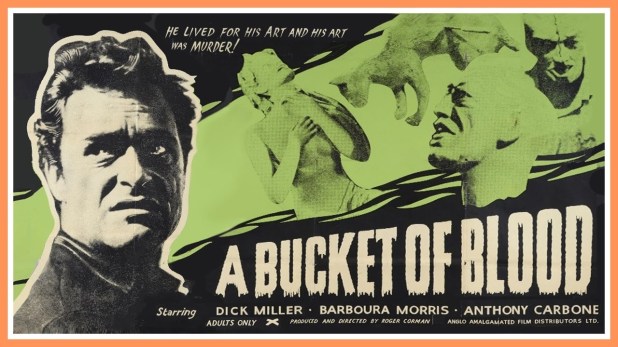
A Bucket of Blood was released on October 21st, 1959, and tells the story of Walter Paisley (Miller), a shy little guy who busses tables at The Yellow Door, a hip coffee joint that caters to beatniks. Walter spends his days cleaning up after the pretentious clientele who treat him poorly, yet he dreams of one day being an artist and rubbing elbows with them. Walter’s boss, Leonard (Anthony Carbone, Creature from the Haunted Sea, The Pit and the Pendulum and a few other Corman flicks) is a particularly unlikable prick, and treats our boy Walter like dirt. One night after a typical shift, Walter returns home to his dingy little one-room apartment to find that his landlady’s cat, Frankie, has gotten into the walls. With no real malicious intent, Walter decides the best way to get Frankie out is to cut through the drywall with a large kitchen knife. As you can imagine, this does not go well, particularly for Frankie. Shocked and terrified that he accidentally skewered Mrs. Swickett’s beloved pet, he gets the idea to cover Frankie’s carcass with sculpting clay, and turn him into a work of art. The next day at the Yellow door, Walter’s “Dead Cat” sculpture, complete with protruding knife, is a big hit with the beat crowd, particularly with one Maxwell Brock (Julian Burton, also in Corman’s Masque of the Red Death), who seems to be the epicenter of the local scene. Suddenly, even that beret wearing tool Leonard is treating Walter with some respect, as is Walter’s crush, Carla (played by Barbara Morris, another Corman alum with Wasp Woman, The Trip and Machine Gun Kelly to her credit). It would seem that Walter’s horse has finally come in, as he goes from forgettable busboy to art sensation overnight. Unfortunately, all that glitters is not gold, and Walter begins to attract the attention of Yellow Door regular and undercover cop Lou Raby, who tails Walter home one evening after an overly enthusiastic female admirer slips Walter a vial of heroin. Detective Raby knocks at Walter’s door and promptly lets himself in once the door is opened. He begins to grill Walter about the heroin, but it’s clear to us in the audience that Walter had no idea what he was given. Walter is a sweet, mousey, gullible little man that we can’t help but like, so Lou’s persistent badgering comes off as just another example of poor Walter being bullied. It is for that reason that when Walter panics and bashes Lou’s skull in with a frying pan that we can’t help being just a bit relieved, and Walter comes off as vindicated. But alas, Detective Raby was no house cat, and Walter has just committed murder. Fortunately, he still has plenty of sculpting clay, and Voila! “Murdered Man” is created, and becomes Walter’s latest masterpiece!
With “Murdered Man”, Walter has become a bonafide artist, has folks desperately trying to outbid one another for his work, and shows up at The Yellow Door wearing a beret, carrying a cane he calls his “Zen Stick” and orders Papaya Cheesecake and Yugoslavian white wine. Fame went to his head very quickly. And although he has become a bit of a pretentious jerk, He’s still just likable enough to keep us rooting for him. We can see that he is in way over his head, but all we can do is pretty much sit back and watch this whole thing run its course. When Carla suggests that Walter sculpt her, he promptly but politely refuses, as that would surely mean the end of Carla. However when the overly obnoxious blonde diva Alice (Judy Bamber of 1963’s Monstrosity) hints that she’d let Walter sculpt her, he responds with “I just might”, with a murderous glint in his eye!
Shot in just five days with a budget of $50,000 and using a recycled set from the film Diary of a High School Bride, A Bucket of Blood was written by Charles B. Griffith, who also collaborated with Corman on Little Shop of Horrors, Beast from Haunted Cave, Ski Troop Attack and Death Race 2000 as well as directing a half-dozen films himself (including Up from the Depths, Forbidden Island and Eat My Dust! starring Ron Howard). Griffith was also instrumental in helping Roger capture the comedic tone of the film, as he did with Little Shop of Horrors. Corman found the idea of doing comedy a bit unnerving, stating in an interview once “If you make a comedy and no one laughs, you’re dead!”. Griffith, however was born into a vaudeville family, and his parents even offered advice on how to make the comedic aspects of the film work. In addition to being a skilled filmmaker, able to make things happen with minuscule budgets and insanely tight schedules, Corman was (and is, for that matter, still kicking in his 90’s these days) a great businessman and very sharp at making pictures that will pique the interest of the movie-going public. The beat scene was a subculture of the 1950’s that brought us the work of one Jack Kerouac, but compared to other subcultures that have been overly exploited in films over the years (Bikers, Hippies, Gangsters etc.) Beatniks never really got a whole lot of screen time, the only other film from the era that comes to mind would be Julian Roffman’s The Bloody Brood, featuring a young Peter Falk, also released in 1959. Corman and Griffith reportedly spent several evenings frequenting beatnik coffee bars and hangouts in doing research to make the characters as “authentic” as possible.
Is A Bucket of Blood one of Corman’s best films? I suppose it depends on who you ask. What the film is to me, however, is 64 minutes of kooky fun. Like many of Corman’s early work, or just about any other wacky 1950’s horror/sci-fi/monster fare, it’s not exactly “terrifying” or even mildly disturbing, but a fun little flick for those who truly appreciate these films for what they are, and how they came to be.
Let’s get this out of the way. This is a movie made by maniacs who have nothing less than the goal of decimating your sanity. View this movie at your own peril.
René Cardona — who also brought us La Momia Azteca contra el Robot Humano — originally crafted this movie, which was remixed for American audiences by K. Gordon Murray, known as the “King of the Kiddie Matinee.” Ever wondered why Santo was called Samson in the U.S. dialogue? You can thank Murray, who also provides the near-manic voiceover for this film.
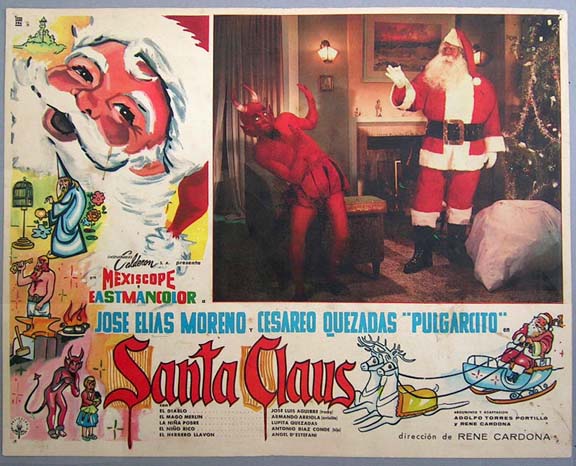
On Christmas Eve, Santa prepares for his big night, as always. He plays his organ while children all over the world sing. They hope to glimpse him as they leave his Toyland castle in space.
If you’re already wondering why anyone would change Santa’s basic character beats, buckle up. Have have some Christmas magic for you?
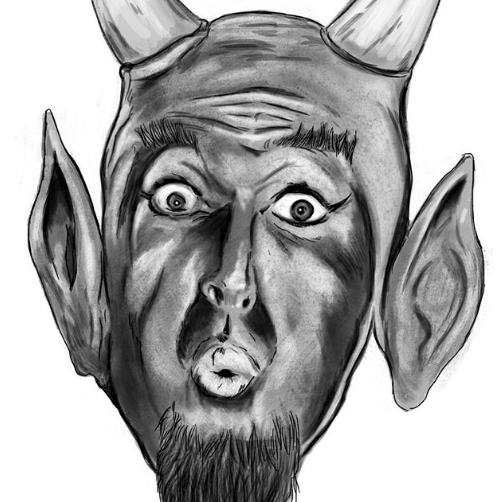
In Hell, Satan tells Pitch, his main demon, to go to Earth and make kids hate Santa. Why? Who knows — we wouldn’t have a movie otherwise.
Pitch asks five kids to help him enrage Santa Claus. Four of them are complete assholes — three brothers who like to start shit and Billy, the son of wealthy but absent parents. They break some windows, but Pitch fails to talk Lupita, a poor girl, into stealing the doll she wants. An angry Santa watches from space with the help of his magic telescope and children’s helpers. Remember that part of Santa’s songs?
Santa also has a device that allows him to watch children’s dreams, further creating a police state only dreamed of by elves on shelves and Tom Cruise in Minority Report. Lupita dreams of adult-sized dancing dolls demanding that she learn how to steal.
The three brothers then break into Billy’s home and steal his toys. They then have the temerity to write to Santa and tell him they have been good all year, but his voice takes over their minds and informs them that he can see everything.
Let me see if I can process what happens next: Santa can attract everyone because of his most trusted henchman, Merlin the Wizard. No, not Ringo Starr from Son of Dracula. No, this friend of Saint Nick gives him sleep powder, a flower that allows him to disappear, a magic key that will open any door on Earth and mechanical reindeer. But oh no — the three evil boys are plotting to enslave Santa. Enslave Santa — that’s how dark this movie is ready to get.
Want to get really dark? One of Santa’s helpers, Pedro, is played by an actor named Cesáreo Quezadas, who was also known by the stage name Pulgarcito, thanks to appearing in the popular film of the same name. This would be like us calling Bela Lugosi Dracula for the rest of his life. He often played plucky orphans, but as he hit puberty, his acting career suffered, leading to him holding up a shoe store in 1971. After some time in jail, he got married and had four kids, but ended up leaving his wife for his secretary, Claudia, and having two kids with her. Those two boys, Gridley and Guillermo, found a video of their father having sex with their stepsister, Mariana. He’s still in jail today, over a decade later.
Remember Lupita? She and her mom pray that she gets not just one baby doll but two — one of which she will give to Baby Jesus, which is kind of like when you ask your parents for money so you can buy them a gift at the Santa shop at school, and all they get is a piece of shit covered with glitter or a cheap screwdriver set that you wonder why they never use.
Santa just wants to get gifts to everyone on Earth, but Pitch keeps screwing with him. And Billy? His parents go out to eat and just leave him all alone. Santa helps out there and even has time to give the three bad kids coal after they try to steal his sleigh.
Pitch is finally lucky enough to empty all of Santa’s dream powder, and then the jolly old man drops his magic flower. He’s fucked. A dog chases him up a tree, and the devil’s majordomo calls the fire department to come so everyone can see Santa and ruin his magic. Merlin helps our hero escape and blasts the demon with a fire hose.
Don’t worry about Lupita. She gets her doll as Santa goes back to his castle. Whew.
This movie won the Golden Gate Award for Best International Family Film at the 1959 San Francisco International Film Festival. I can only imagine that this was one of the early LSD experiments and not a film festival based on artistic merit.
This movie has so many insane ideas that it’s difficult to summarize. From learning that demons primarily eat hot coals to the fact that every child who works for Santa must wear a racist costume that denotes their country of origin (all Japanese children wear kimonos, and all Americans are cowboys), this is a movie brimming with barely concealed menace.
But here’s what’s really weird: Even though Santa has modified all of his children’s countries, none of them know anything about their countries of origin. What is happening?
This is how Santa can be everywhere at once: he is from the Fifth Dimension, and, as we all know from reading Grant Morrison comics, that is the dimension of imagination. Therefore, as a fifth-dimensional being, Santa can see the reality of our dimension and do things that would break our minds if we contemplated them for so long — just like I am doing when I write this. I am putting your brain in danger right now by forcing you to reason with the fact that the physical properties that ground us in the Third Dimension can be pushed beyond the infinite. Merry Christmas.
Santa Claus can also feel physical pain when his mechanical manifestations are hit with rocks. This makes even less sense. Why, in a world where Lucifer constant is constantly murdering him, would Santa put himself in such mortal peril?
This is a movie that raises more questions than it answers. You ask, “Where does Santa come from?” Knowing that he comes from the North Pole, you are shocked to learn that everything you know — including the universe and its laws are governed — is a lie. This movie is meant to keep children occupied, whether on TV or in the movie houses where it ran yearly for three decades while parents try to get a merciful break. However, a central point of the film is for parents to stop ignoring their children, so any child ignored in such a way will have to feel lost in the maelstrom of emotional pain that this movie wields like a scalpel.
I get this for watching Santa Claus vs. the Devil at 4 AM. Pure pain, questions that chatter at my mind and the slowly evolving knowledge that this motion picture could have only been created by the eldritch powers of the Ancient Ones who wait for us Behind the Wall of Sleep, where their madness will infect our souls and cause our children to eat their way from their wombs.

 B&S About Movies
You must be logged in to post a comment.