ATTACK OF THE KAIJU DAY: Unknown Island (1948)

Directed by Jack Bernhard and written by Robert T. Shannon and Jack Harvey, Unknown Island has Ted Osborne (Phillip Reed) and his fiancée, Carole (Virginia Grey), looking for dinosaurs. Good news. They find them.

Along with drunk Captain Tarnowski (Barton MacLane) and even drunker PTSD-having John Fairbanks (Richard Denning), who survived a previous dinosaur attack, they head out. Maybe Fairbanks wants to cuck Ted, too. Who can say?

When they get there, Tarnowski gets into the whiskey, starts shooting crew members and won’t leave the island until he brings one of these giant lizards back alive. And you know, as much as this is about dinosaurs, it’s also about how Tarnowski, Osbourne and Fairbanks all have it bad for Carole. So bad that they continually put her life in danger, but she can take care of herself. One time, when Tarnowski passes out, she grabs his gun and blows away a dimetrodon (which is not technically a dinosaur, but instead a reptile that went extinct ten million or more years before the dinosaurs appeared).

If you see some of these dinos and feel some deja vu, this footage was reused in the American version of Godzilla Raids Again and Adventure at the Center of the Earth. When the crew is firing grenades, there’s a bit of realism in that scene. The two-legged dinosaurs were actually rubber suits worn by actors in the hot desert of Palmdale. When one of them fell, it was actually the actor passing out from heat exhaustion. He died later and the film uses the footage. This is a dinosaur snuff film.

You can watch this on Tubi.

APRIL MOVIE THON 4: Night Has a Thousand Eyes (1948)

April 11: Until You Call on the Dark — Pick a movie from the approved movies list of the Church of Satan. Here’s the list.

Directed by John Farrow — the father of Tisa and, yes, Mia — and written by Jonathan Latimer and Barré Lyndon (the stage name of Alfred Edgar Frederick Higgs; he also wrote The Lodger), this was based on the book by Cornell Woolrich, whose stories were also filmed as The Leopard ManPhantom Lady, Rear WindowThe Bride Wore BlackSeven Blood-Stained OrchidsCloak and Dagger and I’m Dangerous Tonight.

Los Angeles is a dangerous town. It’s the kind of place where oil geologist Elliott Carson (John Lund) can watch his girlfriend Jean Courtland (Gail Russell) try to jump into the path of a train, then take her to dinner as if nothing happened. There, they meet John Triton (Edward G. Robinson), a psychic who keeps telling her that she is going to die soon. Elliot thinks that he’s trying to get her to kill herself and take her money.

The truth is a bit more complicated.

Twenty years ago, Triton, his fiancee Jenny (Virginia Bruce), and Jean’s father Whitney (Jerome Cowan) toured the country as part of a magic show. Whitney also used Triton’s skills at seeing into the future to get rich. However, Triton soon sees Jenny dying after they have a baby. He leaves, Whitney marries Jenny, and they have Jean, but she dies during childbirth, proving his prophecy. Years later, he’s too late to stop Whitney from dying in a plane crash, but he wants to try and save Jenny.

It seems like Jenny made it on the fateful night, only for the clock to be moved forward. Someone comes out to kill her, but Triton stops them. The police arrive and believe that he’s the killer. They shoot him, and as he dies, Elliot finds a note that explains that Triton will die saving Jenny.

A movie about a doomed woman who is afraid of the stars themselves. The title comes from a poem by FW Bourdillon, “The Night Has a Thousand Eyes.”

“The night has a thousand eyes,

And the day but one;

Yet the light of the bright world dies

With the dying sun.

The mind has a thousand eyes,

And the heart but one:

Yet the light of a whole life dies

When love is done.”

Robinson was usually the bad guy in movies, but he’s nearly the lead here. He’d also appear in another Woolrich movie, Nightmare.

According to The Church of Satan, “Satanic themes include the use of theatrics, Reading and Casing the Mark (see the chapter in The Satanic Witch), Skepticism and Doubt, and the exploration of the unknown.”

Anton LaVey often spoke of this movie, saying, “I started out like Edward G. Robinson in Night Has a Thousand Eyes. A carny mental act, a fraud. I believed everything was fixed, gaffed. Then, like Robinson, you start to get real flashes. Only if your life isn’t full of miracles can you recognize the real miracle.”

In Blanche Barton’s The Secret Life of a Satanist, he says, “Robinson actually did several Satanic Films – Hell on Frisco Bay, Little Caesar, The Night Has a Thousand Eyes — most of his roles had satanic overtones. In his personal life, he was an avid art collector and had one of the finest private collections in the world until he lost it in a divorce suit. Chernobog — the devil in Walt Disney’s Fantasia, the one who looms up from the mountaintop during the “Night on Bald Mountain” sequence was actually inspired by Edward G. Robinson’s features, not Lugosi’s as is usually believed. He exuded the diabolical perhaps better than any other actor — with the possible expansion of that statement to include Erich Von Stroheim.”

The Sizzlin’ Something Weird Summer Challenge 2024: Because of Eve (1948)

Roadshow Rarities (June 30 – July 6) In the old days of theatrical releases some of the more lavish movies would be promoted by holding limited screenings in large cities. These roadshow releases would generate hype before the nationwide release and allow producers to tweak the film to the audience’s reaction. This model also worked for low budget productions that may have had no intention of a wide release. These explo roadshows traveled an informal circuit of theaters, churches, revival tents, high school auditoriums and anywhere else they could run a projector. They frequently promised more than they delivered and left town before the angry audience could catch up to them. Through the restoration efforts of SWV many of these movies have survived to piss audiences off to this very day!

Sally and Bob have been married a year and there’s some good news. It seems like she’s pregnant. That means they go to see Dr. West, who has no idea what HiPPA laws are or the privacy of the patient and we learn about how Sally had a baby with Bob’s best friend who died in World War II and their issues with VD and when things get weird, he makes them watch some other movies within the movie like The Story of V.D.The Story of Reproduction and The Story of Life and oh man, throw away your popcorn because you know it’s time to see diseased vaginas and penises. Let’s throw in a cesarian and regular birth, because the people demand it!

After the movie, perhaps you’d like to purchase The Mid-Century Marriage Guide?

Director Howard Bretherton made a hundred or so low budget westerns and was a master of editing in camera, a skill he passed on to his son David Bretherton, who edited Cabaret and Westworld, and his granddaughter Gillian L. Hutshing, who was on the editing team for Blade RunnerRadEyes of Fire and The Monster Squad.

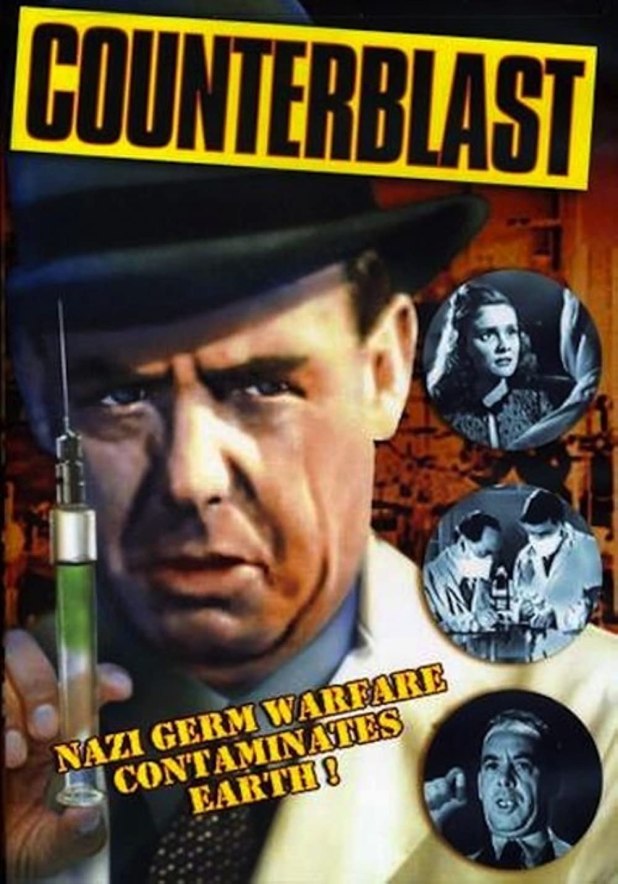
MILL CREEK NIGHTMARE WORLDS: Counterblast (1948)

Born in Austria and settling in England, Paul L. Stein directed a ton of movies over his career and this was his next to last, a spy movie which was one of the two genres he worked in most, the other being female-friendly movies. One of its writers, Jack Whittingham, was the screenwriter that worked with Kevin McClory to create the script for Thunderball that was also filmed as Never Say Never Again.

This movie predates  the disclosure of Operation: Paperclip by telling the story of a Nazi scientist who finds his way to the West, murders a professor, takes his place and plans a biological attack on England. It’s a good thing that the evil scientist falls for a lab assistant and starts being all handsy around her or the war would be lost.

Distributor Herbert Bregstein changed the title to Devil’s Plot and played it in theaters, despite the fact that it was already playing on TV under its original title. I love when that happens but if I had seen this twice — and paid once — I probably would not love it so much.

This has a lot of talking, is longer thahn it should be and really is a rough watch. You know what that means? It’s perfect for a Mill Creek box set.

APRIL MOVIE THON DAY 7: Bill and Coo (1948)

Shot on the world’s smallest film set, this film only has three humans — producer Ken Murray, bird trainer George Burton and Elizabeth Walters — show up in the opening. The stars are the birds of the town of Chirpendale. It was awarded an honorary Academy Award as it doesn’t really fit into the world of normal movies and we’re all better for that.

Bill, a cab driver, is trying to save Coo from a crow named the Black Menace. There’s also a circus act and man, you know, this movie was exactly what I needed the other day, just a fresh dose of innocence and fun.

Director Dean Riesner started as an actor before writing plenty of TV programs, as well as Dirty HarryPlay Misty for MeThe EnforcerFatal Beauty and many more films. He was also married to Maila Nurmi, who we all know better as Vampira.

Today, we may not understand the slang for this movie’s title, which means to sit and speak quietly. This movie is none of those things, a wild ride that has bird firemen, bird motorcyclists and no small matter of astounding bird heroics.

You can watch this on Tubi.

Because of Eve (1948)

Sally and Bob have been married a year and there’s some good news. It seems like she’s pregnant. That means they go to see Dr. West, who has no idea what HiPPA laws are or the privacy of the patient and we learn about how Sally had a baby with Bob’s best friend who died in World War II and their issues with VD and when things get weird, he makes them watch some other movies within the movie like The Story of V.D.The Story of Reproduction and The Story of Life and oh man, throw away your popcorn because you know it’s time to see diseased vaginas and penises. Let’s throw in a cesarian and regular birth, because the people demand it!

After the movie, perhaps you’d like to purchase The Mid-Century Marriage Guide?

Director Howard Bretherton made a hundred or so low budget westerns and was a master of editing in camera, a skill he passed on to his son David Bretherton, who edited Cabaret and Westworld, and his granddaughter Gillian L. Hutshing, who was on the editing team for Blade RunnerRadEyes of Fire and The Monster Squad.

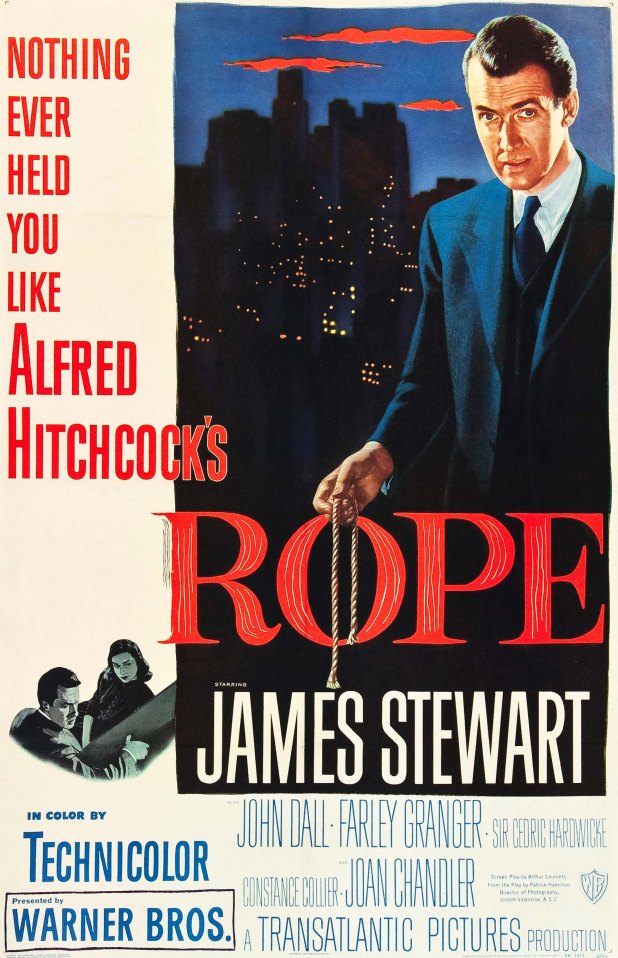
2021 Scarecrow Psychotronic Challenge Day 24: Rope (1948)

24. 2 CLOSE 4 COMFORT: A main character suffers from claustrophobia.

Outside of the expected films like Psycho and Rear Window, Hitchcock has been a blind spot to me, despite my obsession with the Krimi and Giallo films that owe a debt to his work. Let’s change that!

Based on Patrick Hamilton’s 1929 play of the same name, this movie was adapted by Hume Cronyn—yes, the actor and husband of Jessica Tandy—with a screenplay by Arthur Laurents.

After Lifeboat, this is the second in a series of Hitchcock films set in limited settings. It also takes place in real time and appears to be a series of single takes, which are covered by some really clever editing by William Ziegler (who also worked on Strangers on a Train and Spellbound for Hitchcock).

Brandon Shaw (John Dall) and Phillip Morgan (Farley Granger) want to prove their intelligence by staging the perfect murder. And to do so, they don’t just theoretically discuss it. No, instead, they strangle their old classmate David Kentley (Dick Hogan), hide his body in their apartment and then invite their friends over for a dinner party.

This whole scheme came from discussions they had back in college with their housemaster, Rupert Cadell (James Stewart), about Nietzsche’s Übermensch and De Quincey’s theory that murder is a way of showing one’s superiority over others. Yes, the same opium-loving De Quincey whose writing inspired SuspiriaInferno and Mother of Tears. So he’s a guest to take part in their artwork, as it were, as are several former classmates, friends and even the dead man’s father.

The claustrophobia of this movie comes from not only the killers being unable to deal with the impact of their crime — it’s one thing to calmly discuss a murder in the classroom and its another to actually get your hands dirty — as well as the fact that there’s a dead body in a trunk the entire time that people are making merry.

If you’re looking for a movie that pushes the limits of what could be done at the time, Rope is it. That’s totally not claustrophobic, as Hitchcock was going for something that hadn’t been done on film before. The long, unbroken shots — which frustrated Stewart, who claimed that the experiment was worth taking but didn’t work — were unlike anything in standard moviemaking at the time. And it led to really technical things needing to happen, as the entire set was on rollers and could silently be moved as parts come in and out of the scene. What you aren’t seeing is a huge crew constantly moving heavy furniture and the huge Technicolor camera so that they wouldn’t be seen on camera, as well as multiple sound and camera people, so everything could remain in constant motion.

Keep that in mind as you watch the acting in this movie. There was also a series of cues that the talent had to follow as well as actually act in the movie. Of course, this also led to plenty of issues on set, as there was an incident when the camera dolly ran over and broke a cameraman’s foot. In order to keep filming, he was gagged and dragged off the set. That’s in the movie.

Beyond that, this is shot on a stage with a gigantic cyclorama as the background—the largest one ever made—which had models of the New York skyline, as well as working chimneys and lights, a sunset that was artificially created as the movie’s runtime moves along and even spun glass clouds that could change position and shape.

Hitchcock even shot a prequel to the film in the trailer, showing the world outside the apartment. This shows that he implicitly understood how to sell one of his movies by telling the audience that this would be the last time that they’d see David Kentley alive.

This movie was pretty controversial at the time, as the implied relationship between the leads led to its ban in some cities. Keep in mind that this movie is less than a century old when you complain about how people are so sensitive. This is where we’ve come from, and it wasn’t all that long ago.

This movie was unavailable for three decades because Hitchcock bought back its rights and left them as part of his legacy to his daughter Patricia. The other four lost films were Rear WindowThe Man Who Knew Too MuchThe Trouble with Harry and Vertigo. They were finally re-released in theaters in 1984 after thirty-five years of not being seen. Again, we live in a different world where everything is available; it was not always this way.

Jungle Goddess (1948)

Between 1922 and 1954, Lewis D. Collins made around 120 films, most of them Westerns. Here’s one of the rare ones that doesn’t have horses and six shooters, set in the jungle and starring future Superman George Reeves as an explorer.

Pilot Mike Patton (Reeves) and Bob Simpson (Ralph Byrd, who had played Dick Tracy numerous times, so this is a meta comic hero team-up) are looking for Greta Vanderhorn (Wanda McKay, who played the leading lady in many a B movie) in the jungle and find her being worshipped by the natives. She begs Mike to help her escape, but Bob has gone insane and they just might not make it out alive.

Producers William Stephen and Robert Lippert would bring back the Reeves and Byrd team for Thunder in the Pines and had plans for four movies with them every year. Banana Fleet was planned, but never got made.

The white goddess trope might not have started here, but it’s definitely happening in this one. The trope probably started in W. H. Hudson’s 1904 book Green Mansions with his character Rima. The first film example is 1920’s The Jungle Princess. We’ll have a few more examples this week, trust me.

You can watch this on MovieOnline.


Abbott and Costello Meet Frankenstein (1948)

Originally titled The Brain of Frankenstein, the title of this movie was changed to make it less “horror” and to feature the comedy duo. Lou Costello hated the script, claiming his five-year-old daughter could write a better script.

The Universal Monsters hadn’t been in a movie in three years, with Lugosi — who is playing Dracula for just the second time and last time in a feature film — and Chaney no longer under contract. Boris Karloff doesn’t even appear — that’s Glenn Strange* in the role — yet agreed to help promote the movie.

What a set-up. Lawrence Talbot (Lon Chaney Jr.) makes an urgent phone call to warn Chick Young (Bud Abbott) and Wilbur Grey (Lou Costello) that a shipment they’re about to get for a wax museum contains the real Dracula. Of course, they think it’s all a joke until, you know, Dracula really comes back.

Before you know it, Dracula has reanimated Frankenstein’s Monster and has Dr. Sandra Mornay (Lenora Aubert, The Return of the Whistler) on hand to scoop out Costello’s brains and plop them into the Monster’s skull. She’s feigning interest in our hero and there’s also another mysterious woman, Joan Raymond (Jane Randolph, Cat People) acting like she’s in love with him.

Seriously, this is the very definition of a hijinks ensue film. Dracula is disguising himself as Dr. Lejos, but Larry Talbot isn’t fooled. I’ve always loved the scene where the vampire becomes a bat and the werewolf just grabs him and jumps off a balcony to both of their supposed deaths.

While this is the last appearance of the big three Universal Monsters, Abbott and Costello would also meet up with Boris “The Killer” Karloff, Dr. Jekyll and Mr. Hyde, the Mummy and the Invisible Man, which is Abbott says, “There’s no one to frighten us any more.” That’s when a voice comes out of nowhere. “Oh, that’s too bad. I was hoping to get in on the excitement. Allow me to introduce myself—I’m the Invisible Man!” You have no idea how insane I went as a kid every time Vincent Price’s voice bellowed at the end of this. They’d also met up with the Creature from the Black Lagoon on the Colgate Comedy Hour.

This was directed by Charles Barton, who made several movies with the duo, as well as 38 episodes of Petticoat Junction, 90 episodes of Dennis the Menace, 78 episodes of The Amos ‘n Andy Show and 106 episodes of Family Affair. Walter Lantz — who created Woody Woodpecker — directed the animated Dracula to bat sequence.

*Actually, Strange isn’t in one scene. He had broken his ankle tripping over a camera cable, so when the Monster throws Dr. Mornay out the window, that’s Chaney Jr. in the make-up.

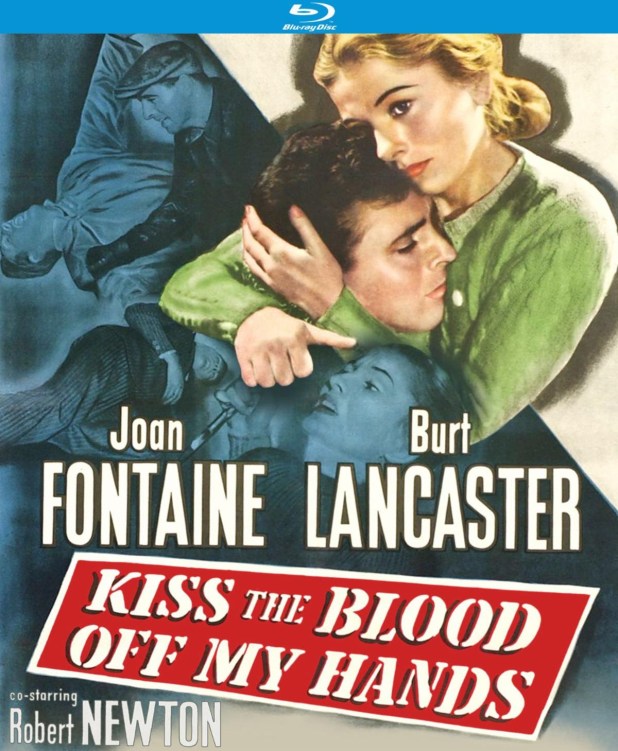
Kiss the Blood Off My Hands (1948)

Kino Lorber Studio Classics has steadily been releasing a number of classic film noir titles under its Film Noir: The Dark Side of Cinema series. This one, starring Joan Fontaine and Burt Lancaster, fits right into those box sets.

Former POW Bill Saunders (Lancaster) barely survived the war and is a man on the edge. This blows up when he kills a man in a bar fight and hides in the home of nurse Jane Wharton (Fontaine), telling her its all an accident. They fall in love and after some jail time for attacking a cop, he gets a straight job. That gets ruined when a gangster who saw the bar fight starts blackmailing him.

Fontaine and Lancaster would recreate their roles for the Lux Radio Theatre broadcast on February 21, 1949 under the title The Unafraid, which was much less offensive of a title. Indeed, there was a fight where this movie was almost called Blood On My Hands and Blood On the Moon. Lancaster was a producer, so he really struggled to keep the original title, seeing as how it was based on a book by Gerald Butler.

Norman Foster mostly directed Charlie Chan and Mr. Moto films, so this is one of his few chances to strike out and make something unique, which he does. Also, the scene where Lancaster is whipped with a cat o’nine tails 18 times was voted #43 in the book Lash! The Hundred Great Scenes of Men Being Whipped in the Movies.

You can grab this blu ray from Kino Lorber, who sent us a review copy. It has a new 2K transfer and commentary by film historian Jeremy Arnold.