MILL CREEK LEGENDS OF HORROR: Secret Agent (1936)

Adapted from a play by Campbell Dixon, based on two stories in the 1927 collection Ashenden: Or the British Agent by W. Somerset Maugham, this adaptation introduces Edgar Brodie (John Gielgud) returning from the war, only to discover he’s been reported dead. The story then follows his transformation into Richard Ashenden, with help from characters like ‘the hairless Mexican’ and ‘the general,’ whose identities are misleading. Elsa Carrington (Madeleine Carroll), who took the assignment for excitement, is also introduced as his wife for cover.

While the Mexican has no issues with killing anyone in his way, both Edgar/Richard and Elsa have problems doing so. She’s already fallen in love with our hero as well and soon learns that Robert Marvin (Robert Young), the man who has been hitting on her from the start, is really the enemy agent everyone is after. And the killer in the middle of all of this, the General (Peter Lorre), seems like he could murder anyone at any time. Also, if he feels twitchy, he was kicking drugs at the time that this was made.

Gielgud wasn’t happy that his character was an enigma, and director Alfred Hitchcock later said that, since he didn’t seem heroic, it was hard to be on his side.

You can watch this on Tubi.

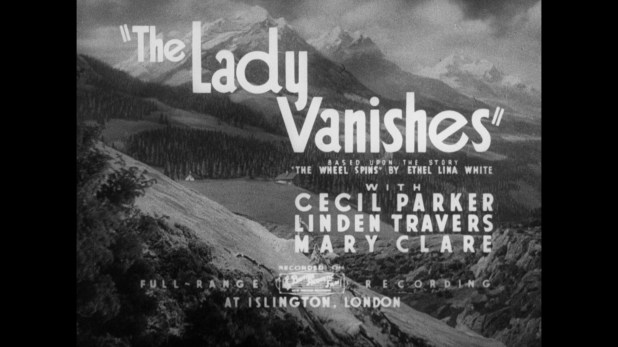
MILL CREEK LEGENDS OF HORROR: The Lady Vanishes (1938)

Based on The Wheel Spins by Ethel Lina White, this Hitchcock thriller is about Iris Henderson (Margaret Lockwood), who is traveling through Europe by train and soon learns that her fellow passenger, Miss Froy (May Whitty), has disappeared, and no one remembers her. Is Iris just seeing things? Has a hit on her head ruined her hold on reality? Will she fall in love with clarinet player Gilbert (Michael Redgrave) and leave her fiancé?

Originally called The Lost Lady, this was to be directed by Roy William Neill. A crew went to Yugoslavia to shoot some background shots, but when the police accidentally learned that the country wasn’t treated well in the story, they kicked the crew out. A year later, as Hitchcock was trying to fulfill his contract, he took on this story.

The characters of Charters and Caldicott, played by Basil Radford and Naunton Wayne, were so popular that they would appear in three more movies: Night Train to Munich, Crook’s Tour and Millions Like Us. While not called by name, they also played versions of the characters in The Next of KinDead of NightA Girl In a MillionQuartetIt’s Not Cricket, Passport to Pimlico and Stop Press Girl as well as radio appearances. The 1979 Hammer remake featured Arthur Lowe as Charters and Ian Carmichael as Caldicott, while a modern-day TV series from 1985 starred Robin Bailey as Charters and Michael Aldridge as Caldicott.

You can watch this on YouTube.

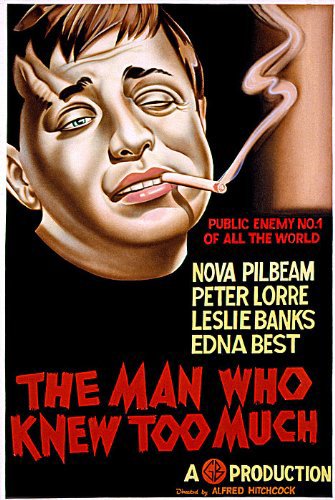
MILL CREEK LEGENDS OF HORROR: The Man Who Knew Too Much (1934)

Probably the best movie of Hitchcock’s British era, one he would remix and remake in 1956. Of these films, he said, “Let’s say the first version is the work of a talented amateur and the second was made by a professional.”

Bob and Jill Lawrence (Leslie Banks and Edna Best) are on vacation in Switzerland, a serene setting that is soon disrupted by the tension of a clay shooting competition. Jill almost outshines a sharpshooter named Ramon Levine (Frank Vosper) before Mr. Abbott’s (Peter Lorre) watch distracts her. This moment of distraction leads to a sudden turn of events, as a French man by the name of Louis Bernard (Pierre Fresnay) is shot while dancing with Jill. The Lawrences are then forced into a dangerous game, as Abbott kidnaps their daughter, Betty, and compels them to be part of his plan to murder a leader.

The release of this film was a significant event, given the circumstances. C.M. Woolf, a powerful figure in the English cinema industry, initially opposed the film, stating that it would only be released if it was remade with a new director, different cast, and different writers. However, Hitchcock’s appeal to Isidore Ostrer, the owner of Gaumont-British, led to the film’s release. The movie’s success was a source of contention, as Woolf, who was forced to release it as a supporting feature, was left displeased.

Lorre made this soon after he had escaped from Nazi Germany. In his first meeting with Hitchcock, he smiled and laughed as the director spoke; this meant that even though Lorre barely spoke English, he made a good impression. He said most of his lines in this movie phonetically.

You can watch this on YouTube.

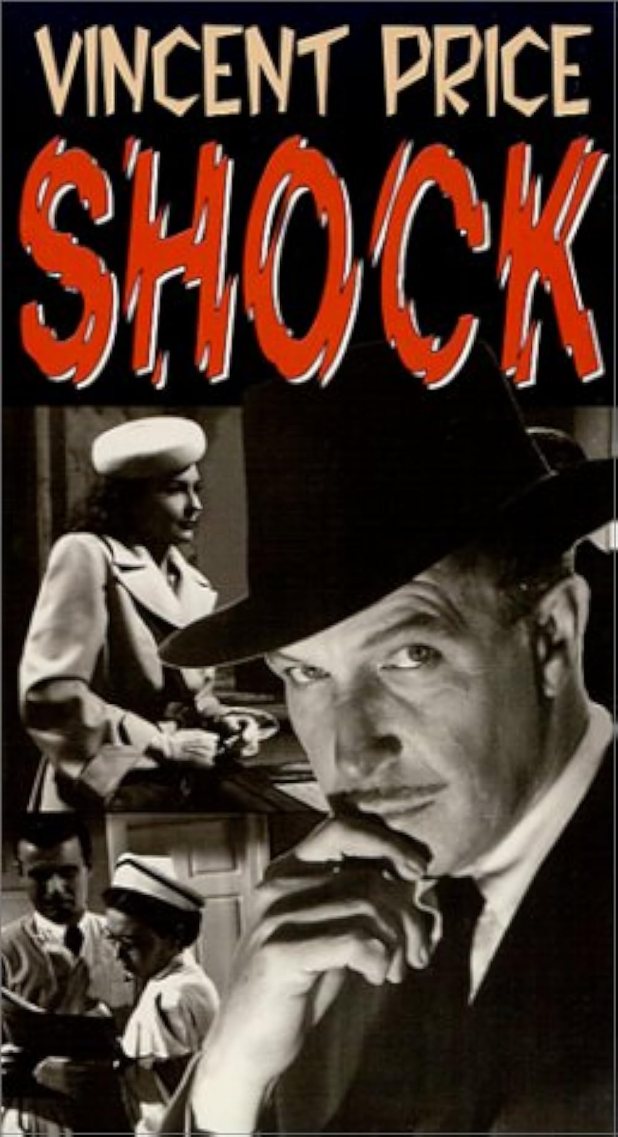
MILL CREEK LEGENDS OF HORROR: Shock (1946)

Dr. Cross, portrayed by the remarkably young Vincent Price, is treating a young patient for shock. She fell into a coma after witnessing a man kill his wife with a candlestick. The twist? The man she saw was Dr. Cross himself. The question remains, how will she escape this perilous situation?

Lynn Bari plays the Doctor’s lover/nurse, Elaine, and, if you know anything about noir, she’s never a leading lady but always the seductress —a “sultry, statuesque man-killer,” as Wikipedia calls her. Sadly, her career fizzled by the 1950s, “sabotaged by unresolved problems with her domineering, alcoholic mother and three marriages.”

As Dr. Cross realizes that Janet is aware of his dark secret, Elaine, his lover and nurse, persuades him to induce a coma in Janet through insulin overdose and shock therapy. Despite his reluctance to harm her, he is left with no choice but to end her life. However, Dr. Harvey intervenes just in time, saving the day and preventing a tragic end.

You can watch this on Tubi.

MILL CREEK LEGENDS OF HORROR: The Lodger (1927)

Based on The Lodger by Marie Belloc Lowndes and the play Who Is He?, which was co-written by Belloc Lowndes, Hitchcock’s third movie was his first thriller and also the start of his cameo appearances. 

A killer named the Avenger has already murdered seven young blondes, always on Tuesday nights. Daisy Bunting (June Tripp), a model, has taken to hiding her hair color, as many other women do. Maybe her cop boyfriend Joe (Malcolm Keen) can keep her safe.

Daisy’s parents (Marie Ault and Arthur Chesney) keep a room at the top of their home and rent it out. The new lodger, Jonathan Drew (Ivor Novello), demands they remove all the photos of young blondes. You would think that this would scare Daisy, but you know how bad boys turn on good girls. Soon, she’s dating the lodger and has left Joe behind; Joe’s convinced she’s dating a killer and even tries to arrest him. 

There’s a reason: the lodger has a photo of the first victim and maps of each murder. Initially, this was supposed to end with a question about whether he really was the killer; the studio wouldn’t let that happen.

For the beginning of the film, Hitchcock wanted to show the Avenger’s murder victim being dragged out of the River Thames. Scotland Yard refused but said they would “look the other way” if he could do the filming in one night. It wasn’t to be. Hitchcock learned that his cameraman had forgotten to put the lens on the camera before filming the scene. It was replaced with a scene where the victim faces the camera and screams. She was lying on a sheet of glass, lit from underneath with the camera mounted on its side and the footage shot downward. An amazing piece of in-camera effects.

You can watch this on YouTube.

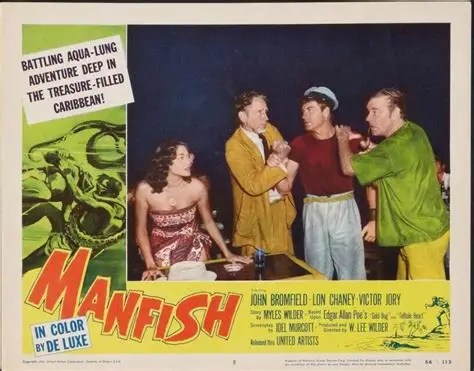
MILL CREEK LEGENDS OF HORROR: Manfish (1956)


Based on “The Gold-Bug” and “The Tell-Tale Heart” by Edgar Allan Poe, this at least has a great title. In the U.S., at least, as it was sold as Calypso in Great Britain.

Directed by W. Lee Wilder (Billy’s brother) and written by his brother Myles and Joel Murcott, this begins with Inspector Warren (Jack Lewis) coming to Jamaica to arrest a criminal known only as the Professor (Victor Jory). There’s also a captain named Brannigan (John Bromfield) who has won a ship called Manfish and the service of its first mate, Swede (Lon Chaney Jr.). Brannigan notices the ring the Professor wears and links it to a treasure map he finds, sending everyone to an island in search of the booty of pirate Jean Lafitte. Also: Brannigan wants the Professor’s woman, Alita (Tessa Prendergast, who would go on to design Ursula Andress’ bikini in Dr. No). Plus, you get another good-looking lady, Mimi (Barbara Nichols, The Human Duplicators). 

A lot of this movie finds the crew of the Manfish — “Big Boy” (Theodore Purcell) and Domingo (Vincent Chang) — turtle hunting. There’s also music by Clyde Hoyte and the Calypsos, and you’ll wonder, how do they get Poe into this? At least Chaney is good, all sweaty and drunk, but still wonderful.

You can watch this on YouTube.

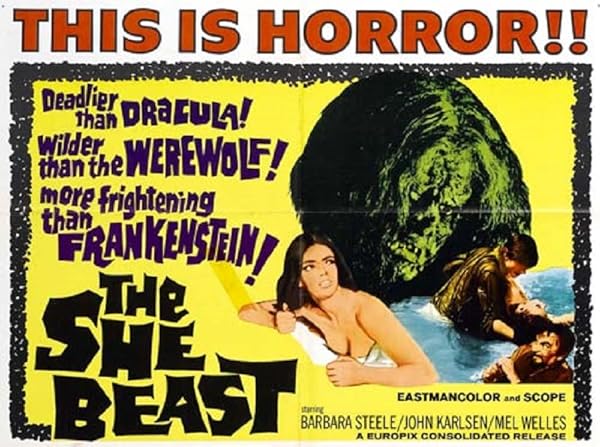
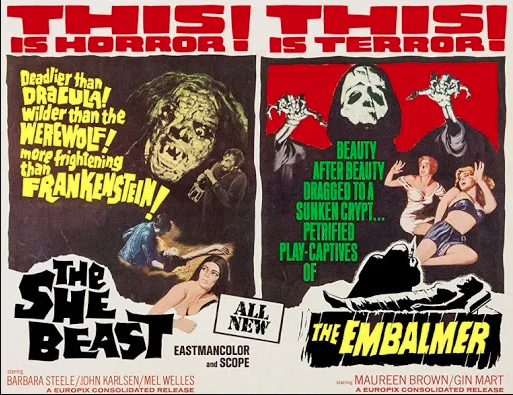
MILL CREEK LEGENDS OF HORROR: The She Beast (1966)

Michael Reeves only directed three movies: this film, The Sorcerers and Witchfinder General. He also had something to do with Castle of the Living Dead* and assisted Don Siegel, worked for Jack Cardiff on The Long Ships and for Henry Levin on his movie Genghis Khan.

Made in 21 days for hardly any money — even when Barbara Steele made $1,000 for one day of work, that day was 18 hours long — and most of the crew is in the movie. Reeves also wrote the script, along with F. Amos Powell and Mel Welles (the director of Lady Frankenstein), under the name Michael Byron.

Two hundred years ago in Transylvania, a witch named Vardella was burned at the stake, but not before threatening to come back for revenge. This would end up ruining the honeymoon of Philip (Ian Ogilvy) and Veronica (Barbara Steele) and that’s not even counting the squalid hotel owned by Ladislav Groper (Welles).

As they enjoy breakfast, Count Von Helsing (John Karlsen) delights in sharing the legend of Dracula and the story Vardella. Well, those foreigners have no interest in this weird old man and blow him off. That night, Phillip catches Groper peeping on his wife and beats him into oblivion. If that doesn’t make this a rough wedding getaway, he wrecks their car into a lake and when they pull out his new bride, it’s the dead body of the witch instead of the gorgeous Steele.

Now, Phillip has to make nice with Von Helsing and be part of his plan to take this dead body, drug it and perform an exorcism to get his wife back. It seems like a lot of work, but I’ve done so much more for women who couldn’t stand in the brightness of Steele’s flawless alabaster skin.

How do you kill a witch? You drown it. That’s also how you find out if someone is a witch.

This played double features in America — distributed by American-International Pictures — with The Embalmer

*Depending on who is asked, Reeves either did minor second unit work, a polish on the script’s dwarf character, a complete takeover of the movie or nothing at all.

You can watch this on YouTube.

MILL CREEK LEGENDS OF HORROR: Deathhouse (1972)

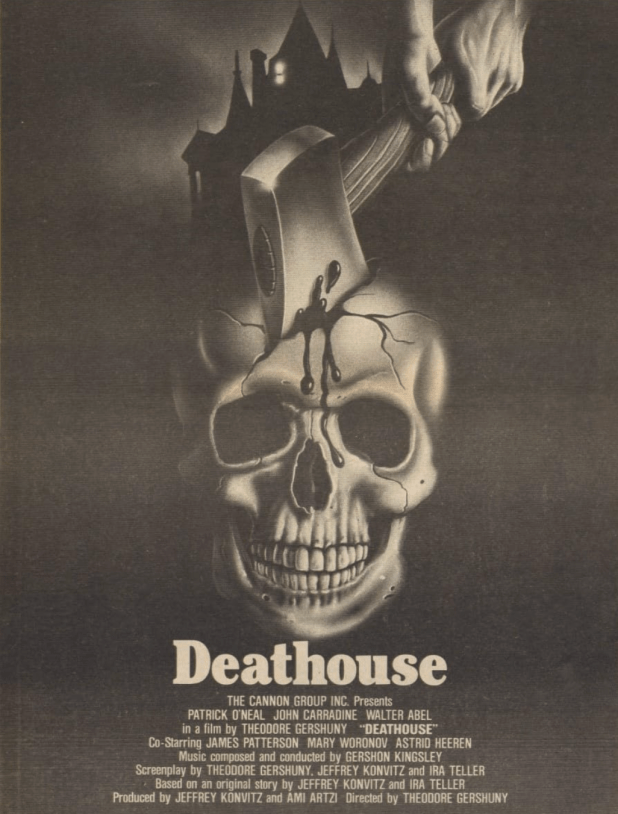
Yes, I realize that Silent Night, Deadly Night originally came out the whole way back in 1972. But nearly nine years after it first played theaters, Cannon released it as Deathhouse on May 8, 1981. If it makes no sense to release a holiday movie in May, well — don’t worry about it. It’s Cannontown.

Christmas Eve, 1950: Wilfred Butler runs from his home, on fire, and supposedly dies in the snow.

Christmas Eve, 1970: John Carter (Patrick O’Neal, The Stepford Wives, The Stuff) and his assistant Ingrid arrive in a small Massachusetts town. He meets with the town’s mayor, sheriff and major citizens like Tess Howard and Charlie Towman (John Carradine!), who may have lost his voice to a tracheotomy but not his need to smoke, about selling the Butler mansion as soon as possible. While staying overnight with Ingrid, who is also his mistress, they are both killed by an axe. The killer calls the police and says that they are Marianne.

Tess, the town’s telephone operator, hears the call and drives to the mansion, where she is greeted by Marianne Butler before she is hit in the head with a candle holder. Meanwhile, Sheriff Mason finds that Wilfred’s grave is empty. He is killed and thrown into the empty hole.

Mayor Adams is asked to go to the Butler mansion but leaves his daughter, Diane (Mary Woronov, Death Race 2000Chelsea Girls) at home. She meets up with a man who claims to be Jeffrey Butler, who has taken the sheriff’s abandoned car. Together, they search for the lawman but can’t find him.

After taking Towman to the mansion, Jeffrey goes back to get Diane. On their way to the mansion, Towman stumbles blindly in front of them and is hit and killed. His eyes had been stabbed out and Diane grows worried about Jeffrey.

Well, fuck me, this movie is also about incest! A diary found at the house reveals that Jeffrey is the son of Wilfred and his daughter, Marianne. Afterward, Wilfred turned the house into an asylum and admitted his own daughter. However, on Christmas Eve 1935, he turned all of the inmates loose. They killed every doctor as well as his daughter. Of note here is that many of the inmates in the flashback are played by former stars of Warhol’s factory, like Ondine, Tally Brown, Kristen Steen and Lewis Love, as well as Flaming Creatures auteur Jack Smith, artist George Trakas and his wife at the time, Susan Rothenberg. Warhol superstar Candy Darling also shows up in the film as a party guest.

Well, it turns out that some of the inmates of the insane asylum ended up being important parts of the town — that’s right, all of the important people John met with in the beginning!

Mayor Adams arrives at the mansion and he and Jeffrey face off, guns drawn, each believing the other is the killer. They kill one another as Marianne shows up, but she is really Wilfred, who is alive. He went after the inmates for their role in the death of his daughter and used his grandson/son/secret shame Jeffrey as a patsy. Diane gets the gun and kills the old man. One year later, the mansion is demolished as she watches.

Director Theodore Gershuny worked on plenty of episodes of Monsters and Tales from the Darkside after this film. He was also married to Woronov. The original title for the film was Night Of The Dark Full Moon and it was also nearly called Zora, which makes little to no sense.

There are some really interesting techniques here, especially in the flashback sequences, which feel like tinted photographs come to life with the saddest version of “Silent Night” ever playing behind the action. I love how experimental and dark these sequences look — they remind me a little of the film Begotten.

This is a dark film for your holiday viewing, so if you want to chase away the family for awhile, this is the one to do it.

MILL CREEK LEGENDS OF HORROR: Blood Legacy (1971)

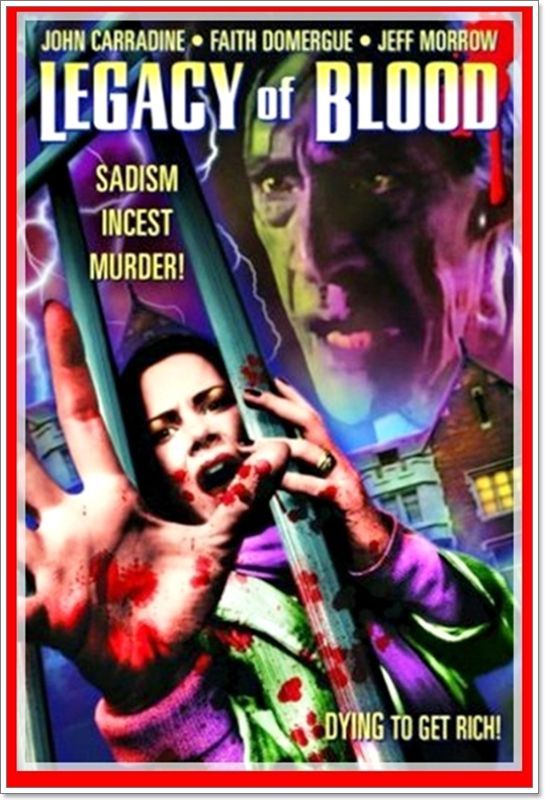
Will to DieBlood LegacyLegacy of Blood?

Whatever you call it, this 1971 film has a plot as old as movies themselves — a patriarch gathers his family to hear his will. Carl Monson, who wrote The Acid Eaters and also directed Please Don’t Eat My Mother was behind this.

This is the last movie for Rodolfo Acosta, who either played Mexicans or Native Americans in Westerns usually. John Carradine is also in this — of course, this movie was made for him — and Richard Davalos (Blind Dick from Cool Hand Luke and the cover image for The Smiths albums “Strangeways, Here We Come” and two of their greatest hits collections), Faith Domergue (Perversion Story), former pro wrestler Buck Kartalian, Jeff Morrow (The Creature Walks Among Us) and John Russell, who replaced James Doogan on the second season of Jason of Star Command.

Yes, the outside of the house is also the same mansion that was used for Wayne Manor. You haven’t gone completely bats yet.

You can watch this on Tubi with riffs from either Elvira or Cinematic Titanic.

MILL CREEK LEGENDS OF HORROR: Shadow of Chinatown (1936)

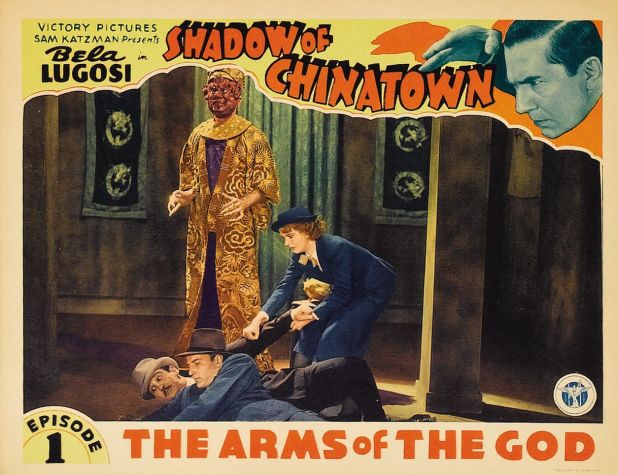
Shadow of Chinatown, a condensed 65-minute version of the 300-minute serial, presents a unique narrative. It delves into the destruction of San Francisco’s Chinatown by Victor Poten (Bela Lugosi) and The Dragon Lady (Luana Walters), hired by white businesses to eliminate the new Chinese businessmen who threaten their profits. This atypical plot, where white individuals are the aggressors against Asians, stands out in a time when the sinister Fu Manchu was the stereotypical villain in most serials.

One of the intriguing aspects of the film is the character of Bela Lugosi, who has the power to influence others. In this movie, he uses his mesmerizing abilities to instill hatred towards the Chinese, a reflection of his own feelings.

This was directed and written by Robert F. Hill, who had 116 directing credits in his career. After World War II, Universal sent him to Japan to open a movie studio, where he warned that the locals would try to attack him if he started an American studio in their country. He needed to get a doctor’s permit to prove his wife needed care back home before Universal would let him give up. The following person Universal sent? The Japanese filmmakers attacked him and used the studio for themselves.

You can watch this on YouTube.