Roger Corman told writer John Sayles just one sentence: He wanted “a female Godfather story about the woman who was with John Dillinger when he was shot.”
The real Lady In Red was Anna Sage, who had come to America from Romania and became a brothel owner. As she faced deportation for her criminal activities, she betrayed public enemy number one, John Dillinger.
On July 22, 1934, Sage, along with Dillinger and his girlfriend Polly Hamilton, went to see the movie Manhattan Melodrama at the Biograph Theater in Chicago. Sage had informed the FBI that she would be wearing a red dress to help identify Dillinger, although she actually wore an orange skirt and white blouse. As they left the theater, federal agents surrounded Dillinger, shooting and killing him in an alley next to the theater. Sage received only half of the promised reward money and was ultimately deported to Romania, despite the promises of the FBI.
Polly (Pamela Sue Martin) is the heroine of this story. She starts out as a simple farm girl who is nearly killed during a bank robbery. If I’m ever in a bank and Mary Woronov busts in, I would let her shoot me and take all my money. Afterward, as Polly is interviewed by reporter Jake Lingle (Robert Hogan), he seduces her. By the time she gets home, her preacher father beats her, sending her on the road to Chicago, where she gets a job at a sweatshop run by Patek (Dick Miller). There, she becomes friends with Rose Shimkus (Laurie Heineman), who is arrested for aborting a baby that Patek fathered. In turn, Polly leads the workers against the man. Looking for work, she finally becomes a taxi dancer, gets arrested for being a sex worker and goes to prison.
There, she finds Rose, and they get a job in the laundry, where they battle a guard named Tiny Alice (Nancy Parsons, who would go on to be Coach Balbricker in Porky’s), who eventually sends her to work in Anna Sage’s (Louise Fletcher) brothel. She’s sold as a virgin and a farmer’s daughter, which means every man wants her, including the reporter, the scarred mobster Frognose (Christopher Lloyd), and the one lone decent man, a gangster named Turk (Robert Forester), who gives her her first orgasm. At the same time, Alice kills Rose and the entire prison riots. As if that isn’t enough sadness, Frognose beats another friend, Satin (Chip Fields), to death.
Along with Pops Geissler (Peter Hobbs) and piano player Eddie (Glenn Withrow), they all work in Anna’s restaurant. Polly starts dating Dillinger, whom Anna recognizes and sells out to Melvin Purvis (Alan Vint). Just like in real life, Polly and Anna go to the movies with Dillinger, who is killed by the FBI as he walks out of the theater. People all walk up to the body and dip things into his blood to sell in the streets.
Polly is devastated by Dillinger’s death, and as if that isn’t bad enough, the reporter who was with her from the beginning writes an article falsely accusing her of betraying Dillinger. Eddie, Pops and Pinetop (Rod Gist) work with her to get revenge, as she evades a hit by Frognose, who is killed by Pinetop. However, as they knock over a mafia bank, everyone is killed but Polly, including Eddie sacrificing himself — but not before finally kissing Polly — and Pops begging Polly to put him out of his misery. Turk returns to kill the reporter, but Polly survives and gets a ride to California.
Sayles said of this film: “I wanted to do more than I knew Roger Corman wanted to do with that script. He basically wanted Bloody Mama Part Three; I wanted to get into other things about the thirties. So I said, “Roger, I will not write you a treatment; I’ll write you a full draft.” And that way I was able to show him things that, if I had just said, “I wanna go into this area, I wanna take her to jail, take her to a sweatshop,” he’d say, “Oh no, that’s beside the point”; whereas when I put it in the script he sort of got to liking the story. So I was able to campaign for the script that I wanted, and get him to agree that he liked that, too.”
It was one of the few scripts he wrote that he wished he had directed. Instead, Lewis Teague was in the chair; he also directed Alligator, Navy SEALs, Cat’s Eye and more. Teague was paid $11,000, but because the film was made non-union, he had to pay his entire salary as a fine to the Director’s Guild.
This movie is so much better than it has any right to be. Quentin Tarantino said: “The John Sayles-scripted, Julie Corman-produced, Lewis Teague-directed 1978 gangster opus The Lady in Red (AKA Touch Me and Die) is my candidate for most ambitious film ever made at Roger Corman’s New World Pictures. Not only do I think this thirties era epic about Polly Franklin (Pamela Sue Martin), the fictional brothel prostitute who inadvertently leads John Dillinger to his death in front of the Biograph Theatre, is Sayles’ best screenplay, I also think it’s the best script ever written for an exploitation movie.” In his novel Once Upon a Time in Hollywood, he directed a 1999 remake of the film in an alternate history.
By the way: Jake Lingle, who is killed at the end of the film, was a real person. Lingle was gunned down in 1930, four years before the setting of this film, shot while tons of people walked by and watched every moment.
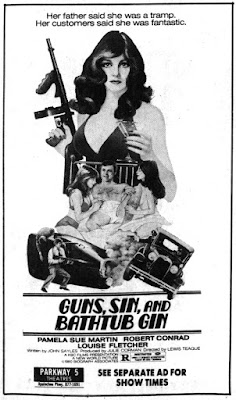
This didn’t do well in theaters. I saw it on HBO many, many times and always loved it, even when I was too young to watch it. Corman re-released it as Guns, Sin and Bathtub Gin, but it still didn’t turn a profit. The title comes from the tagline of The Lady In Red: “She’s made of bullets, sin and bathtub gin.”
At least he got to recycle scenes from this in Big Bad Mama II, which starred the woman he wanted in the lead of this, Angie Dickinson.
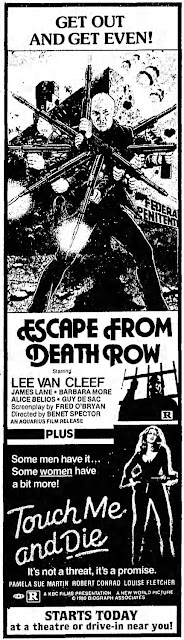
According to Temple of Schlock, it was also released as the title Tarantino referenced, Touch Me and Die: “For some reason, when the film played Chicago — where Dillinger was set up by Sage and killed outside the Biograph Theater on July 22nd, 1934 — New World changed the title to Touch Me and Die and erased all references to Dillinger and the period setting. Even worse, the film was relegated to second feature status under Escape from Death Row (a shady re-release of Mean Frank and Crazy Tont) during its week-long run beginning on July 24th, 1981.”
What makes The Lady in Red stand out among the endless WIP and gangster moll Corman movies is Sayles’ screenplay. Corman wanted a spiritual successor to Bloody Mama; Sayles gave him a Marxist critique of the Great Depression wrapped in a blood-soaked bodice ripper. Unlike most exploitation leads who are born bad, Polly is systematically dismantled by 1930s America.
You can watch this on Tubi.
 B&S About Movies