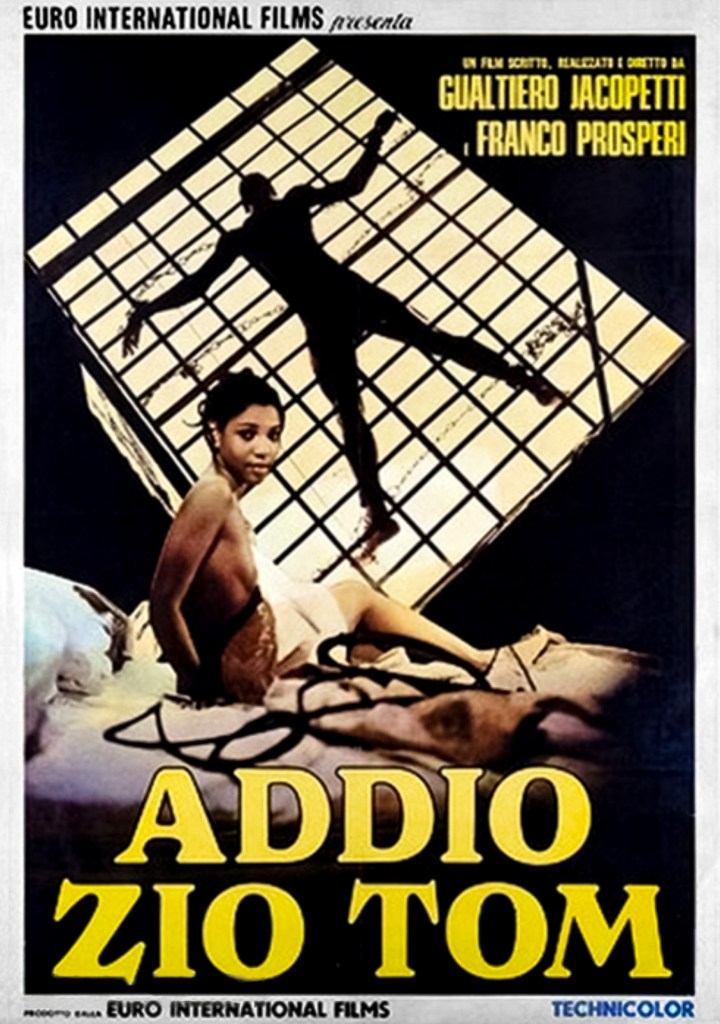
Goodbye Uncle Tom (1971): Five years after Africa Blood and Guts, Gualtiero Jacopetti and Franco Prosperi returned with this movie, which is pretty much one of the roughest films I’ve ever made it through.
This was shot primarily in Haiti, where the directors were the guests of Haitian dictator Papa Doc Duvalier, who gave them diplomatic cars, clearance to film anywhere on the island and as many extras as they required to be used as slaves being treated exactly as slaves were. They were also invited to a nightly dinner with Duvalier himself.
If your mind isn’t already blown, stick around.
Goodbye Uncle Tom is based on true events in which the filmmakers explore America in slavery times, using published documents and materials from the public record to make what they consider a documentary, even claiming to go back in time to achieve this level of realism.
This movie was made in opposition to the claims that Africa Blood and Guts was racist. It didn’t work, as Roger Ebert would say, “They have finally done it: Made the most disgusting, contemptuous insult to decency ever to masquerade as a documentary.” He also stated that “This movie itself humiliates its actors in the way the slaves were humiliated 200 years ago.”
The movie was originally released in Italy in a 119-minute version and was immediately withdrawn. I’ve read that the directors were sued for plagiarism by writer Joseph Chamberlain Furnas. It was then re-released with 17 more minutes of footage.
The director’s cut shows a comparison between the horrors of slavery and the rise of the Black Power Movement, ending with an unidentified black man’s fantasy of living out William Styron’s The Confessions of Nat Turner. In that book, Turned is divinely inspired and given a mission from God to lead a slave uprising and destroy the white race.
This ending upset American distributors so much that they forced Jacopetti and Prosperi to cut more than thirteen minutes of racial politics that would upset their audiences. Pauline Kael still said that the movie was “the most specific and rabid incitement to race war,” a view shared with former Ku Klux Klan leader David Duke, who said that Goodbye Uncle Tom was a Jewish conspiracy to incite blacks on white violence.
This movie is not for everyone. But I feel that it needs to be seen. I rarely get political on this site, but in truth, I feel that we as a country have not done enough to understand the roots of the black experience. While an Italian exploitation film isn’t the best way to learn more, it’s a start.
It’s no accident that Cannibal Holocaust would eventually use the music of Riz Ortolani to juxtapose the horrific images on screen with the beauty of his compositions. The composer had been working with the duo since Mondo Cane, where his song “More” nearly won an Oscar.
But make no mistake that this movie, while intending to be educational and anti-racist, still employs the tools of the mondo and exploitation. How else do you describe the conceit that these filmmakers have gone back in time, taking a helicopter with them that they use to fly away from the terrors of the plantation at the end?
In 2010, Dr. David Pilgrim, the curator of the Jim Crow Museum of Racist Memorabilia, said that when he showed this film to a class, it led to some major traumas. “On the day that we watched Goodbye Uncle Tom three students had unexcused absences, several cried while watching, one almost vomited; most sat, sad and disgusted. I taught for another fifteen years but I never showed that movie again.”
He went on to say that the film “is a more truthful portrayal of the brutality and obscenity of slave life than was Roots; however, I have some major problems with the film. I find it ironic that a movie that explored the exploitation and degradation of Black people was filmed in a way that exploited and degraded Black people. In some ways Goodbye Uncle Tom was just a XXX movie set against the backdrop of slavery; the “peculiar institution” served as an excuse to show sexual and violent gore. Jacopetti and Prosperi told a great many painful truths about slavery but they debased hundreds of Blacks to make the film.”
“I said all of that to say this: Jacopetti and Prosperi were not the messengers that I would have selected, and their implied assumptions about Blacks are troubling, but they made a movie that accurately portrayed the horrors of slavery. Of course, it is the case that a realistic depiction of the savagery of slavery would be difficult to watch no matter who made it. This is why when you finish watching Roots you may feel that a family has overcome great oppression and a nation has become more democratic; whereas when you finish watching Goodbye Uncle Tom you just feel sick to your stomach.”
That says a lot about this movie in a better way than I can, but I’m still going to try to sum it up: this is a well-made movie that may have been made with the best of intentions, but was made by two people who only had the experience to make exactly what they made. It is a movie made about slavery that used slave labor. It is a movie that offended both liberals and conservatives, those that believed in tolerance and those that were racist, those that were black and people who were white. This is a message movie that had its message taken away by American producers, leaving two hours of shock with none of the moral it so desperately needed.
If this movie upsets you, perhaps you needed to be upset. You should be less upset about a movie made nearly fifty years ago and more upset about our nation’s history of racism and intolerance. And you should definitely be upset about the lack of civil rights in our country today, which no matter who is President continually must face challenges.

The Importance of Shocking: Gualtiero Jacopetti (2009): Included with the Goodbye Uncle Tom 4K set, this documentary by Andrea Bettinetti attempts to tell the story behind the man who made Mondo Cane.
Beyond the behind the scenes footage of the mondo films being created, this documentary gets into the journalism career of Jacopetti, which includes a scandal as the paper he worked for, Cronache, published photos so scandalous of Sophia Loren that he earned a one-year jail sentence. What I did not know was how influential his work on newsreels were, which went away from just reporting the news and expanded to cynically comment on events.
According to “Jacopetti’s Sexual Celebrity” by Dalila Missero, “Jacopetti was a famous journalist who was involved in a series of sex scandals, including episodes of paedophilia, prostitution and rape, which had made him a much discussed figure in the Italian media and entertainment system for almost a decade. ” The film does not shy away from this, as it explains how he had to marry a gypsy girl for some time before the marriage was annulled to escape from one of these charges.
This also goes deep into the 1961 car crash that claimed the life of his girlfriend, Belinda Lee, who Jacopetti was buried next a half century later. Beyond having compound fractures, his depression was so deep that American doctors were treating him with a cocktail of drugs that would stun several people.
He’s just as complicated as the films that he made. Hard to defend, yet also someone whose work has merit; if it were simple documentary and not exploitation, it would be celebrated. Yet the mondo genre is born in the gutter, even if it inspired today’s media. I walked away from this still unsure how I felt about Jacopetti, just like how I always feel strange watching his films. Beyond normal sleaze, you feel complicit in them as a viewer, as if you are condoning the ways in which they were made and the moments that they capture.

The Godfathers of Mondo (2003): Directed by David Gregory, this documentary attempts to explain not only the appeal of mondo and the films of Gualtiero Jacopetti and Franco Prosperi, but whether or not they were guilty of war crimes as they filmed their mondo films.
Originally part of Blue Underground’s Mondo Cane Collection, this makes a welcome return on their Goodbye Uncle Tom release. This film may reveal that Carlo Rambaldi was hired to create the burning monk in Mondo Cane 2, yet the subjects are more guarded when having to discuss the atrocities they captured on film. These things, they claim, would still happen if they shot them or not. This is not what unguilty people say.
The strongest part of this film is that Jacopetti and Prosperi were still alive to tell their stories. Shot on their own, they each have a point of view of why they did what they did and how they were intending much of their work to be a condemnation of what they were capturing. Often, the humor and commentary was lost, particularly in America, where these things were edited from their movies. Yet the mondo is based on danger and shocking people, so you have to expect them to be controversial. That said, it seemed like these filmmakers went further every time, all the way to Goodbye Uncle Tom, a movie filmed with slaves of modern times to decry slaves of the past, where Jacopetti and Prosperi take a time traveling helicopter to the American South and reenact the horrors of slavery while wallowing in it.
I wish this had gotten more into Mondo Candido and what the duo did afterward, but this is such a rich document that it’s hard to say anything negative. Just hearing Ortolani talk about these films is something I never thought that I would hear.
The Blue Underground 4K UHD release of Goodbye Uncle Tom has both the Italian and English versions of this movie, as well as the two documentaries discussed above. It also has interviews with Jacopetti, Prosperi and Ortolani, behind the scenes photos and footage, interviews with author Mark Goodall and Professor Matthew J. Smith, the soundtrack to this movie and a collectible booklet with new essay by Dan Madigan. You can get this from MVD.
 B&S About Movies
You must be logged in to post a comment.