In a sleepy town along the coast of California, an unknown animal begins killing people, beginning with a ‘70s version of Dana Carvey. The local sheriff (All My Children’s Philip Carey) recruits local writer John Wetherby (Peter Graves) who used to earn his living as a big game hunter to help track the animal. Baffled by the presence of both four and two-legged tracks, he approaches his shifty ex-hunting buddy Byron (Clint Walker) for assistance who refuses to cooperate. As more people die, the townsfolk begin to believe there’s a werewolf in their midst.
A few weak red herring characters peppered throughout the story aside, Byron is the prime suspect. Not only was he bitten by a wolf, he has a strange obsession with the exchange of power between predator and prey. He hates John’s new “emasculating” life of leisure and possesses a rather creepy yet swaggering demeanor.
Based on the story The Hunter by David Case, Richard Matheson’s teleplay is better than the average TV movie script. On the surface it appears to be a standard whodunnit supernatural mystery. It was only upon further scrutiny I noticed the anti-hunting message and sexual subtext. Both of the protagonists are professional hunters. One becomes civilized and changes careers. The other sticks with it and grows into a psychopath who masks his feelings for another man through hyper-masculinity and violence.
The sexual tension between John and Byron isn’t just palpable. It’s downright steamy. The long knowing gazes, Byron’s unexplained hatred for John’s girlfriend Sandy (Jo Ann Pflug), the passive aggressive references to their time together alone in the Canadian wilderness and the arm-wrestling match where Byron challenges John, to “last seven minutes” are all very obvious references that Byron just can’t quit John. I kept waiting for them to embrace in a passionate kiss and walk off into the sunset together, carrying their very long rifles at waist height.
Alas, this is a ‘70s TV movie, so their past is never fully revealed. Instead, we get a nice double twist where first Byron fakes his death and pins the werewolf murders. After returning to confront him, Byron reveals himself to John, who assumes he was the werewolf all along. Not even close. In fact, it isn’t a werewolf at all that’s been mutilating people. It’s a German Shepherd, tortured and trained to hunt humans by Byron. Why? To awaken John’s “urge to action” and get him to go off to South America with him on another “hunting trip.” It doesn’t work. After a chase reminiscent of The Most Dangerous Game (1932), heterosexuality wins out. John outsmarts Byron and shoots him with a hidden handgun after a nice bit of dialogue where Byron tells his prey, “You wanted me to stalk you.” and John replies, “Let’s just say I didn’t want you to leave.”
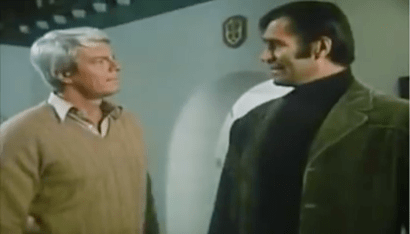
By the time Scream of the Wolf aired, director Dan Curtis was already well-known for working in the horror genre, having made Dark Shadows and The Norliss Tapes. Whether he was aware of the subtext in the teleplay is unclear, but he directs the stalk-attack sequences with his usual skill, and is very unsettling even for a TV movie. As journeymen actors, Graves, Walker, Pflug and Carey are all very good in their respective roles. The musical score is another highlight, with a groovy yet suspenseful theme that’s a combination of Enter the Dragon and Friday the 13th.

While not as well-known as Trilogy of Terror, which arrived the following year, Scream of the Wolf is an overlooked gem that made the rounds on cable about 15 years ago. It’s never been given a proper DVD or Blu-Ray release, but it definitely deserves one. It’s got a good script, plenty of dead bodies, good acting and subtext so subtle it probably flew right over the average ‘70s ABC viewer’s head. Fans of Dan Curtis, or older men arm-wrestling will enjoy it. Did I mention Peter Graves drive a sweet Corvette? The cherry on top.
 B&S About Movies
Reblogged this on womanycom.
LikeLiked by 2 people
Reblogged this on Monsters After Midnight.
LikeLiked by 2 people
Great read for a Great movie.
LikeLiked by 2 people
I sense a similar subtext from Bennett in “Commando.” He seems to want to kill Matrix because he’s not allowed back in Matrix’s unit. He misses the old days of “Matrix and me,” looks forward to fighting Matrix, and speaks admiringly of Matrix to Arius and his men. Also his look is part Freddie Mercury (the hair and the mustache), part clone (the chainmail and leather). Not sure if that’s what the filmmakers intended but in retrospect that’s how it seems coded now.
LikeLike
I actually asked Vernon Wells, who played Bennett, this question.
B&S: I’m sure you’ve heard that both Wez and Bennett are homosexual characters.
Vernon: Yeah, I love that. I was gay in Road Warrior according to half the world and I was gay in bloody Commando too! (laughs)
No, I don’t think Bennett was ever in love with Matrix. I think what he thought was that he was better than him And the only way he could prove that — the whole film was about how he set up everything he could set up — the point for him was who was the tougher man when the two of them finally faced off? Mano y mano, only one could walk away.
Why would I fight him if I was in love with him? I was pissed off. I wasn’t him. I wanted to be the big boy. I wanted to be the big kahuna.
B&S: People find subtext in things even if you didn’t even think of it when you were the one actually acting in the role. They insist that it has to be true.
Vernon: Yes! Everybody insists that the kid on the back of a bike in Road Warrior was my boyfriend. Actually, I rescued him from being killed and he was like my son!
People buy into a theory based on one scene without looking back on what happened before. When I got pissed off that he got the boomerang in his head, well…and he was my son and then he got killed. Why wouldn’t they take it the other way?
LikeLike
That said, I lean toward your theory more than his…
LikeLike