Where do movies take me? My lord, sometimes they take me to auteur projects like this one, by Paul Matthews, all about how a unicorn can fix up people’s lives. Oh David Warner, you deserve better. Joe Penny, too. And man, as much fun as I make of George Hamilton showing up in movies that are horrifyingly bad — Sexette, Evel Knievel and Madusa, I’m looking at you — even he deserves better than this. Man, even Christopher Atkins — The Blue Lagoon anyone? — deserves better!
Polly and her grandfather’s tranquil lives get nutty when her favorite mare dies. Yes, if you’re getting this movie for a kid that loves horses, please know that a horse dies giving birth right off the beginning.
That said, it gives birth to a unicorn that everyone wants to steal. The rest of the film concerns Polly and her friend Toby trying to save it. Want to know how bad this is? Rifftrax hasn’t just taken on one Paul Matthews film. They’ve also taken on The Fairy King of Ar and Berserker, so the guy definitely has an audience. Perhaps not the one he wants, but an audience nonetheless.
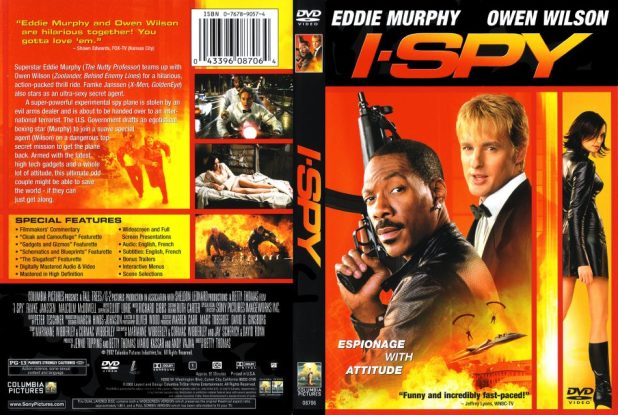
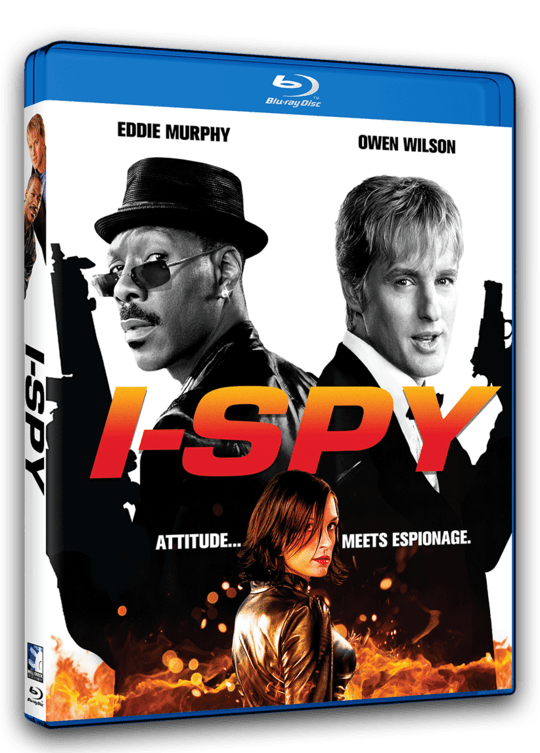
Based on the 1960’s TV series that starred Robert Culp and Bill Cosby, this 2002 remake unites Owen Wilson as Special Agent Alex Scott and Eddie Murphy as boxer Kelly Robinson. Together, they must bring back a stolen spyplane from arms dealer Arnold Gundars (Malcolm McDowell).
Plus, you also get to see Famke Janssen as Special Agent Rachel Wright and well, that’s pretty much worth watching this movie for.
Evil arms dealer Gundars is sponsoring Robinson’s next match and using the event to auction off the stolen plane called the Switchblade. The agency has assigned Robinson as the civilian cover for Scott’s mission to get the plane back. Gary Cole, a long-time favorite of mine, also plays Carlos, the agent that everyone else wants to be.
This was directed by Betty Thomas, who was also behind Only You, The Brady Bunch Movie, Private Parts and 28 Days amongst others. It was written by Cormac and Marianne Wibberley, who wrote The 6th Day, Charlie’s Angels: Full Throttle, Bad Boys II and both National Treasure movies. They were joined by Jay Scherick and David Ronn on the scriptwriting duties. They both worked on the Baywatch theatrical film and Zookeeper.
There’s a cute cameo when Robinson speaks to George W. Bush, as that’s Will Ferrell doing the voice.
I Spy is a strange show to remake, as I don’t know anyone that would be clamoring for a new version of the show. That said, it’s a fun movie and Murphy and Wilson mesh well together.
This has just been re-released by the great people at Mill Creek Entertainment. Check out their new blu ray release right here.
Editor’s Note: This is part of our week-long tribute to the films of Sylvester Stallone. You’ll find links to several more reviews of his films, within. If you don’t see your favorite mentioned, enter the title into the search box to your left; chances are, we reviewed it.
Mention “Sylvester Stallone” in the same breath as “mafia” and your mind dreams up a hitman-action flick in the tradition of The Transporter. You might even flash back to his own F.I.S.T, his first post-Rocky film.
If it was ‘80s Stallone, yes. But this is 21st century Stallone 2.0.
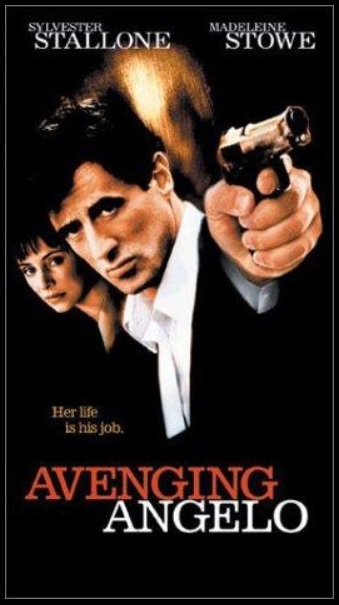
Avenging Angelo is a mafia rom-com in the tradition of Prizzi’s Honor (1985, Jack Nicholson), Married to the Mob (1988, Michelle Pfeiffer), Stallone’s own film, Oscar (1991), and director Billy Wilder’s hit starring Marilyn Monroe and Tony Curtis, Some Like It Hot (1959). Opinions vary on this Stallone-fronted parody of The Godfather and Goodfellas having an analogous chemistry to those earlier mob comedies, but the one absolute truth of the film: Stallone once again shows he’s a skilled actor who deserved to have a breakout hit with one of the dramas, thrillers, and comedies he attempted in the early 2000s.
Avenging Angelo was one of six films released between Cop Land (1997) and Shade (2003) when Sly valiantly—and skillfully—attempted to shed his he-man action image with more insightful and introspective characters. Sadly, all of those attempts failed at the box office and Sly saw his career sliding into direct-to-DVD territory alongside the careers of Bruce Willis, Eric Roberts, and Nicolas Cage (see Precious Cargo, Lone Star Deception, and Arsenal, respectively). So when Avenging Angelo became the second straight-to-video U.S release for Sly after D-Tox, the writing was on the wall: he returned to the action films that made him famous: Rocky Balboa, Rambo, The Expendables, Bullet to the Head, and Escape Plan.
Avenging Angelo, which returned Stallone to his previous action-comedy attempts of Stop! Or My Mom Will Shoot (1992) and Tango & Cash (1989), received a limited theatrical release in Italy and Greece—thanks to it starring Anthony Quinn, who’s highly revered throughout Europe (his career went from an Academy Award for Best Supporting Actor in 1956’s Lust for Life to a Golden Raspberry for Supporting Actor in 1992’s Mobsters). Sadly, Quinn was dying of terminal throat cancer while Avenging Angelo was being filmed—and died before it was released. So when Quinn utters the line “Everybody’s going somewhere” in the film’s initial restaurant scene, it becomes one of the saddest scenes in cinema—on par with Edward G. Robinson’s turn in Soylent Green, in which Robinson hid his terminal bladder cancer during filming and died shortly after the influential apocalyptic flick was completed.
Stallone is the kindhearted (remember, this is a comedy) Frankie Delano who takes offense at being called a bodyguard: he’s a “watcher” who fails in his duties protecting mob boss Angelo Allieghieri (Anthony Quinn) against a hitman named Bruno (Pittsburgh’s (!) Billy Cardell of CBS-TV’s Mike and Molly . . . getting the drop on Sly Stallone? No way, Sly!). Guilt ridden over Angelo’s death, Frankie comes to protect Angelo’s screwball daughter, Jennifer, who now has a contract put out on her by the same people who wanted her father dead. The comedic chase—with a smattering of blood n’ bullets . . . and kisses n’ babies—is on.
And as another example of a film being whatever a distributor wants it to be, the overseas trailer markets Avenging Angelo as a Terence Hill-styled (see 1980’s Super Fuzz) screwball Italian comedy, while the U.S version markets the film—because of Stallone’s presence—as an action film. And speaking of its domestic distribution: DEJ Productions, who saved Stallone’s D-Tox from the Universal vaults, distributed the DVD version in Blockbuster stores, along with additional airings on the Starz and Showtime cable channels (I got my DVD copy from my local library’s annual Book Fair for a buck).
So what is the film, really?
Some have said, because of Madeleine Stowe’s comedic tour-de-force, Avenging Angelo is a chick-flick bordering on the sometimes groan-inducing slapstick (which plays better in Europe than America), more so than a male-appealing action flick, which plays better in America.
How far does the zany and madcap tomfoolery go?
Sly blames a fart on “bloated squirrels suck in the walls” (CLIP) and Madeleine Stowe gets revenge on a mob boss by stripping out of a tight red dress (no nudity, natch) and gives the old dude a heart attack (CLIP), complete with a rising-beeping heart monitor. So, if you liked Stallone’s celluloid nemesis ArnoldSchwarzenegger in Kindergarden Cop, and your mobsters mixed with comedy, then Avenging Angelo is for you. It’s not an award winner . . . and it’s not a Razzie winner, either. Stallone fans won’t feel cheated.
Film geeks, especially budding screenwriters and directors, who supplement their film school studies with DVD commentaries, will enjoy the passionate, entertaining and education commentary track provided by director Martyn Burke, which really gets into the nuts and bolts of the film. Digging even deeper is the unproduced, raw footage vignettes that go behind the scenes of the shoot (Part 1 and Part 2). Yes . . . we are talking about the same Martyn Burke who gave us the abysmal, Canadian early-slasher The Clown Murders (1976) starring John Candy , in addition the Lee Majors post-apoc bomb, The Last Chase.
Considering the studio and producers behind the project lost faith in the film and eschewed a U.S. domestic theatrical release or Euro-theatre plays beyond Greece and Italy, instead selling the film to DEJ Productions for non-theatrical distribution, the DVD is exceptionally well packaged beyond just burning the film to disc and calling it a day, as is the case with most low-budget films dumped into the home video marketplace. If anything, Avenging Angelo is worth watching for Anthony Quinn’s final screen performance.
You can reminisce with Anthony Quinn as he wins The Golden Globes’ 1987 Cecil B. DeMille Award, along with his interview with Jay Leno in 1991 and Johnny Carson in 1983, and Eileen Prose for Good Day!, Boston’s long-running morning show on WCVB-TV.
Editor’s Note: This is part of our week-long tribute to the films of Sylvester Stallone. You’ll find links to several more reviews of his films, within. If you don’t see your favorite mentioned, enter the title into the search box to your left; chances are, we reviewed it.
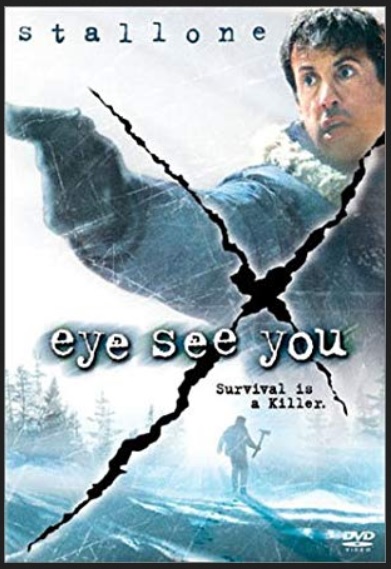
If you had a Blockbuster Video membership during the home video market’s conversion from VHS tapes to DVD discs in the late ‘90s, chances are you saw—and passed over—this psychological-slasher romp starring Sylvester Stallone under its DVD reimaging as Eye See You, distributed exclusively on the nationwide chain’s shelves. If you had an extended cable TV package and channel-surfed the Starz and Showtime cable networks, you also saw the film—and probably passed on it as well. It seems everyone passed on it. I passed on it, eventually watching the film a few years after its release as result of the $1.00 DVD cut out bin at my local Dollar Tree.
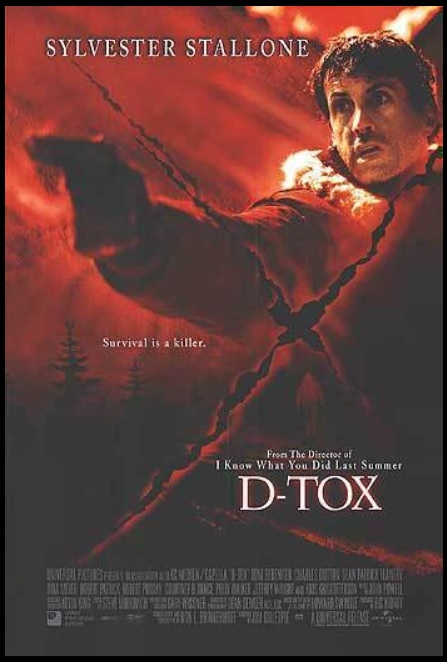
D-Tox is the least known film of the Stallone canons—and it’s completely unknown as part of Ron Howard’s production oeuvre. For me, as with Cobra (1986), the production history behind this failed, joint venture between Universal Pictures and Ron Howard’s Imagine Entertainment is more interesting than the actual film itself. But it’s not as interesting as the off-the rails celluloid madness that is Tango & Cash (1989) . . . now that’s a production tale!
At the time of the newly-founded DEJ Productions acquiring the three years shelved D-Tox from Universal Pictures, DEJ was under the same corporate umbrella as the Viacom-owned (then part of the CBS-TV Network; as of this writing, Viacom and CBS have re-merged) Blockbuster Video, Starz and Showtime networks. DEJ was, in fact, formed by Blockbuster executives for the purpose of acquiring low-budget films for exclusive distribution through Blockbuster Video, so as to take advantage of the home video market’s resurgence via the DVD format. Courtesy of their corporate synergy, DEJ could also sell the films they acquired for exclusive Viacom cable television distribution in the U.S.
However, prior to DEJ acquiring the film, Universal Pictures, in a venture with Paramount Studios under their joint UIP corporate umbrella, unceremonious dumped the film into the overseas’ markets under the title D-Tox, with the hopes the film would find an audience. It ended up grossing less than $7,000 in foreign box office receipts. Ouch.
The film that eventually became known as Eye See You on U.S shores is based on Jitter Joint, an obscure (my local library system doesn’t carry a copy of the book or the DVD) 1999 published-novel written by Dallas Times Herald reporter Howard Swindle. Optioned by Sylvester Stallone with assistance from Ron Howard and Brian Grazer’s Imagine Entertainment for Universal Studios before its publication, the film version—then known under the title Detox—was completed that same year. The end product, shot-on-the-cheap in the economical-advantageous lands of Vancouver, Canada, for $50 million (how much would it have cost if it was shot within U.S borders?), the film failed in its initial test screenings; Universal lost faith in the project and shelved it. As with Stallone’s First Blood using David Morrell’s 1972 novel First Blood and Cobra using Paula Gosling’s 1985 novel Fair Game as its source materials, D-Tox deviates wildly from its source materials and barely resembles the tale of Jeb Quinlan, the Dallas homicide detective in the pages of Jitter Joint solving killings in a rehab center, as this Kirkus book review shows.
A year after the D-Tox overseas failure, Universal authorized a series of rewrites, reshoots, and title changes—there are screener copies of the film that tested as The Outpost in 2000—and it failed, again, in theater test screenings. By that point, with the film’s budget ballooned to $55 million, and with the director and studio still arguing over creative control of the project, Ron Howard stepped in to personally oversee the film in post-production in the hopes of salvaging it. The end result: Universal permanently shelved the film—and it sat in the vaults for three years. Adding insult to injury: Ron Howard had Imagine Entertainment’s name removed from the film, then Universal removed its logos and references from the film. Then, along with DEJ, Blumhouse Productions (Insidious, Happy Death Day, The Purge) hung its production shingle on the film for its unceremonious DVD release. Once you factor in the film’s P&A against its budget, the film hasn’t come close to, and most likely never will, break even.
So how did Sylvester Stallone end up in this mess?
Stallone planned the Jitter Joint project as his follow up to Cop Land (1997), his second attempt to transition out of the boilerplate, action-driven films of his early career and move into more character-driven, insightful works. The film was the first in a three-picture deal between Stallone and Universal in which the studio would pay him $60 million for the three proposed films. When the Jitter Joint–D-Tox project failed and landed on the shelf, Universal pulled out of the deal, gave Stallone his $20 million for services rendered, and set him on his way.
Then, in the wake of the failure of D-Tox in the overseas markets, Stallone’s follow ups of Get Carter (2000) and Driven (2001), both which managed to receive international theatrical distribution, also failed at the box office. The end result was that his next two films—again, character-driven pieces that eschewed his he-man action persona for distraught, tragic heroes—Avenging Angelo (2002) and Shade (2003)—ended up being dumped into the DVD and VOD markets. Nine years after Cop Land, with his valiant six attempts at reinventing his cinematic image deemed a failure (he’s actually very good in all of them), Sly returned with sequels of the films that made him: Rocky Balboa (2006) and Rambo (2008). Then he created his star-studded and action-packed, ‘80s retro-romp The Expendables, which he followed with sequels in 2012 and 2014.
As result of the film’s themes of isolation and its claustrophobic settings, reviews for D-Tox compared the film to Aliens (1986)—with a human killer in lieu of an alien one—crossed with David Fincher’s pseudo-Giallo detective thriller, Seven (1995). As result of D-Tox’s snow-bound setting, other reviewers tipped their hats to John Carpenter’s The Thing. Of course, D-Tox is a murder mystery rather than a sci-fi or action film and, to be honest, doesn’t have any of those film’s unique plot twists or on-the-edge-of-your-seat moments. A more accurate description of D-Tox—courtesy of its murder mystery vibe—is that it plays as out as a graphic version of Agatha Christie’s 1939 novel Ten Little Indians (made into films in 1965, 1974, and 1989). While some critics may disagree, Christie’s novel and John Wood Campbell Jr.’s Who Goes There (1938; source material for The Thing) share a similar master plot—regarding a grouping of paranoid and backbiting protagonists stranded in a remote location perused by an unseen antagonist—and it’s not far removed from the master plotting of David Fincher’s Aliens 3.
Now, if you’re feeling I Know What You Did Last Summer vibe in the frames of D-Tox—where a group of paranoid and backbiting friends are picked off one-by-one by an unseen killer—that’s because Jim Gillespie directed both films. If you’re an older fan of Klaus Kinski (Nosferatu the Vampyre) and a veteran of the video ‘80s, you’ll reference Schizoid (1980), where members of Kinski’s therapy group (without the snowy setting) are murdered by an unknown assailant. Newer film goers might reference Dennis Quaid’s little-seen serial killer romp, Horsemen (2009) with its trouble cop adrift in giallo-inspired, snowy set pieces. Sadly, regardless of its strong giallo-inspired start, D-Tox quickly disintegrates into what many found to be a predictable and pedestrian stalking-slasher pace that, if you removed the gore, you’ll find yourself in an episode of Law and Order: SVU with Olivia Benson being sent to a rehab center and stalked by one of her old collars on a revenge binge.
While D-Tox is not a classic that lends itself to repeat viewings—it has its share of plot gaps, losses of tension, and annoying boilerplate characters doing stupid things (such as looking into door peepholes when a serial killer is on loose and has already killed nine people by drilling out their eyes through door peepholes)—it certainly doesn’t deserve its crushing reviews. Stallone, as he was in Cop Land, is excellent throughout as the alcoholic and failed-suicide attempting F.B.I agent, with his downbeat acting chops matching the film’s mysterious, atmospheric and creepy pace.
Stallone is Jake Malloy, a not-invincible ex-cop who joined the F.B.I as result of his work on a case with a serial killer targeting prostitutes. According to the harassing phone calls made by the serial to authorities to find the bodies, it seems Jack made the serial’s life “difficult” in cleaning up the “prostitution filth” and he cackles: “I see you, but you can’t see me” throughout the film. So, in revenge, the killer changes things up and start targeting cops—and racked up nine kills in six months. Malloy can’t catch him because the serial keeps changing his M.O by picking cops from different precincts with no rhyme or reason. There is, however, one consistent—and very giallo—modus operandi: when he initially claims a victim, the serial rings a victim’s doorbell and, as they look through the door’s peephole, he drills his victim in the eye. Then after drilling out their other eye, he tortures them—he sees them, they can’t see him—and graphically displays their bodies. So, for example, when Malloy’s ex-beat partner ends up with two drill-out sockets, the serial shoves a nightstick down his throat and leaves him swinging in a very Argento-like suspension hogtie from the ceiling for Malloy to see. Then, with the ol’ I’m-calling-you-from-your-house gag, the “Eye Killer” murders Malloy’s just-proposed-to girlfriend—complete with drilled out eye sockets and hanging from the ceiling like a slab of punched up Rocky-meat.
Three months later: Malloy is in an alcoholic tailspin and attempts a slit-wrists suicide with the ol’ if-she-didn’t-meet-me-she’d-still-be-alive, shtick. This leads Malloy’s old F.B.I commander, Chuck Hendricks (Charles Dutton, Aliens 3, natch), to ship him off to a remote rehabilitation clinic “run by ex-police officers for police officers” inside an old Air Force radar outpost that became a military psychiatric hospital before “doctor” Kris Kristofferson bought the abandoned property and turned it into a rehab clinic and named it The Overlook Hotel. Oh, wait, that’s The Shining . . . but let’s cue that freak snowstorm anyway; you know, the one that conveniently downs all the phone lines and strands the ubiquitous, arrogant and paranoid menagerie of double-Y chromosome syndrome-stricken inmates on Fiorina 161 . . . oh, wait, that’s Alien 3 . . . but let’s set loose the unseen killer in the creepy, makeshift military complex anyway; you know, the one that “sees” Malloy’s every move and tracks him to Overlook 161 so, while everyone is detoxing, they start to commit “suicides.” Then Scatman Crothers has a “Shining” moment . . . I mean, Charles Dutton has a “Shining” moment . . . and goes back to the rehab center to see what the hell is going on up there.
At that point, D-Tox degrades into standard chase-action clichés with Malloy running around the underground complex trying to kill the Xenomorph, uh, serial killer, as the bodies pile up (actors Jeffrey Wright, Tom Berenger, Stephen Lang, Robert Prosky, Robert Patrick, Sean Patrick Flanery). It was Malloy’s dispatching crescendo of the killer that was one of the film’s many reshoots; the studio felt the original killing/ending wasn’t a “spectacular enough.” The Eye See You DVD-version of D-Tox includes a bonus vignette package that features eight deleted scenes—but not the original ending. The initial theatrical trailers for D-Tox also include some scenes that were eventually excised from the film’s reimaging as Eye See You.
Regardless of its mix of serial killers and stalk n’ slash plotting missing the John Carpenter Halloween signpost that that it seems the film was going for, if you’re a Stallone fan, you’ll enjoy his work on either version of the film. You can watch the Eye See You trailer from DEJ Productions and the D-Tox trailer from Universal on You Tube—and compare. You can also “see” D-Tox (full movie) on You Tube—with commercials—for free.
All the Italian-made giallo film of the ’60s and ’70s you can handle, with a dive into its literary noir rootsof the ’30s and 40s.
About the Author: You can read the music and film reviews of R.D Francis on Medium and learn more about his work on Facebook. He also writes film reviews for B&S About Movies (the link populates a text-only reference list of his reviews).
M. Night Shyamalan has made some sort of a comeback after years of being a punchline, but at this point in his career, he was still doing pretty well. This is probably his most crowd-pleasing movie, the tale of a minister who has lost his faith rediscovering it in the wake of an alien invasion.
Graham Hess (Mel Gibson) is that man, living with his former baseball player brother Merrill (Joaquin Phoenix), son Morgan (Rory Culkin) and daughter Bo (Abigail Breslin) on a farm in Bucks County, PA. The death of his wife has caused him to disappear from the world, just in time for ominous crop circles to show up all over the world and right in his cornfield.
In addition, animals begin to turn violent and the family is forced to kill one of their dogs when it turns violent. Then, tall dark figures begin to chase them, similar to a harrowing report of aliens showing up at a child’s birthday party in Mexico City. This scene, shot by M. Night with a cam corder, rank as the best he’s put on the screen.
The family barricades themselves in the house, battling an alien that looks to kill them all. Who knew that the glasses of water that Bo leaves all over house would be used — along with a baseball bat — to destroy that invader? And who could guess that these aliens, who were smart enough to make it to our planet, could be defeated with water? It’s a little too easy, if you ask me.
That said, this movie is filled with suspense. It’s one of my wife Becca’s favorites because as a child, she would often leave drinks all over the house and used this movie as a defense for acting that way.
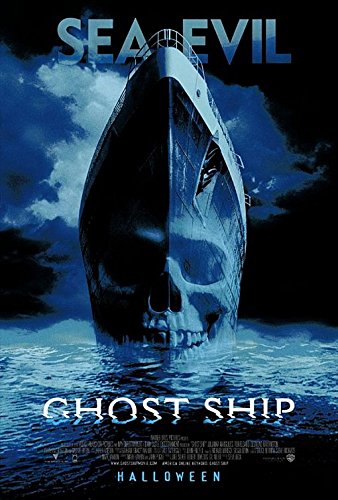
Steve Beck came from ILM — where he did effects on The Abyss, Indiana Jones and the Last Crusade and The Hunt for Red October — before he directed 2001’s Thir13en Ghosts. The follow-up, Ghost Ship, starts with one of the most audacious openings I’ve ever seen in a horror film.
That first scene, set in May of 1962 aboard the Italian ocean liner SS Antonia Graza, features a crowd of wealthy passengers dancing to Francesca singing “Senza Fine.” Katie Harwood, a young girl, is all alone until the ship’s captain offers to dance with her. Just then, a hand unleashes hell: a spool of wire snaps across the dance floor, slicing every single person in half except for Katie, whose height spares her.
Fast forward forty years and the crew of the Arctic Warrior — Captain Sean Murphy (Gabriel Byrne), Maureen Epps (Julianna Margulies), Greer (Isaiah Washington), Munder (Karl Urban), Santos and Dodge — join a Canadian pilot to salvage what’s left of the Antonia Graza.
One by one, a series of supernatural events wipe the crew out, slasher movie style. This is a movie unafraid to wipe characters out left and right, leaving behind chunks of them in its wake. Seriously. Don’t get attached to anyone.
The real tale is that one of these characters is a salvager of souls, a job earned thanks to a lifetime of sin. The gold on board the Antonia Graza is just a trap to collect more and more souls, keeping it afloat until enough souls are collected and management is happy.
Ghost Ship started as Chimera, a spec script by Mark Hanlon, which was a bloodless psychological thriller with nothing supernatural or all that gory in it. A crew of four scavengers goes mad and each one plots to kill the other three. Yet by the time the film hit the big screen, the script had already undergone extensive rewrites. The actors and crew didn’t know that, having signed on for one movie and ending up in a slasher, thanks to those aforementioned radical changes by Joel Silver and his associates.
That said — Photon FX did a great job here. They had a lot of pride on the line, as this was the largest FX shoot in Australia to date. So they went overboard and the results still hold up 17 years later, as both the open and close feature incredible visuals.
This was the first Dark Castle Entertainment horror film released based on an original concept, as the company was originally intended to only remake William Castle films.
I’ve been thinking about that song “Hobo Humpin’ Slobo Babe” by Whale a lot. The song is pretty crazy, best described as a dancy punky ditty about, well, who the fuck knows what it’s about. The video is even stranger, highlighted by lead singer Cia Berg cavorting about with red frizzy hair and braces. The whole album is pretty decent, with Tricky producing a lot of it.
I’m telling you that so I can tell you that the video for the song won the first MTV Europe award for Best Video. And it’s director, Mark Pellington, was the person who helped create today’s film (he also directed the video for Pearl Jam’s “Jeremy” and the movie Arlington Road).
As a Pittsburgher, this movie is somewhat important, as it was filmed here and in nearby Kittanning, PA. Which is somewhat humorous, as Point Pleasant, WV isn’t far at all. They could have just filmed it there. There’s a mothman statue, after all.
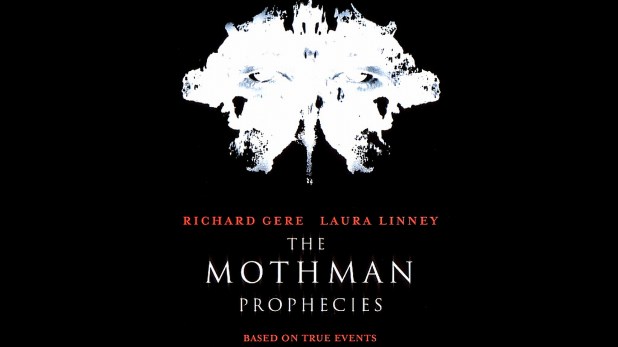
A lot of the script was changed, as this movie is based on the work of John Keel, the paranormal researcher who wrote the book The Mothman Prophecies. Pellington rejected numerous screenplays that were literal takes on Keel’s work, instead wanting to explore the psychological damage that UFO witnesses endure. In the book, Keel went into deepest, darkest West Virginia to interview folks who had seen the huge winged beast called the mothman. At the same time, he began receiving strange phone calls, reports of mutilated pets, visits from men in black (in fact, Keel coined the term!) and it all ends with the collapse of the Silver Bridge across the Ohio River.
Whereas the movie posits that the collapse was never solved, experts determined that an eye-bar in the suspension chain caused its failure. And in reality, 46 people died, not 36.
The movie is therefore fictionalized, sharing the story of Washington Post columnist John Klein (Richard Gere) and his wife Mary (Debra Messing) being involved in a car wreck that leads to her dying of a brain tumor. Before she passes, he finds a notebook filled with pictures of a strange beast.
Between time distortions and loops, strange phone calls, visitations from his dead wife and premonitions, this film does a good job of conveying the terror and confusion that the paranormal can unleash.
My theory has always been that nuclear waste near Point Pleasant unleashed holes in the time/space continuum and the mothman, a fifth-dimensional creature, was unleashed on our 3D space — bringing weirdness in its wake.
There’s a great shot at the end of this film, where the cars drift to the bottom of the river and holiday gifts float and headlights stretch out into nothing. It’s probably the eeriest scene I’ve seen in awhile. According to IMDB, Gene Warren III and five other model-makers, plus two production assistants, spent three full months to fabricate every piece of the bridge set from scratch. He estimates 20,000 individual pieces of steel went into the construction, in order for the ultra-photo-realistic 1/6th scale model suspension bridge to support all the model vehicles and ultimately collapse like a full-scale steel bridge into the water. It really shows — this practical effect looks perfect.
I usually don’t enjoy big budget films, much less ones that take so many liberties with their source material, but this one always wins me over. It’s worth a watch.




 B&S About Movies
You must be logged in to post a comment.