The Legacy (1978)

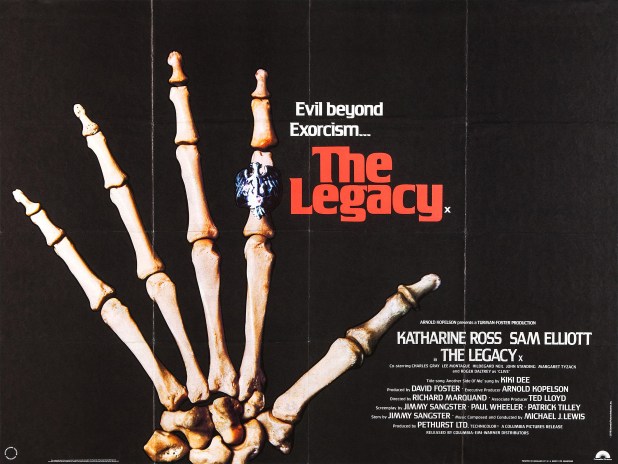
The rich. The powerful. The satanic. And a white cat. Yes, The Legacy really has it all. As Bill Van Ryn of Groovy Doom says, “It’s Suspiria and The Omen in a blender.”

Maggie Walsh (Katherine Ross, The Stepford Wiveand The Swarm) and Pete Danner (a really young Sam Elliott, Mask and The Big Lebowski) get a strange call for their interior decorating business. They are to go to England for an anonymous client, but they have misgivings about leaving Los Angeles. Those go away when the client dies, leaving behind pre-paid airfare.

They’re in England for all of a spot of tea when they are almost killed by a limousine carrying Jason Mountolive, who takes them to his gigantic home called Ravenhurst.

I love this description of the people Maggie and Pete meet at Ravenhurst — “A millionaire, a million-dollar prostitute, a star-maker, a nation-killer, a woman whose lusts are as cold as graveyard snow.” They’re all the beneficiaries of his estate, there to decide who will get what when the old man dies.

Maggie is shocked, because as far as she knows, Mountolive was just alive. Everyone is summoned to his bedroom, filled with sterile walls and a life support system. You can’t see the old man any longer — but a gnarled hand reaches out and gives Maggie the Mountolive ring — one she can’t take off and one everyone else is already wearing.

All manner of accidents and deaths befall the cast members. Pete is nearly killed by a scalding shower (and if you like Sam Elliot, your pulse will be inflamed by this scene). Maria, a swimmer, drowns. Clive (Roger Daltry from The Who), a music mogul, dies from a combination of choking and a gory tracheotomy. Karl (Charles Gray, Diamonds Are Forever, The Rocky Horror Picture Show, The Devil Rides Out) dies in an awesome scene when a spark from a fireplace ignites him, sending him curled up and burnt black. Barbara is killed by an exploding mirror. And Jacques tries to kill Maggie and Pete, thinking they are behind it all, but his gun blows up in his face and he falls to his death.

A series of clippings reveals that each of the guests had been implicated in a scandal or crime, but Mountolive saved them. He comes from a long line of devil worshippers. In fact, his parents were burned at the stake!

Maggie is Mountolive’s great-granddaughter, so she meets with the dying man, who reveals that he killed the others as a sacrifice to Satan so that she can get his powers. Then, she will have six heirs when her time is up. Pete tries to stop her, but it is too late. The staff have all bowed to her and she is now the new owner of Ravenhurst and all of the powers that come with it.

She gives Pete a ring that bonds itself to his finger as her first heir and tells him that it’s time to do anything she wants.

Director Richard Marquand (Return of the Jedi) alternates here between breezy romance, ala Hart to Hart, and gory spectacle. It’s a strange blend but it’s rather enjoyable.

Plus, it has an opening song, “Another Side of Me” (performed by Kiki Dee) that is so late 70’s, it should give you cocaine while you listen to it.

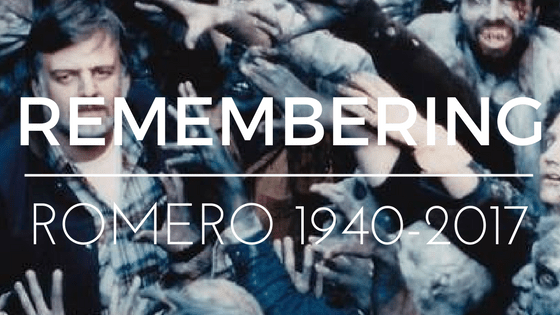
GEORGE ROMERO TRIBUTE: Martin (1978)

In the five years between The Crazies and Martin, much had changed, both in the life of George Romero and his adopted hometown of Pittsburgh.

After the post-World War II economic boom, an outdated manufacturing base — that had already been overextended for the past two decades — was further taxed by hostile relationships between management and labor. And Pittsburgh had even worse issues than the rest of the country, as the raw coke and iron ore materials to create steel were depleted, raising costs. The giant Pittsburgh mills also faced competition from non-union mills with lower labor costs.

As a result, layoffs began happening throughout the region. For example, Youngstown, OH — about an hour and a little more from the Steel City — never recovered from the Black Monday of September 19, 1977 and the closing of Youngstown Sheet and Tube.

According to a 2012 story in the Pittsburgh Post-Gazette, by January 1983, the regional economy officially bottomed out. Unemployment in Allegheny County (where most of the Pittsburgh metro calls home) hit between 14 and 18% with 212,000 jobless individuals. It’s never been that high before or since. And in areas like Beaver County (close to where your author grew up and also where my grandfather worked in the furnaces for forty years), home to industry giants Jones & Laughlin Steel Corp. and Babcock & Wilcox Co., the unemployment hit a staggering 27%. That’s higher than the Great Depression. And for many of the 300,000 manufacturing workers impacted by these changes — before this, you went to high school, you worked in the mill, you had kids, you died — Pittsburgh was dying.

George Romero found himself in similar straits. He was nearly a million dollars in debt thanks to the failure of every film after Night of the Living Dead. He’d taken to working on sports documentaries like his Pittsburgh-centric series The Winners and even directed The Juice is Loose, the story of football hero OJ Simpson — albeit years before his reversal in fortune — and Magic at the Roxy, a TV magic special. He confided in producer Richard P. Rubinstein that he was nearly out of cash. While the producer counseled Romero and explained that bankruptcy was an option, Romero didn’t want to screw over the people who helped him make his films. This action gave Rubinstein plenty of respect for the director and led to their partnership. While this, their first film together, didn’t pay back those investors, Dawn of the Dead would.

Deciding on Braddock — one of the hardest hit mill towns — and utilizing family and friends, Romero started to film what he would later call his favorite film.

In the film’s first script, Martin was an older man who is definitely a vampire, struggling to live (unlive?) in the modern world. But after seeing John Amplas in a Pittsburgh Playhouse production of Philemon, Romero rewrote the film to make Martin younger and more innocent.

Martin’s family has all died in Indianapolis, so he’s on his way to Pittsburgh — but not before shooting a woman up full of drugs and drinking her blood. He’s met at the train station by his uncle, Tateh Cuda, and taken to his new home. Even today, Braddock is one of the most run-down sections of Pittsburgh — the decay evident in the movie got a lot worse before John Fetterman was elected and numerous civic campaigns have brought new business in. That said — it’s still a great setting for a horror film.

Cuda and his niece Christine share a home and have allowed Martin to stay. The old man gives Martin several rules, including one that if ever kills anyone in Braddock, he’ll stake him through the heart. He keeps crucifixes and garlic all over the house, continually telling Martin that first, he’ll save his soul, and then, kill him. Martin yells at Cuda, showing him that he can touch the crucifixes and eat the garlic and bitterly exclaims, “There’s no real magic…ever.”

This is in direct contrast to Martin’s fantasies, shot in black and white (there’s supposedly a 2 hour and 45 minute cut of this film that’s only in black and white) like a romantic vampire movie, where women willingly give up their throats to him. The truth — he barely defeats the women in battle, needs drugs to sedate them and with no fangs, he must use a razor blade to kill them.

Despite Cuda’s continual threat’s of death, he hires Martin to work in his butcher shop as a delivery man. This allows him to meet several women, including Mrs. Santini, who tries to seduce him. Unlike his dreams of control over these women, he can’t even control his own feelings and runs away.

Pittsburgh has always been a talk radio town — local powerhouse KDKA boasts a 50,000 watt antenna that can be heard throughout most of the continental US in the evening — and Martin takes advantage of this, calling a local DJ (Michael Gornick, director of Creepshow 2) to try and figure out life. He becomes known as “The Count” and is one more lonely voice seeking comfort until the sun comes up — again, in marked contrast to the way vampires traditionally fear daytime. The DJ segments hit close to home — I was a long-time listener (1989-2005) of Bob Logue’s Undercover Club. Pittsburgh has a long history — as stated above — of radio shows like Party Line. We’re slow to give up on technology, so AM radio still remains strong here.

Martin tries to keep his thirst under control, but finally sneaks out to the big city — Pittsburgh is very much a bridge and tunnel town where folks stay within one of the ninety small neighborhoods that make up the overall town — and attacks a woman he’d seen at Cuda’s market. But she isn’t alone — she already has an extramarital lover over — and Martin barely overcomes them both before he drugs and rapes the woman. Martin gives in to another hunger after this — a yearning for sex based on love — that he finds with Mrs. Santini.

Meanwhile, Christine, Martin’s sole advocate in the home, finally gives up on living with the ultra religious Cuda and leaves, despite her unfulfilling relationship with her boyfriend (played by an incredibly young Tom Savini). She is slapped across the face by Cuda and shocks him by not registering the blow, instead telling that his time is over and that she doesn’t care what he or the church says.

Martin loses control once he realizes that Christine won’t come back, so he goes into the city and attacks two homeless men, but is almost killed in a battle between the police and drug dealers. He returns to Mrs. Santini’s house to try and escape with her, but she has already killed herself.

In a quick, shocking scene, Cuda dispatches Martin — who he blames for Mrs. Santini’s death — with a stake. During the credits, Cuda buries him as radio callers ask what happened to The Count. The answer? He’s freshly buried, with a crucifix over his grave.

Martin is not only Romero’s most personal films, but it’s also one of his most technically polished. The scenes where the talk radio dialogue plays against Martin’s actions allow for exposition without sacrificing pace. And the black and white versus color sequences — particularly the exorcism scene — play out as a grisly counter to the expected Wizard of Oz dichotomy.

Most strikingly, Martin presents a sympathetic hero versus a snarling monster. The true vampires in the film are the city of Pittsburgh itself, losing the vital blood of young men that once were pumped through its mills and mines and now would go elsewhere, abandoning the city for jobs and lives elsewhere. It would not be until the early 2000s that the city would rise, more phoenix than vampire, and become the tech and gourmet destination that it is today. To go from the Braddock of 1978 to a five-time most livable city in the country has been quite the journey.

The second — and perhaps main — monster of the tale is Tateh Cuda. Whereas we have been traditionally taught to see Dracula as the villain and Van Helsing as the hero, this is a man who will not break from the ways of old, the days when the word of men and church stood above all. He is not to be defied — and when he is and his manhood is decimated by Christine’s departure and final words — all he can do is reassert said manhood in the most phallic way possible: a wooden stake through the heart of the other child he has lost. More than Martin — who questions if he truly is a vampire or not and if he can escape the family cruse — Cuda is trapped in his ways and will never leave them.

When faced with the change of guard at his church, Cuda cannot understand why so many are abandoning not only their faith but the city itself.  When faced with the retirement of a priest he has known his whole life, he yells at Father Howard (Romero, in a small role) “Retired? Huh! Father Carelli is younger than I am. He asked to leave. He left like the rest of them. He thinks this town is finished!” Then, he learns that Carelli left only because cancer has taken him. Father Howard stands in contrast to the pre-Vatican 2 Catholic faith, a new style priest who laughs at The Exorcist without realizing that to someone like Cuda, those rites are very real.

Note: Lincoln Maazel, father of well-known orchestra conductor Lorin Maazel, played Tateh Cuda and lived to be 106 years old — he was already 75 when Martin was filmed.

Martin is not often said in the same breath as Romero’s zombie films and that’s a shame. It remains my favorite of his works, as there are so many ways to analyze the film. It’s not light watching or escapism, but the questions that it poses will stay with you long past the end of the film.

PS – Martin is not an easy film to find. I was satisfied knowing that I could get it at the Carnegie Library until I found my copy at VHSPS.com (sadly, it’s no longer available on their online store, so I’m glad I got my copy).

Sgt. Pepper’s Lonely Heart’s Club Band (1978)

Often one goes into a bad movie asking — to borrow the name of a highly entertaining podcast — how did this get made? Or worse, you have to stop and ask yourself, in the case of a film that ends up offending both target audiences, such as 1972s The Pink Angels, who exactly is this movie being made for?

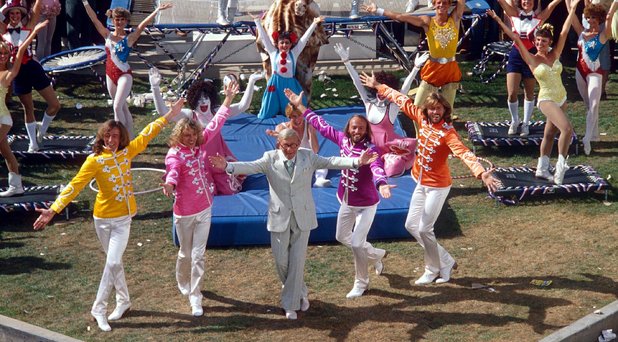
Let me reiterate: In 1978, a movie version of Sgt. Pepper’s Lonely Heart Band — starring the Bee Gees and Peter Frampton — probably made all the sense in the world.

The Brothers Gibb had just come off Saturday Night Fever (1977), a movie that transcended the screen and spawned a movement. Or at least a fad. But between that and Barry Gibb producing Grease’s title song (and I just want to throw in that the Bee Gee’s also wrote and arranged 1979’s Dolly Parton/Kenny Rogers opus, “Islands in the Stream”), the boys from Manchester via the Isle of Man were on the top of the world. It truly does not get any higher a mountain and the fall, we’ll soon see, does not get any further.

Peter Frampton — after a journeyman career of playing in bands and being seen as a viable solo artist — had finally scored big with Frampton Comes Alive! in 1976. The album spent 97 weeks on the charts, selling 8 million copies. That number today is well nigh impossible to reach today; it equals around 13% of the overall records sold in 2016.

So this ersatz Fab Four — if you will or won’t — had star power, at least on vinyl. The Bee Gees had also covered the Beatles for a BBC doc in 1976, despite years of critical derision that they were simply clones of the boys from Liverpool.

Stars were aligning. Even better, Saturday Night Fever and Grease came out on Robert Stigwood’s RSO Label. Stigwood purchased 29 of the Beatles’ best songs for use in a Broadway play and then had the brainstorm to create a film, using the aforementioned big music stars. He got Beatles’ producer George Martin and Abbey Road Studios on board. And even worked with Paramount — the same studio who launched Saturday Night Fever — to get the movie greenlit. Add in what I editorialize was the kind of cocaine mountain that only the ’70s and Martin Scorsese could concoct and…ladies and germs, we got ourselves a motion picture!

So up until now, until that first shot of the film, this all makes sense. It’s when reality allows its ugly head to intrude that we see just what an epic failure of a movie this is. Writer Henry Edwards had never written a script before. And oh, does it show.

Whereas the Beach Boys’ Pet Sounds directly influenced and made the audio Sgt. Peppers an aural feat, there was no such film to inspire this outing. In fact, there isn’t even a story, unlike the Who’s Tommy. So to get across the tale — such as it is — George Burns would be the only person to speak (he’s the Mr. Kite, he of whom the song For the Benefit of… is about) with every other bit of dialogue being sung.

That’s right, kids! It’s the hip sound of today, as frogingly croaked out by the star of Oh God! Meanwhile, the Bees Gees play Mark, David and Bob Henderson. Why those names? Don’t ask! And in the starring role, Peter Frampton is Billy Shears (and not the man who took the place of the headless Paul McCartney if you believe in urban legends)!

At some point in the proceedings, my sainted wife asked if we could shut the movie off. I maniacally cackled in her face and began laughing so hard that my sides began to hurt. I had been overtaken by the delirium of this paean to excess. To wit:

Every single frame is as loud and garish as possible (and not in an Alejandro Jodorowsky way). Yes, Michael Schultz, the famed director of the Fat Boys’ Disorderlies (1987), Car Wash (1976) and The Last Dragon (1985) made this movie with all the technical brilliance of your father with a Super 8 at the theme park.

Each song replaces the beloved guitar, bass and sitar of the Beatles with a synthesizer that only plays human farts.

Every song that you adored will be personified by singers and/or actors you will grow to despise. Did you love Maxwell, of “Maxwell’s Silver Hammer” fame? Then you’re going to hate Steve Martin as the dentist version of him! Yes, years before Little Shop of Horrors (1986) and at the height of his stand-up fame, even Steve Martin is rendered unloveable by this fecund monstrosity of a film. Donald Pleasence is a music exec that sings poorly! They took Alice Cooper out of the asylum where he would fitfully write Welcome to My Nightmare (1975) and had him appear as the Sun King. Nobody you love is unscathed, save Aerosmith, who play the evil Future Villain Brand. A footnote here: The Bee Gees were to defeat Aerosmith in unarmed combat in the film, leading Joe Perry to walk off the set until cooler heads prevail. They are killed by the female Strawberry Fields instead, which I guess is some sort of compromise.

The Bee Gees and Frampton’s acting ability and chemistry make Rex Reed in Myra Breckenridge and Mariah Carey in Glitter (2001) look like Mercury Theater cast members. They mostly look emaciated, as if they were denied trips to craft services unless they got it finally right this take.

By the merciful end, when a deus ex machina Billy Preston shows up to play the horn — saving the day — after Barry Gibbs decimates Golden Slumbers, you’ll hate England, poofy hair, chest hair, motion pictures, actors, actresses and even your trusty DVD player. If this movie is your introduction to the Beatles, you will hate them, popular music and all music, when you come to think of it.

But wait — there’s more! The last scene of the movie builds the album cover of “Sgt. Pepper”, but instead of Buddha and Aleister Crowley showing up, the most famous stars of the late 1970s were all invited, offered free travel and the most elite of accommodations. And who exactly showed up? Big stars, that’s who! Carol Channing! Peter Allen – first wife of Liza, not Lily’s dad! Keith Carradine! Nils Lofgren! Legendary fifth Beatle (when you don’t count the aforementioned Billy Preston) Cousin Brucie! Sha-Na-Na! Pre-Thunderdome Tina Turner! The co-creator of Captain America, Joe Simon! Bocephus! Wolfman Jack! Obviously, the stars did not shine so brightly that day on the Culver City backlot of MGM Studios.

The reviews — and box office for this film — were not kind. I first witnessed it at 3 AM on a Saturday night in 1980. I was 8 years old, so I figured that this movie would age like a fine wine. However, it has aged like a bad piece of steak, left out in the cold and rained on for over 30 years.

Look — you know you’ve got a turkey when Marvel Comics cancels their adaption, George Perez artwork and all. But I still say, you should totally watch this movie. After all this pain it put me through, I need a support group. And this is the only way I’m going to get new members.

This article originally appeared on That’s Not Current. You may read the original article at http://www.thatsnotcurrent.com/movie-review-sgt-peppers-lonely-hearts-club-band-1978/

Be sure to join us for our three part “The Beatles: Influence on Film” series as we look at Sgt. Pepper and 33 other films dealing with the legacy of the Beatles.