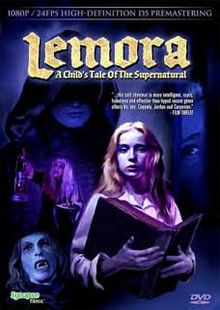
Lemora (1975)

Alvin Lee catches his wife in bed with a lover, breaks in and shoots both of them dead. Later, injured and near death, he begs for his daughter to see him one more time before he dies.

His daughter, 13-year-old Lila Lee (Cheryl Smith, Phantom of the ParadiseThe Incredible Melting ManLaserblast and short time member of The Runaways and drummer for Joan Jett) is the star of the church, where her voice and beauty draw attention — thanks to the peculiar beauty people from her hometown have, which is known as the “Astaroth Look” (inspired by the “Innsmouth look” from H.P. Lovecraft’s The Shadow over Innsmouth).

The Reverend (director Richard Blackburn, who co-wrote and appears in Eating Raoul, as well as appearing as the voice of Dr. Zaius in the Return to the Planet of the Apes cartoon and Stunt Rock) demands that his congregation stop talking about how her father is a gangster. She now belongs to the church and they know how to look after her. Interestingly, that church is on a soundstage that was once Mayberry for TV’s Andy Griffith Show.

That said — the letter leads her to find the town of Astaroth, despite dealing with a young couple who discuss how the Reverend obviously wants to have sex with her, a ticket taker offering her strange candy and a broken down bus ride that ends with a vampire attack.

Lemora is saved by Lila, the queen of the vampires, who is the one who wrote to her. She takes her to her ancient stone house and gives her a new dress. Sitting with he children, Lemora serves her wine — nah, its blood — and asks Lila to sing for the children. Lemora spins her in a dance, asking her to give her body to the music, before throwing her to the floor as a crash echoes through the house. Lemora then bathes her while asking her about her body and all of the boys that have to be after her.

Lila goes to her room and her father, now a vampire, attacks her. Lemora explains that over the last year that many of the people have become ugly and beast-like, therefore they need to be killed. Lemora sucks the vampire blood out of the wound Lila has, then reads her a bedtime story and brushes her hair.

Tomorrow, there will be a blood ceremony, which will make Lila and Lemora sisters, letting them share in power. “Will it be in a church? Baptist?” asks Lila. “No, more ancient,” answers Lemora.

As Lila explores the house, she finds the diary of a girl who was in her shoes in the past. Turns out that Lemora is the queen of the vampires, feeding on her adopted children. So Lila escapes through the town, just as the Reverend comes to save her.

The Reverend comes to save her, but not before a battle where most of the vampires are killed. As Lila’s father has become one of the monsters, she must kill him. Lila mourns, which leads to Lemora offering her a vampire’s kiss.

When the Reverend finally arrives, Lila reaches out to him, wanting to embrace and kiss him, something that he had resisted in the past. Now, she overcomes him and as they embrace, she bites into his neck as Lemora watches. We cut to Lila singing in church as the movie ends.

I’d compare this film — subtitled “A Child’s Tale of the Supernatural” with Valerie and Her Week of Wonders. It’s richly dark, both in lighting and subject matter. It feels more like a dream or a children’s fable than a movie and is worth multiple viewings. It’s such a shame that this movie has been lost and forgotten for so long!

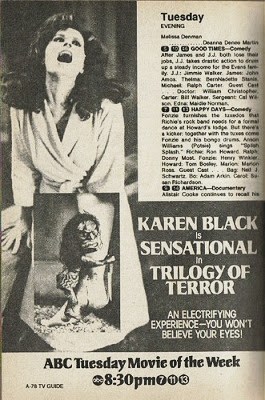
WEEK OF MADE FOR TV MOVIES: Trilogy of Terror (1975)

Dan Curtis and Richard Matheson pretty much ruled 1970s made for TV horror. But when you throw in Karen Black and a memorable miniature villain, you’re left with pure nightmare fuel for 70s kids. Sure, we can endure all sorts of gore and doom now, but on March 4, 1974, the ABC Movie of the Week was about to give you all sorts of bad dreams.

STORY 1: Julie

Chad (Robert Burton, then-husband of the delicious Ms. Black) has it bad for his English teacher, Julie Eldrich (hey, Karen Black is in this, did I mention that?). So much so that just the glimpse of her thigh can make him totally forget all about class and fill his mind with daydreams. His friends don’t get it — his buddy Eddie says she’s ugly. But that won’t stop Chad, who watches Julie undress through her window before he asks her out to the drive-in.

But Chad’s a creep. Instead of just being happy about getting her to go out with him, he roofies her at the drive-in (The Night Stalker is playing, as an easter egg for Dan Curtis fans), checks into a motel and takes all manner of sexually provocative photos of her. Yep. This is a TV movie playing during prime time — the 70s were fucking nuts.

Chad gets what he wants — a blackmailed Julie who will do whatever he wants. Until a few weeks later, she announces that the game is over. Julie’s been a power bottom all along, setting the whole thing up.  “Did you really think that dull, little mind of yours could possibly have conceived any of the rather dramatic experiences we’ve shared? Why do you think you suddenly had the overwhelming desire to see what I looked like under ‘all those clothes?’ Don’t feel bad… I always get bored after a while,” she says before poisoning him and setting his darkroom on fire. She adds his obituary to a scrapbook but there’s no time to rest. Another suitor has already shown up…

STORY 2: Millicent and Therese

Millicent is a brunette prude. Therese is a blonde minx. They’re sisters — both played by Karen Black — and it’ll take you all of ten minutes to figure out the truth. This is a common portmanteau trope, but be patient. This film is about to get awesome.

STORY 3: Amelia

This is a tour de force for Black, who is all alone for the entire story, playing Amelia. Cursed with a mother who questions everything she does and hunted by a Zuni warrior trapped inside a doll, she owns the screen. You may question — well how scary is a little tribal warrior doll going to be? You’ve obviously never seen this. From stabbing Black in the ankles to surviving all manner of damage — even being burned alive in the oven — the Zuni doll is the image that dominates this film and is what most remember it for. The twist ending — back before the “what a twist!” M. Night Shyamalan-style ending got stale — is a great payoff.

Black added a lot of herself to the final story, rewriting much of her dialogue. Sadly, she ended up feeling Trilogy of Terror typecast her for the rest of her career. She never intended to be known as a horror actress. I guess that’s a shame, but she really excelled in every role in every fright fest she appeared in.

Curtis made a new Trilogy of Terror in 1996, even bringing back the Zuni doll. I’ve never seen it — something that I feel I should remedy soon. If you haven’t seen this yet, please stop reading B & S About Movies and come back once you’ve done your homework. Thank you!

UPDATE: You can get the Kino Lober blu ray of this at Diabolik DVD.

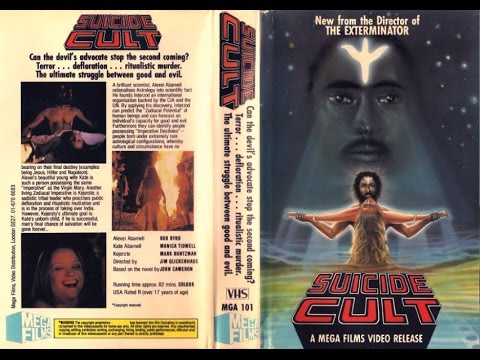
Suicide Cult (1975)

Whenever someone asks — and they often do — “What’s the craziest movie you’ve ever seen?” I usually respond with Suicide Cult. I’ve never had to pick my jaw off the floor more, as watching it felt like the little people I am certain live in my TV were putting on a magical play just for me, using the things I love best. The 1970s. Carnivals. Satanism. Biorhythms. Astrology. Government conspiracies. Religion . This is one film that honestly has it all — and then some.

Man, let me see if I can sum it up:

A government organization called INTERZOD, led by Alexei Abernal, uses technology and astrology to discover threats to the world. One of them is the cult leader Kajerste, who is wanted for crimes in three different countries. And how do they find these people? By determining  their individual zodiacal potential for response to environmental situations and stimuli, that’s how.

The movie smash cuts into a ton of locations and ideas within the first ten minutes, spinning your head, before we meet Alexei’s wife, Kate (Monica Tidwell, the November 1973 Playboy Playmate of the Month who was the first Playmate to be younger than Playboy magazine itself), who sees her adviser Mother Bogarde, surely based on Madame Blavatsky. The young girl is possessed, so she must be stripped and put in a robe. Alright — we also learn that she doesn’t even know her own birthday or may have had it changed at Alexei’s command. Seems he’s a crazy husband — he has security watching her, she isn’t allowed to leave all that often, he doesn’t introduce her to anyone and he lies about what he does. They’ve been married for five months and haven’t had sex! But it turns out that she might be the new Virgin Mary, which makes perfect sense once you start watching this. Turns out she even had an Immaculate Conception at one point and gave her baby to the Catholic Church.

Now, INTERZOD wants to kill off Kajerste with tranquilizers and videotapes and doubles and the help of a Congressman — who gets killed by the cult and this movie came out three years before Jonestown, so imagine. In fact, the cult wipes everyone out and everyone else close to Kate.

But hold on…I want to warn you now. This movie is pretty much all talk about religion and the zodiac. It introduces some insane ideas that could be awesome and then does absolutely nothing about it. In fact, just when it seems like there might be some resolution to the films many plots, it just ends with no resolution!

Can a film be both boring and not boring all at the same time, packed with ideas but so frustrating because you wish you could see the movie that it could have been? Oh yes, that would be Suicide Cult. It’s a movie that could have only been made in 1975. I wonder, if you take enough mind-altering substances, will this film make sense? I am willing to go into a sensory deprivation tank with just this film to find out, Ken Russell directing me.

This film is also called The Astrologer, but there’s another film with the same title that could be even stranger. Made by director, producer, psychic to the stars and actor Craig Denney, it’s a movie about an astrologer who goes on an adventure to find jewels, then becomes a major star so big that he makes a movie about himself called The Astrologer that he watches within the film The Astrologer, then he goes into diamond smuggling, finance and killing people. The entire soundtrack was stolen from the Moody Blues, who get credited for the film! And it’s only been released on VHS and played once on the CBS Late Movie. Either this film is all one big practical joke to get me to hunt all over the web for a copy or it’s improbably real.

Holy shit, I need to see this movie.

https://vimeo.com/110431621

People also ask me, what movies are you excited about this summer? I always answer, “NONE OF THEM!” Not when bursts of pure unknown crazy can still be unearthed from four decades in the past about psychic killers or astrologers who become giant stars that murder people! I beg you Hollywood! Let maniacs take over your films again!

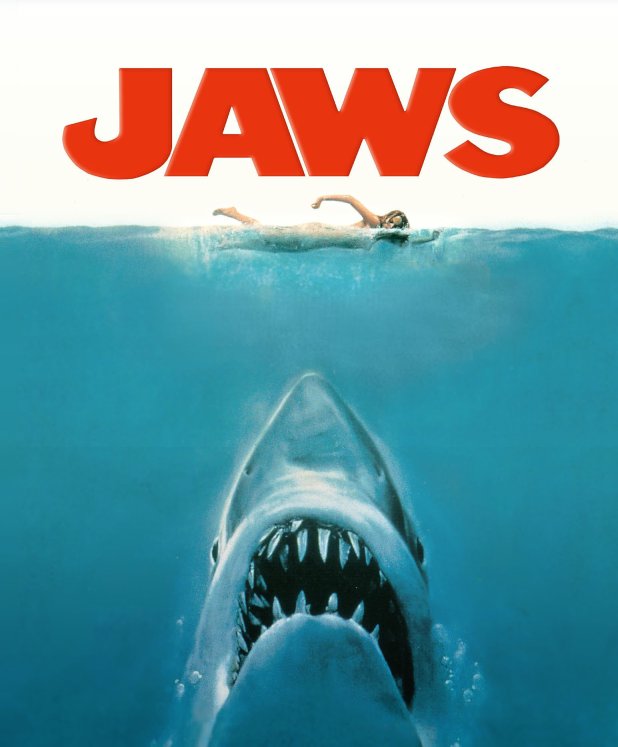
Jaws (1975)

I never consider what I write here to be reviews. They’re more celebrations and my thoughts on films. Most criticism is abhorrent to me — how dare someone who created nothing tear down the work of hundreds of artists, all following the call of the auteur — when they are simply throwing a few words on the internet? Even past critics — Ebert, Kael, Lester Bangs — created art within critique and didn’t simply start a blog. They studied, they put in the sweat, they wrote and wrote — in short, they earned their pedigree to speak as much shit as they freely wanted. I don’t see myself in the same category as them, but it’s something to aspire to. What I want to do is celebrate film, these moments that flicker into our minds and help us escape the everyday ennui.

That said — how does one discuss Jaws, a film that defines ubiquitous? Everyone knows the theme and the beats. It is the very definition of blockbuster, a film that started the trend of wide release, big ad campaigns and merchandising.

The film was originally offered to John Sturges, who helmed The Old Man and the Sea, a film that this parallels. Then, Dick Richards was considered, but he kept referring to the shark as a whale, which cost him the job (this has to be apocryphal and one of those only true on Wikipedia stories). Finally, Stephen Spielberg’s name was gaining steam in La La Land and his work on the TV movie Duel, where an everyman battles an unseen and indestructible force, showed that he was the singular talent who could transform Peter Benchley’s quick read novel into a suspenseful film.

To do that, Spielberg had Benchley write three drafts of the screenplay that ultimately became the mechanical parts of the script. But he jettisoned so much of the book’s subplots, like the affair between Ellen Brody and Matt Hooper (there are some hints of this during the dinner and wine drinking scene, but they’re very subtle) and made the characters more likable. It’s Spielberg himself who suggested that Brody be afraid of the water.

He wanted more character and humor than the grim tone of the book, so he brought Odd Couple sitcom writer Carl Gottlieb on board (he also plays newspaper editor Meadows). That said — there are so many writers that pitched in, including John Milius, Howard Sackler, Ellen Brody and Matt Hooper — it’s hard to tell who wrote what. Gottlieb was on set for most of the film, rewriting scenes after dinner each night, using the actual words of the cast for their dialogue at times. That’s where “we’re going to need a bigger boat” comes from. And some claim that Robert Shaw took a page of dialogue and pretty much created his speech about the wreck of the Indianapolis himself. Again — this film gets closer to how movies are made today, with teams of screenwriters and script docs in the teens, all to make one film. Luckily, Spielberg was able to present these various voices as one distinct vision.

Nine days before filming, no principal roles had been cast. Spielberg had a vision that big stars would take away from the everyman aspects of the film, one in which the shark would ultimately be the star. That’s why Charlton Heston and Robert Duvall were passed over. Quint was almost played by Lee Marvin or Sterling Hayden. Hooper could have been Jon Voight, Timothy Bottoms, Joel Grey or Jeff Bridges before Richard Dreyfuss was suggested by George Lucas. Eager to escape what he saw as a bad performance in his last film, Dreyfuss accepted the role no questions asked. He’d ultimately become the person the director would most see as his alter ego in the film, a role he’d carry on into Close Encounters of the Third Kind.

There’s a famous Dreyfuss quote that the movie started with no script, no actors and no shark. Worse — the film went from a $4 million dollar production to nearly $9 million. The sharks didn’t work, so that left more time for script rewrites and improvising, which leads to a more frightening film. The less you see, the better — plus when you add in the two note John Williams shark theme, you have ready-made suspense.

$1.8 million went into promoting Jaws, including $700,000 on national TV spots. And the poster itself was played with for six month, all to make it more menacing. And it worked — a $7 million dollar opening weekend meant that it made back its costs within the first two weeks. Until Star Wars, it was the most successful movie ever. And the first showing of the film on ABC led to 57% of all TVs in the nation being turned in.

Like I said above, everyone has seen this movie. So how can I find something new, something unique to say about it?

Because I had a moment watching it last night. That’s how.

It’s after the politics of Amity are left far behind. It’s when only three men stand against the shark: the new day of science and more evolved man represented by Hooper; Quint’s warrior man of the past, unafraid of ever needing to fit into polite society and unashamed of itself; and the common everyman, eternally between the two worlds in Brody. Only Brody can truly succeed — Hooper will be forever changed by the experience, showing that his way can only take him so far. And Quint’s the last of a dying breed who must simply die; when his survival is questioned, all Brody can do is say, “Quint? No.” He can’t survive. He is the sacrifice which enables the return to the surface of Hooper and Brody’s one in a million shot that blows the shark to heaven.

In that moment, when the boat that surrounds them and gives them shelter is but splinters against the true terror of nature; when even the boat itself betrays Quint and delivers him into death; when Brody must confront his fear of the water as he tries to climb above it, out of its way, only to sink deeper. In that moment, I sat with my mouth open, awed that a movie over forty years old has the power to make me forget the bombs and rockets blazing outside. In this moment, only the battle between man and beast mattered.

Any film that can do that — whether or not it destroyed the early 70s artistic Hollywood or invented the modern day blockbuster — is one to be celebrated.