Delitto al circolo del tennis (1969)

Professor Riccardo Dossi (Chris Avram) is having an affair with Benedetta (Anna Gael) — the young daughter of his best friend — and being blackmailed by his daughter Lilla (Angela McDonald) and her boyfriend — and Riccardo’s tennis coach — Sandro (Roberto Bisacco). It’s as much a crime of manners and trying to explain the rich and their issues in the late 60s as it is a giallo, but man, it looks great, the world that these people live in is gorgeous and Gael barely can keep her clothes on.

Gael was also Anna Abigail Thynn, Marchioness of Bath; Ceawlin Thynn, 8th Marquess of Bath; Viscountess Weymouth; the Dowager Marchioness; the Honorable Lady Thynn. Yes, beyond starring in movies like Therese and Isabelle, Dracula and Son and Zeta One, she met Alexander Thyn, Viscount Weymouth, in Paris in 1959. They had an affair that lasted for ten years until they were married in 1969. She was 15 when they met.

Unknown to the wealthy Riccardo, the three students want to execute — morally, that is — capitalists and weaken the system. They do it through sex, which is the weapon that no old white man can resist. Except that after he gets blackmailed at the tennis club — man, the heat of bourgeois — he takes the young girl home and balls her, only to have her overdose during the act. What’s a rich man to do? And what if she’s faking the big death, if not the little one?

Based on a novel by Alberto Moravia, this was directed by Franco Rossetti, who was one of the writers of Django and also the director of Emanuelle and Joanna, an Italian softcore movie with Sherry Buchanan in the cast. This was written by Ugo Guerra, Franco Rossetti, Francesco Scardamaglia and Moravia.
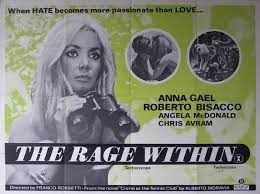
The band that recorded the soundtrack, The Rage Within, get their name from the English title for the film, even if the literal translation would be Crime at the Tennis Club. Composed by Phil Chilton and Peter L. Smith, the music was made to take over the storytelling, as there are long stretches without dialogue. Quartet Records, who have re-released it on vinyl, described it as “Think of it as Zabriskie Point, but without the star power of Pink Floyd.”

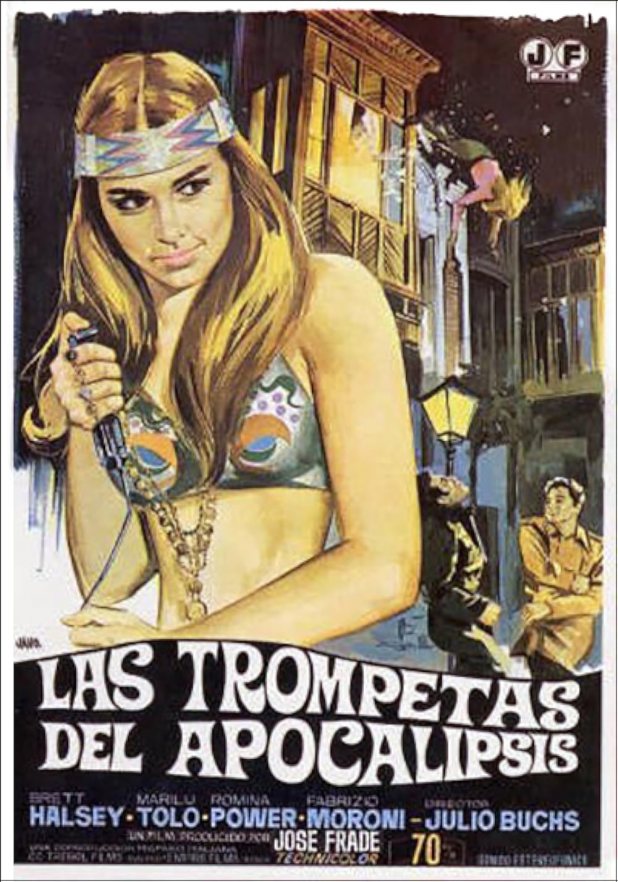
Las trompetas del apocalipsis (1969)

Trumpets of the Apocalypse is also known as Murder By Music and Perversion Story, even if it has nothing to do with Fulci’s movie of the same name.

Richard Milford (Brett Halsey) is a sailor on leave in London who learns that his sister Cathrin has tried to fly while on acid. He doesn’t believe that and investigates her death with her roommate Helen Becker (Marilù Tolo). It seems like the killer is The Romanian (Manuel De Blas) and the murder is all about some bad weed and a song that references the title. There’s a swinging club called the Mouse Hole, where we discover a face painted Romina Power.

Catharin’s music professor killed himself the same way a day before, so obviously our heroes are on to something. There’s also a hurdy-gurdy player whose instrument is his weapon. Alert Donovan…

Director Julio Buchs also made Alta tensión. He wrote this with Domenico Comanducci, Federico De Urrutia, José Luis Martínez Mollá and Mino Roli. I’m a fool for swinging sixties murder movies, much less Spanish-Italian co-productions, so I had a lot of fun watching this.

You can watch this movie on YouTube.


Carnal Circuit (1969)

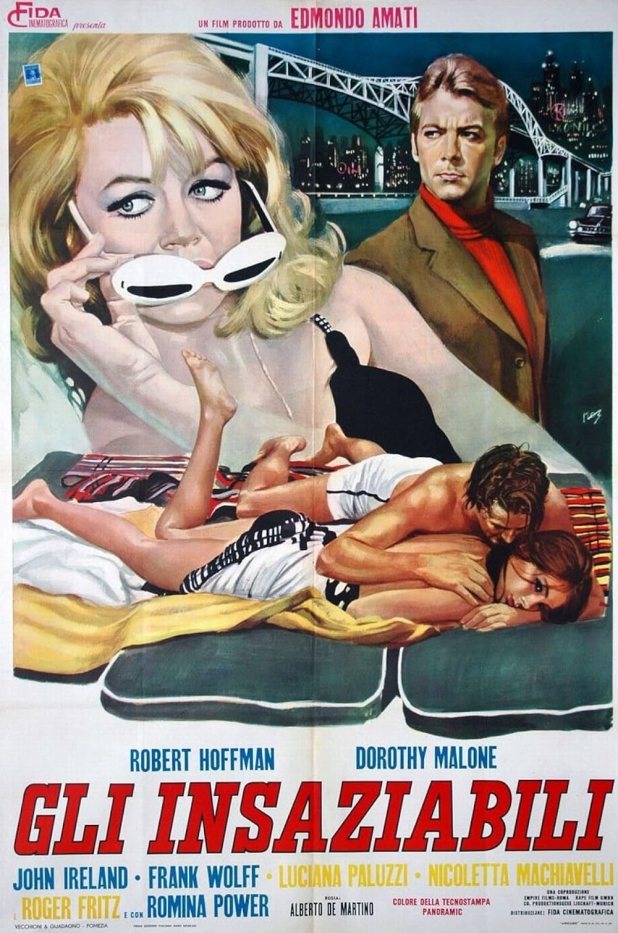
Also known as Femmine insaziabili (Insatiable Females), Mord im schwarzen Cadillac (Murder In a Black Cadillac), The Insatiables and Beverly Hills, this giallo was directed and written by Alberto De Martino (Miami GolemHolocaust 2000OK ConneryStrange Shadows in an Empty RoomThe Antichrist).

Paolo Sartoni (Robert Hoffmann, Spasmo) is an Italian journalist making his way in Los Angeles who takes a beating meant for his childhood friend Giulio Lamberti (Roger Fritz), who is now known as Lambert Smile, the advertising face of International Chemical, but he’s upset the company. Paolo decides to write the story of this assault, only to learn that Giulio is dead. The more he learns about his old friend, the more he discovers that America corrupted him and even caused him to leave his wife Luisa (Nicoletta Machiavelli).

Everyone that Paolo meets from the company are all horrible, including the President of the comapny, Donovan (Frank Wolff), secretary Mary Sullivan (Luciana Paluzzi, A Black Veil For Lisa), Giulio’s boss and new lover Vanessa Brighton (Dorothy Malone, who years later would be in the erotic thriller — what they called giallo in the 1990s — Basic Instinct) and her daughter Gloria (Romina Power, who accidentally had her swimsuit bottom removed by a cameraman and that scene is in the movie; her mother went to producer Goffredo Lombardo shouting and complaining about De Martino; I find this story hilarious because in the same year, she was in Jess Franco’s Marquis de Sade’s Justine), who makes a pass at Paolo. That’s when he learns that Giulio is still alive and will kill anyone — including Paolo’s editor Richard Salinger (John Ireland) — to keep his death a secret.

Bruno Nicolai did the soundtrack, which adds a lot for me. This is a fun film, made in America and filled with the sights, sounds and lovemaking of the late sixities.


Las crueles (1969)

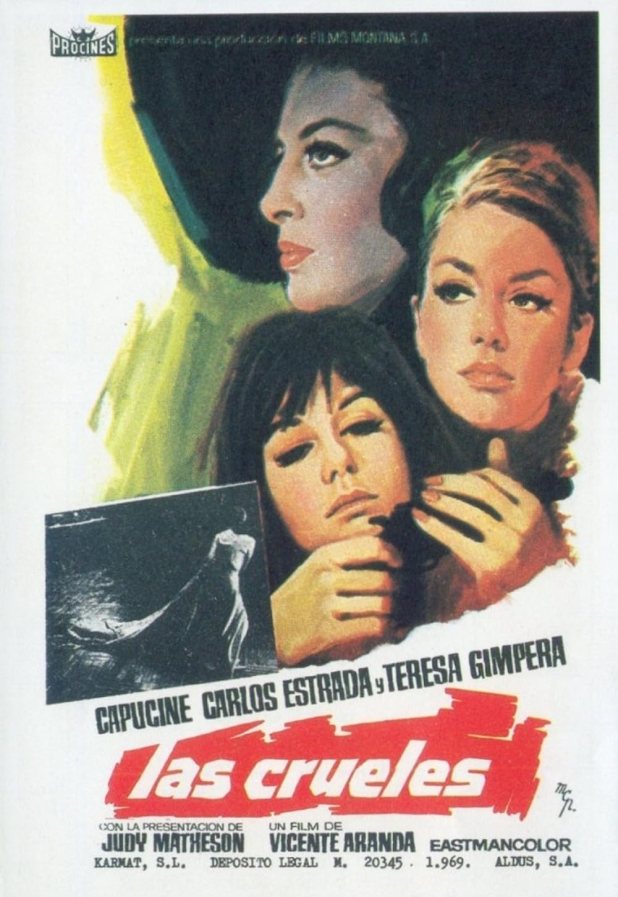
Directed by Vicente Aranda (The Blood Spattered Bride), who wrote the story with Antonio Rabinad, based on the short story Bailando para Parker by Gonzalo Suárez, Exquisite Cadaver starts with a girl committing suicide by laying down headfirst on train tracks.

We meet a man (Carlos Estrada) who is the publisher of pulp horror — giallo — and someone who has become quite successful as a result. He gets a severed human hand in the mail, which he buries in a park. Another package is sent, this time with a torn dress and a photo of a woman. He also gets a telegram, which his wife (Teresa Gimpera, Hannah Queen of the Vampires) reads and it ends with the promise of sending a forearm. He lies and says its for work, but as she follows him, she notices that he is also being stalked by a woman in a black veil.

The woman is Parker (Capucine, The Pink Panther), who lures the man to her house where she gives him LSD. He staggers through her villa, following the sound of her voice, which leads him to a woman’s body inside a refrigerator. He passes out and wakes up at home, his wife having been called by Parker to get her husband.

The man reveals to his wife that he had an affair with a woman named Esther (Judy Matheson, The House That Vanished; is it too soon to talk about ’72?) who told him “I’d die so that my love for you will last. So that indifference will not kill it” before she laid down on the train tracks, as we saw as the movie began. Except that a detective that the man’s wife hired saved Esther.

As she tried to get her life together, Esther fell for a doctor before meeting Parker, who she soon began an affair with. Parker was in love with her, trying to save her, but Esther never stopped loving the man, finally killing herself. Parker then made this plan to get revenge for her lost love, even cutting. her corpse to pieces, sending each one until finally, the head arrives. The man looks for his wife but she is gone, leaving for Paris and a new relationship with Parker, who has seduced her.

After filming ended, Aranda gave Matheson the silver hand pendant that her character wore in the film. She still has it to this day and even established a trademark of wearing it in her subsequent films.

As for the director, he had an accident on the set which led to him directing much of this movie from a stretcher.

Thanks to Theater of Guts, I know that this was released in the U.S. by Gadabout-Gaddis Productions, who released The Man from NowhereFind a Place to Die, Hatchet for the HoneymoonOne On Top of the Other and Marta. According to the site, it played drive-in screens as late as 1983 as a double feature with Twilight Zone: The Movie.

The title Exquisite Corpse comes from the game created by Surrealism founder André Breton that has a collection of words or images collectively assembled by several creators who have no idea what has come before other than a line, which is added to until a complete art piece emerges. The name comes from the phrase that was part of the first work created by the game, “The exquisite corpse shall drink the new wine.”

The Spanish title, Las Crueles (The Cruel Ones), is meant to sound like Les Diaboliques. It was not the title preferred by Aranda.

Raptus (1969)

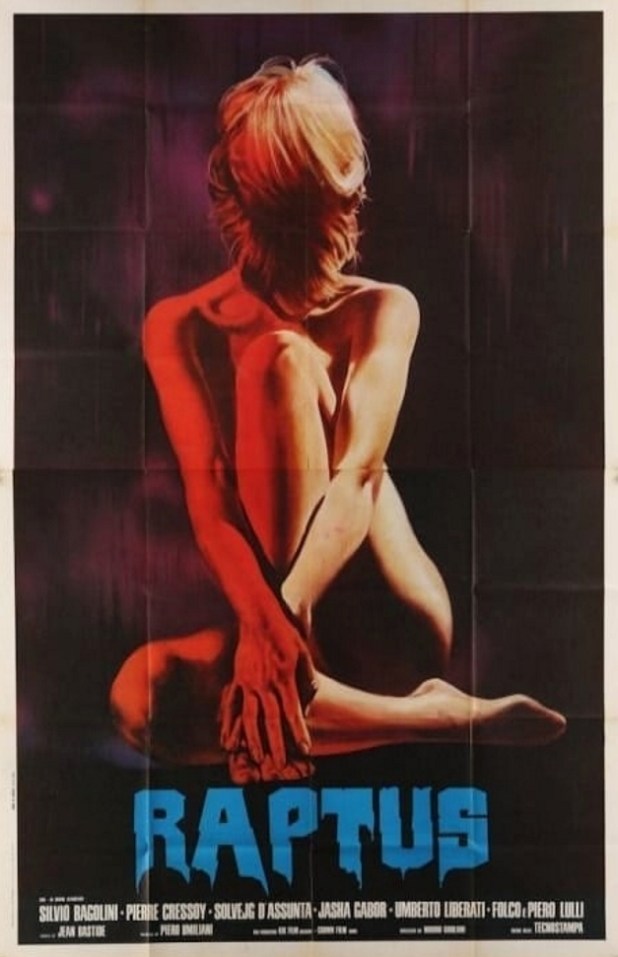
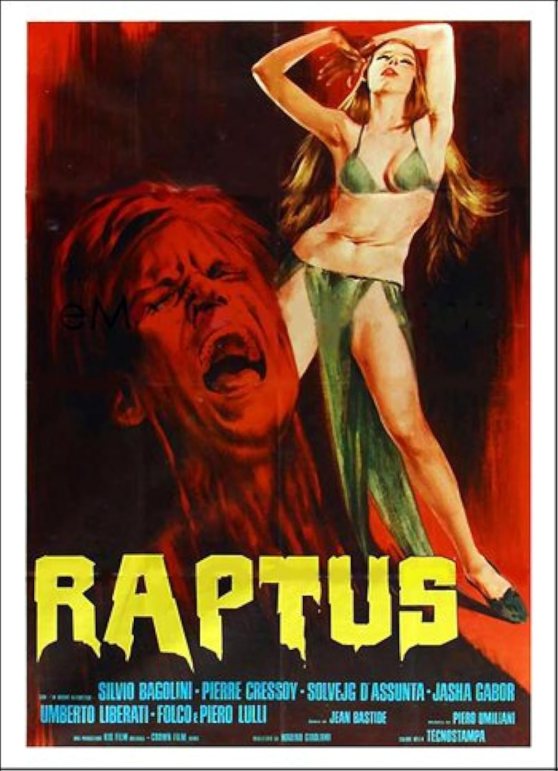
When this was submitted to censors as Eros e Thanatos, censors wouldn’t let it play. Director and writer Marino Girolami (the director of My Friend, Dr. Jekyll; he used many names over the years. As Frank Martin he directed Zombie Holocaust and as Franco Martinelli he made Special Cop in Action and Violent Rome. He used the name Dario Silvestri to direct God Was in the West, Too, at One Time.) cut the film down, including a scene where the killer caressed the body of a victim. All of that showed up in the fumetti release. This film was consider lost for some time, as it wasn’t even released during the boom of VHS releases.

Franco Adami (Umberto Liberati) is charged with murder after a prostitute that he’s seen shows up dead, her body nude and strung up. Defense attorney and alcoholic Montani (Folco Lulli) tries to argue his case with Adami claiming that flashbacks to animal violence let to him killing the lady of the evening. Montani needs some evidence that this is possible, so he meets with the director of an asylum (Daniele Vargas) and meets two patients with similar cases.

Usai (Silvio Bagolini) was a man obsessed with a young girl named Francesca (Caterina Barbero, who was 18 when this was made, which is I guess a little bit less upsetting but still, this has upskirts and full frontal nudity of a teenager shown) who he gets to tutor. Because of his childhood — he had a doll and his father didn’t want his male son to have baby dolls, so he beat him — he can’t stop his thoughts, which end with him killing her and her parents finding her nude and dead by his side just like a human version of a doll.

Gilberto (Piero Lulli) took the sermons he listened to in church — plus the abuse from other students and the priests — and started to kill sex workers to punish them for their immoral acts. He’s Donny Kohler ten years early, using fire to murder women who he believes are sinners.

Montani presents this evidence and not only does it end with Franco going to a mental home instead of prison, he’s able to convince the editor of the paper to take back the things they said about his client. That’s when we learn that Montani is a drunk because his son killed a boy his age and then committed suicide in jail, so he understands the place that Adami was in.

You can watch this on YouTube.

Yellow: le cugine (1969)

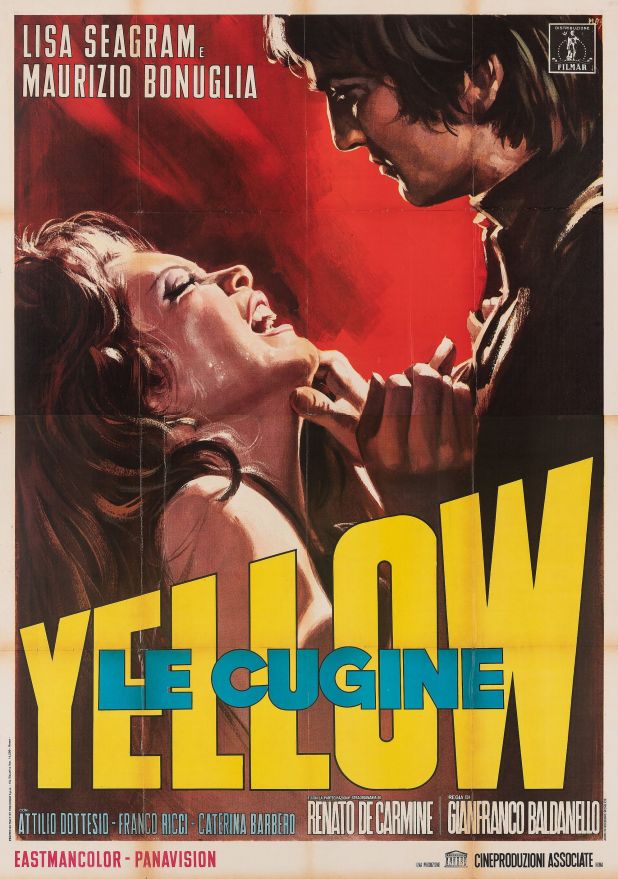
Following the death of her grandfather, Valentina Garbini (Caterina Barbero) and her husband Pierre (Maurizio Bonuglia) have settled into the old family home, sharing it with her cousin Marta (Lisa Seagram, who mostly did TV in America, including three episodes of Beverly Hillbillies as Edythe Brewster, the new wife of the oil man who helped Jed Clampett get rich. They stay in the cabin that has been relocated to the side of the mansion for their honeymoon. She was also Lila, who poisoned Batman and Robin on their TV show with lilacs, and later ran an acting school in Hawaii, Actors 2000). The cousins are oppposites, as Valentina is free with her body while Marta is virginal. The one time that Marta tried to lose her innocence to a local man, her grandfather beat her with a whip.

This changes when Valentina dies. Pierre is fingered by the police, but Marta hides the murder weapon to keep her cousin’s husband by her side, as the suspicion now is on Valentina’s friends. Now, Marta can get what she wants — a man — and the entire mansion. Things don’t end up working out for her, but that’s the morality coming in, I guess.

Also known as The Mill of the Virgins, this was directed by Gianfranco Baldanello (The Uranium ConspiracyVery Close Encounters of the Fourth KindDanger!! Death Ray) and written by Augusto Finocchi and Vittorio Metz. It was edited by Bruno Mattei.

You can watch this on YouTube.

I ragazzi del massacro (1969)

A group of eleven street criminals between the ages of thirteen and twenty have raped and killed a teacher. There’s no evidence or even enough information to determine why they did it or if they had a motive. The judge wants the case closed, but Chief Luigi Càrrua (Enzo Liberti) knows that only Commissioner Lamberti (Pier Paolo Capponi) can solve it. He’s brutal on the boys, while social worker Livia Ussaro (Nieves Navarro) tries to understand how they could be this way. Once the main witness is killed, the rough cop discovers that this case may be more difficult to figure out than he thought it would be.

Based on the book by Giorgio Scerbanenco, director and co-writer Fernando Di Leo cut down the story and concentrated on the boys who have actually committed the crime.

He would also adapt two other books by the author, Caliber 9 and The Italian Connection. Scerbanenco’s books were popular stories to turn into movies, as Yves Boisset made Safety Catch from Venere privata (A Private Venus), Duccio Tessari directed La morte risale a ieri sera (Death Occurred Last Night) from the book Milanesi Ammazzano al Sabato (The Milanese Kill on Saturdays), Luigi Cozzi directed The Killer Must Kill Again from Al mare con la ragazza (By the Sea With the Girl), Carlos Saura directed ¡Dispara!, Romolo Guerrieri made Young, Violent, Dangerous from two short stories “Bravi ragazzi bang bang and “In pineta si uccide meglio,” plus TV movies include the Alberto Siron, Gian Pietro Calasso and Vittorio Melloni-directed  Quattro delitti, the Daniele D’Anza directed La ragazza dell’addio, Bruno Mattei’s Appuntamento a TriesteL’uomo che non voleva morire by Lamberto Bava and Occhio di falco by Vittorio De Sisti.

La bambola di Satana (1969)

Erna Schürer (Scream of the Demon Lover) is Elizabeth Ball Janon, who has gone back to her family’s castle — along with her not-to-be-trusted boyfriend  Jack Seaton (Roland Carey) and their friends Gerard (Giorgio Gennari) and Blanche (Beverly Fuller) — to claim her inheritance.

The only movie from director and writer Ferruccio Casapinta, this finds everyone in the castle battling over what Elizabeth should do with the place. Her uncle’s secretary Carol (Lucia Bomez) says that’s what he wanted while his lawyer Mr. Shinton (Domenico Ravenna) says the opposite. Then there’s Paul Reynauld (Ettore Ribotta) and Claudine (Aurora Batista), who claim that Elizabeth’s uncle had already sold the castle to them.

It all seems like something out of safe detective fiction until that evening when Elizabeth goes to bed and starts having wet dreams about Jack being taken over by a ghost and treating her to some BDSM in the basement, all while Carol stops being the librarian type and gets taken by a secret lover. And would someone get that dog to stop barking?

This was probably directed by cinematographer Francesco Attenni. A lot of it is basic by-the-numbers detective giallo fiction pre-Argento, but man, there’s also a moment where a Satanic gang lashes Elizabeth to a giant cross and then rips her dress off and she seemingly crosses that line from afraid to aroused. We wouldn’t have the poster art without this scene and while I wish that the rest of the film kept this demented and debauched feel, you can’t have peaks without valleys.


THE MOVIES OF AL ADAMSON: The Female Bunch (1969)

Shot in the summer of 1969 at Spahn Ranch, which was the home of the Manson Family at the time, The Female Bunch also has moments filmed at Hanksville and Capitol Reef in Utah as well as Las Vegas, Nevada. Adamson loved shooting outside. He must have loved every second of this movie.

All the bad men she’s dealt with leaves Sandy (Nesa Renet) wanting to end it all. Her friend Libby (Regina Carrol) takes her into the desert to meet Grace (Jennifer Bishop), who leads a gang of women that run drugs and use men.

This is the last movie of Lon Chaney Jr., filmed after Dracula vs. Frankenstein. His voice sounds painful, the result of throat cancer radiation treatments.  He plays Monti, an old Hollywood cowboy who is loyal to Grace. Kim Newman, who writes some great film reviews, wrote a short story about this movie, “Another Fish Story.” In this tale, Charles Manson is trying to using one of the Ancient Ones to destroy the world while Lon Chaney Jr. is given a mission in the desert that will keep The Family from bothering Adamson and crew.

To join this gang of women, you have to be buried alive in a coffin. I don’t know if I’d go that far, but if I got to hang out with Chaney and Russ Tamblyn, I may let you throw some dirt on my grave.

THE MOVIES OF AL ADAMSON: Five Bloody Graves (1969)

Directed by Al Adamson and written by Robert Dix, who plays Ben Thompson, Five Bloody Graves is about Ben battling Satago (John “Bud” Cardos), the man who scalped his ex-girlfriend Nora (Vicki Volante) and her husband (Ken Osborne). Cardos is also Joe Lightfoot, Satago’s brother, who is half-white and half-Native American.

Ben was a former lawman and now, he wanders the Wild West — including an amazingly named town Goblin Valley, Utah, which is a real place — before he helps holy man Boone Hawkins (John Carradine) and a stagecoach full of showgirls like Kansas Kelly (Paula Raymond) and Althea Richards (Darlene Lucht) through Native American territory while death itself (Gene Raymond) narrating explaining how Ben and Satago are his messangers on Earth. It’s all very metal.

This also looks pretty great thanks to cinematographer Vilmos Zsigmond, who went on to win an Oscar for Best Cinematography for Close Encounters of the Third Kind, as well as filming McCabe & Mrs. MillersThe Deer HunterDeliveranceThe Black Dahlia and many more.

The tagline “Lust-Mad Men and Lawless Women in a Vicious and Sensuous Orgy of Slaughter!” is enough to get me in the drive-in for this.