MILL CREEK LEGENDS OF HORROR: The Long Hair of Death (1964)

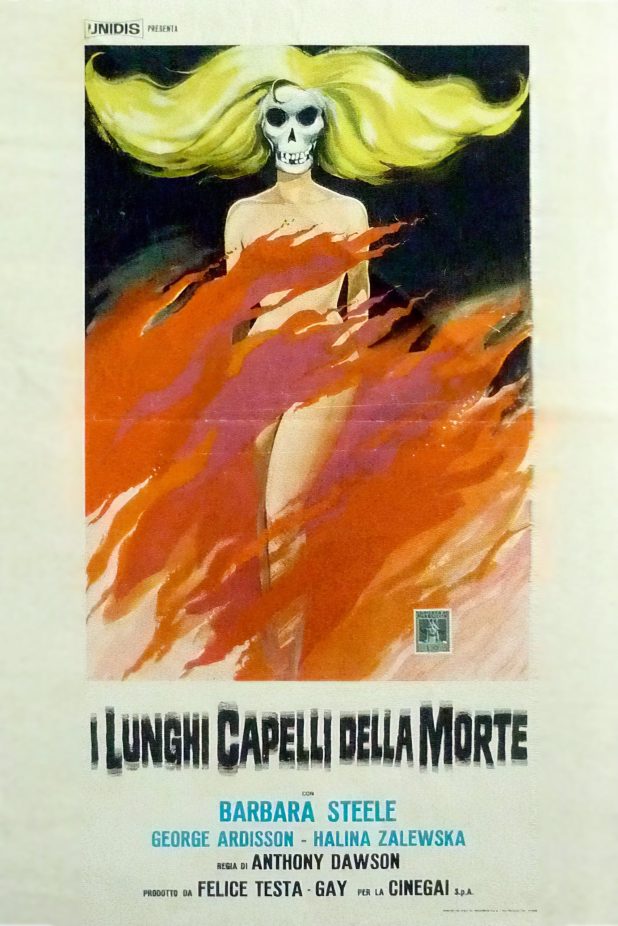
Adele Karnstein (Halina Zalewska, An Angel for Satan) is accused of witchcraft and burned, but really it’s because she wouldn’t sleep with Count Humboldt (Giuliano Raffaelli). When her daughter Helen (Barbara Steele) confronts him, she even offers her body to him to save her mother. The Count still watches as her mother is burned alive and tosses Helen off a cliff. To add even more pain to the Karnestein family, her sister Lisabeth (also Halina Zalewska) is taken in by Humboldt and eventually marries his nephew, Kurt (George Ardisson).

As a plague destroys the country, a storm blows in on the night of the Count’s death, bringing Mary (also Barbara Steele) who inspires Kurt to kill his wife and be with her. Bad idea Kurt. This is an Italian Gothic and all men are morons who must be destroyed by the female ghosts of past tragedy and the curses of mothers whose daughters could not save them.

I mean, Barbara Steele is a ghost whose skeleton is reanimated by lightning. Can movies get any more magical? Do you know how much it makes me fall into a dream of movie drugs to have Steele walking through a cobwebbed castle in a white nightgown holding blazing candles?

While written by Ernesto Gastaldi and Tonino Valerii, neither had enough experience to direct — or so said producer Felice Testa Gay — which brought in Antonio Margheriti to make the film. For as much as Margheriti is known for his miniature-rich war movies, he had a talent for making movies like this. Just check out Castle of BloodThe Virgin of NurembergThe Unnaturals and Web of the Spider.

You can watch this on YouTube.

CHILLER THEATER MONTH: War of the Zombies (1964)

EDITOR’S NOTE: War of the Zombies was on Chiller Theater on Saturday, November 3, 1979 at 1:00 a.m.; Saturday, April 11, 1981 at 1:00 a.m. and saturday, December 3, 1983 at 1:00 a.m. It playted as Zombies.

Also known as War of the Zombies, Rome Against Rome was the second to last film from the Galatea production company (some of their other films include Black SundayBlack SabbathMill of the Stone Women and Ghosts of Rome). It was directed by Giuseppe Vari, who used the name Joseph Warren, and also made The Last KillerShoot the Living and Pray for the DeadWho Killed the Prosecutor and Why?, Sister Emanuelle and Urban Warriors. Its story came from Ferruccio De Martino (who usually was a production manager) and Massimo De Rita (Violent City, The Valachi PapersStreet Law) with a script from Piero Pierotti (who directed Hercules Against Rome and Marco Polo) and Marcello Sartarelli.

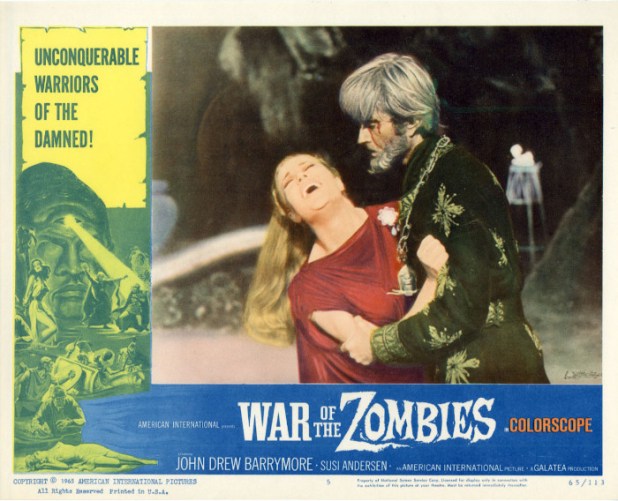
In a remote part of the Roman Empire, cult leader Aderbad (John Drew Barrymore, Drew’s father) is working with the governor to create their own land using the corpses of Roman soldiers brought back from the dead. Centurion Gaius (Ettore Manni) is sent to protect the interests of the senate.

Most of the production money probably went toward making Aderbad’s secret rooms look like something out of Bava, because the actual fight scenes are taken from Hannibal. Susy Anderson (Black SabbathThor and the Amazon Women) and Ida Galli (The PsychicArabella: Black AngelThe Sweet Body of DeborahThe Whip and the Body) are also on hand.

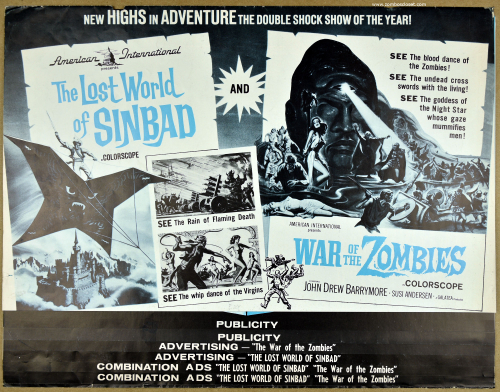
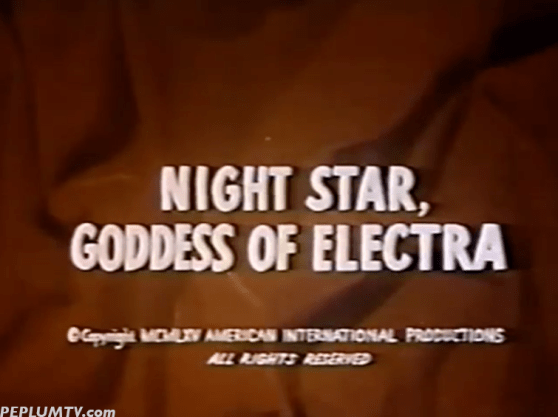
American-International Pictures played this movie as a double feature with Senkichi Taniguchi’s Samurai Pirate, which they named The Lost World of Sinbad. When it was time for Rome Against Rome to air on TV, it was renamed the completely incredible title Night Star: Goddess of Electra.

I wish that there was more to recommend this movie than just as a curiosity. Peplum was giving way to the western, so anything was being tried at this point. According to Mondo Esoterica, two other horror and sandal hybrids are Goliath and the Vampires and, of course, Hercules in the Haunted World.

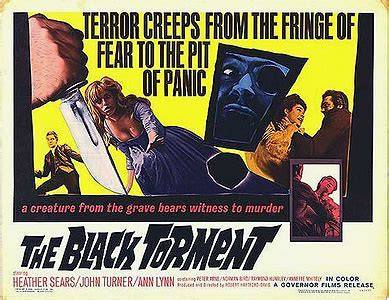
CHILLER THEATER MONTH: The Black Torment (1964)

EDITOR’S NOTE: The Black Torment was on Chiller Theater on Saturday, Novembr 9, 1968 at 1:00 a.m.; Saturday, February 20, 1971 at 1:00 a.m. and Saturday, April 8, 1972 at 11:30 p.m. 

Made by Compton Films, directed by Robert Hartford-Davis and written by Derek and Donald Ford. I watched this because those three men also made one of the wildest British horror movies, Corruption, which we all know is not a woman’s picture.

It feels like British filmmakers trying to make an Italian film, as it starts with Lucy Judd (Edina Ronay) being chased through the woods by a black hooded figure and strangled. We then meet Sir Richard Fordyke (John Turner) and his new bride Elizabeth (Heather Sears) who have come to town so that she may meet her father-in-law Sir Giles Fordyke (Joseph Tomelty). She worries about her first impression, but his father has been weakened by a stroke and can only speak sign language, which can only be understood by his first wife’s sister Diane (Ann Lynn). And oh yeah — Anne killed herself a few years ago when she was told she couldn’t get pregnant. Oh these British upper-crust families and their horrific family trees!

When they finally get there, everyone — from villagers to family — treats them with cold eyes and whispers, because the rumor is that Richard killed Lucy, even if he was far away in London at the time. Witchcraft is in town and the Fordykes are said to be the cause. In fact, there are reports of Richard riding his horse about the village while the dead Anne follows him shouting “Murderer!”

Obviously, someone is trying to destroy Richard. But who? And why?

If you enjoy period dramas with a bit of the supernatural thrown in, well, this is certainly for you. I love that Hartford-Davis would go on to direct a toy tie-in movie, Gonks Go Beat, as well as School for Unclaimed GirlsIncense for the Damned and The Fiend.

CHILLER THEATER MONTH: Mothra vs. Godzilla (1964)

EDITOR’S NOTE: Mothra vs. Godzilla was on Chiller Theater on Saturday, February 17, 1968, at 11:20 p.m. and Saturday, July 26, 1969, at 11:30 p.m. as Godzilla vs. The Thing

With the box office success of King Kong vs. Godzilla and Mothra, Toho chose to send Godzilla against the butterfly in a movie that was meant for children instead of adults. It’s also the last movie — until the Heisei era — that Godzilla would be against humanity.

As a typhoon leaves behind significant damage, a bluish-gray object has been left behind, as well as a giant egg, which is taken by Kumayama, the owner-entrepreneur of Happy Enterprises. He decides that science will have nothing to do with the egg. It’s time to make money off it.

That’s when the twin Shobijin arrive and explain that the egg belongs to Mothra, and if it hatches, Mothra’s larva child will destroy Tokyo as it looks for food. The Japanese government begs them to send Mothra to stop Godzilla, who has come back for the strange object left behind, one that is emitting radiation. Despite all the outside world has done to their island, and even though Mothra is in great pain and dying of old age, they decide that they must help.

While Godzilla does destroy Mothra with his atomic breath, her twin children arise in their larva form and spray the King of the Monsters repeatedly with their sil, allowing Godzilla to be captured.

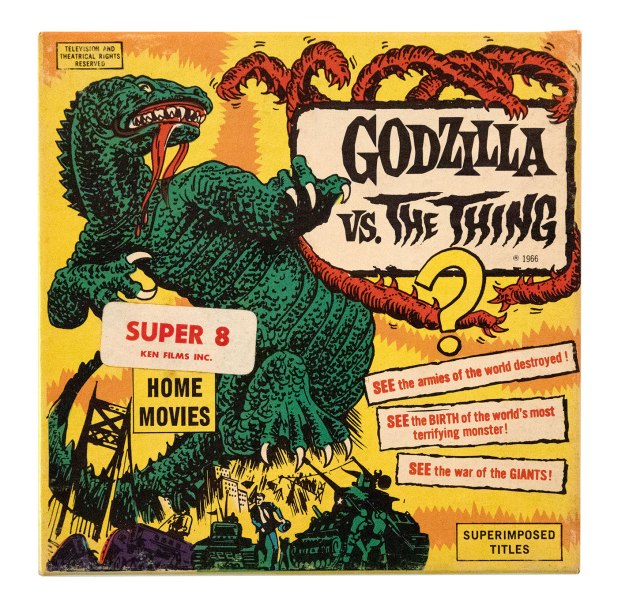
Henry G. Saperstein acquired the American theatrical and TV rights. He planned on the name Godzilla vs the Giant Moth. Still, American-International Pictures bought the movie and released it as Godzilla vs. The Thing, censoring Mothra from the poster to build audience excitement for who the big green lizard would fight. After so many of their films being released in America, Toho shot footage specifically for export, such as a scene where U.S. troops help the Japanese fight the monsters.

When everyone arrives on Infant Island, the skeleton of a turtle can be seen in the background. This character, known as the Mystery Bones of Infant Island, is a living kaiju that was inspired by Mondo Cane.

CHILLER THEATER MONTH: Dagora the Space Monster (1964)

EDITOR’S NOTE: Dagora was on Chiller Theater on Saturday, April 22 at 1:00 a.m. and December 16, 1967 at 11:20 p.m., Saturday, October 16, 1968 at 11:20 p.m., Saturday, May 16, 1970 at 11:30 p.m. and Saturday, April 24, 1971 at 11:30 p.m.

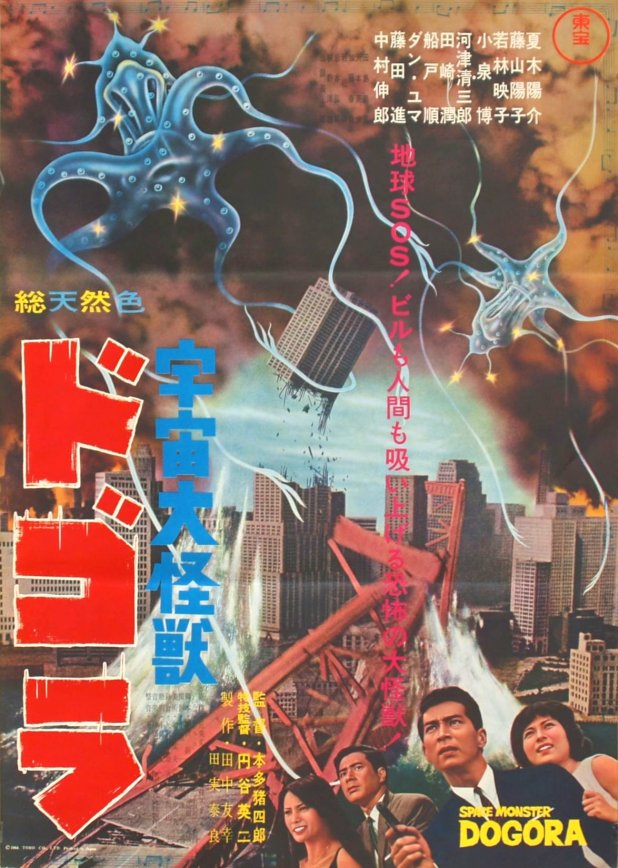
Giant Space Monster Dagora, directed by Ishiro Honda with special effects by Eiji Tsuburaya, is a kaiju movie that I would have hated as a child. It’s mostly a cops-and-robbers movies about diamonds, then it’s all about scientists. Dagora only randomly shows up, and it’s a floating jellyfish that seems like one of the Lovecraft Elder Gods. As an adult, the strange look of this kaiju is precisely why I enjoyed this movie.

When several TV satellites launched by the Electric Wave Laboratory go missing, it’s discovered that they have collided with unidentified protoplasmic cells. While that’s happening, Inspector Komai (Yosuke Natsuki) is searching for the thief who is stealing diamonds all over the world, which leads him to a crystallographer named Dr. Munakata (Nobuo Nakamura).

Meanwhile, Mark Jackson (Robert Dunham) is dealing with diamond smugglers as an undercover agent of the World Diamond Insurance Association. They all soon learn that the diamonds — and other sources of carbon — are being consumed by Dogora, which is the form that the cells have taken. And you’ll never guess what defeats the creature. Artificial wasp venom.

Dagora is only in this movie other than as a still at the beginning of Godzilla: Planet of the Monsters, but it has shown up in several video games, including Godzilla: Monster of Monsters, Godzilla: Heart-Pounding Monster Island!!, Godzilla: Trading Battle and Godzilla Generations.

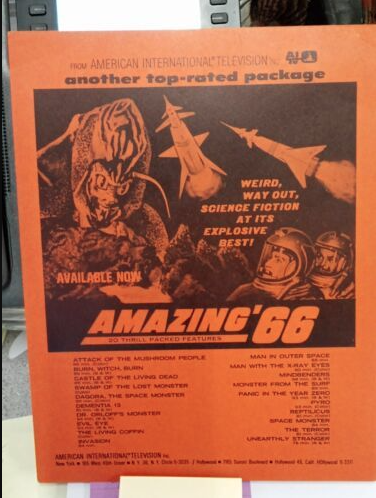
This was syndicated by American-International Pictures as part of two of its TV packages, Amazing 66 and Sci-Fi 65. In their prints, all of the cast and credits are removed, as there’s a jump cut from the main title to the first scene.

Take a look at the movies in these packages!

Amazing 66

Sci-Fi 65

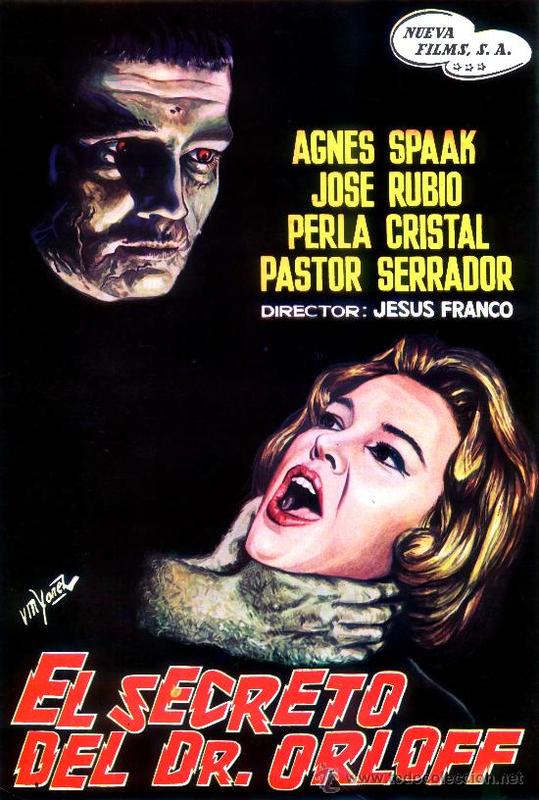
CHILLER THEATER MONTH: Dr. Orloff’s Monster (1964)

EDITOR’S NOTE: Dr. Orloff’s Monster was on Chiller Theater on Saturday, December 17, 1966 at 11:20 p.m. and Saturday, May 17, 1969 at 11:30 p.m.

Jess Franco on Chiller Theater!

He had enough money for film stock and some of the cast; the rest of this movie was made thanks to the kindness of others. And this time, the shadow of Dr. Orloff has been cast on Doctor Conrad Jekyll, one of his students, who has been sent the secrets of using ultrasound to animate his robotic creation, which is really his brother Andros, whom he murdered after discovering that he was cuckolding him with his wife. So what does he do? Uses the robot creature to hunt down his ex-lovers and strangle them.

Yes, it’s dream-logic or more to the point, Franco logic.

An example: the robot knows who to kill based on the necklaces that Dr. Jekyll gives to these nightclub women. Inside is a radio transmitter giving orders to kill, baby, kill.

Also known as The Mistresses of Dr. Jekyll, The Secret of Dr. Orloff and Dr. Orloff’s Monster Brides, this only hints at the nightclub scenes of later Franco, as well as the jazz music moments which threaten to obscure the story and take over the film.

Also, a Christmas movie.

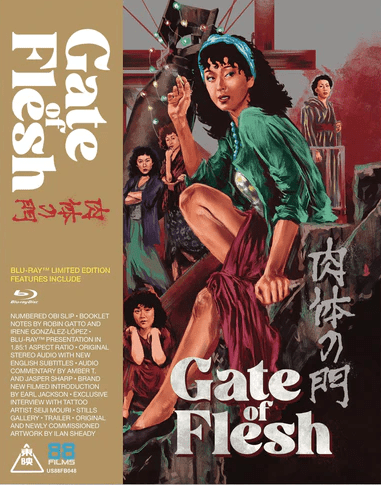
88 FILMS BLU-RAY RELEASE: Gate of Flesh (1964)

The destroyed neighborhoods of Tokyo are home to a group of prostitutes who form a sex worker union and build their own dancehall, Purgatory. Then, the gangsters and pimps make a play for what the women have earned and an unexploded bomb appears.

Based on a novel by Taijiro Tamura and directed by Seijun Suzuki, this is the first of Suzuki’s Flesh Trilogy, followed by Story of a Prostitute and Carmen from Kawachi. The girls are at odds with every man around them — American soldiers and Japanese yakuza — yet make their money by giving their bodies to them. When a soldier, Shintaro Ibuki (Joe Shishido), hides out with them, everyone wants him. The newest girl, Maya (Yumiko Nogawa), wants to run away with him, but that won’t end well.

Seijun said, “The studio wanted to make a skin flick, that’s all. We couldn’t make a real porno back then, though.” What emerges is a movie a lot like one that followed it, The Beguiled.

Making its home premiere for the very first time outside of Japan courtesy of 88 Films, extras include audio commentary by Amber T. and Jasper Sharp, a new introduction by Earl Jakson, an interview with Toei tattoo artist Seiji Mouri, a trailer, a limited edition book, a still gallery and new artwork by Ilan Sheady. You can order it from MVD.

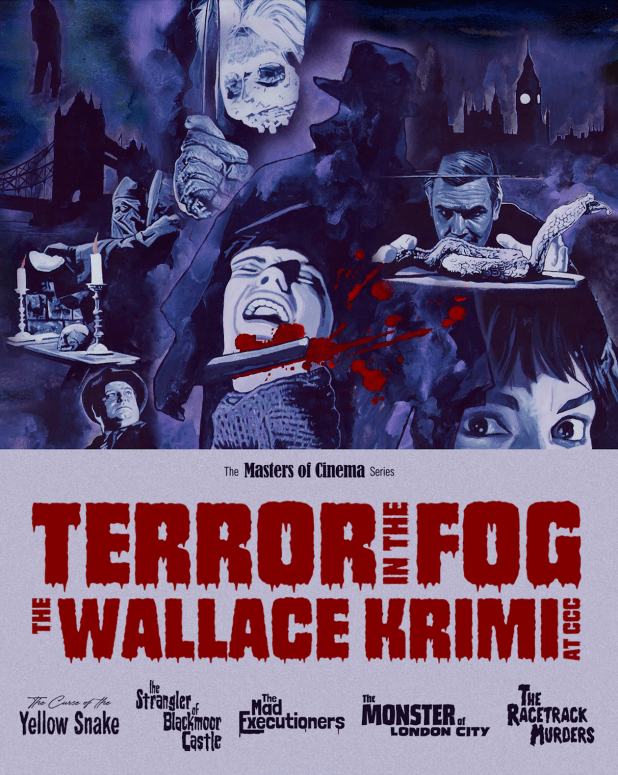
EUREKA! BOX SET RELEASE: TERROR IN THE FOG: THE WALLACE KRIMI AT CCC

As Italy made Giallo and America had Hitchcock, West Germany had Krimi. Freely adapted from works by the British crime writer Edgar Wallace and his son Bryan Edgar Wallace, they combined the traditional murder mystery with horror. Masked and gloved killers stalked their victims like ghosts in the fog of London, starting with Face of the Frog and The Crimson Circle, before producer Artur Brauner launched the CCC Film series of Krimi.

Now, Eureak! has a box set with six examples:

The Curse of the Yellow Snake: A mysterious cult wishes to lay its hands on an ancient artefact that has been brought to London from Hong Kong.

The Strangler of Blackmoor Castle: A masked murderer stalk the grounds of a vast British estate – one who brands his victims’ foreheads with the letter M.

The Mad Executioners: Who should we be more afraid of? The killer or the gang of hooded vigilantes?

The Phantom of Soho: A sleazy nightclub is surrounded by death!

The Monster of London City: Is Jack the Ripper back in London?

The Racetrack Murders (AKA The Seventh Victim): Everyone who knows the racehorse Satan seems to die!

Krimi and Giallo both mean mystery novels to the respective readers of Germany and Italy. While the films they inspired share similarities, they each have their own unique feel. It’s also an ever-changing-back-and-forth trade between these genres, as they increase in bloodshed and masked killer excess as they go on — and I mean that in all the best of ways.

This set is a perfect companion to Eureka!’s Mabuse Lives! Dr. Mabuse At CCC: 1960-1964 set. Each of these releases is nearly a film education in a box, as Tim Lucas, Kim Newman and others open up your mind to blind spots of film that you may have never dared explore. This is beyond a recommendation.

This limited edition of 2000 copies comes inside a hardbound slipcase featuring new artwork by Poochamin with a 60-page collector’s book featuring a new introduction to the Wallace krimi cycle by film writer Howard Hughes, a new essay on Edgar Wallace and Bryan Edgar Wallace by crime fiction expert Barry Forshaw and new notes on each film by Holger. All five films presented in 1080p HD from 2K restorations of the original film elements undertaken by CCC Film.

Extras include new introductions to each film by genre film expert and Video Watchdog founder Tim Lucas; audio commentaries The Curse of the Yellow Snake and The Phantom of Soho by Kim Newman and Barry Forshaw; commentaries on The Strangler of Blackmoor Castle, The Mad Executioners and The Racetrack Murders by Kevin Lyons and Jonathan Rigby and commentary on The Monster of London City by Kim Newman and Stephen Jones. Plus, there’s a new interview with Alice Brauner, producer and managing director of CCC Film and daughter of Artur Brauner and a video essay by Alexandra Heller-Nicholas exploring the influence of the Wallace krimi on the Italian Giallo and American slasher film.

You can get this set from MVD.

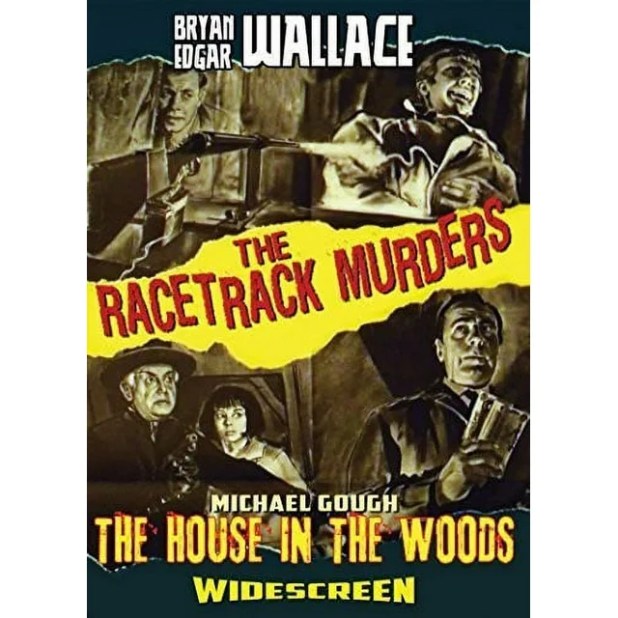
EUREKA! BOX SET RELEASE: TERROR IN THE FOG: THE WALLACE KRIMI AT CCC: The Racetrack Murders (1964)

Das siebente Opfer (The Seventh Victim) was released in English speaking countries as The Racetrack Murders. Based on a novel by Bryan Edgar Wallace, it’s one of several films — hey, we covered a bunch this week — by Rialto Film, who had succes making movies based on the books of his father, Edgar Wallace. This comes from Murder Is Not Enough.

Directed and written by Franz Josef Gottlieb, this is all about how the son of a British racehorse owner and a bookie work together to ruin the odds of his father’s thoroughbred, Satan, being a winner. Insurance fraud is more important to the Krimi, where the Giallo would just kill you. No, the German movie bad guys want to take your diamonds. Or cash. And then kill you. Or, if you’re watching this movie, throw a snake at a horse and then watch it’s jockey die as the result!

This is part of the Terror In the Fog box set and has extras including a new introduction by genre film expert and Video Watchdog founder Tim Lucas and audio commentary by Kevin Lyons and Jonathan Rigby. You can get it from MVD.

EUREKA! BOX SET RELEASE: TERROR IN THE FOG: THE WALLACE KRIMI AT CCC: The Monster of London City (1964)

Who would have thought that a series of Jack the Ripper-style murders would happen at the same time as a new play about the infamous Whitechapel murderer was playing on the London stage? And what if the actor,  Richard Sand (Hansjörg Felmy), who plays Jack becomes a suspect in an example of the ultimate in Method acting?

Director Edwin Zbonek and writer Robert A. Stemmle have adapted another Bryan Edgar Wallace story, this reveals to us thatthe actor may have been insane and an alcoholic in the past, but does that make him a killer? Isn’t he trying to settle down with Ann Morlay (Marianne Koch)? I mean, who wouldn’t want to? So why is he maybe killing sex workers?

Producers Releasing Corporation released this in the U.S. along with The Phantom of Soho. There’s not just a great poster, I’ve also found the pressbook.

This comes at the time when the Krimi and the Giallo were trading back and forth. You can see the influence of Blood and Black Lace, as well as the exploitation film expectation that there had to be nude female flesh. Regardless, it works and creates quite the picture, which has a great killer reveal at the end.

This is part of the Terror In the Fog box set and has extras including a new introduction by genre film expert and Video Watchdog founder Tim Lucas and audio commentary by Kim Newman and Stephen Jones. You can get it from MVD.