EUREKA! BOX SET RELEASE: TERROR IN THE FOG: THE WALLACE KRIMI AT CCC: The Mad Executioners (1963)

Based on White Carpet by Bryan Edgar Wallace, The Mad Executioners has fog — so much fog — and a serial killer who loves to cut the heads off of beautiful women. A mob is organized by a secret court — The Mad Executioners, anyone — forms and starts to hang anyone they think could be the killer. The rope they use comes from Scotland Yard’s crime museum.

John Hiller (Hansjörg Felmy) is assigned to these cases, and it’s personal because his sister was one of the victims. How bad does he want to solve this? His fiancée, Ann Barry (Maria Perschy), is used as bait for the killer, but gets kidnapped, and Hiller has to beat the mad executioners to the killer so he can save her. Plus, there are mad scientist moments and a horse-drawn carriage that brings criminals to be tried by the mystery court.

This combines krimi, Gothic horror and Giallo all in one delicious dish. Dig in!

This is part of the Terror of the Fog box set and has extras, including a new introduction by genre film expert and Video Watchdog founder Tim Lucas and audio commentary by Kevin Lyons and Jonathan Rigby. You can get it from MVD.

EUREKA! BOX SET RELEASE: TERROR IN THE FOG: THE WALLACE KRIMI AT CCC: The Strangler of Blackmoor Castle (1963)

Directed by Harald Reinl, Der Würger von Schloß Blackmoor is a Bryan Edgar Wallace adaptation. Not Edgar Wallace, but his son. He wrote books of his own, adapted his father’s stories for movies and even had some of his stories turned into films like this and The Phantom of Soho and The Dead Are Alive. There’s also a rumor that he was an uncredited contributor to the script of The Cat o’ Nine Tails.

The killer in this is strangling people on a British estate. However, not only does he do that, he then brands an M into the foreheads of those he murders and then decapitates them. Well, maybe he likes to make sure that they’re dead.

The masked killer shows up after a party during which Lucius Clark (Rudolf Fernau) announces that he will be knighted. The hooded strangler accuses him of stealing diamonds and killing Charles Manning, then claims that he will kill until he gets what he wants. He may also only have nine fingers, and the police, Lucius, and his niece Claridge (Karin Dor, who would play Helga Brandt in You Only Live Twice and is also in The Torture Chamber of Dr. Sadism and Los Monstruos del Terror) must solve the case before more are killed.

This is part of the Terror In the Fog box set and has extras including a new introduction by genre film expert and Video Watchdog founder Tim Lucas and audio commentary by Kevin Lyons and Jonathan Rigby. You can get it from MVD.

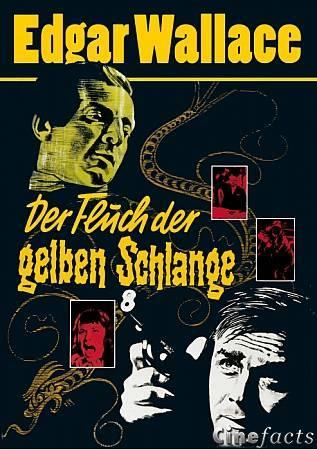
EUREKA! BOX SET RELEASE: TERROR IN THE FOG: THE WALLACE KRIMI AT CCC: Curse of the Yellow Snake (1963)

Directed by Franz Josef Gottlieb. who co-wrote it with Janne Furch, this krimi is based on The Yellow Snake by Edgar Wallace. It’s plot — prep for movies being made in 1963 not being as politcally aware as today — is about a Chinese cult taking over the world with an idol called The Golden Reptile. Fing-Su (Pinkas Braun) leads this cult and is at odds with his Western adopted brother, Clifford Lynn (Joachim Fuchsberger), who comes tosolve the case and is to be married off to one of two arranged marriages, either to Joan (Brigitte Grothum) or Mabel (Doris Kirchner).

Snake cults, human sacrifice, yellow peril — this is less krimi than straight up Sax Rohmer. That said, it looks good and has some fun moments to spare.

This is part of the Terror In the Fog box set and has extras including a new introduction by genre film expert and Video Watchdog founder Tim Lucas and audio commentary by Kim Newman and Barry Forshaw. You can get it from MVD.

CBS LATE MOVIE: Twilight of Honor (1963)

EDITOR’S NOTE: Twilight of Honor was on the CBS Late Movie on February 16 and June 5, 1972, April 11, 1974 and January 14, 1976.

Boris Sagal directed The Omega Man and died while making the miniseries World War III when he got out of a helicopter the wrong way in the parking lot of the Timberline Hotel in Portland — where The Shining exteriors were filmed — and the blades hit him in the head. He died five hours later. He also made this movie, which was written by Henry Denker and based on the book by Al Dewlen.

David Mitchell (Richard Chamberlain) is a widowed lawyer in a small city in New Mexico who is called in to be the public defender for an alleged murderer named Ben Brown (Nick Adams) who has been charged with murder. He’s up against Norris Bixby (James Gregory), with whom he shares a mentor, Art Harper (Claude Rains). No one gives Ben a chance, not even David, as he’s already confessed to the crime and in a small town like this, no jury will listen to him.

Harper reveals that he’s the reason why David got the case, as he’s too ill to try the case, but thinks that Ben deserves justice. Art’s daughter, Susan (played by Joan Blackman, also known for her role in Pets), serves as his secretary and love interest; she has pined for him ever since he was married.

After meeting the wife of the defendant, Laura-Mae Brown (Joey Heatherton), David learns that she was abused by him and hopes he dies in the gas chamber. But what is the truth? Yes, Ben may have killed off-duty cop Cole Clinton (Pat Buttram), but the cop was making time with Mrs. Brown, which could make this a justifiable homicide. But since the town loves Clinton and most of his wealthy friends are serving on the jury, there’s no way this can be won.

Mrs. Clinton (Jeanette Nolan) asks to meet David and reveals that yes, her husband slept around. If he drops the adultery charge, she will ask for mercy for the accused. She wants to keep her daughter (Linda Evans) from finding out what kind of man her husband really was. The lawyer refuses.

The truth is complicated, especially given that Laura received the reward for turning in her husband and is now sleeping with a member of the state’s legal team. Ben may have his issues — being suicidal, maybe loving the wrong woman — but he’s not guilty.

Chamberlain was a big star from the Dr. Kildare TV show, so this was his first role on the screen. It was controversial, as the novel was considered too adult for the clean-cut actor. As for Nick Adams, he excels in this role and was nominated for a Best Supporting Actor Oscar. He went on one of the highest-profile campaigns ever, but lost to Hud actor Melvyn Douglas. The public embarrassment led to Adams being offered fewer roles, an increase in the actor’s depression and may have played a role in him ending his life.

In the UK, this was renamed” The Charge Is Murder and was paired with Children of the Damned for one weird double!

You can watch this on YouTube.

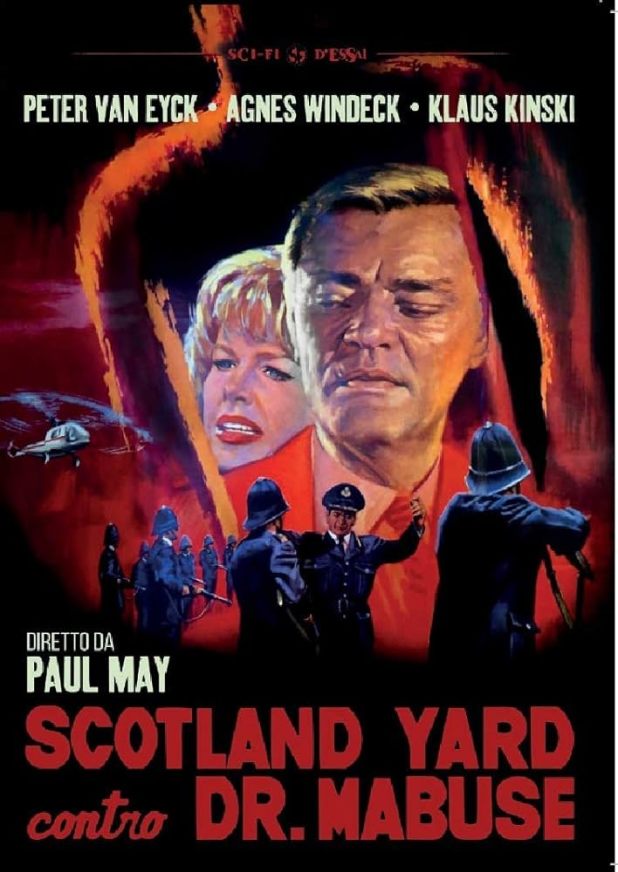
EUREKA BOX SET: Mabuse Lives! Dr. Mabuse At CCC: 1960-1964: Scotland Yard Hunts Dr. Mabuse (1963)

Directed by Paul May and written by Ladislas Fodor from a story idea by Bryan Edgar Wallace, this time Dr. Mabuse (Wolfgang Preiss) has returned as a ghost and Professor Pohland (Walter Rilla) and takes back his criminal empire. He then orders the death of a professor who has invented a mind control device, which puts the man’s daughter Nancy (Sabine Bethmann) into harm’s way, ready to be saved by hero Bill Tern (Peter van Eyck).

The thing I don’t like about this movie? Tern’s elderly mother (Agnes Windeck) has to save the day again and again. She should be the protagonist in this, not her son, who is dumb enough to jump into a river at one point and nearly die. What I did like was seeing Klaus Kinski show up as a cop who gets hypnotized and placed on the side of evil.

These movies have always hinted at a supernatural side of Dr. Mabuse and now, this one pays that off and somehow is one of the slowest of the series.

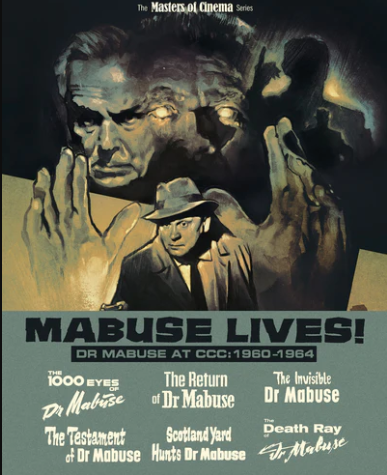
The Eureka box set Mabuse Lives! includes this movie, an introduction by genre film expert and Video Watchdog founder Tim Lucas, a new 1080p presentation from a 2K restoration of the original film elements undertaken by CCC, a commentary track by film historian and author David Kalat, and an alternate ending. You can get it from MVD.

EUREKA BOX SET: Mabuse Lives! Dr. Mabuse At CCC: 1960-1964: The Testament of Dr. Mabuse (1963)

A remake of the 1933 Fritz Lang film, this finds Dr. Mabuse (Wolfgang Preiss) in Hannibal Lecter mode — I get it, Lecter was in Mabuse mode because this comes first, but let me get back to writing this — and trapped in an asylum where Inspector Lohmann (Gert Frobe) keeps visiting, wanting to know how he’s communicating with criminals despite being locked away.

There’s also a boxer named Jonny Briggs (Helmut Schmid) who becomes part of Mabuse’s gang of henchpeople. Maybe he should just not live this life of crime and spend more time with his girl, Nelly. That’s because she’s played by Senta Berger (The Ambushers, When Women Had Tails), and that’s way cooler than being a hood for a mysterious mastermind, but what do I know?

I like how these films are gradually becoming more Eurospy. Here, the last film—The Invisible Dr. Mabuse—leads directly into this one. As no one in the U.S. knew who Dr. Mabuse was—or so they say, despite nearly all of the CCC movies coming out here—this was released as The Terror of the Mad Doctor. This time around, Werner Klingler directs.

The Eureka box set Mabuse Lives! includes this movie, an introduction by genre film expert and Video Watchdog founder Tim Lucas, a new 1080p presentation from a 2K restoration of the original film elements undertaken by CCC, a commentary track by film historian and author David Kalat, and an alternate ending. You can get it from MVD.

WEIRD WEDNESDAY: 13 Frightened Girls! (1963)

I’ve been inspired by the book Warped & Faded: Weird Wednesday and the Birth of the American Genre Film Archive and have decided that every Wednesday on the site will be films that played as part of the Alamo Draft House Weird Wednesday events.

William Castle loved a gimmick. Here, he promised that each of the thirteen girls would be from their own country, even if Judy Pace plays a Liberian. Our American heroine, Candace “Candy” Hull (Kathy Dunn), is fresh out of school and devoted to trying to win the heart of spy Wally Sanders (Murray Hamilton). She goes into espionage herself before getting in trouble.

The rest of the ladies, except Dunn, Lynne Sue Moon (who plays Mai Ling), and Gina Trikonis (who plays Natasha), won their roles in a contest and use their real names for their roles.

Candy and her friends are all the children of diplomats and used to be among the upper crust. But what happens when a spy is killed? Also, there are fifteen girls, not thirteen. But mostly, it’s Candy using the name Kitten and getting in too deep.

The other girls include Alexandra Basterdo (The GhoulThe Blood Spattered Bride), Lynne Sue Moon (55 Days at Peking) and Gina Trikonis (West Side Story and later a costume designer).

This played double features with Gidget Goes to Rome, which may not be what you expect from a William Castle Movie.

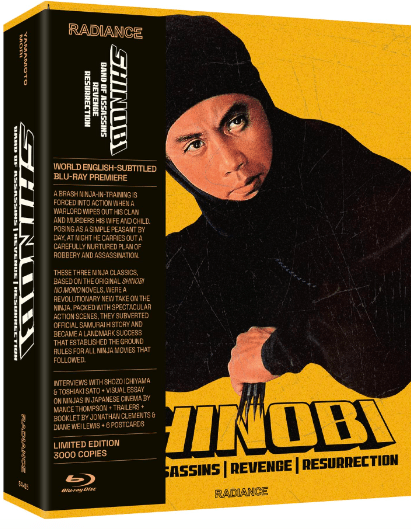
RADIANCE FILMS BOX SET RELEASE: The Shinobi Trilogy (1962,1963)

We often think that ninjas only started to exist in the 80s. Yet, in the early 60s, there was a craze in Japan because of the Shinobi no Mono books and these three movies. Written by Tomoyoshi Murayama, these stories were serialized in the Sunday edition of the newspaper Akahata from November of 1960 to May of 1962, with the name meaning “ninja.”

The novels are set during Japan’s Sengoku period and star Goemon Ishikawa, a famous outlaw hero who used his ninja skills to battle the samurai. While the real man and his son were boiled alive in public after their failed assassination attempt on the warlord Toyotomi Hideyoshi, the fictional version has become a Robin Hood-like character, a man with near-superhuman ninja powers at times.

Goemon had already been the subject of several pre-WWII Japanese films- Ishikawa Goemon Ichidaiki and Ishikawa Goemon no Hoji. Still, in the early 60s, when a thief protecting villagers against the rich and powerful would be a theme that resonated with the Japanese, he became a pop culture sensation.
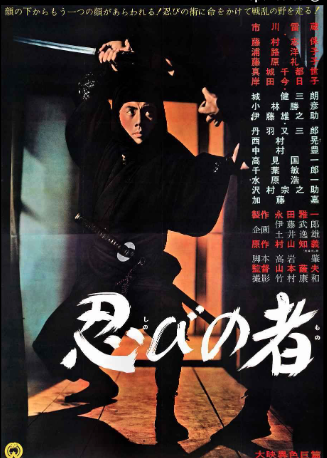
Band of Assassins (1962): Raizo Ichikawa plays Goemon as a young man here, a member of a ninja clan who must constantly worry about being found and destroyed by the samurai. He’s been selected to kill Nobunaga Oda (Tomisaburo Wakayama), which makes the other ninjas jealous. So now, Goemon is nearly a man without a country as he must deal with assassination attempts, double crosses and his mission.

Directed by Satsuo Yamamoto, this turned into the kind of movie that grabbed the attention of Japanese kids. It was intended to be one and done, but by the end, even though only Goemon survives and can escape this world of treachery and violence to have a family, he had to return. Ninjas, a real thing that had disappeared from the world- or is that what they want you to believe? — only to take over pop culture twice in the 20th century.

Revenge (1963): Nobunaga Oda has killed all of the ninjas of the Iga clan, yet he doesn’t know that Goemon has survived. Our hero just wants to build a family and disappear- ninjas are good at part of that- but he’s soon pulled back into combat when his infant son is killed.

Instead of running straight into the bad guys, as most action heroes would, Goemon uses psychological trickery and his ability to hide just about anywhere to drive his enemies crazy. Unlike the first film, where his honor is constantly on the line and he must watch everyone, his goals in this film are much more straightforward: kill the people who ruined his life.

Even though Goemon is boiled alive at the end of this- but not before shouting out the bad guys as way worse thieves than him- there’s still one more movie. How can that happen?
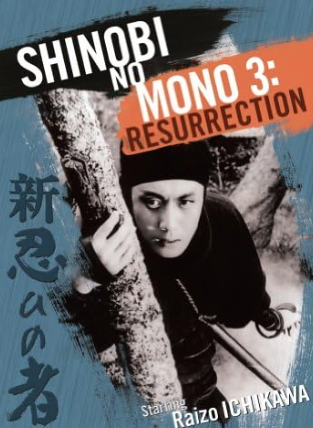
Resurrection (1963): Thanks to Hattori Hanzo (Saburô Date)- yes, the same man who made swords in Kill Bill– Goemon has survived, as he was switched out with another ninja at the last minute. I didn’t see it happen, but that’s just how talented a master ninja can be.

This idea was enough to get director Satsuo Yahamoto to quit the series, which brought in Kazuo Mori to make this for Daiei. It’s revisionist history- perhaps this is where Tarantino got the idea to save Sharon Tate- but in the service of pop culture and film commerce.

Now, he must get the revenge he’s craved for two movies now and take out Toyotomi Hideyoshi (Eijiro Tono). This is more personal and has less swordplay, but I’m sure audiences were ready for more, seeing as how all three of these movies were made over two years.

The Radiance Blu-ray box set of the Shinobi trilogy has digital transfers of each film presented on two discs, made available on Blu-ray for the first time outside Japan. Extras include an interview about director Satsuo Yamamoto with Shozo Ichiyama, artistic director of the Tokyo International Film Festival, a visual essay on the ninja in Japanese cinema by film scholar Mance Thompson, an interview with film critic Toshiaki Sato on star Raizo Ichikawa, trailers, six postcards of promotional material from the films, reversible sleeves featuring artwork based on original promotional materials and a limited edition booklet featuring new writing by Jonathan Clements on the Shinobi no mono series and Diane Wei Lewis on writer Tomoyoshi Murayama. This limited edition of 3000 copies is presented in a rigid box with full-height Scanavo cases and removable OBI strip, leaving packaging free of certificates and markings. You can get this from MVD.

UNSUNG HORRORS HORROR GIVES BACK 2024: Voyage to the End of the Universe (1963)

Each October, the Unsung Horrors podcast does a month of themed movies. This year they will once again be setting up a fundraiser to benefit Best Friends, which is working to save the lives of cats and dogs all across America, giving pets second chances and happy homes.

Today’s theme: Black & White

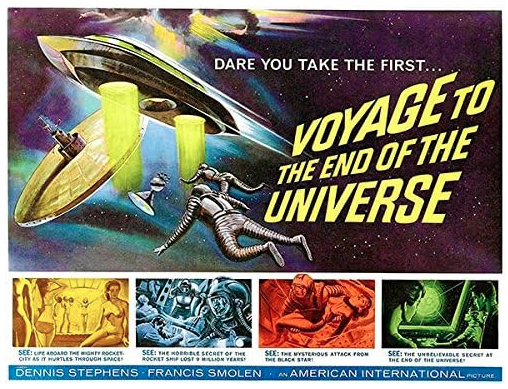
What were American audiences thinking when they got this Czechoslovakian movie dubbed into English, once Ikarie XB-1 and now Voyage to the End of the Universe?

I hoped they loved it.

2163: The 40-person multinational crew of the starship Ikarie XB-1 has spent 28 months at light speed — 15 years of human time — to get to the Green Planet, a mysterious body that humans may be able to live on. To get there, they have to deal with an ancient ship packed with nukes, a radioactive dark star and the crew slowly falling to pieces. Like Dark Star. Or even 2001.

American-International cut twenty-six minutes of this (including a scene where a UFO carries dead capitalists), changed the White Planet to the Green Planet and gave it the new name. But the worst change is that at the end of the original, the crew sees that the planet is populated. In this one, they land and see stock footage of the Statue of Liberty, giving it a gimmick ending.

Director Jindřich Polák used the same props from this film for his next project, a 1963 TV series entitled Klaun Ferdinand a raketa. His career went between science fiction and children-friendly movies, along with some crime movies. He based this on the Stanisław Lem book The Magellanic Cloud and co-wrote it with Pavel Jurácek.

I really enjoyed this, as it seems to get across what it would be like to be a space traveler. The claustrophobia, the worry, the food not being digestible — it gets all the small parts that others forget about correct.

You can watch this on YouTube.

CHILLER THEATER MONTH: Evil Eye (1963)

EDITOR’S NOTE: Evil Eye was on Chiller Theater on Saturday, August 14, 1971 at 11:30 p.m. It’s also known by its Italian title, The Girl Who Knew Too Much

Mario Bava is a genius. This is the root of all giallo before The Bird with the Crystal Plumage and it stars John Saxon as Dr. Marcello Bassi and Leticia Roman as Nora Davis, a young girl who travels to Rome only to witness murder after murder. No one believes her because there’s no corpse. And it only gets worse for her.

Nora was in Rome to help her sickly aunt, who dies the first night that she’s in the city. After walking to a hospital to alert Bazzi, Nora is mugged. When she awakens, she watches a man pull a knife from a woman’s back. The police think she’s an alcoholic and send her to a sanitarium, where she’s rescued by Bazzi.

One of her aunt’s friends, Laura (Valentina Cortese), goes on vacation, allowing Laura to stay in her home. But our detective fiction obsessed heroine can’t resist snooping, finding a series of articles about a serial killer that the press are calling the Alphabet Killer, as he or she kills in alphabetic order. The last murdered person was Laura’s sister, but that was ten years ago. That’s when the phone rings and a voice tells her that “D is for death” and how she will be the next victim.

Nora begins to fall from the doctor and after they tour the city, she gets a phone call that leads them to an empty room with a recorded message telling her to leave the city if she wants to live.

The giallo conventions that we know and love originate here: a foreigner who can’t remember every detail of a murder, now in danger from the killer and unable to be helped by the police, causing them to turn to their own detective skills. Red herrings abound. And the killer seems to be one person, only for their identity to come out just before the end of the film. What is missing are the more psychosexual and high fashion parts of the genre, but don’t worry. They’ll soon show up in force.

The film was the least commercially successful picture of Bava’s career, as giallo films didn’t find favor until Argento’s 1970’s efforts. It was released in the United States by American International Pictures as Evil Eye, part of a double bill with Black Sabbath. This version features a different score and more of an emphasis on comedy.

You can watch this on Tubi.