April 20: Screw the Medveds — Here’s a list of the movies that the Medveds had in their Golden Turkey Awards books. What do they know? Defend one of the movies they needlessly bashed.
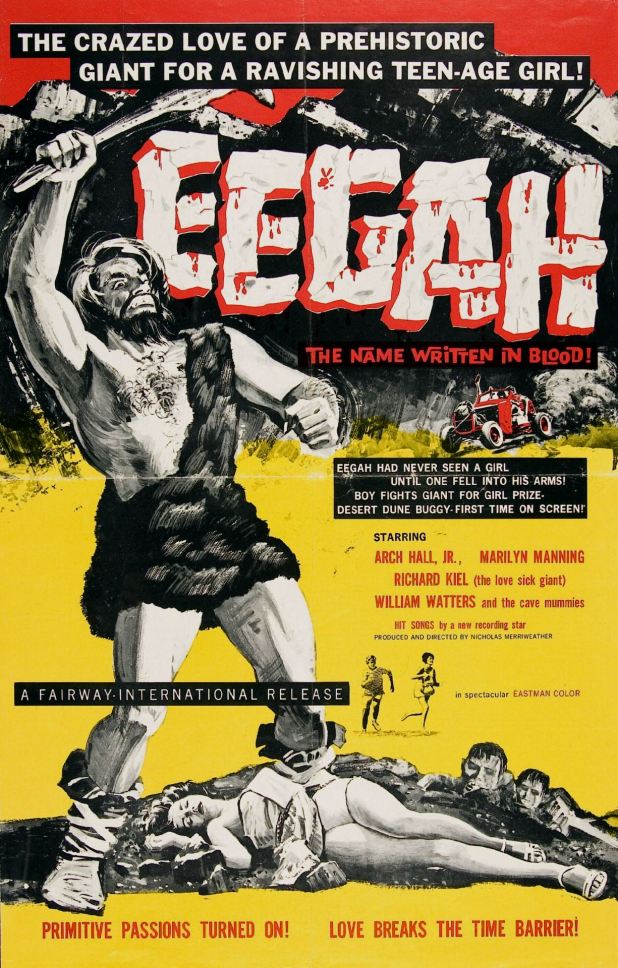
In The Golden Turkey Awards, the Medveds claim that Arch Hall Jr.’s performance as Tommy is “one of the low points in the history of American cinema” and that he has “a face only a mother could love.” He was sixteen when he made this movie, so that feels like a lot of punching down.
Well, maybe they were mad that their dad never put them in a movie.
Well, Arch Hall Sr. thought his son was going to be a star — even if that son said that he couldn’t sing — and made an Elvis movie starring his boy.
Roxy Miller (Marilyn Manning) drives out and accidentally hits Eegah (Richard Kiel) with her car. When she tells her boyfriend Tom Nelson (Arch Hall Jr.) and her father Robert (Arch Hall Sr.), her dad runs out into the desert to try and get a picture. He disappears, she finds him and he’s learned how to speak to the creature and has learned how it has stayed alive all this time. Of course, Eegah wants to marry his daughter, so he says alright, hoping that they can escape.
When they do, Eegah runs after them and dies at a pool party, but not before Ray Dennis Steckler gets thrown into the water. He would go on to make the next Arch Hall Jr. movie, Wild Guitar.
This was shot in the same Bronson Canyon area that Robot Monster was filmed at. In fact, Ro-Man’s base is the same cave that Eegah makes his home.
My favorite thing in this movie was that the sound recorder screwed up his job, so when Robert yells, “Watch out for snakes!” his lips never move.
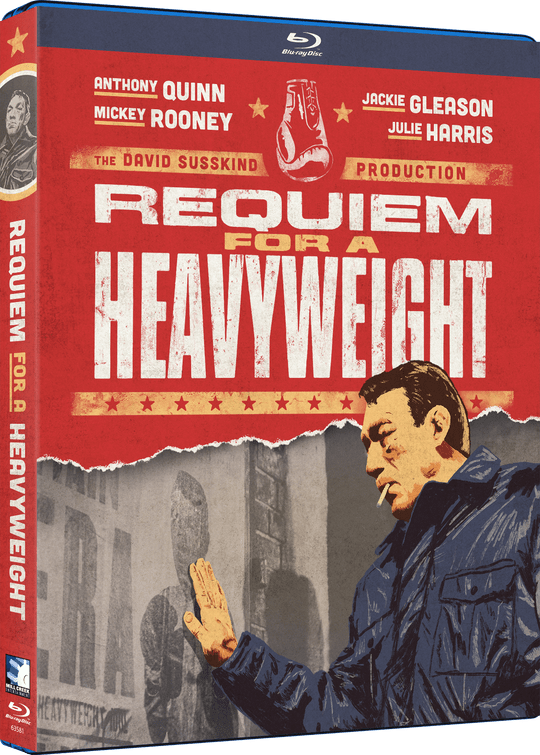
After nearly two decades years in the ring, Luis “Mountain” Rivera (Anthony Quinn) learns that one more punch could leave him permanently disabled. With the help of his trainer Army (Mickey Rooney) and an employment counselor named Grace Miller (Julie Harris), he tries to escape the fight game and work outside the ring. Yet his manager Maish Rennick (Jackie Gleason) has big debts and the only way he can pay them back is to get Rivera to become a pro wrestler, which this movie paints as the most humiliating thing ever, which seems funny today seeing as how popular sports entertainment has remained.
Originally a live telemovie that aired on Playhouse 90 with Jack Palance as Rivera, Keenan Wynn as Maish, Kim Hunter as Grace, Keenan’s father Ed as Army and a completely different ending, the original and this film were both directed by Ralph Nelson and written by Rod Serling (who had 17 matches as a boxer in the army).
Boxers Muhammed Ali and Jack Dempsey, as well as wrestlers Haystacks Calhoun and Gorgeous George, appear as themselves.
Nelson was critical of Quinn’s performance, as he wrote to Life magazine to say, “As written, the hero was a lonely, sensitive human being, a prizefighter who had worked out his hostilities in the ring. Jack Palance won an Emmy for his hauntingly gentle performance on Playhouse 90. Quinn was afraid that gentleness would reflect upon his image of masculinity, so chose to play Sonny Liston instead. I believe Palance’s concept was truer to the role and fulfilled the concept of the script more effectively than Quinn’s attempt to dominate it.”
This is a dark movie as Serling often saw the worst in humanity and often didn’t show a way out for them. Rivera has to sacrifice his own dignity to save a man who has treated him poorly and only shed tears for him once, but to him, that was enough.
EDITOR’S NOTE: You can read Sean Mitus’ article about this movie here.
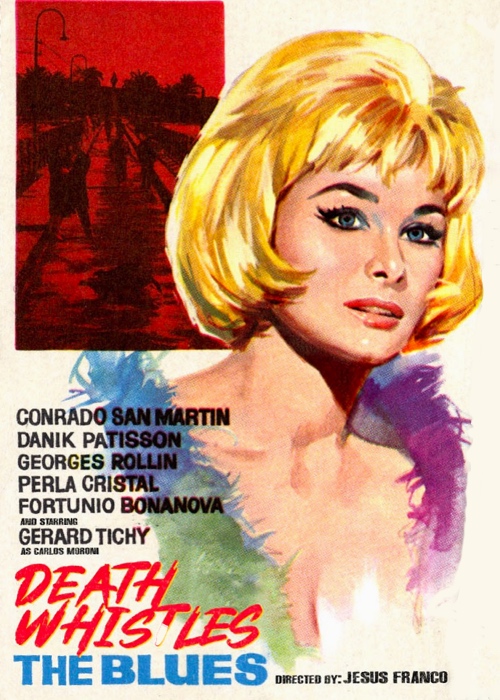
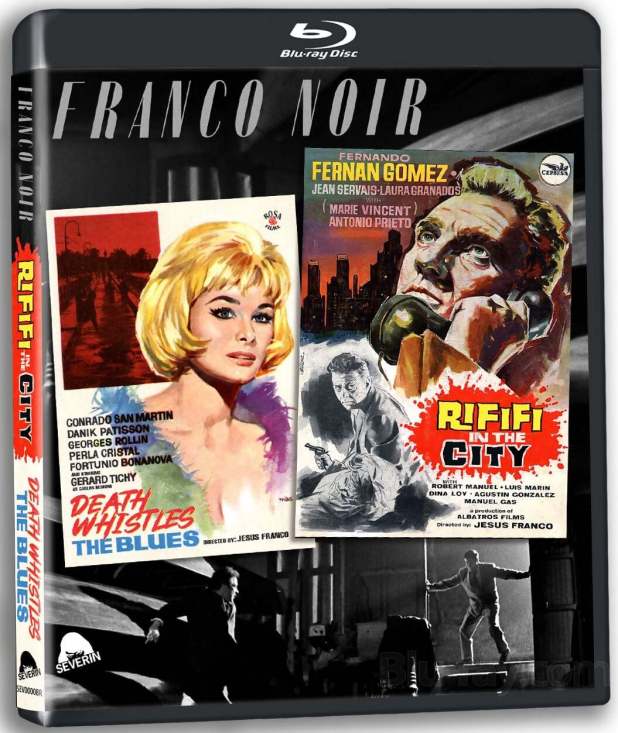
Jess Franco remade this in 1977 as Kiss Me Killer, but before that, this black and white slice of noir feels like an altogether different director. Sure, there’s jazz — Franco himself is playing saxophone in one scene — but this looks and feels different to me. Sure, the easy difference is the black and white, but it feels like a different kind of sexy, if that makes sense. Both this and Rififi in the City have a certain look that I’d like to have seen more often.
Years ago, a guns for money deal went wrong. Trumpet player Julius Smith (Manuel Alexandre) thought he got away with it and then one night he’s spotted by Lina (Perla Cristal), whose husband Castro was killed when it all went wrong. Now, she’s married to another man of loose morals, Paul Vogel (Georges Rollin), who knows way more about hos Julius died than he lets on. The cops decide to find out just how much and have a new singer named Maria Santos (Danik Patisson) join the club and get close to him. Then, Castro (Conrado San Martin) comes back, the final member of the old smuggling operation, stinging from a decade in prison.
This movie looks great, way better than its budget and I get it, it’s not New Orleans, but who cares? I also love that this is an early shared universe for Jess, as The Stardust nightclub also appears in Rififi in the City. All that’s missing is a jewel thief, Dr. Orloff, Lina Romay in a blonde wig (that said, she was eight when this was made), vampire women and a mist that makes women enraptured.
You can buy this from Severin as part of their Franco Noir set or watch it on Tubi.
ABOUT THE AUTHOR: Jennifer Upton is an American (non-werewolf) writer/editor in London. She currently works as a freelance ghostwriter of personal memoirs and writes for several blogs on topics as diverse as film history, punk rock, women’s issues, and international politics. For links to her work, please visit https://www.jennuptonwriter.com or send her a Tweet @Jennxldn
This is Not a Test shares much in common Panic in Year Zero directed by Ray Milland. Both were low-budget productions released in 1962 and both deal with a group of strangers who come together in the California desert outside Los Angeles before/during a nuclear attack. Equally, both seem quaint in 2022. This is Not a Test, in particular presents a highly unlikely scenario for audiences who grew up on Mad Max or zombie apocalypse films. A lone Deputy Sheriff played by Seamon Glass sets up a roadblock on a lonely mountain pass to catch Clint (Ron Starr), a hitchhiking killer on the run. A truck carrying the fugitive along with a few other vehicles are stopped, giving Clint just enough time to flee into the darkness while all the other characters are introduced. We have a couple of gamblers, a married couple on the outs with their dog Timmy, a wise old man and his granddaughter Juney and – joining them later – a nice guy on a scooter. When news of a pending missile attack comes across the police radio, not only does the cop stay at his post, but all eight of the people stopped at the roadblock comply with his every command for the majority of the film. If this film were made today, Deputy Sheriff Dan Colter would either raid the delivery truck and flee the scene, or have his gun stolen and become Deputy Sheriff pork shoulder. In 1962, he’s the law and so “We have to do what he says.”
That’s not to say that things don’t go sideways. Colter is truly an idiot, making all the wrong decisions, including destroying a whole case of booze, which could not only be used to start fires in the post-apocalyptic world, but also to disinfect wounds. Not to mention act as a sedative against the coming horrors.
Things unravel quickest for the dissatisfied married couple once the wife realizes her likelihood of survival is small. Looking for one last moment of happiness, she almost immediately falls into the arms of the truck driver, leaving her cuckolded husband to shoot himself with Colter’s gun in the very next scene while everyone else prepares the back of the truck as a shelter. While a few people choose to stay outside, the majority of the remaining group empty out the back of the truck and cover the air vents with mud. Although they initially plan to hunker down for at least 14 days, once inside, it takes all of 10 minutes for them to become exceptionally sweaty and claustrophobic. Colter kills Timmy the little dog for taking up too much air, a fight ensues and the group bursts forth from the back of the truck only to be greeted by a gang of looters in fresh from the hellscape that is now Los Angeles.
Before any Negan-style nastiness ensues, the final countdown comes over the radio. Some of the people finally knock Colter unconscious, and take his car while the looters barricade themselves inside the back of the truck. Colter wakes up to find Clint running past, who, having been hiding in the woods for the pat 75 minutes, has no idea what’s going on. The film ends with Colter begging to be let inside the back of the truck. The screen turns white, we hear an explosion. The End.
Despite its outdated social platitudes, It’s not a bad little movie. The location is used to good effect and the acting is pretty good. Although nowhere near as gruesome as the later films about nuclear war made in the 80s like The Day After, or the incredibly dark British outing Threads, which gave me nightmares for weeks, This is Not a Test is sufficiently bleak to satisfy fans of this well-worn subgenre. Best of all, it’s available for free on YouTube.
EDITOR’S NOTE: This was first on the site on March 28, 2021.
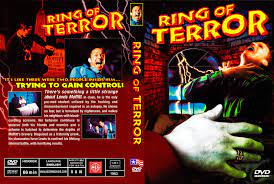
Despite playing college students, nearly everyone in this movie is pushing forty. If you can get past that, well, there’s a lot more wrong with this movie, but it’s just weird enough that it’s worth watching.
Medical student Lewis Moffitt (George E. Mather, who was 42 when this would made* and would go on to supervise the miniatures and optical effects for Star Wars) is afraid of the dark, ever since he saw a dead body when he was a little kid. Now that he’s in college — he must be a non-traditional freshman — the fraternity he’s trying to rush makes him steal a ring — a Ring of Terror? — from a dead man.
Clark Paylow, who directed this, was the second unit guy on so many beach movies and the production manager for The Conversation and Close Encounters of the Third Kind.
*Actually, he was 35, as this was shot in 1955 and not released for several years after it was finished.
You can watch the Mystery Science Theater version of this movie on Tubi. You can also download the original cut of this movie on the Internet Archive.
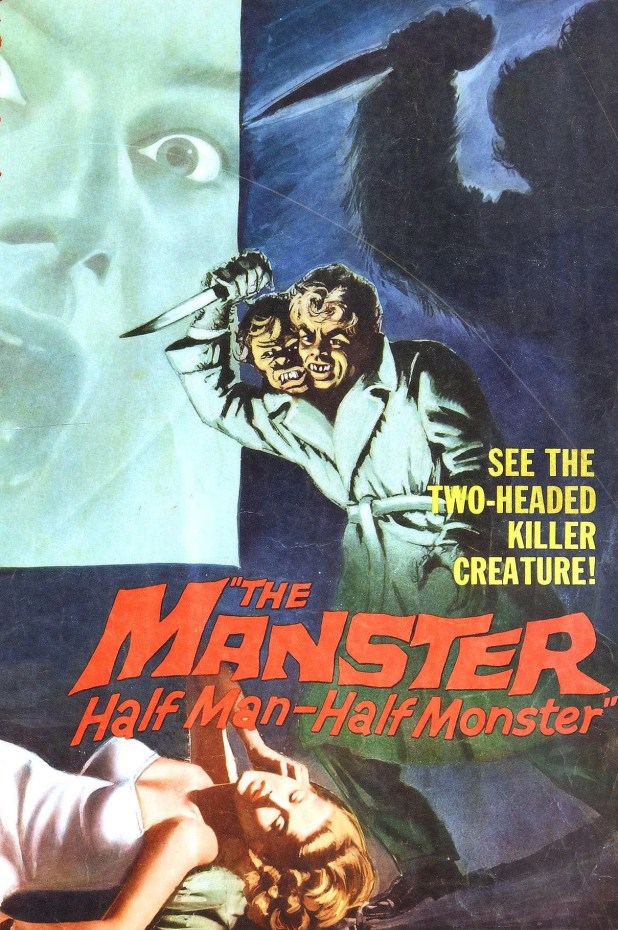
Also known as Soto no Satsujinki or The Two-Headed Killer, The Manster was directed by Greg Breakstone, who was Beezy in the Andy Hardy movies. It was one of several movies that he made in Japan, where he stayed after World War II, including Geisha Girl and Oriental Evil. It was co-directed by Kenneth G. Crane, the movie’s editor, and written by. William J. Sheldon.
Larry Stanford (Peter Dyneley) has been in Japan too long for his wife Linda (Jane Hylton), who wants him back in the U.S., but his last job is interviewing Dr. Robert Suzuki (Tetsu Nakamura), who works with his assistant Tara (Terri Zimmern) to slip him a mickey, the kind of libation that causes a monster to grow right out of his shoulder. By the end of the movie, Larry has become two totally different beings, one willing to toss women into volcanos.
The Manster isn’t great, but it sure is fun. I mean, when else would you get to see someone fight his evil side on the rim of an active volcano?
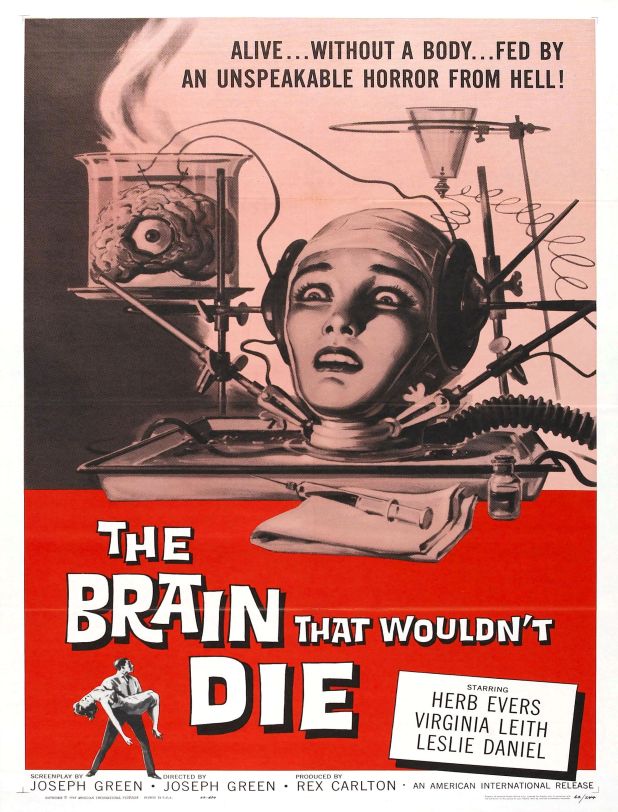
I really dislike anyone who makes fun of this movie. It’s been riffed and goofed on for years, but it’s way better made than it has any right to be and is filled with some big ideas that other movies from its genre and time never would dare to include.
Shot independently around Tarrytown, New York, in 1959 under the working title The Black Door, this film finds Dr. Bill Cortner (Jason Evers) as a surgeon who just won’t accept that death is the end for his patients. And when his fiancee Jan Compton (Virginia Leith) is critically injured in a car accident that he causes, he takes her head and along with his crippled assistant Kurt (Anthony La Penna), he struggles to find her a new body to transplant her still living head on.
While Jan loses her mind due to pain and the sheer oddity of being alive without a body, Dr. Bill hits the go go clubs looking for the perfect body for her. That’s one of the strangest and most delightful moments here, as instead of just any body, Dr. Bill realizes that he needs a body that best answers his sexual needs, which means he cares less about saving Jan than satisfying his repressed desires.
Throughout this story and its slowly going mad rush to tragedy, there’s a past experiment hidden behind the door. It’s played by Eddie Carmel, a 7’3″ circus performer who was known as The Jewish Giant.
This was directed and written by Joseph Green, who owned Joseph Green Pictures. It was such a tiny corporation that it had one employee, Joseph Green, and brought so many wild movies to screens like Jess Franco’s Kiss Me Monster and Two Undercover Angels, Claude Chabrol’s Pleasure Party, Something Creeping in the Dark, Death Knocks Twiceand his own film, The Perils of P.K.
I love the way this movie takes our world and instead creates its own, a place where strippers fight on stage, where camera clubs are a plot point — Sammy Petrillo is one of the dirty men taking pictures! — and old girlfriends can be wooed back just to potentially get to be the body for a new fiancee.
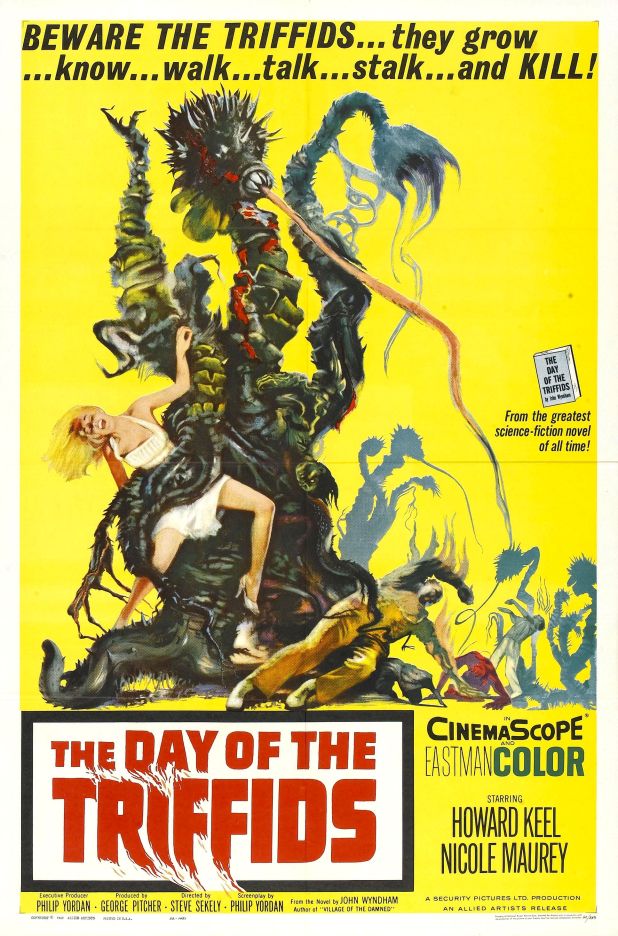
As London was assaulted by the Blitz, writer John Wyndham was who witnessed the destruction of the city from the rooftops of Bloomsbury. Many of the scenes and incidents he saw, including a quiet Sunday morning after the bombs fell, were sent in letters to his long-term partner Grace Wilson and they are in his novel The Day of the Triffids. The book also suggests that while the plant-like triffids came from space, their ability to destroy our planet came from an over-reliance on technology.
Albert R. Broccoli and Irving Allen had purchased the film rights and hired Jimmy Sangster to write the script, which intimidated the screenwriter. He didn’t think that his script was good, but that version was never made. This version, written by Bernard Gordon, who had been blacklisted due to the testimony of producer William Alland. Through his friendship with Philip Yordan — and yes, Night Train to Terror does connect to everything — the writer found regular work as a writer and producer for Samuel Bronston Productions in Madrid, even if through the goodness of his heart Yordan received full credit on movies like CircusWorld, Battle of the Bulge, Custer of the West, The Thin Red Line, Cry of Battle and Horror Express.
Gordon was under FBI surveillance for twenty years and we wouldn’t know that he’d written many movies if it wasn’t for journalist Ted Newsom, who discovered that Gordon was the real name behind the kayfabe author credit Raymond T. Marcus. Gordon led all blacklisted creatives when the Writers Guild of America correctly credited pseudonymous screenwriters from this era.
As for Yordan, he once told his friend Gordon, “It’s Jews like you who ruined the motion picture industry with this anti-hero shit.”
As for Day of the Triffids, it’s loosely based on the book and doesn’t really get across the apocalyptic menace within its inspiration’s pages. It does, however, have giant plants spitting poison that kills at Janette Scott, so there’s that.
Directed by Steve Sekely and Freddie Francis*, it prefigures the way that zombies keep coming in waves that trap humans within increasingly smaller places to hide. Indeed, the hospital scenes in the book inspired 28 Days Later. The goofy inspiration is that the plants are turned back by seawater, a plot twist that would be used to ridiculous effect decades later in Signs.
*Kieron Moore and Janette Scott weren’t in the original cut of the film. It turns out that there were only 57 minutes of good usable footage available, so Francis directed the entire lighthouse sequence to pad the movie.
Also known as I Hate Your Guts, Shame and The Stranger, this film was bought by Roger Corman from Seven Arts in 1960. He originally saw Tony Randall as the star and the movie was turned down by AIP, UA and Allied Artistsbefore he raised the money with help from Pathé Labs, with Corman and his brother Gene paying the rest. That said, Pathé eventually got cold feet and the Cormans distributed the movie themselves.
Even though it cost only $90,000, this was one of the few Corman movies to lose money.
Corman said, “We put our hearts, our souls – and what few people do – our money into this picture. Everybody asked us “Why would you make this picture?” as if to say why try to do something you believe in when everything else is so profitable. Obviously we did it because we wanted to, and we think it’s a damn good job.”
It did teach Corman a valuable lesson. He said, “I think it failed for two reasons. One: the audience at that time, the early sixties, simply didn’t want to see a picture about racial integration. Two: it was more of a lecture. From that moment on I thought my films should be entertainment on the surface and I should deliver any theme or idea or concept beneath the surface.”
Based on the Charles Beaumont novel of the same name — Beaumont also wrote the screenplay — The Intruder has Adam Cramer (William Shatner) has shown up in the small Southern town of Caxton to disrupt integration. Even though he’s a stranger and not even a Southerner, he soon charms the entire town into going from accepting blacks and whites in the same school to attempting to use that very same school’s swingset to lynch a black student.
Shatner has claimed that the lives of the cast and crew were threatened, equipment was destroyed and permission to film in a local schoolyard was revoked. He was also told that a tree in one scene actually was used for lynching. And then the entire production was kicked out of East Prairie, MO for being Communists.
About the Author: Sean Mitus grew up watching “Chiller Theater” & Pittsburgh UHF Channels and has been a drive-in enthusiast for the last eight years. Sean enjoys all genres but has lately become fascinated with Italian horror, giallo and poliziotteschi films.
Want something different from Jesus “Jess” Franco’s eurosleaze/eurohorror filmography, well look no further than Severin Films’ wonderful two-in-one disc Franco Noir. The prolific career of Jess Franco, born Jesus Franco Manera, spanned seven decades from 1954 to 2013. Franco’s early filmography fit with more traditional Spanish cinema showing an entertaining visual flair.
Shortly after he directed The Awful Dr. Orloff, Franco directed La Muerte Silba Un Blues AKA Death Whistles the Blues in 1962. It was a spirited foray into the crime genre taking inspiration from Film Noir. Just one film later, Franco directed Rififi en la ciudad AKA Rififi in the City (connection to Jules Dassin‘s Rififi by the definition of rififi meaning trouble/violent conflict/a brutal show of force).
Both films have the dramatic light and dark shading typical of film noir. Death Whistles the Blues has creative camera moves in the opening scene with the death of a musician and fine tracking and crane shots throughout. There’s also a fine action sequence with exciting staging and flashy editing. Rififi in the City has even more use of noir dark and light contrast throughout. Both films feature wonderful jazz scores with live performances that add flavor to the proceedings.
As for the story, all you need to know is Death Whistle the Blues deals with double-crosses and betrayals coming back to haunt some of the characters. Rififi in the City followed a dogged policeman setting out to avenge a confidential informant’s killer while those involved meet their deaths at the hands of a surprise killer.
Do yourself a favor and check out Death Whistles the Blues and Rififi in the City for good examples of noir cinema from Jess Franco. You won’t be disappointed!
You can get both of these movies in the Franco Noir set from Severin.



 B&S About Movies
You must be logged in to post a comment.