EDITOR’S NOTE: Swamp of the Lost Monsters was on Chiller Theater on Saturday, September 20 at 11:20 p.m. and Saturday, January 2 at 1 a.m.
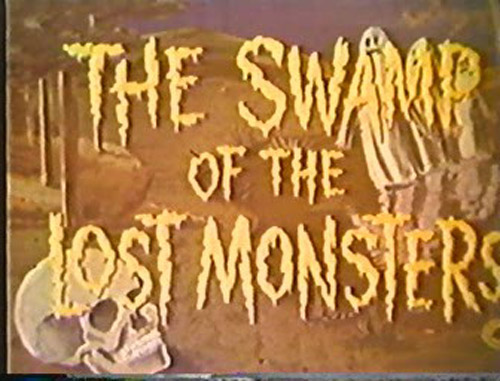
A small Mexican village is dealing with not just the death of a man, but the fact that his body has disappeared too. Now, his brother and a cowboy detective friend (Gaston Santos, who played the same role of a cowboy against the unknown in The Living Coffin, Los Diablos del Terror, La Flecha Envenenada and El Potro Salvaje) head out to battle the gang that killed the man and now want his insurance money.
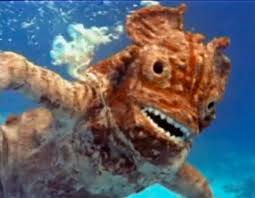
There’s one complication: a man-fish who is just swimming around town.
Seriously, I would have never watched this movie if it wasn’t for the look of this humanoid fishy man. He’s amazing and every moment he’s on screen elevates this movie from typical sagebrush adventure to the realm of absurdity.
Also known as Swamp of Lost Souls, it was directed by Rafael Baledon, who also brought us Orlak, el Infierno de Frankenstein.
EDITOR’S NOTE: Not of This Earth was on Chiller Theater on Sunday, January 19, 1964 at 11:10 p.m.; Saturday, February 6, 1965 at 1:00 a.m. and Saturday, September 16, 1967 at 1:00 a.m.
At 67 minutes, this movie was made to be shown with Attack of the Crab Monsters. Its stars Paul Birch as Mr. Johnson, a man quite literally not of this Earth because he’s an alien from Davanna with blank eyes that can burn right into your brain. If you start to like him, remember that he starts the movie by removing the blood of a teenage girl with some tubes that he keeps in his attache case.
Davanna is dying from the end of a nuclear war which has turned everyone’s blood to dust. Now, as he waits in Los Angeles, Mr. Johnson is attempting to solve the issues with his peoples’ blood. He has a houseboy named Jeremy (Jonathan Haze) and hires away nurse Nadine Storey (Beverly Garland) from a man he has hypnotized, Dr. F.W. Rochelle (William Roerick).
The police are wondering who the vampire killer is, but Mr. Johnson is just trying to stay alive. And look out anyone — like Dick Miller as a vacuum salesman — who comes to his home. Soon, another alien (Anna Lee Carroll) shows up but her blood becomes laced with rabies. She’s not the last as even though Johnson perishes in a car crash — a police siren is too much for his alien hearing — another alien that looks just like him shows up at his grave.
Director Roger Corman and Charles B. Griffith (who wrote the screenplay with Mark Hanna) worked together quite a lot. Griffith said of the story, “It started all this X-ray eye business. Most of Roger’s themes got established right in the beginning. Whatever worked, he’d come and take again, and a lot of things got used over and over. During the production of Not of This Earth, I was married to a nurse, and she helped me do a lot of medical research. I remember how we cured cancer in that script. Somehow the film was a mess when it was finished.”
Birch had no fun making this, as he had to wear the painful contacts all day as Corman wanted to shoot whenever with no prep. The actor was so upset he left before filming was done, so in some shots, that’s not him. Luckily, he has on a hat and sunglasses often, so he was easy to fake Shemp in this by Lyle Latell. Before he left the set, he said, “”I am an actor, and I don’t need this stuff… To hell with it all! Goodbye!”
This has been remade twice, once by Jim Wynorski with Traci Lords as Nadine in 1988 — Wynorski made Roger Corman a bet that he could remake the 1957 film with the same budget and schedule thirty years later — and in 1995, directed by Terence H. Winkless and part of the Roger Corman Presents series.
If you watched this on TV in the 1960s (or any time), there are three more minutes that were added by Herbert L. Strock right after the credits. A voice intones “You are about to adventure into the dimension of The Impossible! To enter this realm you must set your mind free from earthly fetters that bind it! If the events you are about to witness are unbelievable, it is only because your imagination is chained! Sit back, relax and believe.. so that you may cross the brink of time and space.. into that land you sometimes visit in your dreams!” If you’re wondering if a scene or two are repeated, they are so that the movie fit into TV schedules. There were also three scenes that were extended in some theatrical prints: the scene in which Johnson speaks with the courier, him chasing Nadine and when Harry chases him.
BONUS WILDCARD WEEK (September 22 – 28) Go order something from the SWV website and watch it!
There are nine Sūpā Jaiantsu (Super Giant) movies that were first shown in Japan. Takeo Nagamatsu’s 1930 kamishibai The Golden Bat (Ōgon Batto) may have been Japan’s first modern superhero and Gekkō Kamen (Moonlight Mask) the first hero to be on TV, but the first actual super hero movie in Japan was this one.
It was bought for distribution to U.S. television and edited into four films by Walter Manley Enterprises and Medallion Films. The first two original Japanese films, Super Giant and Super Giant Continues, have been cut, edited and have library music instead of the original soundtrack. Also, Super Giant became Starman.
The Mysterious Spacemen’s Demonic Castleand Earth on the Verge of Destruction were turned into Invaders from Space, while The Artificial Satellite and the Destruction of Humanity and The Spaceship and the Clash of the Artificial Satellite was released in the U.S. as Attack from Space. The last film, Evil Brain from Outer Space, is edited together from three movies, The Space Mutant Appears, The Devil’s Incarnation and Kingdom of the Poison Moth.
The films were also sold to France and Italy, where Super Giant is known as Spaceman.
Ken Utsui plays the hero and he always downplayed this movie when interviewed. Some say he was upset about the costume, which had a stuffed crotch. In the first installment, he fights to save the Earth from the country of Metropol and their nuclear arsenal. You’ll notice the connection to sentai shows like Power Rangers with this, but it’s also very similar to the American TV version of Superman. I loved it when I was a kid and still do.
September Drive-In Super Monster-Rama is back at The Riverside Drive-In Theatre in Vandergrift, PA on September 27 and 28, 2024. Admission is still only $15 per person each night (children 12 and under free with adult) and overnight camping is available (breakfast included) for an additional $15 per person. You can buy tickets at the show but get there early and learn more here.
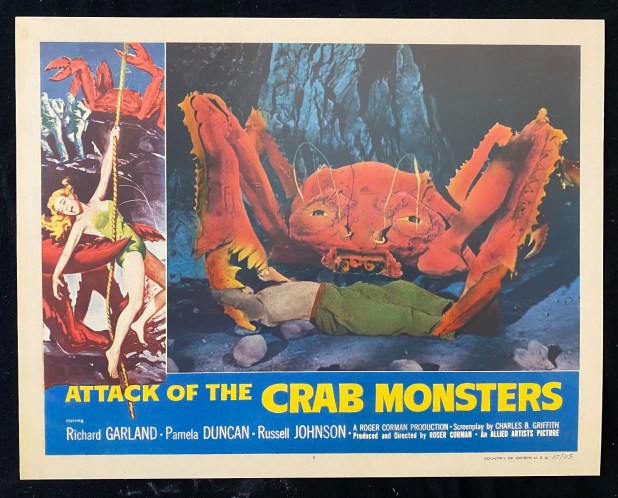
Directed by Roger Corman, this played double features with his film Not of This Earth.
A group of scientists and sailors land on a remote Pacific Ocean island as a search party for a previous expedition that disappeared without a trace. Just like the New X-Men and Krakoa, huh? While they’re there, the scientists plan on studying the impact of nuclear tests from the Bikini Atoll on the island’s ecosystem.
Charles B. Griffith, who wrote this, said he was kind of conned into it: “Roger came to me and said, “I want to make a picture called Attack of the Giant Crabs” and I asked, “Does it have to be atomic radiation?” He responded, “Yes.” He said it was an experiment. “I want suspense or action in every scene. No kind of scene without suspense or action.” His trick was saying it was an experiment, which it wasn’t. He just didn’t want to bother cutting out the other scenes, which he would do.”
Corman, ever the one to make it seem nice, said “I talked to Chuck Griffith about this. Chuck and I worked out a general storyline before he went to work on the script. I told him, “I don’t want any scene in this picture that doesn’t either end with a shock or the suspicion that a shocking event is about to take place.” And that’s how the finished script read.”
Will Dr. Karl Weigand (Leslie Bradley), geologist James Carson,(Richard H. Cutting) and biologists Jules Deveroux (Mel Welles), Martha Hunter (Pamela Duncan) and Dale Drewer (Richard Garland) survive? I know who doesn’t. A sailor named Tate, played by Griffith, who also directed some of the action moments.
Not only does this have giant crabs, they’re also telepathic giant crabs. Guy N. Smith must have seen this movie before he wrote Night of the Crabs, Killer Crabs, The Origin of the Crabs, Crabs on the Rampage, Crabs’ Moon, Crabs: The Human Sacrifice, Crabs’ Fury, Crabs’ Armada, Crabs: Unleashed, Killer Crabs: The Return, Crabs Omnibus and The Charnel Caves: A Crabs Novel.
EDITOR’S NOTE: The Black Scorpion was on the CBS Late Movie on March 21, 1973 and March 7 and August 1, 1975.
This movie has a good FX pedigree: Willis O’Brien, creator of the stop-motion animation effects for the original King Kong, was the special effects supervisor. There’s an urban legend that the spider pit creatures that were cut from that film show up here. While Ray Harryhausen’s An Animated Life would claim that many of O’Brien’s models were still in storage at RKO when this was made, many of them were pretty decayed by that point.
An earthquake happens in Mexico and a new volcano rises, along with someone who believes that a demon bull has come out of hell. If only it could be so simple. Instead, the beasts are gigantic prehistoric scorpions.
How do you kill a monstrous scorpion? You fill an arena with meat and then shoot it with a spear that’s attached to an electric cable, then spark that thing up. You have to admire that level of ingenuity.
October 1958 Playboy Playmate Mara Corday was probably used to this kind of thing by this point, having already dealt with Tarantula and The Giant Claw. I can see dealing with one giant monster, but three? Yeah. That’s being a magnet for kaiju.
An even bigger coincidence is that six of the actors in this movie — Carlos Rivas, Mario Navarro, Pascual García Peña, José Chávez, Roberto Contreras and Margarito Luna — all appear in another Willis O’Brien-animated giant monster movie, The Beast of Hollow Mountain.
June 1: Junesploitation’s topic of the day — as suggested by F This Movie— is Roger Corman Tribute! We’re excited to tackle a different genre every day, so check back and see what’s next.
Susan Cabot was a contract actress for Universal that appreciated getting to play roles she’d never get to play otherwise thanks to Roger Corman. She’s also in The Saga of the Viking Women and Their Voyage to the Waters of the Great Sea Serpent, Carnival Rock, War of the Satellites, Machine-Gun Kelly and The Wasp Woman. She had a rough life, as she was raised in eight different foster homes — and abused in several of them — which led to late life PTSD. Her mother was also institutionalized and she may have inherited some of her mental illness. She married her first husband before she was 18, just to escape, and eventually came to Hollywood where she would act in many a Western and date King Hussein of Jordan. Later in life, as she fell in mental illness and hoarding, even her psychologist would say their sessions were emotionally draining. One night, she woke her son — who had dwarfism and suffered pituitary gland problems — and attacked him with a scalpel and a weight lifting bar. Confused, he took the bar from her and beat her to death. He originally told police she was attacked by a man in a ninja mask as no one understood mental problems in 1986. Eventually, he was put on probation after being in jail for two and a half years.
Back to happier things.
Written by Leo Lieberman and Ed Waters for AIP — Corman didn’t like the script — it has Cabot as Sabra Tanner, a rich girl who feels like her mother doesn’t care about her. She can’t help herself as she hurts everyone around her, like trying to steal her friend Rita’s (Barboura Morris’) boyfriend Mort (Dick Miller) and forcing a heavier pledge named Ellie (Barbara Cowan) to do situps in order to be thin. When Tina doesn’t listen, she paddles her and yeah, this is exploitation so not only does Sabra love it, Tina just may as well. And when Mort won’t give in, she finds a pregnant waitress named Tine (June Kenney) to blackmail him.
None of it ends well, as must happen in so many teen movies. Sabra is a psychopath — as if the opening credits didn’t spoil this — and at the end, all she can do is walk into the ocean and drown. Today, she’d probably get over all this and be a CEO or something.
There’s nothing I love more than a woman destroying people. I’ve had it done to me more than a few times. Now, I just watch it in movies.
June 1: Junesploitation’s topic of the day — as suggested by F This Movie— is Roger Corman Tribute! We’re excited to tackle a different genre every day, so check back and see what’s next.
At 67 minutes, this movie was made to be shown with Attack of the Crab Monsters. Its stars Paul Birch as Mr. Johnson, a man quite literally not of this Earth because he’s an alien from Davanna with blank eyes that can burn right into your brain. If you start to like him, remember that he starts the movie by removing the blood of a teenage girl with some tubes that he keeps in his attache case.
Davanna is dying from the end of a nuclear war which has turned everyone’s blood to dust. Now, as he waits in Los Angeles, Mr. Johnson is attempting to solve the issues with his peoples’ blood. He has a houseboy named Jeremy (Jonathan Haze) and hires away nurse Nadine Storey (Beverly Garland) from a man he has hypnotized, Dr. F.W. Rochelle (William Roerick).
The police are wondering who the vampire killer is, but Mr. Johnson is just trying to stay alive. And look out anyone — like Dick Miller as a vacuum salesman — who comes to his home. Soon, another alien (Anna Lee Carroll) shows up but her blood becomes laced with rabies. She’s not the last as even though Johnson perishes in a car crash — a police siren is too much for his alien hearing — another alien that looks just like him shows up at his grave.
Director Roger Corman and Charles B. Griffith (who wrote the screenplay with Mark Hanna) worked together quite a lot. Griffith said of the story, “It started all this X-ray eye business. Most of Roger’s themes got established right in the beginning. Whatever worked, he’d come and take again, and a lot of things got used over and over. During the production of Not of This Earth, I was married to a nurse, and she helped me do a lot of medical research. I remember how we cured cancer in that script. Somehow the film was a mess when it was finished.”
Birch had no fun making this, as he had to wear the painful contacts all day as Corman wanted to shoot whenever with no prep. The actor was so upset he left before filming was done, so in some shots, that’s not him. Luckily, he has on a hat and sunglasses often, so he was easy to fake Shemp in this by Lyle Latell. Before he left the set, he said, “”I am an actor, and I don’t need this stuff… To hell with it all! Goodbye!”
This has been remade twice, once by Jim Wynorski with Traci Lords as Nadine in 1988 — Wynorski made Roger Corman a bet that he could remake the 1957 film with the same budget and schedule thirty years later — and in 1995, directed by Terence H. Winkless and part of the Roger Corman Presents series.
If you watched this on TV in the 1960s (or any time), there are three more minutes that were added by Herbert L. Strock right after the credits. A voice intones “You are about to adventure into the dimension of The Impossible! To enter this realm you must set your mind free from earthly fetters that bind it! If the events you are about to witness are unbelievable, it is only because your imagination is chained! Sit back, relax and believe.. so that you may cross the brink of time and space.. into that land you sometimes visit in your dreams!” If you’re wondering if a scene or two are repeated, they are so that the movie fit into TV schedules. There were also three scenes that were extended in some theatrical prints: the scene in which Johnson speaks with the courier, him chasing Nadine and when Harry chases him.
Jacques Rivette hailed Anthony Mann as “one of the four great directors of postwar Hollywood” alongside Nicholas Ray, Richard Brooks and Robert Aldrich. Studied by French film critics, several of whom would be part of the French New Wave, Mann started as Preston Sturges’ assistant director as well as the director of screen tests for movies like Gone With the Wind.
He’s probably best-known for his Westerns, many of which starred Jimmy Stewart like The Naked Spur and Winchester ’73. He was fired from Spartacus by its star, Kirk Douglas, and left his next film, Cimarron, after disagreements about shooting on a sound stage. After all, Mann’s locations are just about characters in themselves. He was right. The good news was that when he made El Cid it was a huge success.
The heroes of the Westerns that Mann made aren’t always heroes at first. In his article “The Last Mann,” Richard Corliss said, “The Mann western hero has learned wariness the hard way, because he usually has something to hide. He is a man with a past: some psychic shadow or criminal activity that has left him gnarled and calcified. Not so long ago he was a raider, a rustler, maybe a killer. If a movie were made of some previous chapter in his life, he’d be the villain, and he might be gunned down before he had the chance at redemption that Mann’s films offer.”
Bounty hunter Morgan Hickman (Henry Fonds) rides into town with a dead body, looking to make his money. He’s treated like evil itself, except by Sheriff Ben Owens (Anthony Perkins), a way too young and innocent man who has become the law because no one else wanted the job.
Ben is in love with Millie Parker (Mary Webster), whose father was the last law in town and she won’t take him as a husband until he quits. Hickman tells him she’s smart because he used to have a star and it ruined his life. That said, he does offer to teach Ben a little about how to stand up for himself.
On the day the town plans on celebrating his 75th birthday, Dr. McCord (John McIntire) is killed by the McGaffey brothers, Ed (Lee Van Cleef) and Zeke (Peter Baldwin). The entire town wants them dead but Ben believes in innocent until proven guilty. He’s willing to stand up for himself and even defeats town bully Bart Bogardus (Neville Brand) by slapping him and then outdrawing him.
As for Morgan, he falls for Nona Mayfield (Betsy Palmer) and becomes a surrogate father to her son Kip (Michel Ray). It’s a nice way to show that he can still be a tender person after years of hiding his humanity. It’s also an interesting inverse comparison to the renter falling for his landlady and helping her son relationship that also shows up in The Shootist.
The Arrow release of Tin Star has extras like brand new audio commentary by film historian Toby Roan, an appreciation of the film by author and critic Neil Sinyard, an interview with Peter Bernstein on her father’s work, a trailer and an image gallery. It all comes inside a reversible sleeve featuring original and newly commissioned artwork by Sam Hadley and also has a double-sided fold-out poster, six postcard-sized reproduction artcards and an illustrated collector’s booklet featuring new writing on the film by Barry Forshaw and original press notes.
Goffredo Lombardo of Titanus wanted Italian films to not just be seen in Italy but around the world.
Director Riccardo Freda and cinematographer Mario Bava wanted to make a horror movie. Freda believed that until now, only Americans and German expressionists could make a movie like he had in mind.
Lombardo did not care for horror but gave the team a low budget.
They made magic.
On the 12th day of production, Freda left the set. After an argument with producers, Bava took over, changing parts of the story and the ending.
Again, magic was being made.
A series of mysterious killings are being investigated in Paris, as women of the same blood type are being drained by someone the press calls The Vampire. Journalist Pierre Lantin investigates and becomes even more involved when his dancer fiancee Nora Duval is kidnapped, possibly by The Vampire.
There’s also a man named Joseph addicted to something and is told that he must follow orders to get his next dose. He’s also blackmailing Professor Julian Du Grand, who soon meets with a woman shrouded in darkness named Marguerite who threatens the scholar. We learn that he has died unexpectedly, possibly by suicide, soon after.
Another woman named Lorette is kidnapped and kept in a room filled with the skeletons of past victims. And the truth is the Professor’s death has been faked so that he can work for the woman behind all of this, Gisele, a female vampire who ages each night. She and Marguerite are the same person, a woman who will use anyone and do anything she can to remain eternally young.
Released in the U.S. as The Devil’s Commandmentand also as Lust of the Vampire, which has new scenes added with “Grandpa” Al Lewis added. This was the first Italian horror film of the speaking film era.
Mario Bava and Piero Regnoli’s last-minute rewrites — they were running out of time to make this movie — made Pierre the lead instead of a supporting character. This was needed as all of the other actors had only signed up for ten days.
Much like an other Italian vampire movie, Atom Age Vampire, there are no vampires in this movie. There are some amazing dungeons and the start of what Bava would bring to his movies.
Directed by Nathan Juran (who started as an art director before making this and movies like 20 Million Miles to Earth, The Brain from Planet Arous, Attack of the 50 Foot Woman and so many more) from a screenplay by Martin Berkeley (Tarantula!, Revenge of the Creature) based on a story by producer William Alland, The Deadly Mantis was made with a monstrous papier mâché model of the mantis that measured 200 feet long and 40 feet high with a wingspan of 150 feet. There are some smaller models and actual footage of a praying mantis.
As for the mantis, it escapes from “melting ice in the frozen north” because of the explosions of several volcanos. The creature starts flying toward Washington, D.C. Nothing can seem to stop this thing, not machine guns or flamethrowers. Col. Joe Parkman (Craig Stevens) and his men are on trying to stop it and they’re joined by Marge Blaine (Alix Talton), a magazine reporter who every army guy wants to get with.
How do you kill a gigantic mantis? You throw a “gas bomb” in its face. Good old fashioned U.S. ingenuity wins the day, as always. Of course, at the end, the creature is still moving but that’s just an autonomic reflex. Or maybe it was a planned sequel.
This played double features with The Girl In the Kremlin, which starred Zs Zsa Gabor.
In order to get in all of the various airplanes in this movie, stock footage of military aircraft was used. That’s usually how low budget films got planes but in this one, they are never really consistent and often, a plane can look like more than one different plane throughout the film. Air Force buffs will be driven mad, including the idea that Andrews Air Force Base is in Anacostia, D.C. instead of Prince George’s County, Maryland.
to add realism, but they were never consistent about the type of plane they showed – even showing pictures of drastically different planes that are supposed to be the same plane.
Thanks to Bernard Roy Chandler who provided several revisions to this for me. I appreciate it and also am thankful for you correcting me.









 B&S About Movies
You must be logged in to post a comment.