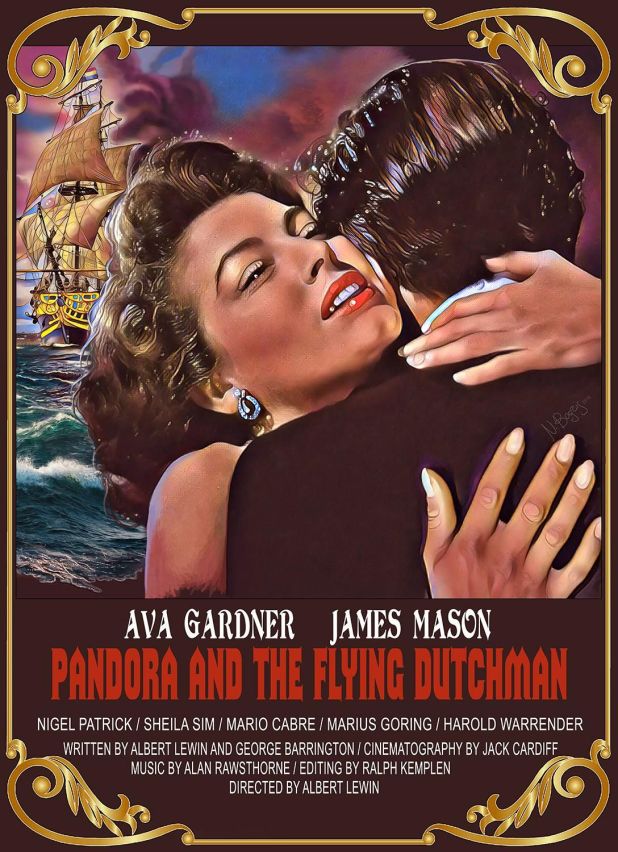
THE IMPORTANT CINEMA CLUB’S SUPER SCARY MOVIE CHALLENGE DAY 20: Pandora and the Flying Dutchman (1951)

20. A Horror Film Shot by Jack Cardiff

The fishermen of a village have found the bodies of a man and woman in their nets, as archaeologist Geoffrey Fielding (Harold Warrender) looks to the camera to tell us their story.

Pandora Reynolds (Ava Gardner) is the kind of femme fatale that can watch a man off himself in front of her and then comment on how boring he was. She tests the men of the village, like making them give up something they love just to be with her. For example, race car driver Stephen Cameron (Nigel Patrick) must drive his beloved vehicle into the sea.

But sea caption Hendrik van der Zee (James Mason) may be the man who breaks her. Perhaps he’s not even a man, as Geoffrey thinks that he’s the Flying Dutchman, a 16th-century ship captain who murdered his unfaithful wife and spoke against God at his trial before being given an escape on a new ship. There, the Dutchman learned that his wife was innocent and to atone for his crime, he gets six months every seven years to find a woman who will die for him. Otherwise, he is cursed to sail forever.

Pandora does fall in love with him, but Hendrik refuses to let her die. Another of the many rivals for her affection, Juan Montalvo (Mario Cabré) murders him, only for Hendrik to return in the audience of Juan’s bullfight. Shocked, he doesn’t see the bull coming and it gores him to death.

Despite agreeing to marry Stephen, Pandora loves the boat captain. She swims out to his ship and learns the truth: He is the Dutchman and she looks exacly like his dead wife. She asks how long they have together if she is to die. He replies that the perfectness of their love places them outside of time just as a storm destroys the ship.

Only Geoffrey knows the truth, saying, “May the consummation of your love endure as long as the punishment that made you worthy of it!”

Directed and written by Albert Lewin (The Picture of Dorian Gray, The Living Idol), this film had sets designed by Man Ray. He also painted the painting of Pandora in the movie.

Man, doomed romance, gorgeous art and Ava Gardner, all in one movie. I loved it!

MOVIES THAT PLAYED SCALA: A Place in the Sun (1951)

Thanks to the British Film Institute, there’s a list of films that played Scala. To celebrate the release of Severin’s new documentary, I’ll share a few of these movies every day. You can see the whole list on Letterboxd.

Inspired by the real-life murder of Grace Brown by Chester Gillette in 1906, which was followed by Gillette’s execution by electric chair in 1908 as well as the book An American Tragedy by Theodore Dreiser, this is one of the best American movies of all time, winning six Academy Awards and the first-ever Golden Globe Award for Best Motion Picture – Drama.

George Eastman (Montgomery Clift) has come to work in his uncle Charles’ (Herbert Heyes) factory. Co-worker Alice Tripp (Shelley Winters) romances him in the hopes that Eastman’s last name will get her ahead in life. But George has also met socialite Angela Vickers (Elizabeth Taylor) and falls in love. But he’s already gotten Alice pregnant, so he can’t forget his past and can’t truly be part of Angela’s world.

George and Alice go to get married, but the Justice of the Peace is closed. Instead, he plans on drowning her and takes her out on a boat, but he decides to let her live. At that moment, she stands up and the boat capsizes. She drowns as he swims to safety. In truth, he killed her, as he never tried to save her and saw this as a way of getting the life he wanted. He’s charged with murder just as he’s been accepted into Angela’s family and ends up going to the electric chair.

Directed by George Stevens and written by Michael Wilson and Harry Brown, this may be too slow and melodramatic for modern audiences, this movie had an impact on fashion, as Taylor’s white lilac gown inspired prom and wedding dresses for a decade.

Stevens spent $2.3 million on this movie and shot more than 400,000 feet of film. It took over a year to edit it. In case you think you’ve seen the Eastwood mansion before, it’s a recycled set from Sunset Boulevard.

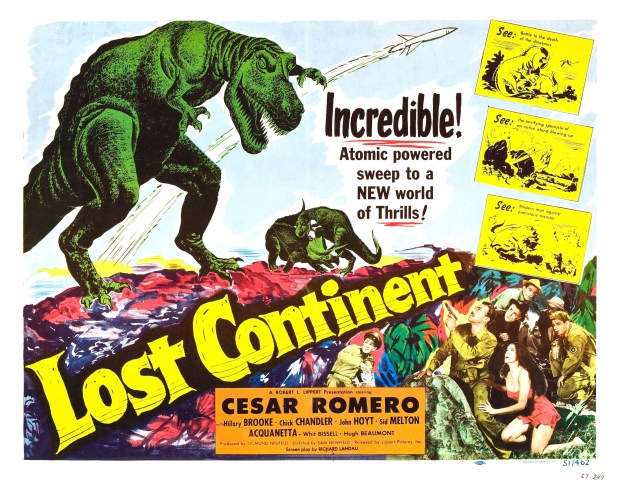
CHILLER THEATER MONTH: Lost Continent (1951)

EDITOR’S NOTE: Lost Continent was on Chiller Theater on Saturday, March 5, 1966 at 11:20 p.m., Saturday, January 11, 1969 at 1:00 a.m., Saturday, August 7, 1971 at 11:30 p.m., Saturday, July 22, 1972 at 11:30 p.m., Saturday, January 20, 1979 at 1:00 a.m., Saturday, May 30, 1981 at 1:00 a.m. and Saturday, May 1, 1982 at 1:00 a.m.

Maj. Joe Nolan (Cesar Romero, the only Joker never to shave), Lt. Danny Wilson (Chick Chandler) and Sgt. William Tatlow (Sid Melton, Alf Monroe from Green Acres) and three scientists — Stanley Briggs (Whit Bissell, the undertaker in The Magnificent Seven), Robert Phillips (Hugh Beaumont from Leave It to Beaver) and Russian Michael Rostov (John Hoyt, Flesh Gordon) — are headed out to find an atomic rocket that has crashed in the South Pacific.

Spoiler: they find dinosaurs.

Yes, if you want to see a movie where dinosaurs wipe out a team of smart men and military guys, by all means, Lost Continent is the movie for you.

You’ve got Ward Cleaver being brutalized by a brontosaurus and a triceratops goring one of the team members, who eventually get back at the dinos by shooting a pterosaur for food. If this was an Italian movie, that would have been a real pterodactyl and we would have watched one of the natives hack at it with a dull machete.

Also, if you like rock climbing and tinting a black and white film green so that it doesn’t seem dated or uncool, then you’re also going to love this.

Director Sam Newfield has 277 directorial credits on his IMDB page, among them Radar Secret Service and I Accuse My Parents. In fact, he made so many movies that he also used the names Peter Stewart and Sherman Scott to hide the sheer amount of films that he directed. He’s considered to be the most prolific film director in the history of American film and some believe that his final number of movies could be well over three hundred projects thanks to his industrial promotional one-reelers, training films, comedy shorts, TV series episodes, full-length features and the very same TV series episodes that were padded into full-length features.

Sadly, all of this work came from the fact that Sam suffered from a serious gambling addiction, making him poor for most of his life and even breaking up his marriage. After thirty years of directing, he was so broke that his brother Sigmund, the head of PRC Pictures, paid off all his debts and gave him a place to live for the last six years of his life. After all, he’d only paid him $500 a movie for years, so it was the least that he could do.

UNSUNG HORRORS HORROR GIVES BACK 2024: La Muerte Enamorada (1951)

Each October, the Unsung Horrors podcast does a month of themed movies. This year they will once again be setting up a fundraiser to benefit Best Friends, which is working to save the lives of cats and dogs all across America, giving pets second chances and happy homes.

Today’s theme: Mexico

Rivas (Fernando Fernández) is unhappy with his life and has been offered by death the chance to live less years but have the remaining ones be more successful. When the reaper comes for him as Tasia (Miroslava), she decides to stay a few days before ending his existence in the hopes that she can learn what it’s like to be human.

Obviously, this is a Mexican take on Death Takes a Holiday, as Tasia says in one scene, “And even if they say around there that Death takes holidays, it’s a lie. This is the first time. I’ve never worked in the movies!”

The best part is a scene where Tasia dances with skeletons to Camille Saint-Saens’ “Danse Macabre.” It’s both weird and gorgeous in equal measure.

Rivas has told his family that Tasia is a relative from far away and not the person about to end the life of their father. He’s wasted so much of his life and now that the days are growing shorter, he wonders how he can keep Death around, even if she must become part of the family.

Miroslava is a tragic figure and its ironic that she is Death in this movie. Even how she died was up for debate, as the accepted record is that she overdosed on sleeping pills, holding a portrait of her lost love bullfighter Luis Miguel Dominguín. Others said that she had an image of Mexican comedian Cantinflas and an even wilder theory is that she died in a plane crash with a married businessman and her body was taken to her bed to look like a suicide.

You can watch this on YouTube.

MILL CREEK SCI-FI CLASSICS: The Wasp Woman (1959)

Produced and directed by Roger Corman, this movie was originally a double feature with Beast from Haunted Cave. When it was released to TV two years later, a new prologue was added by director Jack Hill to add to its running time.

The musical score from this film may seem familiar because it’s the same music from Corman’s A Bucket of Blood. It was written by Fred Katz, who sold Corman the same score for a total of seven films, including The Little Shop of Horrors and Creature from the Haunted Sea.

Janice Starlin (Susan Cabot) is the founder and owner of a large cosmetics company. She starts losing money when the public begins to see that she is aging, so her scientists reverse the aging process by using the royal jelly of the queen wasp. It doesn’t work fast enough, so she breaks into her own company’s lab and injects herself multiple times.

So she gets twenty years younger over the weekend but occasionally transforms into a wasp woman who kills people. At the end, when acid is thrown in her face, that scene was more real than it should have been. Someone had filled the breakaway bottle with water and it was so heavy that when hit her, she thought that her teeth had been knocked out. To make matters worse, the fake smoke used to simulate the acid also choked her. So after she fell through the window, she found herself unable to breathe. To save herself, she tore off her makeup as well as a good chunk of skin around her neck.

Things didn’t get much better in life for Susan Cabot. This was her last film and at the end of her life, she suffered from depression and suicidal thoughts. The psychologist that she was seeing felt that she was so troubled that he could no longer see her and her home was filled with trash and rotting food.

After her mental health continued to worsen, Cabot’s 25-year-old son, Timothy Scott Roman, beat her to death with a weightlifting bar. While he would initially claim that a man in a ninja mask was the killer — thinking that no one would believe her struggles with mental illness — the truth was that she woke him screaming and attacked him with both a scalpel and the barbell. His defense attorneys claimed his aggressive reaction to his mother’s attack was due to the drugs he took to counteract his dwarfism and pituitary gland problems.

Prosecutors changed the charge to voluntary manslaughter at the end of the trial, as no evidence had been presented to support the premeditation required for a murder conviction. Roman, who had already spent two-and-a-half years in jail, was sentenced to three years’ probation.

Corman remade this with director Jim Wynorski for his Roger Corman Presents series on Showtime.

Don’t have the box set? You can watch this on Tubi. You can also watch it with the Cinematic Titanic crew riffing on it on Tubi.

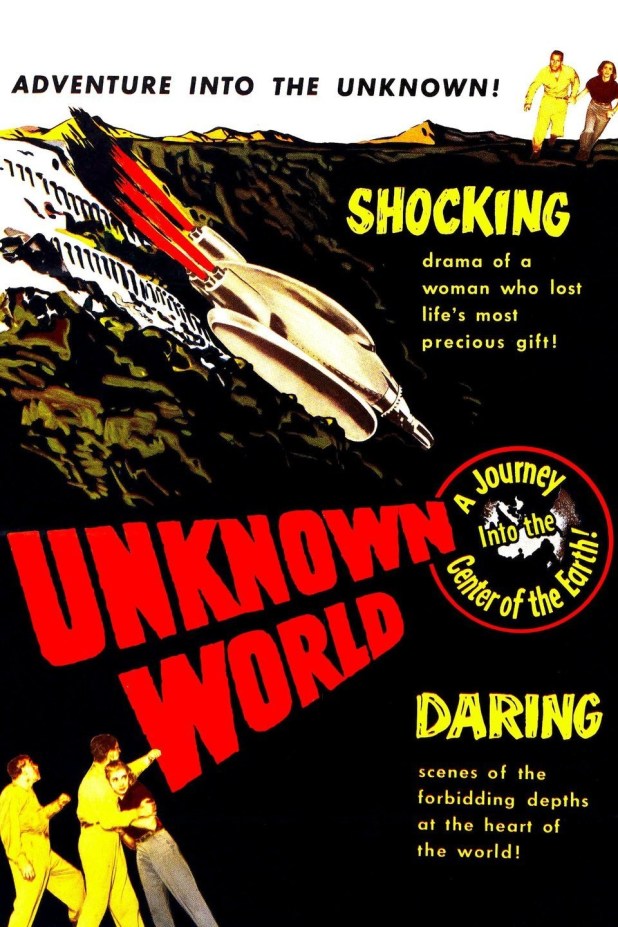
MILL CREEK SCI-FI CLASSICS: Unknown World (1951)

Unknown World was made by two Hollywood special effects men, Jack Rabin and Irving Block, who are two of the film’s three producers. It was directed by Terry O. Morse, who shot the American scene in Godzilla, and written by Millard Kaufman, who also wrote Bad Day at Black Rock and The Klansman.

Victor Kilian, who plays Dr. Jeremiah Morley, lost an eye in a fight scene with John Wayne and was blacklisted for decades due to his political views, which is why he is uncredited in this. He’s invented a big tank that can drill into the center of the world, the Cyclotram, and has taken a crew of scientists through Carlsbad Caverns, Bronson Caves, Nichols Canyon and finally Pismo Beach to find a place where the human race can survive a nuclear war. Sadly, that unknown world makes everyone sterile.

Let me tell you, people were obsessed by the center of the Earth in 1951.

Have you ever heard of the Shavers?

Richard Shaver first encountered these creatures from Lemuria when the tools at his factory job started playing other peoples’ thoughts into his brain. He could also hear the Shavers torturing people underground. Now, you may say that he was mentally ill, but he also was writing to the pulp magazine Amazing Stories. He claimed to have discovered an ancient language he called Mantong. Editor Ray Palmer (the namesake of DC Comics’ Silver Age version of The Atom) thought that Shaver was onto something. He helped him write A Warning to Future Man,” where Shaver discussed cities within the Earth, populated by the good Teros and the evil Deros. This was turned into “I Remember Lemuria!” which appeared in the March 1945 issue of Amazing Stories. That issue instantly sold out and then something really odd began: thousands of letters began appearing saying that they’d had the same experiences as Shaver.

Amazing Stories‘ readership either loved or hated the Shaver stories. According to Wikipedia, “Palmer would later claim the magazine was pressured by sinister outside forces to make the change: science fiction fans would credit their boycott and letter-writing campaigns for the change. The magazine’s owners said later that the Shaver Mystery had simply run its course and sales were decreasing.”

That didn’t end the Shaver stories. Palmer credits these tales with the public fascination with UFOs. John Keel’s 1983 Fortean Times piece “The Man Who Invented Flying Saucers” claims that “a considerable number of people — millions — were exposed to the flying saucer concept before the national news media were even aware of it. Anyone who glanced at the magazines on a newsstand and caught a glimpse of the saucer-emblazoned Amazing Stories cover had the image implanted in his subconscious.” Indeed, Palmer was quick to defend the Shaver stories and claim that “flying saucers” were their validation.

Palmer’s newsletter after The Shavers were forced out of Amazing StoriesThe Hidden World.

Don’t have the box set? You can watch this on Tubi.

MILL CREEK SCI-FI CLASSICS: Bride of the Gorilla (1951)

Edward G. Robinson Jr. was originally in this movie but was fired by the producers after his arrest for writing a bad check for $138 to the Laguna Beach Garage.

Director and writer Curt Siodmak had already written The ApeThe Wolf Man, Frankenstein Meets the Wolf Man and I Walked With a Zombie before making this his first directed effort. He had ten days to make it.

Deep in the Latin American jungles — a bad place to be if you stay too long — plantation manager Barney Chavez (Raymond Burr) has murdered his boss and stolen away his wife Dina Van Gelder (Barbara Payton). Bad news for them: Al-Long (Gisela Werbisek), a witch, has seen the crime and cursed Chaves to transform every night into a gorilla. A cop by the name on Taro (Lon Chaney Jr.) puts the murder of the rich man and all the gorilla killings together. The natives believe Sukura, a demon, is the killer. And as for Dina, Barney seems way too into going out alone amongst the wildlife at night when he should be in bed with her. By the end, Lon Chaney shoots a weregorilla and Burr sees his own reflection before he dies, which feels like the reverse roles for what we should be watching.

Speaking of bad checks, Payton got arrested for that, plus had a reputation as a drinking party scene girl before she even started acting. Even after rehab, her parents would indulge in heavy drinking with her. Two years after this movie, Payton was paid $1,000 for her autobiography, I Am Not Ashamed. It had unflattering photographs of her and she discussed how she was homeless and had been beaten while a call girl. She’d die in 1967 at the age of 39 of heart and liver failure. Her parents died of alcoholism a few years later.

Woody Strode is in this as a cop. He’d have an affair with Payton, which would have caused a big uproar in 1951.

Don’t have the box set? You can watch this on Tubi.

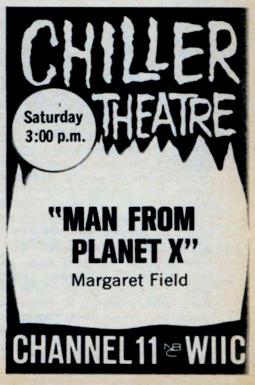
CHILLER THEATER MONTH: Man from Planet X (1951)

EDITOR’S NOTE: Man from Planet X was on Chiller Theater on Saturday, November 2, 1963 at 3:00 p.m. It also aired on Saturday, November 7, 1964.

After landing in the foggy Scottish moors, an alien follows Professor Elliot (Raymond Bond) and American reporter John Lawrence (Robert Clarke). They can’t communicate and wonder what he wants. Dr. Mears (William Schallert) tries to use music and when that doesn’t work, he attempts to murder the space brother by shutting off his breathing machine.

It turns out that the alien was actually leading Planet X here to take over our planet, so maybe the bad guy had the right idea. How odd.

This was directed by poverty row icon Edgar G. Ulmer, who also directed The Daughter of Dr. JekyllThe Amazing Transparent Man and Girls In Chains. In Peter Bogdonvich’s book Who the Devil Made It, he said, “I really am looking for absolution for all the things I had to do for money’s sake.”

Speaking of cash, this was shot on the sets of Joan of Arc and pumped in fog so you didn’t notice.

You can watch this on Tubi.

MILL CREEK THRILLERS FROM THE VAULT: Five (1951)

Arch Oboler was a key innovator of radio drama, as well as someone with a big personality and the ego to match. Starting his career with a spec script called The Futuristics and getting into trouble with his first show where he made fun of sponsor American Tobacco, this set the tone for Oboler’s writing career. But after three years of working on scripts he probably hated, Oboler’s script for Rich Kid was picked up by Rudy Vallée which led to a great job writing scripts for Don Ameche on The Chase and Sanborn Hour.

After Wyllis Cooper left the show Lights Out to work in Hollywood (he wrote Son of Frankenstein), the show was given to Oboler. Already a series known for its violence, the new writer upset listeners with his very first episode which ended with a young girl being buried alive and not rescued. Playing at midnight with no sponsor, Lights Out was still under the watchful eye of censors, yet Cooper worked in anti-fascist messages and created episodes like “Chicken Heart,” in which a chicken heart grows so large it destroys the planet. More controversy would follow when he wrote an Adam and Eve script for Ameche and Mae West where West was an Eve that wanted to lose her virginity and voluntarily leave the Garden of Eden. Between that story airing on The Chase and Sanborn Hour on a Sunday and West later trading suggestive back and forth bon mots with Edgar Bergen’s dummy Charlie McCarthy — she said, “Come on home with me, honey. I’ll let you play in my wood pile.” — West was barred from radio until 1950.

Meanwhile, Ameche, Bergen and Oboler got away with it. In fact, Oboler soon started his own NBC radio show Arch Oboler’s Plays. West, who once said “I believe in censorship. I made a fortune out of it,” went on to great success on stage, in Vegas and in the movies. She invested her money in real estate so well that she could pretty much do anything she wanted after this. For example, when one of her boyfriends, boxer William Jones, was denied entry to her Ravenswood apartment building because of a ban on African-Americans, West bought the whole building and changed the rules.

But I digress.

Oboler’s show went up against Jack Benny, but he was also able to adapt stories like Dalton Trumbo’s Johnny Got His Gun. The show ended up being successful and got Proctor and Gamble as a sponsor, coming back as Everyman’s Theatre. Oboloer hated that the sponsors had an ad in the middle of his show and was out of radio for a year before coming back for the World War II propaganda show Plays For Americans. He lost that show when he made a speech at the Radio Institute at Ohio State. Oboler believed that his show should instill hatred of the enemy in the listener, which some took as he was just as bad as the enemy.

After bringing back Lights Out and creating several other propaganda radio shows, there was only one place left for Oboler. Like Orson Welles before him, he went to Hollywood. Some of his better films include Strange Holiday and Bewtitched, as well as the 3D films he innovated like Bwana Devil and The Bubble. He also created the TV series Oboler’s Comedy Theatre, had plays made of his work, published several books and was still writing radio dramas for Mutual Radio Theater as late as 1980. His writing inspired — obviously — Rod Serling as well as Don Coscarelli, who has spoken of how much the Oboler movie The Twonky frightened him as a kid.

I told you all that to tell you about Five, a movie that stands out on the Mill Creek Thrillers from the Vault set because while everything else is comedic or harmless, Five is absolutely brutal.

The only survivors of a nuclear bomb are the Five: Roseanne Rogers (Susan Douglas Rubeš), Michael (William Phipps), Oliver P. Barnstaple (Earl Lee), Charles (Charles Lampkin) and Eric (James Anderson). Roseanne is pregnant, which is the only thing that stops Michael from assaulting her. Oliver is an old man who quickly dies after meeting the group. And Eric is a racist who can’t work with Charles, a black man.

Eric is the reason why so much goes wrong: he destroys the crops of the group, murders Charles and sneaks off Roseanne and her newly born son after she wonders if she can ever find her missing husband. By the end of the film, Eric has shown signs of radiation poisoning and runs off to die, while Roseanne makes the long walk back to Michael with her child dying on the way. All they can do is tend to the soil and make it one more day together.

One of the first movies to show what the atomic bomb would do, Five pulls no punches, killing people with no concern of age or race.

Speaking of race, having an African-American lead was a big idea in 1951. Obolor saw Lampkin read the James Weldon Johnson poem “The Creation” on a local Los Angeles TV show and it’s the speech that the actor reads in Five. It was possible the first time many in the U.S., Latin America and Europe would have heard African-American poetry.

Even the setting of Five is unique. It was shot in the Frank Lloyd Wright-designed Cliff House on the Eaglefeather ranch that Oboloer owned. It was not without tragedy in real life, as on April 7, 1958, Oboler’s six-year-old son Peter drowned in rainwater. During the 2018 Woolsey Fire, the Cliff House burned to the ground.

Made for just $75,000 — Oboler used recent graduates from the University of Southern California film school and unknown actors — this was sold to Columbia for a profit. This would not be the last end of the world movie; in fact, Planet of the Apes ends on the same beach where Eric washes ashore. It is, however, one of the most somber ones.
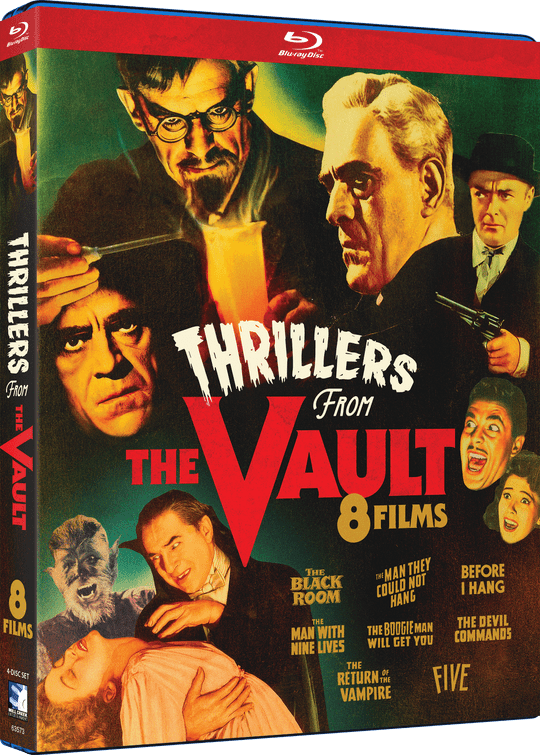
Mill Creek’s Thrillers from the Vault set also includes The Black Room, The Man They Could Not HangBefore I HangThe Devil Commands, The Man With Nine Lives, The Boogie Man Will Get You and The Return of the Vampire. There’s also a commentary track from Tom Waver and Larry Blamire and a documentary, Madness and Mayhem: Horror in the 30s and 40s. You can get it from Deep Discount.
MILL CREEK NIGHTMARE WORLDS: Unknown World (1951)

Unknown World was made by two Hollywood special effects men, Jack Rabin and Irving Block, who are two of the film’s three producers. It was directed by Terry O. Morse, who shot the American scene in Godzilla, and written by Millard Kaufman, who also wrote Bad Day at Black Rock and The Klansman.

Victor Kilian, who plays Dr. Jeremiah Morley, lost an eye in a fight scene with John Wayne and was blacklisted for decades due to his political views, which is why he is uncredited in this. He’s invented a big tank that can drill into the center of the world, the Cyclotram, and has taken a crew of scientists through Carlsbad Caverns, Bronson Caves, Nichols Canyon and finally Pismo Beach to find a place where the human race can survive a nuclear war. Sadly, that unknown world makes everyone sterile.

Let me tell you, people were obsessed by the center of the Earth in 1951. The Shaver Mystery was maybe not in Amazing Stories any longer — editor Ray Palmer claimed a conspiracy got them forced out of the pulp magazine — yet still found an audience in Palmer’s newsletter called… The Hidden World.