Sizzlin’ Summer of Side-Splitters 2025: Blithe Spirit (1945)

July 28 – Aug 3 Screwball Comedy: Just imagine, the Great Depression is raging and you’re getting less than a fin a week at the rubber boiling factory, but it only costs two bits to go to the movies all day, so let’s watch some quick-talking dames match wits with some dopey joes!

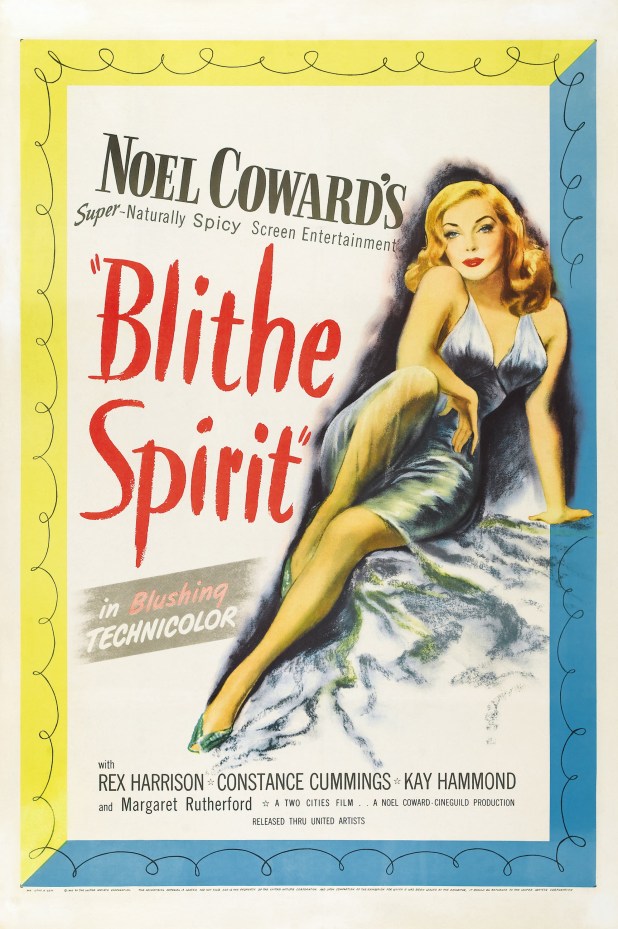
Based on the Noel Coward play, this movie has socialite and novelist Charles Condomine (Rex Harrison) looking for material for his next book. He decides to have Madame Arcati (Margaret Rutherford) come to his home and conduct a séance. As an unbeliever, he’s shocked when it brings the spirit of his first wife, Elvira (Kay Hammond), into his life, as she tries to ruin his marriage to Ruth (Constance Cummings), who can’t see or hear the ghostly form of his first bride.

Coward wanted this cast and screenwriter Anthony Havelock-Allen saw this as one of the reasons why this movie failed, saying “The point of the play is a middle-aged man well into his second marriage, having long ago put away the follies of his youth with his sexy first wife, and suddenly being woken up by her reappearance as a ghost. Rex Harrison was not middle-aged, and Kay Hammond, though a brilliant stage actress, didn’t photograph well and also had a very slow delivery, which was difficult in films. When we started shooting scenes with Kay and Rex, it became obvious that Constance Cummings (the second wife) looked more attractive to the average man in the street than Kay. This upset the whole play.”

In his book, A Serious Business, Harrison didn’t seem to enjoy it either: “Blithe Spirit was not a play I liked, and I certainly didn’t think much of the film we made of it. David Lean directed it, but the shooting was unimaginative and flat, a filmed stage play. He didn’t direct me too well, either – he hasn’t a great sense of humour … By that time, it had been over three years since I’d done any acting. I can remember feeling a bit shaky about it, and almost, but not quite, as strange as when I’d first started, but Lean did something to me on that film which I shall never forget, and which was unforgivable in any circumstances. I was trying to make one of those difficult Noel Coward scenes work … when David said, “I don’t think that’s very funny.” And he turned round to the cameraman, Ronnie Neame, and said: “Did you think that was funny, Ronnie?” Ronnie said, “Oh, no, I didn’t think it was funny.” So what do you do next, if it isn’t funny?”

Coward hated the ending that was added, as it has Charles dying — perhaps due to his wives’ spirits — and joining them as ghosts. He claimed that it ruined the best play he ever wrote.

A classic today, it was a box office disappointment for director David Lean in 1945. It did win Tom Howard the Academy Award for Best Visual Effects.

You can watch this on Tubi.
RE/SEARCH Incredibly Strange Films: Mom and Dad (1945)

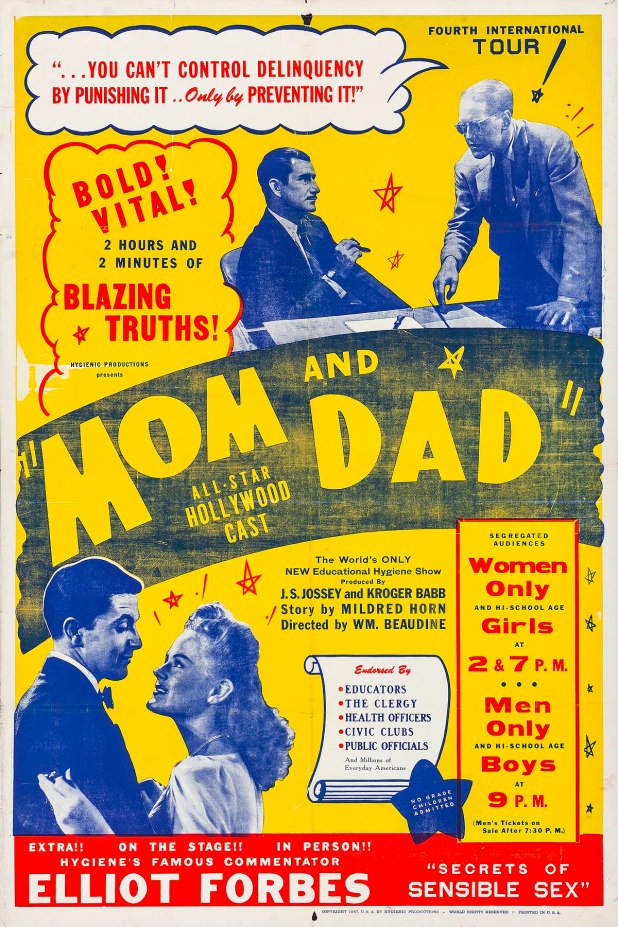
Howard W. “Kroger” Babb called himself America’s Fearless Young Showman and lived by the belief, “You gotta tell ’em to sell ’em.” The name Kroger either came from working at the grocery store as a kid or the fact that his dad loved B.H. Kroger coffee. He worked numerous other jobs all through his teens, even showing up in Ripley’s Believe It Or Not for refereeing a record number of games. After working as a reporter, he did publicity for the Chakeres-Warners movie theaters and found out he had a gift for working people into the movies.

In the early 1940s, Babb joined Cox and Underwood. This distributor bought movies too controversial to advertise and took them on the road, four-walling theaters. Babb went on the road to sell Dust to Dust, which was High School Girl with a childbirth scene added. He made Cox and Underwood so much money that they retired. He decided to make his own company, Hygienic Productions.

After Babb somehow was invited to a meeting that discussed how many young girls were getting pregnant by soldiers from Sheppard Air Force Base, he worked with his future wife Mildred Horn to write a screenplay. He got twenty investors and Willian “One Shot” Beaudine to direct the movie.

Costing $62,000 to film and make 300 prints, it went on the road, often with Babb presenting the movie. He had a devotion to profit: expenses were estimated at 5% for selling and distribution overhead was 7%, resulting in some of the highest returns in movies. He believed that it made $63,000 for every $1,000 the twenty investors put in, while  the Los Angeles Times estimated in 1977 that it made $40 million to $100 million in profit.

He also had renowned educator Elliot Forbes show up, along with a shapely nurse, to talk during the movie and sell books about hygiene. There wasn’t really an Elliot Forbes but there were at least a hundred of the man with that name constantly going around the country for decades showing the film. Depending on the morality of each city, Mom and Dad could be shown as a cautionary film, a controversial one, an educational opportunity or the chance for men to see a woman’s private parts. The fact that a baby was coming out of them was just the price perverts paid to see a vagina bare on the big screen.

The book that was sold, Man and Boy and Woman and Girl, cost 8 cents to make. He sold it for a dollar, making around $40 million. The IRS came after him throughout his life and he was always sure to never give the same figures. He also claimed he lost a hundred pounds on the Astounding Swedish Ice Cream Diet, so Babb was the best of what I love about old movies: a carny flim-flam snake oil salesman who was always looking to make money and was always selling.

Sure, he got sued 428 over the movie, but wasn’t it all worth it?

Mom and Dad is about Joan Blake (June Carlson), a good young girl who sleeps with pilot Jack Griffin (Bob Lowell) after he sweet talks her into the backseat of his car. She’s soon pregnant and her parents, Sarah (Lois Austin) and Dan (George Eldredge) can barely pay attention to her. Her brother (Jimmy Clark) finally gets her to talk to Carl Blackburn (Hardie Albright), a teacher kicked out for teaching sex education, and explaining what is happening to her.

Depending on the print that was in your theater, you also saw a variety of sex hygiene movies, including one that showed childbirth, whether normal or caesarean, as well as one that graphically shows what syphilis does to the human body. Also, your ending would either have Joan have the baby, lose it when it was stillborn or have it adopted. If you saw the film in a black theater, Olympic athlete Jesse Owens would be there.

Exploitation films would not be what they were without Kroger Babb.

You can watch this on YouTube.

MILL CREEK SCI-FI CLASSICS: White Pongo (1945)

Back in the day of these movies, the costumes were never one and done. Ray “Crash” Corrigan was an experienced gorilla man and played a similar role earlier that year in The White Gorilla, where he was both the jungle explorer and the gorilla. This costume was years later brought out of storage for  Jerry Warren’s 1956 movie Man Beast. Corrigan also played apes in Tarzan the Ape Man, Tarzan and His Mate, the Flash Gordon serial, Three Missing LinksMurder in the Private CarHollywood PartyRound Up Time In TexasThe ApeThree Texas SteersDizzy DetectivesDr. Renault’s SecretThe Monster MakerThe Hairy ApeMiraculous JourneyCrime On My HandsThe Lost TribeZamba, Forbidden Jungle, Bela Lugosi Meets a Brooklyn GorillaThe Strange Case of Doctor Rx, Captive Wild Woman, Nabonga and Unknown Island. Corrigan was also It in It! The Terror from Beyond Space.

He sold the suits to Steve Calvert, a Ciro’s bartender, who like him rarely asked for screen credit. But he was making money. Corrigan was on a hunting trip with Clark Gable when he decided to buy some land that he called Corriganville. That was used to shoot movies and as a tourist attraction. Corriganville was eventually sold to Bob Hope in 1966, becoming Hopetown, but is now known as Corriganville Park.

Anyways, White Pongo.

In the Belgian Congo, natives dance around the fire and plan on killing Gunderson, who is freed by an attack by an albino gorilla named White Pongo and an elderly scientist who sends him with a diary all about the gorilla into the jungle. As you can imagine, the goal is to bring this supposed missing link back to civilization which is never a good idea.

Director Sam Newfield made hundreds of movies, such as The Terror of Tiny TownFight That Ghost and I Accuse My Parents. It was written by Raymond L. Schrock, who wrote the Lon Chaney The Phantom of the Opera.

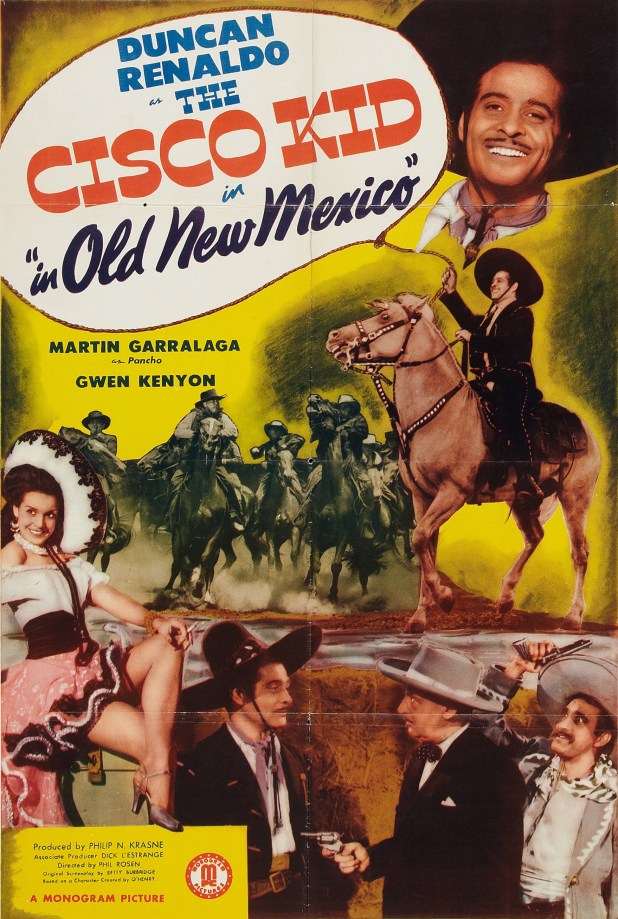
Cisco Kid Movie Collection: Cisco Kid In Old New Mexico (1945)

Cisco (Duncan Renaldo) and Pancho (Martin Garralaga) are bandits who hold up a stagecoach and take Ellen Roth (Gwen Kenyon). Yet she wins them over by telling them that she’s a nurse who has been framed for murder. They decide to help her in their own way, demanding a ransom for her that the killer has — Will Hastings (Norman Willis) — has to pay so he doesn’t seem like the killer of his aunt. Cisco then implicates Roth by meeting with him and offering to kill her for money. Oh Cisco.

Director Phil Rosen also made It Could Happen to YouThe Shadow ReturnsReturn of the Ape ManSpooks Run Wild and more than a hundred other movies. Writer Betty Burburdge was the daughter of Civil War Major General Stephen G. Burbridge and Mabel Burbidge, an advice columnist. She acted in a ton of silent films before becoming a writer, specializing in Westerns. Of the 124 movies he wrote, 14 starred Gene Autry.

This is one of the three movies with the Cisco Kid made in 1945.

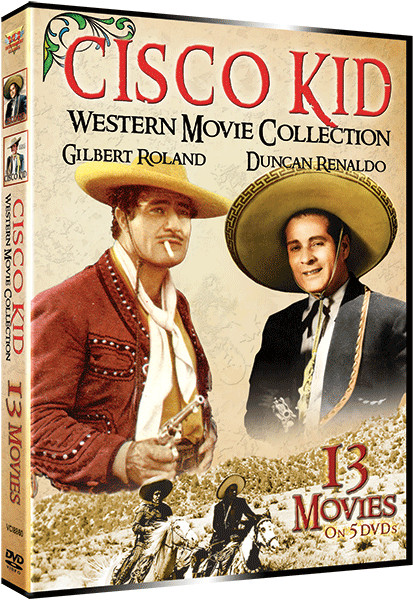
The Cisco Kid Western Movie Collection is available from VCI Entertainment. It has 13 movies and extras like two Cisco Kid TV episodes, interviews with Duncan Renaldo and Colonel Tim McCoy, and photo and poster galleries. You can get it from MVD.

Cisco Kid Movie Collection: Cisco Kid Returns (1945)

The first of three Cisco Kid films made in 1945r with Duncan Renaldo as Cisco and Martin Garralaga as Pancho, Cisco Kid Returns finds our hero trying to escape murder charges and keep his girlfriend Rosita (Cecilia Callejo) from marrying John Harris (Roger Pryor). There’s also the daughter of a murdered man who is used by Cisco as the child he claims that he has had with Rosita

The last film of director John P. McCarthy, this is not the first Cisco Kid movie. 1914’s The Caballero’s Way is the original film, starring William R. Dunn. Vester Pegg was Cisco in a 1919 film, then Warner Baxter took over the role in five films between 1928 and 1939, even winning a Best Actor Academy Award for In Old Arizona. Caesar Romero also was Cisco in six films from 1939 through 1941.

The Cisco Kid Western Movie Collection is available from VCI Entertainment. It has 13 movies and extras like two Cisco Kid TV episodes, interviews with Duncan Renaldo and Colonel Tim McCoy, and photo and poster galleries. You can get it from MVD.

Cisco Kid Movie Collection: South of the Rio Grande (1945)

There were three Cisco Kid movies made in 1945. That’s how popular the character was. This one, directed by Lambert Hillyer (who made so many movies, including Dracula’s Daughter) and written by Victor Hammond and Ralph Bettinson, is unlike many of the other movies in the series as its a musical. It starts with Cisco (Duncan Renaldo) singing to a potential girlfriend. Then, he and Pancho (Martin Garralaga) head to Mexico to stop the corrupt Miguel Sanchez (George J. Lewis) and romance the ladies like Pepita (Armida) and Dolores Gonzales (Lillian Molieri) who work in a cantina.

Sixty-two minutes long, this Monogram Pictures series joined Charlie Chan and Palooka Joe as their dependable features. They kept making them and audiences kept going to see them.

The Cisco Kid Western Movie Collection is available from VCI Entertainment. It has 13 movies and extras like two Cisco Kid TV episodes, interviews with Duncan Renaldo and Colonel Tim McCoy, and photo and poster galleries. You can get it from MVD.

CHILLER THEATER MONTH: House of Dracula (1945)

EDITOR’S NOTE: House of Dracula was on Chiller Theater on Saturday, May 14, 1966 at 1:00 a.m. It was on so many times: Saturday, October 28, 1967; December 16, 1972; November 3, 1973; October 12, 1974; October 30, 1976 in a triple feature with House of Frankenstein and Curse of Bigfoot; November 19, 1977 and January 1, 1983.

A sequel to House of Frankenstein, this would be the seventh film to feature Frankenstein’s Monster (Glenn Strange*) and the fourth for both Count Dracula (John Carradine) and the Wolf Man (Lon Chaney, Jr.). Although it was a success, it would be the last of the serious Universal Monster films, with the comedic Abbott and Costello Meet Frankenstein coming out in 1948.

Director Erle C. Kenton made 131 movies between 1916 and 1957, including several horror movies for Universal like The Cat Creeps and The Ghost of Frankenstein. He started as an actor with Mack Sennett’s Keystone Kops and finished his career on TV, directing shows like The Texan and Telephone Time.

Baron Latos — come on, everyone knows that you’re Dracula — ha come to Visaria to discover a cure for vampirism from Dr. Franz Edelmann (Onslow Stevens, Them!) and his assistants Milizia (Martha O’Driscoll, Ghost Catchers) and Nina (Jane Adams, who was given her first name by American servicemen and played Vicki Vale in the second Batman and Robin movie serial). Of note is that Nina is a hunchback, which is certainly a gender switch way ahead of its time.

Edelmann has been working on the clavaria formosa plant, which has the ability to reshape bone. How this is possible is the kind of horror movie science that requires you to just accept it and move on.

Soon, Larry Talbot also shows up and he wants the cure for his lycanthropy. What, did Edelmann put out an ad in a trade magazine for monsters? They don’t believe him, so he begs Inspector Holtz (Lionel Atwill, who memorablely was quoted in Hollywood Babylon as saying, “All women love the men they fear. All women kiss the hand that rules them… I do not treat women in such soft fashion. Women are cat creatures. Their preference is for a soft fireside cushion, for delicate bowls of cream, for perfumed leisure and for a master – which is where and how they belong.”) to lock him up. He transforms and then the doctor theorizes that pressure on the brain is why he turns furry, not the moon. He responds by flinging himself into the ocean, where he survives and washes up inside the castle, where an unresponsive Frankenstein’s Monster still holds the skeleton of Dr. Niemann from House of Frankenstein.

If you’re thinking — I bet Dracula tries to sleep with that comely blonde assistant, because after all Martha O’Driscoll played Daisy Mae in the original Li’l Abner, you’d be right. The quick-thinking Edelmann drags his coffin into the sun and sets him ablaze, but before long, a blood transfusion gone wrong leads to Dracula’s blood making him evil.

By the end, the good doctor is breaking necks, villagers descend on the castle and Talbot ends up being the one to save the day, wiping out every single other monster. This would be Chaney’s last Universal contract film, although they’d bring him back for the aforementioned Abbott and Costello movie.

Throughout the production, his drinking was out of hand. For example, Glenn Strange was stuck in the cumbersome Frankenstein’s Monster makeup and also had to spend the day in quicksand. He could barely feel his feet, so Chaney helped the only way he knew how. He got the actor smashed thanks to a bottle of scotch.

Speaking of sad stories, Atwill died a few months after this movie from lung cancer. The last few years of his life were a mess. He had married socialite Louise Cromwell Brooks, the ex-wife of General Patton, but after their 1939 separation, he went a little wild. So wild that a 1940 Christmas party, where at the least stag loops were shown and at the worst underage girls were assaulted, ended up getting him in front of a grand jury on morals charges. Sure, he was judged guilty of felony perjury and sentenced to five years probation. But thanks to the Hays Office — who also took the fangs )pun intended) out of the original version of this script — his career went from Universal to movie serials and lower than B movies. He died while making one of those serials, Lost City of the Jungle.

This movie was a big part of monster kid’s lives, as it was part of the Son of Shock package that was sold to TV stations in 1958. The other movies are Before I HangBehind the MaskThe Black RoomThe Boogie Man Will Get YouThe Face Behind the MaskIsland of Doomed MenThe Man They Could Not HangThe Man Who Lived TwiceThe Man With Nine LivesNight of TerrorThe Devil CommandsBlack FridayThe Bride of FrankensteinCaptive Wild WomenThe Ghost of FrankensteinHouse of FrankensteinThe Invisible Man’s RevengeJungle CaptiveThe Mummy’s Curse and The Soul of a Monster.

*Actually, four different actors played Frankenstein Monster: Strange, Boris Karloff in footage from Bride of Frankenstein and Lon Chaney Jr. and his stunt double Eddie Parker from The Ghost of Frankenstein.

CBS LATE MOVIE MONTH: The Story of G.I. Joe (1945)

EDITOR’S NOTE: The Story of G.I. Joe was on the CBS Late Movie on October 13, 1972 and May 18, 1973.

Ernie Pyle, a Pulitzer Prize-winning American journalist and war correspondent, is revered for his stories about the ordinary American men who fought in World War II. His work was so impactful that President Harry Truman acknowledged, “No man in this war has so well told the story of the American fighting man as American fighting men wanted it told. He deserves the gratitude of all his countrymen.”

As for this movie, when they were picking someone to play Pyle, he told the filmmakers, “For God’s sake, don’t let them make me look like a fool.”

Producer Lester Cowan picked Burgess Meredith, a captain in the Army at the time and could not be released from active duty. Presidential advisor Harry Hopkins overruled that order, overruled that order, and General George C. Marshall approved Meredith’s honorable discharge.

He spent time with Pyle in New Mexico as the writer recovered from surviving an accident bombing at the start of Operation Cobra in Normandy. They believed that Meredith was the best actor for the role besides Leslie Howard, who had recently died in a plane crash.

Director William A. Wellman, a decorated combat pilot during World War I who served in the Lafayette Flying Corps of the French Air Force and earned a Croix de Guerre with two palms for valorous action, asked the Army for 150 soldiers and demanded that they speak their own dialogue, live with the actors and train with them.

The 18th Infantry, U.S. Army, a unit that had never seen combat, is sent to the front lines. Lt. Bill Walker (Robert Mitchum) allows Pyle, who is inexperienced in combat, to accompany him. Despite a brutal defeat at the Battle of Kasserine Pass, they become efficient killing machines. The movie doesn’t shy away from the horrors of war, depicting a battle near Monte Cassino that forces the men into caves, eating from cold ration cans for Christmas and slowly losing their sanity. As a man Pyle watched get married dies in combat and another suffers a breakdown, the writer learns that he has won the Pulitzer, which seems like no comfort. After reuniting with the unit after the battle, he sees a long line of mules carrying the dead, the last one holding his friend Walker, which causes the men to weep openly.

Pyle’s poignant words, “For those beneath the wooden crosses, there is nothing we can do, except perhaps to pause and murmur, ‘Thanks pal, thanks.'”, encapsulate the profound loss and the enduring gratitude felt by those who survived the war.

Pyle was pretty honest about the movie, saying, “They are still calling it The Story of G.I. Joe. I never did like the title, but nobody could think of a better one, and I was too lazy to try.” Sadly, he was killed in action on Ie Shima during the invasion of Okinawa two months before the premiere of the movie about his life.

Sources

Cotillion : Ernie Pyle – War Correspondent. http://cotillion.mu.nu/archives/223272.php

William A. Wellman — Wikipedia Republished // WIKI 2. https://wiki2.org/en/William_Wellman

Story of G.I. Joe | International Military Forum – IMF. https://www.military-quotes.com/forum/story-g-joe-t515.html?s=71be3e6c2acdb3eb06984571079155df

In the Movies: Wartime Columns: Ernie Pyle: Indiana University. https://erniepyle.iu.edu/wartime-columns/in-the-movies.html

Spellbound (1945)

In the amazing list “Hollywood Giallo (+ its others),” IMDB user Schwenkstar says of this movie, “The razor blade, the repressed memories, the amnesia, the mistaken identities, the Freudian subtext, the surreal dream sequences, the fixation on eyes and the hooded figure all prefigure giallo films.”

Based on The House of Dr. Edwardes by Hilary Saint George Saunders and John Palmer, Spellbound finds Dr. Constance Peterse (Ingrid Bergman) working as a psychoanalyst at Green Manors, a mental health facility in Vermont. The rest of the staff whisper that she’s an ice queen, but she’s instantly all hot and bothered by the arrival of the new director Dr. Anthony Edwardes (Gregory Peck).

Yet all is not well. Edwardes has a strange fear of parallel lines against a white background and his signature doesn’t match up to his published books. He confides in her that he’s killed Edwardes and has taken over his identity; she doesn’t believe him and works to save him. Man, women were seeing unredeemable men as projects as far back as 1945.

The rest of the world believes Edwardes/John Ballantyne to be a murderer, but Dr. Peterse keeps believing in her man, even when he’s arrested, tried and convicted of murder. Do memories lie? Can they be implanted? And can Gregory Peck really be a murderer?

Director Alfred Hitchcock made this movie for producer David O. Selznick, one of three films he made for him before creative conflicts got in the way (the other two are Rebecca and The Paradine Case. Selznick asked Hitchcock to make a film based upon his positive experience with psychoanalysis and that inspired the movie Selznick brought in his own therapist, May Romm, MD, to serve as the technical advisor on the production, which basically meant arguing with Hitchcock.

What led to even further fights between director and producer was the dream sequence. Hitchcock had hired Salvador Dalí to conceive and design that segment, but it was too long — twenty minutes! — for Selznick and only two minutes — which were directed by William Cameron Menzies — are in the movie. Whatever ended up on the cutting room floor is lost forever.

Hitchcock explained to François Truffaut, “Dalí had some strange ideas; he wanted a statue to crack like a shell falling apart, with ants crawling all over it, and underneath, there would be Ingrid Bergman, covered by the ants! It just wasn’t possible.”

However, he did add that only Dali could make a true dream sequence possible: “What I was after was the vividness of dreams. As you know, all Dalí’s work is very solid, very sharp, with very long perspectives, black shadows. This was again the avoidance of the cliché: all dreams in movies are blurred. It isn’t true—Dalí was the best man to do the dreams because that’s what dreams should be.”

Dead of Night (1945)

The solid-state model of the universe is an alternative to the Big Bang theory, which states that the univere has a finite history and “changed dramatically with time, growing bigger, emptier and more desolate.”

In contrast, the solid-state model sets forth the theory that “the density of matter in the expanding universe remains unchanged due to a continuous creation of matter, thus adhering to the perfect cosmological principle, a principle that asserts that the observable universe is practically the same at any time and any place.”

Who knew that such big ideas would come from a horror movie?

Fred Hoyle, Thomas Gold and Hermann Bondi — the men who theorized the solid-state model — saw this film and it answered an issue that Hoyle had had with their work. He hated the notion of a Big Bang and liked the idea of an eternal and unchanging universe. So how could he come to terms with the idea that things could change while remaining the same? The end of this movie provided him with the answers he sought.

Because this film is basically a story that could be rewound and watched again and again, the group began to think of the universe as being the same. As it expands, “new matter is created in the increasing gaps between galaxies so that the overall density of the universe remains the same. In this way, the universe could expand, but continue forever largely unchanged.”

This thought process all came from Gold wondering out loud, “What if the universe was like that?” as they sat and talked after the movie.

Walter Craig has come to a farmhouse to discuss some architectural renovations. Yet as he arrives, he believes that he has been there before and that he has met every guest in the past, perhaps in a dream. They come together to tell him their stories and each one doesn’t just make for a great film, but inspired nearly every horror movie that would come after.

A race car driver has a premonition of his death in “The Hearse Driver,” a story that was inspired by E.F. Benson’s “The Bus-Conductor,” which would in turn inspire the Bennett Cerf story that would be adapted as “Twenty-Two” on The Twilight Zone.

“The Christmas Story” has a woman explore a wing of a large house that no longer exists in our reality, then “The Haunted Mirror” nearly causes a man to murder his soon-to-be wife and kill himself.

“The Golfer’s Story” comes from “The Story of the Inexperienced Ghost” by H. G. Wells. Two men are in love with the same woman and make a wager for her love. When one loses the game, he drowns himself and haunts the other. Basil Radford and Naunton Wayne, who play the golfers, would continue to play similar men of leisure obsessed by sport in several films, as they started these characters in Hitchcock’s The Lady Vanishes. They also show up in the Hammer remake, as well as their own BBC series.

“The Ventriloquist’s Dummy” is probably the story that this is best remembered for and while it came after The Great Gaboo, it would go on to inspired everything from Devil Doll and Magic to two episodes of The Twilght Zone, “The Dummy” and “Caesar and Me.” The close, where the doll Otto rises to his feet had to have made an impression on Dario Argento. Just watch Deep Red.

The first horror movie to be made in England after the war, this movie was directed by Alberto Cavalcanti, Charles Crichton (A Fish Called Wanda), Robert Hamer and Basil Dearden, this film was cut apart when it played in America. Because of the length of the movie, “The Christmas Story” and “The Golfer’s Story” were both cut, so when those characters show up at the end, no one knew who they were.

Obviously, a few Americans saw this and were inspired. Milton Subotsky and Max Rosenberg would go on to make more than a few films that took the model of Dead of Night and made it even more successful. They had to move to England to start their company Amicus, but they became the highest mark for all anthology films.

Resources for this article: 

The Guardian: Dead of Night – The Movie That Changed the Universe. Posted January 5, 2005.