CHILLER THEATER MONTH: Invisible Ghost (1941)

EDITOR’S NOTE: Invisible Ghost was on Chiller Theater on Saturday, November 16, 1968 at 1:00 a.m. and Saturday, June 17, 1972 at 1:00 a.m.

Joseph H. Lewis directed low-budget movies, but he made great ones. Gun CrazySo Dark the Night, this movie…he went above and beyond the money that the movie cost.

Dr. Charles Kessler (Bela Lugosi) is in the middle of a divorce and lives in a lonely home with his daughter, Virginia (Polly Ann Young), and servants. He’s also a killer, which he doesn’t even know, because when he sees his ex-wife (Betty Compson), who has brain damage from a car accident, he goes into a trance. Ralph Dickson (John McGuire), Virginia’s boyfriend, is convicted of the crimes her father committed and is executed. 

Kessler is a kindly man, you know, except when he sees that woman who ruined him. I get it, if I saw my ex-wife, I might lose my mind too. Anyways, Ralph has a twin brother, Paul, who shows up, and then Kessler’s wife just walks right ina nd he goes into his murderous hypnosis routine in front of everyone. It’s not his fault.

This is the first of nine movies Lugosi would make for Monogram. There are no ghosts, visible or invisible.

You can watch this on Tubi.

CHILLER THEATER MONTH: The Devil Commands (1941)

EDITOR’S NOTE: The Devil Commands was on Chiller Theater on Saturday, September 2, 1967 at 11:20 p.m.

Director Edward Dmytryk is best known for his film noir movies, winning Oscars for directing Crossfire and The Caine Mutiny and being named as one of the Hollywood Ten. This group of blacklisted film industry professionals refused to testify to the McCarthy-led House Un-American Activities Committee and, as a result, served time in prison for contempt of Congress. In 1951, however, Dmytryk testified to the HUAC and named Arnold Manoff, Frank Tuttle, Herbert Biberman, Jack Berry, Bernard Verhous, Jules Dassin, Michael Gordon and 15 others. He claimed that the Alger Hiss case, which found Communist spies in the U.S. and Canada, and the invasion of South Korea changed his mind. That said, he probably also wanted to improve his own career.

The screenplay was written by Robert Hardy Andrews and Milton Gunzburg, the inventor of the Natural Vision stereoscopic 3-D system, based on a story by William Sloane, who also wrote To Walk the Night.

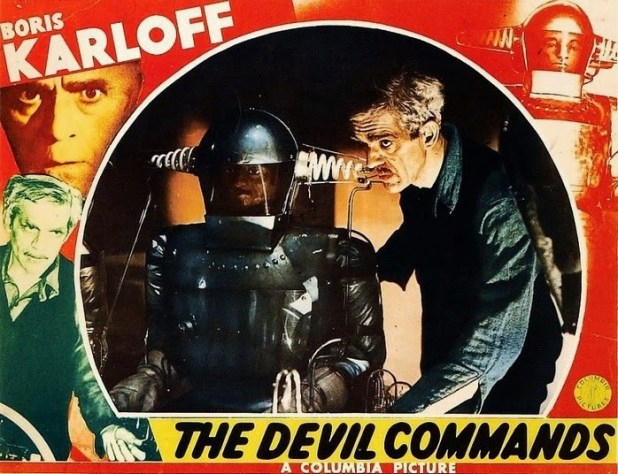
Boris Karloff plays Dr. Julian Blair, a brain wave researcher, who loses his wife Helen (Shirley Warde) when she dies in a car crash. He becomes obsessed with communicating with her in the world beyond death. He is assisted by his butler, Karl (Ralph Penney), and a Spiritualist medium named Mrs. Walters (Anne Revere), whose influence over the once logical man worries his research assistant, Richard (Richard Fiske), and his daughter, Anne (Amanda Duff).

I enjoy how, in these Columbia films, Karloff is the villain, yet there are reasons why he has gone wrong. It’s an intriguing way of approaching an antagonist, and Karloff makes each of them their own unique version of an archetype.

Sizzlin’ Summer of Side-Splitters 2025: Mr. & Mrs. Smith (1941)

July 28 – Aug 3 Screwball Comedy: Just imagine, the Great Depression is raging and you’re getting less than a fin a week at the rubber boiling factory, but it only costs two bits to go to the movies all day, so let’s watch some quick-talking dames match wits with some dopey joes!

Mr. & Mrs. Smith was the only pure comedy Hitchcock made in the United States — much less a screwball comedy — that he claimed that he made as a favor to Carole Lombard. She plays Ann Smith, whose fights with her husband David are so rough that they last days at a time. She also directed his cameo, making him redo it several times to the cheers of the crew. Man, she sounds like a blast, because she’d also sneak into the parking lot during breaks and put stickers for the opposite political party of her co-star. Robert Montgomery, on his car.

One morning, she asks him a question: would he marry her again if they could do it all over? Considering that he’s lost his freedom and independence, he says no. This gets tested when Harry Deever (Charles Halton) tells them both — independently — that because of a jurisdictional mishap, their three-year marriage in Idaho is no longer valid in New York City, where they now reside.

They break up, and Ann is able to turn David’s law partner and friend, Jefferson Custer (Gene Raymond), on him and even starts dating him. He introduces her to his family and takes her to Lake Placid. David follows with a ploy to get her back.

This is one of the first movies to show a pizzeria, if you can believe that.

You can watch this on YouTube.

Sizzlin’ Summer of Side-Splitters 2025: Topper Returns (1941)

July 28 – Aug 3 Screwball Comedy: Just imagine, the Great Depression is raging and you’re getting less than a fin a week at the rubber boiling factory, but it only costs two bits to go to the movies all day, so let’s watch some quick-talking dames match wits with some dopey joes!

The third and final installment in the initial series of supernatural comedy films inspired by the novels of Thorne Smith, this follows Topper and Topper Takes a Trip. The strange thing is that it may have Cosmo Topper (Roland Young) and his wife (Billie Burke), but it has a totally different set of ghosts.

Wealthy young heiress Ann Carrington (Carole Landis, One Million B.C.) and her best friend Gail Richards (Joan Blondell) are nearly killed by a masked and black gloved Giallo-style maniac when he shoots out their tire. They have a comical time catching a ride — Blondell’s thigh causes a man to crash a car — before Cosmo and his driver Eddie (Eddie “Rochester” Anderson) pick them up and drive them to their destination, the Carrington mansion.

Everything about this place is creepy, so strange that you wonder if Ann and Gail are about to put on diaphonus white gowns and clutch candleabras. There are evil servants, like Lillian (Rafaela Ottiano) and Rama (Trevor Bardette). And the sinister Dr. Jeris (George Zucco), who warns Ann that the father she has never met, Henry Carrington (H. B. Warner), is in poor health. She was raised far away, as her mother had asked in her will, after she and her father’s business partner died in a company mine. Now, her father tells her that tomorrow, on her birthday, she will assume complete control of the family fortune.

Gail makes a fuss about her room being small and takes Ann’s, but who could sleep after a chandelier almost kills them? Somehow, they do go to bed, just in time for that murderer in black to knife Gail, thinking that she’s Ann. But don’t be sad — this is a Topper movie and Gail comes back as a ghost, one who threatens Topper with a scandal if he doesn’t help solve her murder. As for his driver, he claims that he’s going back to working for Jack Benny, because ghosts never showed up there.

Seriously — Gail’s body shows up and then disappears, and I wonder, is this an Edgar Wallace-written Topper? There’s mistaken identity, leather gloved knife-carrying lunatics, family drama, a will — this has it all and by all, I mean it’s totally a Giallo. At least this ends happily, except for the ghosts again scaring Rochester.

Director Roy Del Ruth (The Alligator People) and writers Jonathan Latimer (30+ Perry Mason episodes), Gordon Douglas (who would later direct Them! and In Like Flint) and Paul Gerard Smith put together a fun farce that may not have all the characters of the films, but has the right ones. Blondell fondly recalled the film thirty years later, saying, “It was a hit but has grown on TV viewings because it is public domain. I laugh when I see it. I laugh at Eddie Anderson, Patsy Kelly, Billie Burke, and Rollie Young. It’s a send-up of all those dark house plots.”

You can watch this on YouTube.

CHILLER THEATER MONTH: The Wolf Man (1941)

EDITOR’S NOTE: The Wolf Man was on Chiller Theater on Saturday, September 18, 1965 at 1:00 a.m., Saturday, May 13, 1967 at 11:20 p.m., Saturday, April 13, 1968 at 1:00 a.m., Saturday, March 29, 1969 at 1:00 a.m., Saturday, November 6, 1971 at 11:30 p.m., Saturday, February 17, 1973 at 11:30 p.m., Saturday, January 19, 1974 at 11:30 p.m., Saturday, September 10, 1977 at 11:30 p.m. and on the final Chiller Theater on December 31, 1983 at 1:00 a.m. with It Came from Beyond Space.

As you watch this movie, understand the pains that Lon Chaney Jr. had to go through for your entertainment. While the stories got exaggerated over the years, even a portion of their truth is a testament to the actor’s herculean patience. Although the effects improved with each movie, this makeup — which was originally developed for Werewolf of London — took five to six hours to apply and a full hour to remove. There were even “finishing nails” carefully hammered into the skin on the sides of the actor’s hands so that they would remain motionless during the transformation scenes, which took ten hours of Chaney getting makeup, going to set to hold still against a pane of glass, then back for more makeup on a day that stretched to twenty-one hours of work over two days of filing.

Larry Talbot has returned to Wales to make peace with his father, Sir John Talbot (Claude Rains) and falls for a local girl (Evelyn Ankers, Universal’s “Queen of the B’s”).

During their initial meeting, he buys a silver-headed walking stick decorated with a wolf just to get to talk to her while she works. She tells him that it depicts a werewolf, a fact of life that he learns all about when he defends her friend from an attack and gets bitten on the chest as a result.

Soon, he learns from the fortune teller Maleva (Maria Ouspenskaya) that it was her son Bela (Bela Lugosi!) who bit him. Now, he will live up to the poem that is recited several times during this film: “Even a man who is pure in heart, and says his prayers by night; May become a wolf when the wolfbane blooms and the autumn moon is bright.”

The funny thing is that poem is not an ancient tale; it was written for the movie by screenwriter Curt Siodmak. He based the chasing of Talbot and his life being thrown upside down on his experiences in post-WW II Germany.

Director George Waggner would go on to direct plenty of TV, including episodes of Batman and Cheyenne.

While this film was a success and Larry Talbott (with Chaney playing him) would return for four more films, the character never appeared in its own direct sequel. Joe Johnston would direct a 2010 remake with Benicio del Toro in the lead role. There was also talk that the character would be played by Dwayne Johnson in the planned Dark Universe and Ryan Gosling in a Blumhouse version of the film.

Most of the legends of werewolves come not from folklore but directly from this film, including a person becoming a werewolf through a bite, the weakness to silver bullets, and werewolves’ and their victims’ hands being marked with pentagrams.

Fun fact: A five-year-old Sam asked every child in his kindergarten class to show their palms, as he had told his teacher that he was doing a magic trick for the class. In truth, he was checking to see if any of them were werewolves.

CHILLER THEATER MONTH: The Black Cat (1941)

EDITOR’S NOTE: The Black Cat was on Chiller Theater on Saturday, January 4, 1975 at 1:00 a.m.; Saturday, August 28, 1976 at 1:00 a.m.; Saturday, July 23 at 1:00 a.m. and Saturday, June 11, 1983 at 1:00 a.m.

Cat lady Henrietta Winslow (Cecilia Loftus) lives in what looks like a haunted house. But that’s where he family must go to hear the reading of her will. She plans on leaving half of her money to her niece Myrna (Gladys Cooper),  the other half to her granddaughter Margaret (Claire Dodd) and the estate to her granddaughter Elaine (Anne Gwynne).  Meanwhile, Myrna’s husband Montague (Basil Rathbone) has invited realtor Gil Smith (Broderick Crawford) and antiques dealer Mr. Penny (Hugh Herbert) to help him creak up the estate.

Smith saves Henrietta’s life by keeping her from poisoned milk — this has already been added to my poisoned milk Letterboxd list — but she’s later killed when she is cremated one of her murdered cats. Her money is not to be given to anyone until her faithful maid Abigail dies (Gale Sondergaard) and she tries to throw everyone out, but they won’t leave.

Meanwhile, Montague’s son Richard (Alan Ladd) catches his father with Margaret and threatens to tell Myrna, just in time for Abigail to be murdered. The killer is using secret tunnels in the house to pull off their scheme, but one of the surviving black cats solves the case by setting them on fire.

An attempt to cash in on the success of The Cat and the Canary, this was directed by Albert S. Rogell. The original script by Eric Taylor and Robert Neville was rewritten by Robert Lees and Frederic I. Rinaldo.

The Black Cat (1941)

Cat lady Henrietta Winslow (Cecilia Loftus) lives in what looks like a haunted house. But that’s where he family must go to hear the reading of her will. She plans on leaving half of her money to her niece Myrna (Gladys Cooper),  the other half to her granddaughter Margaret (Claire Dodd) and the estate to her granddaughter Elaine (Anne Gwynne).  Meanwhile, Myrna’s husband Montague (Basil Rathbone) has invited realtor Gil Smith (Broderick Crawford) and antiques dealer Mr. Penny (Hugh Herbert) to help him creak up the estate.

Smith saves Henrietta’s life by keeping her from poisoned milk — this has already been added to my poisoned milk Letterboxd list — but she’s later killed when she is cremated one of her murdered cats. Her money is not to be given to anyone until her faithful maid Abigail dies (Gale Sondergaard) and she tries to throw everyone out, but they won’t leave.

Meanwhile, Montague’s son Richard (Alan Ladd) catches his father with Margaret and threatens to tell Myrna, just in time for Abigail to be murdered. The killer is using secret tunnels in the house to pull off their scheme, but one of the surviving black cats solves the case by setting them on fire.

An attempt to cash in on the success of The Cat and the Canary, this was directed by Albert S. Rogell. The original script by Eric Taylor and Robert Neville was rewritten by Robert Lees and Frederic I. Rinaldo.

MILL CREEK THRILLERS FROM THE VAULT: The Devil Commands (1941)

Director Edward Dmytryk is best known for his film noir movies, winning Oscars for directing Crossfire and The Caine Mutiny and being named as one of the Hollywood Ten. This group of blacklisted film industry professionals refused to testify to the McCarthy-led House Un-American Activities Committee and as a result served time in prison for contempt of Congress. In 1951, however, Dmytryk testified to the HUAC and named Arnold Manoff, Frank Tuttle, Herbert Biberman, Jack Berry, Bernard Verhous, Jules Dassin, Michael Gordon and 15 others. He claimed that the Alger Hiss case, which found Communist spies in the U.S. and Canada, and the invasion of South Korea changed his mind. That said, he also probably wanted to fix his own career.

The screenplay was by Robert Hardy Andrews and Milton Gunzburg, the inventor of the Natural Vision stereoscopic 3-D system, from a story by William Sloane, who also wrote To Walk the Night.

Boris Karloff plays Dr. Julian Blair, a brain wave researcher, who loses his wife Helen (Shirley Warde) when she dies in a car crash. He becomes obsessed with speaking to her in the world beyond death and is helped by his buitler Karl (Ralph Penney) and a Spiritualist medium named Mrs. Walters (Anne Revere), whose influence over the once logical man worries his research assistant Richard (Richard Fiske) and daughter Anne (Amanda Duff).

I enjoy how in these Columbia films Karloff is the villain yet there are reasons why he has gone wrong. It’s an intriguing way of approaching an antagonist and Karloff makes each of them their own unique version of an archetype.

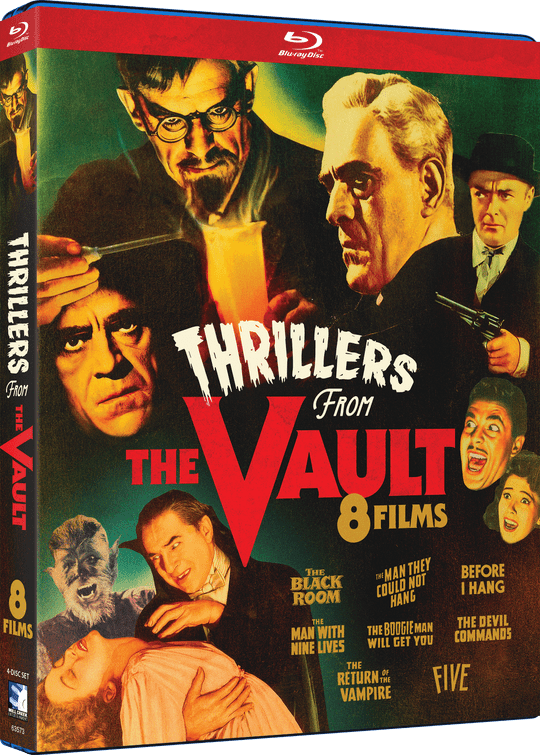
Mill Creek’s Thrillers from the Vault set also includes The Black Room, The Man They Could Not Hang, Before I HangThe Boogie Man Will Get You, The Man With Nine Lives, The Return of the Vampire and Five Each movie has a commentary track — The Devil Commands has Tom Weaver — and there’s also a documentary, Madness and Mayhem: Horror in the 30s and 40s. You can get it from Deep Discount.

MILL CREEK NIGHTMARE WORLDS: Emergency Landing (1941)

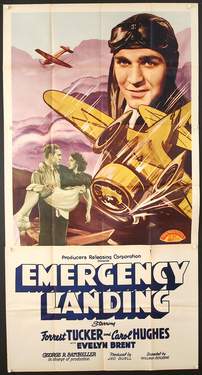
William Beaudine made movies in almost every genre and not only that, he made tons of them. His career started in 1909 and ended in 1966 with Billy the Kid Versus Dracula and Jesse James Meets Frankenstein’s Daughter. He made 75 movies in the forties and Emergency Landing also known as Robot Pilot is one of seven he made in 1941. His nickname? “One Shot” because that’s all he ever used, hurrying to get movies finished and out of the way.

“Doc” Williams (Emmett Vogan) has invented a wireless remote control airplane, but he and his pilot friend Jerry Barton (Forrest Tucker) have difficulty selling it, even to Jerry’s aircraft industry boss George Lambert (William Halligan). Meanwhile, two enemy agents plan on stealing that invention and oh yeah, don’t forget the screwball comedy with George’s spoiled daughter Betty (Carol Hughes, who plays Dale Arden in the Flash Gordon serials).

There’s also a role for Billy Curtis as Judge Gildersleeve. Curtis was the Muchkin city father in The Wizard of Oz, as well as roles in Gorilla at LargeGogHigh Plains Drifter and Eating Raoul over his fifty year career.

This played on TV as early as 1945, making it one of the first films to play on that new at the time invention.

Adventures of Captain Marvel (1941)

Created the year after Superman by C.C. Beck and Bill Parker, Captain Marvel is the alter ego of newspaper boy Billy Batson, who gains the powers of Solomon, Hercules, Atlas, Zeus, Achilles and Mercury when he says “Shazam!”

He was created when Fawcett Comics’ circulation director Roscoe Kent Fawcett said, “Give me a Superman, only have his other identity be a 10- or 12-year-old boy rather than a man.”

During the 40s, his comic book — Captain Marvel Adventures — claimed the “Largest Circulation of Any Comic Magazine” and was selling fourteen million copies a year.

This certainly didn’t make National Periodical Publications — the home of Superman — happy.

Republic made this serial was because Paramount Pictures successfully tied up rights to Superman and only made cartoons, not live action movies. Republic kept trying to get those rights and kept getting turned down. They took the script they had written for their Superman serial and changed it to The Mysterious Dr. Satan.

Then, they started talking to Fawcett and this became the first licensed live action comic book adaption.

National attempted legal action to prevent Republic from even making this serial, citing Republic’s failure at gaining the right for Superman. This would come back to haunt Fawcett, as litigation continued for seven years with National Comics Publications, Inc. v. Fawcett Publications, Inc. heading to trial in 1948.

While the presiding judge decided that Captain Marvel was an infringement, DC hadn’t copyrighted several of their Superman daily newspaper strips and basically had abandoned their Superman copyright. You can only imagine of Siegel and Schuster, who created Superman, felt after selling the rights to their character for $130. That said, the first court case went in Fawcett’s win column.

National appealed and secured the Superman copyright. In 1952, Judge Learned Hand did not find that the character of Captain Marvel itself was an infringement, but rather that specific stories or super feats could be infringements. Yet instead of a retrial, an exhausted Fawcett chose to settle, permanently canceling all of the Captain Marvel-related comics and paying National $400,000 in damages.

Fawcett creators Otto Binder and Kurt Schaffenberger ended up at DC, working on Superman. Hoppy the Marvel Bunny was sold to Charlton, British reprints became Marvelman instead of Captain Marvel for another decade. In 1972, DC Comics began licensing all of the Captain Marvel characters, except that Marvel was now around — which is why Marvelman became Miracleman but that’s another long story — which meant that now, Captain Marvel was Shazam. C.C. Beck did the first ten issues before quitting, saying “As an illustrator, I could, in the old days, make a good story better by bringing it to life with drawings. But I couldn’t bring the new stories to life no matter how hard I tried.”

For years, Shazam and his family lived on Earth-S, until the Crisis on Infinite Earths made all DC Comics take place on one Earth, which lasted for a few years until we came right back to a multiverse. By 1991, DC owned the characters outright and while they may have struggled to fit into their larger universe, the character has remained popular enough to get his own TV series in the 70s — this writer had a homemade costume as a child that he wore as soon as he got home from school — and the 2019 movie, which was released the very same year that Marvel had a Captain Marvel movie.

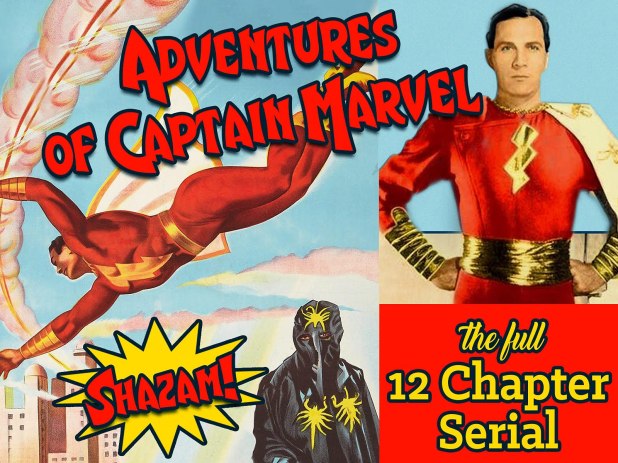
The serial changes up the origin somewhat. During an archaeological expedition to find the lost secret of the Scorpion Kingdom in the Valley of the Tombs, the Golden Scorpion is found inside a crypt. Only one person hasn’t entered the crypt, respecting the warning: Billy Batson, who is given the powers of Shazam by the ancient wizard with that very same name.

When the archaeologists come back to America, the villain known as the Scorpion starts killing them and stealing parts of the Golden Scorpion. Now, Captain Marvel must protect the surviving scientists and stop the villain from using the treasure for evil.

Directed by William Whitney — Quentin Tarantino is a huge fan: “Easily the most violent movies ever made for children were made by Witney (I say that as a badge of honor; get ‘em while they’re young). That would include many of his serials: Drums Of Fu Manchu, Spy Smasher, Dick Tracy Returns. And especially The Adventures of Captain Marvel, which easily contains in Tom Tyler’s Captain Marvel, the most homicidal berserker superhero of cinema. (Most of the gags and set pieces that Spielberg restages for Raiders of the Lost Ark are taken from Witney’s chapter plays)” — and John English, this is a fun serial, often looked at as one of the better examples of these short adventures. As for the effects, well, they used a weighted cape and a dummy to make it look like flight. People were amazed in 1941, though.

You can watch this on Tubi.