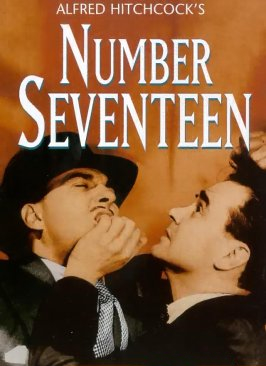
Based on the stage play by Joseph Jefferson Farjeon, this begins with Detective Barton (John Stuart) encountering an unhoused man, Ben (Leon M. Lion), as well as a dead body. As people continue to arrive at the house — one falls from the ceiling — the dead body disappears. In fact, it may still be alive. There are also three thieves — Brant (Donald Calthrop), Nora (Anne Grey) and Henry Doyle (Barry Jones) — a man named Sheldrake (Garry Marsh) and a necklace hidden in a bathroom.
There’s also a train chase right onto a ferry, which is some significant action. However, this sadly wasn’t a box-office success. Hitchcock said it was a disaster; he was in a strange phase of his career, remaking stage plays that never seemed to work. Those miniatures of the chase are good, however, and it’s an hour or so long. Not a lot to invest, and you get to see a master early in his career.
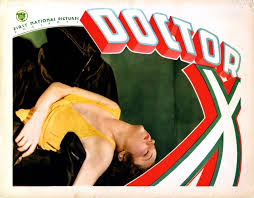
Based on the stage play The Terror by Howard W. Comstock and Allen C. Miller, Doctor X shouldn’t be disregarded by today’s horror fan just because it was made in 1932. It’s packed with murder, cannibalism, sex workers, strange relationships, frightening special effects and so much more. Because it was made in the two-color Technicolor process, it looks nothing like you’d think either, nearly a painting come to life. Large cities got to see this version while other countries and smaller towns only had black and white, which is how audiences saw this movie when it made its way to television in the 1950s.
It was feared that the color print was gone until the death of Jack Warner, who had one. The true color vision of Doctor X was donated to the UCLA Film & Television Archive, who did a digital restoration in 2020.
Lee Taylor (Lee Tracy) is writing about The Moon Killer, a serial murderer who has been killing during every full moon. Each body has pieces missing, as if they were eaten, which has driven the police insane as they search for suspects.
Doctor Xavier (Lionel Atwill) is the police’s expert on the case, yet they believe that he may be the suspect as well. After all, the brains are removed with surgical skill with a scalpel similar to the one he uses. If not him, it could be the other experts at the Academy of Surgical Research: Dr. Wells (Preston Foster), an amputee who has written several studies of cannibalism; Dr. Haines (John Wray), a voyeur; Dr. Duke (Harry Beresford), who is paralyzed and Dr. Rowitz (Arthur Edmund Carewe), who is studying the mental impact of the moon.
The police are morons, as they trust Dr. X enough to let him investigate this case, bringing together all the suspects. Each of them is connected to an electrical system that tracks their heartbeat in the hopes that reenacting a murder will tell Dr. X who The Moon Killer is. Only Wells is not in this experiment, as the murderer has two hands while he has just one.
As Dr. Xavier’s butler Otto (George Rosener) and maid Mamie (Leila Bennett) act out the horrible slaughter, Taylor starts to fall for Dr. X’s daughter, Joanna (Fay Wray), despite the fact that she outright hates him for writing that her father was probably the suspect that everyone should watch for.
The lights go out and when they come back on, Rowitz is dead, a scalpel in his head. That night, when his body is set out, it gets cannibalized. Mamie runs and Joanne must take her place as the experiment continues, but that’s when the killer — SPOILER! — is revealed as Welles, who has been creating inhuman flesh and he wants to kill Dr. X’s daughter next.
She’s saved by Taylor and because this is a pre-Code horror movie, he sets Welles on fire and tosses him out a window.
The success of this movie led to Atwill and Wray appearing in Mystery of the Wax Museum. Before that release could be filmed — which also has effects by Max Factor — they were also in The Vampire Bat. While The Return of Dr. X is not a sequel, Night Monster, which also stars Atwill, is a remake.
The Moon Killer is based on Albert Fish, who was called the Moon Maniac. He was still murdering while this was being made, as he was arrested shortly after this was in theaters.
Doctor X is from some other world, a place filled with weird jokes, strange killers and a doctor’s home that seems like it’s more dungeon than domicile. I can’t wait to go back there again.
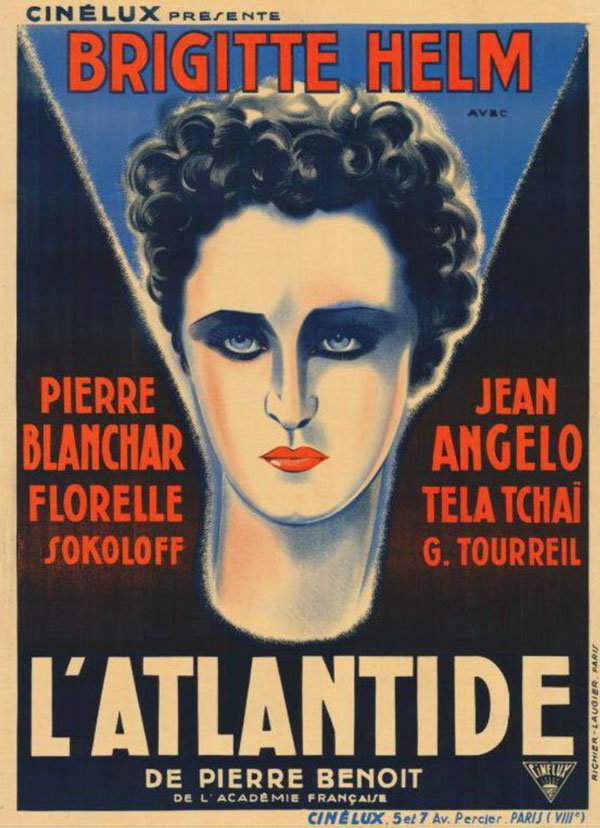
After Jacques Feyder refused to make a sound version of his 1921 film L’Atlantide, G.W. Pabst stepped in to make three this, shot in English, French and German with three different casts yet always having Brigitte Helm (the robot from Metropolis) in the lead.
Based on Pierre Benoit’s novel L’Atlantide, this movie has two French Foreign Legionnaires lost in the Sahara Desert when they find the very unlikely entrance to Atlantis, which is ruled over by Antinea. Yet this isn’t a movie like Stargate or one of the many matriarchal spacewomen films that would come out in the fifties. Instead, it’s a German Expressionistic dream-filled tale of what lies beneath the unexplored space of the desert and that is more unexplored space, because the Earth is vast and we are bored and yet there is so much that we have not done.
That said, the original novel is even more fantastic, with the queen presiding over a burial plot filled with the dead bodies of extinguished past lovers. Here, she’s the daughter of a dancer from our world and a tribal leader and you know, maybe we want the unreal over the real sometimes.
Brigitte Helm would retire three years later, yet was once considered to be Frankenstein’s bride. She moved to Switzerland and said that the Nazi takeover of the film industry sickened her; she made thirty movies in just seventeen years before that.
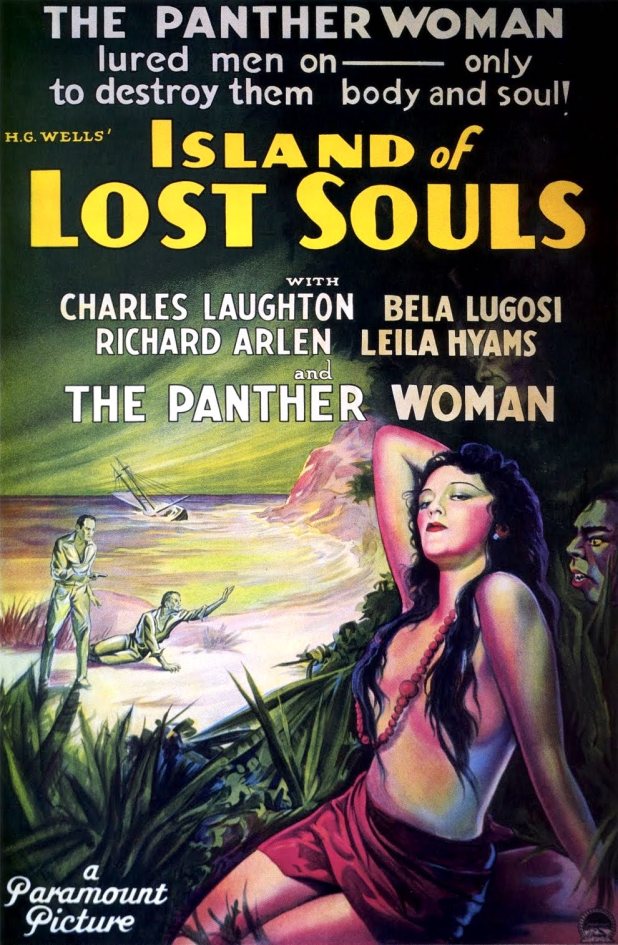
For all the infamous takes on The Island of Dr. Moreau, the third try — after the silent films Ile d’Epouvante and Die Insel der Verschollenen — got it right. Written by Waldemar Young (The Unholy Three, The Mystic) and Philip Wylie (whose Gladiator inspired Superman, The Savage Gentleman led to Doc Savage and When Worlds Collide was homaged by Flash Gordon), this film ended up banned in 14 states for embracing evolution and a line where Moreau says, “Do you know what it means to feel like God?” When it was re-released nine years later, any inference that Moreau created the animal/human hybrids was cut. It didn’t make it to the UK until 1957, a fact that pleased original writer H.G. Welles, who hated the movie as it was more horror than a studied philosophical narrative.
Director Eric Kenton took the long way to Hollywood, starting as a school teacher and then doing dog, pony and animal shows at the circus before working in vaudeville. He was a fan of horror, making The Ghost of Frankenstein, House of Frankenstein, House of Dracula and The Cat Creeps as well as two Abbott and Costello movies, Pardon My Sarong and Who Done It?
Edward Parker (Richard Arlen) survives a shipwreck and is rescued by a freighter delivering animals to the literal island of Dr. Moreau. After saving M’ling (Tetsu Komai), an animalistic looking man, from the captain, both are thrown off the boat and sent to Moreau via Mr. Montgomery’s (Arthur Hohl, a Pittsburgh native who was also in Show Boat) boat.
Moreau (Charles Laughton, who in addition to a fine acting career also had perhaps the finest one and done directing career with The Night of the Hunter) shows off his animal men to Parker, including Lota (former model Kathleen Burke, who was tied to this role for the rest of her life), a woman who appears human but is truly a panther. But something is amiss. After all, why would she refer to the lab as the House of Pain? And why would Moreau need to hold his men back with a whip and make them recite the Law of Man?
“Not to eat meat, that is the law. Are we not men? Not to go on all fours, that is the law. Are we not men? Not to spill blood, that is the law. Are we not men?”
The Sayer of the Law is, obviously, Bela Lugosi. And he’s perfect in this.
Lota falls for Parker, which was all a ruse by Moreau, as he wanted to see if she could feel human emotions. Parker is enraged by this, as he still loves his fiancee Ruth (Leila Hyams) and is shocked to see Lota’s fingernails turn into claws. She’s lost in despair, yet Moreau laughs, screaming that he will burn out the animal left within her in his House of Pain.
Speaking of Ruth, she gets a rescue crew to visit the island and save Parker and that’s when Moreau decides to kill everyone, using one of his creations Ouran (Hans Steinke) as the killer. This backfires, as the rest of his creations realize that if the man who made them doesn’t need to follow the law, they don’t need to either.
“What is the law? Law no more!” they shout as they hold Moreau down and repeatedly stab him with his own surgical tools, just as Montgomery, Parker, Ruth and Lota make their escape. At the last moment, Ouran attacks and Lota gives her life to allow Parker and Ruth to live their lives far from the now burning island.
This is a movie that shocked and upset audiences, with even the sound design causing chaos. Soundman Loren L. Ryder recorded a mix of animal sounds and foreign languages, then played them backward at multiple speeds. The sound that resulted made people physically sick.
As much as Welles disliked this movie, his book was missing the dynamic between Parker, Ruth and Lota. The Panther Woman character was so popular and enduring that she influenced every adaption made after this one, such as Frances in Terror Is a Man, Ayessa in The Twilight People, Barbara Carrera in the 1977 remake and Aissa in the 1996 movie that is so infamous.
This film also influenced numerous musicians. The Cramps’ song “The Natives Are Restless” is about the film, Blondie had the song “Island of Lost Souls,” House of Pain took their name from the movie (and even named a tour He Who Breaks the Law), The Meteors had a song with the title of the film, Oingo Boingo recorded “No Spill Blood” and Buckethead has a song named “Island of Lost Minds.”
Cleveland-based horror rock band Manimals based much of their look on the film and when they played the song “Island of Lost Souls” live, fans would shout “What is the law?”
Van Halen played a song called “House of Pain” that was a progressive rock song that was definitely not the radio friendly rock they’d soon become known for. When played live, David Lee Roth would give a long introduction about how the movie inspired the song and then Eddie would go into an intro that eventually became “Eruption.” The demo of the song — there’s a different version with different lyrics on 1984 — is incredible.
Yet no band was more inspired than Devo. The “What is the law?” dialogue formed the lyrics to their “Jocko Homo,” while they took the question “Are we not men?” for their 1978 debut album Q: Are We Not Men? A: We Are Devo!
Pretty good for a movie with no music on its soundtrack.
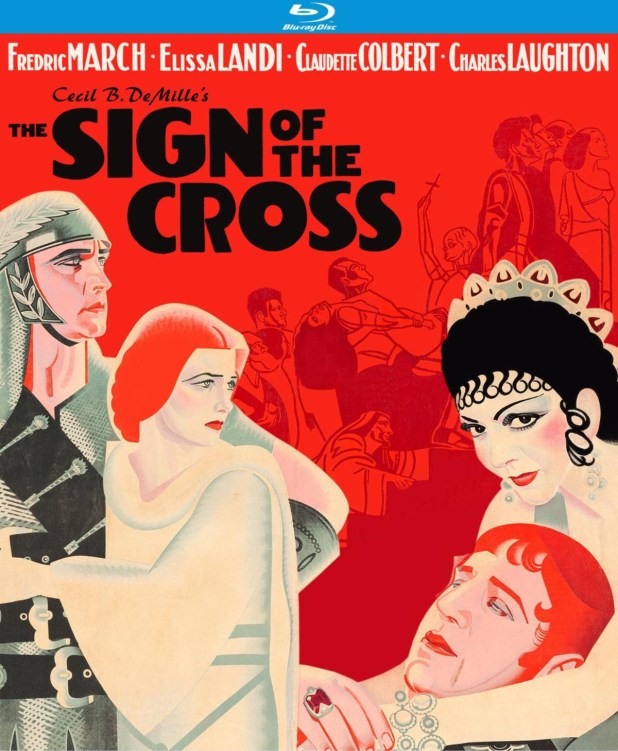
The third of Cecille B. DeMille’s Biblical trilogy, following The Ten Commandments (1923) and The King of Kings (1927), this religious-themed movie actually upset Catholics so much that the Catholic Legion of Decency, an organization dedicated to identifying and combating objectionable content, was formed in 1934. I used to love checking out what movies they rated as O for Offensive, as quite often, those were the ones I sought out.
The scene that did it is when Poppaea (Claudette Colbert) bathes herself in the milk of asses, which was really powdered milk that soon went sour under the hot lights. Actually, more than one scene did it, as the Hayes also asked DeMille to cut Ancaria’s (Joyzelle Joyner) seductive dance for a woman, the orgy scene, a gorilla dancing around a nearly nude woman, a dead body-filled cart, elephant stomping on Christians and a crocodile getting ready to chow down on a tied-up girl.
Somehow, someway, this movie was sold to three audiences: regular movie fans, churchgoers and then students. It’s an early attempt at market segmentation and changing the ad message for each group. I have no idea how the religious and the young reacted to some of the insanity in this movie.
Emperor Nero Claudius Caesar (Charles Laughton) is burning Rome to the ground and blaming it on the Christians, but Roman Prefect Marcus Superbus (Frederic March) has fallen for one of the enemy, the Christian Mercia (Elissa Landi). This causes Empress Poppaea (Colbert, who hadn’t played an evil role at this time in her career), who yearns for Marcus, to team with Nero to kill every religious person left.
John Carradine plays numerous small roles in this — a Christian martyr, the leader of the gladiators and several voices — having been hired when the out of work actor’s booming voice was heard by DeMille on Hollywood Boulevard. It’s like Cannibal Holocaust, except at some point, everyone knelt and prayed instead of shredding a turtle to pieces.
The glory of DeMille’s Biblical epics is that they both want to save and damn your soul at the same time. It’s blood and circuses, spectacle and sermon, all at the same time. There really hasn’t been anything like these Pre-Code movies ever since.
You can get the new Kino Lorber reissue of this film, complete with two commentary tracks by film historians Mark A. Vieira and David Del Valle, here. This is a moment of history that demands to be in your collection.
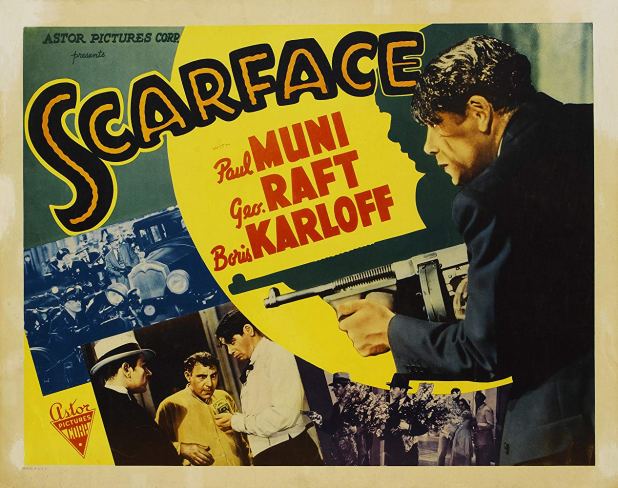
Paul Muni plays gangster Antonio “Tony” Camonte — based on Al Capone — as this film details his bloody rise from the bottom to the top of Chicago’s gangs. This film was directed by Howard Hawks and produced by Howard Hughes, who wanted another hit after 1931’s The Front Page.
Hawks and Hughes were not on friendly terms, as there had been a lawsuit between the two, alleged that Hawk’s film The Dawn Patrol had stolen from Hughes’ Hell’s Angels. Over a game of golf, they dropped the suit and came to terms. Hawks was also pleased to see Ben Hecht would be the writer. Hecht was incredibly suspicious of Hughes as a producer, so he demanded a $1,000 a day salary to be paid every day at 6 PM. A grand a day in 1932, adjusted for inflation, would be around $18,450.80 today. Talk about being a gangster.
Luckily, Hecht and Hawks gelled well and agreed that the story of the gangster in the movie should mirror the Italian Borgia family, right down to the hints of incest between him and his sister.
The movie starts with Camonte (Paul Muni) killing “Big” Louis Costillo on the orders of boss Johnny Lovo, which enables the boss to take control of the speakeasies and bars of Chicago’s South Side. Johnny promotes Camonte to his key lieutenant but warns him to avoid the Irish gangs on the North Side.
Tony ignores that and begins taking over, drawing the attention of rival gangs and the police. Johnny realizes that Tony is out of control and begins making moves against him, all while Tony goes after Johnny’s girl Poppy. He woos her with his extravagant apartment, including a view of a neon sign that proclaims, “The World Is Yours.”
Meanwhile, Tony goes to war with the Irish gangs, sending the coin flipping hitman Guino Rinaldo (George Raft, the gangster’s gangster) to wipe out the Irish leader in his florist shop headquarters. Tom Gaffney (Boris Karloff!) takes over the Irish mob and comes after Tony’s men with Thompson submachine guns, but Tony even dresses up like a cop to wipe out his rivals, finally killing Gaffney in a bowling alley.
As the South Side gang celebrates, Tony dances with Poppy right in front of Johnny. That leads to an order of assassination to made against Johnny’s former friend and protege. Too bad for Johnny, who turns the tables. Once he kills Johnny, he’s the boss of all bosses, but the police start closing in. He’s also lost his mind, as he kills his sister once she secretly marries Guino, his best friend and most loyal soldier.
His sister calls the police on him, but in the end, she stays behind and defends him to the death. As tear gas fills his apartment, he rushes to the room, killed to the sounds of the cheering under that big neon sign. The world is, indeed, yours.
Scarface is a pre-Code movie, but was still screened for the California Crime Commission and police officials. None of them found it to be a dangerous influence, but the Hays Office insisted on changes. Hughes believed they had a vendetta against the film, which would go on to be one of the most censored movies in Hollywood.
That’s because the Hays Office wanted to avoid the sympathetic portrayal of crime. So criminals always had to be punished or shown the error of their ways. The strange thing is that the Office didn’t have the authority to actually censor films until 1934, but they’d often tried to delay films, which was damaging to the bottom line.
Maybe that vendetta is because the Office wanted changes to the script before the movie was even shot, but Hughes exclaimed, “Screw the Hays Office, make it as realistic, and grisly as possible.”
After the censorship battles, the film released a year late and was behind similar films like The Public Enemy and Little Caesar. Censorship boards in New York, Ohio, Virginia, Kansas, Detroit, Seattle, Maryland, Portland and Chicago all banned this movie until the Hays Office assured them that Hughes had made changes to the film. No completely uncensored version of Scarface is known to exist.
That said, the film was well-received, particularly by its inspiration, according to George Raft. However, it provoked outrage among Italian citizens and organizations.
Tony believes in that neon sign he can see outside his window. Yes, the world can be yours for some people, but that ascent — given his mania — is near impossible. His rise will come with an even bigger fall.
 B&S About Movies