April 9: Do You Like Hitchcock? — Write about one of his movies.
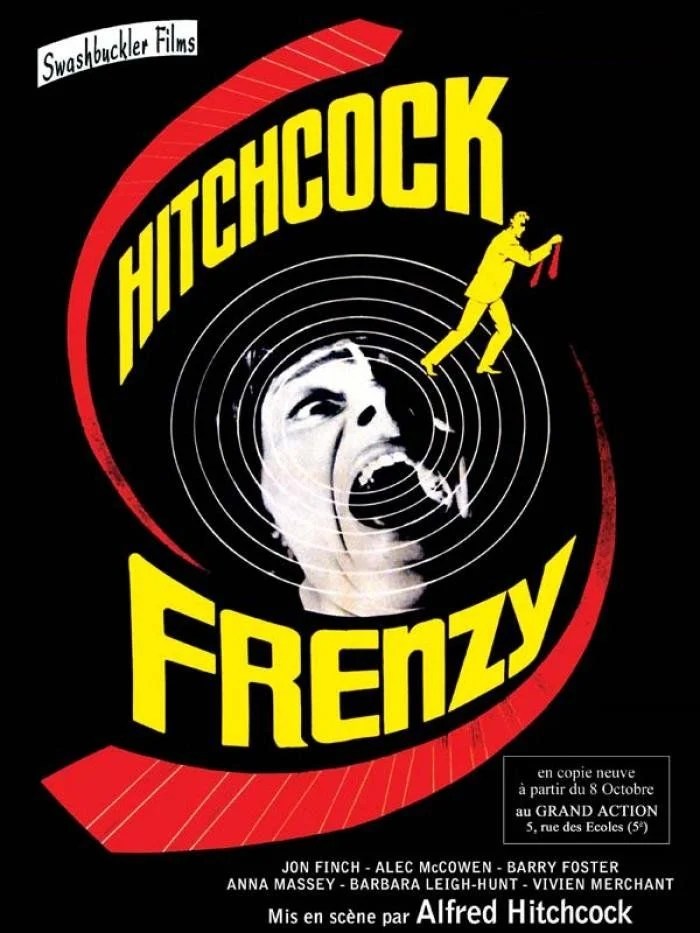
After Torn Curtain and Topaz were failures, Alfred Hitchcock went back to murder. After those two espionage films, this was an actual Hitchcock film, one in which former RAF squadron leader Richard Blaney (Jon Finch), a man with a history of angry bursts of violence, becomes the prime suspect in the Necktie Murders, which have actually — way too early spoiler — been committed by his friend, Bob Rusk (Barry Foster).
Yet this is a film of firsts. It’s the only Hitchcock film to receive an R rating in the U.S. during its initial release, and it would be the first time nudity appeared in one of his movies. Those scenes, which are also filled with detailed murders, were so harsh that actresses Barbara Leigh-Hunt and Anna Massey refused to be in them. Body doubles did the job instead.
Hitchcock, ever the technician, used a Linhof Technika camera for many of the film’s ultra-tight close-ups, capturing the grit of early 70s London. He also returned to his roots, filming on location at Covent Garden, where his father had been a vegetable merchant. You can almost smell the rotting produce and the stale ale.
The first victim we meet is Brenda Blaney (Leigh-Hunt), Richard’s ex-wife, who runs a dating service. They’ve already turned down Rusk, as he’s a pervert, so when he comes back, he quickly assaults and strangles her. Her secretary comes back from lunch, just in time to see Richard wandering around, trying to get in. When the body is found, he’s now a suspect. He hides with a former co-worker, Babs Milligan (Massey); they have sex, and hours later, she runs into Rusk, who kills her as well.
In a time before DNA evidence, Richard is totally screwed. He even goes to prison for the crime and escapes, only to make his way back to Rusk’s flat to find another dead body in the bed. Luckily, Rusk comes back to the scene of the crime just in time to be caught by Inspector Timothy Oxford (Alec McCowan).
One of the film’s most famous sequences involves Rusk trying to retrieve a monogrammed tie pin from the rigor-mortis-clutched hand of a corpse hidden in a potato truck. It took three days to film that scene, and Foster (Rusk) actually had to endure being covered in real potato dust, which is apparently quite the skin irritant.
Michael Caine was Hitchcock’s first choice for the role of Rusk, but said, “He offered me the part of a sadist who murdered women, and I won’t play that. I have a sort of moral thing, and I refused to play it, and he never spoke to me again.” This does not explain why he plays a woman killer in Dressed to Kill. Spoilers again, huh?
In the article “Frenzy at 50: The most violent film Hitchcock ever made,” Mark Allison writes, “On the surface, this project bore everything that audiences could expect from the ageing auteur – a murdered blonde and an innocent man clearing his name, served with lashings of suspense – but with the greater permissiveness of early 1970s cinema came a much nastier tone than Hitchcock had ever attempted before. Without fear of censorship and facing competition from a new wave of exploitation cinema, from U.S. splatter horror to the Italian giallo, Hitchcock unleashed all his voyeuristic impulses on this shockingly brutal film. The result is, perhaps, just the sort of horribly graphic murder story that he’d always wanted to make, if only he’d been allowed.”
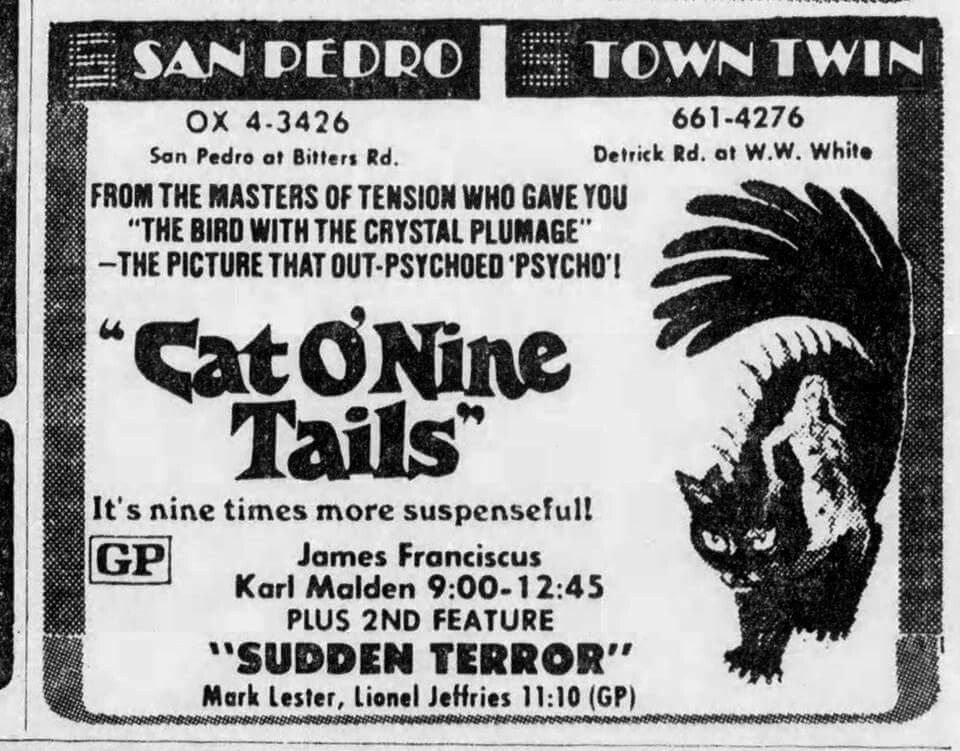
Speaking of gialli, Dario Argento was proclaimed the man who “out Psycho-ed Psycho,” if we are to believe the newspaper ads for The Cat o’Nine Tails.
Yet here’s Hitchcock making a giallo, a film about a strangler who uses neckties, just like a movie that would follow the very next year, Torso. For me, it’s nowhere near the excesses of the Italian psychosexual killer genre, even if Hitchcock’s daughter Patricia thought it was so disturbing that she wouldn’t allow her children to watch it.
Roger Ebert said, “Alfred Hitchcock’s Frenzy is a return to old forms by the master of suspense, whose newer films have pleased movie critics but not his public. This is the kind of thriller Hitchcock was making in the 1940s, filled with macabre details, incongruous humor and the desperation of a man convicted of a crime he didn’t commit. The only 1970s details are the violence and the nudity (both approached with a certain grisly abandon that has us imagining Psycho without the shower curtain). It’s almost as if Hitchcock, at seventy-three, was consciously attempting to do once again what he did better than anyone else.”
 B&S About Movies