April 6: Independent-International: Write about a movie by Sam Sherman. Here’s a list.
ABOUT THE AUTHOR: Adam Hursey is a pharmacist specializing in health informatics by day, but his true passion is cinema. His current favorite films are Back to the Future, Stop Making Sense, and In the Mood for Love. He has written articles for Film East and The Physical Media Advocate, primarily examining older films through the lens of contemporary perspectives. He is usually found on Letterboxd, where he mainly writes about horror and exploitation films. You can follow him on Letterboxd or Instagram at ashursey. His April Movie Thon list is here.
EDITOR’S NOTE: I love that Adam did the same movie as me!
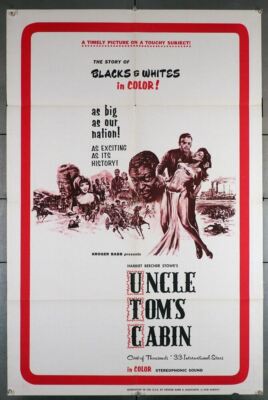
Why make an entirely new film when you can just add some sleaze to an existing one?
This philosophy was one avenue Independent-International Pictures travelled when releasing motion pictures in the 1960s and 70s. Led by director Al Adamson and producer Sam Sherman, the production company released many profitable films to the drive-in circuit. One method the duo used would be to acquire European films that perhaps did not provide financial success upon initial release and shoot some additional footage that could be inserted into it for a more sensational experience.
Case in point: Uncle Tom’s Cabin. In 1965, German director Gèza von Radvànyi adapted Harriet Beecher Stowe’s iconic novel of American slavery, turning it into a 170 minute epic that did not catch on with audiences, despite premiering at the Cannes Film Festival. Rights to the film were sold to Kroger Babb, one of the most famous exploitation producers who might be best known for his “sex hygiene” film Mom and Dad. Babb cut the film down to 110 minutes and released it in 1975 under the title Cassy (a minor yet important character in the film), but the movie again failed to attract an audience. By the time Sam Sherman and Al Adamson got involved, the year was 1977, and “slavesploitation” was suddenly a hot commodity thanks to Mandingo and Roots. But the content would need to be beefed up for tickets to be sold. No problem. Adamson shot some scenes of rape, interracial love, and torture, and these scenes were (pretty seamlessly) added into the original picture.
I would love to set my eyes on Radvànyi’s original film. Starring Herbert Lom as slave trader Simon Legree, Uncle Tom’s Cabin pulls no punches in showing the struggles of individuals at the hands of such a merciless individual. Uncle Tom, along with other slaves, is sold to Legree to help settle some debts of his owner. Legree is a memorable villain, and Lom’s performance, behind his scarred face, is just the type of person viewers would love to hate.
Is it possible that the exploitative scenes added by Adamson and Sherman actually do improve the film? Perhaps. There is no doubt as to which scenes were added. And these scenes definitely made me sit up in my chair a bit straighter. As someone who has never read the novel, the film made me research the differences between Stowe’s tome and adaptations over the years. In this version, after attempting to flood the cotton crop, the runaway slaves run into the welcoming arms of the saintly men of a Catholic mission. This ending might have been added to cater to European sensibilities.
But what about the stereotype of the Uncle Tom character himself? In this film, Uncle Tom lays down his life protecting others, a far cry from how Uncle Tom is discussed today as a man who would do anything to please his masters for self-preservation. Turns out the character in this film is closer to the one created by Stowe. Uncle Tom is a Christ-like figure, intentionally written this way to appeal to Christian readers in an attempt to convert them to the abolitionist cause. It worked. As the film announces via a title card at the beginning of the picture, Uncle Tom’s Cabin helped propel Abraham Lincoln’s desire to end the practice of slavery in the United States.
It is amazing to think that an exploitation version of a German film about America’s darkest period in history can actually educate. Will I now read the book I’ve put off reading for so long? Maybe. Of course, I have too many movies to watch to actually read a novel. And many more Al Adamson films to see–Uncle Tom’s Cabin is only the second of his films I’ve seen. I have so much work to do.
 B&S About Movies