Shot entirely on location in Ireland, mainly employing Irish actors and crew, Excalibur was an essential film for the Irish filmmaking industry and helped start the careers of Liam Neeson, Patrick Stewart, Gabriel Byrne and Ciarán Hinds.
It was also known as the Boorman Family Project, as several members of director Jonathan Boorman’s family appear: his daughter Katrine Boorman as Igrayne (Arthur’s mother), his daughter Telsche as the Lady of the Lake, and his son Charley as Mordred as a boy. It was shot a mile from his home, so he was able to stay home for the entire shoot.
Boorman has wanted to make the movie since 1969, yet United Artists saw the three-hour script as too costly and instead offered him The Lord of the Rings, which he did not make but did develop. He ended up using some of the work that went into that adaptation here and was potentially inspired by Monty Python and the Holy Grail.
He’d worked with Rospo Pallenberg on that canceled film (as well as Exorcist II: The Heretic and The Emerald Forest; Pallenberg would also direct Cutting Class), so he worked with him here to bring Malory’s Morte d’Arthur to theaters. Boorman said that his film was about “the coming of Christian man and the disappearance of the old religions, which are represented by Merlin. The forces of superstition and magic are swallowed up into the unconscious.”
I love Roger Ebert’s review of this movie, in which he said that the film was both a wondrous vision and a mess, “a record of the comings and goings of arbitrary, inconsistent, shadowy figures who are not heroes but simply giants run amok. Still, it’s wonderful to look at.”
It’s beyond gorgeous, actually, a movie that combines shocking gore with artistic flourishes, like the three ladies in white who attend Arthur to Avalon at the close. Boorman was also smart enough to cast Nicol Williamson as Merlin and Helen Mirren as Morgana Le Fay, two actors who had had a conflict when they acted together in Macbeth. He felt that tension would be seen on screen, and it certainly is. That said, Mirren claimed that the two became friends while making Excalibur.
It rained every single day of the shoot, which added to the film’s foggy look. It had many issues, as the first fight scene had to be filmed three times. It was filmed at night, and the exposure meter was broken, leaving two scenes underexposed.
Boorman’s career is pretty great. Sure, there are the big movies like Deliverance, but I love that he shoots for the fences and makes off-the-wall stuff like Zardoz and Exorcist II: The Heretic. Here’s to less playing it safe for directors, even if the misses turn out to be spectacular losses. I don’t think that can happen in entertainment anymore.
My initial exposure to this film came from Mad Magazine. Often as a kid, we wouldn’t see an R-rated movie until it was on HBO, so many of the films I’ve had to find as an adult were first seen through the eyes of Mad’s Usual Gang of Idiots. This time, Don Martin did the movie adaption. I’m happy to share a few panels with you thanks to Jesse Hamm on Twitter.


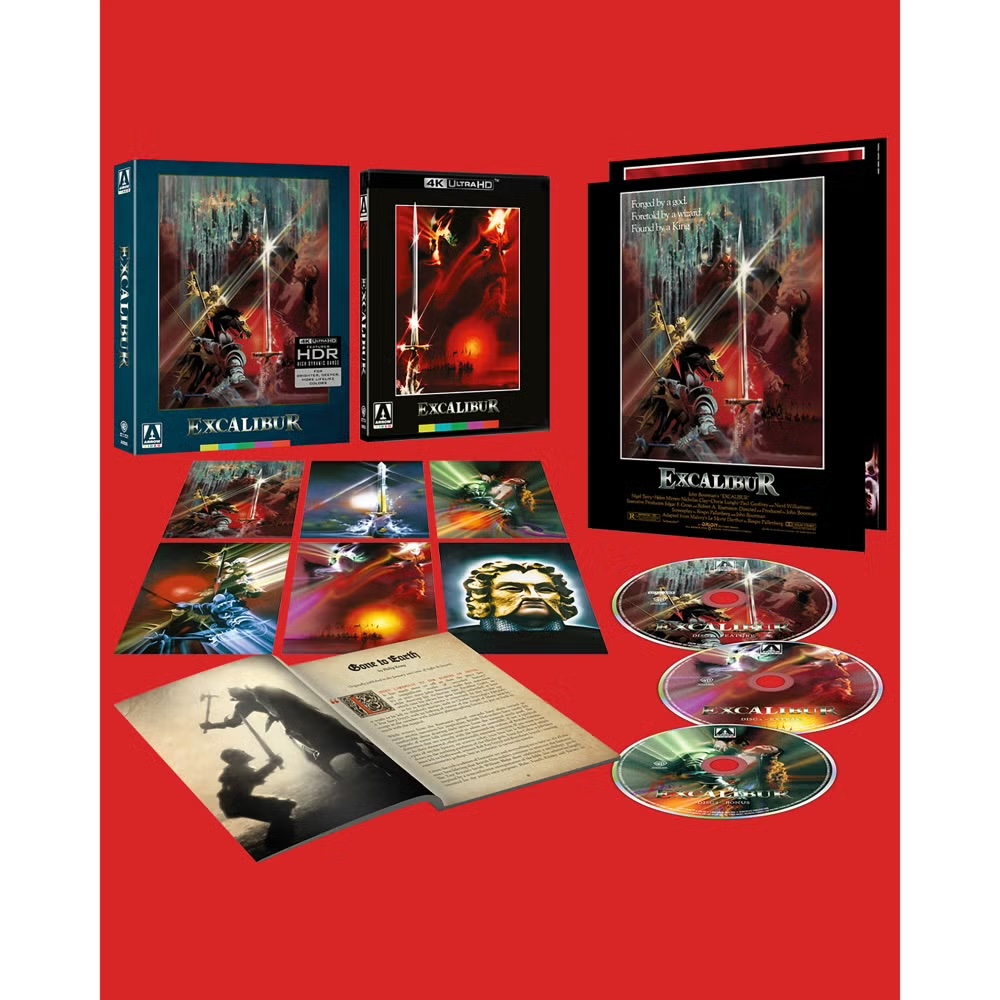
The Arrow Video 4K UHD and Blu-Ray release of Excalibur — buy it at the MVD links — has so much. It all begins with a brand-new 4K restoration from the original 35mm negative by Arrow Films, presented in its original aspect ratio of 1.66:1 for the first time on home video. You get both the theatrical and TV cuts, as well as extras like two new audio commentaries: one by Brian Hoyle, author of The Cinema of John Boorman, and the other by filmmaker David Kittredge, director of Boorman and the Devil. There’s also an archival audio commentary by director John Boorman. Plus, there’s The Making of Excalibur: Myth into Movie, a never before released 48-minute documentary directed by Neil Jordan during the production of Excalibur; new interviews with Boorman, Charley Boorman, creative associate Neil Jordan, production designer Anthony Pratt and 2nd unit director Peter MacDonald; Anam Cara, a new featurette on the working friendship of John Boorman and co-writer Rospo Pallenberg featuring a newly filmed interview with Pallenberg; Divided Nature, a brand new featurette by film historians Howard S. Berger and Kevin Marr; trailers; an imkage gallery and Excalibur: Behind the Movie, a 50-minute retrospective documentary in which cast and crew look back on the making of the film. It’s all inside a reversible sleeve featuring two original artwork options, along with a collector’s perfect-bound booklet containing writing by Charlie Brigden, K.A. Laity, Kimberly Lindbergs, Josh Nelson, Philip Kemp, John Reppion, Icy Sedgwick and Jez Winship, a double-sided fold-out poster featuring two original artwork options and six postcard-sized reproduction art cards.
 B&S About Movies