A shell-shocking saga of mutants, martial arts and New York mayhem, the Teenage Mutant Ninja Turtles trilogy brought comic book grit, practical effects wizardry and pizza-fueled fun to a generation of moviegoers, helping turn four sewer-dwelling brothers into global pop culture icons.
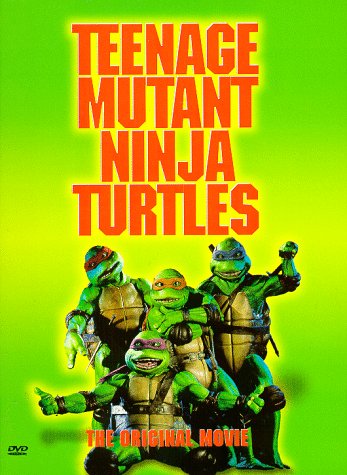
Teenage Mutant Ninja Turtles (1990): Before the internet, geeks like me read the Comics Buyer’s Guide Magazine — I devoured every tabloid-sized issue — and learned what new books were worth reading. Teenage Mutant Ninja Turtles, created originally as a joke sketch of a turtle with nunchucks by Kevin Eastman and named “teenage mutant” by Peter Laird, was a black and white comic packed with violence that hit the cultural zeitgeist of the late 80s. It hit all the trends of comics, like the teenage angst of X-Men and Teen Titans along with the ninjas of Daredevil. In fact, the same canister of radioactive material that gave Matt Murdock his radar sense is what turned four baby turtles into Leonardo, Michaelangelo, Donatello and Raphael.
Who knew that a few years later, they’d be the biggest cartoon and toy around?
In 1990, the movie came out, and yes, it has a lot of the kid elements of the cartoon, like the love of pizza, April O’Neil (Judith Hoag) being a reporter, and Michelangelo behaving like a surfer dude. But so much of the film comes directly from the first issue of the comic. And it has martial arts in its soul, as it was produced by Golden Harvest.
Every major studio turned it down for distribution, including Walt Disney Pictures, Columbia Pictures, Universal Pictures, MGM/UA, Orion Pictures, 20th Century Fox, Paramount, and Warner Bros., before New Line took a chance. It paid off, as its $32 million was the second-highest opening weekend at the time — behind Batman — and ended up being the ninth biggest movie of 1990.
The complicated turtle costumes took 18 weeks each to be created by Jim Henson’s Creature Shop. Henson said that the creatures were the most advanced that he had ever worked on. But they work — you really start to believe in the characters more than you do in the later CGI efforts.
The film begins with the four Turtles — Leonardo (Brian Tochi, Revenge of the Nerds, Police Academy 3 and 4), Raphael (Josh Pais), Donatello (pop culture force Corey Feldman) and Michelangelo (Robbie Rist, Cousin Oliver) — working for the sewers and the shadows to protect New York City — but actually North Carolina — and saving the life of April.
Leo is closest to their sensei, Splinter (former Elmo Kevin Clash); Don is the inventor; Mike is the partier; and Raph is filled with rage, which leads him to battle street vigilante Casey Jones (Elias Koteas).
Above I just listed the voices, but it took so many talents to bring the characters to life.
Inside the Leonardo suit was David Forman, an Olympic tumbler and stuntman, with Martin P. Robinson controlling the face. He is also Mr. Snuffleupagus and designed, built, and played Audrey II in Little Shop of Horrors. Leif Tilden was Donatello; he also performed several characters on Henson’s Dinosaurs show. He was supplemented by Ernie Reyes Jr. for martial arts scenes, skateboarder Reggie Barnes for skate scenes and facial movements by David Rudman. Michelangelo was a Broadway performer, Michelan Sisti, with facial movements by Mak Wilson. Raphael was performed by his voice actor, Josh Pais, with David Greenaway handling the facial animation, and Kenn Troum handling the fighting scenes. Splinter was puppeteered by Clash, who also provided his voice, with Rickey Boyd handling the face animation, and movement assisted by Robert Tygner.
The Turtles are in battle against a ninja clan known as The Foot — Daredevil fought The Hand — which is led by Oroku Saki, known as the Shredder (James Saito), the man who killed Splinter’s master, Tatsu. Yes, the “radical rat” used to watch his master do karate and picked it up. When he found the four mutated baby turtles in the sewer, he saved them and taught them how to become ninja.
The Foot Clan has some major actors in its employ. Look for Sam Rockwell as an unmasked member and Skeet Ulrich and Scott Wolf under hoods.
In the UK and Germany, this movie was known as Teenage Mutant Hero Turtles, and the violence is toned down. Also, Mike’s nunchaku aren’t shown, since that weapon is always censored. The German version goes even further, adding cartoon sound effects to all the fight scenes.
This was directed by Steve Barron (who also made Electric Dreams, Coneheads and the music videos for “Billie Jean” by Michael Jackson, “Take On Me” by a-ha and “Don’t You Want Me” by The Human League) and written by Bobby Herbeck, who had the original idea of making the movie, and Todd W. Langen, who did a Page One rewrite of the original script.
Sally Menke, who edited all of Quentin Tarantino’s movies until she died in 2010, was the original editor of this film, but Golden Harvest removed her because they didn’t like her work. Weird, huh?
Trust me, I was a big fan. I bought every single Playmates toy, had all the comics, and watched every episode of the show, but my heart was in the original black-and-white comics. That’s why I love the first film: while it’s made kid-friendly, it still has so much of that look and feel.
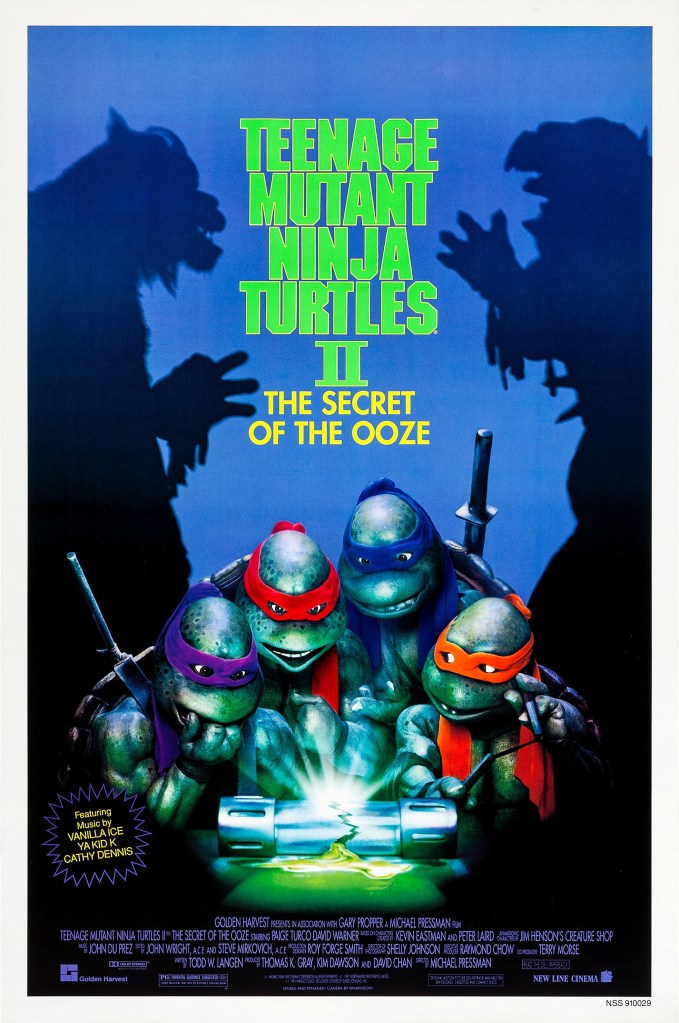
Teenage Mutant Ninja Turtles II: The Secret of the Ooze (1991): Directed by Michael Pressman (who is still directing episodes of Law and Order today, but also made Some Kind of Hero, Doctor Detroit and The Great Texas Dynamite Chase) and written by Todd W. Langen, who also wrote the first film, the second Ninja Turtles movie toned down the violence, mostly removed the weapons from the turtle’s three fingered hands and was much more kid-like than the original. I mean, Vanilla Ice raps “Ninja Rap” at one point.
They also had twice the original budget and, at the time, ended up the second-highest-grossing independent film ever, behind the first movie.
Brian Tochi and Robbie Rist returned as Leo and Mike, while Adam Carl replaced Corey Feldman as Don and Laurie Faso replaced Josh Pais as Raph. Leo would now be played by Mark Caso, with Rob Tygner as the facial assistant and Larry Lam as the stunt double. Mike was Michelan Sisti with Mak Wilson as the face and Nick Palma doing stunts. Don was Leif Tilden, with Rob Mills moving the face and Steven Ho doing the fighting. Raph was Kenn Troum with David Greenaway as the facial assistant, and Hosung Pak did the stunts. He played Liu Kang in the first two Mortal Kombat games and was one of the fighters on WMAC Masters. Kevin Clash would return to voice and puppet Splinter with assistance from Rickey Boyd and Sue Dacre.
As Shredder died at the end of the last film, the Foot Clan would be led by Tatsu (Toshishiro Obata) before bringing their leader (François Chau replacing James Saito) back to life and transforming him into Super Shredder (wrestling genius Kevin Nash). They also gain two new mutants: an evil turtle named Tokka — Kurt Bryant in the suit, with Rick Lyon animating the face and David Rowden doing the stunts — and the wolf-like Rahzar — Mark Ginther in the costume, with Gord Robertson animating the face and Hamilton Perkins doing the stunts. Both of these new villains were voiced by Frank Welker, who, if you want an animal voiced in your movie or cartoon, you go to.
The new mutants were used instead of the cartoon’s Bebop and Rocksteady, who co-creator Peter Laird hated and said, “their constant one-note shtick in the first animated series was extremely annoying and silly to the point of being stupid.”
Paige Turco would replace Judith Hoag as April O’Neil, and Casey Jones doesn’t even show up.
Needless to say, I didn’t like this as much as the first, even if I love the look of the bad guys in the film.
What I do like is David Warner being in this as ooze expert Professor Jordan Perry, and Ernie Reyes Jr. getting to be in the movie in a turtle costume. And yes, Tokka, Rahzar and Super Shredder are all amazing, but come on. Ninja rapping.
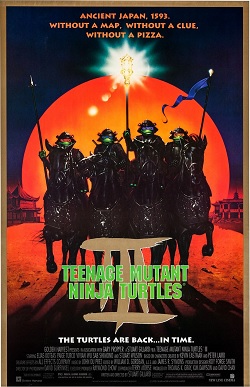
Teenage Mutant Ninja Turtles III (1993): If the first movie is close to the comic with some kid elements and the second backs off from that, the third Teenage Mutant Ninja Turtles movie goes all in on silliness, as the turtles go back in time to feudal Japan and switch places with the honor guard of Lord Norinaga (Saburo Shimono).
It’s all because of some things that April O’Neil (Paige Turco) buys at a flea market, including a scepter for Master Splinter. At least Casey Jones (Elias Koteas) gets to be in this one, even if he just sits around for most of the movie.
Only Brian Tochi (Leonardo) and Robbie Rist (Michelangelo) did voices for all three of the original movies, but Corey Feldman returned as Donatello, and Tim Kelleher is Raphael, with James Murray taking over as the voice and puppeteer of Splinter.
Co-creator Kevin Eastman said of this movie, “What we tried to do with the third movie was to make it as good a story as we could. We went through a painstaking level of dos and don’ts, what they could and couldn’t do. We wanted something that would be good for all ages again. I call movie one the best, movie two the worst, and movie three halfway in between.” A lot of the ideas in this come from the “Masks” story in issues 46 and 47 of the original comics. The time scepter looks a lot like the one that Renet, the apprentice timestress of Lord Simultaneous, uses.
What we do get to see is the Turtles helping Lord Norinage’s son, Kenshin (Henry Hayashi), and his lover, Mitsu (Vivian Wu), stop the war between villages and Walker’s (Stuart Wilson) sale of guns to the samurai. The whole idea of not changing time is never even considered by this movie.
The costumes were made by All Effects Company instead of Jim Henson’s Creature Shop. I guess Golden Harvest was pretty much done with the movies by this point and didn’t feel like spending much.
This was directed by Stuart Gillard, who wrote the script with Turtles creators Eastman and Laird. He also directed Lost Boys: The Thirst, War Games: The Dead Code, the remake of The Initiation of Sarah and the Disney movie Girl vs. Monster.
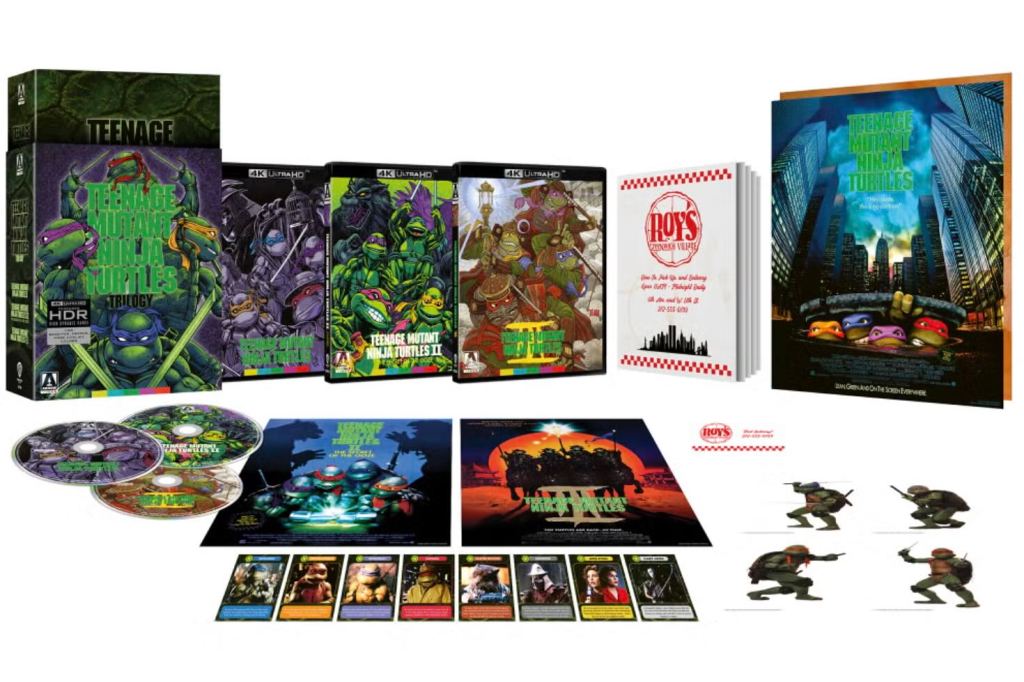 The Arrow Video release of these movies has brand new 4K restorations of all three films by Arrow Films; a perfect bound collector’s booklet in the style of a Roy’s Pizza menu, featuring new writing on the movie by Simon Ward, John Torrani and John Walsh; reversible sleeves featuring original and newly commissioned artwork by Matt Frank and Roberto Rivera Padro; a double-sided foldout poster featuring original artwork from Teenage Mutant Ninja Turtles and the “Map of the Kappa Realm”, a stylised re-creation of the ancient scroll that appears in Teenage Mutant Ninja Turtles III; two additional double-sided foldout posters featuring original and newly commissioned artwork by Matt Frank and Roberto Rivera Padro; eight character trading cards; a Roy’s Pizza loyalty card and four character stickers.
Teenage Mutant Ninja Turtles has a new 4K restoration of the film from the original camera negative by Arrow Films approved by director Steve Barron, two audio mixes, new commentary with director Steve Barron and another by comic book expert and podcast host Dave Baxter; interviews with Barron, Robbie Rist, Brian Tochi, Ernie Reyes Jr., Judith Hoag, Brian Henson and Rob Tygner. There’s also the UK version, an alternate ending, alternate Korean footage, trailers, an image gallery and a feature on the film’s locations.
The second film features a 4K restoration of the movie from the 35mm interpositive by Arrow Films, new commentary with director Michael Pressman, moderated by filmmaker Gillian Wallace Horvat, interviews with John Du Prez, Kenny Wilson, and Steve Mirkovich, an archival feature, plus a trailer and an image gallery.
The third movie has a 4K restoration of the film from the 35mm interpositive by Arrow Films, new commentary with director Stuart Gillard, interviews with Sab Shimono and Vivian Wu, an alternate UK opening, a trailer and an image gallery.
 B&S About Movies
You must be logged in to post a comment.