April 19: Record Store Day — Write about a movie starring a musician.
ABOUT THE AUTHOR: Jennifer Upton is an American (non-werewolf) writer/editor in London. She currently works as a freelance ghostwriter of personal memoirs and writes for several blogs on topics as diverse as film history, punk rock, women’s issues, and international politics. For links to her work, please visit https://www.jennuptonwriter.com or send her a Tweet @Jennxldn
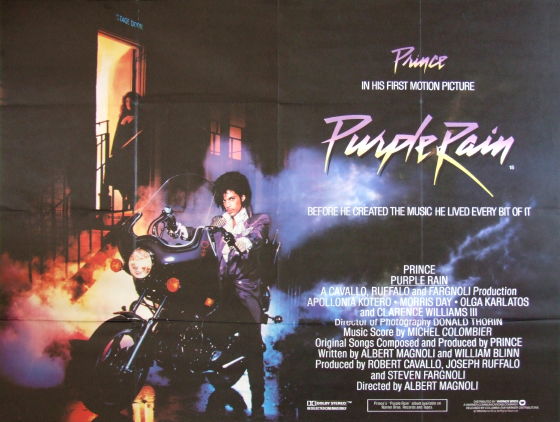
I was 12 in 1984, living in a small town in upstate NY with very little to do in terms of entertainment.
That summer, I was utterly obsessed with the movie Ghostbusters. I had the T-shirt and thee soundtrack and collected every issue of every magazine that wrote about it.
That August, the film got knocked out of a stellar hold-over run at our tiny local theatre for something called Purple Rain. I remember vividly riding by with my mom and voicing my frustration that my favorite film had been usurped. I noticed the line of teenagers and young adults wrapped around the corner and filed it into the back of my mind. It played for a solid month.
The following March of 1985, Prince and the Revolution brought the Purple Rain tour to Syracuse. I didn’t attend, but my friends who did wouldn’t shut up about it for weeks.
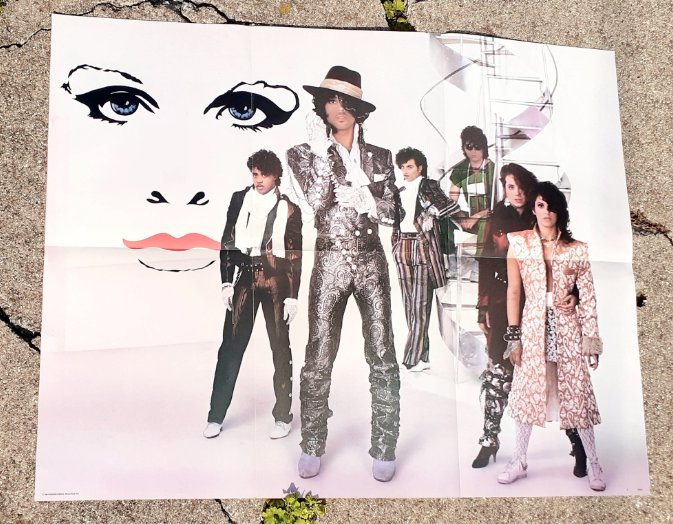
Prince was everywhere, and I just didn’t get it. Until I saw the video for “Little Red Corvette” on Friday Night Videos that April. When he broke into that split during the guitar solo, something in my soul (and my nipples) woke up and said, “Hello!” I immediately went out and bought the only Prince record my local store had in stock. Purple Rain. The album blew my mind. It was rock-funk fusion perfection. The album came with a poster of his band, The Revolution. As I hung it upon my bare wall, I wondered, “Who are these female musicians, and the guy dressed like a doctor?”
My family had no VCR at that time, so I saved my babysitting money and rented one. The first film I rented was, of course, Purple Rain. Soon after, I rented a second machine and made a dub of the original so that when the inevitable day came for us to finally get our own VCR, I’d be able to watch this movie ad infinitum. Which I did.
Through the film, I discovered the identities of the people on the poster. Revolution members included r. Fink on keyboards, Bobby Z. on drums, Brown Mark on bass, and most importantly, real-life couple Wendy Melvoin on guitar and the classically trained Lisa Coleman on keyboards. I also discovered that as impressive as the album was, the band’s live performances were outstanding.
Flash forward to 2025. Prince is gone, having passed away alone in an elevator in 2016. The estate re-released the film for one night only all over the globe in 4K with a new Dolby mix for the soundtrack. I was in the second row, with a glass of wine and a good friend, cheering all the way for The Kid, Prince’s semi-autobiographical character created for the film. He’s a dick. But that’s the point.

The Kid comes from a dysfunctional family with an alcoholic, abusive, failed musician father, Francis L. (Clarence Williams III, and his long-suffering mother (Olga Karlatos) whose singing career was ruined by said father.
The Kid is a control-freak misogynist just like his dad. His bandmates struggle with his their lack of creative input – something true to life where publishing rights and royalties were concerned.
The band’s regular gig at First Avenue is under threat from another regular band at the club. The Time (another Prince creation), whose comical leader, Morris Day would love to push out The Revolution in favor of his new girl group, Apollonia 6, featuring The Kid’s new love interest Apollonia (Patricia Kotero) a beautiful, young singer/dancer who has just rolled into town to try her luck at First Avenue.
The Kid has a choice. He can either follow the path of his father, beat his girlfriend and ruin his career, or he can mellow out, trust his bandmates to write good songs and stop being a dick to women. The whole thing comes to a head when he plays the now legendary title song, composed in the film by Wendy and Lisa.
In real life, Prince brought the basic chords of “Purple Rain” to the band at their warehouse rehearsal space in 1983. While Wendy and Lisa did not compose the song, they certainly helped. Wendy reworked the simple chords Prince had brought into the iconic opening chords as we know them today. Nobody plays those chords the same way Wendy does, and it never sounds as good. She took Prince’s original, basic chords, inverted them, stretched out that third chord like a boss, and made history.
The entire band spent the next few days working the song out together as a group. At one point, during a break, Lisa Coleman saw a homeless man, who had been outside listening to the song, crying because it was so beautiful. She knew them; they had something special.
The success of the film and the album wasn’t because of the storyline or the romance, although it should be noted that it was the first film in history to land in the Box Office Top 10 whose leads were people of color. The film succeeds because of the musical sequences. It’s basically one long music video with a dramatic storyline woven throughout, and it still works after all these years.
The opening sequence of “Let’s Go Crazy” is visual storytelling at its finest. It introduces the setting and all the major characters strictly through editing with minimal dialogue.
During the scene where The Kid sings “The Beautiful Ones “to Apollonia, who is on a date with Morris at First Avenue, I turned briefly to observe the audience’s reaction. Some were shaking their heads in disbelief, mouths agape at the genius screaming into the mic on screen. Others were smiling from ear to ear. I leaned over and whispered to my friend, “Imagine being that good at anything at the age of 24.”
Is anyone in this film a great actor? No. But the cast is charismatic, and they all hold their own in the dramatic scenes. Morris’s “What’s the password?” comedy scene, a re-creation of the Abbott & Costello “Who’s on First” skit with counterpart Jerome Benton, still elicits chuckles.
One person walked out of the special screening during a scene depicting a violent fight under a railroad bridge between Apollonia and The Kid. There’s no point in sugar-coating it. The film is filled with misogyny. People like this existed in 1984, and they still exist today. The point was and is that The Kid had a choice.
Following the attempted suicide of Francis L., The Kid finds redemption through musical collaboration with the female members of his band. He saves his regular gig at the club and announces his forthcoming stardom by ending the film with Baby, I’m a Star. If you didn’t know it before seeing the movie, you knew it when the credits rolled.
Given that this was Prince’s most productive period musically, it’s safe to say that in real life, he found redemption through The Revolution as a band more than any other lineup of the New Power Generation who came after them. This was the last true band he was ever in. The rest were simply hired hands. Great musicians, all of them, but not collaborative in the truest sense of the word. If you don’t believe me, listen to the track below:
It must be noted that the song “Purple Rain,” as well as the tracks “I Would Die 4 U” and “Baby, I’m a Star,” were recorded live at First Avenue in August 1983, before the film was shot. It was the debut gig of Wendy Melvoin, who was just 19.
Engineer Susan Rogers, who manned the van on the day of the recoding, added a few overdubs for these tracks in the studio, but otherwise, what you’re hearing in the film and on the album is one of the tightest live bands to ever exist. Prince’s sound during this period was informed by this group of people, all hand-picked by to bring his vision to life.
Yes, the dialogue can be corny at times, and yes, Jerome does throw a girl into a dumpster under Morris Day’s instruction, but the musical sequences are the reason Purple Rain the movie stands the test of time. And it’s the reason it will endure into the future.
Note 1. – I still have hair envy for Apollonia’s do after 31 years.
Note 2. – Wendy Melvoin’s father was musician Mike Melvoin, who composed the funky theme for the TV series Bigfoot and Wildboy. The kind of trivia I live for.
 B&S About Movies
You must be logged in to post a comment.