If you haven’t picked it up from the movies I talk about on this site, I’m a big fan of Severin Films. I was so excited about this opportunity to speak with David Gregory, the man behind the label. In this interview, you’ll learn about their new Russ Meyer releases, what it took to make that happen and how movies are selected for Severin, as well as an exploration of the films of Bruno Mattei and Joe D’Amato, the video nasties era from a true expert and even a possible sneak preview of a few upcoming releases.
You can listen to this interview here or read it below, where it’s been edited for flow.
B&S About Movies: I talked to Kier-La Janisse a while back, and she referred to you as the filmmaker whisperer. That was her nickname for you. She said that so many of these people she spoke to would not give her the time of the day, but when you spent two minutes with them, they were suddenly like, “Yeah, take everything. Here’s all this footage.” Is that true?
David Gregory: Well, I think that’s a bit of an exaggeration. (laughs) I mean, she’s pretty good at tracking down filmmakers and rights owners herself. But there have been a few situations where I’ve been very persistent in going after titles in ways others might have given up on. When I get to the right person, I make an effort to make a case for why Severin is the best home for a given film or collection. And that was the case with The Meyer Estate. We had to go to some lengths in order to convince them that we were the right people to do this.
B&S: Was it years that you put into this to try to get them to release the films?
David: I first tried to get the films for other companies back while working at Blue Underground. So, in the early 2000s, a couple of companies tried to do it. And I was consulting for a couple of other labels as well.
I did put in a pretty substantial offer back then. It didn’t go anywhere. But no, this latest situation came around a couple of years before the actual releases, when an intermediary had been talking with the estate, and he came to us. And that was when we had to start, you know, making the case for why we’re the right company.
Janet at The Trust is the ultimate decision-maker there. She was concerned that we were more of a horror label, so it wouldn’t be a good match, but we could show our pedigree of all the various genres, including erotic films from around the world that we’ve restored, released and remastered as well.
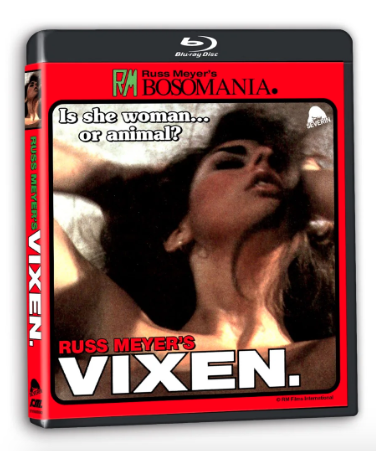
B&S: I am so excited that these are coming out because my biggest worry was that it was tough for folks to find the Meyer films outside of the ones that Criterion had put out. The fact that these movies are somewhat reentering circulation is amazing. I never wanted him to become a lost director or somebody whose work was hard to find. Did you feel that kind of responsibility?
David: I’m not sure the Trust ever wanted that to happen either. It’s taken time for them to find a company that will do it the way they think is the right home for the place because other boutique labels can do the work just as well as we have. Still, they wanted things like retaining Russ’s graphic design for the covers, for example, and we designed them before we even signed the contract to show that we agreed. We want them to look like the way Russ had the VHSs but just updated to the Blu-ray and UHD sizing. We wanted to go to extra lengths before signing the deal to show we were on board.
B&S: That was my favorite thing when I got them. Wow, this is just like the videocassette I owned, you know, 25, 30 years ago.
David: And it’s funny, isn’t it? Because those videocassettes were everywhere back in the video era, it really wasn’t hard to see Russ Meyer’s films in the video era. Many were available on Laserdisc, too.
But he had started to deteriorate. His mental health had started to deteriorate in the early days of DVD. So he never really jumped, even though he was ahead of the game quite often in the previous technologies to get all of his stuff out there, distributing it himself, you know, taking the phone calls famously at his house, and you have to order copies from him. So, that just fell by the wayside when he couldn’t keep up once the DVD era kicked in. They did do some of the DVDs themselves, but they used the existing masters, which, of course, when VHS came in, were state-of-the-art transfers, but they are far from state-of-the-art now.
You know that technology moves on quite a bit and quickly, but there was no resistance on the part of the Trust—quite the opposite. They wanted to make sure that these were now state-of-the-art transfers. And that was another thing. They needed to ensure that these were beingå done to the best possible specs.
B&S: It’s amazing to have them because, in my head, I experienced them as the videocassettes. So I know how scenes and colors look. And now, to see these, it’s almost getting a chance to see a completely new movie without getting too hyperbolic.
David: Yeah, exactly. It was the same when we were watching the transfers as they were in the scan. Once we watched the scans as they were being color corrected and restored, it was leaps and bounds like above what we had seen before. That is the point of upgrading things like this. We went to extra lengths on these, particularly on Beneath the Valley of the Ultra Vixens, which was the one that had damage to the negative. But, you know, we certainly didn’t want it to look ropey when going to this trouble. So we had to put in a lot of hours to get rid of some of the moisture damage on the negative. Also, the aspect ratio, you know, they’d only been shown on their open matte versions before, which is not how they were shot and supposed to be exhibited.
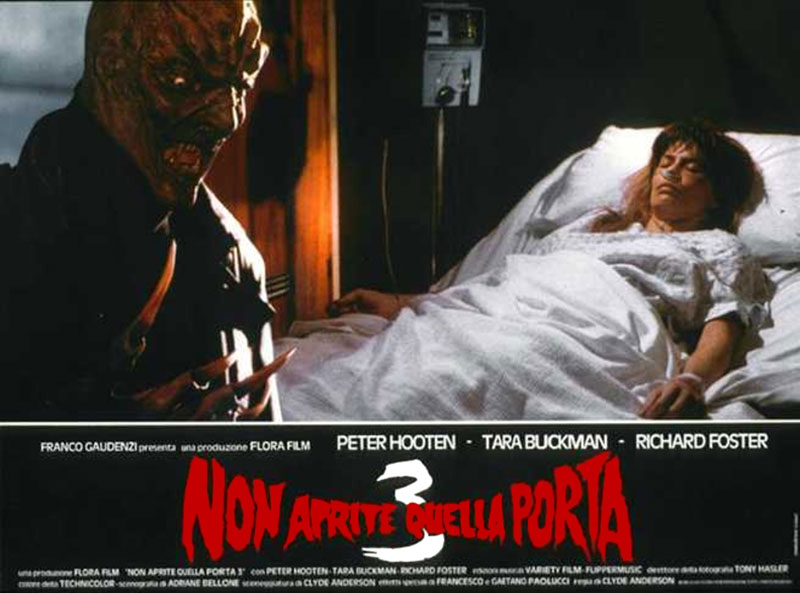
B&S: That’s my favorite Russ movie. So it’s like seeing that in as perfect a format as possible… To me, it was the biggest story of physical media last year. This is the stuff that I want to come out.
There are other great labels, but you guys are like the Criterion collection of the movies that I like if you will. I was a big fan of Night Killer before you put it out. That is such a Severin movie. And then when you guys grabbed it, I was like, “This is perfect.”
David: That sort of thing is very much in our orbit. The umbrella of what we do has expanded quite a bit over the last few years. But I think we’ve stayed true to what we always were. You know, we’ve incorporated more voices and more people into deciding what that roster of films is.
B&S: I read an interview where you said that you feel like you’re almost putting together a team of people, almost like how studios had that group of folks, like a Corman kind of group of folks. And I think that’s amazing. What makes someone able to work for you? And also, what makes a film a Severn film?
David: Well, the first part was more kind of something I realized when we did the annual Super Shock Festival last year when I had, you know, the team of full-time employees and freelancers all gather together in Los Angeles. And we have this all-day event where we show three new releases. We don’t tell anybody what it is ahead of time, and they get to hear about them first.
It was then when we were all hanging out back, and I was looking around. I was like, I always really wanted, I always was inspired by John Waters, in particular in Shock Value when he talked about his stock company of like-minded people who would go on these adventures with him and make these movies, all bringing their kind of creativity and uniqueness to the package. It’s not all just John at the top; everybody does what he says. It’s like everybody brings something to it. And, you know, Ed Wood had that. Ray Steckler had that. And, you know, many independents have that for several reasons. You need people who will roll with it to be able to make low-budget movies and get them done.
But in this case, I realized that, yes, we have that now, and while we’re not necessarily going out and making movies the way they did, we’re definitely using our own unique charms and expertise to bring things to the table. And that’s what makes me really happy.
As far as what constitutes a Severin film, it’s often ultimately my decision. There are exceptions, such as the box sets that Kier-La does. She’s the one who’s making those choices. I mean, she still ultimately has to run them by me, but you know, in a lot of cases, I don’t even know what these films are, so I’m trusting her and her deep knowledge of cinema that is beyond mine to bring interesting stuff to the table. Really, that’s it. It’s stuff that interests us. We all are into the same movies. And there are slightly different age groups now, though. I realize now that I’m in the older age group. When some of the Intervision stuff came up, which was shot on video, that was not my cup of tea. But I could see in the people a decade or younger than me; they grew up watching that stuff and finding it interesting and fun. So it doesn’t get counted out just because it’s not my cup of tea. As long as it’s something that one of us is passionate about and it doesn’t look too out of place in the Severin line, which at this point, now that we’ve got, you know, Mike Lee movies and, and Overboard, it’s like, it can stretch pretty wide.
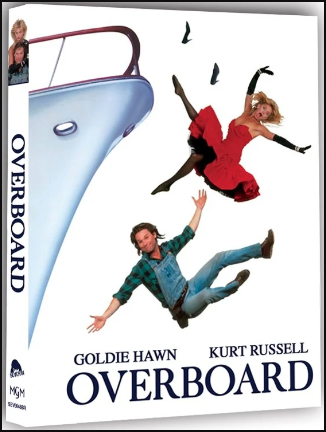
B&S: What was the reason behind Overboard? I’ve always been interested that that was a release. Was it just trying to expand?
David: It was a drunken license, that is what it was. I was in Santa Barbara with my partner and a couple of friends. One of the friends she started talking about how she loves Overboard. And we started talking about how that movie has a lot of gaslighting. There’s a lot wrong with that movie. And I somewhat facetiously said it wouldn’t look out of place next to The Sinful Dwarf. And we all laughed. Can you imagine if there was a Severin version of Overboard?
I texted my colleague, who was making an offer to MGM for some other titles, and put in an offer for Overboard. This would be hilarious, you know, and then they accepted the offer. So we ended up—there was no going back at that point—and so we did. And it was a movie I liked that we were happy to put out. But it is funny that it came about.
B&S: I like seeing it on con tables next to your other releases.
David: Now it’s one of those things that’s like, what’s the odd man out here? And it’s like, well, you say that, but if you look at the subtext.
B&S: What’s a perfect example of a Severin release?
David: Well, there are many, because there are films that we go to town on. Santa Sangre is a good example of that and it’s one of my favorite movies. It’s a masterpiece of cinema in general. Still, when we did the first Blu-ray and DVD, I wanted to interview as many people as possible from making the movie because I hadn’t seen anyone talking about it except for Jodorowsky. There were so many interesting characters in the making of this movie. So we did a full feature-length documentary on that. That was for the first release. So when we came to the UHD and got Jodorowsky to supervise the color correction in 4K, it was like, well, we need to do more stuff.
Many people on the Italian side of things hadn’t been interviewed and hadn’t been included on the previous disk. So, there was a whole host of more features on that. The packaging has become very important as well. So I think the design of that cover is beautiful, and we got the guy who designed all the tattoos, Sergio Arau, who is a filmmaker in his own right — he did A Day Without a Mexican — and he’s also a rock star in Mexico, a fairly famous rock star and also a political cartoonist. That’s why he was hired to draw the tattoos of the tattooed woman, and he now lives in LA. I asked him to do some of the stages of the cross, but only four of them were the backdrop of the four discs in there. Things like that made it something that we were very pleased with.
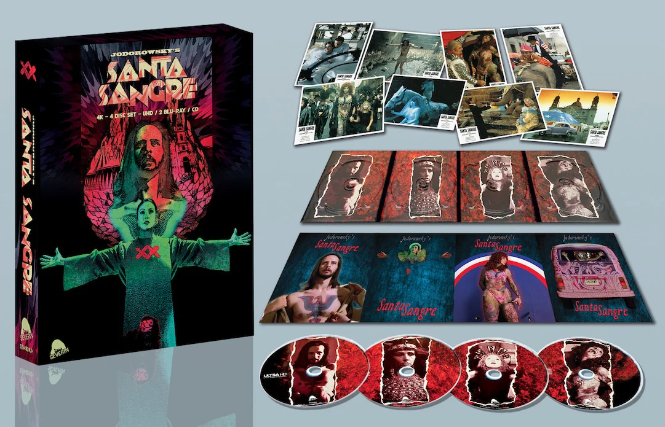
B&S: I was so excited when you put Santa Sangre out because it was a formative movie for me. My hometown mom-and-pop video store got that movie and put it in the horror section. And I was a 13-year-old kid who rented every horror movie. I brought it home and I had only seen slashers and traditional horror at that point, and suddenly, I was confronted with Santa Sangre. And it changed the way that I saw movies, right? So I think your label has done that for a lot of folks, too.
David: Well, I’m very pleased to hear that. I mean, Santa Sangre is a perfect example of that because it really is, you know, an Italian slasher movie, but done by Jodorworsky, so it’s not like an Italian slasher movie at all. (laughs) It has the kind of basics there but through his kind of phantasmagorical lens.
Even something like Hell of the Living Dead, which we just did. I’m very fond of that as Zombie Creeping Flesh as I saw it. As I mentioned on my podcast, it was also very formative for me because it was that film specifically where I realized that the government and the powers that be are liars and basically will say whatever fits their agenda. And so for that to be a realization at 11 or 12 years old, when I was watching it at home, and suddenly my dad comes in and sees that I’m watching it and says it’s been in the newspapers, this is to be banned.
I was like, “Just look at it. Why would you ban this film?” Particularly in the cut version that was out in the UK. So anyway, coming back to doing that, when we finally got the rights to that, I was like, “This we’re giving a super-duper special edition to because I’d worked on the previous editions from Blue Underground, and then the rights came to us. And so I wanted to go many steps further. I wanted to do the full treatment.”
I used the Zombie Creeping Flesh title on the back of the wrap. I had a seven-inch single by Peter and the Test Tube Babies, the punk band, when I was a kid, and I wanted to ask them why they did a song called “Zombie Creeping Flesh. And then, of course, we got Brad Carter to do a novelization. And he, boy, did he take that and run with it. I mean, it’s something like 500 pages that he did of a novelization of Hell of the Living Dead, which is quite something.

B&S: Being from Pittsburgh, Dawn of the Dead is essential to me. When Bruno Mattei gets this job to make a version of Dawn of the Dead that’s maybe a little happier. But it’s not; it’s even more depressing than Dawn.
David: And it’s probably inspired more by Fulci’s Zombie than by Dawn of the Dead, even though that whole beginning bit with the… (laughs)
Yeah, that’s a bit that could easily be cut out and means nothing to the overall film. But it is a bleak movie. And that was kind of the whole point that Claudio Fragasso and Rosella Drudi, who wrote it when they were very young, they wrote this epic treatment for what the film was going to be, like naively thinking that this is what they could make with the budget they had. Of course, it was completely thrown out for the script that was made. But that is what Brad used as the impetus for his novelization. He worked with Claudio and Rosella at the beginning stages to discover their original global world zombie apocalypse story.
B&S: I love Italian movies because they’re not what you expect them to be. You’re in a maniac’s hands and just go for the ride.
David: Exactly, and a lot of it was about, well, what elements do we necessarily need here? Often it seems like we don’t need it to make absolute narrative sense for a start. Then secondly, you know, as long as it’s got certain elements, but of course, all the filmmakers who were doing these things, no matter what resources the producers gave them, they were going to do it as well as they possibly could.
And that’s why interesting work came out of it, even though it’s rough around the edges. It’s so low budget, and they had to make do with what they had. They never like half-assed it, you know. So even if they knew what they were doing would turn out to be a little hokey, they’re not going to turn their back and say, “I’m above this.” They took it seriously.
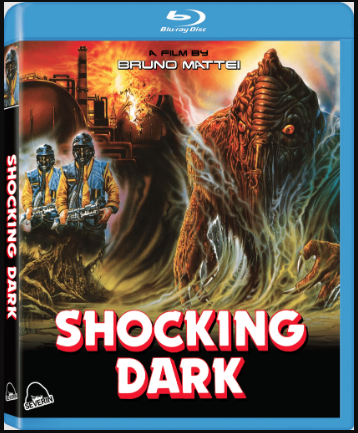
B&S: This is why I like another film you put out, Shocking Dark. I love the idea that this may be a work-for-hire thing, and Mattei is making this movie as a rip-off of two other films. ut within that, there’s still room for art. Magic can come out of it. It’s almost like alchemy that when that happens, it can create a more memorable movie than the movie it’s stealing from.
David: That’s exactly right. Shocking Dark and Robowar, in particular, and the stuff they did in the Philippines, that’s not easy to pull off with little to no money. The actual infrastructure they had for filmmaking was very limited back then. But they did have things like helicopters and stunt people who didn’t mind jumping out of a house that was on fire or blowing up or those kinds of things. So you get this production value and imagery that you wouldn’t necessarily get in anything else.
B&S: What is a movie that you’ve worked hard to get and it didn’t happen?
David: We get plenty of films that we’re unable to get. Y ou know, often people send us lists of titles. These films haven’t been out for a while. There’s a reason that they’re not out often more often than not. They have already been considered explored, and usually, it’s because a major studio owns them, so we can’t get them, or it’s not worth getting them for the price that the studios need. But yeah, I can’t think of any example where we actually, except for right at the beginning of our career. When we ran a VHS label in England, Carl and I had a deal for the original Texas Chainsaw Massacre. We had an agreement in place, and the deal memo came through.
But I spoke to the censor at the time, James Ferman, asking him, “Don’t you think it’s about time that this film should be allowed now? The video nasties thing is now over a decade old. Can we accept this is a great film and not dangerous to society?”
And he said, “Absolutely not.”
And there’s no way even to cut the film because, you know, it would be under an hour long. And then you’d have to cut most of the second half out and blah, blah, blah. We had to let that deal go.
Fast forward a couple of years and Ferman has been walked out of the censor job, quite rightly, for just making decisions and ignoring all evidence. He got walked out of there, and a new guy came in. Well, okay, let’s go back and get this deal because surely nobody else on the planet thinks this movie is actually dangerous, which was correct. But another company had already licensed the film, knowing that the new guy was coming in, and they made a fortune out of it.
But the good thing from that was that I ended up making Texas Chainsaw Massacre: The Shocking Truth, just because I was like, “Damn it, I’m going to do something on my favorite movie no matter what.” That’s when I met Gunnar Hansen, and that started that documentary, which really kind of started me in featurette making.
B&S: Do you find as much joy in making the featurettes and the documentaries as you do in releasing things?
David: Yeah, but now I’m more inclined to find subjects where I can actually make a substantial feature out of, like Enter the Clones of Bruce or Blood & Flesh: The Reel Life & Ghastly Death of Al Adamson or Suzzanna, which is the one we just did for the folk horror set. Those are the things that kind of excite me because they’re not stories that have been told too many times before. I feel like they need to help because now so many of us have interviewed the same people about the same film so many times that it’s not quite as exciting to go back and do another interview with Claudio Simonetti about Suspiria.
I love Suspiria and Claudio Simonetti, but it’s like it’s been done a thousand times now. I’m more likely to get excited about stuff that hasn’t been done before, which is not as easy to find, of course. In the last twenty years, we have had thousands of times more interviews on camera than we ever had in the DVD era—not just interviews I’ve done. Tons of people have done it all around the world, you know.
B&S: I always worry that there isn’t this bottomless pit of stuff. Like, am I going to run out of movie drugs, as I call them?
David: I don’t think we are, just because there are so many things that when, even on my whiteboards over here, there are so many films that haven’t actually been out before, that certainly haven’t been out for a while. Or, you certainly haven’t been out with an English-friendly subtitle track or whatever it may be. There’s always going to be the need to upgrade Opera, you know when a new technology comes in, you’ve got to release a big film like Opera or Santa Sangre. That needs to be in the best possible format. You know, you can’t just leave Opera in the Blu-ray world. It needs to be brought up to date.
But even though I don’t do so much stuff for other labels anymore, hardly ever now, but Dawn of the Dead was one that I worked on for the Second Sight edition. Going to the Monroeville Mall with Tom Savini, Tasso Stavrakis, Mike Gornick and Tom Dubinsky, like walking around the Monroeville Mall with those guys, going, “This is where this happened, this is where this happened.” That was just phenomenal. Dawn of the Dead is a personal favorite of mine, so going to the Monroeville Mall itself was exciting enough, but then to do it as a feature, because again, Dawn of the Dead, a lot has been said about Dawn of the Dead, you know, over the years. So we had to find something that was a bit of a different angle.

B&S: But also a movie that hasn’t had a U.S. release in a while because of the rights issues. Martin, the same way.
David: We got to go to Braddock for Martin as well, with Dubinsky, Savini, and Gornick. Sadly, Tony Buba was not in Braddock that day, which is a real bummer because he is Mr. Braddock. I mean, he’s basically made tons of documentaries about Braddock. Had I been able to actually have the foresight, I would have actually changed the schedule so that we could actually have him there. But yeah, he’s in the documentary, but he’s not there when we’re walking around town. It was still fun with the other guys because they were still like, “Oh, isn’t this where this happened? Isn’t this where that happened?”
So that was still kind of fun. And the town still looks like the kind of run-down town they depicted in Martin. I really loved going to those, like the stuff I do with Stephen Thrower, where we go to all the Franco locations. I love doing that stuff because, you know, it really breaks it out from the talking head formats, which is everywhere. It’s still necessary to get people to tell the stories, but to actually go to a place and have them point things out just opens it up a bit.
B&S: As someone who grew up during the Video Nasties era and has been in England and now you’re here in the U.S., do you feel like the younger generation, like younger, feels more puritanical here?
By that, I mean when young folks get on “Film Twitter” and complain about sex scenes and movies. There were complaints about the Franco-influenced cover that Criterion released the other day; you have all these people being overly protective of a character when the director is the one who came up with all of it.
Does that kind of baffle you a little bit?
David: It does, but it’s not being done in a way where the government is taking it away from you. o everybody is allowed to, as is something I always said, it’s like, you know, you’re allowed to be upset by this stuff existing and even shout from the rooftops about why you don’t think people should be able to see it.
But it shouldn’t be the government taking it away from you. It shouldn’t be the powers that be taking it away from you. By all means, debate amongst yourselves about this particular film and why you think it’s wrong. And I’ll tell you why I don’t think it’s wrong or why I think I’m proud to have Emanuelle and the Last Cannibals on the label, you know, being from a product of its time.
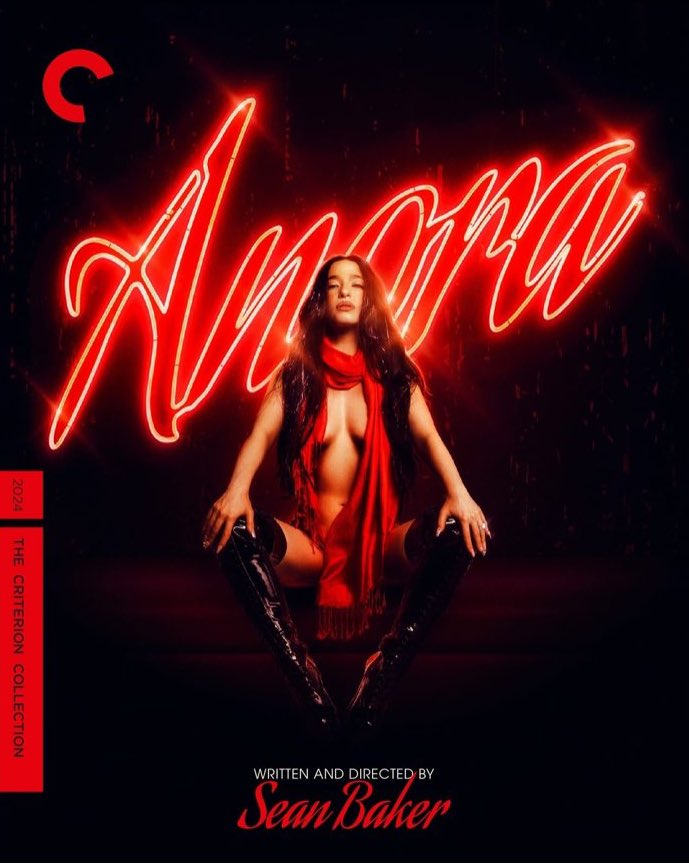
The fact that people are up in arms about the Anora cover that’s inspired by Vampyros Lesbos is kind of fascinating. It’s just like they felt weirdly protective of the character. There was one guy who was actually arguing who hadn’t seen the film. He basically said, “From what I’ve heard about the film, this takes away her agency.” And so what are you even saying? It’s very hard to argue with you if you made up your mind without actually seeing the film. (laughs)
What was often the case with video nasties is that the people hadn’t actually seen the films. They just assumed that this was what was in them.
I understand entirely that certain people are horrified by some of the films we champion, but that is their prerogative. But we do try our best, particularly with things that probably wouldn’t be made now, like a lot of the Black Emanuelle films, we try to put context in there so that you do actually get to understand where this thing comes from and it’s not just blah, that’s it, but still. If you just want to watch the movie, that’s your prerogative. But if you want some context, we try to put that on there, too.
B&S: I first saw Emanuelle In America on Cinemax at probably 11 or 12 years old. I was definitely way too young to see it. But imagine seeing this and being like, okay, there’s the prurient content. But then it’s like all of a sudden, there’s snuff footage. It’s like, where is this coming from?
David: And, of course, I absolutely love that. The kind of analysis that Kier-La was able to get on these is second to none, you know, and exactly what they needed. But to me, I’m just thinking of Joe D’Amato and his writing friend (Maria Pia Fusco); I went to dinner with her before she died a few years ago, and I was asking, “Who came up with the idea of snuff footage and a horse basically in an Emanuelle film? Who was that for?” And she was just basically like, “Oh, Joe and I had a bottle of wine and we’re like, how can we mess with people?”
You know, it’s that simple. And I love that. Tickles immensely.
B&S: I love that Joe D’Amato is known for making sex movies but also says, “I’m also going to make you upset about it while you’re watching it.”
David: Yeah, exactly. And also, you know, these might not be the kind of movies I want to make over and over and over. So let’s keep it interesting.
He was a very cheeky chap. He obviously had an incredible sense of humor and people loved him. I mean, he was a very inclusive director. He was a director who, you know, gave a lot of people their start and, you know, break into the industry, their first directing jobs, like Michele Soavi, for example. And so he’s a guy who knew what he was doing. This wasn’t some cynical cash grab. He was actually a very cheeky artist.
Now, we have a lot more D’Amato coming. We’re huge, huge fans of D’Amato. But we’ve got more coming.
B&S: I know you probably hate getting requests from people, but I figured I would use this last part of the interview to make my request. Thunder. The whole trilogy.
David: Yes, and that’s the trilogy that stars Mark Gregory, right? Yes, yes. So he’s Marco Gregorio, and they were directed under a pseudonym for…was it Larry Ludlam? Yeah. That was the pseudonym of Fabrizio De Angelis, who produced Emanuelle in America. The problem with that is they’re owned by MGM.
Basically, you’ve got to – if a title like that comes up, chances are it’s owned by a studio, and a studio is just…
First of all, it’s too difficult to come to a reasonable arrangement with them for films like that. Secondly, they also don’t let you do the kind of extras we would want to do on something.
B&S: Mark Gregory is such a weird actor to get into. He’s not all that manly and he keeps getting cast in these macho roles. I mean, he’s the original man in Adam and Eve vs. the Cannibals!
David: What do you think of that movie?
B&S: I love that movie. I think that movie is so weird. The English dub, the snake has the wildest accent. Where did the devil get that accent? And supposedly, they stole the nature scenes from a documentary that was directed by George Miller. So that’s coming out?
David: I’m saying anything. (laughs)
B&S: I wanted to thank you. Severin has put our site on the back of a lot of stuff, like on Rats and Hell of the Living Dead. That legitimizes my decision to buy way too many movies and talk about them too much.
David: I love that. It goes both ways. That’s fantastic.
B&S: How many marriages have you impacted? The one fight my wife and I have is that I keep asking for the Black Emanuelle set, and she says, “You don’t need that.”
David: I like to think we bring people together. (laughs) I would also like to think we open people’s eyes to cinema that they never knew existed. They may not like it, but you know, yeah, it’s a wild and wonderful world out there.

Thanks to Danielle Garnier, Michael Krause and David Gregory for making this interview happen. You can buy all of Severin’s movies on their website, including the new Russ Meyer releases, Vixen, Supervixens and Beneath the Valley of the Ultravixens. There’s constantly something new and wonderful from this company and I’m so honored that I had some time to speak with Mr. Gregory.
 B&S About Movies
You must be logged in to post a comment.