EDITOR’S NOTE: As the journey through Cannon continues, this week we’re exploring the films of 21st Century Film Corporation, which would be the company that Menahem Golan would take over after Cannon. Formed by Tom Ward and Art Schweitzer in 1971 (or 1976, there are some disputed expert opinions), 21st Century had a great logo and released some wild stuff.
Terminal Island has been created as an off-shore island prison after the abolition of the death penalty by the U.S. Supreme Court. Now, first degree murderers are sent there to spend the rest of their lives battling to remain alive in what has become a lawless place. Kind of like Escape from New York only eight years earlier or No Escape but two decades before.
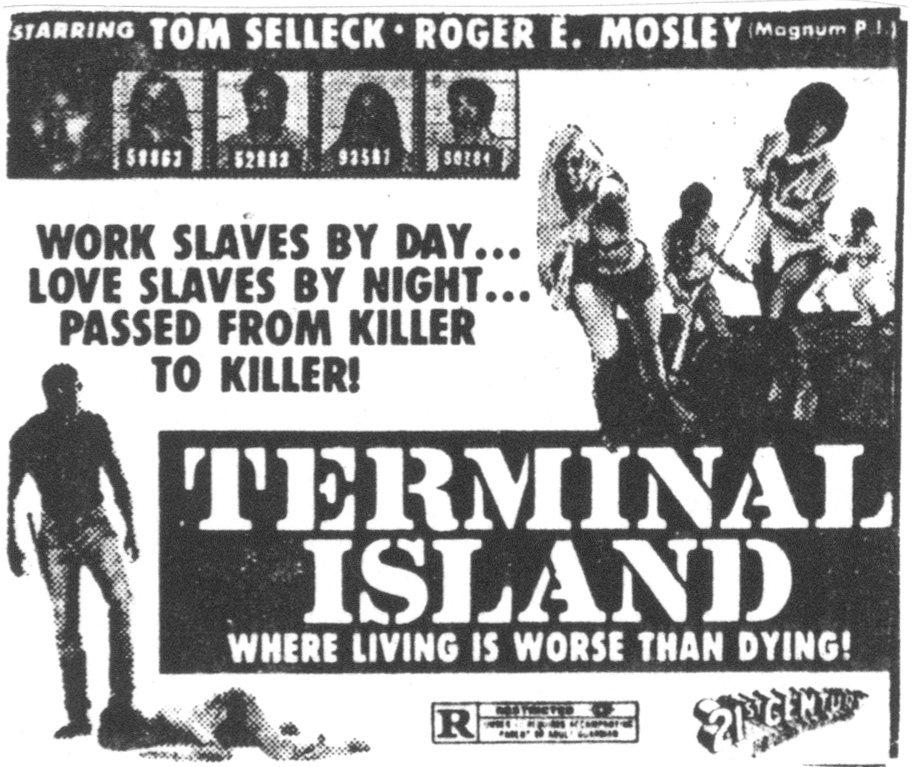
Carmen (Ena Hartman) is dropped off at Terminal Island by the last guards she’ll see. Prisoners are stuck on the island until they die, which could be any minute the way things are here. There, she meets Dr. Milford (Tom Selleck), who was sentenced there for a mercy killing and joins the camp of Bobby (Sean Kenney) and Monk (Roger E. Mosley, working with Selleck years before Magnum P.I.).
As the male prisoners just keep killing one another, the women work in the fields by day and service them at night. Carmen is joined by the revolutionary firebrand Lee (Marta Kristen), the sex-loving Joy (Phyllis Davis) and the silent Bunny (Barbara Leigh).
A.J. (Don Marshall) and Cornell (Ford Clay) start their own camp and steal some of the women. Carmen ends up with A.J. while another man, Dylan (Clyde Ventura) tries to assault Joy. She responds by later covering his privates with honey and setting bees loose near him.
Lee teaches everyone how to use weapons and together, the men and women of this rebel camp decide to go after Bobby. In the final battle, nearly everyone is killed, other than Dr. Milford, who decides to stay instead of returning with the guards; Bunny, who gets her voice back and Monk, who is blinded.
Director Stephanie Rothman made this instead of The Big Doll House, saying “I would be in control of how the subject matter was treated, and while I had to put in the usual elements of sex and violence, I also could introduce ideas about how prisoners were treated, and how they could treat each other, that were not necessarily in these other films. I didn’t have to turn it into what most of these other films were, which was a cartoon.”
She also avoided having a rape scene. “In a film like Terminal Island, practically the whole film involves violence because the subject matter is violent people. I accepted that. I recognized that if I was going to make films, and I was going to make them for the market, I was making them for it. I wanted to make films very much and that’s what I needed to do. What I needed to do was try to refine that and give it some meaning beyond the violence itself, or beyond the nudity itself. In that sense, I tried very hard to not make it exploitative.”
I love that the women and the men in this end up having equal agency by the end. While this is exploitation, Rothman is a great director and turned in something here that’s better than the assignment. It’s an idea that takes advantage of its budget, with an outdoor location and simple effects working for a great concept.
You can watch this on Tubi.
 B&S About Movies
You must be logged in to post a comment.