In 1966, Dennis Feltham Jones published one of the first tales of A.I run amok with the novel Colossus (adapted as 1970’s Colossus: The Forbin Project), concerned with a self-aware military defense system. In 1973, Dean Koontz personalized the tale as Demon Seed (itself adapted into a 1977 film): a Frankenstein-meets-Rosemary’s Baby tech-horror about a computer scientist’s home-grown security system imprisoning his wife for a nefarious purpose.
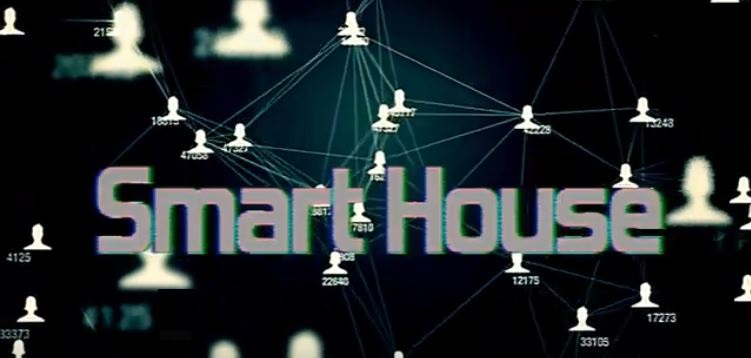
In 2023, writer John Oak Dalton — who gave us Mark Polonia’s bonkers Noah’s Shark (2021) and Shark Encounters of the Third Kind (2020) — revisits the genre and updates the tech via today’s smart speakers and the net-based ASMR phenomenon (that’s “autonomous sensory meridian response” for the uninitiated) that’s given rise to a new breed of interactive, social media influencers. According to an April 2022 article published by Richard Craig at ASMR University: approximately 25 million ASMR You Tube-based videos have been published, while Amazon’s Twitch subsidiary now offers real-time ASMR live streams.
In the always-effective, micro-budgeted world of John Oak Dalton: Smart House shot for a reported $130,000 as a “contained thriller” (see 1954’s Alfred Hitchcock’s Rear Window to 2002’s Colin Farrell’s Phone Booth for examples). In this, his third writing-director effort — after The Girl in the Crawlspace (2018) and Scarecrow Country (2019) — Mari (Iabou Windimere of Crawlspace) is one of those whispering, book reading and hair brushing, ASMR influencers smart speaker-connected to her “smart house” via Cassandra. An Alexa-cum-Siri-styled A.I (voiced to smoky-perfection by indie goddess Brinke Stevens) that controls everything: from coffee pots to floor cleaners, was developed by Cordell (always effective, Oak Dalton stockplayer Tom Cherry), Mari’s infamous hacker father: his infamy comes by way of his hacking The Pentagon’s computers.
As with the many A.I terrors before — which B&S delves into with an “Exploring: The ‘Ancient Future’ of A.I” and “Drive-In Friday: Computers Take Over the World” features — Cassandra becomes self-aware . . . or demon-possessed . . . or hacked during Mari’s latest live-stream . . . that traps the social media star — already dealing with a violent boyfriend and restraining orders — in the house to do its (her) evil, digital bidding. Meanwhile, under a perpetual, bathrobed house arrest and banned from the utilizing the web (that leaves him “connected” via an old landline telephone and tethered by an ankle-monitor), Cordell hacks-a-way into the tangles of the Dark Web to discover who or what has taken over his creation and imprisoned his daughter.
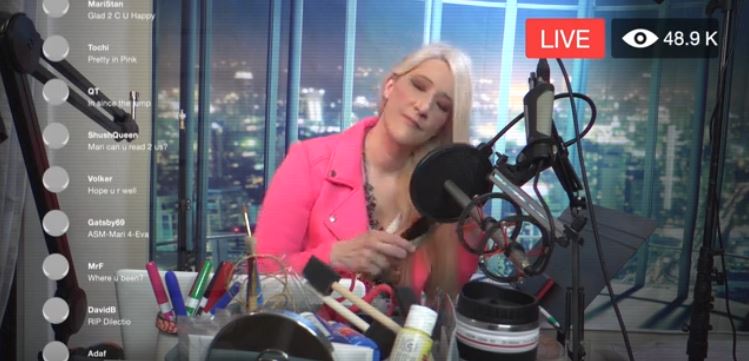
When Muncie, Indiana-born John Oak Dalton spoke with B&S About Movies in 2021, he expressed his passion in wanting to make movies that he wanted to watch himself. Alongside his fellow, Dayton, Ohio, based celluloid co-conspirator Henrique Couto (2019’s Ouija Room), that horror-erudition once again unspools across the frames of his third writer-directing effort: another well-written, multi-layered mystery. Dalton’s developed characters — who, in a reflection of our current, social media-addicted world, interact only via smartphones, the internet, or anomalously on the Dark Web; meanwhile Mari’s life, as is the case with most social media celebrities: her online persona is happy-happy joy-joy, but a hot mess offline — rise above the usual, direct-to-streaming norms we lazy-Sunday rabbit-hole on Tubi. As with Dalton’s previous dual-efforts, Smart House offers effective, against-the-budget set design and crisp cinematography that’ll play nicely on your handheld-devices, PCs, laptops, or cast to your larger smart TVs.
You can follow John Oak Dalton at his official blog as well as Facebook, and keep track of the eventual online release of Smart House at ITN Studios.
 B&S About Movies
Pingback: Smart House 2023 horror film reviews trailer Movies and Mania – usa spanish
Pingback: Sensible Home 2023 horror movie critiques trailer Motion pictures and Mania – Flashbreakingnews.com