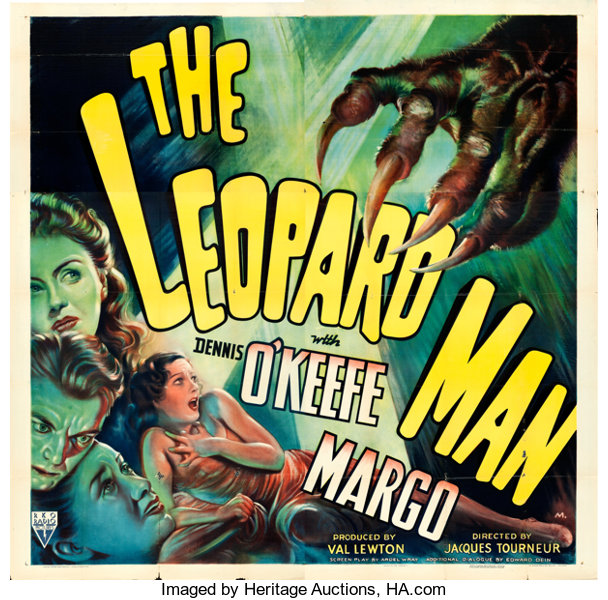
Based on the book Black Alibi by Cornell Woolrich, The Leopard Man is one of the first movies to depict a serial killer. Written by Ardel Wray and Edward Dein for producer Val Lewton and directed by Jacques Tourneur, the master artist behind Cat People, I Walked with a Zombie and Night of the Demon.
Somewhere in New Mexico, nightclub owner Jerry Manning hires a black leopard as a publicity stunt for his girlfriend, Kiki Walker (Jean Brooks, who is also in Lewton’s The Seventh Victim). She uses the giant cat to interrupt her rival, Clo-Clo (Margo, the wife of Eddie Albert, whose career was decimated by the blacklist), as she performs. Clo-Clo uses her castanets to scare the animal which runs into the night.
A series of murders happens, all blamed on the leopard, but when its body is found, the hypothesis that a human being may be at the center of these killings becomes fact. This film may be only sixty-six minutes, but each moment is infused with dark terror and dread. The beast waits for nearly everyone in the darkness of town and even moments in the daylight are offset with reminders of how North America’s indigenous people were treated by explorers.
This film was critically savaged when it came out, which astound me. It was also re-issued in 1952 along with King Kong, as RKO needed another movie title that sounded like it could have a creature in it.
The Leopard Man appears as one of the movies on The Church of Satan’s film list, perhaps as much for its subject matter as the fact that a big cat — one of LaVey’s favorite things — appears. It’s also a movie in which nearly every character is responsible for the murders, no matter their intentions, not just the one doing the actual killing. That’s quite a Satanic notion.
Its main character, Jacqueline Gibson, exemplifies the nightmare of existence that is at the heart of so many of Val Lewton’s characters. For her, life is absolutely meaningless and the only way out is to end things, despite the efforts of so many people to discover her, to save her and to add meaning.
Her only relative is Mary Gibson (Kim Hunter), who learns that her sister — the owner of a cosmetics firm — has disappeared and can no longer pay for her religious education. Jacqueline has been missing for eight months and has left behind only a room she’d rented above a restaurant, one that has a tipped chair and a hanging noose.
Mary’s quest to find out what happened to her sister leads her to meet a secret husband (Hugh Beaumont!) and psychiatrist Dr. Louis Judd (Tom Conway), who has somehow survived his death in Cat People. He tells her that her sister had been his patient due to the depression that resulted from her membership in a Satanic coven. That group possesses great power, having taken over Jacqueline’s company and even killing the detective that Mary hires to learn more.
Judd has kept Jacquline hidden all this time and she’s become even more brittle as the group attempts to destroy her for revealing their existence to the world. She would be the seventh person the cult has destroyed — The Seventh Victim — but they are averse to violence. As she’d wanted to end her life for so long, they tell her to drink poison. She refuses and even eludes a switchblade-wielding killer that they sent for her, only to have one last encounter with a girl in her apartment complex that is terminally ill. She tells Jacqueline that even though she knows she will die that she deserves one night on the town before the haunted center of this film enters her apartment and apparently kills herself.
There are many layers that you can view this movie under. There are definitely undercurrents of lesbian love between Jacqueline and one of the cultists named Frances. And there’s also the matter of so many scenes being removed from this film. For some, they may induce the feeling that something is missing, which they would call a plot hole. To others, it makes the film seem more like a dark dream. To me, it’s about. the occult power of large cities, places that can swallow people.
Charles O’Neal’s original script for this movie was all about an orphaned heroine caught up in a series of murders that happen around the Signal Hills oil wells. The title came from the fact that she would be the killer’s seventh victim. Lewton wanted the story to go in a different direction and called in DeWitt Bodeen, who had experience with an actual Satanic coven in New York City that he had encountered. Rumor has it that Bodeen was homosexual, which may or may not inform much of the subtext.
This movie doesn’t just embrace nihilism, it has rough sex with it. To wit, this burst of dialogue:
Gregory Ward: I love your sister, Mary. I love her very much. It’s easy to understand now, isn’t it? A man would look for her anywhere, Mary. There’s something… exciting and unforgettable about Jacqueline. Something you never… quite get hold of. Something that keeps a man following after her.
Mary Gibson: Because I loved Jacqueline I thought I knew her. Today I found out such strange things, frightening things. I saw a hangman’s noose that Jacqueline had hanging… waiting.
Gregory Ward: Well, at least I can explain about that. Your sister had a feeling about life; that it wasn’t worth living unless one could end it. I helped her get that rope.
The Seventh Victim is noir, occult, proto-giallo — hell, whatever you want to call it. It’s one of those movies that I return to every once in a while, as haunted by it as every character in the film is when they encounter its main character.
Inspired by the painting Isle of the Dead by Arnold Böcklin, this movie was written by frequent Lewton collaborator Ardel Wray and was the second of three movies that Lewton would make with Boris Karloff. It’s directed by Mark Robson, the fourth of five movies he would director for the producer.
Karloff needed back surgery during the making of this movie. While the film got back on schedule, he made The Body Snatcher with Lewton and then went right back to work on this movie.
During the Balkan Wars of 1912, General Pherides (Karloff) and American reporter Oliver Davis (Marc Cramer) visit the Isle of the Dead as his soldiers bury their newly dead friends. As the General finds the crypt of his long-gone wife, he finds it open and hears her voice singing on the abandoned island.
The central belief in the film is that a vorvolaka, a zombie-like vampire that feasts on human livers, is amongst the living. The small group on the island faces a plague and as they begin to die, one after the other, the General attempts to instill law and order in the face of insanity. Instead, he succumbs to the madness he sought to stop, believing that one of their number is the monster and even burying a woman alive.
This film barely made money for RKO due to its high budget. It was later re-released alongside Mighty Joe Young, a film that it feels like a strange partner for.
Inspiration can come from anywhere. For example, this movie was based on William Hogarth’s 1732-1734 painting series A Rake’s Progress.
Written by producer Val Lewton and director Mark Robson, who would go on to make Peyton Place, Valley of the Dolls and Earthquake. It would be Lewton’s last movie for RKO.
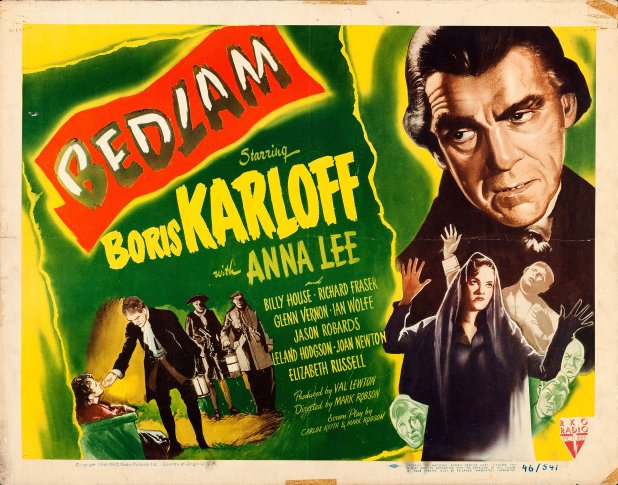
Boris Karloff plays Master George Sims, who runs a fictionalized version of Bedlam, or as it is more formally known, the Bethlem Royal Hospital. Referring to his patients as looneys, he makes them perform for him. He’s based on John Monro, who was in charge of the real Bedlam and actually charged the public admission to see his patients’ bizarre behavior.
Shocked by the treatment of the patients, Nell Bowen (Anna Lee, “The British Bombshell” who would become the matriarch of soap operas General Hospital and Port Charles) tries to reform Sims’ asylum, only to end up jailed there and menaced by the very patients she was trying to save.
The film closes with this legend: “Reforms were begun in 1773 — a new hospital was erected shortly afterward — and since that time Bedlam — once a by-word for terror and mistreatment–has led the way to enlightened and sensible treatment of the mentally ill.”
EDITOR’S NOTE: This originally ran on March 12, 2021 on our site, but with Val Lewton’s birthday being today, we’ve re-running it.
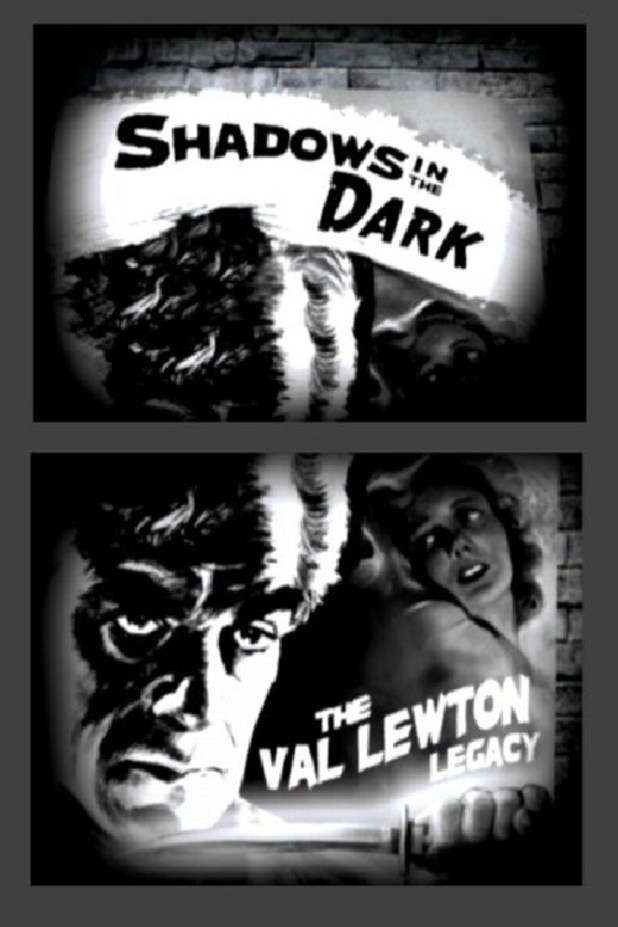
Part of The Val Lewton Horror Collection, this documentary explains the magic of Val Lewton. Directed by Constantine Nasr (who has created many featurettes for DVDs), it unites William Friedkin, Joe Dante, John Landis, Mick Garris, Guillermo del Toro, Kim Newman, George Romero and many more to help tell the story.
Lewton’s films may have been horror movies that only cost $150,000, but unlike many in Hollywood, he was giving artistic freedom within those confines. Before even starting to work at RKO, he said, “They may think I’m going to do the usual chiller stuff which’ll make a quick profit, be laughed at, and be forgotten, but I’m going to fool them…I’m going to do the kind of suspense movie I like.”
Unlike those aforementioned films, Lewton understood that true terror remained in the shadows and never showed its face. “If you make the screen dark enough,” he said, “the mind’s eye will read into it anything you want.”
Who else could have produced a film that featured the line “We’ve found that there is no Heaven on Earth, so we must worship evil for evil’s own sake.”?*
You’ll learn just enough about Lewton by watching this. You’ll get so much more actually watching his movies.
Producer Val Lewton’s second film for RKO took two different inspirations that were pretty different. First was an article by Inez Wallace and the other was Charlotte Brontë’s Jane Eyre. Despite that pedigree, this film got one of those “get ’em in the theater” titles that was forced on Lewton by RKO.
The movie starts with nurse Betsy Connell (Frances Dee) explaining how she walked with a zombie, as if you weren’t already sold. She’s on the island of Saint Sebastian to care for the wife of sugar plantation owner — and descendant of slave traders — Paul Holland (Tom Conway). The woman she is to nurse to health, Jessica, has had her spinal cord irreparably damaged by a serious illness. She no longer has the will to live or do anything for herself.
On a day off, Betsy sees Holland’s half brother Wesley at a bar. As he drinks himself into oblivion, the calypso singer Sir Lancelot uses the song “Shame and Scandal in the Family” as exposition, explaining that Jessica and Wesley were once in love, but Paul wouldn’t allow it. Then, she was struck by the fever that for all purposes ended her life. Meanwhile, Paul blames himself for his wife’s condition and if that isn’t enough, Betsy falls for him and decides that the best way to win his heart is to bring his wife back, whether by insulin shot or voodoo.
If that doesn’t shock you, this will: the voodoo priest of the island is really Paul and Wesley’s doctor mother, using the religions of the island to convince the locals to use modern medicine in the guise of magic. Of course, that doesn’t stop them from believing that Jessica is one of the walking dead. There’s one last surprise. The doctor believes that she was really possessed by voodoo and has made her daughter-in-law into a zombie.
The end of this film, as Wesley wanders into the water carrying his true love’s dying body as a voodoo spirit follows them into the sea. It’s mesmerizing, as is the spirit of doomed love that hands over this movie.
Director Jacques Tourneur was a master of the black and white horror film. I’d also recommend his movies Cat People, The Leopard Man and Curse of the Demon.
After House of Frankenstein, Boris Karloff was sick of his most famous role. He called that movie a “monster clambake,” as it included Frankenstein’s monster, Count Dracula, The Wolf Man and a hunchback. The film was a success, yet he decided not to renew his contract with Universal. He signed for three films with RKO — the other two are Isle of the Dead and Bedlam — and referred to producer Val Lewton as “the man who rescued him from the living dead and restored, so to speak, his soul.”
Shot concurrently with Isle of the Dead Lewton worked as producer on both films and as the screenwriter* on this, as well. An adaption of Robert Louis Stevenson’s The Body Snatcher, Lewton and Philip MacDonald expanded the story and made references to 1828’s West Port Murders.
Dr. Wolfe “Toddy” MacFarlane (Henry Daniell, The Philadelphia Story) is a famous teaching doctor, one so busy that he turns down a woman (Rita Corday) who needs an operation that will allow her daughter (Sharyn Moffett) to walk.
Donald Fettes (Russell Wade) is his best student, but one who can no longer afford classes. The doctor extends the offer of being an assistant, but this brings Fettes into the dark world of the resurrection man.
That title comes from a time when Edinburgh was the leading European city for anatomical study. The demand for cadavers to experiment upon was far more than the supply, as the law stated that medical research corpses could only be from who had died in prison, suicide victims or orphans. The resurrection men were, to take the title of this movie, body snatchers who illegally took bodies from fresh graves.
The body snatcher of this movie is John Gray, a cab driver in public but a taker of corpses in secret. He’s been the secret behind MacFarlane’s success and he even uses their secret to force the doctor to operate on the little girl. The operation isn’t a success and even when he tries to drink away his failure, Gray is there to remind him that he owns him. How the doctor attempts to escape forms the dramatic center of this film.
Bela Lugosi has a small role here as one of the doctor’s assistants. As he had just signed an RKO deal, it only made sense to have him appear one more time with Karloff. This would be their last movie together.
It was directed by Robert Wise, who would later make The Day the Earth Stood Still, West Side Story, The Sound of Music and The Haunting. He had been an editor at RKO and replaced Gunther von Fritsch,the original director on The Curse of the Cat People, when it went past schedule.
This was a lost Val Lewton movie for some time. That’s because the producer was sued for plagiarism by playwrights Samuel R. Golding and Norbert Faulkner, who claimed that they had submitted a script of this story to him as a possible movie. As a result, the film was taken out of theaters and not shown for fifty years, at which point it became available in the public domain. The whole affair deeply upset Lewton for a long period of time.
Tom Merriam (Russell Wade) is a a young merchant marine officer new to the ship Altair. He bonds with Captain William Stone (Richard Dix), even as the ship begins to lose crew members. The captain starts to seem weak at best — unable to save a man with an emergency appendectomy until Tom covers for him — and murderous at worst — crushing another crewmember named Louie (Lawrence Tierney!) who spoke against him.
Merriam quickly realizes that the captain has gone insane, but he has an entire crew on his side and thre may be no way for him to survive. Even when our hero tries to save the men by pointing out the captain’s madness, they continue to take his side.
Using the fictional island of San Sebastian from I Walked with a Zombie and much of Lewton’s stock company like Ben Bard, Sir Lancelot and Edith Barrett, this is another example of his lean films. Director Mark Robson also was behind another one of my favorite Lewton films, The Seventh Victim.
EDITOR’S NOTE: It’s Val Lewton’s birthday and thanks to Shudder adding so many of his films, I’d love to get more people watching them. This one is probably his best effort.
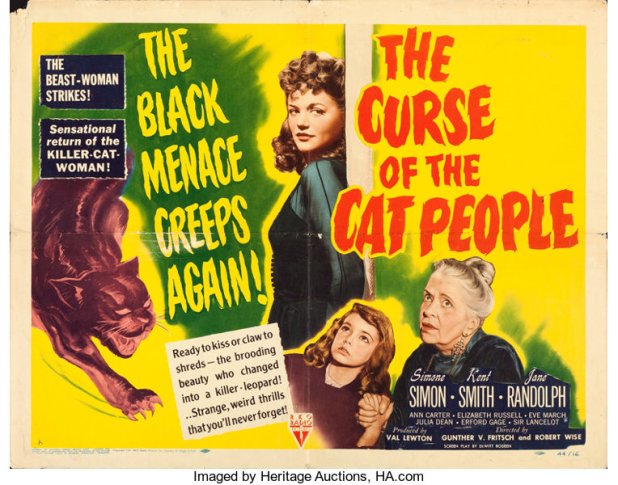
fter the success of Cat People, RKO demanded that Val Lewton get started on a sequel. The original director was Gunther von Fritsch, but when he fell behind schedule, Robert Wise took over.
It was the first film for both men. Fritsch would eventually make Body and Soul and Stolen Identity while Wise would win Best Director and Best Picture for both West Side Story and The Sound of Music. Of interest to genre fans would be his films The Body Snatcher, A Game of Death, Star Trek: The Motion Picture, The Andromeda Strain and, of course, The Haunting.
Sharing sets with The Magnificent Ambersons — just as the original Cat People did — this film may be a sequel and have the same cast and characters, but it is a much different movie. Lewton wanted to call it Amy and Her Friend, but the studio wanted to make money.
Lewton invested so much of his time and himself into this movie, basing it on his childhood and own mindset. RKO, on the other hand, was upset that it wasn’t the same movie that Lewton had already made.
Sometime in the past, Irena (Simone Simon) died — see Cat People — and Oliver Reed (Kent Smith, The Cat Creature) moved on to marry Alice Moore (Jane Randolph, Abbott and Costello Meet Frankenstein). Now, he has a six-year-old daughter named Amy (Ann Carter, The Boy with Green Hair) who lives in a dream world. At the center of it is Irena — now a ghost who she only knows from a photograph.
Amy also becomes friends with an aging actress named Julia Farren (Julia Dean, Nightmare Alley) whose daughter Barbara (Elizabeth Russell, who was also implied to be a cat person in the original film) hates her. Barbara also begins to hate the attention that Amy receives from her mother.
The end of this film — with Barabara about to kill the young girl and Irena’s spirit returning to save her — is sheer artistry on celluloid. It astounded me and I still can’t shake the feeling I had as I watched this film.
The theme of this film — everyone believes that Amy is insane because she cannot leave the world of fantasy — was pretty much how Lewton lived as a child. In fact, his wife believed that he never truly came back to the real world as an adult. He also based the tension between Amy and her father on the relationship that he had with his daughter Nina.
You could see this as a holiday movie. You could also see it as a story of what child abuse does. Several therapists used this movie as a teaching tool for years, even asking Lewton why he had such a silly name for such a serious movie.
Shout! Factory has a blu ray of this that I urge you to purchase. This is pure cinema and has my highest recommendation.
EDITOR’S NOTE: This is Val Lewton’s birthday, so we had to bring back our review on the film that he is most often associated with. This originally ran on the site on August 24, 2020.
The Lewton Bus is also known as the Cat Scare. You may also know it as the Jump Scare. It’s that moment in so many horror movies where tension is raised and built and then, when it seems like the heroine is about to be attacked, a cat will hiss or the brakes of a bus will loudly intrude into your senses. It’s the sound and fury of tension being released. It is pretty much everything horror has that takes the anxiety of the outside world and releases it.
Speaking of tension, Cat People is a movie packed with it. For 1942, it’s an incredibly prurient film. Serbian-born fashion illustrator Irena Dubrovna (Simone Simon) is so convinced that she’s descended from werecats that she holds back the passion that her husband and marriage demands, pushing him into the arms of another woman.
It’s the first movie that producer Val Lewton — just leaving his deal with producer David Selznick — would make for RKO pictures. While these movies were modestly budgeted, Lewton was able to assemble a team to make the films that he wanted to make. With director Jacques Tourneur, writer DeWitt Bodeen, screenwriter DeWitt Bodeen and editor Mark Robson — the creator of the aforementioned Lewis Bus — he would go on to make deeply personal tales hidden in the guise of the B picture.
The studio had come up with the title and told Lewton to make a movie of it. He told Bodeen that he was unhappy with the title already and “”if you want to get out now, I won’t hold it against you.” But the writer dug into the history of cats within horror and worked to make a movie less about vampires and monsters, more about psychological terror and the unseen. Yet Lewton also told his team, “if you’re going to have horror, the audience must be able to identify with the characters in order to be frightened.”
Irena is first glimpsed sketching the panthers in a New York City zoo. There, she meets and falls for Oliver Reed (Kent Smith). Over tea, she explains to him how she is descended from a village that turned to witchcraft and devil-worship after being enslaved by the Mameluks. While King John would drive the Mameluks out, when he learned that villagers had gone wild, he had them killed. Yet only the wisest and most evil of them escaped. Oliver laughs it off, but Irena believes this legend.
Despite the fact that cats hiss in her presence and just her touch kills a bird, Oliver marries Irena. But soon, the fact that she will not consummate their marriage — that passion would awaken the beast within — he’s pushed into the arms of Alice Moore (Jane Randolph). This is where the Lewton jump scares come from in the film, as Irena continues to stalk Alice through the streets and, even more famously, the claustrophobic pool of the Royal Palms Hotel.
Despite costing $135,000, Cat People made $1 million back in rentals, leading to RKO asking for a sequel. We’ll get to The Curse of the Cat People later this week, a side story in a way that is superior to this film. The Seventh Victim would also bring back Tom Conway’s Dr. Judd character — despite him being seemingly killed in this movie — as he tries to help another woman who seeks the embrace of death.
The shadowy tone of this film and the idea of a woman who is filled with animalistic passion — and the ability to become an animal — became a trope of its own in other films released in the wake of this movie. They include Cry of the Werewolf, Jungle Woman, The Soul of a Monster, Cult of the Cobra, The She-Creature, She-Wolf of London and more.
Cat People’s influenced every horror movie that would come after. Perhaps the most obvious devotee was Curtis Harrington, whose Night Tide takes the idea of a woman convinced she is from another world to the boardwalk carnival, and his TV movie The Cat Creature, a tribute that even features Kent Smith in its cast.
You can get this movie from the Criterion collection.






 B&S About Movies
You must be logged in to post a comment.