Malice 2: Metamorphosis (2018)

After the events of the first Malice, Alice (Brittany Martz) tries to live a normal life but is known in her school as “the girl who blows things up.” Now, she’s haunted by dark dreams of an epic medieval battle, Roman solders and the armored specter of her deceased father. You know, normal teen stuff.

But Alice is a teen. She speaks like one. Acts like one. And this film just feels so completely authentic to me, despite its fantasy setting.

After barely surviving the confrontation with the beast beneath her house — which cost her the life of her father (Mark Hyde), yet she was able to save her mother (Leanna Chamish, Deborah Merritt from the WNUF Halloween Special!) and sister Abbey (Nora Parker) — Alice is concerned that she’s really going mad instead of dealing with nightmares that promise that a great reckoning is due to come to her small town. And oh yeah, she has a stepfather, Jed Spry (Matt Gulbranson), and Catholic school to deal with.

I realize that this is a super low budget effort — like all of Phillip Cook’s movies — but it’s deserving of your time to watch it. How often do you get a movie that deals with fantasy, growing up, ecoterrorism, conspiracy and a tough and capable girl being in charge?

You can watch this on Tubi. You can also watch all of the original episodes here.

ETs Among Us 2: Our Alien Origins, Antarctica, Mars and Beyond (2018)

“The third planet is sure that they’re being watchedBy an eye in the sky that can’t be stoppedWhen you get to the promised landYou’re gonna shake that eye’s hand”

This time, Cybela Clare has brought together a group of experts — Richard Dolan, Linda Moulton Howe, Robert Morningstar, Nick Pope and Debbie Ziegelmeyer — to explain how Antarctica came to b, how UFOs got there, the secrets of Mars, why the moon is like Antarctica, underwater bases and so much more.

Were Adam and Eve aliens? Are there pyramids under the ice? How does Elon Musk fit in?

I love all of Clare’s alien films because they just barrage you with facts and every once in a while, you stop wondering how and why people would believe such a thing and start believing it for yourself. You don’t need to pay for cable and watch Ancient Aliens to see this. Her movies are out there, changing and blowing minds. This movie reminds me of the days of the strange, unusual and conspiracy-minded before the fun of the unexplained went from Coast to Coast to MAGA and Q-Anon. Finally, weirdness I can just enjoy non-politically and just zone out and oh yeah, I totally believe that we’re all descended from gods from space. I have since Rod Serling told me about it in UFOs: Past, Present, and Future.

You can watch this on Tubi.

MVD DVD RELEASE: What She Said: The Art of Pauline Kael (2018)

From 1968-1991, Pauline Kael reviewed movies for the New Yorker and made film criticism into an art form. As a result of her writing, people began to think more about the movies they saw, transforming entertainment into something that could become even more. She had her enemies and her fans, even today. Like Quentin Tarantino, who said, “Kael was so on the nose at times that she could sometimes change your mind about a film you may have thought was pretty good.”

Directed and written by Rob Garver, this takes the life and reviews of Kael and turns it into a movie worth watching. It’s told mainly in her own words — spoken by Sarah Jessica Parker — which are taken from interviews, private letters and published writing.

Kael had one standard. Movies shouldn’t bore her. I’d like to think that she’d enjoy the movie that came out of her life. It seems incredibly meta for me to attempt to review this, but it made me think of the way that I look at films.

The MVD DVD of this movie has extras that include interviews with Quentin Tarantino and Paul Schrader, deleted scenes and a never before released interview of Alfred Hitchcock by Pauline Kael. You can get it from MVD.

Cinematic Void January Giallo 2023: Knife + Heart (2018)

EDITOR’S NOTE: Cinematic Void will be playing a 35mm print of this movie on Friday, Jan. 27 at 7:30 PM at The Little Theatre in Rochester, NY. For more information, visit Cinematic Void or purchase tickets here

Knife + Heart is a true anomaly when it comes to giallo. It’s from France, a country more given to the fantastique film than the giallo — though there are movies like The Night CallerWithout Apparent Motive and The Night Under the Throat. And its victims aren’t gorgeous women, but the actors of the gay porn industry, changing the psychosexual dynamics of the form.

Instead of featuring the sounds of a band like Goblin or a score by the likes of Morricone or Orlandi, Knife + Heart has music by Anthony Gonzalez of M83 who is director Yann Gonzalez’s brother.

A young man is killed by a masked man whose very sex conceals his murder weapon to open the film. Then, we meet Anne (Vanessa Paradis), an adult film director who has recently been abandoned by her girlfriend and editor Lois. The man killed in the opening was the star of several of her films; now she must find an actor to take his place. That leads her to Nans, who despite identifying as a straight man agrees to be in her movie.

The new film — Homocidal — will be her version of the murders, which continue targeting members of her cast. The police either can’t — or won’t — help. But the movie gets finished and as the group celebrates its completion with a picnic, the killer strikes again, just as Anne pretty much assaults Lois in an attempt to get her back.

The true killer is a man whose father caught him making love to another man. He killed his lover and castrated his son, who was also burned in a fire before being brought back from the dead by a blind crow — the fact that this movie isn’t called Call of the Blind Crow speaks to its non-Italian origins — and seeing one of Anne’s movies brought his memories back.

This being a giallo, there’s also a bird expert with a disfigured hand that looks like he has, quite literally, chicken fingers. Plus, the entire end of the movie is explained via voiceover. The fact that so much of this movie is given to style over substance means that it lives up to the movies that inspired it.

While the murders are in your face, the sex is nearly hidden from view. And Anne is an intriguing protagonist — drunken and bitter instead of the normal virginal giallo and slasher ingenues that save the day. She instead brings the killer closer with each scene that she directs.

WATCH THE SERIES: The Purge Part 2

The First Purge (2018): The first Purge, that is, the original 2013 film, wasn’t all that great. Yet each sequel has done the exact opposite of tradition by being better than the film that inspired it. 2016’s The Purge: Election Year ended the 12-hour evening of lawlessness, so where do you go from here? A prequel. Can it live up to where the series has gone over three films?

While this entry is written and produced by James DeMonaco, this is the first time he has not directed one of the films, handing those duties over to Gerard McMurray.

Ever wondered how The Purge came to be? Well, to push the crime rate below 1% for the rest of the year and restore the economy, the New Founding Fathers of America (NFFA) decided to test Dr. May Updale’s (Marisa Tomei, slumming it here John Cassavetes style) theory that a one night venting of aggression would do wonders for people’s state of mind.

However, the test doesn’t happen in the suburbs, but instead in the marginalized, low income, black and Latino neighborhood of Staten Island. Despite $5,000 being given to each Purger (you gotta spend money to make money, I guess) and more money offered for each kill, people decide that they wanna party more than they wanna kill. And that’s when the NFFA takes matters into its own hands, sending in mercenary death squads to get the job done.

Can protestor Nya and her brother Isaiah survive the night and the attention of the maniacal drug addict Skeletor (the best part of the film, as he owns the screen from the second he first appears)? Will drug lord Dmitri rise up and defend the neighborhood that he’s pillaged? Will white people wear Klan hoods and Nazi outfits and burn churches to the ground?

Do I even need to answer these questions?

That said — I was entertained by this movie, which is both simultaneously wish fulfillment and dire warning. It’s also so many movies in one, combining a slasher film with a running movie with a dystopian/post-apocalyptic film, then adding a side of gritty urban drama, a crime movie and finally, an action shoot ’em up. It works if you don’t think too much about how The Purge could ever become true. Actually, screw that. Over the past two years, I totally see how it could not only happen, but be endorsed by the American people.

This movie isn’t going to be escapism from the slowly darkening world outside the theater. It’s junk food, sugar-filled candy that conceals a center that we’re all finding harder and harder to swallow. If only the world’s problems were so easily solved within 12 hours that could unite us all by violence, which in these films, seems to solve everything. The real world is much messier, much more depressing and much more oppressive.

That said, if you want to see a Nazi in neon gleaming latex get shot with a rocket, it’s pretty much the best pick you’ll find this summer.

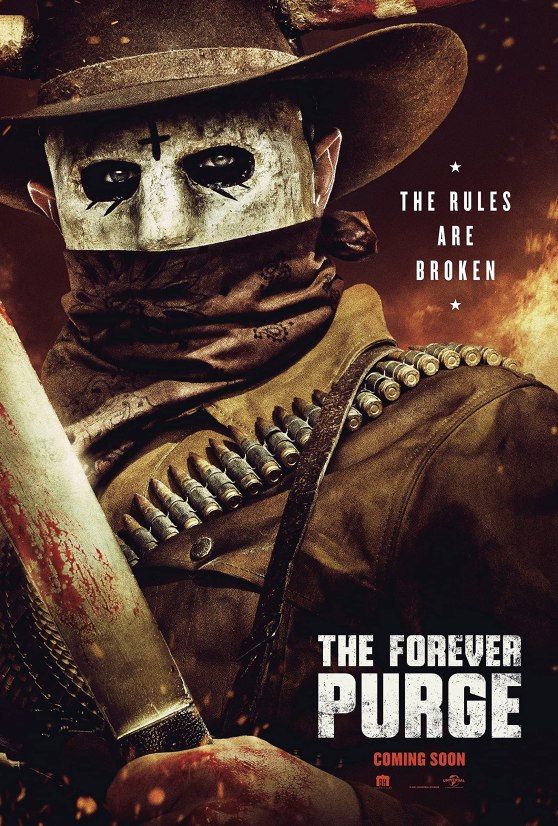
The. Forever Purge (2021): Directed by Everardo Gout and written by series creator James DeMonaco, this is yet another example of “the last Purge” before they announce another sequel. That said, this series has gone from middling to decent to actual pretty good to middling all over again, so I was happy that this pushes the Purge in a new direction: once the killing starts, it won’t stop. Sure, the series has gotten pretty heavy handed, but if the last few years have taught us anything, it’s that the Purge is closer than ever before.

These films always get laughed at for the way they handle social issues and then they make over $52.8 million worldwide over its $18 million budget.

Eight years after Charlene Roan’s presidential election — The Purge: Election Year — the New Founding Fathers of America have regained control of the U.S. government and have re-instituted the Purge. Racism has gotten out of control and this years Purge seems like it will cause more damage than anyone can imagine.

I mean, you can totally see how they tore this from the headlines. That’s kind of why I have a soft spot for these movies, which feel like the last gasp of the exploitation movies that we love that would stare a cynical eye on what was really happening and figure out how to make some money off   of it.

Despite all of the film’s main characters surviving the Purge, the next day the killing continues thanks to a faction called the Forever Purgers, who have decided to turn the tables on the rich and show them what it feels like to be undervalued.

It’s easy to be snide and think these films are a waste of time, but for some reason, I’ve found something to enjoy in every film after the first one. I’m really looking forward to Frank Grillo’s character Leo Barnes coming back in the next film, as his journey between The Purge: Anarchy and The Purge: Election Year made for a great story.

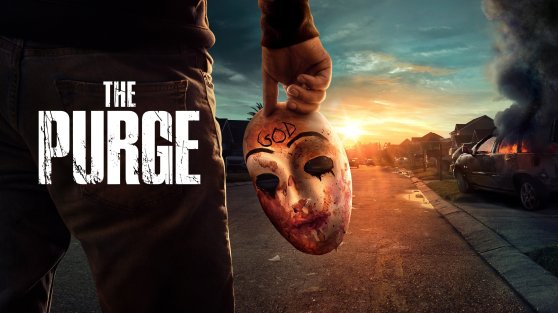
The Purge TV series: Lasting two seasons — the first takes place in 2027 and the second season between 2036 and 2037 — the first season was all about what goes into the Purge before it happens, seen from the perspective of several characters as an anthology series. Season two starts as an annual Purge night ends and multiple arcs show why different characters were involved and how the Purge changed their lives.

The Man Who Killed Hitler and Then the Bigfoot (2018)

ABOUT THE AUTHOR: A.C. Nicholas, who has a sketchy background and hails from parts unknown in Western Pennsylvania, was once a drive-in theater projectionist and disk jockey, Currently, in addition to being a writer, editor, podcaster, and voice-over artist, he contributes to Drive-In Asylum. His first article, “Grindhouse Memories Across the U.S.A.,” was published in issue #23. He’s also written “I Was a Teenage Drive-in Projectionist” and “Emanuelle in Disney World and Other Weird Tales of a Trash Film Lover” for upcoming issues.

Unlike the Louis Armstrong song featured in On Her Majesty’s Secret Service, “We Have All the Time in the World,” I’ve been thinking about how little time we really have in this life. I’ve been around long enough to have lived in a generation with no cable TV, pay TV, VHS, DVDs, or streaming, where we watched genre films in grindhouses, at midnight screenings, and on broadcast TV shows such as The CBS Late Movie and Pittsburgh’s Chiller Theater. Few of those films featured senior citizens, and if they did, the older timer was usually a psycho-lunatic, like Neville Brand in Eatea Alive. Today, however, things have turned, and it’s in vogue to feature senior citizens in genre films—and to show them having sex. See X from director Ti West, for example.

Until the film I’m about to review here, the best exploitation film featuring the elderly—and how shabbily society treats them—was Bubba Ho-Tep, Don Coscarelli’s imaginative, funny, and ultimately sad, meditation on what it’s like to grow old. (George Romero’s elder-abuse public service film, The Amusement Park, was years away from rediscovery.) I think though, The Man Who Killed Hitler and Then the Bigfoot, equals, if not betters, Coscarelli’s cult gem, which had Elvis and JFK, at the end of their lives, fighting a reanimated mummy.

Reading the title of writer/co-producer/director Robert D. Krzykowski’s film, going in, I didn’t know what to expect. You have “killed,” “Hitler,” and “Bigfoot.” Gotta be trashy exploitation, right? But it’s The Man Who Killed Hitler and Then the Bigfoot, with the pretentious-sounding definite article “the” before Bigfoot, raising a parallel to Mel Gibson’s The Passion of the Christ. Is it a hybrid high- and low-brow film? I’m happy to report that it is—and strides both the arthouse and grindhouse perfectly.

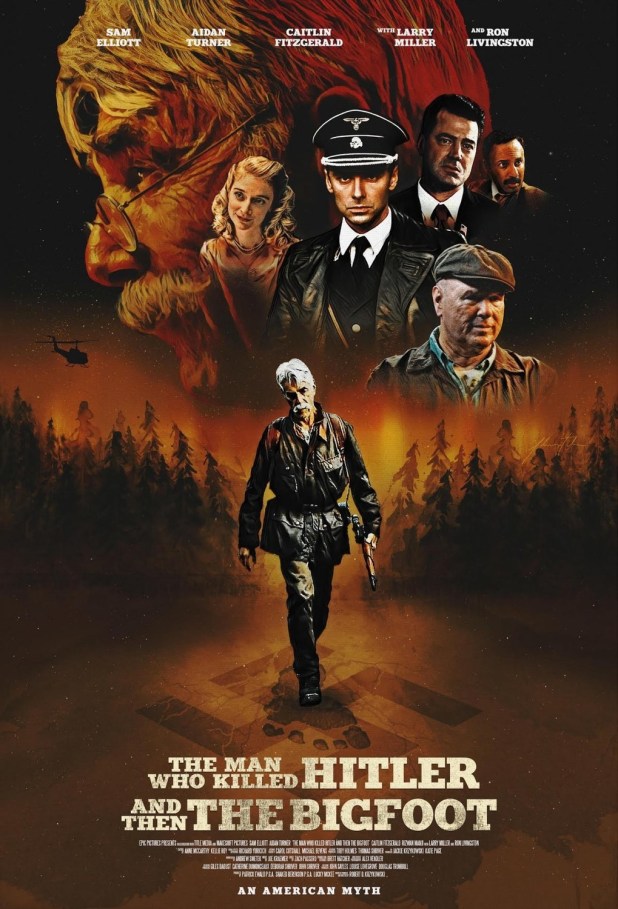
America’s wonderfully grizzled character actor Sam Elliott, with a look and voice for the ages, in a performance for the ages, is Calvin Barr, a World War II veteran who lives by himself in a small town. He has his dog and a mysterious trunk under his bed. He leads a simple, reclusive life. About the only person he regularly talks to is his brother, Ed, the town barber, in a nice performance by comedian Larry Miller. Calvin’s life is winding down until the day two government agents, one from the U.S.A, played by Ron Livingston (credited as “Flag Pin”) the other, a Canadian, played by Rizwan Manji (billed as “Maple Leaf”), knock on his door. They know about Calvin’s hidden past. During the war, he had killed Adolph Hitler during a secret mission, a mission which is classified, so no one will ever know that Calvin is a hero.

Flag Pin and Maple Leaf implore Calvin to go on another dangerous mission. You see, Bigfoot in the Canadian Pacific Northwest is sick with a virus that could potentially wipe out mankind. (Man, this movie was sure prescient about the pandemic! Calvin’s immune to the disease (don’t ask for the particulars, just go with the flow), so they want him to kill the Bigfoot and save the world.

And, thus, we get to the heart of this beautiful film. What is your legacy? Are you a hero if no one ever knows of your heroic actions? What is the price of being a hero? (You can guess that there’s a sad flashback about a lost wartime love.) And finally, can you find meaningful closure to your life while up against the Grim Reaper? The film asks you to ponder these questions, and by the end, you’ll be thinking about them for a long time. I know I have.

But lest you think the film is what Joe Bob Briggs would describe as a “lobster,” a pretentious arthouse film, let me assure you it delivers with some highly entertaining, gory exploitation action featuring the horribly diseased Bigfoot. As I said, it straddles that line between art and exploitation perfectly.

I loved The Man Who Killed Hitler and Then the Bigfoot. It’s a film that’s so conceptually weird that it couldn’t possibly be good. But it is, just like Bubba Ho-Tep. As an aside, you’ll note that brilliant indie writer/director John Sayles and legendary special effects artist Douglas Trumbull are credited as executive producers, with Trumbull doing the special effects. They obviously had faith in Robert D. Krzykowski’s vision, and when you see the film, you will too. I hope he creates more oddball gems in the future. His first feature is amazing, a cult film waiting to be discovered.
DISMEMBERCEMBER: The Legend of the Christmas Witch (2018)

EDITOR’S NOTE: This was originally on the site on December 23, 2019.

During the day Paola is an ordinary primary school teacher, but at night, she turns into…The Christmas Witch, a magical creature who brings gifts to the good kids.

That said, what is a Christmas Witch? Well, she doesn’t even come on Christmas! In Italian folklore, Befana is an old woman who delivers gifts throughout Italy on Little Christmas, which is called Epiphany Eve (the night of January 5), the night before the Catholic Church celebrates the manifestation of the divinity.

Some suggest that Befana is descended from the Sabine/Roman goddess named Strenia. Regardless, each year, she visits all the children of Italy to fill their socks with candy and presents if they are good, or a lump of coal,  dark candy or a stick (if they live in Sicily) if they are bad. She also will sweep the house, which is symbolic of sweeping away the problems of last year.

So wait…why are we covering this on our site? Stay tuned after the trailer.

So why did we watch it?

The director is Michele Soavi.

You read that right. The same man who made Cemetery ManStagefrightLa Secta and The Church.

This is his first theatrical film since 2008’s Blood of the Losers.

Yes, let that sink in. The dude in the metal mask from Demons made a Christmas movie for kids.

Don’t worry — it’s pretty crazy, even if his visual style is a bit muted here.

The plot concerns Paola being kidnapped by Mr. Johnny, a cruel toymaker who got his childhood ruined by the Witch and is now seeking revenge. Six brave kids all learn the teacher’s secret and work together to save Christmas from commercialism.

So yeah. Merry Christmas early, everyone. You may have wanted something filled with gore and all manner of insanity like a rabbit that learns how to use a TV remote, but hey, you can’t pick what’s under your tree. Just enjoy this one, which you can find for free on Tubi and Amazon Prime.

CAULDRON FILMS BLU RAY RELEASE: Abrakadabra (2018)

EDITOR’S NOTE: The Cauldron release of this film comes with a CD soundtrack with music by Luciano Onetti, behind the scenes footage and a trailer. You can get it from MVD.

Thirty years after his father The Great Dante was killed during a magic trick gone wrong, Lorenzo is now being accused of a series of murders that all have magical themes as he struggles to present the biggest show of his career.

This is the third film in the Onetti Brothers’ Giallo Trilogy, following Francesca and Sonno Profundo. For all the reviewers that bring up their Argento style, the true maniacs, the ones who put on their gloves while watching a giallo, the people like, well, me and you — we realize that their influences go beyond the touchstones every critic uses. For all of those that love Martino as much as Argento, good news. This feels like one of his films that was lost in time.

I caught the YouTube premiere of the film, which is missing most of the gore and nudity, which would be the selling point for many a fan of these films. But for the other parts of the form, such as the soundtrack, the plot that goes everywhere and nowhere at the same time, even the look of the color and film, this is a true piece of giallo in a time when I wondered if all the gold has truly been mined.

That said, you can look forward to people decrying its dubbing, acting and plot. Those people have never seen anything beyond Suspiria and have declared themselves experts. Screw it. I hope these Argentinian madmen keep making movies. I’ll pour them a whole bottle of J&B if I ever get the chance to meet them.

PS: I realize that the example I picked isn’t even a giallo. Those of you that have read copy and pasted reviews of movies that reference this genre will, I hope, get the joke.

SLASHER MONTH: Puppet Master: The Littlest Reich (2018)

EDITOR’S NOTE: This was originally on the site on August 20, 2018.

Despite being direct to video releases (yes, some have had limited releases in theaters and the first was considered for theatrical release), the Puppet Master series is one that’s packed with content. Produced by Full Moon Features, the series started in 1989 with Puppet Master, which has been followed by ten sequels/prequels, a non-canon crossover with the characters of Demonic Toys, two comic book mini-series, an ongoing comic book series, toys and now, this reboot.

Opening in Postville, Texas, where that “old guy” comes into a bar where he’s been frequently upsetting the female customers. That “old guy” is Andre Toulon, the inventor of the puppets who this movie is all about and he’s played by Udo Kier, of all people. After bothering the bartender and her girlfriend, he leaves into the night, upset as they embrace and kiss.

Later that night, the girls leave the bar and discuss their future. After hearing a noise, one of them is attacked. Soon, we see Toulon lying in a basement, telling the puppets to come to him. This scene felt really disjointed — setting up the murder but not showing it actually happening. Everything jumps forward to the police investigating the crime scene, with both girls dead and small footprints running away from the car.

The police rush — with no backup or warrant — to the Toulon house, where we see Andre rise painfully and pull down a concrete pillar. They enter the house and we hear gunfire as the title card appears.

Note: the producers have stated that this film takes place in a parallel universe, which is why Andre Toulon is an evil Nazi instead of battling against the Third Reich.

Dallas, Texas. Today. Edgar (Thomas Lennon, The State, Reno 9-11 and a character actor who has shown up in plenty of films way below his talent level) is recovering from a divorce and has retreated to his childhood home to heal. There, he discovers a mint condition Blade doll in his dead brother’s room and decides to sell it at a convention that celebrates the Toulon Murders for a big profit. Joining him on the way are Markowitz (Nelson Franklin, Scott Pilgrim vs. the World) and Ashley.

They sign up for a tour of the Toulon house, led by Carol Doreski (Barbara Crampton, Re-AnimatorChopping Mall, We Are Still Here), the officer who raided the mansion thirty years ago. She explains the backstory of how Toulon began creating the puppets and where everything went wrong.

Once Toulon escaped World War 2 — his wife committed suicide at sea — he settled in this small Texas town. On the night the police were called in, they found a house of horrors, including a soundproof room where Jewish women were tortured. There are also books in the house on all manner of subjects like astrology, numerology, demonology and more, as well as books that came directly from Adolf Eichmann, the creator of the Final Solution.

Finally, Doreski shows the tour group where Toulon was shot as she finishes the tour at the mausoleum where his body lies in rest. There are rods inside the building that some feel have occult significance, but that no one can really explain.

When Edgar and Ashley — now a couple who make out at every opportunity — come back to their hotel room, his Blade doll is missing and the front desk answers back in French, saying “Remain in the shadows.” If you think things are going to get normal from here on out, well, things are only going the other way. Soon, Torch appears and makes the first two gory kills. In a world of CGI, it’s nice to see some practical effects here! The burn effects are really well done.

This isn’t a film that skimps on nudity, either. We cut right from those brutal kills to a couple in the throes of passion — including breasts against the window ala Catholic High School Girls in Trouble from The Kentucky Fried Movie. Blade soon gets involved, slicing them to ribbons, including a Pet Semetary style ankle shredding.

Say what you will about this movie, but it knows its audience. We find another convention goer watching some wrestling in his room (I recognize David Starr, which I wonder is intentional as he’s a Jewish pro wrestler). Man, I don’t want to spoil the kill that follows, but suffice to say I’ve never seen anyone urinate on a decapitated head before. Just wow. If you’re looking for the red stuff — and I guess the yellow stuff — this movie has you covered.

While Markowitz tries to get some action at the bar, Detective Brown (Michael Paré from Streets of Fire! This is the kind of casting I’d dream of if Italian exploitation movies were still being made!) shows up to investigate the missing Blade doll. Soon, he learns that everyone that brought a doll has lost them. And man do they pay. We don’t meet a single character really and get to know them, we just watch puppets decimate them. But hey — isn’t that why you’re watching this?

This movie totally needs a Joe Bob Briggs breakdown of the kills. Spinning robot fu. Intestine ripped out fu. Drill fu. Puppet abortion fu. Seriously, that last one is on the level of Joe D’Amato or Ruggero Deodato depravity.

The police make everyone leaves their rooms and gather in the lobby as multiple crime scenes appear. Can everyone survive the onslaught of Blade, Pinhead, Tunneler, Torch, Mechaniker, Happy Amphibian, Grasshüpfer, Mr. Pumper, Junior Fuhrer, Autogyro and Money Lender?

“Lots of terrible shit happens to people who don’t deserve it,” says a fan at the end of the film. “I don’t think things are fully resolved,” says our sole survivor as a TO BE CONTINUED comes up. Well, here’s to hoping!

Directed by Sonny Liguna and Tommy Wiklund (Animalistic) and written by S. Craig Zahler (Bone Tomahawk, Brawl in Cell Block 99) with credit given to Charles Band, there’s a major narrative shift that changes up this film from any that have come before. Where in the past, the puppets were created to battle the Nazis and have been taken over by whomever can command them, here they were explicitly by a Nazi to kill their enemies, like Jewish people, blacks, gay people and gypsies. Essentially, the characters that you want to cheer on are committing hate crimes. That’s a pretty big jump to make. Then again, if you see this is an exploitation film, you know that all bets are off. Creator Charles Band told Entertainment Weekly, “You’ve got to go back to what exploitation movies were 40-50 years ago. I mean, it’s hard today. There’s so much out there. We’re so jaded. I mean, television news, when something bad happens, it’s worse than most horror movies I’ve ever made: decapitations and terrorism. And, you know, what do you do to an audience that has seen it all, to get them talking? What [Cinestate] has done is gone full-on exploitation. They’ve got something going there, where there is going to be controversy.”

I’ve hinted at it before, but the Italian sleaze roots of this film run deep. So deep that Fabio Frizzi (The Beyond, Zombi, Manhattan Baby) did the score! And the role that Skeeta Jenkins plays totally feels made for Bobby Rhodes.

Band has stated that he still has plans to make his own Puppet Master movies and that Cinestate has plans to make a big budget version of Castle Freak next. Here’s hoping that movies like Trancers and Subspecies also get their shot!

Despite the changing of the series’ premise — I’ve never been a hardcore fan, so I got past this quickly — this movie is exactly what it should be. Quick, brutal and filled with the red stuff. Sure, we never find out what the hell is going on in that mausoleum. And we have no idea what happens next. But isn’t that the beauty of a fun exploitation movie? Shut your brain off and enjoy.

MVD DVD RELEASE: Checkered Ninja (2018)

Anders “Anden” (“The Duck”) Matthesen is a Danish stand-up comedian, actor and rapper who worked with Thorbjørn Christoffersen to turn his 2016 book into an animated movie. Yes, a ninja movie from Denmark!

The film begins in Thailand, where Danish businessman Philip Eberfrø is inspecting his new factory. One of the young boys laboring there accidentally uses his checkered scarf to make a ninja doll. A boss on the floor beats the boy until Phillip stops him and then grabs a weapon and beats the boy to death. As this happens, lightning strikes the building, guiding the spirit of Taiko Nakamura — based on a real-life bandit during the 16th century Azuchi–Momoyama period in Japan — to avenge that child’s death. That’s what Nakamura has been doing ever since he was betrayed and unable to save ten children. Giving up his own life, he can possess animals and objects to set the balance of justice.

Now in the form of a stuffed ninja doll, Takamura hides on a Danish cargo ship and is found by a sailor named Stewart Stardust who gives him as a birthday present to his nephew Alex Stenstrøm. The ninja surprises Alex by coming to life and defending him from a bully, but he’s still there to take the life of Phillip.

This is an interesting coming-of-age tale, as the ninja and the teen must learn a lesson. The ninja is devoted to what he knows, fighting and death, while Alex sees another way out of issues. Of course, Alex can barely deal with his brother and being beaten up at school, so he has some things to learn as well.

I really liked this film, as it has a fun animation style and doesn’t take itself too seriously. I’m also surprised by how kids’ movies in other countries aren’t afraid to have violence, swearing and some PG-13  content. It didn’t ever go too far, but if you know those parents that overly worry about that kind of thing, well…maybe let their kids watch it at your house.

How big was this movie in Denmark? It sold a million tickets, making it the highest-grossing Danish film since Op pa fars hat in 1986 and three Robert awards for best children’s film, best adapted screenplay and best original song (“Skubber det sne”). It was even nominated for a Bodil Award for Best Danish Film.

Here’s hoping the sequel makes it way here too!

You can get the DVD of Checkered Ninja from MVD.