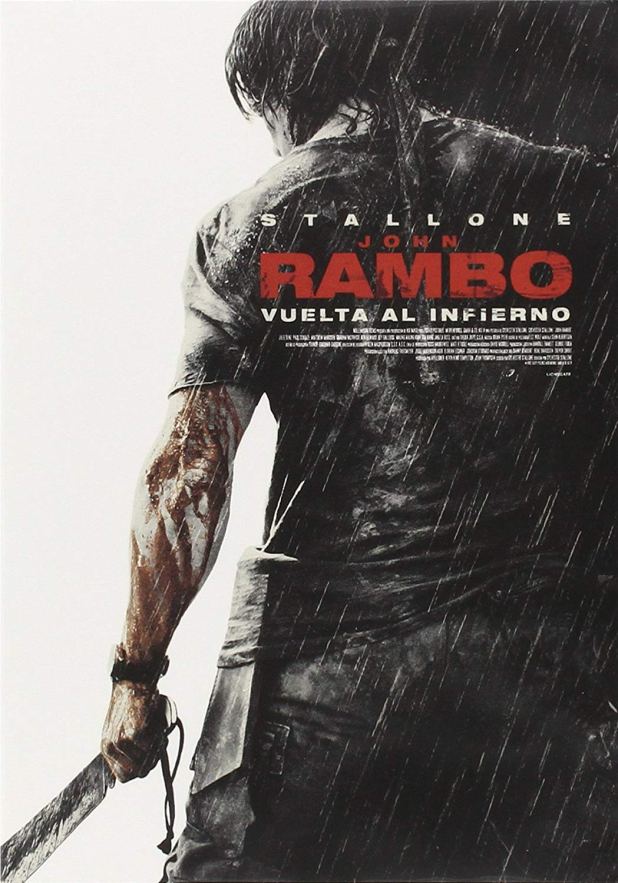
Rambo (2008)

Why did it take twenty years to make another Rambo movie? Stallone claims that it was due to a lack of a compelling story. An early idea had Rambo traveling to Mexico to rescue a young girl, but it lacked the Rambo essence of a lost man wandering and trying to find himself.

There was also a thought that Rambo should be living a quiet life with his wife and child when white supremacists kidnap his family. Another idea saw Rambo trying to stop a hostage situation at the United Nations — where he is strangely working as a diplomat — and battling terrorists (including his adopted son, who I’ll assume is Hamid from Rambo III).

Speaking of the United Nations, that’s where Stallone got the idea to set the film in Burma. In fact, lead villain Maung Maung Khin is a former Karen freedom fighter who accepted the role to bring awareness of the Saffron Revolution to the world.

The film is banned by the Burmese government. It is, however, available there in bootleg versions thanks to the opposition youth group Generation Wave. The Karen National Liberation Army has publically stated that the movie gave them a morale boost and have adopted the “Love for nothing or die for something” line as a rallying cry. “That, to me,” said Sylvester Stallone, “is one of the proudest moments I’ve ever had in film.”

When the film’s original director left, Stallone stepped in. He had no vision for the film until he realized, “What if the film was directed by Rambo?” He had another big idea that totally amped up the film, too. Realizing that the film had a low budget and that gore is cheap, he decided to go all in.

I’m here to tell you that this movie is 100% all in.

The ruthless Major Pa Tee Tint leads an army of men who systematically destroy small villages, killing innocents, drafting teenagers and abducting and assaulting the women. A missionary named Michael Burnett hires Rambo — who makes his living as a snake catcher and boat pilot in Thailand — to use his boat on a humanitarian mission to provide medical aid.

Pirates stop the boat and Rambo is forced to kill them to save Sarah Miller (Pittsburgh’s own Julie Benz), the only woman in the group. Everyone is so upset by how violent Rambo is that they send him away. Within hours, they’re attacked by Tint’s soldiers.

Of note, Benz began working for the U.S. Campaign for Burma after this movie was released, saying “I can’t continue my life without trying to help the situation.”

Father Arthur Marsh (Ken Howard, The White Shadow), the pastor of the missionaries’ church, asks Rambo to take five mercenaries upriver on a rescue effort. Our hero offers further help, but their leader refuses. Luckily for him, Rambo sticks around as the soldiers quickly outnumber the mercenaries.

What follows is an absolute massacre, as Rambo graphically dispatches of everyone in his way, sometimes with whole groups being wiped out by weapons fire and other times hand to hand. If you’re squeamish about gore at all, you should avoid this film, which is packed with graphic displays of death and dismemberment. I’m serious: there is an average of 2.59 killings for every minute of screen time and an overall body count of 466 people.

David Morell, the writer of First Blood spoke highly of the film: “I’m happy to report that overall I’m pleased. The level of violence might not be for everyone, but it has a serious intent. This is the first time that the tone of my novel First Blood has been used in any of the movies. It’s spot-on in terms of how I imagined the character — angry, burned-out, and filled with self-disgust because Rambo hates what he is and yet knows it’s the only thing he does well. … I think some elements could have been done better, [but] I think this film deserves a solid three stars.” 

JCVD (2008)

This movie started when a producer had reached a deal with Jean-Claude Van Damme to play himself in a movie. Knowing that director Mabrouk El Mechri was a big fan, he asked him to read the script. The problem was that the screenwriters thought that Van Damme was exactly who he tried to portray to the public — an action hero and personality given to delivering long speeches on television appearances that touch on personal well-being and the environment in a strange Zen koan combination of French and English. In other words, the writer though Jean-Claude was a clown.

The producer offered El Mechri the chance to write and direct, which he agreed to only if he could actually meet with JCVD first. He didn’t want to waste months writing something that Van Damme could veto or not give everything to. Luckily, the actor got the concept immediately and the film was a go.

Jean-Claude Van Damme plays a version of himself, called JCVD in the credits, who is out of his luck. Our of money. And in a custody battle where his own daughter rejects him in court. He goes back home to Brussels where he is still a hero but he is obviously a man on the edge.

At a post office, a robbery begins after JCVD is unable to get a wire transfer for money that he desperately needs. As he’s taken hostage, the police mistakenly believe that the actor is behind the crime, despite him protecting the other hostages and trying to negotiate with the police. But when he asks the police to send $465,000 to his lawyers, it’s unclear as to whether he’s become part of the criminals or he’s just trying to gain their trust.

The media gathers around the event, as well as the police bringing in JCVD’s parents, as we see TV footage of the actor speaking in his strange patois about all manner of subjects on French TV.

That’s when this movie becomes genius. The camera and Van Damme lift above the set and he begins speaking about the absurdity of the situation, as well as his career, the loves of his life and his reliance on drugs. The actor made El Mechri swear not to tell anyone about the content of this monologue, so this was called the X scene on set. There was a black curtain drawn around Van Damme, who is ironically a shy person, and when the actor hit the line about not wanting to die, the crane was lowered back onto the set. Only the actor knew what he said until they saw the dailies.

This scene is incredibly tough to watch, as Van Damme is tougher on himself than his harshest critics, saying, “When you’re 13, you believe in your dream. Well it came true for me. But I still ask myself today what I’ve done on this Earth. Nothing! I’ve done nothing!”

Interestingly enough, Van Damme has always been able to say cut on his own movies, but for this movie, he made an agreement that the director would have the final say. So much of the film is ad libbed as well, such as the scene where the taxi driver is abusive to the star. JCVD was told to be nice to her, no matter what she said.

Van Damme finally uses his celebrity to become friends with one of the robbers, but a battle ensures between the robbers and when the police hear a shot, they come in guns blazing. Finally, the last surviving robber takes JCVD hostage. In his head, he imagines that he hits one of his trademark kicks to save the day, but in real life, he just shoves the man into the cops and is arrested himself, sent to jail for a year.

At the end, he’s teaching the other inmates martial arts when his mother brings his daughter to see him. It’s an emotionally brutal scene as we see Van Damme begin to shake and nearly collapse. It’s more real than anything he’s ever done, yet in the confines of the unreal world of cinema. Yet this meta moment touched me and I found a tear streaming down my face, something that has never happened when watching any of his films before.

I loved this movie. It’s easily the best film of my JCVD week, but that’s because it’s knowingly breaking the cycle of his films. It’s a credit to the actor that he allowed the public to see him in such a raw way here.

You can watch this for free on Tubi.

Speed Racer (2008)

As a kid, I was totally obsessed with Japanese culture. In the late 1970’s, we had Godzilla, Gamera, Johnny Sokko, Ultraman, Battle of the Planets, Starblazers and Speed Racer all on TV at the same time. The thing is, I was the older brother who always felt like the screw-up, so Racer X was my hero. I avoided this movie when it was released. How could it live up to my memories? I’m pleased t admit I was wrong. This movie is crazy in all the best ways.

After years of this movie never getting made, The Wachowskis were able to bring it to the screen. Just from the beginning — where time overlaps and we get both the backstory of Speed, his brother Rex and the race that they’ve both won — this movie grabs you. Yes, it’s way too CGI intense but at some point, all the blurring and spins and overlaps just win you over.

Speed Racer (Emile Hirsch) loves racing and loves his family — Pops (John Goodman), Mom (Susan Sarandon), brother Spritle, chimp Chim Chim, his mechanic Sparky and his girlfriend Trixie (Christina Ricci) — even more. He once had a brother named Rex who left the family for racing and became one of the dirtiest racers in the sport before dying in the Casa Cristo 5000 cross country rally. Seriously, the flashback scene that tells you all of this will either thrill or exhaust you.

Everything from the show is here, from how Speed leaps from the Mach 5 and the screen turns to pose in the original animation to characters like race fixer Cruncher Block, Inspector Detector, Snake Oiler and Prince Kabalah as well as the Mach 5, the Shooting Star, the GRX race car and the Mammoth Car.

In a better world, the fact that this movie exists in a candy-colored neon world would have been seen as a welcome escape from the grim and gritty world that we live in. Sadly, it was not to be, although the film made up from its box office losses via merchandising and video sales.

At one point, Julien Temple was to direct, Johnny Depp was to play Speed and Henry Rollins was going to be Racer X. I kinda wanna see that movie now.

Get Smart (2008)

Peter Segal has made films that people love — Tommy Boy50 First DatesThe Nutty Professor II: The Klumps — and critics hate. Here, he’s remaking the Mel Brooks and Buck Henry show that ran from 1965 to 1970. Instead of Don Adams, Steve Carrell takes over as Maxwell Smart.

Smart is more geek than spy, in awe of agents like 23 (Dwayne “The Rock” Johnson) and 99 (Anne Hathaway). Once KAOS (none of the spy agencies are acronyms here) exposes the identities of every CONTROL agent, he gets his chance to be a spy, going to battle with Siegfried (Terence Stamp!), one of the baddies from the 60’s show. It’s also great to see Alan Arkin as the Chief.

There are some fun cameos here, like Bill Murray as Agent 13, who must always be a tree); James Caan as the President; Terry Crews and David Koechner as CONTROL agents; Larry Miller and Kevin Nealon as CIA guys; former WWE wrestler The Great Khali as a henchman and Patrick Warburton as the robotic Hymie.

A sequel has been rumored for some time. There was a direct-to-video spin-off, Get Smart’s Bruce and Lloyd: Out of Control (featuring the tech geeks, Warburton, Crews and a cameo by Hathaway). It only lasted seven episodes. It was based on the reunion movie, Get Smart, Again!

I totally forgot that there was a 1995 Fox series with Don Adams and Barbara Feldon returning to their roles to help their son, Andy Dick, become a CONTROL agent.

I did not forget 1980’s The Nude Bomb, a film that brought Maxwell Smart back in again to battle a bomb that takes off clothes. Smart doesn’t even work for CONTROL in this one, but for the PITS. Agent 99 isn’t in it and Feldon wasn’t even informed that the movie was being made. You know who is? Sylvia Kristel, which probably explains why an 8-year-old me was so excited by this film. Actually, I have no idea if pre-puberty me would know how magical she was, but I’d like to think I knew what was up. It’s directed by Clive Donner, who was behind the TV movie Spectre and 1981’s Charlie Chan and the Curse of the Dragon Queen, a movie that would never be made today because Peter Ustinov was Chan and Angie Dickinson was the Dragon Queen. Whitewashing has been real for years, people.

You can watch this film for free on Vudu.