April 25: Bava Forever — Bava died on this day 43 years ago. Let’s watch his movies.
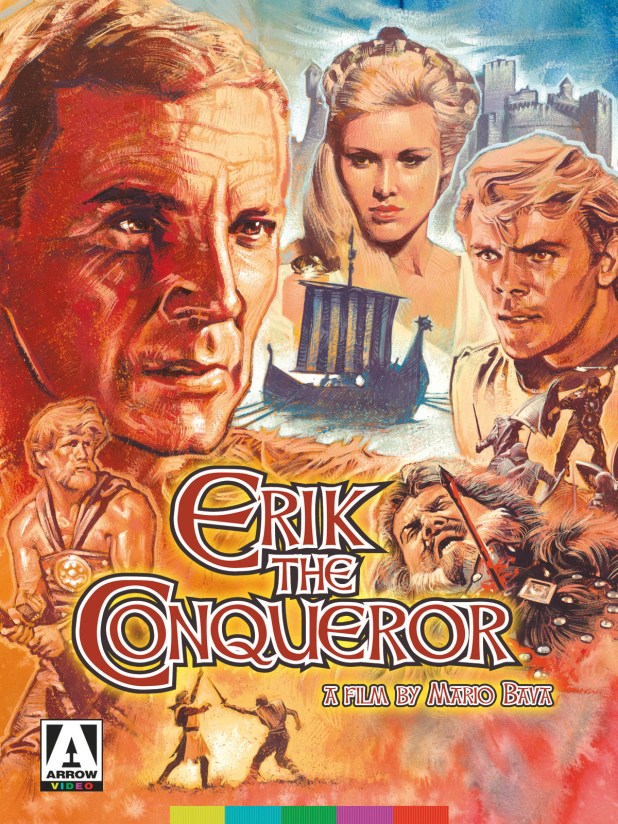
Known in Italy as Gli invasori (The Invaders), this is the story of two Vikings, Erik (George Ardisson) and Eron (Cameron Mitchell), who are separated when Sir Rutford (Andrea Checchi) of England makes a surprise attack on their father, King Harald (Folco Lulli). In the battle, Eron is rescued, and when King Lotar (Franco Ressel) becomes angry that Rutford has gone against his orders, he is also killed. His wife, Queen Alice (Françoise Christophe), rescues Erik and raises him.
Twenty years later, King Olaf (Jean-Jacques Delbo) has made Eron his warrior of choice, ready to take the fight back to England. Meanwhile, Erik is made Duke of Helford and leader of the English Navy, but Rutford sabotages his ship and sets it on fire. In the battle to come, brother fights brother, brother discovers sister, and Eron dies, naming Erik to his title.
Together, the Viking, English, and Scottish armies defeat Rutford. At the same time, Erik becomes King of the Vikings with vestal virgin Rama (Alice Kessler) while her twin sister Daya (Ellen Kessler) sails alone with the body of her lover, Eron.
Shot in Rome’s Titanus Studios, this is director Mario Bava making use of all his camera tricks while also having good acting and amazing sets to work with. This is only the second movie he’d directed, and already you could see his power. There’s an incredible spider death trap and a mesmerizing beauty in the story of two brothers, long kept apart, first enemies and the twin sisters who love them. Yes, it was inspired by The Vikings, but the best Italian movies start with another movie and then do something all their own.
Dr. Charles Decker (Michael Gough) has been presumed dead, but he’s really been hiding out in Africa, learning how to grow plants and animals to a huge size. Like the baby chimp Konga, which he turns into a monstrous ape and then, well, he goes bonkers. I mean, he was before too, but even more after. He sends Konga to London to kill all of the scientists who made fun of him like Professor Tagore (George Pastell) and Dean Foster (Austin Trevor).
No one knows that and he keeps on teaching, getting obsessed with one of his students named Sandra (Claire Gordon), which angers his assistant and lover — and wife? — Margaret (Margo Johns). When she turns him down, Decker assaults her, at which point Margaret injects Konga with so much of the serum that he grows gigantic and kills her before going wild on London, starting with grabbing Decker and tossing him. As for Sandra, she’s attacked by a man-eating plant and the movie never gets back to her!
The cops kill Konga — no comments, I’m trying to be non-political — and he turns back into a chimp.
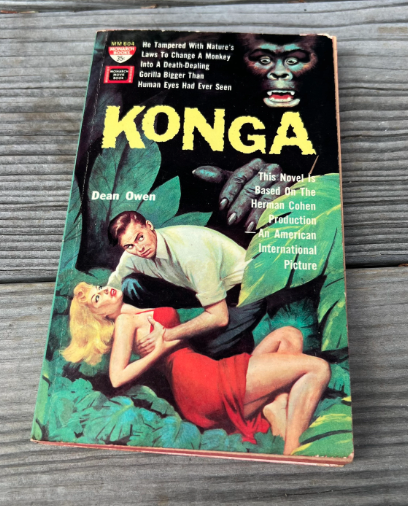
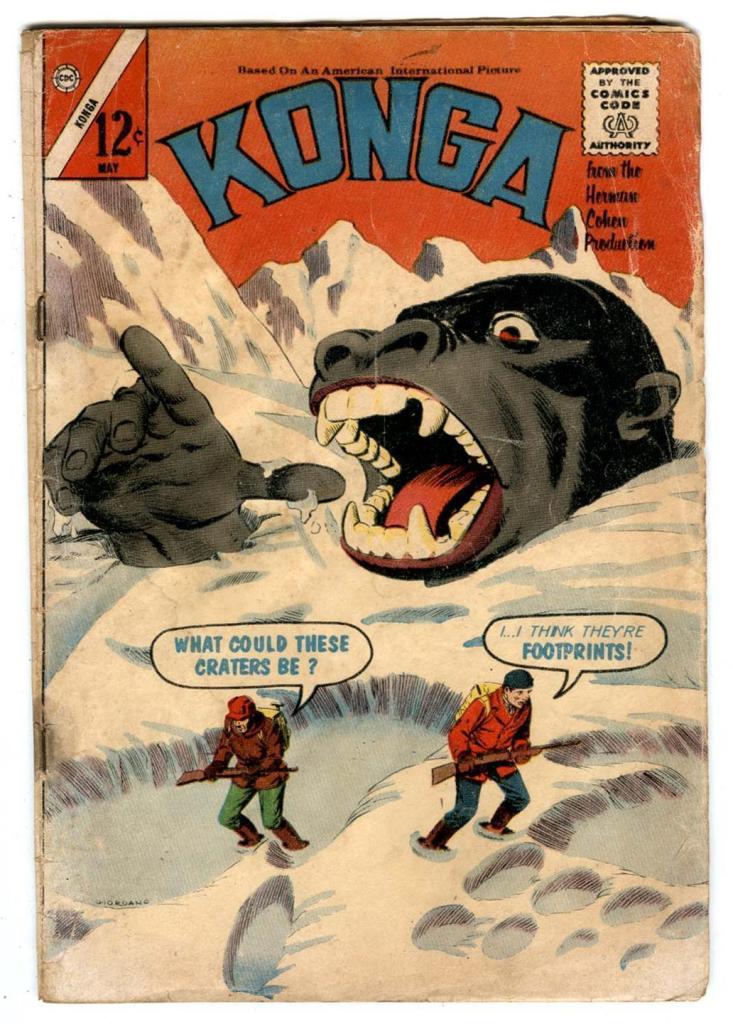
Dudley Dean McGaughy wrote the novelization as Dean Owen. It has a ton more sex — the movie has nothing like it — than the film, as does McGaughy’s Reptilicus paperback. Charlton Comics — who published two issues of a Reptilicus comic book — had also done a Gorgocomic book with Joe Gill and Steve Ditko. Of that work, said, “I read the screenplay of Gorgo. From the first reading to this day, I marvel at how well Joe adapted the character to comic books.”
Gill and Ditko brought the big ape back from the dead for a few stories in which he fought mole men and undersea monsters. It’s wild that Ditko was drawing this book at about the same time that he was on the Marvel monster books and starting on Spider-Man.
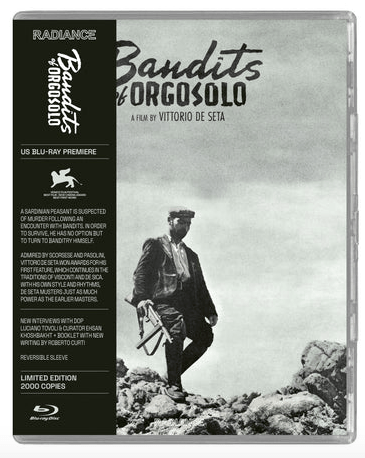
Michel (Michele Cossu) is a shepherd in Sardinia who has been wrongly accused of stealing livestock and killing a policeman. He runs into the hills with his brother Peppeddu (Peppeddu Cossu) and their flock, which they are still paying for. Losing the sheep would be too much to bear for his family, but that’s what happens as they are chased by the authorities. Then, facing a trial, he decides to be what he has been charged with: a criminal.
Directed by Vittorio De Seta, who wrote the script with Vera Gherarducci, this has a documentary feel, as those are the movies that De Seta started his career with. This is the story of a poor man who only has his job to sustain him, living within some of the most remote areas of the world, just trying to earn a living when the rest of the universe seems to conspire against him. There is no mastering nature just as there is often no way out when your back is against the rocks.
This is a gorgeous, if dismal, film and while set in the 20th century, it could have been set at any time, as the world that it comes from has remained the same since we counted time.
Radiance Films blu ray of Bandits of Ogrosolo is the first blu ray release of this movie in the U.S. It has a new 4K restoration from the original camera negative by The Film Foundation and Cineteca di Bologna at L’Immagine Ritrovata laboratory, in association with Titanus with funding provided by the Hobson/Lucas Family Foundation. Extras include interviews with cinematographer Luciano Tovoli and curator and filmmaker Ehsan Khoshbakht, a trailer, a reversible sleeve featuring original and newly commissioned artwork by Filippo Di Battista and a limited edition booklet featuring new writing by Roberto Curti.
William Castle mortgaged his house and formed William Castle Productions in 1958. For his fifth movie after Macabre, House on Haunted Hill, The Tingler and 13 Ghosts, Castle had another of his gimmick ideas: the Fright Break.
Before the end of the movie, a 45-second timer would tell audience members that they could get a free refund if they left now. The first night Castle tried this, they all did. Some even came back for a free second show, so he had numbered and color coded tickets. This cut down on the people seeing his movie for free, but there were still some people who wanted a cheap night out.
Castle wouldn’t allow them.
He created the Coward’s Corner, where a voice over would laugh at the people leaving, forcing them into a yellow corner. He even wanted to paint their backs yellow, but this was too much for theaters.
I learned about this from John Waters, who said this in his book Crackpot: “He came up with “Coward’s Corner,” a yellow cardboard booth, manned by a bewildered theater employee in the lobby. When the Fright Break was announced, and you found that you couldn’t take it any more, you had to leave your seat and, in front of the entire audience, follow yellow footsteps up the aisle, bathed in a yellow light. Before you reached Coward’s Corner, you crossed yellow lines with the stencilled message: “Cowards Keep Walking.” You passed a nurse (in a yellow uniform? … I wonder), who would offer a blood-pressure test. All the while a recording was blaring, “Watch the chicken! Watch him shiver in Coward’s Corner!” As the audience howled, you had to go through one final indignity – at Coward’s Corner you were forced to sign a yellow card stating, “I am a bona fide coward.” Very, very few were masochistic enough to endure this. The one percent refund dribbled away to a zero percent, and I’m sure that in many cities a plant had to be paid to go through this torture. No wonder theater owners balked at booking a William Castle film. It was all just too complicated.”
Emily (Joan Marshall using the name Jean Arless) convinces the bellboy at a hotel to marry her and she pays $2,000 to him. Late in the evening, they drive to the justice of the peace and start the ceremony, only to kill the official and run, laughing about it to the mute old woman, Helga (Eugenie Leontovich) that she cares for.
Then we meet Miriam Webster (Patricia Breslin), who has just come back to America with her brother Warren (spoiler if I tell you). Warren is the sole heir of the family, as their abusive father has just died, and if he marries, he will get the money. Miriam is going to marry Karl (Glenn Corbett), who catches Emily destroying his fiance’s flower shop. It turns out that Emily and Warren are married. They’re never seen together.
Well, after Helga goes up the stairs on a stair lift and her head falls off, Emily is revealed. This has a lot of Psycho in it, yet it still feels like a unique film. It’s certainly a major reveal and I’d rather you watch the movie. I’d like if you’d watch several William Castle movies.
Here’s a drink.
Killer Kool-Aid
2 oz. vodka
1 oz. Southern Comfort
2 oz. Midori
1 oz. amaretto
6 oz. grape Kool-Aid
Shake everything up with ice in a cocktail shaker.
Pour in a glass filled with crushed ice and drink.
EDITOR’S NOTE: Goliath and the Vampires was on Chiller Theater on Saturday, October 5, 1968 at 1:00 a.m., Saturday, August 29, 1970 at 11:30 p.m. and Saturday, June 23, 1973 at 11:30 p.m. It played as The Vampires.
Released in its native Italy as Maciste control il vampiro, American-International Pictures thought no one in the U.S. knew who Maciste was. He’s also been called Hercules, Samson, Atlas, Ulysses and Colossus with several of his films being part of the Sons of Hercules TV package.
The character first appeared in the 1914 silent film Cabiria, has been in more than fifty movies and has been played by Mark Forrest, Reg Park, Gordon Mitchell, Reg Lewis, Kirk Morris, Samson Burke, Alan Steel, Richard Lloyd, Renato Rossini and Frank Gordon. This time, the man carved from rock is played by Gordon Scott.
Directed by Giacomo Gentilomo (Hercules Against the Moon Men, Slave Girls of Sheba) and Sergio Corbucci (Django, The Great Silence and, yes, Super Fuzz) and a script by Corbucci and Duccio Tessari (one of the fathers of the Italian Western), this movie is totally incredible. Seriously, it slowly built into something that exploded my brain.
Nearly all of the men in Goliath’s village are killed and the women and children taken. He swears to kill everyone until learning that they are all under the spell of the vampiric monster Korbrak (Guido Celano). Yes, pirates who are controlled by a vampire demon who set villages on fire and killing the mother of a demigod as well as kidnapping his girlfriend!
Korbrak is turning all the people he has killed into faceless monsters that serve as his foot soldiers and when Goliath finally meets him face to face, he learns that they are twins. Well, not for long, as Korbrak’s face gets ripped off revealing a horrible visage. There’s also a scene where Goliath is trapped inside a giant bell, as well as everything in the realm of the vampires being colored with gels.
There are also good guys with blue skin and a rubber spider that is one of the best giant spiders you’ll see. This would be the best peplum ever made if it wasn’t for Hercules in the Haunted World but you know, Bava and Christopher Lee together is a tough customer.
Goliath is pretty much a blank slate as a hero but everything else in this movie is just plain weird and by weird, read that as perfect. Monstrous bone and body eating bad guys, even the heroes threatening to send a beautiful woman into a pit filled with monsters while she begs for her life, a sultan who has become the ruler because he sold his soul, people falling on spikes, children being menaced by flaming trees and so much blood. Like, this has all the gore — in 1961, mind you — that every other peplum film not named Conquest wishes that it had.
EDITOR’S NOTE: Night Tide was on Chiller Theater on Saturday, September 4, 1965 at 1:00 a.m. and Saturday, February 20, 1971 at 11:30 p.m.
Written and directed by Curtis Harrington — one of the leaders of New Queer Cinema and also the director of Queen of Blood, What’s the Matter with Helen?, Who Slew Auntie Roo?, Ruby and so many more — this film was always one I wanted to see as it features Marjorie Cameron in a small role.
Harrington had also shot a documentary about her — The Wormwood Star— and I’ll forgive you if you have no idea who she is. Cameron was many things — an artist, poet, actress, and probably most essentially, an occultist. A follower of Crowley’s Thelema, she was married to rocket pioneer and nexus point of all things 20th century occult, Jack Parsons. In fact, Parsons believed that he had conjured Cameron to be the Whore of Babylon/Thelemite goddess Babalon as part of his Babalon Working rite, which he conducted alongside L. Rod Hubbard. No, really. It may have also opened our world to the aliens that have obsessed us since Kenneth Arnold reported a UFO in 1947.
After a suicide attempt and being institutionalized, Cameron gathered a group of magic practitioners around herself that she called The Children, whose sex magic rituals were to create a moonchild. She was now pregnant with what she referred to as the Wormwood Star, but that ended in miscarriage. Many of The Children soon left, as her proclamations of the future had grown increasingly apocalyptic.
Cameron’s orbit — much like her husband’s — unites both the worlds of art and the occult, straddling appearing in the films of Kenneth Anger, working with UFO expert and contactee George Van Tassel and appearing in Wallace Berman’s art journal Semina.
Why did I tell you all this? Because it fascinates me that she’s in Night Tide.
Johnny Drake (Dennis Hopper!) is a young sailor on shore leave who meets Mora (Linda Lawson, who is also in William Castle’s Let’s Kill Uncle), a woman who makes her living appearing in a sideshow. They fall in love before he learns that her past boyfriends have drowned under mysterious circumstances. That may — or may not — be because Mora is a siren, a legendary creature who exists to lure men to their deaths. Adding to her suspicions is the mystery woman (Cameron) who calls to her and demands that she follow her destiny.
One evening, under a full moon, she invites him deep sea swimming, but cuts his hose, forcing him to surface so that she isn’t tempted to kill him. She then swims into the depths of the ocean, fulfilling the call of the mystery woman. And when he returns to the boardwalk, her dead body is still in the mermaid sideshow, now there for visitors to gawk at her dead eyes.
Despite a police confession as to who the killer is, the strange woman in black and her call to the sea is never explained.
Anton LaVey discussed this film in Blanche Barton’s The Secret Life of a Satanist: The Authorized Biography of Anton Szandor LaVey. “There’s a whole genre of films that are just little evocative low-budget gems that I certainly wouldn’t call schlock but that are also being revived as a consequence of more attention in those directions. Director Curtis Hanington’s first movie, Night Tide filmed around the Santa Monica Pier and Venice. California in the late ’50’s, is a psychologically intricate story about a young sailor (Dennis Hopper) who falls in love with a mermaid It’s just wonderful to see these precious works of art being finally given the attention they merit.” This also appears on the Church of Satan film list.
According to Spencer Kansa’s Wormwood Star: The Magickal Life of Marjorie Cameron, Anger introduced Cameron and LaVey, who was delighted to meet the actress, having been a fan of the film.
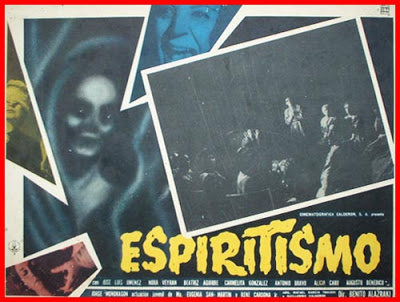
EDITOR’S NOTE: Spiritism was on Chiller Theater on Saturday, July 1, 1967 at 1:00 a.m.
Benito also directed Munecos Infernales, Santo vs. the Zombiesand the astoundingly titled Frankenstein el Vampiro y Compania. This time, he’s sending his movie up north where Espiritismo will become Spiritism thanks to K. Gordon Murray.
This goes the Monkey’s Paw one better by having Satan himself grant the wishes. I mean, when the Lord of Lies is giving things away, that’s when you start questioning things. Louis and Mary Howard (Nora Veryan and Louis Fernandez) decide to attend a seance with a medium by the name of Elvira (Diana Ochoa). She warns them that April 8 will be the start of tragedy and seeing as how that’s their 20th anniversary, they suddenly get concerned and soon are dealing with death, spirits and the decimation of their family.
This movie features a character so clueless that she goes to a seance for herself, which sounds like a joke I should be saving for the next time someone wants to play The Dozens against me. Actually, the scene where she discovers that she is dead and can’t believe it is incredibly sad.
EDITOR’S NOTE: The Haunted Strangler was on Chiller Theater on Saturday, February 19, 1966 at 11:20 p.m., Saturday, May 20, 1967 at 11:20 p.m., Saturday, November 16, 1968 at 11:20 p.m. and Saturday, January 2, 1971 at 11:30 p.m.
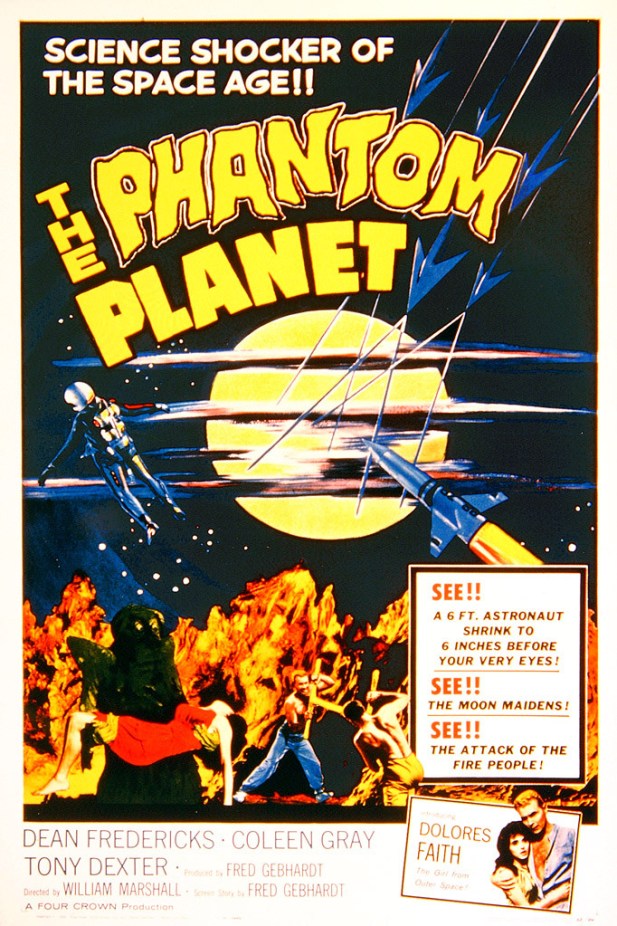
Released as a double feature with AIP’s Assignment Outer Space, The Phantom Planet finds the U.S. Air Force having bases on the moon and getting ready to fly to Mars. It’s 1980.
Captain Frank Chapman (Dean Fredericks) and Lt. Ray Makonnen (Richard Weber) are investigating why astronauts bound for Mars keep disappearing. Is it a phantom planet taking them? Well, Makonnen dies in a few seconds, so don’t get used to him, as meteor storm destroys their ship and Chapman ends up on an asteroid where he’s suddenly all of six inches tall.
Welcome to Rheton, Chapman, a planet that has a tractor beam and is ruled by Sesom (1910s and 20s matinee idol Francis X. Bushman), who has a mean blonde daughter Liara (Coleen Gray, Nightmare Alley). She’s interested in this human who is allowed to stay on the planet, as is the mute Zetha (Dolores Faith, who is in House of the Black Death, V.D. and The Human Duplicators; she left acting to marry Maxwell House heir James Robert Neal). Once he’s used to his new home, he’ll get to marry whoever he wants. Liara declares her love for him and he turns her down; Heron (Anthony Dexter) who has been in love with her tries to set up Chapman and they duel to the death. At the last moment, the Earthling saves Heron and finally falls for Zetha.
The reasons why this planet flies through space the way it does is to stay away from the evil Solarites but now that Chapman and Heron are friends, they rid the planet of them and then our hero is able to leave this planet behind, including the women who love him. The Solarite who captures Zetha, who gets her voice back before she is rescued, is played by Richard Kiel in his first film.
The costumes, sets and special effects in this all come from the TV series Men Into Space. Some people believe that parts of this movie’s sets were recycled for Voyage to the Bottom of the Sea.
Director William Marshall also acted in the movie State Fair. Writer Fred Gebhard also wrote 12 to the Moon while co-writer Fred De Gorter mostly worked in TV.
BONUS WILDCARD WEEK (September 22 – 28) Go order something from the SWV website and watch it!
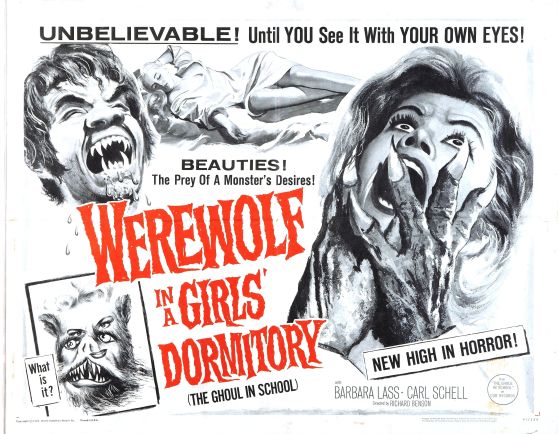
Lycanthropus was directed by Paolo Heusch (The Day the Sky Exploded) and written by Ernesto Gastaldi. Heusch used the name Richard Benson, as all Italian directors of that time had to have an American names.
If the title Werewolf In a Girls’ Dormitory isn’t good enough — and it is, it’s one of the best exploitation titles ever — it was also released as I Married a Werewolf, Ghoul in a Girl’s Dormitory, Monster Among the Girls and The Ghoul In School, which is the name of the song that Marilyn Stewart and Frank Owens wrote and that was sung by Adam Keefe. In case you wonder why a voice that sounds like Peter Lorre says, “Come with me to the corridors of blood,” that’s because this movie was on a double feature with Corridors of Blood.
Director Swift (Curt Lowens) is trying to run a reform school that’s funded by Sir Alfred Whiteman (Maurice Marsac). Swift brings on a new teacher named Julian Olcott (Carl Schell, the brother of Maximilian) even though he’s aware of the fact that when Olcott was a doctor, some patients died.
One of the girls, Mary Smith (Mary McNeeran), is sleeping with Whiteman and also blackmailing him. She’s the first to die — shocking that the bad girl of all these reform girls is the first to die and that she’s also sleeping with the rich man paying for all of the school — and the police decide that she was killed by wolves. Priscilla (Barbara Lass, Roman Polanski’s first wife) believes that someone else did it, as she finds a note that was threatening Mary. Like a giallo main character, she ends up investigating the case herself with the help of the school’s handyman Walter (Luciano Pigozzi) and Whiteman. She soon learns that his wife Sheena (Annie Steinert) knows who killed the girl ruining her marriage but she won’t reveal the truth.
As you can tell by the title, there is a werewolf. It gets there and yes, it’s amazing when it happens. This movie looks so much better than you’d expect with its title. It’s also the only werewolf movie I’ve ever seen where the girls attacked by the monster have orgasms while in the jaws of the furry creature.
Want to see what Bill Van Ryn of Drive-In Asylum thinks? Check out what he has to say here.
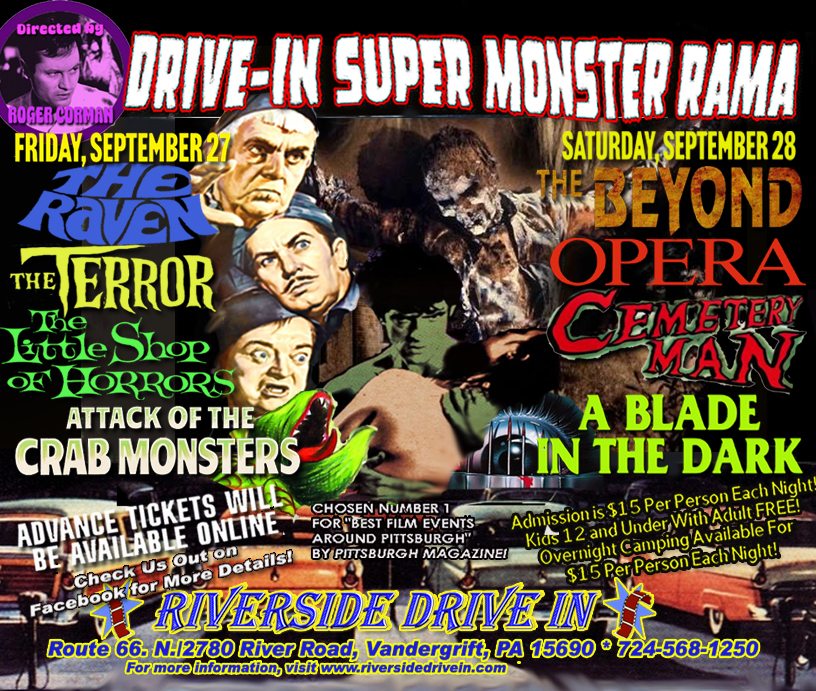
September Drive-In Super Monster-Rama is back at The Riverside Drive-In Theatre in Vandergrift, PA on September 27 and 28, 2024. Admission is still only $15 per person each night (children 12 and under free with adult) and overnight camping is available (breakfast included) for an additional $15 per person. You can buy tickets at the show but get there early and learn more here.
Directed by Roger Corman, written by Charles B. Griffith and made under the name The Passionate PeopleEater, this movie was made in two days for $28,000 on the same sets as A Bucket of Blood. Playing double features with Black Sundayand Last Woman On Earth, it became a cult film and that continued once it aired repeatedly on TV.
Gravis Mushnick (Mel Welles) and his two employees, Audrey Fulquard (Jackie Joseph) and Seymour Krelboined (Jonathan Haze), run a flower shop that seen better days. When Seymour screws up an order for dentist Dr. Phoebus Farb (John Shaner), he’s fired until he shows his new plant, which he claims he grew from a seed that he was given by a Japanese gardener over on Central Avenue. He names it Audrey 2 and before you know it, it lives on human blood and then people. Yet it brings people into the store and becomes famous. Gravis calls Seymour son now.
Of course, Gravis eventually sees Seymour feeding a dead homeless man — it was an accident, but still — to Audrey 2 and then Dr. Farb, who he killed in self defense. But the crimes are getting worst and the police — named Fink and Stoolie — and the Society of Silent Flower Observers of Southern California wants to give Seymour an award. All he wants is the original Audrey, but the plant hypnotizes him and makes him continue bringing him food.
The movie was actually written at a coffee house. Corman said, “We ended up at a place where Sally Kellerman (before she became a star) was working as a waitress, and as Chuck and I vied with each other, trying to top each other’s sardonic or subversive ideas, appealing to Sally as a referee, she sat down at the table with us, and the three of us worked out the rest of the story together.”
This is also an early Jack Nicholson movie — the actor said that “I went in to the shoot knowing I had to be very quirky because Roger originally hadn’t wanted me. In other words, I couldn’t play it straight. So I just did a lot of weird shit that I thought would make it funny.” — and as you know, went on to become even bigger when it was made into a musical and remade in 1986. There was even a cartoon, Little Shop, that was on Fox Kids and had Corman as a consultant. As for this one, Corman was so sure it wouldn’t do well that he never got a copyright and let it go into public domain.





 B&S About Movies
You must be logged in to post a comment.