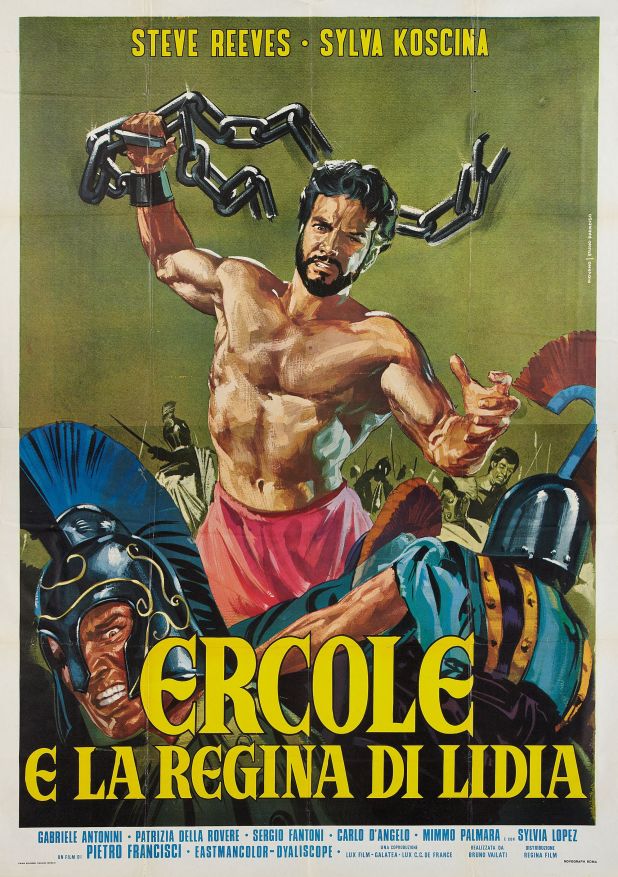
In Italy, this movie is known as Ercole e la Regina di Lidia (Hercules and the Queen of Lydia) and it’s loosely based upon various Greek myths and the plays of Aeschylus and Sophocles, as envisioned by co-writers Ennio De Concini and Pietro Francisci, who also directed. It’s also the second — and last — Hercules movie with Steve Reeves in the lead.
Hercules has been brought in to settle the battle over who should rule Thebes between brothers Eteocles and Polynices. However, a magic spring looks so refreshing and Hercules is hypnotized by a harem girl and becomes the kept man of Queen Omphale of Lydia (Sylvia Lopez, who sadly died the same year this movie was made), who plans on sleeping with our hero until she gets bored and turns him into a statue.
Luckily, Ulysses is on hand to help him get his memory back, just in time to decimate three wild tigers in order to rescue his wife beloved Iole (Sylvia Koscina). Then, our hero realizes that he should just let the two brothers kill one another.
Wrestling fans will be happy to see Primo Carnera (he was also a boxer and known as the Ambling Alp) show up as Antaeus.
Mario Bava served as special effects supervisor on this film (he was the cinematographer for Hercules and Hercules Conquers Atlantis; he would then direct the incredible Hercules In the Haunted World), which you can definitely see in the foggy dream sequences.
While Reeves would leave the series to Reg Park, the two Hercules files he was in would be successful all over the world.
You can watch this on Tubi with Mystery Science Theater 3000 riffing or check out the original on YouTube.
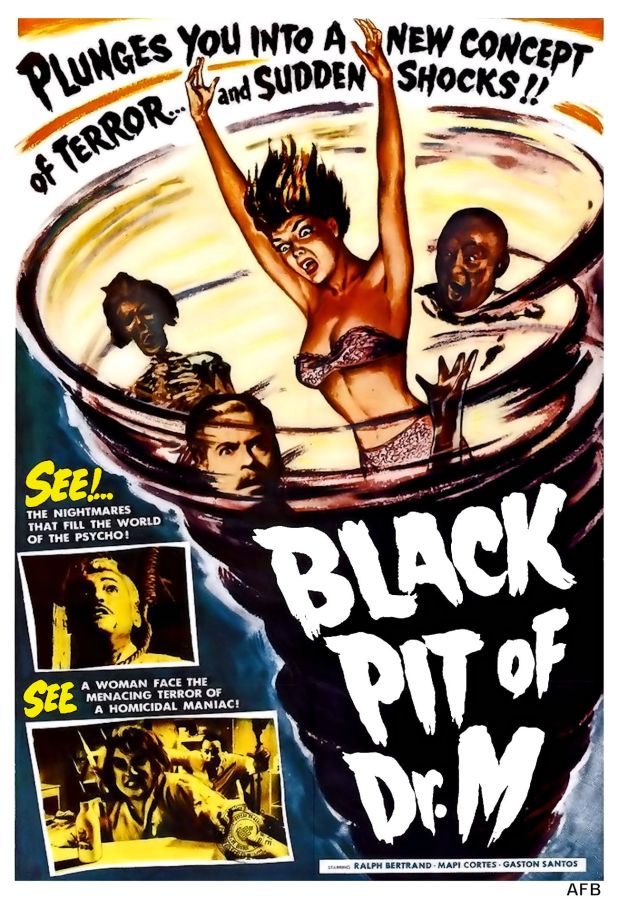
EDITOR’S NOTE: The Black Pit of Dr. M was on Chiller Theater on Saturday, February 4, 1967 at 1:00 a.m. It was also on the show on August 10, 1968 and May 20, 1972.
Misterios de ultratumba was released as The Black Pit of Dr. M in the U.S. and it’s a movie that explores man’s fascination with what comes after this world.
Dr. Mazali (Rafael Bertrand) and Dr. Jacinto Aldama (Antonio Raxel) make a bet with one another: whoever dies first will return to tell the other what happens after death. Aldama goes first and appears to Mazali during a seance, telling him that within three months, he will know everything about the afterlife.
Aldama’s ghost leads Patricia (Mapita Cortés) — also his daughter, but that’s a spoiler — to the insane asylum Mazali leads. The older doctor falls for her, but she and an intern named Eduardo (Gastón Santos) are in love. He also lets another inmate out of her cell and she instantly burns an orderly with acid right to the face. She’s murdered, Mazali takes the fall and heads to the gallows, proving that he will indeed soon know the afterlife.
While most early Mexican horror repeats the Universal horror movies and most Americans only know lucha movies to be the rest of the genre output from south of the border, the truth is that there are moments of sheer gothic dread for those willing to look. I’d definitely recommend this movie — the opening with the mental patients filling the frame is harrowing and a man rises from his grave in an incredibly unsettling fashion — as well as Hasta el Viento Tiene Miedo.
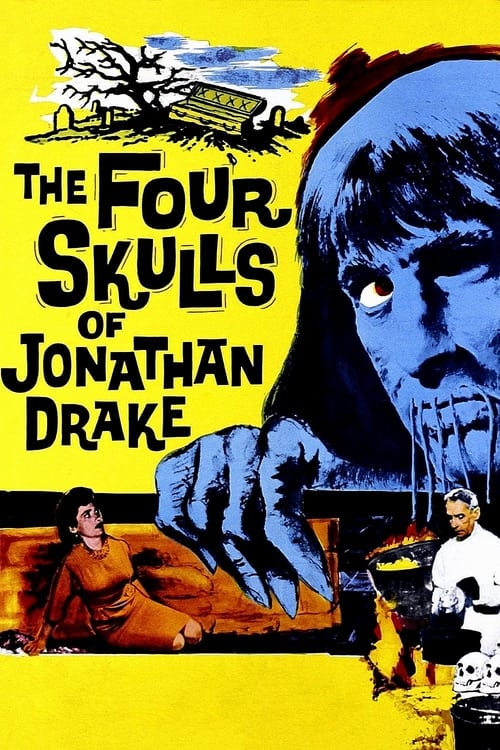
EDITOR’S NOTE: The Four Skulls of Jonathan Drakewas first on Chiller Theater on Saturday, November 30, 1963 at 3:00 p.m. It also aired on August 2, 1964 and August 7, 1965.
Directed by Edward L. Cahn and written by Orville H. Hampton, this is the tale of the Drake family. Because of a massacre in Ecuador led by Capt. Wilfred Drake, the men of their family have all been cursed to die at the age of sixty, beheaded and their severed heads shrank down. A killer named Zutai (Paul Wexler) kills one of the Drake men, Kenneth, before Jonathan (Eduard Franz) can warn him.
Of course, the family physician seems to think that the real curse of the Drake men is heart disease. That may be true, but then where are their heads? After all, we’ve seen the Zutai and his bamboo weapon stabbing people and he nearly poisons Jonathan, who keeps having visions of floating skulls.
There’s also The Cult of Headless Men who have had their lips sewn shut and fingertips branded with small skulls to achieve endless life. Perhaps the real culprit behind all of this could be Dr. Emil Zurich (Henry Daniell). After all, he has a white person’s head on a black person’s body, which is pretty wild for 1959. Either way, the curse demands four skulls and right now, it only has three.
This was kind of movie that was “Written, Produced and Directed To Scare The Daylights Out Of You!” Whether or not it did may depend on just how creeped out you are by voodoo and skulls.
As part of United Artists’ Science Fiction-Horror-Monster Features, which was sold to TV stations in 1963, this aired all over the U.S. well into the 70s. It also played theaters with another movie by the same director, Invisible Invaders. These movies have two different production companies listed — Premium Pictures for Invaders and Vogue Pictures for Four Skulls — but they are the exact same company.
EDITOR’S NOTE: The Tingler was on Chiller Theater on Saturday, October 2, 1965 at 1 a.m. It also aired on March 11 and November 25, 1967 and May 9, 1970.
The third of five films that director William Castle and writer Robb White made together — the others are Macabre, House On Haunted Hill, 13 Ghosts and Homicidal — this movie starts with Castle talking right to us, the audience: “I am William Castle, the director of the motion picture you are about to see. I feel obligated to warn you that some of the sensations—some of the physical reactions which the actors on the screen will feel—will also be experienced, for the first time in motion picture history, by certain members of this audience. I say ‘certain members’ because some people are more sensitive to these mysterious electronic impulses than others. These unfortunate, sensitive people will at times feel a strange, tingling sensation; other people will feel it less strongly. But don’t be alarmed — you can protect yourself. At any time you are conscious of a tingling sensation, you may obtain immediate relief by screaming. Don’t be embarrassed about opening your mouth and letting rip with all you’ve got, because the person in the seat right next to you will probably be screaming too. And remember this—a scream at the right time may save your life.”
Dr. Warren Chapin (Vincent Price) has learned that each one of us has a tingler, a parasite that is attached to our spine that feeds and grows stronger when we are afraid. The only way to stop this from killing us is to scream.
He is able to take a tingler from the body of Martha Higgins (Judith Evelyn), a deaf and mute woman who could not scream and the wife of a man — Oliver Higgins (Phillip Coolidge) — whose theater only shows silent movies. It turns out that Higgins killed his wife by fright and now the tingler gets loose in his theater. This is where the gimmick of this movie would come in, as special chairs would vibrate as Dr. Chapin asks for the lights to be shut out and everyone to scream for their lives.
Percepto was the gimmick for this movie. Castle attached electrical buzzers — war surplus airplane wing deicing motors — that buzzed the seats. When the big scene happens — during a scene from the silent movie Tol’able David — Price’s voice frightens everyone by saying, “Ladies and gentlemen, please do not panic. But scream! Scream for your lives! The tingler is loose in this theater!” In drive-ins, there was a different version of the movie with Castle’s voice saying that the tingler was loose in the drive-in.
In their excoriable book The Golden Turkey Awards, Harry and Michael Medved gave Percepto the award for “The Most Inane and Unwelcome ‘Technical Advance” in Hollywood History.” My hatred for them is incalculable.
Castle hedged his bets by adding red color to a black and white murder scene in the bath as well as placing professional fainters and a doctor and nurse that would revive them in certain theaters. The guy was the kind of lunatic that I wish was still making movies. He also experimented with rolling bean bags to brush against the legs of audience members, speakers mounted at different areas that would make noises when the tingler appeared and even having people physically tickle the legs of people in their seats.
This was also the first movie to reference LSD.
John Waters has mentioned this movie several times as one that he loves. He told NPR that when the tingler got loose, “Every kid went crazy. It was cinema mayhem.” He even played Castle on the TV show Feud: Bette and Joan and wrote an introduction for the 1992 re-issue of Castle’s autobiography, Step Right Up!: I’m Gonna Scare the Pants off America.
EDITOR’S NOTE: The Manster was on Chiller Theater on Saturday, September 28, 1964 at 11:15 p.m. It also aired on June 24, 1967 and July 20, 1968.
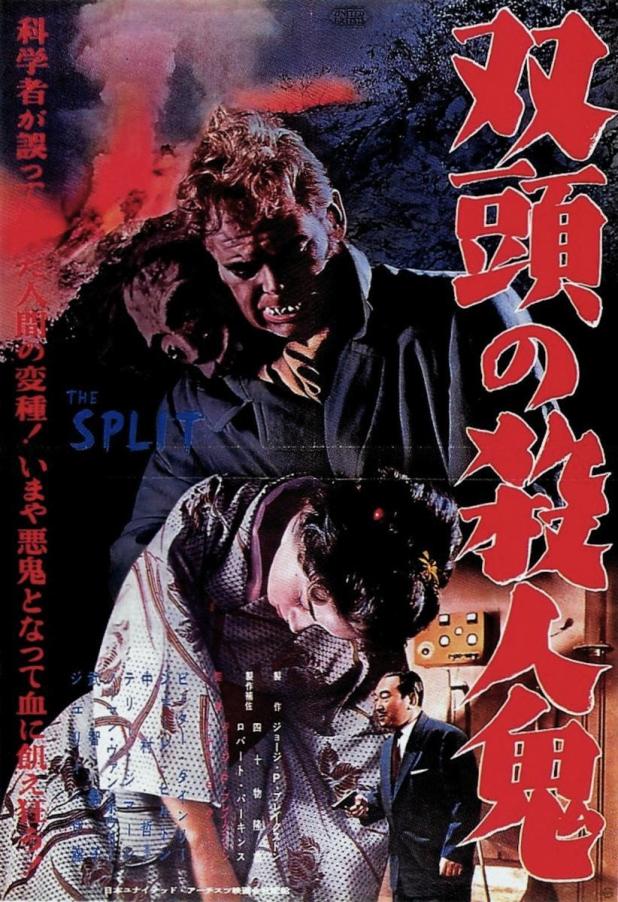
Also known as Soto no Satsujinki or The Two-Headed Killer, The Manster was directed by Greg Breakstone, who was Beezy in the Andy Hardy movies. It was one of several movies that he made in Japan, where he stayed after World War II, including Geisha Girl and Oriental Evil. It was co-directed by Kenneth G. Crane, the movie’s editor, and written by. William J. Sheldon.
Larry Stanford (Peter Dyneley) has been in Japan too long for his wife Linda (Jane Hylton), who wants him back in the U.S., but his last job is interviewing Dr. Robert Suzuki (Tetsu Nakamura), who works with his assistant Tara (Terri Zimmern) to slip him a mickey, the kind of libation that causes a monster to grow right out of his shoulder. By the end of the movie, Larry has become two totally different beings, one willing to toss women into volcanos.
The Manster isn’t great, but it sure is fun. I mean, when else would you get to see someone fight his evil side on the rim of an active volcano?
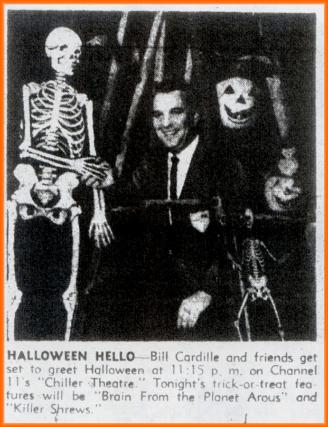
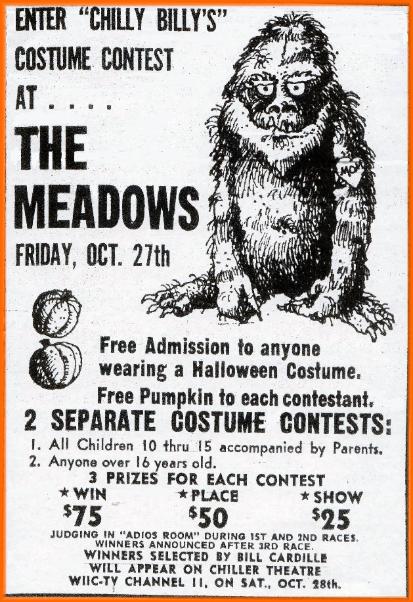
EDITOR’S NOTE: The Killer Shrews was on Chiller Theater on the first Halloween show hosted by Chilly Billy on October 31, 1964.
During World War II, Ray Kellogg was a US Navy Lieutenant as part of the O.S.S. Field Photographing Branch. That’s where he met John Ford and when Kellogg came back to the U.S., he headed off to 20th Century Fox, where he eventually became the head of the special effects division and helped invent CinemaScope.
He directed four films: The Giant Gila Monster;My Dog, Buddy; and The Green Berets, which he co-directed with John Wayne and Mervyn LeRoy.
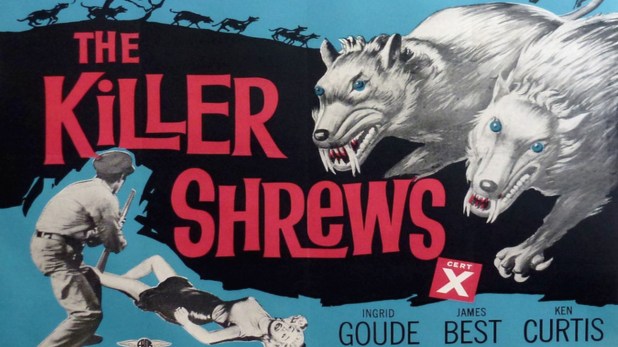
But today…today we’re here to discuss the fourth of his films: The Killer Shrews.
James Best has the lead in this movie as Captain Thorne Sherman. Best is probably best known for playing Sheriff Roscoe P. Coltrane on The Dukes of Hazzard, but he was a classically trained actor. So was Sorrell Brooke, who played his partner-in-crime Boss Hogg. The two often delighted in improvising most of their scenes together. And while they were working with younger and even untrained actors, by all reports they treated everyone incredibly well.
In addition to acting, Best was also a painter of some renown, a writer, a black belt and even ran an acting school, counting Burt Reynolds, Gary Busey, Clint Eastwood (who posted the insurance bond on Best so he could be on Dukes as the actor had a history of heart attacks), Roger Miller, Glen Campbell, Regis Philbin, Lindsay Wagner (who was his family babysitter before he encouraged her to act) and Quentin Tarantino as his students. Here’s some trivia: he was also a cousin of the Everly Brothers.
So why did he do this regional horror film? “I did the original The Killer Shrews as a favor. I made a movie with Sammy Ford, who was friends with a special effects man, Ray Kellogg, who wanted to direct his own picture. And we looked at the original’s script, and he didn’t have hardly any money whatsoever, but I did him a favor by acting in it. Ken Curtis, of course, was producing it from the start. I like Ken, and he wanted me to do it, so I went down there to Texas where we shot this thing. I didn’t realize it was so cheap. I mean, it was really cheap. For me it was a blast, but it was so bad! I think it was voted the worst picture of the year at the time. And then it caught on as a drive-in cult film, and believe it or not, after so many years I noticed that it was playing all over the place.”
Sherman and his crew are delivering supplies to a remote island that’s manned by a group of research scientists led by Marlowe Cragis (Baruch Lumet, who was a Yiddish theater actor), research assistant Radford Baines (Gordon McLendon, a former pirate radio operator who went on to create one of the first mobile news units in American radio, as well as the first traffic reports, jingles, all-news radio station and “easy-listening” programming; he also produced this film, The Great Gila Monster and Escape to Victory), Marlow’s daughter Ann (Ingrid Goude, the Swedish daughter of a steel factory manager that had been Miss Sweden for 1956; her Universal Pictures contract wasn’t successful, although she was in the TV show Love That Bob and the Rowan and Martin movie Once Upon a Horse…), her about to be cucked fiancee Jerry (Ken Curtis, who was the lead singer for the Sons of the Pioneers on their big hit “(Ghost) Riders in the Sky” before he was Festus on Gunsmoke) and the man who takes care of all of them, Mario.
They picked the wrong research lab to visit, because it turns out that the scientists have been experimenting on shrews to test a serum that will shrink humans to reduce world hunger. But the problem is that the drug makes shrews twice as big. You’d think they would have figured that out long before they started injecting shrews, but I’m no scientist.
Before long, the shrews show up — The Rats Are Coming! The Shrews Are Here! could be another title for this — and chew right through the walls of the lab, along with anyone that gets in their way. The humans confound these monsters by using oil drums as suits of armor and making it to the beach, just in time for Ann’s fiancee to get eaten alive when he stays behind. She and the manly hero celebrate with a kiss as they leave behind the island and the shrews to their fate.
The beauty — or horror — of this film is that the close-ups of the shrews are all hand puppets, while the long shots are coonhounds with giant rugs over them. This is the same effect technique that was used in the rat movie Deadly Eyes twenty-three years later.
A sequel, Return of the Killer Shrews, was produced in 2012, bringing back best after fifty-four years as Thorne while Bruce Davison (Willard himself!) taking over the role of Jerry. It also features Best’s Dukes co-stars John Schneider and Rick Hurst. There was also a parody remake in 2016.
You can watch this on Tubi. There’s also a Mystery Science Theater 3000 riff on Tubi.
EDITOR’S NOTE: The Atomic Submarinewas first on Chiller Theater on Sunday, October 27, 1963 at 11:10 p.m. It also aired on January 18 and June 21, 1964.
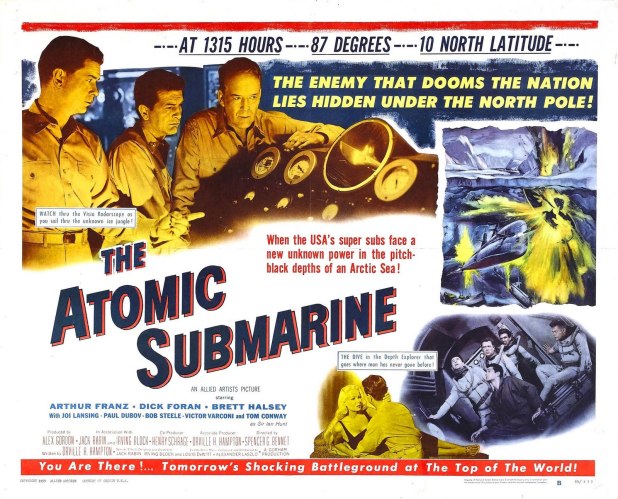
A submarine is destroyed near the North Pole by a UAP — well, maybe USP? — that brings in Commander Dan Wendover (Dick Foran), the captain of the atomic submarine Tigershark, and Nobel Prize-winning scientist Sir Ian Hunt (Tom Conway). The crew, which includes Lieutenant Commander Richard “Reef” Holloway (Arthur Franz), Dr. Carl Neilson Jr. (Brett Halsey) and Dr. Clifford Kent (Victor Varconi), are to stop whatever is destroying ships. Turns out its one-eyed aliens and their spaceships, which are no match for America’s fighting men and their magnificent military-industrial complex.
But hey — Joi Lansing is in it. So that’s good. Jean Moorhead, Playboy Playmate of the Month for October 1955 is also in the cast. She’s in one of my favorite Ed Wood movies, The Violent Years. And obviously, this inspired Voyage to the Bottom of the Sea.
This movie was directed by Spencer Gordon Bennet and written by Orville H. Hampton with uncredited help by Irving Block and Jack Rabin.
EDITOR’S NOTE: The Cosmic Manwas first on Chiller Theater on Saturday, October 26, 1963 at 3:00 p.m. It also aired on August 7, 1965.
USAF Col. Matthews (Paul Langton) and Dr. Karl Sorenson (Bruce Bennett), an astrophysist at the nearby Pacific Institute of Technology (PIT), are called as a UAP flies over Oak Ridge, CA at 180,000 miles an hour and coming to rest in Stone Canyon, floating off the ground. That night, a creature from inside the ship goes to the lab of Sorenson and Dr. Richie (Walter Maslow) to solve some problems that have puzzled them for months. They see whatever it is as friendly, but Matthews sees it as an enemy.
Kathy Grant (Angela Greene) is a widow whose fighter pilot husband died in the Korean War. She runs a lodge near the canyon while caring for her wheelchair-bound terminally ill son Ken (Scotty Morrow). A stranger (John Carradine) arrives and she thinks he’s a scientist. He’s the alien, of course, and begins to learn how play chess from the young boy.
Known as the Cosmic Man, the alien appears to the scientist and military. He tells them that as mankind is about to go into space, they must learn to stop being prejudiced or they will never be able to live with other races. He says that he will leave in the morning, so the military guys start shooting him. He walks away like it’s no big deal. The humans in this movie are the worst, trying to kill the Cosmic Man even when he heals Ken and helps him walk again.
At the end, the UAP flies away and Sorenson says, “He’ll be back.” I hope not. We treated him like a jerk. I also hope Sorenson realizes that Kathy is an attractive woman in her late thirties, in the full bloom of sexual power, and stops spending all night in the lab and more in the lodge. Both she and Ken need a daddy, after all.
Director Herbert S. Greene only made one other movie, Outlaw Queen, which has Andrea King from The Beast with Five Fingers as a Greek immigrant who starts her own casino in the Wild West. If you think to yourself, “Who could write a movie like that?” the answer is Edward D. Wood Jr.
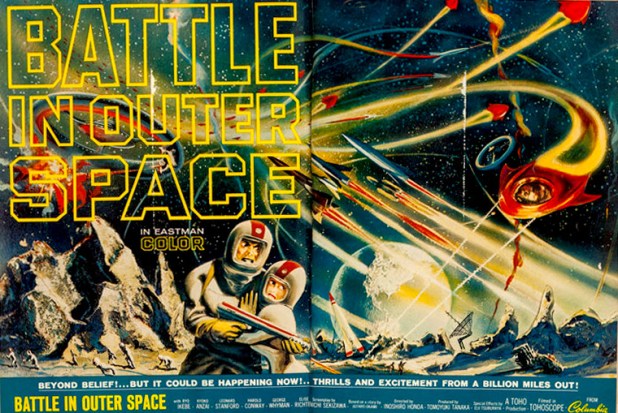
EDITOR’S NOTE: Battle In Outer Spacewas on Chiller Theater on Saturday, December 11, 1965 at 11:20 p.m. It also aired on December 23, 1967 and December 21, 1968.
Directed by Ishirō Honda, written by Shinichi Sekizawa and special effects by Eiji Tsuburaya, Battle In Outer Space starts with disaster all over the world. Major Ichiro Katsumiya, Professor Adachi and Dr. Richardson think that it’s aliens and they are soon proved right by Dr. Ahmed, the Iranian scientist in the group, who starts sabotaging everything.
The Earth is going to become part of the planet Natal, unless Earth can get it together and do what we do best: kill things. Some of the biggest cities are turned into models and blown up real good, but don’t worry. We know how to vaporize things. We have the technology.
The exterior of the Science Center is the National Sports Center, which was made as part of the Tokyo Olympiad. I love that Japanese filmmakers decide to just blow up their own country more often than anyone else’s, but when the Cinerama Dome in Tokyo gets zapped, I did get depressed.
When Apollo 11 landed on the moon, Eiji Tsuburaya watched and said, “We were right, our special effects team did a great job. Now, we can hold our heads before the public.”
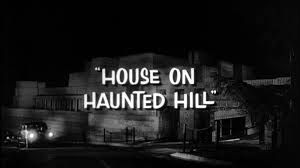
EDITOR’S NOTE: House On Haunted Hill was first on Chiller Theater on Saturday, May 2, 1964 at 4 p.m. It also was on the show on July 17, 1965; June 25, 1966; November 24, 1979 and October 16, 1982.
William Castle is one of my heroes. While he isn’t a world-class director, he was a top of the line showman. His book Step Right Up!…I’m Going to Scare the Pants off America is required reading. You can also check out the great documentary Spine Tingler! The William Castle story to learn more.
One of the gimmicks that he used to sell his movies was called Emergo. As theaters played this movie, an elaborate pulley system released a plastic skeleton that would fly across the presumably horrified — or amused and even rancorous — audience.
This movie ended up being a huge success. Alfred Hitchcock — who Castle often imitated in movies like Homicidal — took and made his own low-budget horror film. You’ve probably seen it. It’s called Psycho.
It’s such a simple set up: Frederick Loren (the always awesome Vincent Price, whose line in this movie “It’s close to midnight” starts off the Michael Jackson song “Thriller,” a track on which he also appears) is an eccentric millionaire — is there any better kind? — who invites five people to a party for his fourth wife Annabelle (Carol Ohmart, Spider Baby) in an allegedly haunted house.
If any of these people can survive one night, they get $10,000. They include test pilot Lance Schroeder (Richard Long, who was the professor on Nanny and the Professor), newspaper columnist Ruth Bridges (Julie Mitchum, yes the sister of Robert), psychiatrist Dr. David Trent (Alan Marshal in his next to last film; the actor Marshal died two years later from a heart attack while appearing in Chicago with Mae West in a production of her play Sextette. He had a heart attack on stage but finished the performance. The show, as they say, must go on…), Nora Manning (Carolyn Craig, probably best known for this movie) and Watson Pritchard (Elisha Cook, Mr. Nicklas from Rosemary’s Baby).
The only thing that these strangers have is that they all need money. The Lorens also hate one another and are convinced that they are trying to kill one another. And for what it’s worth, Watson believes that the house is genuinely haunted by the ghosts of those murdered there, including his brother. There’s also a vat of acid in the basement that was used to kill the previous owner’s wife.
So is the house truly haunted? Is Annabelle trying to kill her husband Frederick? Who will survive? And how cool would it have been to have seen this movie in person with a giant skeleton bursting loose at the right moment?
House On Haunted Hill was filmed at the Ennis House in Los Feliz California, which was designed in 1924 by Frank Lloyd Wright. It also appears in the movie Blade Runner and was the mansion that Angel, Spike, and Drusilla lived in on the TV version of Buffy the Vampire Slayer. It was also used on the soap opera show within a show Invitation to Love on David Lynch’s Twin Peaks.
This was remade in 1999 and that film also had a 2007 sequel, Return to House on Haunted Hill.
You can get this movie as part of Shout! Factory‘s The Vincent Price Collection II on blu ray. Or you can watch it with or without Rifftrax commentary on Tubi. It’s also available on the Internet Archive.
One last bit of trivia: The theme song to this movie actually has lyrics! They are:
“There’s a house on Haunted Hill / Where ev’rything’s lonely and still / Lonely and still / And the ghost of a sigh / When we whispered good-bye / Lingers on / And each night gives a heart broken cry / There’s a house on Haunted Hill / Where love walked there’s a strange silent chill / Strange silent chill / There are mem’ries that yearn / For our hearts to return / And a promise we failed to fulfill / But we’ll never go back / No, we’ll never go back / To the house on Haunted Hill!”








 B&S About Movies
You must be logged in to post a comment.